No-ID Verification Casinos for UK Players: The Offshore Truth Behind the Promise
 Available in GB
The promise is simple. A casino that lets you register with an email address, deposit without uploading a passport or a bank statement, and start playing within a minute. The search queries that surface this page — “no id casino uk,” “no id needed,” “no id required,” “no photo id,” “no id check” — all point to the same place. The promise is real. What the search results tend to underplay is that every casino offering it to a player in Great Britain is operating outside the UK regulatory system entirely.

This page works through what that means: which offshore operators UK players are actually using, how the no-ID sign-up flow runs, the welcome packages each one advertises, and the protections a UKGC-licensed casino provides that no offshore brand can match. The ranking is transparent about its own limits. Every brand listed is unlicensed in Great Britain. Choosing one is a trade-off the player makes knowingly or not, and this page is built so the trade-off is visible before the first deposit.
*Current as of September 8, 2026 · Licence claims verified against the Gambling Commission’s public register and independent review sources.*
What a No-ID Casino Is — and Why It Always Means Offshore
A “no-ID verification casino” is a gambling site that does not require customers to upload proof of identity before depositing or playing. In practice that means a registration form asking for an email address, a username and a password, perhaps a date of birth and a phone number for withdrawals, and a deposit button within two minutes of landing on the homepage. No passport scan, no driving-licence photo, no utility bill, no bank statement.
The reason this is the first paragraph of an honest article is that no UK-licensed casino can offer it. Since 7 May 2019 the Gambling Commission has required every operator it licenses to verify a customer’s name, address and date of birth *before* the customer deposits or gambles — the pre-2019 72-hour grace period is gone. The Commission’s own guidance is plain: “All online gambling businesses must ask you to prove your age and identity before you gamble.” Any casino marketing “no ID” or “no KYC” to British players is therefore not licensed by the Commission. It is running from Curaçao, Anjouan, Costa Rica, or another offshore jurisdiction, and it is doing so without a GB operating licence.
The phrasing matters here. UK players who search for “no id verification casino uk” are not necessarily searching for a way to avoid regulation. The legitimate use cases are real: a player who values privacy, a crypto-native gambler comfortable with self-custody, someone frustrated by document-upload friction that adds little. The search variants — *no id needed*, *no id required*, *no id check*, *no photo id* — all describe the same offshore reality. The point of opening with the regulatory line is not to lecture but to set the terms: this article covers casinos the UKGC does not license, and the protections that licensing provides therefore do not reach them.
How a No-ID Casino Actually Works: Sign-Up, Deposit, Play
The flow at a typical offshore no-ID casino runs in three short steps. A new player enters an email address, picks a username, sets a password, and confirms the account. The form takes under a minute. The casino assigns the account a customer ID and the deposit page appears, usually pre-selected on Bitcoin or another cryptocurrency, with cards and e-wallets as alternatives. The player sends funds, the wallet credits, and the games library opens.
The friction the UKGC imposes is absent by design. The KYC check that triggers at this point at a UK-licensed site is replaced by the offshore operator’s policy of not asking. The moment KYC does surface is at the other end of the customer journey, when a withdrawal is requested. Large withdrawals — the trigger threshold varies by operator, but a few thousand pounds is a common inflection — bring an identity check after the fact. The player is paid out of the small withdrawals and asked for documents only on the bigger ones. That asymmetry is the core of the no-ID offer.
MyStake’s sign-up, as one example, asks for an email and a phone number. The deposit page accepts crypto, cards, and a range of e-wallets. From the player’s perspective the experience is fast and quiet. Compared to a UK-licensed casino, where the same form would be followed by an automatic credit-reference-agency check that the player never sees — e-verification, not document upload — the difference is real but narrower than the marketing suggests. UK e-verification is itself frictionless for most customers. What the offshore route adds is the absence of the credit-reference check, the absence of the name-and-address match, and the absence of any pre-deposit check at all.
The Privacy You Gain by Skipping ID Checks
The privacy upside is straightforward at the sign-up screen. No passport copy sits in a database. No driving-licence photo is held. No credit-reference agency is asked to confirm the player’s address. No bank statement is uploaded, which means no bank has a record of a gambling-related payment reference. The trail that a UKGC-licensed casino is required by the LCCP to keep — and that a UK data-subject can request a copy of under GDPR — does not exist in the same form offshore.
The legitimate privacy preference is real. Some players do not want their gambling activity surfaced to a credit file, recorded against a future mortgage application, or visible to a partner who shares a household bank account. The offshore model delivers on that preference in a way a UKGC site cannot, because the UKGC site is required to keep the records. What the offshore model cannot do is offer true anonymity, because the player is still depositing real money. The crypto route narrows the trail but does not eliminate it: every on-chain transaction is permanent, and most exchanges that convert crypto back to sterling run their own KYC. The privacy is relative, not absolute.
The bypass motive is the other side of the same coin. A player who wants to gamble without an ID check to evade a self-exclusion arrangement, to circumvent a UK-imposed deposit limit, or to recover from a period of harm finds an open door offshore. The same frictionless sign-up that protects the privacy-conscious also removes the safety net from the player who most needs one. The rest of this article returns to that point, because it is the one the marketing does not surface.
The Protections You Leave Behind at a UKGC Casino
The list of what a UKGC licence provides is long, and most of it is invisible to a player who has never needed it. GamStop self-exclusion has been mandatory for every GB-licensed online operator since 31 March 2020 — exclusion periods of six months, one year, five years, or five years with auto-renewal, none of them cancellable early. Alternative dispute resolution is provided by an approved ADR body, and the Commission handles complaints that the ADR cannot. Customer funds are held in segregated accounts, with the level of protection disclosed to the player. Online slots carry a statutory stake cap, age-banded: £5 per spin for players 25 and over (in force 9 April 2025) and £2 for players aged 18 to 24 (in force 21 May 2025). Bonuses carry a 10x wagering cap (in force 19 December 2025) and mixed-product promotions are banned. Credit cards have been banned for all remote gambling since 14 April 2020. Auto-play is banned, spin speed may not exceed 2.5 seconds per game cycle, and reverse withdrawals are permanently banned. Financial vulnerability checks run at a £150 net deposit threshold in a rolling 30-day period, using publicly available data. Financial risk assessments for the highest-spending players are announced and pending commencement.
None of those protections reaches an offshore no-ID casino. That is not because the offshore operator chose to ignore them one by one; it is because the UKGC has no jurisdiction over the operator and the operator holds no GB licence. The protections are not features a casino opts into. They are conditions of holding a licence that an offshore operator does not hold.
Who No-ID Casinos Suit — and Who Should Stay Away
The reader profile that makes the trade-off a reasonable one is a privacy-conscious recreational player who understands what they are giving up, deposits within a budget they have set in advance, and is comfortable with crypto custody. A second profile is the crypto-native gambler who already holds Bitcoin or stablecoins in self-custody, treats the casino as one venue among several, and understands that the speed of a Lightning withdrawal does not replace the protection of a UKGC-licensed dispute route. For these readers the no-ID model delivers what it advertises: speed, privacy, and a frictionless sign-up, with the trade-off accepted on its own terms.
The reader profile that should stay away is just as clear. Anyone with a current or recent history of problem gambling. Anyone with an active GamStop exclusion — and a hard fact worth stating plainly: a GamStop exclusion has no effect at any of the offshore casinos on the list below, because GamStop is online-only and licence-bound. Anyone who has been refused credit, set a self-imposed limit, or asked a partner to manage their bank account against impulse deposits. The 0.4% of adults in England who meet the PGSI threshold for problem gambling, and the 1.6% who sit at moderate risk, are a small share of the population, but the National Gambling Helpline’s 81.5% share of contacts citing online gambling in 2026 — a five-year high — shows the population is concentrated in this exact product category. The same frictionless sign-up that suits a recreational crypto user is the frictionless sign-up that the player with a harm history most needs removed. Offshore no-ID casinos are not a route around self-exclusion; they are the place self-exclusion stops working.
Demo Mode and Fun-Play at No-ID Casinos
Demo play, where the casino loads a slot in free-play mode using virtual credits, is widely available at offshore casinos and does not require an account at most of them. A player who lands on a game page can usually click “Demo” or “Fun Play” and start spinning without registering, depositing, or verifying anything. The game runs on the same RNG and the same maths as the real-money version, so a player can read a slot’s volatility, pace, and feature frequency before committing a deposit.
The catch is that the demo is genuinely fun-play only. There is no path from a demo session to a real withdrawal without a registered account and a deposit, and the moment that deposit lands the player is in the same offshore environment described throughout this article. Demo play is a useful way to learn a game’s mechanics; it is not a way to test a casino. MyStake’s 6,000+ game catalogue includes most of the major studios — Pragmatic Play, Evolution, Hacksaw Gaming, Play’n GO, Betsoft, BGaming — and the demo coverage across that catalogue is broad, but the point that a UKGC-licensed demo delivers the same thing with enforceable protection behind it is the one a UK reader should weigh.
Key Protections Lost Offshore
| Protection | UKGC-Licensed | Offshore (No-ID) |
|---|---|---|
| Self-Exclusion | GamStop (National) | Site-specific only |
| Dispute Resolution | Approved ADR | Operator discretion |
| Fund Protection | Segregated | None mandated |
| Stake Caps | Age-banded (£2/£5) | None mandated |
| Wagering Cap | 10x maximum | None (30x–80x typical) |
The 10 No-ID Casinos Available to UK Players in 2026 — Ranked by What They Actually Deliver
The ten operators below are consistently named across multiple no-KYC review sites as serving UK players in 2026. None holds a Gambling Commission licence. All are offshore-licensed (Curaçao and Anjouan dominate the list), and one — BetPanda — holds no recognised gambling licence at all, only a Costa Rican corporate filing. The ranking is built on licence transparency, bonus value and wagering terms, game-provider quality and count, registration friction, and the evidence base for withdrawal speed. The single most important fact is the first: these are not GB-licensed brands, and a UK player choosing one accepts the trade-off that follows from that.
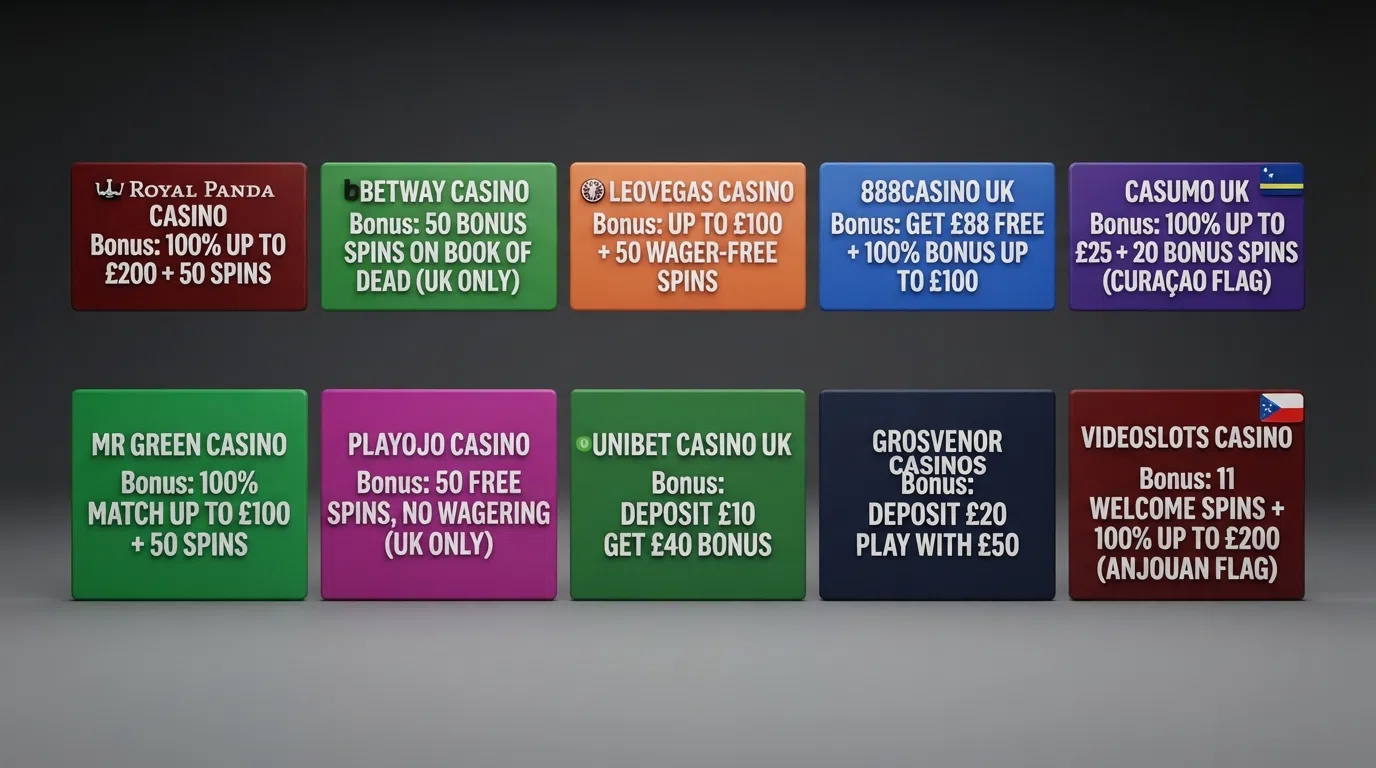
The shared regulatory note in the table below does not soften this. An offshore licence does not authorise provision to GB consumers, and unlicensed provision is illegal regardless of what the operator’s own marketing may say. That is the Commission’s published position, and it is the position a UK player needs to know before looking at the welcome numbers.
| Operator | Licence / Jurisdiction | Welcome Bonus | Wagering | Free Spins |
|---|---|---|---|---|
| MyStake | Curaçao GCB OGL/2024/1798/1048 (Santeda International B.V.) | 300% up to €1,500 across 3 deposits | 30x (deposit + bonus) | 10 FS standard; 300 FS variant |
| Rolletto | Curaçao (Santeda International B.V. network) | 150% up to £500 | 30x (bonus) | 200 FS (50 instant + 30/day x 5) |
| Goldenbet | Curaçao (Santeda International B.V. network) | 300% up to £1,500 across 3 deposits | 35x (deposit + bonus) | 100 FS |
| Freshbet | Curaçao (shared ownership with Goldenbet) | 300% up to £3,000 across 3 deposits | 30x (bonus) | 200 FS (100+50+50 across deposits) |
| Donbet | Curaçao (Santeda network) | 150% up to €750 casino / 170% up to €1,000 crypto | 30x (deposit + bonus) | 50–100 FS depending on track |
| Velobet | Curaçao (Santeda network) | 150% up to £500 (sub-£500 deposit) / 100% up to £1,000 (£500+) | 30x (bonus) | 70 FS (£100 cap) |
| Cosmobet | Curaçao | 150% + 100% + 80% up to €500 each / 200% crypto up to €1,000 | 30x (30x dep+bonus; 35x crypto) | 50 FS casino track |
| Jackbit | Anjouan (Union of Comoros) | 100 wager-free FS on $50+ deposit | 10x on FS winnings | 100 FS (max $100 cashout) |
| BetPanda | None recognised (Costa Rica corporate registration, Star Bright Media S.R.L.) | 100% up to 1 BTC | Up to 80x | — |
| Duel | Anjouan / Curaçao (varies by review source) | — | — | — |
The column of wagering multiples above deserves a moment on its own. The UKGC cap, in force from 19 December 2025, is 10x. Every number in the table above sits at 30x or above, with BetPanda’s headline at up to 80x. That is the comparison that defines the trade-off: offshore welcome packages look richer than UK offers because they have to be, and the difference between a 10x cap and a 30x one is the difference between a bonus a recreational player can clear in an evening and one that takes a serious commitment of time and money. The next section returns to that arithmetic in detail.
MyStake
MyStake is the heavyweight of the list, and the 6,000+ games catalogue is the reason. Pragmatic Play, Evolution, Betsoft, Hacksaw Gaming, Play’n GO, and BGaming all feed the library, which is broader than the entire game library at most UK-licensed sites. The Curaçao licence sits with Santeda International B.V. under OGL/2024/1798/1048, and the welcome package is a 300% match up to €1,500 across three deposits, with 30x wagering on the combined deposit and bonus. A promotional 300-free-spin variant runs at higher deposit tiers.
MyStake is one of the brands that briefly went dark during the B2B-supplier pull-out of 2026, when a network of offshore casinos lost access to UK-licensed game providers for a period before the providers returned to the sites. The episode illustrates the structural instability of the offshore model: the licence is real, the games catalogue is large, and the supply chain can be cut by a regulator halfway around the world.
For a crypto-native player who wants game variety, MyStake is the breadth pick. The 30x wagering is at the lower end of the offshore range, and the €1,500 ceiling is substantial without being a marketing fantasy. The 30-day bonus validity window is standard. The fairest reading is that this is a top-three offshore brand on the substance of what it offers, and the same as every other brand on this list on the substance of what it does not.
Rolletto
Rolletto is the free-spin pick. The welcome package is a 150% match up to £500 plus 200 free spins, structured as 50 spins on first deposit and 30 per day for the next five daily logins, on the Candyland slot. The bonus funds carry 30x wagering with a 30-day validity and a £20 minimum deposit. The free-spin winnings, and this is the part the headline does not surface, are capped at a £300 maximum cashout.
The £300 cap is a real number. A player who hits a large win on one of the 200 free spins sees the cashout limited regardless of the spin result, and the daily-login structure means the full 200 spins are not available on day one. The Curaçao licence is held under the Santeda International B.V. network, the same operator umbrella as MyStake and several of the others on the list.
For a player who values free-spin volume and does not expect to convert a single spin into a four-figure withdrawal, Rolletto’s structure makes sense. The match percentage is lower than the 300% competitors and the bonus ceiling is smaller, but the 30x wagering is at the lower end. The £300 FS cap is the caveat the marketing softens, and it is the caveat a player needs to read before depositing.
Goldenbet
Goldenbet is the 300%-match competitor, paired with 100 free spins and a 35x wagering load on the combined deposit and bonus. The minimum deposit is £20, the validity is 30 days, and the maximum bet while the bonus is active is capped at £5 per spin. The licence is Curaçao, under the Santeda International B.V. network, and the operator shares ownership with Freshbet.
The headline number — 300% up to £1,500 — is identical to MyStake’s, but the 35x wagering, on a deposit-and-bonus basis, is a heavier load than the 30x most of the field carries. That difference is the work of an evening of slot play in real terms. The £5 max bet is the UK’s age-banded stake cap for over-25s imported by the operator voluntarily, which is a smaller concession than it sounds — the cap applies to a single line of slots, not to the entire gameplay.
For a player who likes a 300% match and a familiar game catalogue (Pragmatic Play, Evolution, Play’n GO, Hacksaw Gaming), Goldenbet is a credible pick. The 35x is the price the headline does not show, and a player who runs the calculation before depositing is doing the work this page exists to enable.
Freshbet
Freshbet is the £3,000 ceiling — the largest headline bonus on the list. The structure is a 300% match across three deposits: 150% up to £1,500 plus 100 free spins on the first, 100% up to £1,000 plus 50 free spins on the second, 50% up to £500 plus 50 free spins on the third. The wagering is 30x on the bonus, the free spins are typically £0.10 per spin, and the licence is Curaçao, with shared ownership with Goldenbet.
The £3,000 number is real, and so is the work it takes to clear it. 30x on a £1,500 bonus is £45,000 of turnover, before the second and third deposits are layered on top. The three-deposit structure rewards a player who plans to stay, and disadvantages a player who deposits once and withdraws. The free-spin value at £0.10 is at the standard end of the field.
For a player who intends to play through three deposits and has the bankroll to clear a £3,000 bonus over a 30-day window, Freshbet offers the largest matched amount on the list. For a player who wants a single deposit, the 150% on the first deposit is competitive but not category-leading. The shared-ownership note with Goldenbet is worth surfacing: it tells a reader that the two brands are not independent choices, and the diversification a player thinks they are getting by splitting between them is thinner than it looks.
Donbet
Donbet runs two parallel welcome tracks. The casino welcome is 150% up to €750 plus 50 free spins with 30x wagering on the combined deposit and bonus, a €20 minimum deposit, 30-day validity, and a €5 max bet while the bonus is active. The crypto alternative is the larger offer: 170% up to €1,000 plus 100 free spins. The licence is Curaçao under the Santeda network.
The dual-track structure is the differentiator. A player depositing in euros via card or e-wallet takes the 150% track; a player depositing in crypto takes the 170% track, with the better headline and the same 30x load. Pragmatic Play, Evolution, and Play’n GO supply the game catalogue, which is narrower than MyStake’s but consistent with the field otherwise.
For a crypto-funded player who wants a stronger match than the standard 150% without the 300% headline-and-heavy-fine-print pattern, Donbet is the cleanest of the dual-track offers. The €750 ceiling on the casino track is the lowest of the 150%-match competitors, and the crypto track is the part of the offer most worth examining.
Velobet
Velobet is the two-tier deposit threshold. A deposit of £20 to £499 returns 150% up to £500 plus 70 free spins; a deposit of £500 or more returns 100% up to £1,000 plus 70 free spins. The wagering is 30x on the bonus. The free-spin winnings carry 35x wagering with a £100 maximum cashout. The licence is Curaçao under the Santeda network.
The lower tier rewards a smaller deposit with a higher percentage; the higher tier rewards a larger deposit with a higher ceiling and a smaller percentage. The free-spin cap at £100 is the tightest on the list — a single large win on a 70-spin set at any reasonable stake can blow past that, and the cap kicks in regardless.
For a player who plans to deposit under £500 and wants a higher match, the lower tier is the better of the two. For a player who plans to deposit £500 or more, the lower match percentage is the price of the larger ceiling. The £100 FS cap is the single most important number on this page for any player chasing free-spin value: it is one-third of Rolletto’s cap, and it is the constraint that makes the headline’s 70 free spins a smaller offer than the count suggests.
Cosmobet
Cosmobet runs a three-part welcome plus a separate crypto track. The casino welcome is 150% up to €500 plus 50 free spins on the first deposit, 100% up to €500 on the second, and 80% up to €500 on the third, all at 30x wagering on the combined deposit and bonus. A crypto-specific welcome of 200% up to €1,000 at 35x wagering is also available, with a €20 minimum deposit. The licence is Curaçao.
The three-deposit structure rewards the long-term player and disadvantages the one-and-done. The crypto track’s 200% is a stronger headline than the 150% of the casino track, with a higher 35x wagering as the offset. Pragmatic Play, Evolution, and Play’n GO supply the games.
For a player who intends to work through three deposits and prefers the higher ceiling on the crypto track, Cosmobet is competitive. The €500 ceiling per deposit is smaller than the £1,000–£1,500 of the 300%-match competitors, but the three-deposit total reaches €1,500 before considering the crypto track.
Jackbit
Jackbit is the wager-free outlier. The welcome is 100 free spins on a first deposit of at least $50 — wager-free, which is to say the deposit itself does not carry a wagering requirement. The free-spin winnings, however, carry 10x wagering within seven days, with a $100 maximum withdrawal cap. The licence is Anjouan (Union of Comoros), and the registration is username-and-password only.
The “wager-free” label is the marketing word this page exists to puncture. The free spins are wager-free; the winnings from those free spins are not. A player who lands a $200 win on the 100 free spins has $200 reduced to a $100 cap, and the $100 then needs to be wagered 10x — $1,000 of turnover — within seven days. The seven-day window is the shortest in the field. The Anjouan licence is a lighter regulatory touch than Curaçao, which the operator will frame as a benefit and a careful reader will frame as a smaller safety net.
For a player who wants the lightest possible wagering load and is comfortable with crypto deposits, Jackbit’s structure is genuinely the closest to a UKGC-style offer on the list, and the closest to one that delivers the wager-free label honestly. The $100 cap is the bound, the seven-day window is the clock, and the rest is arithmetic.
BetPanda
BetPanda is the licence question. The operator holds no recognised gambling licence. What appears in some write-ups as a “Costa Rica licence” is a corporate registration under Star Bright Media S.R.L. — a company filing, not a gaming authority sign-off. The welcome is 100% up to 1 BTC with wagering up to 80x and a 7-day validity. Bitcoin Lightning withdrawals are tested at roughly 8 seconds for a Lightning cashout, which is the speed benchmark of the list. The registration is email only and the operator is crypto-only.
The 80x wagering is the heaviest load in the field, and 7 days is the shortest validity window. The Bitcoin Lightning speed is the genuine upside — a withdrawal that completes in 8 seconds is qualitatively different from one that takes 24 hours, and the player who values that speed is the player BetPanda is built for. The games catalogue (Pragmatic Play, Evolution, Hacksaw Gaming) is the same as the field.
For a crypto-native player who values withdrawal speed above all else and accepts that the operator holds no regulatory sign-off, BetPanda is the speed pick. For any other reader, the missing licence is the single most important fact on the page, and it is the one the marketing is least likely to surface.
Duel
Duel is the registration-light wildcard. The sign-up is username and password only, and the operator skips ID checks below deposit thresholds, so a small first deposit goes through without any document request. The licence is reported as Anjouan or Curaçao depending on the review source, and the game catalogue covers Pragmatic Play, Evolution, and Hacksaw Gaming.
The terms of the welcome offer were not surfaced this run. The honest read is that Duel is a credible sign-up-friction pick on the basis of registration speed and game quality, and a reader who lands on Duel should read the bonus terms on the operator’s own page before depositing. Where research did not surface a number, this page does not invent one.
For a player whose priority is the shortest possible path from landing page to first spin, Duel sits at the right end of that scale. The lack of a confirmed welcome package is the cost of choosing a brand on sign-up friction alone, and it is the cost the operator’s marketing does not put on the homepage.
Why No-ID Casinos Sit Outside UK Regulation — and What That Costs You
The legal architecture behind this page is not a paragraph of caution. It is the reason the page exists, and the reason every brand on the list is offshore. The Gambling Act 2005, the statute that governs gambling in Great Britain, was extended to remote operators by the Gambling (Licensing and Advertising) Act 2014. The 2014 reform introduced the point-of-consumption licence: any operator taking customers in Great Britain needs a Gambling Commission licence, regardless of where the operator is based. The three licensing objectives set by section 1 of the Act are preventing crime, ensuring fair and open gambling, and protecting children and other vulnerable persons. The day-to-day obligations sit in the Licence Conditions and Codes of Practice (LCCP) and the Remote Technical Standards (RTS).

The 7 May 2019 change is the one that closed the no-ID gap for licensed operators. The Commission’s guidance now requires name, address, and date of birth to be verified before a customer deposits or gambles. A “no ID” GB-licensed casino is therefore a contradiction in terms — the conditions of holding the licence are the conditions that rule the model out. Every brand that offers the model to UK players is operating outside that framework.
The distinction between operator and player is worth getting right. Section 33 of the Gambling Act 2005 makes it a criminal offence to provide facilities for gambling without the required licence — a summary offence carrying up to 51 weeks’ imprisonment, a fine at level 5 on the standard scale (in practice unlimited), or both. That is the operator’s exposure, not the player’s. A UK player who gambles on an unlicensed site commits no offence under section 33. What the player loses is protection: no Commission complaints route, no approved ADR provider, no British consumer redress if funds are withheld, no GamStop coverage. The penalty is structural rather than legal.
The Commission’s own line, published in industry guidance, is that an overseas licence does not authorise provision to Great Britain consumers, and unlicensed provision is illegal regardless of what the operator’s own marketing may say. That sentence is the closest thing to a single statement of the regulatory position, and it is the sentence a UK player should hold in mind before the welcome package.
What “No ID Verification” Really Means
The phrase means one thing and only one thing at the UK-facing end of this market: the casino is not asking the player to verify their identity before they deposit or play. The search variants — *no id needed*, *no id required*, *no id check*, *no photo id* — all describe the same model. The model is offered by offshore operators because the UKGC mandate rules it out for licensed operators, and it is demanded by UK players because the UKGC mandate adds friction even when it is frictionless from the player’s perspective.
The phrase can also be misread. “No ID” does not mean “no KYC ever.” It means no KYC at sign-up. The KYC check surfaces at withdrawal, typically above an operator-set threshold, and a player who hits a large win may find the verification they did not do at sign-up waiting for them at the cashier. The phrase also does not mean “low-friction” in the sense a UK-licensed casino uses the term. UK e-verification, where a credit-reference agency confirms name, address, and date of birth in the background without the player uploading anything, is the licensed market’s answer to the friction question. The licensed model removes the document upload while keeping the verification. The offshore model removes the verification.
Why Every UKGC Casino Must Verify Your ID Before You Play
The obligation is the single most important regulatory change for this page’s subject. Since 7 May 2019 every GB-licensed remote gambling operator must verify a customer’s name, address, and date of birth before the customer can deposit or gamble. The pre-2019 grace period, where a customer could play for 72 hours before sending documents, no longer exists. The Commission’s guidance page on age and ID verification is the source, and the line is plain: “All online gambling businesses must ask you to prove your age and identity before you gamble.”
The mechanism is e-verification for most customers. The licensed casino passes the name, address, and date of birth the customer entered at sign-up to a credit-reference agency, which returns a match in seconds for the majority of UK addresses. The customer does not upload anything; the check happens in the background. Where the match fails, the casino asks for a document — passport, driving licence, utility bill — and the customer provides it. The whole process is invisible for most customers and is the licensed market’s answer to the question this page is built around.
The Gambling Commission’s public register of licence holders is the single source of truth for whether an operator is licensed. The register is searchable at gamblingcommission.gov.uk and lists every business the Commission has licensed. None of the ten brands on the list above appears on it. The absence is the fact.
The Gambling Act 2005 and the Point-of-Consumption Licence
The Gambling Act 2005 is the statute. The Gambling (Licensing and Advertising) Act 2014 extended it to remote operators and introduced the point-of-consumption licence. Before 2014 an operator licensed in another jurisdiction could take UK customers without a GB licence, and many did. The 2014 reform closed that route. From November 2014, any operator — wherever based — taking customers in Great Britain has needed a Gambling Commission licence. The LCCP and RTS are the day-to-day rulebook, and the LCCP’s social responsibility codes (3.4.4 on financial vulnerability checks, 5.1.1 on wagering requirements, 6.1.2 on credit cards) are the conditions that an offshore operator is not bound by.
The single sentence that captures the position is the Commission’s published guidance that an overseas licence does not authorise provision to GB consumers, and unlicensed provision is illegal regardless of what the operator’s own marketing may say. The Commission’s enforcement is disruption-based, not blocking-based: cease-and-desist notices with 48-hour deadlines, search-engine URL delisting, domain-registrar pressure, payment-provider referrals, and pressure on GB-based advertisers and affiliates. The Commission does not currently hold statutory ISP or DNS blocking powers; legislation has been proposed but not enacted.
Offshore vs UKGC: Two Routes, Two Very Different Safety Nets
The UKGC-licensed route is built around the verification the player sees at sign-up and the protection the player does not see until needed. GamStop self-exclusion covers every participating GB-licensed site, and participation has been mandatory since 31 March 2020. Approved ADR provides an independent dispute route, and the Commission handles complaints the ADR cannot resolve. Customer funds are held in segregated accounts with the level of protection disclosed. Online slots are capped at £5 per spin (25+) or £2 per spin (18–24). Bonuses carry a 10x wagering cap. Credit cards are banned. Auto-play is banned and spin speed is capped at 2.5 seconds per game cycle. Reverse withdrawals are permanently banned. Financial vulnerability checks run at a £150 net deposit threshold in a rolling 30-day period.
The offshore no-ID route delivers none of that. No GamStop coverage, no ADR, no Commission complaints route, no fund-protection segregation, no age-banded stake caps, no 10x wagering ceiling, no auto-play ban, no reverse-withdrawal ban, no financial vulnerability checks. The wagering loads on the table above — 30x, 35x, 80x — are the visible part of the difference. The instability of the model is the invisible part. In 2026 a network of offshore casinos including MyStake, Goldenbet, Donbet, Velobet, Cosmobet, Freshbet, and Rolletto briefly went dark when B2B suppliers pulled out, before the suppliers returned and the sites came back. The episode was a single event, but the structural pattern it illustrated — the supply chain can be cut by a regulator with no jurisdiction over the operator — is permanent.
What You Give Up Outside UKGC Protection
- No GamStop coverage. The national self-exclusion scheme is online-only and licence-bound, covering participating GB-licensed sites only. A GamStop exclusion has zero effect at any of the offshore brands on the list above.
- No Commission complaints route. The Commission handles complaints against GB-licensed operators. Offshore operators are outside its jurisdiction.
- No approved ADR. GB-licensed operators are required to use an approved alternative dispute resolution provider. Offshore operators are not.
- No British consumer redress. If an offshore operator withholds funds, the player’s practical routes are chargeback, the operator’s own complaints process, or the regulator of whatever jurisdiction issued the licence.
- No guaranteed fund-protection segregation. GB-licensed operators disclose the level of fund protection. Offshore operators are not required to.
- No age-banded stake caps. The £5/£2 statutory caps do not apply offshore. The £5 max bet at Goldenbet and Donbet is a self-imposed cap, not a regulatory one.
- No 10x wagering ceiling. The 10x cap is an LCCP condition. Offshore operators set their own terms; 30x to 80x is the field.
- No auto-play ban. The UKGC ban on auto-play and the 2.5-second spin-speed cap do not apply offshore.
- No reverse-withdrawal ban. UKGC operators cannot offer reverse withdrawals. Offshore operators can.
- No financial vulnerability checks or financial risk assessments. The LCCP’s £150 net-deposit check and the announced FRAs (start date to be confirmed) are UKGC conditions. Offshore operators are not bound by them.
No-ID Withdrawals: Faster Cashouts, Fewer Safeguards
The withdrawal story at a no-ID casino is the other half of the offer, and it is the part the marketing leads with. No document upload at the cashier, no waiting on a compliance team, no three-day review window. Crypto withdrawals, in particular, can clear in minutes — and at the extreme end, BetPanda’s Bitcoin Lightning withdrawals have been tested at roughly 8 seconds for a Lightning cashout. That is the speed benchmark of the list, and it is qualitatively different from the licensed market’s typical 24-hour e-wallet or 3–5 day bank-transfer window.
The verification trigger is the constraint. A player who makes small withdrawals sees no friction. A player who hits a four-figure win on a single spin can find the KYC check that was absent at sign-up waiting at the cashier — passport, driving licence, proof of address, source-of-funds documentation. The threshold varies by operator, and the operator’s discretion is wide. The asymmetry is the trade-off: the no-ID offer is at its best on small, frequent withdrawals, and at its weakest on the single big win the player most cares about.
The absence of the UKGC reverse-withdrawal ban is the part the marketing does not mention. A UK-licensed operator cannot offer a reverse-withdrawal button — once a player has requested a withdrawal, the player cannot cancel it from the cashier and gamble the funds back. An offshore operator can. The choice is the player’s, and the choice is one a reader should know exists.
No-ID Bonuses: Bigger Headlines, Heavier Fine Print
The arithmetic is the point. The UKGC wagering cap, in force from 19 December 2025, is 10x. The wagering multiples in the comparison table above are 30x for most of the field, 35x for Goldenbet and Cosmobet’s crypto track, and up to 80x for BetPanda. That is three to eight times the UK ceiling. The bonus validity windows are 7 to 30 days. The free-spin cashout caps are £100 at Velobet, £300 at Rolletto, $100 at Jackbit. The mixed-product ban that prevents a UK-licensed casino from offering “bet £10 on football, get free spins” does not apply offshore, and several of the brands above run exactly that kind of cross-vertical promotion.
The work the bonus actually takes is the work the headline does not show. Take a £100 deposit at Goldenbet, where the welcome is a 300% match with 35x wagering on the combined deposit and bonus. The bonus is £300. The combined figure for wagering is £400. The required turnover is 35 × £400 = £14,000. At a £5 max bet per spin, that is 2,800 individual spins. At a 5-second interval per spin, that is 14,000 seconds of play, or just under 4 hours of continuous spinning. A recreational player can clear that in an evening; a player who logs on for an hour a day needs four evenings. The £14,000 turnover is the real cost of the offer; the £300 bonus is the headline.
The statistical expectation of clearing that turnover is the bonus’s real cost. A slot at a 96% return-to-player returns 4% of turnover as the house edge, so the expected loss from a £14,000 turnover is £14,000 × 0.04 = £560. That is the price the player pays for the chance of clearing the £300 bonus. The offer is worth taking when the player values the bonus at more than the expected loss, and not otherwise. The same arithmetic runs at every other brand on the list, scaled to the wagering multiple and the bonus size, and the result is the same shape every time: a small expected loss at the 10x UKGC benchmark and a substantially larger one at the 30x–80x offshore multiple.
Slots and Casino Games at No-ID Operators
The game catalogues on the list are not the weak point. Pragmatic Play, Evolution, Hacksaw Gaming, Play’n GO, Betsoft, and BGaming supply the field, and several of the brands run libraries of several thousand titles. MyStake’s 6,000+ game catalogue is the largest, and the major studios appear across the rest of the list. The point worth surfacing is the regulatory one: UKGC-licensed B2B providers supply games to offshore casinos serving GB customers, and the Commission has taken enforcement action against licensees for that supply. Several of the brands above briefly went dark in 2026 when the B2B pull-out cut off the game feed, before the providers returned and the sites resumed.
The safer-game-design rules the UKGC enforces are absent offshore. The 2.5-second spin-speed cap, the ban on features that speed up play, the ban on losses disguised as wins, the auto-play ban — none of these apply at an offshore no-ID casino. A UK-licensed slot is built to a set of design constraints; an offshore slot on the same engine is the same game without those constraints. The same maths, the same RTP figure, the same provider, with a different feature set exposed to the player.
Crypto and Bitcoin: The Engine of Anonymous Casino Play
Cryptocurrency is the fuel of the no-ID model, and the reason no UKGC casino accepts it is the reason it works offshore. The UKGC’s source-of-funds, AML, and LCCP requirements make direct crypto deposits effectively impossible at any operator legally serving Great Britain, and no UK-licensed casino accepts cryptocurrency deposits in 2026. The offshore operator accepts Bitcoin, Ethereum, USDT, and Litecoin because the offshore operator is not bound by the UKGC’s source-of-funds regime. The crypto route is what makes the no-document-upload deposit possible.
The privacy advantage is the part the marketing leads with. A Bitcoin deposit does not appear on a bank statement. A USDT transfer does not route through a payment processor that runs its own KYC. The trail a UKGC-licensed casino is required to keep does not exist in the same form offshore. The trail the player leaves on-chain is permanent, but it is pseudonymous rather than identified, and most players converting back to sterling do so through an exchange that runs KYC at the off-ramp rather than the on-ramp.
BetPanda’s Bitcoin Lightning withdrawals — roughly 8 seconds for a Lightning cashout in testing — are the speed benchmark of the list. For a player whose priority is the shortest possible gap between a win and a spendable balance, Lightning is the technology that delivers it. The same operator holds no recognised gambling licence, which is the cost of the speed, and the cost is the part the homepage does not lead with.
Pay-by-Mobile at No-ID Casinos
Pay-by-mobile is the alternative route for a player who wants low-friction deposits without a bank trail and without a crypto wallet. The mechanism is simple: the deposit is added to the player’s mobile phone bill or deducted from pay-as-you-go credit, and the casino receives the funds through a payments aggregator. No card details, no bank transfer, no crypto on-ramp. The £30 daily deposit cap that most UK pay-by-mobile billers apply is the typical ceiling, and the small deposit sizes are the design.
The trade-off is the same as the crypto route, in a different shape. A pay-by-mobile deposit leaves a record on the player’s phone bill rather than a bank statement, and the phone-bill record is a less obvious gambling reference for a partner or a mortgage underwriter who glances at the statement. The privacy is real. The verification absence is the same: the casino is not asking for ID because the payment method is the verification, and the payment method’s own cap is the limit. The offshore operators in the field vary in their pay-by-mobile coverage, and the right way to read a particular brand’s offering is on the operator’s own deposit page, where the available methods are listed for the player’s country.
The UKGC Crackdown on Offshore No-ID Operators
The Commission’s enforcement model is disruption, not blocking. The toolkit is built around cease-and-desist notices with 48-hour deadlines, referral of illegal URLs to search engines for delisting, work with domain registrars to suspend domains, pressure on GB-based advertisers and affiliates, and payment-provider referrals. The published figures for April 2024 to June 2025 are 3,140 disruption notices, 447,778 URLs referred to search engines, 287,961 URLs removed, and an average 32% fall in engagement across 160 disrupted sites. For October 2024 to September 2025, the Commission reported 208,088 enforcement actions on illegal online gambling. The Commission does not currently hold statutory ISP or DNS blocking powers; legislation has been proposed but not enacted.
The 2026 B2B pull-out is the concrete illustration. A network of offshore casinos including MyStake, Goldenbet, Donbet, Velobet, Cosmobet, Freshbet, and Rolletto briefly went dark when UKGC-licensed B2B suppliers stopped providing games to the unlicensed sites. The sites came back, several of them with the same providers restored, but the episode showed the structural fragility of the offshore model. The licence is held in a permissive jurisdiction, the games are supplied by a UK-licensed provider, and the regulator of the supplier can cut the supply chain. A player who deposits at an offshore casino is betting on a supply chain the operator does not fully control.
Safer-Play Tools Where UK Protections Don’t Reach
The UK responsible-gambling infrastructure is the most developed in the world, and it is built around the GB licensing system. Offshore operators are outside that system, and the infrastructure does not reach them. The help resources, however, do. GamCare’s helpline takes calls from anyone in the UK regardless of where the gambling took place, the NHS gambling harm clinics treat patients regardless of where the harm happened, and the National Gambling Support Network’s data covers both licensed and unlicensed play. The tools the player can use at an offshore casino are a different and thinner set.
GamStop and Self-Exclusion: Why They Stop at the UKGC Border
GamStop is the national multi-operator online self-exclusion scheme for Great Britain, mandatory for every Gambling Commission online operating licence since 31 March 2020. Exclusion periods are six months, one year, five years, or five years with auto-renewal, and the exclusion cannot be cancelled early. The scheme is online-only and licence-bound: it covers participating GB-licensed sites and no others. A GamStop exclusion has zero effect at any of the offshore brands on the list above.
The data on circumvention is the part the marketing does not surface. Of gambling clients in the National Gambling Support Network, 81% reported using a self-exclusion tool, but 25% reported having the ability to circumvent it. The 25% figure is the share of harm-experienced players who found a route around their own self-exclusion, and the offshore no-ID casino is exactly the route that route takes. A self-excluded player who lands on a no-ID casino with an email address and a crypto wallet has, in the time it takes to fill in a one-field form, undone the protection the self-exclusion was meant to provide. The offshore casino may offer its own self-exclusion tool, and most of the brands on the list do, but the tool is voluntary, site-specific, and not connected to the national scheme.
Deposit Limits, Loss Limits and Session Timers at No-ID Sites
The UKGC’s mandatory deposit-limit regime is the licensed market’s answer to the question of how a player sets a budget. From 31 October 2025 operators must prompt a customer to set a financial limit before their first deposit, and a standardised gross deposit limit must be offered by 30 September 2026. Decreases must be actioned immediately; increases may not be. Financial vulnerability checks run at a £150 net deposit threshold in a rolling 30-day period, and financial risk assessments for high-spending players have been announced with thresholds of £5,000/£2,500 (stage 1) and £1,000/£3,000 (final) for 25+ players, and £2,500/£750 or £2,000 (final) for under-25s, with a start date still to be confirmed.
Offshore operators are not bound by any of this. Some of the brands on the list offer deposit limits and session timers as voluntary features, and a player who wants a limit can usually set one in the responsible-gambling section of the account. The limit is a feature the operator chooses to provide, not a condition of the licence the operator does not hold. A player who has set a self-imposed budget and deposits at an offshore casino is the one setting the limit, and the casino is the one that may or may not enforce it. The licensed market’s deposit-limit regime is built into the system; the offshore market’s is built into the player’s own discipline.
UK Help Resources: GamCare, the Helpline and NHS Clinics
The help infrastructure is the part the page can leave the reader with, and the part the operator’s marketing does not. The National Gambling Helpline is run by GamCare, available 24/7 on 0808 8020 133 by call, online chat, or WhatsApp. In January 2026 GamCare made 996 referrals to treatment and peer-based support services — a 48% increase year-on-year and a single-month record. The helpline is open to anyone in the UK, regardless of where the gambling took place, and a player who has been gambling at an offshore casino is no exception.
The wider support network is layered. NHS gambling harm clinics operate in England, Scotland, and Wales, providing treatment rather than advice. GambleAware funds prevention and treatment and publishes research, including the prevalence data this page draws on. Gamblers Anonymous provides peer support through meetings and online groups. The National Gambling Support Network combines emotional support, self-exclusion tools, and blocking software, and the network’s research is the source of the 81% / 25% figures on self-exclusion use and circumvention. The 30% of adults who gamble and are experiencing any level of problems now want treatment, support, or advice — almost double the 17% in 2020. The demand is real, the supply is built, and the entry point is the helpline.
How Big Is the Problem? The Numbers Behind Online Gambling Harm in the UK
The prevalence data is the frame the rest of the page sits inside. The NHS Adult Psychiatric Morbidity Survey 2023–24 found 0.4% of adults in England experienced problem gambling (PGSI score 8+) and 1.6% experienced at least moderate risk gambling (PGSI score 3+). The figures are small as a share of the population, but they translate to several hundred thousand adults, and the National Gambling Helpline’s 81.5% of contacts citing online gambling in 2026 — a five-year high — shows the concentration of harm in exactly the product category this page is about.
The statutory levy is the operator-side cost that funds the help infrastructure. From 6 April 2025 the levy replaced voluntary contributions, imposed by the Gambling Levy Regulations 2025. The remote casino licence rate is 1.1% of gross gambling yield, with the proceeds split 50% to treatment, 30% to prevention, and 20% to research. The levy is collected by the Gambling Commission from licensed operators, and it does not reach offshore brands. The 1.1% is the licensed market’s contribution to the infrastructure the offshore market uses without contributing to. Remote Gaming Duty, the operator-side tax on online casino gross yield, rose from 21% to 40% from 1 April 2026, and the player pays no tax on gambling winnings in any case — the player-side betting duty was abolished in 2001.
How We Selected and Ranked These No-ID Casinos
The ten operators on the list are the brands that consistently appear across multiple no-KYC casino review sites serving UK players in 2026, cross-referenced against the UK market’s traffic landscape. The selection was made on the basis of brand recognition in the no-KYC space, breadth of the welcome offer, range of game providers, and registration friction — the factors a UK player searching for this category actually weighs.
The licence status of every brand was checked against the Gambling Commission’s public register at gamblingcommission.gov.uk and against independent review sources. None of the brands appears on the GB register, and all are confirmed as offshore. The Commission requires pre-gambling ID verification from every GB licensee, which makes a “no ID” GB casino a structural impossibility; the absence of any of the listed brands from the register is the confirmatory fact rather than the entry point. BetPanda is flagged separately because it holds no recognised gambling licence at all, only a Costa Rican corporate filing, and the absence is the differentiator.
The ranking is built on five criteria, applied in order. Licence transparency: the operator’s licence is clearly stated, in the operator’s own terms and conditions and in independent review sources, and the regulatory touch of that licence is honestly characterised. Bonus value and wagering terms: the headline offer is read alongside the wagering multiple, the validity window, the max bet, and the free-spin cashout cap, and the offer is judged on the work it takes to clear, not the size of the headline. Game-provider quality and count: the studios feeding the library, and the breadth of the catalogue. Registration friction: the steps from landing page to first deposit, and the moment at which KYC surfaces. Withdrawal speed evidence: where the operator has been tested for payout speed, the result is given weight; where it has not, the omission is noted.
The scope is worth stating. This ranking covers the offshore no-ID space only. It does not include GB-licensed casinos, every one of which requires pre-gambling ID verification and is therefore outside the page’s subject. A UK player who wants a GB-licensed casino is reading the wrong page, and the GB-licensed market is its own subject.
No-ID Play: Weighing Privacy Against the Protection You Leave Behind
The arithmetic runs through every section above. A £100 deposit at a typical offshore welcome offer takes £14,000 of turnover and roughly 4 hours of continuous play to clear, at an expected loss of around £560. A £1,000 withdrawal at the same operator triggers the KYC check that the no-ID offer promised was absent. A self-exclusion set up at a GB-licensed site has no effect at any of the brands on the list. A player who hits a £300 cap on free-spin winnings at Rolletto or a $100 cap at Jackbit cannot argue the cap down at an approved ADR, because the offshore operator is not bound by one. A dispute about a withheld withdrawal goes to the operator’s own complaints process, the regulator of whatever jurisdiction issued the licence, or a chargeback at the issuing bank. The licensed market’s protections are not features a casino chooses; they are conditions of the licence the offshore casino does not hold.
The reader who should be reading this page is the recreational, crypto-native player who understands the trade-off, deposits within a budget they have set in advance, and treats the no-ID casino as one venue among several. For that reader the offer is what the marketing says: frictionless sign-up, fast withdrawals, a wide game catalogue, and a welcome package that is structurally richer than a UK-licensed one because the wagering load is structurally heavier. The reader who should not be reading this page is anyone with a current or recent history of problem gambling, anyone with an active GamStop exclusion, anyone who has been refused credit, and anyone who has asked someone else to manage their money against impulse. The same frictionless sign-up that suits a recreational player is the frictionless sign-up that the player with a harm history most needs removed. A self-excluded player who lands on a no-ID casino is undoing the protection the self-exclusion was set up to provide.
The practical steps before a deposit are the same regardless of which operator a player chooses. Check the licence on the operator’s own terms and conditions page and on the regulator’s own register. Read the bonus terms in full, including the wagering multiple, the validity window, the max bet, the free-spin cap, and the games excluded from bonus play. Set a personal deposit limit before the first deposit, even where the casino does not require one. Know the helpline number — 0808 8020 133 — before the first spin, not after a bad night. The licensed market’s mandatory deposit-limit prompt is not a feature at an offshore casino; the limit is a feature the player has to set for themselves.
The closing position is the one the page opened with. Every no-ID casino serving UK players is offshore and unlicensed by the UKGC. The privacy and speed the model delivers are real. The protection the model does not deliver is also real, and the absence is structural rather than incidental. The UKGC-licensed route, with its mandatory ID checks, GamStop coverage, approved ADR, segregated funds, age-banded stake caps, 10x wagering ceiling, financial vulnerability checks, and reverse-withdrawal ban, is the only route with enforceable player protections. Choosing offshore means accepting that the player is their own safety net. The trade-off is the player’s to make, and this page exists to make sure the trade-off is visible before the first deposit, not after the first loss.
Frequently Asked Questions
Can I play at an online casino in the UK without providing ID?
No UKGC-licensed casino allows it. Since 7 May 2019 every operator licensed by the Gambling Commission must verify your name, address, and date of birth before you can deposit or gamble. Casinos that advertise “no ID” or “no KYC” to UK players are running offshore licences — typically Curaçao or Anjouan — and are not licensed in Great Britain. You can play at one, but you do so outside the UK regulatory system, which means no GamStop coverage, no ADR, and no British consumer redress if funds are withheld.
What happens after I click “register” at a no-KYC casino?
The form typically asks for an email address, a username, and a password, sometimes a date of birth and a phone number. The account is created in under a minute, and the deposit page appears. The KYC check that a UK-licensed site runs in the background does not happen. Verification surfaces later, usually when you request a withdrawal above an operator-set threshold — a few thousand pounds is typical — and at that point you may be asked for a passport, a driving licence, or a proof of address. The no-ID offer is real at sign-up; it is conditional at withdrawal.
What payment methods can I use at a no-ID casino?
Cryptocurrency is the dominant route. Bitcoin, Ethereum, Tether, and Litecoin are accepted across most of the field, and Bitcoin Lightning withdrawals at BetPanda have been tested at roughly 8 seconds for a Lightning cashout. Cards and e-wallets are accepted at several of the brands, and pay-by-mobile is available at some. No UKGC-licensed casino accepts cryptocurrency in 2026, which is the structural reason the no-ID model runs on crypto and the reason the no-ID model is not available in the licensed market.
Do no-ID casinos accept UK players and GBP?
The operators on the list above accept UK players, and most accept GBP alongside EUR and USD. The legal position is that an overseas licence does not authorise provision to GB consumers, and unlicensed provision is illegal regardless of the operator’s marketing. A UK player is not committing an offence by playing at an offshore casino; the operator’s exposure under section 33 of the Gambling Act 2005 is the operator’s, not the player’s. What the player gives up by playing offshore is the protection, not the legality of the act.
Will a self-exclusion with GamStop stop me playing at a no-ID casino?
No. GamStop is online-only and licence-bound. It covers participating GB-licensed sites and no others. A GamStop exclusion has zero effect at any of the offshore brands on this list. National Gambling Support Network data shows 81% of gambling clients used a self-exclusion tool, but 25% reported the ability to circumvent it — and the no-ID offshore casino is the route the circumvention takes. If you are self-excluded and you are reading this page, the helpline number is 0808 8020 133, available 24/7.
How can I gamble responsibly at an offshore casino without UKGC protections?
Set a personal deposit limit before the first deposit, because the casino will not set one for you. Read the bonus terms in full, including the wagering multiple, the validity window, the max bet, and the free-spin cashout cap. Confirm the licence on the operator’s own terms page and on the regulator’s register. Know the helpline number (0808 8020 133) before the first spin, not after a bad night. Treat the offshore casino as a venue rather than a safety net, and treat the National Gambling Helpline as the safety net the venue does not provide. If gambling stops being entertainment, the call is free and the line is open.
Account – nodeposit-casinobonuses-uk
Content created by the «nodeposit-casinobonuses-uk» team