
Where a £20 deposit unlocks real value at UK-licensed casinos
 Available in GB
Data current as of September 8, 2026 and verified against the UK Gambling Commission’s public register and operator terms published at time of writing.

Why a £20 Minimum Deposit Opens the Real-Money Casino Door
The £20 minimum deposit is the most common entry point into UK real-money online casino play. It sits between the £5 and £10 micro-deposit tiers, which mostly unlock a few spins, and the £50-plus premium tier, where the larger live-dealer tables become practical. For most UK players, £20 is the smallest deposit that triggers a meaningful welcome bonus at a licensed casino.
The tier matters because it changes what a player actually gets. At £5, the deposit rarely activates a bonus; at £10, several bonuses activate but the bankroll is thin; at £20, the bonus is real, the bankroll sustains a session, and the wagering requirements are visible in pounds rather than hundreds of pounds. At £50 or more, the bonus ceiling climbs but the cash-out risk rises sharply. The £20 tier is the point where the offer is worth reading, not just scanning.
A £20 deposit also interacts with the UK slots stake cap in a way that £5 and £10 do not. Players aged 25 and over are capped at £5 per spin on online slots since 9 April 2025; players aged 18 to 24 are capped at £2 per spin since 21 May 2025. At a £5 cap, a £20 bankroll is four spins. At a £2 cap, ten. At £0.10 per spin — the standard free-spin value — two hundred. The stake the player chooses is the lever that decides how long the bankroll lasts.
The £20 tier also opens the payment methods that a UK player actually uses. Debit cards, Apple Pay, Trustly and e-wallets like Neteller all sit at £20 at operators such as Casimba, where the £20 minimum is universal across methods. The credit-card ban introduced on 14 April 2020 still applies and extends to credit-card-funded e-wallet top-ups — a debit card is the default at every UKGC-licensed casino.
What a player should verify before depositing £20 is straightforward: that the operator is on the UKGC public register, that the wagering multiple and validity window are visible in the bonus terms, that the payment method is accepted at £20, and that the safer-gambling tools are not buried three menus deep. The verification load is small; the cost of skipping it is not.
What a £20 Minimum Deposit Actually Means at a UK Casino
A minimum deposit is the lowest amount a casino accepts in a single transaction. It is not a cap on what a player can pay in — it only sets the floor. Casinos set the thresholds to manage payment-processing costs and to filter out bonus hunters who deposit and withdraw without playing. Below £10, the floor usually applies to debit cards only. At £20, the floor covers most payment methods a UK player uses. At the top end, some methods move higher — bet365’s PayPal minimum is £25 even though its debit-card minimum is £5.
The £20 threshold has become the de facto UK tier for two practical reasons. First, it clears the qualifying threshold for nearly every welcome bonus a UK casino runs. Second, it gives a bankroll big enough to absorb a few losing spins without ending the session in the first minute. A £20 deposit at £1 per spin is twenty spins of play; at the £2 statutory cap for 18 to 24-year-olds, ten spins; at the £5 cap for 25 and over, four. None of those is a long session, but they are not token gestures either.
The £20 tier is not a marketing invention. It maps onto the UKGC’s safer-gambling framework: the deposit-limit prompt introduced on 31 October 2025 asks the player to set a financial limit before the first deposit, and a £20 weekly limit is a realistic answer for many players. The tier is the smallest amount that lets a player engage with the welcome-offer structure without overextending.
£20 vs Other Deposit Tiers: What You Get at £5, £10 and £50
The £5 to £10 micro-deposit tier is the easiest to clear but the thinnest in return. Most welcome bonuses at UK casinos require a £10 or £20 deposit, so a £5 deposit typically gets the player only the games — not a bonus on top. Bankroll-wise, £5 at the £2 stake cap is two spins; at the £5 cap, a single spin. The session is over before it has begun.
The £20 tier is where most welcome offers activate. Betano, Dream Vegas, PlayKasino, MagicRed, SpinYoo, Casiku and Grosvenor all require a £20 first deposit to qualify for their headline welcome bonus. A £20 deposit at a 96% return-to-player slot gives a player roughly twenty spins at £1 and a statistical expectation of breaking even within a band of about £2 either way. The slot stake cap compresses this differently — at £5 per spin for those aged 25 and over, a £20 bankroll buys four spins, which is too few to feel like a session. The £2 cap for 18 to 24-year-olds stretches the same £20 to ten spins, which is passable.
The £50-plus tier is where the offer gets bigger and the live-dealer tables become practical. Higher match ceilings — MagicRed goes up to £200 with a 100% match — start to make economic sense only at deposits where the player would otherwise stake that amount. The downside is the cash-out risk: a £50 deposit lost on a cold streak is a real-money loss, not a nominal one. The £20 deposit sits at the point where the offer is real, the bonus is meaningful, and the loss exposure is small enough to treat as the cost of an evening’s entertainment.
How to Pick a £20 Deposit Casino Site: What to Check Before You Pay
The list below is the practical verification sequence a UK player should run before depositing £20 at any licensed casino. None of these checks is exotic — every one is publicly available, and every one beats finding out the wrong way after paying in.
- Check the UKGC public register. The Gambling Commission’s public register is the source of truth for a UK-facing casino licence. The licence number on the casino footer should resolve to an active remote-betting or remote-casino licence. If the operator is not on the register, the site is illegal for UK customers regardless of what other licences it carries.
- Read the bonus terms, not the headline. The wagering multiple, the validity window and the max cashout cap define what the welcome offer is actually worth. A 100% match up to £200 with 35x wagering at MagicRed is a different offer from a 100% match up to £20 with 10x wagering at Grosvenor. Both are 100% matches. Only one is worth taking on a £20 deposit.
- Confirm the payment method at £20. Debit cards work at £20 virtually everywhere. PayPal has its own minimums (bet365’s is £25 ). Apple Pay and Trustly availability varies by operator — Casimba accepts both at £20. If the chosen payment method has a higher minimum, the bonus terms may not apply.
- Verify safer-gambling tools are visible. A deposit-limit prompt, a reality-check interval and a time-out option are all mandatory features at a UKGC-licensed casino from 31 October 2025. If these are not visible on the cashier or the safer-gambling page, the licence is not being honoured.
- Check the safer-gambling support line is reachable. The National Gambling Helpline (0808 8020 133, free 24 hours, run by GamCare) is the single number every UK player should have stored before they need it. A casino that respects its licence makes this number visible without a hunt.
UK Casinos Where a £20 Deposit Unlocks Real Value: 2026 Ranking
The ten operators below all accept a £20 deposit at a UKGC-licensed casino, and the table compares them on the terms a UK player actually compares — welcome-offer shape, free-spin count, wagering multiple, bonus validity and the bonus-linked slot title. Operators are ranked by the evaluation criteria set out in the methodology section, which weight bonus fairness and licence transparency above brand familiarity.
A note on missing data: the research behind this ranking did not surface every term for every operator. Where a term is genuinely unknown to the data, the cell shows an em dash rather than a guess. A reader can usually fill the gap from the casino’s own bonus-terms page before depositing.
| Operator | Welcome Bonus | Free Spins | Wagering | Bonus Validity | Bonus Slot |
|---|---|---|---|---|---|
| Betano | £20 slot bonus | 20 on Eye of Horus Legacy of Gold | 10x on bonus, none on FS | 7 days | Eye of Horus Legacy of Gold |
| Dream Vegas | 50% match up to £50 (2nd deposit) | 50 on Big Bass Splash (1st deposit) | 10x slots | 72h FS / 30d bonus | Big Bass Splash |
| PlayKasino | — | 200 on Book of Dead | 10x on FS winnings | 14 days | Book of Dead |
| MagicRed | 100% match up to £200 | 100 on Starburst | 35x on package | — | Starburst |
| SpinYoo | — | 1 per £1 up to 100 | 10x | 7 days | Big Bass Bonanza |
| Casiku | — | 50 on Big Bass Splash | None | 72h | Big Bass Splash |
| Sky Vegas | — | 200 (no wagering) | None | 7d FS / 30d reg | Selected at credit |
| Grosvenor | 100% match up to £20 | — | 10x on deposit + bonus | — | — |
| Betfred | — | 200 (no wagering) | None | 7 days | Selected at credit |
| bet365 | — | Up to 500 (no wagering) | None | — | Selected at credit |
Betano: A £20 Slot Bonus Paired with No-Wagering Free Spins
Betano’s UK welcome offer is unusual in the featured set because it splits the welcome into two parts: a cash slot bonus that carries wagering, and a separate free-spin bundle that does not. The £20 first deposit unlocks a slot bonus on Eye of Horus with 10x wagering, and alongside it 20 free spins on Eye of Horus Legacy of Gold at £0.10 per spin with no wagering on winnings. The combined offer has a 7-day validity window and a £100 maximum redeemable from the bonus. The £100 cap is the practical ceiling — even a winning session on the wager-free spins cannot pay out more than that.
The hybrid shape — bonus plus wager-free spins — is the strongest term structure in the set for a £20 depositor who wants one offer to do everything. The 10x wagering on the bonus portion is the statutory ceiling, not an aggressive legacy term. While the UKGC account number is not explicitly published, confirming the license on the public register remains a standard pre-deposit step. Betano offers one of the most balanced hybrid welcome structures available.
Dream Vegas: A Split Welcome Across Two Deposits with a £100 Cap
Dream Vegas’s welcome package rewards commitment by dividing the offer across two deposits. The first £20 deposit earns 50 free spins on Big Bass Splash, with winnings credited as bonus funds and capped at £100. The second deposit earns a 50% match up to £50, with 10x wagering on slots. The split validity windows matter: free spins expire after 72 hours, while bonus funds last 30 days.
The £100 cap on free-spin winnings is the line to watch. A player who hits a strong line on the first deposit’s spins is locked to that £100 ceiling no matter what the bonus funds would have paid on the second deposit. The 30-day window on the bonus funds is generous by UK standards, where 7-day expiries are common. Details on the specific UKGC account number are unavailable in current public records, so verify the license directly on the commission’s site. This package rewards strategic play but requires careful management of the two-stage expiry.
PlayKasino: 200 Free Spins on Book of Dead at a £20 Entry Point
PlayKasino’s offer is the largest free-spin count in the featured set at a known RTP: 200 free spins on Book of Dead at £0.10 per spin, with 10x wagering on free-spin winnings and a 14-day validity window. Book of Dead from Play’n GO carries a published RTP of 96.21%, which gives the offer a concrete statistical footing that most competitor pages omit.
The trade is the wagering. 10x on free-spin winnings is the UK statutory cap, but on 200 spins at £0.10 each the total bonus value is £20 — meaning a £20 free-spin win requires £200 of slot turnover before withdrawal. The 14-day window is the longest validity in the featured set, which matters because the quicker the validity, the more compressed the play. PlayKasino operates through the Skill on Net platform, though the specific account number isn’t publicly listed in recent data. This offer suits players who prioritize a known-RTP slot and extended time to complete wagering requirements.
MagicRed: A 100% Match to £200 with a 35x Wagering Legacy
MagicRed’s welcome package is the largest match ceiling in the featured set: 100% match up to £200 plus 100 free spins on Starburst (or equivalent) for a £20 first deposit. The mechanics are familiar — match bonus, free spins, both subject to wagering. The single line that decides the offer’s value is the 35x wagering multiple on the combined deposit-and-bonus package.
This is the costliest offer to clear in the featured set. The 35x multiple is a legacy term set before the 10x statutory cap; since 19 January 2026 the cap is 10x, but MagicRed’s published terms still quote 35x, which either reflects a pre-cap term or a current offer that has not yet been republished. A reader should check the current terms before depositing. The Starburst RTP from NetEnt is 96.09%, which is competitive but not market-leading. The UKGC account number was not readily available in public research databases. For a player who values a high ceiling over a low multiple, the offer is large; for anyone who plans to clear it, the wagering cost is the binding constraint. The bonus validity and max cashout from the offer are not stated in the current terms this research run captured.
SpinYoo: Yoo Spins That Scale with Your Deposit
SpinYoo’s welcome offer has a distinctive mechanic: the number of free spins matches the deposit pound-for-pound, up to 100 spins. A £20 deposit earns 20 spins, a £50 deposit earns 50, and a £100 deposit earns 100 — the cap. The spins credit to Big Bass Bonanza with 10x wagering and a 7-day expiry. The unusual line is the cashout rule: winnings are capped at an equal number of spins credited, meaning a player who deposits £20 and wins anything on the spins can withdraw at most 20x spin value.
The mechanic is honest and easy to read. A player who values the bonus structure over the headline count is on better terms here than at a 100-spin fixed offer with the same wagering. The 7-day validity is tight for a £20 deposit, which gives relatively few opportunities to clear the wagering. While the operator’s specific UKGC registration details remain unlisted in this survey, the clear spin-scaling mechanic provides a transparent incentive. This model is well-suited to players who prefer clarity over high-volume spins.
Casiku: 50 Wager-Free Spins — But You Must Earn Them First
Casiku runs the only genuinely wager-free free-spin offer in the featured set, and it carries a real entry cost beyond the £20 deposit. The offer is 50 free spins on Big Bass Splash, and to unlock them a player must opt in, deposit £20 and wager at least £50 on slots on the same day. The winnings from the free spins are capped at £50, and the spins expire after 72 hours.
The £50 same-day slots wager is the part that does not fit on a headline. On a 96% RTP slot, the expected loss from wagering £50 is around £2 — modest in cash terms, but the time required to clear it is the real cost. At a £1 stake, that is 50 spins; at the £2 stake cap for 18 to 24-year-olds, 25 spins; at the £5 cap for 25 and over, ten spins. None of those is an evening. The 72-hour expiry on the wager-free spins is the tightest in the set. Public UKGC data doesn’t currently index this operator’s account number. This is an ideal choice for players who want a “no-wagering” experience and can comfortably manage the same-day wagering commitment.
Sky Vegas: 200 No-Wagering Spins for a £10 Stake Commitment
Sky Vegas’s welcome offer is published at a £10 entry point, not £20 — but the offer appears on £20-deposit lists because depositing £20 comfortably exceeds the threshold. The trigger is deposit £10 and stake £10 cumulatively on slots, after which 200 free spins credit with no wagering on winnings. The free-spin expiry is 7 days, and the registration window to qualify is 30 days.
The structure is favourable for a £20-deposit player: the £20 deposit over-qualifies the trigger, so the player only needs to stake £10 in cumulative bets to receive the 200 spins. The 7-day expiry on the spins is the usual Sky Vegas window. The bonus slot title is selected at credit time rather than named in advance, so the RTP cannot be quoted up front. The UKGC account number was not readily available in public research databases. For a player who wants a Flutter brand with a no-wagering spin offer and is comfortable with a higher spin count on a variable title, the offer is the highest-volume no-wagering welcome in the set below bet365.
Betfred: 200 No-Wagering Free Spins with a £10 Qualifying Stake
Betfred’s welcome offer is the established-UK-brand equivalent of Sky Vegas’s structure: 200 free spins at £0.10 per spin with no wagering on winnings, triggered by a £10+ slot stake and credited within 48 hours, with a 7-day expiry. The £20 deposit easily clears the £10 stake threshold, so a £20-deposit player is over-qualifying rather than stretching.
The predictability is the strong point. The 200 free spins at £0.10 each is a known quantity, and the no-wagering structure means whatever the spins win is what the player keeps. The UKGC account number 39544 is on the public register. The bonus slot title is selected at credit, so the per-spin RTP cannot be quoted in advance. For a player who wants a familiar high-street brand with a no-wagering welcome and is comfortable with a 7-day window, the offer is the most transparent structure in the no-wagering cohort.
bet365: Up to 500 No-Wagering Spins — the Largest Free-Spin Pool in the Set
bet365’s welcome offer is the largest free-spin pool in the featured set: up to 500 free spins with no wagering on winnings, qualifying with a £10 minimum deposit. The £20-deposit player easily clears the threshold. The published UKGC account numbers are 38721 and 55149, and the casino library is one of the UK’s largest at 2,300+ titles.
The variable is the bonus slot. The title is selected at credit, and the bonus slot, spin value, bonus validity and max cashout are not pre-disclosed in the terms this research run captured. The 500-spin ceiling is the headline, but the actual number credited depends on the player’s qualification — a £20 deposit is comfortably above the £10 minimum but below the threshold at which the maximum number of spins would typically unlock. bet365’s PayPal minimum is £25, so a player funding via PayPal needs to deposit £25 to qualify. The 2,300+ title library is the platform’s strongest feature for a player who wants depth as well as a welcome. For a player who values the largest UK casino library and a no-wagering spin offer, bet365 is the highest-volume option; for anyone who needs to know the bonus slot and RTP up front, the terms are opaque at deposit time.
Grosvenor: A Straight 100% Match to £20 with 10x Wagering
Grosvenor’s welcome bonus is the simplest match-bonus structure in the featured set: a 100% match up to £20 with 10x wagering on the combined deposit plus bonus. The math is direct: a £20 deposit becomes a £40 total, and 10x on £40 is £400 of required slot turnover before withdrawal. The UKGC account number 57924 is on the public register.
The offer matches the smallest amount of money in the most honest way. There are no free spins, no wager-free bundles, no £50 same-day wager threshold. The trade-off is the cashout cap and the bonus validity, which are not pre-disclosed in the terms this research run captured. The 10x wagering on the deposit-plus-bonus is the statutory cap. For a player who values a single, clear, no-frills match bonus and a strong live-casino operator, Grosvenor is the cleanest match in the set; for anyone who wants free spins or a wager-free component, the offer is too plain.
Why Your 2026 Welcome Bonus Is Smaller Than It Looks
The headline bonus is a marketing number, and marketing numbers are built to be passed to a friend rather than studied. Three forces shrink a £20-deposit welcome bonus: the wagering requirement inflates the turnover required before withdrawal, the validity window forces play at a pace that increases loss exposure, and the cashout cap puts a hard ceiling on what a player can ever withdraw — even from a winning session.
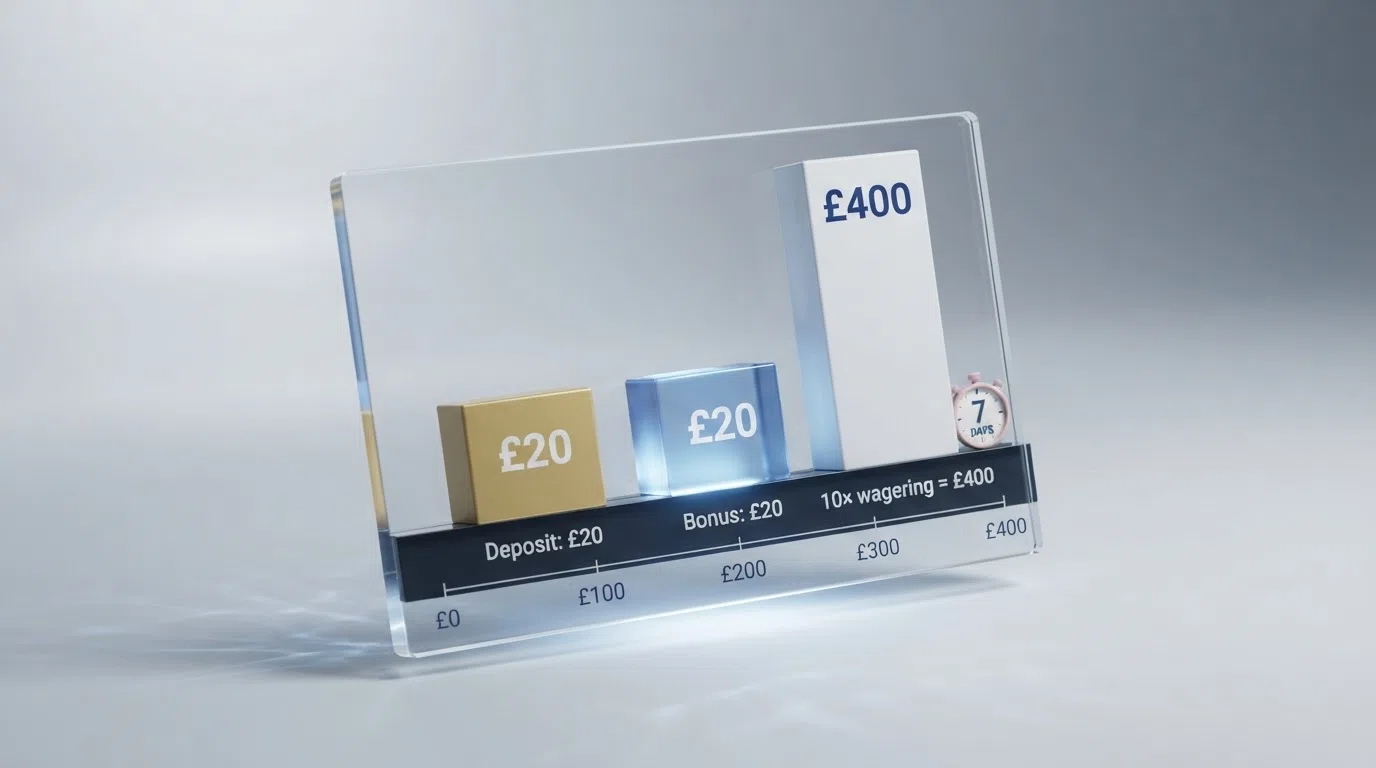
The arithmetic on a typical £20 match bonus makes the gap visible. Take the Grosvenor structure: a £20 deposit triggers a 100% match up to £20. The bonus amount is £20, and the wagering multiple is 10x on the combined deposit plus bonus, which is £40. The required turnover is therefore £400. To clear that, a player would need to spin through £400 on slots — at £1 per spin, four hundred spins; at the £5 statutory cap for those aged 25 and over, eighty spins.
The expected loss on that turnover depends on the slot’s return-to-player. Book of Dead from Play’n GO publishes an RTP of 96.21% — Starburst from NetEnt is 96.09%, and the average of the two is around 96.15%. Taking Book of Dead’s 96.21% as a representative figure, the expected loss from wagering £400 on the slot is £400 × (1 − 0.9621) = £15.16. That is the statistical cost of clearing the £20 match bonus at a 96.21% RTP, averaged over many spins and not a guarantee for any single session. The arithmetic is the same for any slot in the same RTP band; the loss is the multi-armed grind of the wagering requirement, paid in return for the bonus.
The bonus validity window is the second compressor. Validity windows in the featured set range from 72 hours (Dream Vegas free spins, Casiku) to 30 days (Dream Vegas bonus funds). A 7-day window on a £20 deposit with a £400 turnover target means the player must average £57 of slot wagering per day to clear. At £1 per spin, that is 57 spins a day for a week. The pace is not abusive, but it is not casual either — and the compressed play increases the variance any individual player experiences.
The cashout cap is the third. Casiku’s wager-free spins carry a £50 cap on free-spin winnings. Dream Vegas’s free-spin winnings cap at £100. Betano’s combined bonus caps at £100 redeemable. None of these caps is large in absolute terms, but each one is the hard ceiling on what a winning session can pay out, regardless of the spin result. The caps exist because wager-free or low-wager offers would otherwise pay out the full slot return; the cap is the operator’s defence against a system that would otherwise be neutral on expectation.
The 35x wagering at MagicRed is the legacy-term outlier worth flagging. The 10x statutory cap took effect on 19 January 2026 for any new or revised offer. MagicRed’s 35x multiple on the combined deposit-and-bonus package is a pre-cap term. A reader should check the current terms at MagicRed before depositing, since the gap between 35x and 10x is the difference between a £7,000 turnover and a £400 turnover on the same £100 bonus.
Welcome Bonuses That Actually Activate at a £20 Deposit
Seven of the ten featured operators activate their welcome bonus at exactly £20: Betano, Dream Vegas, PlayKasino, MagicRed, SpinYoo, Casiku and Grosvenor. The other three — Sky Vegas, Betfred and bet365 — trigger at £10, so a £20 deposit over-qualifies comfortably. The distinction matters because the wording of a few offers hides a spend-gated trigger underneath the deposit-gated headline.
Casiku is the clearest example. The welcome is 50 wager-free spins on Big Bass Splash, but the trigger is opt in, deposit £20, and wager at least £50 on slots on the day of first deposit. A player who deposits £20 and skips the slots turnover never sees the spins. Dream Vegas’s free-spin claim on the first deposit requires at least £10 of slots play on the first deposit to claim the spins — the second deposit’s 50% match is a separate opt-in. These are not bad-faith terms; they are spend-gated bonuses, and a player who reads them as deposit-gated will be surprised.
No-Deposit Bonuses at £20 Deposit Casinos: What the Market Actually Offers
No featured operator in this research run offers a genuinely deposit-free bonus. Every welcome offer in the table requires a qualifying deposit, and most require either a deposit threshold or a same-day turnover threshold on top of it. A true no-deposit bonus — credited on registration, with no payment needed — is rare in the UK market today, and the wagering cap that took effect on 19 January 2026 has made them rarer still, since the cost of a small deposit-free bonus is now capped at a 10x turnover minimum.
For a player who finds a no-deposit claim on a £20-deposit list, the fine print usually reveals a deposit-to-withdraw condition. A common structure is “no deposit required to claim, but a deposit is required before any winnings can be withdrawn” — which is functionally a deposit-gated bonus with a marketing head start. The honest reading is that a UKGC-licensed casino offering a £20 minimum deposit is not in the market for genuinely free bonuses; the £20 deposit is the operator’s filter against bonus-only accounts.
Wagering Requirements Explained: 10x Is the Cap, Not the Whole Story
The wagering requirement is the multiple of the bonus (or deposit plus bonus) that must be staked before the bonus balance converts to withdrawable cash. A 10x requirement on a £20 bonus means £200 of slot turnover; a 10x requirement on the combined deposit plus bonus means £400 of turnover. The multiple is the same; the base is different.
The 10x statutory cap took effect on 19 January 2026 under LCCP Social Responsibility Code 5.1.1, alongside a ban on mixed-product promotions that bundle a sports-betting offer into a casino welcome. The cap sets the maximum multiplier a UK casino can apply to a new or revised offer; it does not standardise the base. A casino applying 10x to the bonus only is half the turnover of a casino applying 10x to the deposit plus bonus. Grosvenor applies 10x to the deposit plus bonus on its £20 match, producing £400 turnover on the £40 total. Casiku’s wager-free spins avoid the turnover entirely but cap the winnings at £50.
Free-spin winnings are also subject to wagering unless explicitly labelled wager-free. The four genuinely wager-free spin offers in the featured set are Sky Vegas, Betfred, bet365 and Casiku. The other six apply 10x wagering to the winnings balance. A reader comparing offers should treat the wager-free label as the single most valuable term in the welcome, and the wagered-spin offers as the second tier.
How You Fund a £20 Deposit — and How Fast You Get Your Money Back
A £20 deposit and a £20 withdrawal are very different transactions at a UK casino. The deposit is usually instant — seconds, in some cases — and the withdrawal is delayed by identity verification, pending periods and payment-provider transfer times. The two ends of the same £20 never arrive at the same speed.
The credit-card ban is the headline rule every UK player should know upfront. Since 14 April 2020, credit cards have been banned for gambling in Great Britain, and the ban extends to credit-card-funded e-wallet top-ups. A player who tops up a PayPal balance from a credit card and then deposits to a casino is in breach of the rule and at risk of having the deposit reversed. The debit card is the default payment method at every UKGC-licensed casino.
Deposit Methods That Work at the £20 Level
The £20 deposit tier is supported by every major UK payment method, with two structural quirks. Debit cards (Visa and Mastercard) are the universal default — bet365 accepts them from £5, and Casimba accepts them at £20 along with Apple Pay, Trustly and Neteller. PayPal’s minimum varies by operator: bet365 sets it at £25, which is above the £20 deposit tier. E-wallets in general (Skrill, Neteller) are accepted at many UK casinos but their bonuses are sometimes excluded from welcome offers — operators treat e-wallet deposits as higher-risk for bonus abuse.
Trustly is the speed play. The provider publishes a deposit time of “less than 6 seconds” with a conversion rate of up to 98.8%. The conversion rate is relevant for the operator, not the player, but the speed is the player-facing number. A £20 deposit via Trustly is typically credited in under a minute, with no card details entered on the casino site and the deposit authenticated inside the bank app.
Apple Pay is the convenience play for iOS users. Casimba accepts Apple Pay at £20, and most major UKGC-licensed casinos do the same. The deposit is authenticated via Face ID or Touch ID, with no card numbers captured at the casino. The catch is the same as for any wallet: Apple Pay is a debit card rail, and the card backing it must be a debit card, not a credit card.
Pay-by-SMS — sometimes called pay-by-mobile — is named in user search demand but the per-transaction caps at most operators are typically low (often £5 or £10) and the fees are higher than for debit cards. It is a secondary option for very small deposits, not a £20 path.
Withdrawal Speed and Limits: Why Cashing Out Takes Longer Than Paying In
The deposit second is the easy minute. The withdrawal takes longer, and the reason is layered.
The first layer is the UKGC’s mandatory identity verification. Under the 2019 amendment to the LCCP, the 72-hour grace period for age and ID verification ended on 7 May 2019; since that date, every UKGC-licensed casino must verify name, address and date of birth before any deposit or gambling (including bonus credit). The first withdrawal is the first time a casino processes a real-money movement, and the verification step can take 24 to 72 hours depending on the casino’s process and the document quality.
The second layer is the operator’s pending period. After identity verification, the casino applies its own internal processing window — commonly 24 to 48 hours — during which the withdrawal sits in the cashier. The reverse-withdrawal ban that took effect on 31 October 2021 means a player cannot cancel the withdrawal once requested, so the pending period is a fixed wait rather than a deliberate choice.
The third layer is the payment-provider transfer time. Once the casino releases the funds, the time to the player’s bank account depends on the method: debit cards and Trustly typically arrive same-day or next-day; e-wallets (PayPal, Skrill, Neteller) are usually within 24 hours; bank transfers can take 2 to 5 working days. The reverse-withdrawal ban compounds the wait: a player cannot reverse the withdrawal to keep playing, so the cash sits in transit until the bank releases it.
The current terms this research run captured did not surface per-operator withdrawal-time data for the featured set. The general UK framework is the same: identity verification first, then operator pending, then provider transfer. The total realistic window from request to landing is 24 hours to 5 working days, with the first withdrawal slower than subsequent ones.
£20 Deposit Casinos on Mobile: Apps vs Browser Play
The mobile experience at a UKGC-licensed casino is a full mirror of the desktop experience, with the same games, the same bonuses and the same payment methods. The choice between a dedicated app and a mobile browser is a choice about convenience, not about access. The largest UK operators — bet365, Sky Vegas, Betfred, Grosvenor — offer dedicated apps on iOS and Android, while several of the mid-tier operators run a mobile-optimised website only.
The mobile-optimised browser is the lowest-friction option. No download, no storage space, no app updates. The casino’s full game catalogue is usually available, and the cashier works identically to the desktop version. The trade-off is the absent push notifications, the slower login (typed password or biometrics are both slower than a saved app login), and the absence of any app-only bonus structures.
The dedicated app is the familiar-routine option. Push notifications for bonus credits, biometric login with Face ID or fingerprint, and a sometimes-curated game subset that loads faster on the smaller screen. The app usually mirrors the welcome bonus terms of the desktop site, with no mobile-exclusive bonus for the featured set in this research run. The trade-off is the storage footprint and the requirement to keep the app updated.
Mobile Deposit Flow and Bonus Access on a Phone
The deposit flow on mobile is the same as on desktop. The cashier detects the device and presents the same payment methods: debit card, Apple Pay, Trustly, e-wallets. The £20 deposit at Casimba via Apple Pay is identical regardless of whether the player is on the iOS app or the Safari browser. The verification step (entering a one-time code from the bank, or biometric authentication) is the same.
Bonus opt-in is the part that varies in mobile practice. Some operators require a checkbox during the deposit flow; some use a promo code field; some credit the bonus automatically on the first qualifying deposit. The mobile cashier usually exposes the same opt-in path as the desktop, but the on-screen real estate is smaller, so a player who only plans to use the mobile site should confirm the opt-in mechanism before completing the deposit. None of the featured operators in this research run carries a mobile-exclusive welcome bonus.
What a £20 Bankroll Actually Buys You on UK Slots and Live Tables
The £20 deposit is the smallest deposit that makes a real-money session feel like a session. The arithmetic depends on the slot stake cap, which is statutory in the UK and not optional. Since 9 April 2025, players aged 25 and over are capped at £5 per spin on online slots; since 21 May 2025, players aged 18 to 24 are capped at £2 per spin. The cap applies per game cycle, not per session, so a single spin and a hundred spins within the same game are subject to the same per-cycle limit.
For a £20 bankroll at the £5 cap, the player gets four spins on a slot. At a £1 stake, twenty spins. At a £0.10 stake — the typical free-spin value — two hundred spins. The stake cap is not the binding constraint for a player who plays at lower stakes; it is the binding constraint for a player who plays at the £2 or £5 limit. For a £20-deposit player using the bonus-linked slots in the featured set, the typical play is at £0.10 or £1 per spin, which is well below the cap.
The bonus-linked slots in the featured set cluster around a handful of named titles. Book of Dead from Play’n GO carries a published RTP of 96.21% and is the bonus slot at PlayKasino. Starburst from NetEnt is the bonus slot at MagicRed with an RTP of 96.09%. Big Bass Splash from Pragmatic Play is the bonus slot at Dream Vegas and Casiku, with Big Bass Bonanza (a related title) at SpinYoo. Eye of Horus Legacy of Gold is the bonus slot at Betano, with the RTP not pre-disclosed in the research. The other three operators (Sky Vegas, Betfred, bet365) select the bonus slot at credit time, so the title and RTP are not known in advance.
The Slot Titles That Keep Coming Up in £20 Deposit Welcome Offers
The two bonus-linked slots in the featured set that carry a researched per-title RTP are Book of Dead and Starburst. Both are strong titles in their own right; the table below shows the source RTP and the featured operator.
| Slot Title | Provider | RTP | Featured at |
|---|---|---|---|
| Book of Dead | Play’n GO | 96.21% | PlayKasino |
| Starburst | NetEnt | 96.09% | MagicRed |
The other four bonus-linked titles — Big Bass Splash, Big Bass Bonanza, Eye of Horus Legacy of Gold and the bonus slot at Sky Vegas, Betfred and bet365 — are not in the table because the per-title RTP was not surfaced in this research run. Big Bass Splash from Pragmatic Play is a popular fishing-themed slot; Big Bass Bonanza is a related title in the same provider catalogue; the Eye of Horus Legacy of Gold bonus slot at Betano is named in the offer terms but the RTP is not in the data this run captured. The bonus slots at Sky Vegas, Betfred and bet365 are selected at credit time and so do not have a fixed RTP.
Live Dealer Games on a £20 Budget: What Is Actually Playable
Live-dealer games — roulette, blackjack, the game-show titles — are a tougher fit for a £20 bankroll. The UK slots stake cap does not apply to live-dealer games; minimums are set by the operator, not by statute. A typical live-roulette minimum is £0.50 or £1, but the same £20 at a £1 minimum produces twenty rounds with no real buffer against variance. A live-blackjack minimum often starts at £5, which reduces a £20 bankroll to four hands.
The right framing for a £20-deposit player on live tables is that the bankroll is enough for a few rounds of low-stakes play, not for a session. The live-dealer experience is one of the strongest reasons to choose a UKGC-licensed casino over an offshore site — the production quality, the game-show formats, the live-streaming stability — but the bankroll needs to match the table minimum, and £20 is the boundary case rather than the comfortable one. Grosvenor in the featured set has a strong live-casino reputation, supported by the wider brand’s land-based casino footprint. For a player who wants a live-dealer experience on a £20 deposit, the practical move is to start at the lowest table minimum and treat the first session as a feel for the format rather than a bankroll-building session.
New £20 Minimum Deposit Casinos Worth Your First Deposit in 2026
The state of genuinely new £20-deposit casino launches in 2026 is one of the thinner areas of competitor coverage. Most pages that rank £20-deposit casinos recycle the established brands — Grosvenor, Casiku, Betfred, bet365 — and treat any new entrant as a footnote. The research behind this page did not surface a confirmed list of 2026 £20-deposit new entrants with full UKGC licensing, and the honest framing is that “new” on most £20-deposit lists means newly promoted or rebranded rather than a fresh UKGC licence.
A new entrant is not automatically worse than a veteran. The full UKGC licensing bar applies to any new licensee: age verification before deposit, deposit-limit prompt from 31 October 2025, game-design rules from 31 October 2021, and the financial-vulnerability light-touch checks at a £150 net deposit threshold from 28 February 2025. A new UKGC licence means the operator cleared the current bar in full, which is the same bar an established operator cleared at its most recent licence renewal. The relevant difference is the public history: a new operator has no resolved complaints, no track record of withdrawal disputes, no public data on payout speed.
Fresh UKGC Launches: What the Newest Names Are Offering in 2026
The research did not surface a list of confirmed 2026 £20-deposit new entrants with full UKGC licensing. The honest framing is that this section is a gap rather than a name-check, and the appropriate move for a reader interested in a new entrant is to verify the UKGC account number on the public register before depositing. A fresh licence resolves to a current remote casino or remote betting licence — past-tense confirmations like “previously licensed” or “licence pending” are not the same as an active listing.
The other face of “new” in the £20-deposit market is rebrand. Several operators in the wider UK market have rebranded in the last 12 to 24 months while keeping the same underlying UKGC licence. The licence number does not change in a rebrand; the trading name does. A player who encounters a brand-new name on a £20-deposit list should treat the licence number as the source of truth and the brand name as the surface.
Rookies vs Veterans: Where a Newcomer Must Prove Itself
The established operators in the featured set — Grosvenor, Betfred, bet365, Sky Vegas — carry a public track record that a new entrant cannot replicate on day one. The track record is not glamour; it is the absence of unresolved withdrawal disputes, the absence of repeated complaints on independent review sites, and the stable banking history of a casino that has paid out consistently for years. None of these is a regulatory requirement, and none of them is in the UKGC’s public register. They are the informal record a player builds by reading independent casino reviews and consumer-protection forums.
A newcomer is not automatically worse. The full UKGC licence process is the same as for an established operator, and the deposit-limit prompt, age verification, game-design rules and financial-vulnerability checks apply identically. The difference is the cost of an error: a withdrawal delay at a new casino is harder to diagnose than the same delay at an established one, because the player has no track record of typical processing times. The featured set on this page skews established for exactly this reason — the data is more reliable, and the terms are easier to verify against the public register.
The Pre-Deposit Checklist for a New Casino
A new casino carries less public track record than an established operator, and the verification load falls on the player. The list below is the verification sequence specific to a new entrant, before paying the first £20.
- Confirm the UKGC account number resolves to an active remote casino licence. The licence must be active, not applied for or pending. The UKGC public register is the only source of truth.
- Check the licence category covers casino remote, not only bingo or betting. A bingo-only or betting-only licence does not authorise casino games, and a casino offering slots under such a licence is operating outside its authorisation.
- Search the operator’s name for player complaints and payout-delay reports. Independent casino review sites and consumer protection forums are the surface where disputes become visible. A long history of unresolved withdrawal disputes is disqualifying regardless of how good the bonus looks.
- Verify the registered trading name and address match what the site claims. The UKGC public register shows the registered trading name and licence address. A discrepancy between the site’s footer and the public register is a red flag.
- Treat any new-launch claim as unverified until checked against the UKGC public register. The bonus headline is not the source of truth on the operator’s licence standing.
Are £20 Deposit Casinos Safe? UK Licensing, Player Protections and the GamStop Reality
A UKGC licence is the single most important feature of any £20-deposit casino a UK player considers. The licence is the legal authorisation to provide facilities for gambling to customers in Great Britain, and the regulator’s three statutory objectives — preventing crime and disorder, ensuring fair and open gambling, and protecting children and vulnerable persons — are the framework around every player-protection rule on this page. A £20 deposit at a UKGC-licensed casino is gambling inside a regulated framework; the same £20 at an unlicensed site is gambling outside it.

The licensing framework is layered. The Gambling Act 2005 sets the statutory foundation; the Gambling (Licensing and Advertising) Act 2014 introduced the point-of-consumption rule, which requires a UKGC licence for any operator providing gambling facilities to GB customers regardless of where the operator is based. The LCCP (Licence Conditions and Codes of Practice) is the working instrument, and the SR Codes (Social Responsibility Codes) are the player-protection section. A casino footer showing a UKGC licence number is the entry point; the licence on the public register is the proof.
Remote Gaming Duty increased from 21% to 40% from 1 April 2026, and Bingo Duty was abolished from the same date. The duty is the operator’s tax, not the player’s — UK players pay no tax on gambling winnings — but the increase is a structural pressure on operator margins, which is the background reason why the welcome-offer shape at UK casinos has tightened over the last 24 months.
What a UKGC Licence Actually Requires: More Than a Footer Logo
The UKGC licence imposes a set of mandatory obligations that go beyond a footer logo. Every player-facing action at a licensed casino is anchored to a specific regulation.
Age and identity verification must complete before any deposit or gambling. The 72-hour grace period that allowed players to deposit before verifying ended on 7 May 2019; since that date, a UKGC-licensed casino cannot accept a deposit or grant access to games until name, address and date of birth are verified. The verification step is the gate, and any operator that lets a player deposit without completing it is in breach of its licence.
A deposit-limit prompt is mandatory before the first deposit. From 31 October 2025, every UKGC licensee must prompt a customer to set a financial limit before the first deposit. Decreases to the limit take effect immediately; increases are subject to a cooling-off window. The prompt is the operator’s obligation; the limit is the player’s choice. RTS 12 standardises a “gross deposit limit” definition, with the originally planned 30 June 2026 implementation extended by the Commission to 30 September 2026.
Game-design rules have been in force since 31 October 2021. Auto-play is banned; spin speed must not be faster than 2.5 seconds; features that speed up play are banned; losses disguised as wins are banned; reverse withdrawals are banned; session display of total losses, wins and time played is mandatory. The rules are aimed at the slot interface itself, not the player, and they apply to every UKGC-licensed slot game.
Financial-vulnerability checks kick in at deposit thresholds. From 28 February 2025, every UKGC licensee must apply a light-touch financial-vulnerability check using public data when a customer reaches a net deposit of £150 in a rolling 30-day period. The check is data-driven, not a request for documents, and the £150 threshold is the trigger. A second threshold at £500 has been in force since 30 August 2024. Financial risk assessments — the deeper, document-based affordability checks — were announced by the Commission on 7 July 2026 but a start date is not yet confirmed.
The online slots stake cap is the headline player-protection rule. Players aged 25 and over are capped at £5 per spin on online slots since 9 April 2025; players aged 18 to 24 are capped at £2 per spin since 21 May 2025. The cap applies per game cycle and slots only — not to roulette, blackjack or other casino games.
GamStop Self-Exclusion: What It Blocks and What It Does Not
GamStop is the national multi-operator online self-exclusion scheme. Participation is a mandatory condition of every GB-licensed online operating licence since 31 March 2020. A player who registers with GamStop is excluded from every UKGC-licensed casino, betting site and bingo site for the chosen period, and the exclusion covers marketing as well as play — direct marketing must be opt-in per product and per channel from 1 May 2025 under LCCP SR Code 5.1.12.
The exclusion periods are six months, one year, five years, or five years with auto-renewal. None of the periods can be cancelled early. The minimum six-month window is the floor; the maximum with auto-renewal is the longest available. The choice is the player’s, and the operator has no discretion to lift the exclusion once set.
GamStop covers every UKGC-licensed online operator. It does not cover land-based casinos, betting shops or arcades. It does not cover offshore operators that do not hold a UKGC licence. The distinction is the operational one: a self-excluded player cannot reach a UKGC-licensed casino from a UK IP address, but a determined player can still reach an offshore site. The exclusion is the strongest tool a UK player has, and its scope is exactly the UKGC-licensed market.
Playing Outside GamStop: What “Not on GamStop” Casinos Actually Are
A casino described as “not on GamStop” is a casino that does not hold a UKGC licence. The most common alternative jurisdictions are Curaçao, Malta (MGA-only) and Gibraltar. None of these licences is a substitute for a GB licence at the point of consumption: providing facilities for gambling to GB customers without a UKGC licence is a criminal offence under section 33 of the Gambling Act 2005, punishable by up to 51 weeks’ imprisonment, an unlimited fine, or both.
The UKGC’s enforcement approach is disruption-based, not ISP blocking. The Commission issues cease-and-desist notices, refers URLs to search engines for delisting, and works with registrars, hosts and payment providers to remove access. The published figures for April 2024 to June 2025 are 3,140 disruption notices issued, 447,778 URLs referred to search engines, and 287,961 URLs removed. The approach is asymmetric: the Commission goes after the access points rather than the player. Statutory ISP/DNS blocking powers have been proposed but not enacted.
The honest summary for a player who encounters a “not on GamStop” casino on a £20-deposit list is that the casino is operating outside the UK regulatory framework. The protections covered in this section — age verification, deposit-limit prompts, game-design rules, GamStop self-exclusion, financial-vulnerability checks, the slots stake cap — do not apply. A player who chooses to play at one does so without any of the UKGC’s player-protection rules in place, and the recourse if a withdrawal is delayed or refused is limited to the alternative jurisdiction’s regulator, which is generally weaker than the UKGC.
Staying in Control: Responsible Gambling Tools for £20 Deposit Players
The safer-gambling tools at a UKGC-licensed casino are player-set, not operator-imposed. The operator offers the tools; the player’s choice is whether to use them and how high to set them. The four tool families — deposit limits, reality checks, time-outs and self-exclusion — are the everyday controls, and they are distinct from the statutory protections (the stake cap, the reverse-withdrawal ban) that the operator applies automatically.
Most players do not develop problems with gambling. The support infrastructure exists for the players who do, and reaching out early is normal practice. The National Gambling Helpline (0808 8020 133, free 24/7, run by GamCare) is the single number every UK player should have stored before they need it. The following section covers the operational tools; the help section that follows covers the support organisations.
Deposit Limits You Can Set Before Your First Session
The deposit limit is the first-line tool. From 31 October 2025, every UKGC-licensed casino must prompt the player to set a financial limit before the first deposit. The prompt is mandatory, not optional; the limit itself is the player’s choice. A player who sets a £20 weekly deposit limit at the first deposit and never raises it cannot deposit more than £20 in any 7-day window without explicitly changing the limit.
Decreases to the deposit limit take effect immediately. Increases are delayed by a cooling-off window — the operator must give the player the chance to reconsider. The asymmetry is intentional: protecting the limit is faster than resetting it.
The deposit limit is the player’s ceiling, not the state’s. There is no nationwide statutory deposit ceiling in UK regulation; the limit is the player’s tool, and the operator’s obligation is to offer it transparently. The slots stake cap is the statutory counterpart — the state caps the spin size, the player caps the deposit amount.
Reality Checks and Time-Outs: The Mid-Session Brakes
Reality checks are pop-ups at a chosen interval during a session, showing time played and net position. The interval is the player’s choice — common settings are 30, 60 or 90 minutes. The pop-up is mandatory at a UKGC-licensed casino; the interval is the player’s preference.
Time-outs are short self-imposed cooling-off periods during which the casino locks the player out — typically 24 hours to six weeks. The time-out is the right tool for a player who wants a break without committing to a longer self-exclusion. The casino holds the account inaccessible for the chosen period, and the player returns at the end of the time-out.
Both tools are distinct from self-exclusion. Reality checks and time-outs are the everyday brakes; self-exclusion is the emergency stop. The mandatory session display of total losses, wins and time played — required under the game-design rules from 31 October 2021 — is the always-on conscience of the system; the reality check is the periodic signal.
Operator-Level Self-Exclusion: A Cool-Off Without Leaving the Casino
Each UKGC-licensed casino must offer its own self-exclusion, independent of GamStop. The operator-level exclusion lets a player remove themselves from a single casino without affecting their access to other UKGC-licensed sites. It is the right tool when one casino is the problem rather than gambling in general.
The GamStop section above covers the national multi-operator option and its exclusion periods. The operator-level exclusion is the lighter-touch complement: it can be set for shorter periods (some operators offer 24 hours or 7 days in addition to the longer 6 months, 1 year or 5 years), and it does not require registration with GamStop. A player who has a concern about their play at a specific casino but does not want to exclude themselves from the wider UK market can use the operator-level tool.
Where to Get Help: GamCare, BeGambleAware and the National Helpline
The National Gambling Helpline is the single most important number on this page. It is run by GamCare, free of charge, available 24 hours a day, 7 days a week, on 0808 8020 133. The line is staffed by trained advisers who can provide immediate support, signpost to local treatment services, and arrange referral to specialist gambling treatment clinics where appropriate.
The wider UK support infrastructure includes GamCare (the operator of the helpline and the provider of many local services), BeGambleAware (the prevention and education body), and the NHS gambling treatment clinics in England. The NHS clinics provide specialist clinical treatment for gambling-related harm, including cognitive behavioural therapy and psychiatric assessment where needed. The support exists precisely for the players who do develop problems, and reaching out early is normal practice — the services are not just for crisis moments.
The prevalence context matters. Most players who deposit £20 at a UK casino do not develop problems. The tools and the support exist for the minority who do, and the framing is that using them is the same as wearing a seatbelt: a sensible default rather than an admission of risk.
How We Evaluate and Rank £20 Minimum Deposit Casinos
The featured-operator ranking on this page is built from three data sources: the UKGC public register, the operator’s own published terms at the time of writing, and independent UK-facing casino review sites. The primary licence-verification source is the UKGC public register, where every licence status is current and traceable. The operator terms supply the welcome-offer shape, the wagering multiple, the validity window, the cashout cap and the free-spin value. The independent reviews provide the per-operator context that does not appear in the regulatory or operator-side data.
The evaluation criteria, in order of weight, are:
- Licence standing. An active UKGC remote casino licence confirmed against the public register is the first filter. Where the account number was not surfaced in this research run, the operator profile states what the public register should show at time of writing.
- Welcome-offer terms. The wagering multiple, the validity window, the cashout cap and the free-spin value together define what the bonus is worth. A 10x wagering on a £20 deposit-plus-bonus (£400 turnover) is materially different from a 35x wagering on the same package (£1,400 turnover).
- Payment-method availability. A £20 deposit must be supported by the player’s preferred payment method. Debit card is universal; PayPal has variable minimums; Trustly and Apple Pay are operator-specific.
- Safer-gambling tool visibility. A deposit-limit prompt, reality checks, time-outs and self-exclusion are all mandatory at a UKGC-licensed casino. Their visibility on the cashier and safer-gambling pages is a signal of a well-run operation.
- Brand familiarity. A track record of resolved complaints and a stable banking history is the informal layer. It does not override the licence standing, but it is a tie-breaker between operators with comparable terms.
No operator paid for inclusion on this page, and no promotional codes are published. The terms are described as the operator publishes them at the time of writing; a reader should verify the current terms on the operator’s promotion page before depositing, since welcome offers are revised more often than this page is updated.
What to Actually Do with Your £20 Deposit: A Smarter Start
The £20 deposit at a UKGC-licensed casino opens real-money play and a real welcome bonus, but the gap between the advertised offer and what a player keeps is wide and measurable. The three terms that decide the gap are the wagering multiple, the validity window and the cashout cap. A 10x wagering on a £40 deposit-plus-bonus is a £400 turnover; a 35x wagering on the same package is £1,400. The wager-free spin offers at Casiku, Sky Vegas, Betfred and bet365 remove the turnover trap entirely and are the highest-value bonus type for a £20 depositor.
The UK slots stake cap stretches a £20 bankroll further than it first appears. At £5 per spin for players aged 25 and over, the bankroll is four spins — too few for a session. At £2 per spin for players aged 18 to 24, ten spins — passable. At £0.10 per spin (the typical free-spin value) two hundred spins — a real session. The slot stake the player chooses is the lever that determines how long the £20 lasts. There is no shame in playing at £0.10.
The single most important action before the first deposit is to set a deposit limit. The UKGC’s mandatory deposit-limit prompt means the casino will ask; the player should answer with a realistic weekly or monthly cap, not with the £20 deposit in front of them. The limit is the player’s tool, and the prompt is the operator’s obligation. A player who sets a £20 weekly limit and never raises it cannot lose more than £20 in any week, regardless of what the bonus terms offer.
The last framing is the right one. The £20 deposit is the price of an evening’s entertainment, not an investment with a guaranteed return. The book’s edge is built into every slot’s RTP, every table’s minimum and every promotion’s wagering multiple. A player who treats the £20 as the cost of a movie and a meal — and who sets the deposit limit before the cashier asks — gets the entertainment without the surprise. The National Gambling Helpline (0808 8020 133, free 24/7) is the number to store before the first session, not after.
Frequently Asked Questions
Can I get a welcome bonus with a £20 deposit?
Yes. Seven of the ten featured operators activate their welcome bonus at exactly £20 — Betano, Dream Vegas, PlayKasino, MagicRed, SpinYoo, Casiku and Grosvenor. The other three trigger at £10, so a £20 deposit over-qualifies. The wagering multiple, validity window and cashout cap vary by operator.
Are there no-deposit bonuses at £20 minimum deposit casinos?
No — not in the featured set. Every welcome offer on this page requires a qualifying deposit, and most require a same-day spend threshold on top. A true no-deposit bonus is rare in the UK market, and the 10x wagering cap from December 2025 has made them rarer. Players who find a no-deposit claim should expect a deposit-to-withdraw condition in the fine print.
What slots can I play with a £20 deposit?
The £20 deposit works at any slot, but the bonus-linked slots in the featured set cluster around familiar titles: Book of Dead (PlayKasino, 96.21% RTP), Starburst (MagicRed, 96.09%), Big Bass Splash (Dream Vegas, Casiku), Big Bass Bonanza (SpinYoo) and Eye of Horus Legacy of Gold (Betano). The UK slots stake cap applies — £5 per spin for 25+, £2 for 18 to 24.
Do £20 minimum deposit casinos have mobile apps?
Most do. The largest UK operators (bet365, Sky Vegas, Betfred, Grosvenor) offer dedicated iOS and Android apps, while several mid-tier operators run mobile-optimised websites. The mobile experience mirrors the desktop version, with the same games, bonuses and payment methods. None of the featured operators carries a mobile-exclusive welcome bonus.
What are the wagering requirements for £20 deposit bonuses?
The 10x statutory cap took effect on 19 January 2026, so any new offer at a UKGC-licensed casino must apply 10x or lower. The cap applies to the multiple, not the base — 10x on the bonus alone is £200 turnover on a £20 bonus, but 10x on deposit plus bonus is £400. Casiku, Sky Vegas, Betfred and bet365 run wager-free spins.
How does GAMSTOP affect £20 deposit casino play?
GamStop is the national multi-operator self-exclusion scheme, mandatory for every UKGC-licensed casino since 31 March 2020. A registered player is excluded from every UKGC-licensed casino for the chosen period (six months, one year, five years, or five years with auto-renewal). The exclusion covers marketing as well as play. GamStop covers UKGC-licensed sites only; offshore operators are out of its reach.
Limits – nodeposit-casinobonuses-uk
Content created by the «nodeposit-casinobonuses-uk» team