
Best Real-Money Online Casinos UK in 2026 — Ranked, Verified and Spelled Out
 Available in GB
The UK real-money online casino market moved £1.55 billion in gross gambling yield in the last quarter alone, with 13.4 million monthly active accounts spinning or betting 26.8 billion times in those three months. Slots drove the bulk of it. This page walks through what that market actually looks like from a player’s seat in 2026: the brands that hold a current UK Gambling Commission licence, the bonuses their terms actually deliver, the games that sit behind the welcome offers, and the rules that govern every pound staked. A “real-money” casino, in plain terms, is any site where you deposit pounds, wager them on games of chance, and can withdraw what you win. It is the only kind of online casino the Gambling Commission licenses, and the only kind on this page.

Data current as of September 8, 2026, verified against the UK Gambling Commission’s public register of licensed businesses.
Real-Money Online Casinos in the UK — What’s Actually on the Table
A UK-licensed real-money casino is a website holding a Gambling Commission operating licence, regulated under the Gambling Act 2005 and the Licence Conditions and Codes of Practice (LCCP). It sits on the Commission’s public register, accepts deposits in pounds, lets you wager on slots, table games and live-dealer products, and pays withdrawals back to you in cash. It is not a sportsbook, though some licensed operators carry both. It is not a bingo site, though the same operator may hold a separate bingo licence. And it is not a social casino, where virtual credits cannot be withdrawn because no real money ever changed hands.
The three product silos under a UKGC operating licence — casino, betting, bingo — are separate permissions. A single brand may hold all three, which is why the Coral you bet on the Grand National with can also be the Coral whose slot lobby you opened last night. The silo matters for the bonus rules introduced in January 2026, which is why the section on bonus terms revisits it. For the present purpose, the structural point is that casino GGY is dominated by slots in a way the other products are not. Across the 2024–25 financial year, online casino games generated £5.0 billion in gross gambling yield. Slots alone delivered £4.2 billion of that. Table games and live casino shared the remainder, and the slot share keeps growing — up 12% year-on-year in the most recent quarter.
The UKGC public register, last refreshed 29 July 2026, holds 2,663 licensed business records. That is the universe a player can choose from. The ten on this page are a small, named slice of it.
How to Choose a Safe Real-Money Casino in the UK — the Non-Negotiables
Three checks come before the first deposit, and each one takes a minute. The first is the UKGC public register. The Commission’s website lets you search by brand name or licence number; the register last refreshed 29 July 2026 holds 2,663 records, each one a business the Commission has licensed to serve British customers. A brand not on the register is illegal in Great Britain regardless of what other licence it holds. A Malta Gaming Authority permission, a Curaçao eGaming sub-licence, a Gibraltar remote betting licence — none of these substitute for the GB permission. A GB licence is a point-of-consumption requirement: it is the customer’s location that triggers it, not the operator’s base. If you are in England, Scotland or Wales and you are playing for real money, the operator needs a UKGC number, full stop.
The second check is GAMSTOP. Every operator licensed by the Gambling Commission must be part of the GAMSTOP self-exclusion scheme — that requirement took effect on 31 March 2020, and the Commission’s enforcement is not ambiguous on it. If a casino is not on GAMSTOP, it is not on the UKGC register. The two are the same gate read from two sides.
The third is an alternative dispute resolution (ADR) provider. An ADR is the body you go to when you and the operator cannot resolve a complaint between yourselves. IBAS (Independent Betting Adjudication Service) handles most UKGC-licensed disputes. The Commission’s licence conditions require operators to sign up with an ADR; a casino that cannot name one has skipped a basic consumer-protection step. The absence of a named ADR is not a red flag in the same league as the absence of a licence, but it is a sign that a brand has not finished the paperwork, and paperwork is what protection is built from.
A fourth check is implied rather than listed, and worth saying aloud: a UKGC-licensed casino cannot, by law, accept cryptocurrency. The Gambling Act 2005 prohibits it, and no crypto casino holds a UKGC licence. Every Bitcoin, Ethereum or USDT casino you can find from a UK IP address is unlicensed in Great Britain, even if it holds a Curaçao, Costa Rica or Anjouan permit. This page covers that topic directly in the offshore section.
The UK’s Best Real-Money Online Casinos in 2026 — Ranked and Fact-Checked
The ten operators below are ordered by how their welcome offers stack up against the four variables that determine real value: wagering burden, spin value, cashout cap and game-provider depth. Every brand is verified as licensed on the UKGC public register as of July 2026. Every offer listed is subject to the 10× wagering cap that took effect on 19 January 2026 — the cap is a ceiling, not a floor, and zero wagering remains a legal offer type. Where an offer genuinely carries no wagering on winnings, the table says so.
| Operator | Welcome Offer | Free Spins | Wagering on Winnings | Offer Validity |
|---|---|---|---|---|
| bet365 | Up to 500 free spins, no wagering | Up to 500 (10 daily selections over 20 days) | None | 30 days to claim; 7 days per set |
| William Hill | 200 free spins on Big Bass Splash | 200 at £0.10 each | 10× | 72 hours from credit |
| Sky Vegas | Up to 200 free spins, no wagering | 50 on registration, 200 after £10 stake | None | 7 days |
| Ladbrokes | 100 free spins + 300 LadBucks | 100 at £0.10 each | 10× | 48 hours to accept; 7 days to use |
| Paddy Power | 60 no-deposit + 200 deposit-triggered spins | Up to 260 total | None | 7 days |
| Coral | 100 free spins | 100 | 10× | Per terms |
| Betfred | 200 free spins, no wagering | 200 at £0.10 each | None | 7 days; 48 hours to accept |
| Betfair | Terms to be verified directly with operator | — | — | — |
| 888casino | 100 free spins on Pragmatic slots | 100 at £0.10 each | 10× (capped at £300) | 7 days |
| Virgin Games | 100 free spins on Big Bass Splash | 100 at £0.01 each (1p × 10 lines) | None | 30 days |
The top three — bet365, William Hill and Sky Vegas — separate themselves from the rest on volume, transparency and the post-wagering value of the spins, not on the size of the headline figure alone. The order below moves through the rest, and each block ends on a verdict for the player it suits and the one it doesn’t.
bet365 — Up to 500 Free Spins, Zero Wagering
bet365’s offer is the largest in the ranking and, more importantly, the only one in the top three built around genuinely zero-wagering winnings. The structure is not a single drop of 500 spins; it is ten daily selections made over twenty days, each selection pulling from a set of prize sizes — five, ten, twenty or fifty spins. The mechanic rewards return: a player who logs in for twenty consecutive days collects more than one who opens the offer on day one and forgets about it. The minimum lifetime deposit to qualify is £10, which closes the offer to anyone who has not funded the account at all, but is not a high bar. Each spin is worth £0.10, and the 30-day claim window plus 7-day use window on each set gives the longest pacing in the ranking.
The “no wagering on winnings” line is the one that actually changes the value calculation. A £20 win from a free spin at bet365 is £20 you can withdraw. A £20 win from a William Hill spin is £20 minus 10× playthrough (£200 of further wagering) and capped at £30 if you ever want to take the money out. The bet365 number is what it says it is, with the arithmetic intact rather than reduced. The trade-off is the entry floor — a player who has never deposited at bet365 and never intends to play there is not the audience. For anyone willing to set up a £10 deposit and return for twenty days, this is the most generous spin package in the UK right now.
William Hill — 200 Free Spins on Big Bass Splash, Tight £30 Cap
William Hill is the most familiar high-street name in the ranking, and the offer plays to that familiarity: 200 free spins on Big Bass Splash after depositing and staking £10+, each spin worth £0.10, with 10× wagering applied to winnings and a hard £30 cap on what you can keep. The 72-hour expiry from credit is the shortest validity window in the ranking — a player who does not load the qualifying slot within three days of credit loses the spins. Big Bass Splash, the named title, is a Pragmatic Play release with a 96.71% return-to-player, and the title specificity is itself useful: the maths of the offer can be modelled, and a player knows exactly what the house edge is.
The £30 cap is the offer’s centre of gravity. Even a strong spin run on a 96.71% slot produces a withdrawal figure that, after 10× wagering, is shaped by what the cap allows rather than what the maths would otherwise produce. The offer is for a player who wants a recognisable name, a specific slot, a quick decision and a small, predictable upside. It is not for a player optimising on per-spin expected value — the cap removes that calculation. Within its design, the offer is clear, fast and honest about its limits.
Sky Vegas — No-Wagering Free Spins from a Household Name
Sky Vegas sits inside the Flutter group alongside Paddy Power and Betfair, and the welcome offer is built around a two-stage structure: 50 free spins credited on registration with no deposit required, then up to 200 more spins after staking £10 within 30 days. All spins carry no wagering on winnings, which places Sky Vegas in the same value category as bet365 and Paddy Power — what you win is what you can take. The 7-day free-spin expiry is short, but the registration-stage spins mean a player has something to play with the moment SMS verification clears.
The first eligible game is auto-selected by Sky Vegas, which removes the choice the bet365 daily-selection mechanic offers but cuts the time-to-spin to seconds. The wager-free structure is the substantive point. For a player who values a brand they already pay a TV subscription to and a bonus that pays out at face value, Sky Vegas is a clean entry. The trade-off is the smaller headline figure than bet365 and the lack of title transparency at the point of credit. The argument in its favour is simplicity.
Ladbrokes — 100 Free Spins plus LadBucks, the Entain Formula
Ladbrokes’ casino welcome offer is a £10 deposit-and-spend trigger that returns 100 free spins at £0.10 each on selected games plus 300 LadBucks, the operator’s loyalty currency. The 10× wagering applies to free-spin winnings, in line with the post-January 2026 cap. The 48-hour acceptance window is the shortest trigger-to-claim period in the ranking, and the 7-day use window on the spins themselves is the standard. LadBucks is the part that does not sit on a slot machine at all — it is spendable inside the Ladbrokes ecosystem on free bets, bonuses and other promotions, and it exists outside the 10× wagering cap that applies to the spin winnings.
The practical shape of the offer is a familiar high-street welcome with a loyalty-currency sweetener that adds a small chunk of value for a player who already uses the Ladbrokes app for football betting. For a casino-only player, the LadBucks component does nothing. The 100 spins at £0.10, with a 10× playthrough and no published cap in the research, are the comparable figure to Coral’s mirror offer. The verdict: a strong pick for the Entain bettor who also wants to try the casino; an underwhelming pick for the player who does not.
Paddy Power — The Only No-Deposit Free Spins in Our Top 10
Paddy Power is the sole operator in the ranking offering genuinely deposit-free spins. The registration flow credits 60 no-deposit free spins after SMS verification — 50 on selected slots, 10 on Paddy’s Mansion Heist — and a further 200 spins drop after depositing and wagering £10. There is no wagering on winnings across either batch. The 7-day expiry applies to both, and the no-deposit nature of the first 60 means a player can try the casino without funding an account at all.
That is rare, and it is the structural reason Paddy Power sits high on a reader’s list who has not decided to spend money yet. The post-January 2026 bonus landscape has tightened no-deposit offers across the UK, and the 60-spin registration package is now the exception rather than the rule. The trade-off is the same as every other Flutter-group offer in the ranking: what you win is what you keep, and what you win depends on the slot’s maths. For a player who values testing a casino before committing a deposit, Paddy Power is the only one of the ten that allows it.
Coral — Bet £10, Get 100 Free Spins from the Entain Playbook
Coral’s casino offer mirrors Ladbrokes’ structure because both brands run on the Entain platform: stake £10, receive 100 free spins with 10× wagering on winnings. The casino tab on Coral is a different shopfront over the same engine, with a different game-presentation layer and a different loyalty-currency system. The Entain platform standardisation means the 10× wagering is the same on both brands, and the 100-spin count is the same.
The differences are on the surface — game selection in the lobby, branding, retail presence on the high street — and underneath in the loyalty layer and any cross-product offers that the post-January 2026 mixed-product ban now prohibits. For a player who has a Coral account from sports betting and wants to try the casino without learning a new platform, Coral is the natural pick. For a player comparing casino-only experiences, the Coral vs. Ladbrokes decision is closer to a coin flip, and the verdict is the one that gives the player the cleanest brand fit.
Betfred — 200 Free Spins, No Wagering, Debit Card Only
Betfred’s 200-free-spin welcome is the no-wagering competitor to bet365 in raw count, with a clean offer structure: stake £10, receive 200 spins at £0.10 each, no wagering on winnings, 7-day validity, accept within 48 hours. The headline is almost identical to a high-street bet365 figure. The decisive difference is the payment-method restriction: a Betfred-qualifying deposit must be made by debit card. A player who funds accounts with PayPal, Apple Pay, Open Banking or a prepaid voucher does not qualify.
The debit-card requirement is the reason Betfred sits below Sky Vegas in this ranking despite the higher spin count. It is also the reason the offer is suited to the player who already pays for everything with a Visa or Mastercard debit card and sees no friction in the restriction. The verdict: a strong offer for the debit-card user, a non-starter for the e-wallet user.
Betfair — The Exchange Giant’s Casino Wing
Betfair’s casino product sits inside the Flutter group alongside Sky Vegas and Paddy Power, and the licence is active on the UKGC register. What the research could not confirm with sufficient granularity for a numerical write-up was the current welcome offer: free-spin count, wagering terms, spin value, validity window and cashout cap. The qualitative case for Betfair’s casino is straightforward — a long-established brand, an exchange liquidity base that no casino-only operator matches, a game-provider roster that includes Playtech, NetEnt and Evolution, and a Flutter-group platform that allows a player to move between sportsbook, exchange and casino without leaving the wallet.
The honest position is that a player considering Betfair should verify the welcome offer directly on the Betfair Casino site before depositing, because the headline figure that prompted the ranking in this guide is not confirmed in the terms-and-conditions research available for this review. The licence is real, the platform is established, and the provider depth is genuine. The offer is the gap.
888casino — 100 Free Spins with a £300 Max-Cashout Ceiling
888casino is one of the oldest online casino brands in the world, now under the evoke group alongside 888 Holdings, and the welcome offer is the most numerically specific in the ranking: deposit £10, wager £10 on slots, receive 100 free spins at £0.10 each on selected Pragmatic Play slots, with 10× wagering on winnings and a hard £300 cap on what you can keep. The £300 ceiling is the highest cap in the ranking — ten times the William Hill figure and roughly the same as several no-cap offers, once the wagering and the slot variance are factored in.
The 7-day claim window and 7-day use window are standard. The Pragmatic Play exclusivity signals a specific house style in the bonus-game roster: Big Bass variants, Sweet Bonanza and the studio’s other high-volatility releases. For a player who wants the highest published cap and a studio-anchored game list, 888casino is the right pick. For a player who prefers zero-wagering terms, the cap is irrelevant because the playthrough does the work first.
Virgin Games — 100 Spins at 1p Each, No Wagering, 30 Days to Use
Virgin Games runs a 100-free-spin welcome on Big Bass Splash at £0.01 per spin — with no wagering on winnings, no published cashout cap, and a 30-day expiry. The 30 days is the most generous validity window in the ranking; the £1 total spin value (100 × £0.01) is the smallest. The asymmetry is the point. A player at Virgin Games is risking effectively nothing across the bonus round — the 100 spins cost the operator £1 in spin value total — and the no-wagering structure means whatever comes back is withdrawable. The trade-off is ceiling, not floor.
For a casual player who wants the longest runway to use a bonus, the lowest effective risk per spin, and the cleanest no-wagering structure, Virgin Games is the right pick. For a player chasing a headline figure, the 100 × 1p offer will look like a rounding error next to bet365’s 500 × 10p. They are different products. The verdict: pick Virgin Games if you want to try a slot at length without risk; pick bet365 if you want the most spins with money on the line.
Why Your 2026 Casino Bonus Is Smaller Than It Looks
The advertised offer and the offer you actually keep diverge, and the gap has a name. Wagering requirements, spin value, cashout caps and validity windows are the four levers that shrink a bonus’s real value, and a player who reads only the headline is paying the marketing rate rather than the after-small-print rate. The January 2026 10× wagering cap rewrote the top end of the multiplier range — bonuses that previously carried 30×, 40× or 65× wagering are now constrained to 10× at the ceiling — but the other three levers still drive the spread between offers that look identical at the top of the page.
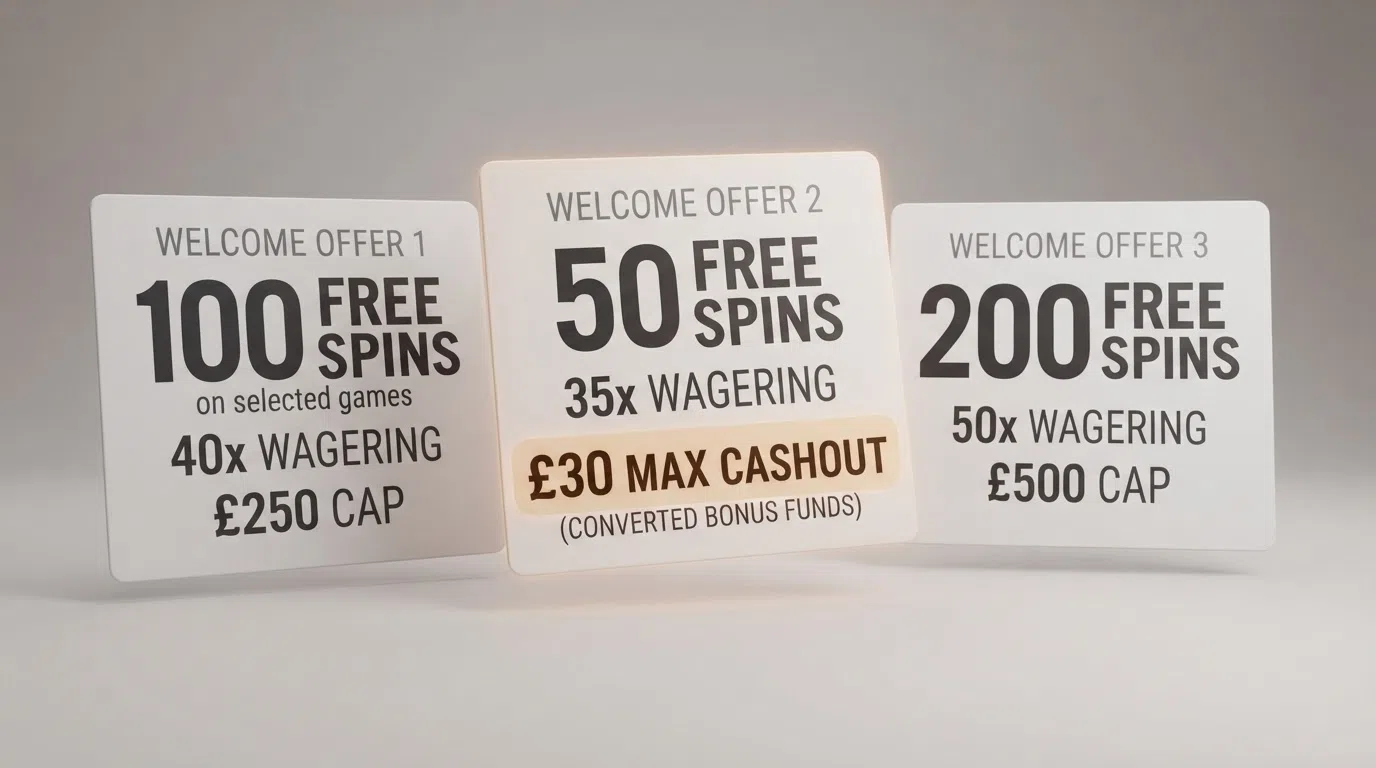
The two “200 free spins” offers in the ranking illustrate the spread. Both William Hill and Betfred offer 200 spins at £0.10 each, both trigger on a £10 stake, both run on similar slot rosters. One caps withdrawals at £30 and applies 10× wagering to winnings; the other applies zero wagering and no published cap. The headline is identical. The amount a player actually keeps, on a moderate spin run, can be £30 apart.
“No wagering” is not a marketing flourish. It is a structural category of offer in which the bonus money or free-spin winnings is paid in cash and treated as your own. The wager-free offers in the ranking — bet365, Sky Vegas, Paddy Power, Betfred, Virgin Games — let a player withdraw what the slot produces. The 10× offers — William Hill, Ladbrokes, Coral, 888casino — require the winnings to be played through ten times before they become cash, and the cap then takes a second pass.
The January 2026 Wagering Cap — What the 10× Rule Actually Means
The 10× maximum on bonus wagering, in force from 19 January 2026 under LCCP Social Responsibility Code 5.1.1, is the first hard ceiling on bonus playthrough in British gambling regulation. It is a ceiling on the multiplier against the bonus amount, not against deposit+bonus. A 10× cap on a £10 bonus means £100 of required turnover. A pre-2026 offer at 30× against £10 meant £300, and a 65× offer meant £650. The rule closes the gap between mild and punishing offers and forces the entire industry below the same multiplier line.
The cap does not cover everything. Free-spin winnings still carry their own wagering terms, and operators can attach playthrough to that specific bucket at any level up to the cap. The cap also does not set a floor: zero wagering remains legal, and the wager-free offers in this ranking sit on the right side of the line. What the cap bans is the historical 30×–65× standard, which is why every offer in the ranking is now within a tighter band than the same brands were offering twelve months ago.
The same January 2026 package banned mixed-product promotional offers. A promotion that conditions a casino bonus on a customer placing a sports bet, playing a hand of bingo or buying a lottery ticket is now prohibited. The rule closes a cross-product loophole that operators used to drive players between products under one bonus umbrella. The player effect is fewer hybrid offers; the marketing effect is that each product’s welcome package now stands alone, and the comparisons on this page compare offers that are strictly casino-to-casino.
Free Spins, No-Deposit Bonuses and the Small Print That Shapes Their Value
Two free-spin offers with identical headline counts can be worth £30 apart in withdrawable cash. The four levers that create the gap are worth tracking individually.
Spin value is the hidden multiplier. A £0.10 spin is ten times the face value of a £0.01 spin, and the operator’s “200 free spins” headline counts the spin, not the per-spin value. Virgin Games’ 100 × 1p offer is a £1 slot bonus at face value; bet365’s 500 × 10p offer is a £50 slot bonus. The headline figure is spins; the real figure is spins times value.
Wagering on winnings is the multiplier that runs after the spin. A £20 win on a wagering-free offer is £20 in cash. A £20 win on a 10× offer must be played through £200 of further wagering before the remaining balance can be withdrawn, and a moderate-volatility slot will not return the full £200 on a typical session. The maths of how much survives the playthrough depends on the slot’s RTP and volatility, but a single-digit-multiple return is a realistic median.
Max-cashout caps are the hard ceiling. William Hill’s £30 cap means a player cannot keep more than £30 from the 200-spin welcome regardless of what the slot produces. 888casino’s £300 cap is a tenfold increase on the William Hill figure. The no-cap offers — bet365, Sky Vegas, Paddy Power, Betfred, Virgin Games — let the slot’s variance speak for itself, with the wagering terms (or absence of them) doing the limiting.
Validity windows run from 72 hours to 30 days across the ranking. A 72-hour window (William Hill) is a single-session offer: the player loads the slot, plays the spins, takes what is left. A 30-day window (Virgin Games) is a multi-session offer, paced across weeks, and a player who forgets about the spins has time to return. For a casual player who logs in once a fortnight, the longer window is the difference between an offer used and an offer lost.
No-deposit bonuses, finally, are now nearly extinct in the UK post-2026. Paddy Power’s 60-registration-spin offer and Sky Vegas’s 50-registration-spin offer are the two genuine no-deposit packages in the featured set. The 19 January 2026 bonus rules tightened what is allowed in this category, and most operators have either dropped their no-deposit offer or restricted it to opt-in, mobile-verified, single-use packages that the Commission scrutinises line by line.
Online Slots for Real Money — The Games, the Odds and the Stake Caps
Online slots are the centre of gravity of UK casino GGY: £4.2 billion of the £5.0 billion total in FY2024-25 came from slots, and the slot share of new GGY grew 12% year-on-year in the most recent quarter. A real-money slot is a digital reel game with a random number generator determining the outcome of every spin, a return-to-player figure setting the long-run house edge, a volatility rating shaping the distribution of payouts, and a maximum-stake cap imposed by the Gambling Commission. The stake cap is the structural reason a UK player cannot “chase” a progressive jackpot by raising the bet per spin: the cap is statutory, and it applies per game cycle, not per button-press.
Two adults at the same casino can face different maximum bets on the same slot. Players aged 25 and over can stake up to £5 per game cycle, in force from 9 April 2025. Players aged 18 to 24 can stake up to £2, in force from 21 May 2025. The cap is set by the Gambling Act 2005 (Operating Licence Conditions) (Amendment) Regulations 2025 — Statutory Instrument 2025/215 — and it is the first statutory online slot stake ceiling in British history. The age banding is the unusual feature: most gambling regulation treats all adults as one group for product rules, and the slot cap creates a per-age structural tier that no other UK product carries.
For a worked example of what a typical session costs, take 100 spins on Big Bass Splash at £0.10 per spin with a 96.71% return-to-player. The expected loss is 100 × £0.10 × (1 − 0.9671) = £0.33. That figure is a statistical average over many sessions, not a guaranteed outcome for any single play. A session could produce a small win, a small loss or a near-zero result; the £0.33 is the figure the maths points to when the 100 spins are played millions of times across millions of players. It is also the figure the worked example produces with the inputs named in this section — illustrative only, and specific to the Big Bass Splash RTP rather than a universal slot rate.
How Online Slots Actually Work — RTP, Volatility and the Random Number Generator
RTP, volatility and the random number generator are the three numbers that govern every spin. Return-to-player is a percentage of total wagers that a slot returns to players over a very large number of spins — typically millions. A 96.71% RTP means the house keeps 3.29% over the long run. The figure is a statistical average, not a per-session promise. A player who spins 200 times in a session and wins £15 has beaten the RTP for that session; a player who spins 200 times and wins nothing has lost to the RTP for that session. The house edge is the average of all those sessions combined.
Volatility is the shape of risk. A low-volatility slot pays small amounts often — a steady drip of small wins that keeps a session balance near the deposit. A high-volatility slot pays large amounts rarely — long dry stretches punctuated by occasional big hits. The math is the same in aggregate, but the experience of playing is different. Players who prefer longer sessions on smaller bankrolls tend to favour low-volatility games; players chasing a large payout and willing to absorb dry stretches tend to favour high-volatility games.
The random number generator is what makes every spin independent. There is no memory across spins, no cycle to “wait out,” no “due” win. The outcome of spin 200 has no causal relationship with the outcome of spin 201. The pattern-recognition instinct that sees a near-miss as a near-win is a cognitive bias, not a feature of the game. Slots do not get “hot” or “cold.” They produce a sequence of independent random outcomes at a fixed long-run return.
The game-design rules imposed in 2021 and extended in 2025 shape how the game presents itself. Auto-play is banned. The spin-speed minimum is 2.5 seconds for slots and 5 seconds for other online casino products. Features that speed up play are banned. Losses disguised as wins — a slot celebrating a payout that is smaller than the stake — are banned. Reverse withdrawals are permanently banned. The total-loss and time-played display is mandatory. These rules change the feel of the game rather than its mathematics, and they are the reason a UK slot looks and sounds different from an offshore version of the same title.
The Slot Providers Behind UK Casino Lobbies — Pragmatic Play, NetEnt and Beyond
A casino’s game lobby is built by a handful of studios, and the provider mix on a casino’s platform signals the depth of its catalogue. Across the ten operators ranked on this page, the recurring names are Pragmatic Play, NetEnt, Playtech, Evolution, Microgaming, Play’n GO, Push Gaming, Big Time Gaming, Red Tiger and IGT. Each studio has a profile, and a player who knows the profile can predict what the lobby looks like.
Pragmatic Play is the studio behind Big Bass Splash, the title that anchors two of the welcome offers on this page (William Hill and Virgin Games). The studio’s catalogue is dominated by high-volatility slots with strong bonus features — the Big Bass series, Sweet Bonanza, Gates of Olympus. NetEnt is the studio behind Starburst and a roster of low-to-medium-volatility classics that have been in UK lobbies for over a decade. Playtech runs a deep catalogue that includes licensed-branded slots and the Age of the Gods progressive jackpot network. Evolution is the dominant live-dealer studio, and its slots arm (Evolution-owned NetEnt, Red Tiger, Big Time Gaming) carries the Megaways mechanic that reshaped slot design in the late 2010s.
Push Gaming, Play’n GO, Microgaming and IGT round out the typical lobby. Push Gaming’s slots (Fat Series, Jammin’ Jars) carry a high-volatility house style. Play’n GO’s Book of Dead is one of the most-played slots in the UK. Microgaming’s progressive jackpot network holds some of the largest fixed-pool prizes available to UK players. IGT’s catalogue includes Cleopatra and the Megajackpots progressive network. A casino carrying all of these is a deep-lobby operator; a casino carrying three of them is a mid-depth operator; a casino carrying one is a specialist.
Progressive Jackpots — The Slots Where One Spin Can Change Everything
A progressive jackpot slot pools a fraction of every spin across every casino carrying that title, and the prize grows until a player hits the trigger combination. Fixed-jackpot slots have a static maximum prize. Progressive slots do not. The Mega Moolah network (Microgaming), the Age of the Gods network (Playtech), the MegaJackpots network (IGT) and the Mega Fortune network (NetEnt) are the most-cited examples in UK-licensed casinos.
The UK stake cap changes the progressive-jackpot proposition. A player cannot chase a larger progressive prize by raising the bet per spin beyond £5 (or £2 for under-25s), because the cap is statutory. The Mega Moolah “max bet for the progressive” feature, common in offshore versions, is muted at UK-licensed casinos because raising the stake does not raise the prize the way it does on an unrestricted site. The progressive is still winnable, and the prize pool still grows with play, but the lever a high-stakes player would normally pull is removed.
For a player whose interest is the large prize rather than the slot experience, the progressive-network titles in a casino lobby are worth scanning before depositing. The provider mix tells you which networks are available. A casino with Microgaming, Playtech and IGT in its roster carries three of the four major UK-licensed progressive networks; a casino with only Pragmatic Play and NetEnt has none.
Live Casino & Table Games — Where Strategy Has a Seat
Slots dominate the GGY, but live-dealer and table games are where a player’s decisions change the outcome. A live-dealer game is a real table — a real wheel, real cards, a real dealer — streamed in HD from a studio floor, with bets placed on a digital interface and settled in real time. The games are governed by physical equipment rather than a random number generator, and the rules of blackjack, roulette and baccarat are public, well-known and well-modelled.
The RTP difference between a slot and a blackjack hand played with basic strategy is structural. A slot pays out a fixed long-run return determined by the game design. A blackjack hand played with basic strategy approaches 99.5% RTP — a house edge of 0.5% — which is the lowest in a typical UK casino lobby. The trade-off is that the player has to know basic strategy and stick to it under live play. A player who deviates from basic strategy at the table gives the house edge back quickly.
The complication is that live-dealer play is routinely excluded or heavily discounted from bonus wagering. The contribution rate for live-dealer games is typically 0% to 10% of the playthrough that slots contribute, which means a free-spins bonus with 10× wagering on winnings cannot be cleared at the live-dealer lobby. The reason is structural: a low-house-edge game played with optimal strategy would clear a bonus at near-zero cost to the player, and operators protect the bonus value by restricting where the wagering happens.
Live Dealer Games — Real Tables, Real Dealers, Streamed to Your Screen
A live casino lobby is a different experience from a slot lobby. The visual style is a studio floor with a dealer behind a real table, multiple camera angles, a digital betting interface overlaid on the streamed picture, and a chat function for player-dealer interaction. The HD streaming infrastructure is expensive to run, and the studios are concentrated in a handful of European and Asian locations.
Evolution is the dominant live-dealer provider across the featured set, and the studio’s catalogue sets the standard for what a UK live lobby looks like. The standard table games — blackjack, roulette, baccarat — are joined by game-show hybrids like Crazy Time and Lightning Roulette, which combine a wheel-spin mechanic with a presenter-led game-show format and bonus rounds. The game-show titles cost more to operate than the table games and carry lower RTPs as a result, and they sit in a different value category from the standard tables.
Minimum stakes on live-dealer tables typically start at £0.50 or £1 per hand or spin, with VIP tables running higher. RNG (computer-generated) versions of the same games sit alongside the live lobby with lower minimum stakes — often £0.10 — and they are the option for a player who wants the game without the streamed-dealer experience. The RTP on the RNG version is slightly different from the live version in some cases, and the rules of the game (number of decks, dealer hits/stands on soft 17) vary by provider.
Blackjack, Roulette and Baccarat — the Table Games Where Decisions Matter
Blackjack is the table game where optimal play approaches the lowest house edge in the lobby. The basic strategy of when to hit, stand, double down and split is well-known, well-published and well-rehearsed. A player who plays basic strategy approaches 99.5% RTP, against a slot’s typical 94–97%. The gap is not a small one; over hundreds of hands, it represents the difference between losing £0.50 per £100 wagered at the blackjack table and losing £3–£6 per £100 at a typical slot.
Roulette variants carry a wider house-edge spread. European roulette (single zero) has a house edge of 2.70% — the wheel has 37 pockets and pays out as if there were 36. American roulette (double zero) has a house edge of 5.26% — the wheel has 38 pockets and pays out as if there were 36. The two are visually similar but mathematically distinct, and a UK-licensed casino will offer European roulette as standard and American roulette as a deliberate choice.
Baccarat is the simplest of the three. The player bets on the banker’s hand, the player’s hand, or a tie. The banker’s hand carries a house edge of approximately 1.06% (after a 5% commission on winning banker bets is applied). The player’s hand carries a house edge of approximately 1.24%. A tie bet carries a house edge of over 14% and is the worst bet on the table. A baccarat player who sticks to the banker’s hand approaches a lower house edge than almost any other game in the lobby.
The post-January 2026 mixed-product ban affects how a casino can market these games. A promotion that conditions a blackjack bonus on a player also placing a sports bet is now prohibited. Each game’s welcome offer stands alone, and the cross-sell that used to bridge casino tables and the sportsbook is shut down. For a player who wants a clean table-game experience, the rule is a structural improvement.
Free Slots That Pay Real Money — Is the Promise Real?
“Free slots that pay real money” is a search term that lands in three places, and the three are not the same product. The first is demo mode, a play-for-fun version of a real-money slot that uses virtual credits and pays out virtual credits; the winnings are not withdrawable because the credits have no real-world value. Demo mode is mandatory at UK-licensed casinos and is the right tool for learning a slot’s mechanics without risking a deposit.
The second is free-spins promotions. A no-deposit free spin (Paddy Power, Sky Vegas) or a deposit-triggered free spin (most of the ranking) is a real-money bonus: the spins are paid for by the operator, the winnings are paid in real cash (after any wagering and any cap), and the player can withdraw what survives. This is the only “free” route from a slot spin to a withdrawable cash balance, and the offers in the ranking are the cleanest examples.
The third is free-to-enter slot tournaments. A tournament is a leaderboard competition where the player spins at no cost and the top finishers share a real-money prize pool. Tournament prize pools at UK-licensed casinos typically run from £500 to £10,000 depending on the operator, the slot and the entry structure. The free-to-enter variant is rare outside the major brands’ promotional calendars, and the prize pool is small relative to the player base.
What “free slots win real money” searches actually land on, in practice, is the no-deposit-bonus pages of UK-licensed casinos. Paddy Power’s 60-registration-spin offer is the clearest example in the ranking. The expectation that a player will leave the casino with a withdrawal from a no-deposit bonus is the marketing message; the reality is that the slot’s maths, the wagering (or absence of it) and the cashout cap shape the actual withdrawable figure. “Free” in this context means a zero-cost entry into a real-money game. The winnings are not free of the slot’s variance.
Deposits, Withdrawals and Getting Your Money Out Fast
UK casinos handle money through a defined set of payment methods, and the law rules some out. Credit cards have been banned for gambling since 14 April 2020 under LCCP licence condition 6.1.2, and the ban extends to e-wallets funded by credit cards — a player cannot route a credit-card-funded PayPal balance into a casino deposit. Cryptocurrency is not accepted at any UKGC-licensed casino, and the Gambling Act 2005 prohibits the operator from doing so. The remaining methods are debit cards, e-wallets (PayPal, Skrill, Neteller where supported), Open Banking transfers, Apple Pay and Google Pay, and a small set of prepaid options (paysafecard, vouchers) that are deposit-only with no withdrawal route.
The withdrawal process at a UK casino is a three-stage flow: pending period, processing, then settlement by the payment method. The pending period is the casino’s internal review window, and it ranges from hours to a few days depending on the operator. The processing step is the operator’s own checks — KYC verification, anti-money-laundering review, source-of-funds where flagged. The settlement step is the payment method’s own timeline, and that is where most of the delay lives.
KYC verification is mandatory before a first deposit or any gambling. The rule, in force since 7 May 2019, requires name, address and date of birth to be verified before a real-money session begins. A casino that lets you deposit without verifying your identity is breaking the rules, and a player who finds one has found an unlicensed site. The financial-vulnerability-check system layers on top: at £150 in net deposits over a rolling 30-day period, the operator must run a check against publicly available data (CCJs, bankruptcy orders, IVAs, DROs). The check is not a credit score; it is a check on whether the player is in a known financial-distress category.
How Fast UK Casinos Actually Pay Out — Withdrawal Times by Method
The withdrawal time is the product of three numbers, and the player sees only the last. The first is the operator’s pending period — the time between the player requesting a withdrawal and the operator beginning to process it. The second is the operator’s processing window — the time the operator takes to review the request, run any checks and authorise the payment. The third is the payment method’s settlement window — the time the bank, e-wallet or transfer system takes to credit the player’s account.
E-wallet withdrawals (PayPal, Skrill) are typically the fastest at the method level. After processing, the funds clear in hours. Debit-card withdrawals take one to three business days, with Visa Fast Funds cutting the time to hours at participating banks. Open Banking transfers (Trustly and similar) can be same-day where supported, and they are increasingly the standard at UK-licensed casinos for both deposits and withdrawals.
The reverse-withdrawal ban is the rule that complicates a fast payout. A player used to be able to cancel a pending withdrawal and return the funds to the playing balance; that option is permanently banned. The pending period now ends in either a paid withdrawal or a refused one, with no in-between. The rule reduces the chance of a player cancelling a payout and continuing to play with the funds, and it is the reason the pending period is the part of the flow a casino has the most control over.
Per-operator withdrawal times vary and are best checked on each casino’s banking page at the point of deposit. The method-level differences are the structural part of the answer; the operator-by-operator detail is the variable that the published terms-and-conditions pages carry.
PayPal, Apple Pay, Debit Cards and Open Banking — Your Deposit Options
Debit cards are the universal fallback. Every UKGC-licensed casino accepts Visa and Mastercard debit, and the deposit-to-play path is the shortest. Withdrawals return to the same debit card by default, and Visa Fast Funds cuts the settlement window to hours at participating banks. A player with a basic Visa debit and a current account has the simplest possible banking experience at a UK casino.
PayPal is selective. Not every UKGC-licensed casino accepts PayPal, but the ones that do benefit from a fast e-wallet withdrawal time. The PayPal deposit is instant; the PayPal withdrawal clears in hours after the operator’s processing window. PayPal’s availability is a mark of a casino that has invested in payment-rail integration, and it is worth a few hours’ difference in the practical banking experience.
Apple Pay is deposit-only. A player can fund an account with Apple Pay (where the casino supports it) but cannot withdraw to Apple Pay. Withdrawals return to a linked debit card, and the Apple Pay experience is a deposit-side convenience rather than a full banking loop. Google Pay works similarly.
Open Banking and Trustly are the faster bank-transfer layer. A player authorises a payment through their bank’s app, the funds clear in minutes, and the withdrawal returns the same way. Open Banking is increasingly the default at new-licensee casinos and at established operators that have updated their banking pages. The settlement window is the shortest of any method that returns funds to a bank account.
Paysafecard and prepaid vouchers are deposit-only and offer no withdrawal route. A player who deposits with a paysafecard must nominate a bank account or debit card for the withdrawal. The cryptocurrency option does not exist at any UKGC-licensed casino. A site that markets itself as a “crypto casino” and serves UK players is unlicensed in Great Britain, and the offshore status is the topic of the next major section.
Casino Apps vs Mobile Browser — Which Setup Works Better?
The mobile experience at a UK casino runs on three platforms: a native iOS app, a native Android app, and a mobile browser. Each has a different cost and a different ceiling. A native app is a download from the App Store (iOS) or a direct download from the operator’s site (Android), and the experience it offers depends on the operator’s engineering investment. A mobile browser is a website rendered in Safari or Chrome, with no download and no native OS integration. A progressive web app (PWA) is a halfway house — installable from the browser, runs in a thin wrapper, offers push notifications and a home-screen icon without the full native-app build.
Google Play’s gambling policy is the reason most UK casino Android apps are downloaded directly from the operator’s site rather than from the Play Store. Google has historically restricted real-money gambling apps in the Play Store, and the workaround has been APK direct download from the operator. iOS apps are listed on the App Store under a more permissive real-money gambling framework, and they are the standard install path for iPhone users.
A native app’s advantages are performance, push notifications, FaceID or TouchID login, and a smoother gaming experience. The disadvantages are download friction, app size, and the risk that the app lags the browser version in feature updates. A mobile browser’s advantages are zero download, immediate access, and parity with the desktop experience. The disadvantages are no push notifications, no biometric login by default, and a slightly slower experience on older devices.
The “best casino app” question is therefore less a brand question and more a question of which operator’s mobile experience loads the full game range with the shortest login-to-spin time. A casino with a deep game library and a fast mobile app is the right answer; a casino with a deep library and a slow app is the wrong one. A casino with a thin library and a fast app is not the answer either, because the range is the value.
Crypto Casinos and UK Players — The Offshore Trap
No crypto casino holds a UK Gambling Commission licence. The Gambling Act 2005 prohibits licensed operators from accepting cryptocurrency, and the Commission’s position is that the prohibition is structural rather than case-by-case — no licensee has ever been permitted to take crypto deposits. Every Bitcoin, Ethereum or USDT casino serving UK players is operating under an offshore licence, and the offshore licences in active use are Curaçao, Costa Rica and Anjouan. The UKGC’s public register does not list any of them, because they are not licensed.
The hard line is worth saying twice. As one industry source put it, “No crypto casino holds a UKGC licence since the Gambling Act 2005 prohibits licensed operators from accepting cryptocurrency.” That is the regulatory state, and it is the same for every crypto casino a UK player can find through a search engine.
What a UK player loses by gambling at an offshore crypto site is the entire UKGC protection framework. There is no GAMSTOP coverage, because GAMSTOP is a UK-licensed-operator scheme and the crypto site is not on it. There is no ADR route, because the alternative dispute resolution providers (IBAS and the others) are scoped to UKGC licensees. There is no UKGC complaints route, because the Commission does not have jurisdiction over an operator it has not licensed. There are no statutory stake caps, because SI 2025/215 applies to UKGC licensees. There are no financial-vulnerability checks at £150 net deposit, because the LCCP applies to UKGC licensees. And there is no guarantee of payout, because the regulatory backstop that makes a UK operator pay out — the threat of licence suspension, the duty to keep customer funds segregated, the ADR escalation route — does not apply offshore.
The honest note is that the UKGC does not penalise individual players for gambling at unlicensed sites. The Commission’s enforcement targets operators and intermediaries — cease-and-desist notices, search-engine delisting referrals, domain-registrar pressure — and the most recent published year (April 2024 to June 2025) shows 3,140 disruption notices issued, 447,778 URLs referred to search engines, and 287,961 URLs removed. The player on the other end of the transaction is not the enforcement target. The loss of protection is the consequence, and it is real.
New UK Online Casinos in 2026 — Worth the Hype or Same Old Risk?
A “new” UK casino in 2026 means a recent UKGC operating licence grant, not necessarily a new company. Many of the new entrants are white-label launches on established platforms — the same game-provider roster, the same payment-rail stack, the same safer-gambling plumbing, but a new brand over the top. A new casino competes on bonus generosity, mobile-first design, and the marketing reach of a fresh launch. An established casino competes on track record, payout reliability, and the loyalty base it has built.
The four checks to run on a new casino are the same as the four checks on an established one, but the order shifts. Start with the UKGC register and confirm the licence number. The register is searchable by brand name and lists the licence type, the licence status and the date the licence was issued. A licence that was issued last quarter is a genuinely new operator; a licence that was issued five years ago under a previous trading name is a rebrand. The second check is the ADR provider — IBAS is the standard, and a new casino should name one. The third is the ownership group. A new brand from an established group (Flutter, Entain, evoke, Betsson, the Kindred group) carries the parent’s track record; a new brand from an unknown group carries only its own. The fourth is the withdrawal-policy page. A clear, method-by-method timeline is the sign of a casino that has thought about banking; a vague “processed within X business days” line is a sign of a casino that has not.
The risk profile of a new casino is not higher by virtue of being new. A UKGC licence is the same licence whether the operator is six months or six years old. The risk profile is higher if any of the four checks fails, and lower if all four pass. A new casino that passes all four is a legitimate option; a new casino that fails any of them is the same as an offshore casino for the purpose of player protection, regardless of the UKGC number on the homepage.
UK Gambling Regulation — The Rules That Guard Your Money
UK gambling regulation is the structural reason a UK-licensed casino is a different proposition from an offshore one. The Gambling Commission, an executive non-departmental public body sponsored by the Department for Culture, Media and Sport, holds the regulatory authority. The statute is the Gambling Act 2005, extended to remote operators by the Gambling (Licensing and Advertising) Act 2014, which made a GB licence compulsory for any operator serving GB customers regardless of where it is based. The licence conditions and codes of practice (LCCP) are the operational rules, and the Remote Technical Standards (RTS) are the technical detail. The three licensing objectives, set out in Section 1 of the Gambling Act, are preventing gambling from being a source of crime or disorder, ensuring gambling is conducted in a fair and open way, and protecting children and other vulnerable persons from being harmed or exploited.

The rule changes between 2020 and 2026 reshaped UK online casino play. The credit-card ban came in April 2020. The game-design rules (auto-play ban, 2.5-second spin speed, losses-disguised-as-wins ban, reverse-withdrawal ban) came in October 2021 and were extended to all online casino products in January 2025. The age-banded slot stake caps came in April and May 2025. The financial-vulnerability check at £150 net deposit came in February 2025. The statutory levy at 1.1% of remote casino GGY came in April 2025. The 10× wagering cap and the mixed-product promotion ban came in January 2026. The deposit-limit prompt came in October 2025, and the standardised gross deposit limit under RTS 12 comes in September 2026. The Remote Gaming Duty increase to 40% came in April 2026.
| Rule | What It Caps or Requires | In Force Since |
|---|---|---|
| Statutory slot stake cap (£5/£2) | Per-game-cycle stake of £5 (25+) or £2 (18–24) on online slots | 9 April 2025 / 21 May 2025 (SI 2025/215) |
| 10× bonus wagering cap | Maximum 10× the bonus amount on casino bonus wagering | 19 January 2026 (LCCP SR Code 5.1.1) |
| Mixed-product bonus ban | No bonus conditioned on playing a different product type | 19 January 2026 (LCCP SR Code 5.1.1) |
| Credit card ban | No credit card deposits, including via e-wallets funded by credit cards | 14 April 2020 (LCCP 6.1.2) |
| Auto-play ban and 2.5s spin speed | Auto-play prohibited; minimum spin interval 2.5s (slots), 5s (other products) | 31 October 2021 (extended 17 January 2025) |
| Reverse-withdrawal ban | No cancellation of a pending withdrawal | 31 October 2021 |
| Financial vulnerability check | Check at £150 net deposit in a rolling 30-day window using public data | 28 February 2025 (LCCP SR Code 3.4.4) |
| Deposit-limit prompt | Operator must prompt customer to set a financial limit before first deposit | 31 October 2025 |
| Gross deposit limit (RTS 12) | Standardised “deposit limit” based solely on money paid into the account | 30 September 2026 |
| Statutory levy | 1.1% of remote casino GGY to fund treatment, prevention and research | 6 April 2025 |
| Remote Gaming Duty | 40% of GGY for online casino operators (up from 21%) | 1 April 2026 |
| GAMSTOP | Mandatory self-exclusion for all GB-licensed online operators | 31 March 2020 |
| Anonymous play ban | Name, address and date of birth verified before first deposit or any gambling | 7 May 2019 |
The Stake Caps, the Wagering Cap and the Credit-Card Ban — Market Mechanics at a Glance
The four rules that define what a UK player can bet, borrow and be charged to play are the stake cap, the wagering cap, the credit-card ban and the game-design package. The stake cap is a per-game-cycle limit on the total staked within a single game round. The phrase “per game cycle” matters: a single spin on a multi-line slot is one cycle, and the £5 cap applies to the total stake across all lines, not to a single coin. Two players at the same casino, one 25 and one 22, can face different maximum bets on the same slot — the older player £5, the younger player £2.
The 10× wagering cap is the first hard ceiling on bonus playthrough. Pre-2026 offers at 30×, 40× and 65× are no longer legal, and the cap closes the gap between mild and punishing bonuses. The cap applies to the bonus amount, not to deposit+bonus, which means a £10 deposit + £10 bonus with a 10× cap on the bonus is £100 of required turnover, not £200. The cap sets a ceiling; the floor remains zero, and the wager-free offers in this ranking sit on the right side of the line.
The credit-card ban is a total prohibition. A UKGC-licensed casino cannot accept a credit card directly, cannot accept a credit-card-funded e-wallet deposit, and cannot route a credit-card payment through a third party. The rule was introduced on 14 April 2020 under LCCP 6.1.2 and was the first product-level payment ban in British gambling regulation. The aim was to prevent the use of borrowed money for gambling, and the rule’s effect was to close the credit-card channel entirely.
The game-design rules are a package of product changes introduced in October 2021 and extended in January 2025. Auto-play is banned, meaning a player cannot set 100 spins to run unattended. The minimum spin interval is 2.5 seconds for slots and 5 seconds for other online casino products, meaning the game cannot be sped up beyond a fixed floor. Features that speed up play (quick-spin, turbo mode) are banned. Losses disguised as wins — a slot that celebrates a payout smaller than the stake — are banned. Reverse withdrawals are permanently banned, meaning a pending withdrawal cannot be cancelled to return the funds to the playing balance. The total-loss and time-played display is mandatory, meaning the casino must show the player their net position and session duration.
How the UKGC Enforces Player Protection — Age Checks, Deposit Limits and Sanctions
The compliance machinery behind the rules is what makes the framework operational. Age and identity verification is the pre-deposit requirement: a player cannot deposit or gamble without name, address and date of birth verified. The rule, in force since 7 May 2019, closed the anonymous-play loophole that earlier UK-licensed sites had allowed. A player who finds a site that does not ask for ID is on a non-compliant site, and the answer to that is to leave.
The financial-vulnerability check at £150 net deposit in a rolling 30-day window is the next layer. The check uses publicly available data only — county court judgments, bankruptcy orders, individual voluntary arrangements, debt relief orders — and it is not a credit score. A player who has none of those markers passes the check and continues. A player who has one or more is flagged for an affordability conversation with the operator. The check is at the heart of the Commission’s safer-gambling approach, and it is the reason a small deposit pattern over time triggers a different operator behaviour than a large single deposit.
The gross-deposit-limit standardisation under RTS 12, in force from 30 September 2026, is the next step. The Commission’s position is that “from 30 June 2026 all online operators must provide customers with the opportunity to set a ‘deposit limit’ which is based solely on the amount a customer pays into their account over a set duration. To avoid confusion, only this form of limit may be called a ‘deposit limit’.” The rule closes a category confusion in which operators have historically offered “deposit limits” that are actually net-deposit or net-loss limits, and it standardises the terminology and the calculation method across the industry.
The enforcement model is disruption rather than technical blocking. The Commission issues cease-and-desist notices to unlicensed operators, refers URLs to search engines for delisting, and applies pressure to domain registrars. In the year to June 2025, the Commission issued 3,140 disruption notices, referred 447,778 URLs to search engines, and secured the removal of 287,961 URLs. The Commission does not hold ISP/DNS blocking powers, and legislation to grant them has been proposed but not enacted. The consequence is that an unlicensed site can be hard to find via search but easy to reach via a direct URL, and the burden of avoiding one is on the player rather than on the network.
Responsible Gambling — Tools to Set Before You Spin
The safer-gambling tools every UK-licensed casino must offer are deposit limits, reality checks, time-outs, self-exclusion, session-length tracking and win/loss display. Each is mandated by the LCCP, and each is offered through the responsible-gambling or safer-gambling page of the operator’s site. The tools are not abstract; they are settings a player turns on before the first session, and they shape what the casino will and will not allow.
GAMSTOP is the central self-exclusion system. It is a free, online register that blocks a player from all GB-licensed online gambling sites. Registration is at gamstop.co.uk or by phone on 0800 138 6518, and the exclusion is processed within minutes. The exclusion periods are 6 months, 1 year, 5 years, or 5 years with auto-renewal. The minimum period cannot be cancelled early. After the minimum period expires, the exclusion continues for up to 7 years unless the player contacts GAMSTOP to remove it. GAMSTOP is online-only; it does not cover land-based casinos, and it does not cover unlicensed offshore sites.
The help infrastructure behind the tools is the part of the framework that operates independently of the operator. GamCare runs the National Gambling Helpline on 0808 8020 133 — a 24/7, free, confidential line. GambleAware provides information and treatment-direction, funded by the statutory levy. NHS gambling-harm clinics operate in England, Scotland and Wales — the NHS Northern Gambling Service, the National Problem Gambling Clinic in London, and the Scottish Problem Gambling Network. Gamblers Anonymous UK runs peer-support meetings across Great Britain. A player who is concerned about their own play, or about someone else’s, has a clear, free and confidential route into help.
From Deposit Caps to Self-Exclusion — the Tools Every UK Player Should Use
The practical order for a player setting up safer-gambling controls starts with a deposit limit. A deposit limit can be set daily, weekly or monthly, and the rule is asymmetric: a decrease in the limit takes effect immediately, an increase has a cooling-off period (typically 24 hours to 7 days depending on the operator) to prevent the limit being raised impulsively. A player who sets a £200 weekly deposit limit cannot deposit more than £200 in any 7-day rolling window; a player who sets a £100 weekly limit cannot deposit more than £100. The limit is a ceiling, not a target, and setting it low is the safer choice.
A reality check is a pop-up timer that shows session duration and net position. The interval is operator-set, typically 30 to 60 minutes, and the pop-up is mandatory. The display shows the player how long they have been playing and how their balance has moved. A player who is ahead by £40 after 45 minutes is in a different position than a player who is down by £120, and the reality check is the moment the session is paused for that information to land.
The GAMSTOP registration process is the strongest tool available. Registration takes a few minutes and requires name, address and date of birth. Once registered, the exclusion applies across every GB-licensed online gambling site, and the casino-side technical integration means the player cannot log in, cannot deposit and cannot play. The exclusion is anonymous to other players, the operator sees only that the customer is registered, and the support infrastructure behind GAMSTOP (GamCare, the helpline, the NHS clinics) is available throughout the exclusion period.
The financial-vulnerability check at £150 net deposit in a rolling 30-day window is the operator-side system, not a player-set tool. The check is triggered automatically when the deposit threshold is crossed, and the operator runs a check against publicly available financial-distress markers. A player who has none passes; a player who has one or more is contacted for an affordability conversation. The check is not a credit score and does not affect creditworthiness, and it is the reason a small-deposit pattern over time is treated differently from a single large deposit.
The four steps a player should take before the first real-money session, in order: set a deposit limit at a level the player can absorb as a loss; turn on a reality check at the shortest available interval; register with GAMSTOP if the player has any history of gambling-related concern; save the GamCare helpline (0808 8020 133) and the GAMSTOP phone number (0800 138 6518) in the phone. The order is escalating, and the player who takes all four has built the full layer of controls the UK framework makes available.
Our Review Method — How These Ten Casinos Were Chosen and Ordered
The starting point for every brand on this page is the UKGC public register of gambling businesses. The register, last refreshed 29 July 2026, holds 2,663 licensed business records, and each one was the candidate set. The ten brands ranked on this page are the slice of that candidate set that, at the time of review, met all four gates: an active UKGC operating licence, a real-money casino product (not betting-only or bingo-only), a current welcome offer worth describing, and enough provider depth and player-protection record to compare meaningfully.
The five criteria that ordered the ranking are bonus fairness, game-provider depth, payout reliability, mobile experience and player-protection record. Bonus fairness is the criterion that most shaped the order, and it is measured by the product of four variables: the wagering burden on the offer, the spin value, the cashout cap, and the validity window. An offer with zero wagering, a high spin value, no cap and a long validity outranks an offer with 10× wagering, a high spin value, a low cap and a short validity, even if the headline spin count is the same. Game-provider depth is the breadth of the studio roster, with the major UK-facing providers (Pragmatic Play, NetEnt, Playtech, Evolution, Microgaming, Play’n GO, Push Gaming, Big Time Gaming, Red Tiger, IGT) as the benchmark. Payout reliability is qualitative, drawn from operator-published terms and the public-records track record. Mobile experience is the quality of the operator’s app and browser experience as a player would encounter them. Player-protection record is the operator’s compliance posture — the safer-gambling tools offered, the deposit-limit integration, the GAMSTOP participation, the absence of public enforcement action.
The sources consulted are operator terms and conditions, UKGC licence records, affiliate-audit data and player-review platforms. Where the terms-and-conditions pages were specific, the offer detail is specific. Where the snippets reviewed for this ranking did not surface a particular variable (a Betfair welcome offer in the current form, for example), the page says so rather than guessing, and a player who needs that detail should verify it on the operator’s site before depositing.
This review does not measure live user-testing of every withdrawal or per-title RTP audits on every game. The first would require weeks of player accounts across ten operators; the second is a separate audit exercise with a different methodology. Both are out of scope for an editorial ranking, and both are flagged here so a reader can calibrate the review’s limits. The ranking is a reasoned order backed by the facts on this page, not a numerical score, and the per-operator verdict at the end of each block is the editorial judgement on top of the published terms.
Which Real-Money Casino Is Right for You? — What to Do Next
The decision framework the page has built is short. Match the bonus structure to your playing style. A high-volume slot player — someone who logs in daily and works through bonuses methodically — is best served by the offer with the most spins and the longest runway, which on this page is bet365’s 500-spin no-wagering package or, for the lower-volume counterpart, Virgin Games’ 100-spin no-wagering 30-day offer. A casual weekend spinner — someone who plays once a week and wants a clean, predictable experience — is best served by a brand-name welcome with a clear cap, which on this page is William Hill or 888casino. A player who wants to test a casino without funding an account is best served by Paddy Power’s 60 no-deposit spins or Sky Vegas’s 50 registration spins. A table-game player is best served by an operator with a strong live-dealer lobby and a recognition that the welcome offer will not be cleared at the live tables.
The operators that stand out on each criterion are specific. On raw spin count, bet365. On a recognisable high-street name with a specific slot, William Hill. On no-wagering with a household brand, Sky Vegas. On no-deposit access, Paddy Power. On a 200-spin no-wagering offer for debit-card users, Betfred. On the highest published cashout cap, 888casino. On the longest validity window, Virgin Games. On Flutter-group brand stability with a gap in the published offer, Betfair. On a 100-spin wagering offer under the Entain umbrella, Ladbrokes and Coral. The ranking does not pick a single winner because the decision is multi-criterion and the right answer depends on the player.
The non-negotiable safety checks to run before depositing at any casino are the three the page opened with: the UKGC public register, GAMSTOP participation, and ADR coverage. A player who skips any of the three is trusting a brand on its marketing rather than on its regulatory record, and the framework is what makes a UK-licensed casino worth the trust.
The straight statement of cost is the last thing the page has earned the right to say. The expected loss from a 100-spin session on Big Bass Splash at £0.10 per spin, with the slot’s 96.71% RTP, is approximately £0.33 — a statistical average across many sessions rather than a guaranteed outcome for any single play. The figure scales linearly with the number of spins and the stake per spin. A 1,000-spin session at the same stake produces an expected loss of approximately £3.29. A 10,000-spin session at £1 per spin produces an expected loss of approximately £329. The figures are estimates, not promises; the slot does not remember, the house edge is the long-run average, and a single session can produce anything from a small win to a near-total loss. The maths is the reason the deposit limit is the first setting a player should turn on.
The final word: the best casino is the one whose terms you have actually read, whose limits you have set, and whose licence you have checked. The ranking on this page is a starting point, not a conclusion. The licence check is a minute. The terms are a page. The limit is a setting. None of them take long, and the cost of skipping any of them is paid by the player who skipped it.
Frequently Asked Questions
How do I know if an online casino is licensed by the UK Gambling Commission?
Search the Gambling Commission’s public register at gamblingcommission.gov.uk/public-register by the brand name or the licence number shown on the casino’s homepage. The register is the Commission’s authoritative list of every business it has licensed to serve GB customers, and it was last refreshed 29 July 2026 with 2,663 licensed business records. A brand not on the register is not licensed in Great Britain, regardless of any other licence it may hold.
What is the minimum age to play at an online casino in the UK?
The minimum age is 18. Every UKGC-licensed casino verifies date of birth before first deposit or any gambling, and a player who cannot verify is refused service. The age banding of the slot stake cap (the £2 per-game-cycle limit for 18-to-24-year-olds vs. the £5 limit for 25 and over) is a separate rule that follows once the age is verified.
How fast can I withdraw my winnings from a UK online casino?
Withdrawal time is the product of the operator’s pending period, the operator’s processing window, and the payment method’s settlement time. E-wallets (PayPal) typically clear in hours after processing. Debit-card withdrawals take one to three business days, with Visa Fast Funds cutting the time to hours at participating banks. Open Banking transfers (Trustly and similar) can be same-day. The pending period is the operator’s control; the settlement time is the method’s. Reverse withdrawals are permanently banned, so the pending period ends in a paid or refused payment, not a cancellation.
Are online casino winnings taxable in the UK?
No. Gambling winnings in the UK are not subject to income tax, capital gains tax or any other player-side levy. The operator pays Remote Gaming Duty (40% of GGY from 1 April 2026) and the statutory levy (1.1% of remote casino GGY from 6 April 2025); the player pays nothing on winnings. The position is the same for slots, table games, live casino, sports betting and bingo.
What is GAMSTOP and how do I register for self-exclusion?
GAMSTOP is the free, UK-wide self-exclusion register that blocks a player from every GB-licensed online gambling site. Registration is available at gamstop.co.uk or by calling 0800 138 6518. Exclusion periods range from six months to five years, and the service is available online only, excluding land-based casinos and unlicensed offshore sites.
What is the maximum I can bet per spin on online slots in the UK?
The statutory maximum stake is £5 per game cycle for players aged 25 and over (in force from 9 April 2025) and £2 per game cycle for players aged 18 to 24 (in force from 21 May 2025), imposed by SI 2025/215. The cap applies per game cycle — the total staked within a single round, not a single coin — and is set by age, so two adults at the same casino can face different maximum bets on the same slot.
What Is a Real-Money Online Casino — and How Is It Different from a Betting Site?
The distinction is structural, not cosmetic. A UKGC operating licence names the activities it covers. A “casino” licence authorises real-money gaming against the house on games of chance. A “betting” licence authorises pool betting, fixed-odds betting and the operation of betting exchanges. A “bingo” licence authorises real-money bingo. A brand may hold all three licences, in which case it is a hybrid operator with three separate products behind one login — and a single set of safer-gambling and marketing rules that now, post-January 2026, forbid cross-product bonus offers entirely. The casino tab you tap is governed by the casino licence. The sportsbook you tap next is governed by the betting licence. They share a wallet; they do not share a bonus.
“Real money” is the keyword the search term turns on, and it means what it says: pounds in, pounds out. A social casino runs on virtual credits that cannot be cashed because no real currency ever entered the system. A sweepstakes casino operates under a different model (and is not licensed in Great Britain anyway). Demo mode on a real-money slot is the same game engine with a £0 balance; you cannot withdraw what you win in demo because you never risked what you could lose. The £4.2 billion slot GGY figure is a measure of pounds wagered, lost on average over millions of spins, and pocketed by operators as the house edge compounds.
Casinos – nodeposit-casinobonuses-uk
Content created by the «nodeposit-casinobonuses-uk» team