
Real-Cash Online Casino Games in the UK: What 2026 Players Actually Get
 Available in GB
Real-cash play at a UK-licensed online casino is not the same thing as the demo mode every operator lets you open without a password. In demo mode, the casino hands you virtual credits that you can spend on slots, blackjack and roulette to learn the rules. The reels spin, the cards turn, the wheel stops — and nothing comes out the other side. Real-cash play means your own money goes in, your own money comes out, and everything in between is governed by the Gambling Commission, the LCCP and the Remote Technical Standards rather than by the operator’s goodwill.

The market itself is substantial. The Gambling Commission’s Gambling Survey for Great Britain (Wave 4, September 2025 to January 2026) puts overall gambling participation in the past four weeks at 47%, with online participation at 37%; strip out the lottery-only players and the online figure falls to 15%. Those are the people the bonus offers on every “best casinos” page are trying to convert. What follows is what those offers actually cost, which slots pay back what, and the rules a UK-licensed site has to follow that an offshore brand does not.
*Data current as of September 8, 2026, verified against the UK Gambling Commission’s public licence register.*
What Playing for Real Cash at a UK Online Casino Actually Means
Real Cash vs Free-Play: The Difference That Matters
A demo session costs the casino nothing and pays you nothing. A real-cash session is the opposite: you deposit, you stake, and the house edge is the take on every spin or hand. That house edge exists whether you are playing for £0.10 a spin on Starburst or £5 a spin (the legal ceiling for players aged 25 and over) on a high-volatility title. The game engine does not change between the two modes — the random number generator, the return-to-player percentage and the volatility are identical — but the player’s relationship to the outcome is not. Losses in demo mode do not register. Losses in real-cash play do, which is why every UK-licensed operator is required to display session losses, session wins and time played on screen during real-money play, and to display those figures in pounds sterling rather than as a multiplier of stake.
Casinos offer free-play mode for the same reason bookmakers offer a betting calculator: it gets you familiar with the product before you commit. It is also a responsible-gambling tool — a player who wants to know what a Megaways title looks like can find out without first putting £20 in. The line between the two is absolute, though. Demo credits cannot be converted to real cash, and no UK-licensed operator will pay out winnings earned on a virtual-balance session.
How a Real-Cash Online Casino Works, from Deposit to Withdrawal
The player journey has four fixed stages. First, registration. The operator collects a name, address and date of birth, and since 7 May 2019 that information has to be verified before the account can deposit or play — not at withdrawal, as the older system worked, but in advance. Second, deposit. Credit cards have been banned as a funding method in Great Britain since 14 April 2020, and the ban extends to credit-card-funded e-wallet payments, so the working options are debit cards, bank transfer, PayPal, Apple Pay and a small set of Open Banking providers such as Trustly. Third, play, on whatever game the player has chosen, with the responsible-gambling tools (deposit limits, reality checks, time-outs) already configured. Fourth, withdrawal, and this is the stage where the closed-loop rule bites: the money has to go back to the same payment method it came in on, or to a method in the player’s own name. Reverse withdrawals — a “cancel and keep playing” button that the old-style cashier used to offer — were permanently banned in October 2021, and they are not coming back.
The order matters because each stage gates the next. An unverified account cannot deposit. A card-funded deposit cannot happen. A withdrawal that the closed-loop rule catches will be returned, not paid out, and the player will be asked for documents again.
The UK Real-Cash Casino Landscape at a Glance
The shape of the UK market is set by the Gambling Act 2005, the Gambling (Licensing and Advertising) Act 2014, and the day-to-day rulebooks built on top of them — the LCCP and the Remote Technical Standards. The Gambling Commission, sponsored by the Department for Culture, Media and Sport, is the regulator. To serve customers in Great Britain an operator must hold a GB licence, regardless of where the company is incorporated; a Malta or Curaçao licence is not a substitute. Northern Ireland sits outside the Commission’s remit, which is why the licensing question is sharper in GB than in Belfast.
The operator tax has moved. Remote Gaming Duty on online casino gaming rose from 21% to 40% with effect from 1 April 2026. That is a tax on the operator’s gross gaming yield, not on the player, and the player pays no income tax or capital gains tax on casino winnings. The levy is separate — a statutory treatment, prevention and research levy paid by operators from 6 April 2025 — and the two should not be conflated.
The player base is large and concentrated: 37% of British adults have gambled online in the past four weeks, and a substantial slice of that group plays at a UK-licensed site rather than an offshore brand. The reason is the protection that comes with the licence, which the rest of this page works through in detail.
The Casino Games That Pay Real Cash — and How They Work
Slots, Table Games, and Live Dealer: Every Game Type That Pays Real Cash
The real-cash library at a UK-licensed casino splits into three broad families. Online slots are RNG-driven reel games, ranging from classic three-reel fruit machines through five-reel video slots to Megaways titles with up to 117,649 ways to win. RNG table games are the digital version of blackjack, roulette and baccarat — the same rules as a casino floor, with the cards or wheel produced by a certified random number generator rather than a human dealer. Live dealer games are studio-streamed: a real croupier runs the table in front of a camera, the player bets on a digital interface, and the result is determined by physical cards or a physical wheel, not by RNG. Live dealer is the closest thing to a land-based casino that the UK online market offers, and the operating hours on the big providers (Evolution, Playtech, Pragmatic Play Live) run twenty-four hours a day.
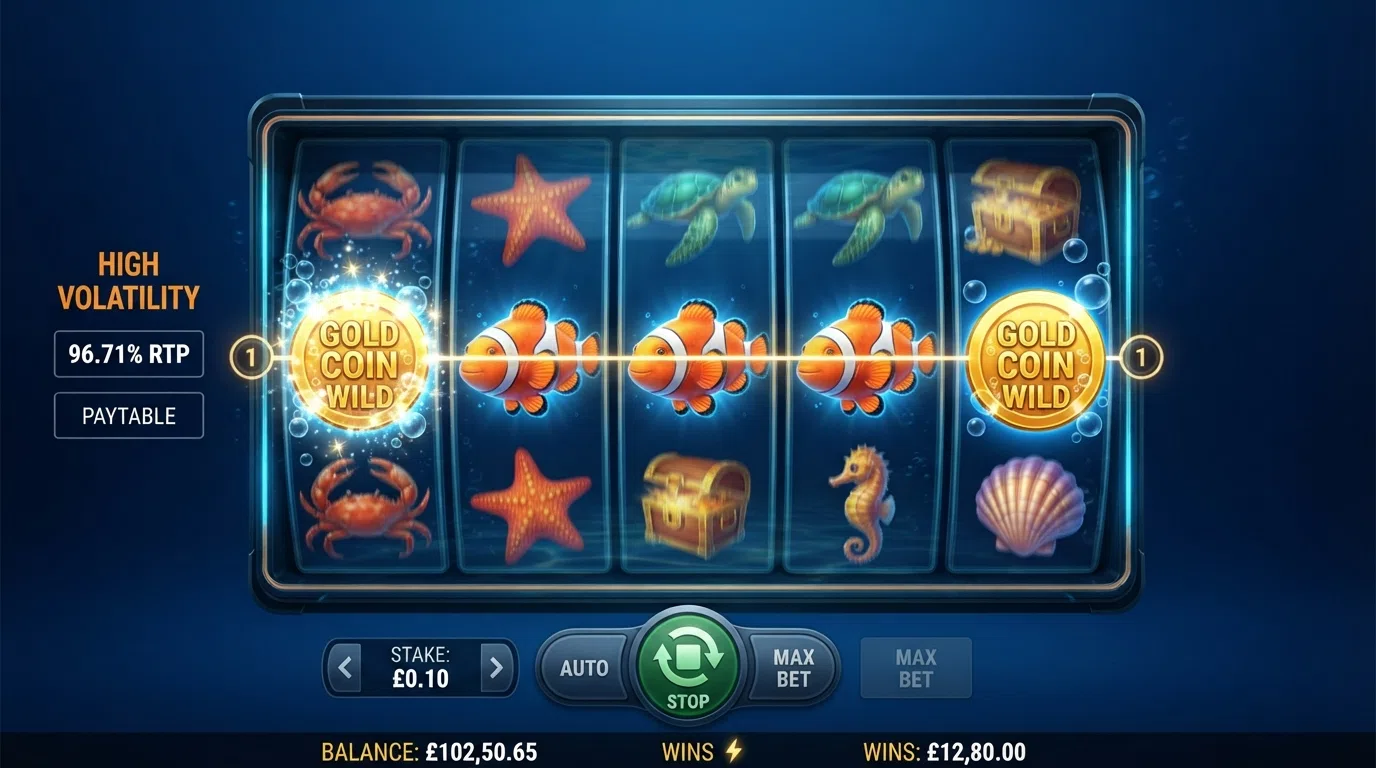
Jackpot slots are a fourth category that overlaps the others. Progressive jackpots pool a slice of every stake into a single prize that grows until it is won; fixed jackpots pay a set amount. Either way, the money is real and the payout is paid by the operator in cash, not in bonus funds.
Every title in every family is governed by the same game-design rules under the Remote Technical Standards. Auto-play is banned. The minimum spin interval is 2.5 seconds. Features that speed up play — turbo mode, the “skip the bonus animation” button — are prohibited. “Losses disguised as wins” — the celebratory sound and animation for a payout smaller than the stake that triggered it — are banned. Each of these rules addresses a known design pattern that research had linked to longer sessions and higher losses, and they apply to every real-cash title a UK-licensed casino offers.
Inside Every Spin: How Payout Percentages and Risk Shape Your Session
The return-to-player percentage on a slot is the slice of every pound staked that the game returns to players in the long run. Big Bass Splash runs at 96.71%, which means that, across millions of spins, the game pays back £96.71 of every £100 wagered. Starburst runs at 96.09%. Book of Dead runs at 96.21%. Gates of Olympus runs at 96.50%. Dead or Alive II runs at 96.82%. The remaining 3 to 4 pence in the pound is the house edge, and that edge is the same on every spin regardless of how the previous spin went.
Volatility is the second number to look at, and it is a measure of how the returns are distributed. A low-volatility slot pays out small amounts often. A high-volatility slot pays out rarely and in larger lumps. Big Bass Splash is high volatility with a 2,100x maximum win — long dry spells, then the occasional spin that returns 2,100 times the stake. Starburst is low volatility with a 500x ceiling. Book of Dead is high volatility with a 5,000x maximum. Gates of Olympus is high volatility with a 5,000x maximum. Dead or Alive II is very high volatility with a maximum win reported between 100,000x and 111,111x depending on the source.
The combination matters. A 96% RTP on a high-volatility game is a long-run average that may not show up in a single session of a few hundred spins. The same 96% on a low-volatility title will produce a steadier pattern of small returns. Neither is “better” than the other; they are different products for different bankrolls, and the operator’s game information panel is required to display the RTP and the rules so the player can compare.
The random number generator underneath is independently certified — typically by Gaming Laboratories International, eCOGRA or another testing house on the Commission’s approved list — and the certification covers both the randomness of the output and the published RTP. The Commission treats the certification as the floor, not the ceiling; operators can be (and have been) sanctioned for mis-stating RTPs in marketing.
The Best Real-Cash Online Slots in the UK Right Now
The five titles below are the slots UK-licensed operators most frequently name in their welcome-offer terms, and each is the slot for which research carries per-title data. RTP and maximum win are what the operator and the developer publish; volatility is the consensus across the review sources research consulted. Past RTP does not guarantee future spins — the percentages are long-run averages across millions of game rounds — but they are the most informative number a player has when comparing one slot to another.
| Slot Title | Provider | RTP | Volatility | Maximum Win |
|---|---|---|---|---|
| Big Bass Splash | Pragmatic Play | 96.71% | High | 2,100x |
| Starburst | NetEnt | 96.09% | Low | 500x |
| Book of Dead | Play’n GO | 96.21% | High | 5,000x |
| Gates of Olympus | Pragmatic Play | 96.50% | High | 5,000x |
| Dead or Alive II | NetEnt | 96.82% | Very high | 100,000x |
Most UK-licensed operators carry hundreds more titles than this — Ladbrokes’ library runs to over 2,000 slots, and the Flutter and bet365 libraries are comparable in breadth — but per-title RTP is something the operator publishes in the in-game help, not something review pages can defensibly assert without a fresh test certificate. The five above are the slots with the data to anchor a comparison.
What Actually Improves Your Chances at Real-Cash Slots
Nothing a player does at the reels changes the house edge. There is no spin count that “warms up” a slot, no bet size that triggers a bonus round that a smaller stake would have missed, and no time of day when the games pay out more generously. The random number generator produces each outcome independently, and the published RTP is the long-run average over all outcomes combined. A strategy that promises to “beat” a certified slot is selling certainty the game was built not to provide.
What the player does control is which game to play and how much to stake on it. The highest-RTP slots in the operator’s library are the ones that pay back the largest share of every pound over the long run. A high-volatility title is a worse fit for a small bankroll than a low-volatility one, because the dry spells are longer and a single unlucky session can wipe the balance before any of the larger wins materialise. Bonus terms matter too: a free-spin offer on Big Bass Splash is worth more than the same offer on a lower-RTP title, and an offer with no wagering is worth more than the same headline number with a 10x turnover behind it.
The UK game-design rules give the player a further set of tools. The mandatory session display shows net position in pounds, and the mandatory 2.5-second spin interval means a session of any meaningful length takes time. Reality checks and time-outs can be set in the responsible-gambling section of the account. None of these tools move the house edge, but they keep the player in contact with what is actually happening to the balance.
The Best Real-Cash Online Casinos in the UK for 2026
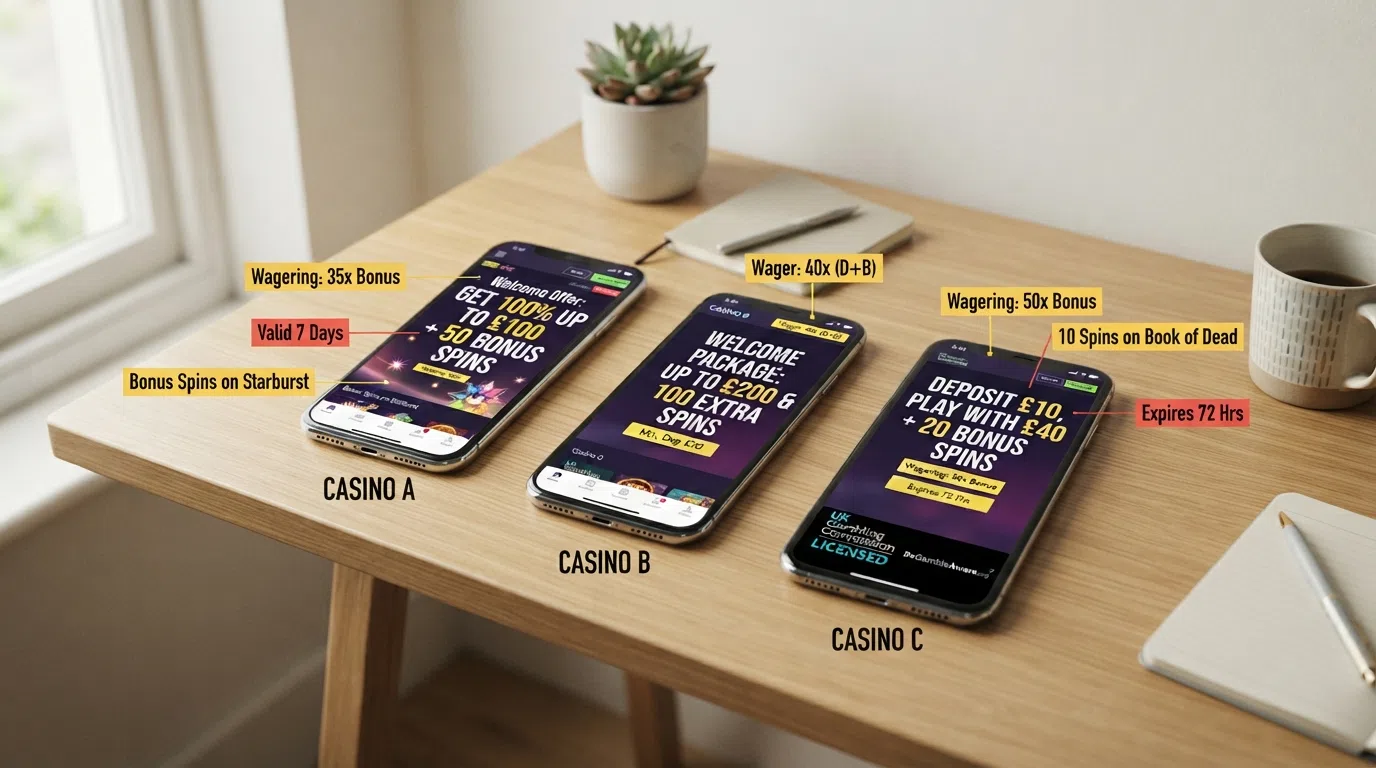
The table below ranks ten UK-licensed operators by the welcome offer research surfaced, the wagering terms attached, the bonus validity window and the licence status as recorded on the UKGC public register. The ranking is ordered by offer shape — the cleanest combination of zero-wagering, named eligible slots and a long validity window sits at the top, and the more restricted combinations sit lower. Operator terms change frequently, and the figures below are the ones research surfaced at the time of writing; the operator’s promotion page is the live source.
| Operator | UKGC Licence Status | Welcome Bonus | Free Spins | Wagering Multiplier | Bonus Validity |
|---|---|---|---|---|---|
| Bet365 Casino | Active, remote casino from 17 Oct 2019 | Up to 500 free spins (prize wheel) | Yes | 0x | 30 days to claim |
| William Hill Casino | Account 2752, active from 1 Jan 2009 | 100% up to £300 + 30 spins | 30 | — | 72 hours (spins) |
| Sky Vegas | UKGC-licensed, Flutter group | Up to 200 free spins after £10 deposit-and-spend (+ 50 no-deposit in one variant) | 200 (+ 50) | 0x | 7 days (spins); 30 days to deposit |
| Ladbrokes Casino | Account 1611, remote casino from 1 Nov 2014 | Deposit-and-spend free-spin package | Yes | 10x | 30 days |
| Paddy Power Games | UKGC-licensed, Flutter group | 60 no-deposit + 200 deposit spins | 260 (split) | 0x | 7 days |
| Betfair Casino | UKGC-licensed, Flutter group | 50 no-deposit + 100 deposit spins | 150 (split) | 0x | 7 days |
| Betfred Casino | UKGC-licensed | Bet £10, get 200 free spins | 200 | 0x | — |
| Grosvenor Casinos | Account 57924, Rank Interactive | Play with £40, deposit £20 | Yes (in some variants) | 10x | 7 days (spins) |
| 888casino | UKGC-licensed | 100% up to £100 | — | 10x | 48h to claim; 90 days to wager |
| LeoVegas | UKGC-licensed, LeoVegas Gaming plc | 50 wager-free spins on Big Bass Splash | 50 | 0x | 7 days to deposit & wager; 3 days to use spins |
Six of the ten featured operators — Bet365, Sky Vegas, Paddy Power, Betfair, Betfred and LeoVegas — run zero-wagering welcome offers. Two more — Ladbrokes and 888casino — sit at the 10x cap, which is the new ceiling under the LCCP social responsibility code that took effect on 19 December 2025. The remaining two, William Hill and Grosvenor, have offers that are either unconfirmed in their wagering or carry conflicting figures across sources. The post-2025 UK market is a 0x-or-10x market, and the rest of this page explains what that means for the actual cost of clearing a bonus.
Bet365 Casino
bet365 is the largest operator in the UK by handle, and its casino welcome offer reflects that scale: a prize wheel that can award up to 500 free spins, with no wagering on the resulting winnings and a 30-day window from sign-up to claim. Some segments of the prize wheel award spins without a deposit requirement, which makes the offer unusual in the post-2025 UK market — most zero-wagering packages are deposit-and-spend triggered. The eligible slots in the current run are Book of Horus, Curse of the Bayou, Magic Forge and Wrath of the Deep; the per-title RTP for those games is not in the data this round, and the spin value is set in the operator’s terms. bet365’s UKGC remote casino gaming licence is active on the public register from 17 October 2019. The verdict: the cleanest no-wagering welcome in the table, the broadest game library, and a 30-day claim window that is longer than the 7-day window most of the zero-wagering set offers. For a player who values flexibility over a fixed spin count, this is the strongest of the ten.
William Hill Casino
William Hill is the legacy brand of the table, with a UKGC account (2752) that has been active since 1 January 2009 — older than most of its competitors. The headline offer is a 100% deposit match up to £300 plus 30 free spins, with a £0.10 spin value; a separate promotion surfaced in research gives 200 free spins after a £10 deposit and wager. The catch is the 72-hour free-spin validity and, on one of the offer variants, a £30 winnings cap on the free spins. Big Bass Splash appears as an eligible slot in one promotion, which gives the player a 96.71% RTP base for any bonus-round work. The deposit match itself does not carry a stated wagering multiplier in the data surfaced this run, so the terms on the operator’s site are the live source. William Hill is a long-licensed, well-known brand; however, the tighter spin clock makes this offer most suitable for players who can use their spins inside 72 hours and who have carefully reviewed the £30 winnings cap.
Sky Vegas
Sky Vegas is the Flutter group’s mass-market casino brand, and its current welcome offer is up to 200 free spins after depositing and spending £10, with 50 no-deposit spins attached in one variant. There is no wagering on the free-spin winnings, the spins expire seven days after they are credited, and the deposit-and-spend trigger has to be met within 30 days of registration. The eligible games are chosen by the operator, which is a real constraint — the player cannot pick the highest-RTP slot in the library and run the spins there. The verdict: the cleanest combination of a deposit-free tranche and a deposit-and-spend tranche in the table, with the 0x wagering the rest of the Flutter group also offers. For a player who wants to test the casino with £5 of no-deposit spins before committing £10, this is the most flexible of the Flutter set.
Ladbrokes Casino
Ladbrokes (UKGC account 1611, remote casino from 1 November 2014) runs a deposit-and-spend free-spin package at the 10x wagering cap — the maximum allowed under the LCCP social responsibility code from 19 December 2025. The welcome offer carries a 30-day bonus validity, and the library runs to over 2,000 slots, with named eligible titles including Big Bass Bonanza (96.71% RTP), Sweet Bonanza and Starburst (96.09% RTP) in the current snippet. The 10x figure is the line that divides this offer from the zero-wagering cluster: a £5 bonus (50 spins at £0.10) becomes £50 of turnover before withdrawal, and at a 96.71% RTP the expected cost of clearing is the section below the table. This is a deep library with a long validity window and a flexible slot list, but the 10x wagering requirement means it is slightly less cost-effective than the zero-wagering competitors.
Paddy Power Games
Paddy Power’s welcome offer splits the difference in the table: 60 no-deposit spins plus 200 deposit-triggered spins, zero wagering on the winnings, a £0.10 spin value, and a 7-day clock from credit. The no-deposit component is one of the larger in the table (Sky Vegas offers 50; Betfair offers 50; Bet365’s prize wheel can pay it out), and the deposit-triggered component matches Sky Vegas at 200. The eligible slot on one variant is Paddy’s Mansion Heist, for which per-title RTP is not in this round’s data. The same £30 redeemable cap that applies on some William Hill free-spin offers applies on one Paddy Power variant. This offer provides a significant spin volume, though the 7-day expiry requires active play and the £30 winnings cap on the no-deposit variant acts as a performance ceiling.
Betfair Casino
Betfair’s current welcome offer is the cleanest in the table on structure: 50 no-deposit free spins plus 100 further spins after depositing and spending £10, at £0.10 per spin, with no wagering and a 7-day expiry. The eligible games are Jackpot King titles — Crabbin’ For Cash Extra Big Catch Jackpot King and other selected Jackpot King slots in the current run, for which per-title RTP is not in the data this round. The no-deposit component at 50 spins × £0.10 is £5.00 of free play, which is what the bonus-cost calculation below uses to work through the wagering arithmetic. This is an excellent choice for players who want a clear, well-documented bonus structure and are happy to use their spins within the 7-day window.
Betfred Casino
Betfred’s current welcome is a wager-£10-get-200-free-spins proposition with no wagering on the winnings. The bonus validity, the eligible slot title and the per-spin value are not in the data surfaced this round, which means a player looking at this offer has to read the small print on the operator’s promotion page before depositing. The wagering multiple is the cleanest in the table at 0x, which puts it in the same group as Bet365, Sky Vegas, Paddy Power, Betfair and LeoVegas. The verdict: zero-wagering terms, a 200-spin headline that competes with the rest of the cluster, and a gap in the surfaced data that means the operator’s T&Cs are the source that closes the loop. Best for a player who is happy to read the bonus page before claiming.
Grosvenor Casinos
Grosvenor is the land-based-turned-online brand of the table, operating under Rank Interactive (UKGC account 57924). The welcome offer is “Play with £40, Deposit £20”, with free spins in some variants and a 7-day spin validity where they apply. The wagering multiplier is the weak point, and the operator’s terms are the only safe source. While Grosvenor is a well-regarded high-street brand, players should confirm the specific wagering terms on the official promotion page before deciding if the £20 deposit commitment aligns with their preferences.
888casino
888 is one of the few operators in the table still running a classic deposit-match bonus rather than a free-spin package: 100% up to £100 on a first deposit of £10 or more, with a 10x wagering multiplier on the bonus funds (a separate 888casino policy page cites 30x as a default unless the offer terms specify otherwise), a 48-hour claim window from deposit, and a 90-day wagering window. One variant surfaced this run carries a £100 winnings cap, which is the kind of ceiling that turns a headline number into a smaller real one. The 10x figure is the regulatory cap, so the 30x default in the policy page is the contradiction to resolve on the promotion page. This classic deposit-match offer is well-suited to players who prefer bonus cash over fixed free-spin packages, though the wagering requirements and potential winnings caps warrant a careful check of the terms.
LeoVegas
LeoVegas’ welcome offer is the most tightly scoped in the table: 50 wager-free spins on Big Bass Splash after depositing and wagering £10, with a £0.10 spin value, a 3-day spin expiry, and a 7-day window from registration to deposit and a further 7 days to wager the deposit once. Big Bass Splash’s 96.71% RTP is the figure the bonus runs on, which gives the calculation below its cleanest inputs. The verdict: the shortest spin clock in the table (3 days), the cleanest eligible slot in the table, and the cleanest wagering terms — best for a player who wants to deposit, wager once, and use the spins in a single sitting.
Why Your 2026 Casino Bonus Is Smaller Than It Looks
The bonus headline is the spin count, the deposit-match percentage or the “up to” figure that the operator’s landing page leads with. The real cost is what sits behind it: the wagering multiple, the validity window, the eligible games and the maximum cashout cap. The UK regulator tightened the first of these from 19 December 2025, when the LCCP social responsibility code capped wagering requirements at 10x and banned mixed-product promotions. The cap is the ceiling, not the floor, and the ten operators above split cleanly into the brands that run at the cap (Ladbrokes at 10x, 888casino at 10x, Grosvenor at 10x per one source) and the brands that run at zero (Bet365, Sky Vegas, Paddy Power, Betfair, Betfred, LeoVegas).
The bonus-cost calculation below uses the Betfair shape — 50 free spins at £0.10 = £5.00 in bonus value, no wagering — to set the inputs, and then steps through what a 10x wagering requirement on the same £5.00 would actually cost on Big Bass Splash at its 96.71% RTP. The point is the comparison, not the number: a £5.00 bonus at 0x wagering keeps the full £5.00 plus any winnings; the same £5.00 at 10x wagering becomes £50.00 of required turnover, and the expected cost of clearing that turnover is what the formula produces.
How to Claim a No-Deposit Bonus (and What Stops You Withdrawing)
The claim flow has four steps. First, registration, with the name, address and date of birth verified before the account can be credited (the 7 May 2019 rule that pre-play verification imposes, not at withdrawal). Second, the bonus is credited automatically or via a promo code on the registration page. Third, the player uses the spins or the bonus cash on the eligible game or games inside the validity window — 7 days for Betfair, 7 days for Paddy Power, 3 days for LeoVegas’ deposit-triggered spins. Fourth, the player attempts to withdraw the winnings, and this is where the three barriers appear.
The first barrier is the wagering requirement. The 0x offers in the table (Bet365, Sky Vegas, Paddy Power, Betfair, Betfred, LeoVegas) do not impose one on the free-spin winnings, so any amount won is withdrawable subject to the other rules. The 10x offers (Ladbrokes, 888casino, Grosvenor per one source) require the winnings to be staked a set number of times before they clear.
The second barrier is the maximum cashout cap. William Hill’s £30 cap on one of its free-spin offers and Paddy Power’s £30 cap on one variant, plus 888casino’s £100 cap on one deposit-match variant, are the explicit ceilings. A win above the cap is paid only up to the cap, and the rest is forfeit.
The third barrier is the closed-loop withdrawal rule. A no-deposit bonus has no deposit to “loop back” to, so the operator pays the winnings to a verified payment method in the player’s own name — typically a debit card or PayPal account that has been added to the cashier.
Wagering Requirements: The 10x Cap and What It Means in Practice
A 10x wagering requirement on a £5.00 bonus means £50.00 in turnover before the winnings become withdrawable. The maths is the same as the maths the rest of this page runs on: turnover = bonus × wagering factor. The LCCP cap that took effect on 19 December 2025 sets 10x as the maximum, and the older offers that ran at 30x, 40x or 50x are no longer the UK norm.
Worked against Big Bass Splash at 96.71% RTP and a £0.10 stake, the £50.00 of required turnover plays out as 500 spins at the minimum 2.5-second spin interval — but in practice, the spin interval is closer to 5 seconds once reality-check pop-ups and bonus animations are included. At 5 seconds per spin, 500 spins is 2,500 seconds, or roughly 42 minutes of continuous play. The expected return across those 500 spins at 96.71% RTP is £48.36, which means the £50.00 stake returns £48.36 on average and the player is “expected” to be £1.64 down on the clearing play. That is the bonus’s real cost: not the £5.00 headline, not the £50.00 turnover, but the £1.64 of expected loss that the wagering requirement imposes over and above the bonus value.
The same £5.00 bonus at 0x wagering does not have this cost. The 50 spins still play at 96.71% RTP and the player is still expected to lose a slice of them, but there is no extra turnover to clear. A 0x offer is, in the relevant sense, cheaper than a 10x offer by exactly the cost of the clearing play, which is a function of the RTP, the stake, the spin count and the wagering factor.
The six featured operators that run 0x offers — Bet365, Sky Vegas, Paddy Power, Betfair, Betfred and LeoVegas — sit on the cheap side of that comparison. The three that run at 10x — Ladbrokes, 888casino, Grosvenor per one source — sit at the cap. The trade-off is between the cleanest possible bonus (0x) and an offer shape some players prefer (a deposit match rather than a free-spin bundle).
When Free Spins Are Actually Wager-Free
The 0x wagering cluster is the post-2025 UK default, and the 10x cap is the regulatory reason it exists. Before 19 December 2025, UK bonuses routinely carried 30x, 40x and 50x wagering; after the cap, an offer above 10x is not compliant, and operators either dropped into the 0x-or-10x band or restructured the offer entirely. The 10x offers that remain in the table are the ones that converted to the cap without going further. The 0x offers are the ones that decided the cost of a free-spin bundle no longer justified the friction of a wagering requirement.
What still constrains a 0x offer is everything except the wagering multiple. The validity window is the most common: 7 days at Betfair, Sky Vegas (spins) and Paddy Power, 3 days at LeoVegas (spins), 30 days to claim at Bet365, 72 hours at William Hill on one offer. The eligible games are operator-chosen at Sky Vegas, Paddy Power and Betfair (Jackpot King titles), which means the player cannot pick the highest-RTP slot in the library. The cashout cap remains: William Hill’s £30, Paddy Power’s £30, 888casino’s £100 on the deposit-match variant. None of these is a wagering requirement, but each is a ceiling on what a no-wager bonus can return.
Winning Real Money Without Making a Deposit
There are three paths to a real-cash win at a UK-licensed casino without funding the account first, and they are not equally common. The first is the no-deposit free-spin bundle, which the section above works through. The second is a free-play prize tournament, in which the operator runs a leaderboard competition on a slot or a table game, paying real cash to the top finishers from a prize pool — these are occasional rather than permanent offers, and they are not part of the standard welcome package. The third is a demo-mode promotion, which is rarer still: the operator runs a free-to-play tournament and credits real cash to the winners, but no UK-licensed brand uses demo credits as a withdrawal mechanism, and the winnings are paid as a real-cash bonus rather than as a conversion of the virtual balance.
What all three paths have in common is a qualifying barrier. The no-deposit spin bundle requires registration and identity verification. The free-play tournament requires registration and a session on the eligible game. The demo-mode promotion requires the same. None of the three is a way to play at a UK-licensed site without an account, and none of the three pays out to an unverified account holder.
Free Slots That Award Real Cash Prizes
A no-deposit free-spin offer is the closest the UK market has to “free slots that pay real cash”, and the distinction between this and a play-money slot is the difference between a withdrawable win and a non-withdrawable one. The 50 no-deposit spins at Betfair and the 50 no-deposit spins at Sky Vegas, plus the 60 no-deposit spins at Paddy Power, plus the prize-wheel segment at Bet365, are all examples: the spins play on a real-money game with a real RNG and a real RTP, and the winnings (subject to the offer’s terms) can be withdrawn.
A play-money slot is different. The game is the same, the reels spin the same way, and the bonus rounds trigger the same way, but the credits are virtual and the winnings are virtual. No UK-licensed operator converts virtual credits to real cash, and the offer is not a “win real cash” offer for that reason — it is a game-familiarisation tool, useful for learning how a title pays, and nothing more.
The free-play tournament is the borderline case. A tournament on, say, Big Bass Splash with a £5,000 real-cash prize pool pays the top finishers in cash, and the entry is free. These promotions are run by the operator or by the game provider, and the prize pool is funded by the operator rather than by the players’ stakes. They are not a permanent feature of the welcome offer, and a player who relies on them as a no-deposit path is depending on a promotion that may or may not be running.
Demo Mode: Practise Without Risk, But Do Not Expect a Payout
Demo mode is the slot, table or live-dealer game running on virtual credits rather than on real money. Every UK-licensed casino offers it, and the in-game help makes the mode visible — a “Fun Play” or “Demo” toggle on the slot, a “Practice” mode on the RNG table games, and a “Play for Fun” balance on the live-dealer studio where the studio is configured to allow it. The RNG, the RTP and the volatility are the same as in real-money mode, because they have to be — the certification covers the game, not the funding source.
The point of demo mode is to learn the game. A player who has not played Big Bass Splash before can find out what the free-spins round looks like, how often the scatter lands, and how the bonus mechanic plays out, without putting any of their own money at risk. Demo mode is also a responsible-gambling tool, in the sense that a player who wants to keep playing without the financial exposure can do so.
The line is absolute. Demo credits cannot be converted to real cash. No UK-licensed operator offers a “convert my demo balance” option, and any site that did would be in breach of the Commission’s rules on game fairness. A player who wants to win real money has to switch to real-money mode, deposit, and accept that the house edge applies to every spin from that point on.
Free-Play vs Real-Money: What Changes When You Switch
The game does not change. The reels, the cards and the wheel are produced by the same RNG (or the same physical equipment, in live dealer) in both modes, and the published RTP is the same. What changes is the player’s relationship to the outcome, and the operator’s relationship to the player.
In real-money mode, the operator is required to display the session net position, the session time played and the most recent stake on screen. Reality-check pop-ups trigger at intervals the player has set. The responsible-gambling tools (deposit limits, time-outs, reality checks, GAMSTOP self-exclusion) are active. Bonus eligibility is triggered by the first deposit, and the offer’s terms apply to any winnings.
In demo mode, none of this applies. The virtual balance cannot go below zero in a way that matters, the session display is not required, and the responsible-gambling tools are dormant. The player can sit with a slot for hours in demo mode without any of the real-money frictions kicking in.
The transition from one mode to the other is the moment the offer terms apply. A player who has been playing Big Bass Splash in demo mode and then switches to real-money mode with a Betfair no-deposit spin bundle starts the 7-day clock from the moment the spins are credited, and the £5.00 of free spins plays out under the offer’s terms — eligible game, validity window, wagering, cashout cap — rather than under the demo’s open-ended terms.
How Fast Do UK Casinos Actually Pay Out?
Withdrawal speed at a UK-licensed casino is a function of three separate timers, and the operator’s marketing usually names only the fastest of them. The first timer is the operator’s pending period, which is the time between the player requesting a withdrawal and the operator approving it. The second timer is the operator’s processing time, which is the time the payments team takes to release the funds. The third timer is the method transit time, which is the time the payment network (PayPal, Visa, Faster Payments) takes to deliver the money to the player’s account. The marketing claim of “instant withdrawal” usually refers to the first timer being zero; it does not necessarily refer to the second or third.
The closed-loop rule applies throughout. A deposit made with a Visa debit card has to come back to a Visa debit card in the player’s own name, and an Apple Pay deposit has to come back to the card underneath the Apple Pay wallet. A withdrawal to a different card, a different e-wallet or a bank account in a different name is rejected at the cashier rather than at the network.
Withdrawal Speed by Method: What “Fast” and “Instant” Really Mean
PayPal withdrawals at UK-licensed casinos are typically same-day once the operator approves the request, because the PayPal network credits the player’s PayPal balance as soon as the operator pushes the payment. Visa debit withdrawals are typically 1 to 3 banking days after the operator approves the request, depending on the card issuer. Apple Pay withdrawals are dependent on the underlying card, so the timing is the same as the card it is linked to. Trustly (Open Banking) is typically same-day to next-day, because the transfer runs over the Faster Payments network. Bank transfer is typically 2 to 5 working days, depending on the receiving bank’s processing.
The fastest path on most UK-licensed sites is PayPal or Trustly, on the assumption that the operator’s pending period is short and the player’s account is already verified. The slowest path is bank transfer to an account at a bank with a long hold on inbound credits, which is rare but happens.
What “instant” means in marketing is usually the operator’s pending period being zero, not the funds arriving instantly. A withdrawal to PayPal at a zero-pending operator can still take 2 to 4 hours end-to-end, because the operator’s processing time and PayPal’s crediting time are not zero. A withdrawal to Visa debit at the same operator can take 24 to 72 hours end-to-end, because the card network sits behind both timers.
The Withdrawal Methods UK Players Actually Use
UK-licensed casinos offer a narrower range of withdrawal methods than the offshore market, because the credit-card ban and the e-wallet routing rule close off the funding sources that used to be common. The methods that are usable, in rough order of speed, are:
- PayPal — typically same-day once approved; widely supported; closed-loop rule applies
- Trustly (Open Banking) — typically same-day to next-day; growing in availability; closed-loop rule applies
- Visa debit — typically 1 to 3 banking days after approval; universally supported; closed-loop rule applies
- Mastercard debit — typically 1 to 3 banking days after approval; widely supported; closed-loop rule applies
- Apple Pay — dependent on the underlying card; the card network’s timer applies
- Bank transfer — typically 2 to 5 working days; universally supported; not always closed-loop-eligible
Credit cards are not on this list because the funding ban rules them out. Cryptocurrency is largely absent from UK-licensed sites because the closed-loop rule and the player-verification requirements do not map onto a crypto wallet in a way the Commission has approved. A player who wants to deposit and withdraw in crypto is in the offshore market, with the consequences that flow from there.
Why Your Payout Is Delayed: KYC, Pending Periods, and Closed-Loop Rules
The three most common causes of a delayed withdrawal, in the order the player is likely to hit them, are KYC document review, the operator’s pending period, and the closed-loop rule. The first is the most common on a first withdrawal: even though the account was verified before the first deposit (the 7 May 2019 rule), the operator may trigger an additional review at withdrawal — a source-of-funds check, a payment-method verification, a check against PEP and sanctions databases. The review is mandatory under the anti-money-laundering rules the Commission applies, and the time it takes is the time the player waits.
The second is the operator’s pending period. Some UK-licensed operators run a 24-hour pending period as standard, during which the player can cancel the withdrawal (the reverse-withdrawal ban in October 2021 killed the “cancel and keep playing” option, but a player can still cancel a withdrawal in the pending period for any other reason). Other operators run a 0-hour pending period, with the processing time starting as soon as the request is submitted. The pending period is a known number, published in the operator’s withdrawal policy, and the player can plan around it.
The third is the closed-loop rule. A withdrawal to a payment method that does not match the deposit method is rejected, and the player is asked to choose a method that does match. This is not a delay in the processing sense; it is a delay in the administrative sense, and the cure is the player adding the matching method to the cashier and resubmitting.
Real-Cash Casino Apps: What You Can (and Cannot) Do on Mobile
The real-cash casino experience on mobile runs on two paths. The first is the native app, downloaded from the App Store on iOS or from the operator’s own site on Android (Google Play restricts real-money gambling apps in the UK, and the operators route around it with a direct download). The second is the mobile browser, which loads the casino’s full site in a phone-sized window. Both paths lead to the same game library, the same cashier and the same responsible-gambling tools, and the difference is in the device-side experience rather than in the offer.
The Best Real-Cash Casino Apps for UK Players
The ten operators in the table above all offer a UK-facing mobile experience, and the depth of the app offering varies. Bet365’s app is the broadest in the table, with the full sportsbook and casino under a single login. Sky Vegas, Paddy Power, Betfair and the rest of the Flutter group offer separate casino apps (in addition to the main betting app), and the casino app carries the full slot library. Ladbrokes’ app covers both the sportsbook and the casino. William Hill’s app is the legacy product of the table, and the mobile-browser experience is competitive with the app. Grosvenor’s app is the cleanest of the high-street brands, with the live-dealer lobby front and centre. 888casino’s app is a single-purpose casino product, which keeps the focus on the slot library. LeoVegas is the mobile-first brand of the table, and the app is the strongest in the set for a player who plays primarily on phone. Betfred’s app covers both the sportsbook and the casino in a single build.
What research did not surface this run is per-app store ratings or per-operator performance benchmarks, so the comparison above is structural rather than tested. The App Store rating is a useful proxy for stability and update cadence, and a player who installs one of these apps is choosing on the basis of brand fit and offer shape as much as on app quality.
Slot Apps That Pay Real Cash: What to Look For
There is no UK-licensed “slot-only” app in the way there is a “poker-only” or “bingo-only” app. The slot library sits inside a casino app, and the casino app is the product the operator ships. A player who wants a slot-first mobile experience is choosing a casino app with a strong slot lobby, not a dedicated slot app.
The minimum requirements for a real-cash slot app in the UK are the same as the minimum requirements for any real-cash casino product. The operator must hold a UKGC licence (verifiable on the public register). The deposit and withdrawal methods must be the ones the closed-loop rule permits (debit card, PayPal, Apple Pay, Trustly, bank transfer — not credit card, not most crypto). The games must be RNG-certified, which is the operator’s responsibility rather than the app’s, but the certification status is visible in the in-game help. The responsible-gambling tools (deposit limits, reality checks, time-outs, GAMSTOP self-exclusion) must be present and active in the app, which they are on every UK-licensed operator.
A player who is choosing a slot app is choosing an operator, and the operator ranking in the table above is the starting point. The slot app that pays real cash is the casino app with the highest-RTP eligible slots in its welcome offer, the cleanest wagering terms, and the most reliable withdrawal pipeline.
Is It Legal? UK Casino Regulation and What It Protects
Online casino gaming for real cash is legal in Great Britain, and the framework that makes it legal is the Gambling Act 2005, extended to remote operators by the Gambling (Licensing and Advertising) Act 2014. The Gambling Commission, sponsored by the Department for Culture, Media and Sport, is the regulator. The Commission’s three licensing objectives, set out in Section 1 of the Act, are preventing gambling from being a source of crime or disorder, ensuring that gambling is fair and open, and protecting children and other vulnerable persons. The LCCP (Licence Conditions and Codes of Practice) and the RTS (Remote Technical Standards) translate those objectives into the day-to-day rules that a licensed operator has to follow. Northern Ireland sits outside the Commission’s remit, and a licence to serve customers in GB does not, on its own, cover customers in Belfast.
What a UK Gambling Commission Licence Actually Requires
A UKGC licence carries a substantial set of operator obligations, and the obligations that bear on the player experience directly are the ones worth listing. Pre-play identity verification is mandatory since 7 May 2019 — the operator has to verify name, address and date of birth before the customer can deposit or gamble, not at withdrawal. Age-banded stake limits on online slots came into force in 2025: £5 per game cycle for players aged 25 and over from 9 April 2025; £2 per game cycle for players aged 18 to 24 from 21 May 2025, under SI 2025/215. The game-design rules in force since 31 October 2021 are: no auto-play, no spin speed faster than 2.5 seconds, no features that speed up play, no losses-disguised-as-wins, no reverse withdrawals, and a mandatory on-screen display of session losses, session wins and time played in pounds sterling. The bonus rules in force since 19 December 2025 are a 10x cap on wagering requirements and a ban on mixed-product promotions. The deposit-limit rules in force (and extended to 30 September 2026) redefine a “deposit limit” to mean a limit on money paid into the account over a set period, and require that limit to be offered before the first deposit. Direct marketing is opt-in per product and per channel, in force from 1 May 2025.
The age-banded stake limit is the change that has reshaped the slot market most visibly. The £2 ceiling for under-25s is a hard cap that no game cycle can exceed, and the £5 ceiling for over-25s is the same. A game that auto-stakes at £10 is not a real-cash game at a UK-licensed site; the operator has to disable it or the regulator can take action.
The Protections You Get as a UK-Licensed Player
The UK framework gives the player a set of protections that an offshore site does not, and the protections are enforceable rather than aspirational. ADR (alternative dispute resolution) is mandatory: if the operator’s internal complaint process does not resolve the issue, the player can take it to an ADR provider the Commission has approved, and the ADR ruling is binding on the operator. GAMSTOP is the national online self-exclusion scheme, mandatory for all online licensees since 31 March 2020, and a player who has registered with GAMSTOP cannot open an account with any UK-licensed online casino for the duration of the exclusion. Financial vulnerability checks are mandatory: the operator has to run a light-touch check using public data when a customer’s net deposits cross a rolling-30-day threshold (£500 from 30 August 2024, £150 from 28 February 2025), and enhanced financial risk assessments have been announced in staged form but the start date has not been confirmed. The credit-card ban is a player protection as well as a payment rule. The UKGC public register is the single authoritative way to confirm whether a brand or holding company holds a GB operating licence, and a player who is unsure can search it. Player winnings are tax-free, which is the cleanest possible statement of the player’s tax position.
The offshore market sits outside all of this. A player using an unlicensed site loses the ADR route, the GAMSTOP coverage, the financial-vulnerability check, the credit-card ban, the stake caps and the game-design rules. The Commission enforces against operators, advertisers and intermediaries rather than against players, but the player’s loss of protection is real.
Playing Safely: The Tools Every UK Player Should Know
The responsible-gambling infrastructure available to a UK player has three layers. The first is operator-side: deposit limits, reality checks, time-outs, session information displays, self-exclusion. The second is national: GAMSTOP, the National Gambling Helpline (operated by GamCare, 24/7, free and confidential), NHS gambling harm clinics in England, Scotland and Wales, and the Gamblers Anonymous fellowship. The third is the prevalence data that gives the infrastructure its urgency — the GamCare 996 referrals to treatment in January 2026, up 48% on the same month the year before; the 52,000+ calls to the National Gambling Helpline each year and the sub-two-week treatment waiting time from referral reported by GambleAware’s National Gambling Support Network; the 37% of British adults who gambled online in the past four weeks in the Gambling Commission’s latest survey.
The UK Gambling Commission, in its “Organisations that can help” page, notes that the National Gambling Helpline, operated by GamCare, provides confidential advice, support, and information on problem gambling. You can speak with an adviser for free 24 hours a day, 365 days a year over the phone or Live Chat. These two resources provide the practical summary of the help available: confidential, free, and reachable at any hour.
Deposit Limits, Reality Checks, and Time-Outs: Your Built-In Safety Net
The operator-side tools are the ones the player configures in the responsible-gambling section of the account, and each is mandatory for a UK-licensed casino to offer:
- Deposit limits — a mandatory offer before the first deposit; a request to decrease the limit is actioned immediately; a request to increase it is delayed, and the delay is the cooling-off period. From 30 September 2026 (extended from the original 30 June 2026) only a limit on money paid into the account may be called a “deposit limit”, which closes the loophole where a bonus-restriction limit or a net-deposit limit was being marketed as the deposit limit.
- Reality checks — pop-up timers that interrupt play at a set interval (typically 30, 60 or 90 minutes) and display the session net position and time played. The player can dismiss the pop-up and continue, or end the session.
- Time-outs — short cooling-off periods (typically 24 hours to 6 weeks) during which the account is locked and cannot be reopened. GAMSTOP is the longer-period version.
- Session information display — the on-screen net position, time played and most recent stake in pounds sterling, required during real-money play since 31 October 2021.
The configuration is in the player account, and a request to tighten a limit is immediate. A request to loosen a limit is delayed, and the delay is the protection — it is the period in which a player who has decided to deposit more can change their mind.
GAMSTOP Self-Exclusion: How It Works and When to Use It
GAMSTOP is the national online self-exclusion scheme, free to use and mandatory for every UK-licensed online casino and betting site. A player registers at GAMSTOP with their name, address and date of birth, and the registration blocks new account openings at every UK-licensed online operator for the chosen exclusion period. The exclusion periods are six months, one year, five years, or five years with auto-renewal. The exclusion cannot be cancelled early — the five-year minimum is a hard floor, and a player who has registered is locked out for the full period they chose. The auto-renewal option is the one to choose if the underlying issue is ongoing; the fixed-period options are the ones to choose if the player is taking a defined break and intends to return.
What GAMSTOP does not cover is the offshore market. A player who has registered with GAMSTOP can still open an account with an unlicensed site, and the offshore site is under no obligation to check GAMSTOP. The protection is real but it stops at the UKGC perimeter, and the player who is serious about self-excluding is choosing both the GAMSTOP registration and the avoidance of offshore sites.
The mechanics of using GAMSTOP are simple. The registration is online, takes a few minutes, and takes effect within 24 hours across the participating operators. The exclusion applies across the entire UK-licensed online market, not just at the casino where the player was previously playing. When the exclusion expires, the player has to contact GAMSTOP to confirm the end of the exclusion, and the operators are notified to re-enable account opening.
How We Selected and Ranked These Real-Cash Casinos
The ten operators in the ranking table are UKGC-licensed, UK-facing, real-money online casino operators — no free-to-play brands, no social casinos, no sweepstakes operators. The starting point for the ranking is the UK Gambling Commission’s public register, which is the single authoritative way to confirm that a brand or holding company holds a GB operating licence. Every operator in the table has a live entry on the register at the time of writing, with the licence dates shown in the table where research surfaced them.
The second source is the operator’s own promotion page, which is the live source for the welcome offer. Operator terms change frequently, and the figures in the table are the ones research surfaced at the time of writing; a player who is about to deposit should read the operator’s current terms rather than rely on the snapshot.
The third source is the independent review publishers research consulted, which include Racing Post, SpinVerdict, Bookies, gg.co.uk, Agamble, mybettingsites and Slotmachines. The publisher pages are useful for the structure of an offer (the wagering multiplier, the spin count, the validity window) but they are not the source for the per-title RTP, which is the developer’s published figure and is visible in the in-game help at the operator.
The ranking criteria, in order of weight, are: UKGC licence status (the gate, not a tiebreaker), wagering multiplier (0x ranks above 10x, because the cost of clearing is the relevant comparison), the presence of a deposit-free component (a no-deposit tranche reduces the player’s exposure), the bonus validity window (a longer window is more player-friendly), and the eligible-games list (named titles let the player pick the highest-RTP option). The ranking is not an editorial recommendation to play at a particular site; it is an ordering of the offers on the criteria above, and the final choice is the player’s.
The review is not exhaustive. The UK-licensed online casino market runs to several hundred brands, and the ten in the table are the ones research surfaced for this run. A player who is choosing where to deposit is well advised to check the UKGC register for the brand’s licence entry, read the operator’s promotion page for the current terms, and read the bonus terms carefully before claiming.
Your Real-Cash Casino Checklist: What Matters and What Doesn’t
The single non-negotiable is the UKGC licence. A UK-facing real-money casino without a GB licence is an offshore site, and the protections the rest of this page describes do not apply. The UKGC public register is the verification route, and a player who is about to deposit £10 at a brand they have not used before should spend 30 seconds on the register before they spend £10 on the deposit.
The second thing that matters is the wagering multiplier. 0x is cheaper than 10x by exactly the cost of the clearing play, which the section above works through against Big Bass Splash. A 10x offer at the regulatory cap is still a real cost; a 0x offer is a real cost plus nothing. The third is the bonus validity window: a 7-day clock requires the player to act in the same week, a 30-day window is more forgiving, and a 72-hour clock is the tightest in the table. The fourth is the eligible-games list: a named title with a known RTP lets the player choose; an operator-selected list does not. The fifth is the maximum cashout cap, which is the ceiling on a free-spin win and is worth knowing before the player claims.
What does not matter as much as the marketing suggests is the headline number. “Up to 500 free spins” is the prize-wheel ceiling at Bet365, not the floor; “100% up to £100” at 888casino is the deposit-match maximum, not the guaranteed credit. The brand age matters less than the licence status: a legacy name without a current UKGC entry is not a safer bet than a newer name with one. The mobile-app-vs-mobile-browser distinction matters less than the underlying operator: the game library is the same, the cashier is the same, the licence is the same. The slot’s theme is irrelevant to the return; the RTP and the volatility are the two numbers that drive the long-run outcome.
The one number to compute before claiming is turnover = bonus × wagering. A £5.00 bonus at 10x is £50.00 of required play. A £5.00 bonus at 0x is £5.00 of free play. The expected cost of clearing the wagered version is the RTP gap applied to the turnover, which the section above runs against Big Bass Splash at 96.71% RTP. The expected cost of the wager-free version is zero, on top of the house edge the spins would have applied anyway.
The one action to take before depositing is to check the UKGC public register and read the bonus terms. The one number to compute is the turnover. The UK regulatory framework gives the player more protection than most markets — pre-play verification, age-banded stake caps, a 10x wagering cap, GAMSTOP, ADR, a public register — but only inside the perimeter, and only at a licensed site. A player who steps outside it loses the protections and keeps the risk.
Frequently Asked Questions
What is the maximum I can stake per spin on UK online slots?
The UK Gambling Commission’s age-banded stake cap, in force under SI 2025/215, sets the maximum stake per game cycle at £5 for players aged 25 and over (from 9 April 2025) and £2 for players aged 18 to 24 (from 21 May 2025). A UK-licensed casino cannot offer a real-money slot spin above that ceiling, and the cap applies per game cycle rather than per session. The figure is a hard limit: a game that auto-stakes above the cap is not a real-money game at a UK-licensed site.
How do I check whether a UK casino is licensed by the Gambling Commission?
The UK Gambling Commission’s public register is the single authoritative route. The register lists every operator that holds a GB operating licence, with the licence account number, the trading names covered, the licence activities (for example, remote casino, remote bingo) and the licence status. A player who is about to deposit at a brand they have not used before should search the register for the brand’s trading name and the holding company, and confirm that the licence is active. The register is online and free to use, and the verification takes a couple of minutes.
What does a 10x wagering requirement mean on a UK casino bonus?
A 10x wagering requirement means the player has to stake the bonus value ten times before the winnings become withdrawable. On a £5.00 bonus, that is £50.00 of required turnover. The 10x figure is the maximum allowed under the UK Gambling Commission’s LCCP social responsibility code, in force from 19 December 2025, and the older offers at 30x or 40x are no longer the UK norm. Several of the operators in the table above run at 0x (no wagering), which is below the cap and removes the clearing-play cost entirely.
What is the difference between RTP and volatility in online slots?
RTP (return to player) is the long-run percentage of every pound staked that the slot returns to players, expressed as a figure like 96.71% for Big Bass Splash. Volatility is the distribution of those returns: a low-volatility slot pays out small amounts often, a high-volatility slot pays out rarely and in larger lumps. The two are independent. A 96% RTP on a low-volatility slot produces a steady pattern of small returns; the same 96% on a high-volatility slot produces a long-run average that may not show up in a single session. Both numbers are visible in the in-game help at a UK-licensed casino.
Do UK players pay tax on casino winnings?
No. UK players do not pay income tax or capital gains tax on casino winnings, and the position is the same for sports betting, poker and bingo winnings. The operator pays Remote Gaming Duty (which rose to 40% from 1 April 2026) and the statutory treatment, prevention and research levy, both of which are operator-level taxes. The player keeps the full amount of any withdrawal, less any fees the operator discloses in the cashier, and the operator reports winnings to HMRC only in the specific circumstances where anti-money-laundering rules require it.
No-Deposit Casino Bonuses: Free Cash or Free Spin?
A no-deposit bonus comes in two shapes in the current UK market, and only one of them is cash. A no-deposit cash credit — a small amount of real money the operator credits to the new account with no funding required — is rare in the post-2025 UK landscape, and none of the ten featured operators in the table above runs one as a headline offer. A no-deposit free-spin bundle is the common shape: 50 spins at £0.10 each at Betfair (£5.00 in spins), 50 at Sky Vegas, 60 at Paddy Power, and a prize-wheel segment at Bet365 that can pay out deposit-free spins. The free spins have a real monetary value — 50 at £0.10 is £5.00, 60 at £0.10 is £6.00 — but the player cannot choose to spend that £5.00 on a different game, and any winnings are subject to the offer’s terms (wagering, validity, eligible games, cashout cap).
The distinction matters because a “no-deposit bonus” advertised in a comparison table can be either of these, and the working value is different. A £5.00 no-deposit cash credit with no wagering is worth £5.00 in real terms. A 50-spin no-deposit bundle at £0.10 with no wagering is worth whatever the 50 spins return, on the eligible game, inside the validity window — which is almost always less than £5.00 in expected value because the house edge applies to every spin.
Casino Apps vs Mobile Browser: Does It Matter?
A native app offers a faster cold-start (the casino icon on the home screen opens the lobby without a browser load), push notifications for bonus offers and reality-check pop-ups, and biometric login (Face ID on iOS, fingerprint on Android) that the mobile browser cannot match. The app also offers a more stable connection on patchy mobile data, because the app is built to handle reconnects in a way the browser is not.
The mobile browser offers no download, no storage and no operating-system update friction. The full game library is available without the operator’s app team having shipped a build, which means a new slot can be live in the mobile browser on the day the operator adds it to the desktop site. The trade-off is the cold-start time and the lack of push notifications.
In practice, the two paths converge. Most UK-licensed operators have invested in the mobile site to the point where the difference is small, and the choice between them is a matter of preference — biometric login and push notifications on the app, or zero installation and a slightly fresher game library in the browser. The one place the app still wins decisively is the cashier, where the saved payment method and the biometric authentication make a deposit a one-tap action.
Casinos – nodeposit-casinobonuses-uk
Content created by the «nodeposit-casinobonuses-uk» team