
British Casinos Not on GamStop: What's Real, What Costs What
 Available in GB
The phrase “British casinos not on GamStop” sounds like a category of British-licensed gambling. It is not. The label is a marketing device that flags a site as offshore-licensed, openly available to UK players, and not connected to the national self-exclusion register. Every operator reviewed here is licensed outside Great Britain, accepts GBP from British customers and sits beyond the reach of the Gambling Commission. That is the entire meaning of the term, and it is the single most important thing a reader can take from the first paragraph.
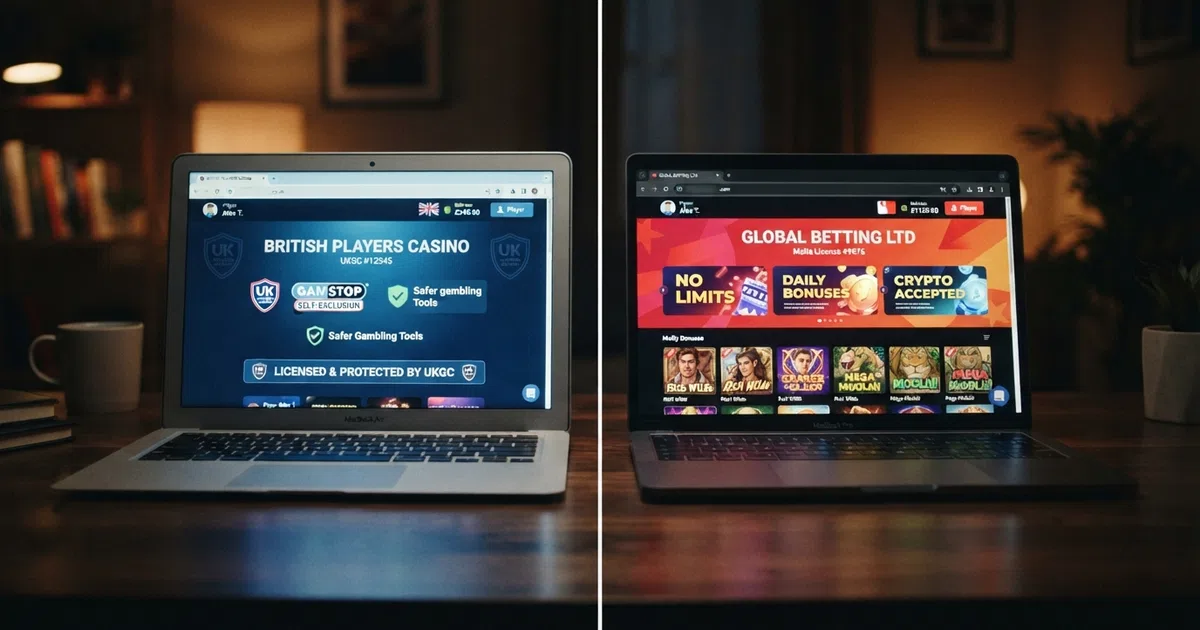
The choice the page lays out is therefore a narrow one with sharp edges. A UKGC-licensed casino trades larger bonuses and looser limits for the full suite of consumer protections: GamStop self-exclusion, ADR dispute resolution, FSCS fund cover, RTS game-design rules, affordability checks and a regulator with statutory teeth. A non-GamStop casino trades those protections for higher welcome offers, the absence of the £5/£2 age-banded stake cap, auto-play, credit-card deposits and a wagering multiple that can run to 45×. Neither side is a secret. The maths, the regulation and the recent enforcement record are all on the table.
Data current as of September 8, 2026 and verified against the UK Gambling Commission’s public register (last updated 29 July 2026, 2,663 licensed businesses).
What “British Casinos Not on GamStop” Actually Means
The “British” Label: A Marketing Term, Not a Regulatory One
“British casino” and “UK casino” travel as if they were synonyms. In a regulatory sense they are not. “UK-licensed” means an operator holds a Gambling Commission operating licence and accepts the full set of LCCP obligations; “British” as a marketing tag means the operator has built its site, support and payment rails with British customers in mind. The two concepts coincide at UKGC-licensed brands and diverge at every other casino that targets the UK from Curaçao, Costa Rica or Anjouan.
The reason this matters is that “British” carries a regulatory weight the word has not earned. Search queries conflate geography with licensing, and offshore operators have not been slow to use that confusion. A site can call itself “Britain’s favourite” while holding a Curaçao GCB sub-licence, displaying pound-sterling balances and offering National Lottery-style scratchcards to UK customers from a server farm in another jurisdiction. None of that is illegal under the Gambling Act 2005; section 33 criminalises the operator, not the player. But the word “British” on the homepage then promises a regulatory relationship that does not exist.
Online-Only, Offshore-Run: The Shape of the Non-GamStop Market
The non-GamStop segment is structurally different from the British high street and online market. These are online-only casino sites with no UK land-based presence, no UKGC oversight and no obligation to verify identity before the first deposit. The dominant licensing jurisdictions are Curaçao, where the Gaming Control Board (GCB) now operates a tighter regime than the former master-licence system, and Costa Rica, where a separate data-hosting licence has long been used as a wrapper for offshore casino operations. A handful of operators sit under Anjouan or hold licences of more limited standing.
Most of these brands run a free-play demo mode alongside the real-money lobby. The demo is genuinely useful: it lets a reader test a slot’s volatility, hit frequency and bonus structure before staking any cash. What the demo does not do is replicate the cash-out experience, the wagering contribution of a bonus, or the KYC friction that real-money play can trigger at withdrawal. It is a catalogue, not a guarantee.
The market itself is built around GamStop circumvention. Since 31 March 2020, every UKGC online operating licence has carried mandatory participation in the national self-exclusion scheme. By definition, then, a casino that is “not on GamStop” is a casino that does not hold a GB licence. The category is defined by the regulation it sits outside.
What You Give Up When You Step Outside GamStop’s Shield
What “Not on GamStop” Means — and Why Players Look Beyond GamStop
“Non-GamStop” describes the absence of a regulatory relationship, not the presence of a product feature. GamStop participation has been a mandatory condition of every UKGC online operating licence since 31 March 2020; a casino that does not appear on GamStop is, by construction, not a UKGC licensee. The category is defined by the licence the operator does not hold.
Several forces have widened this market over the last eighteen months. From 9 April 2025, online slots at UKGC-licensed sites have carried a statutory maximum stake of £5 per game cycle for players aged 25 and over; from 21 May 2025, that ceiling dropped to £2 for the 18–24 age band. From 19 December 2025, wagering requirements at UKGC sites have been capped at 10× and mixed-product promotional offers have been banned outright. The 40% Remote Gaming Duty took effect on 1 April 2026, and the 1.1% statutory levy on gross gambling yield for remote operators has been in place since April 2025. Each of these measures tightens the economics for UKGC licensees and widens the gap that an offshore operator can fill with a larger welcome package, a higher wagering multiple, or both.
The result is a coherent commercial logic. A non-GamStop brand can offer 150–600% welcome matches because it pays neither the 40% duty nor the 1.1% levy, faces no 10× wagering ceiling, and answers to a regulator that does not cap bonus generosity. The same regulatory gap is the source of every benefit and every risk the rest of this page will describe.
GamStop at a Glance: 614,738 Self-Excluded and Counting
GamStop is the national multi-operator online self-exclusion scheme for Great Britain, run by a not-for-profit operator and free at the point of use. As of mid-2026, 614,738 consumers held active exclusions, a 16% year-on-year rise in registrations during the first half of the year. May 2026 alone set a new monthly record. In 2025, the scheme added 117,756 new registrations and closed the year with 561,983 active exclusions. The national self-exclusion population is not shrinking.
The mechanics of opting in are deliberately hard to reverse. A registrant chooses a minimum exclusion period of six months, one year or five years; the five-year option is the most common, taken by more than half of all those currently on the register. The exclusion cannot be cancelled early. Once the chosen period expires, the exclusion does not simply lift — if the person does not contact GamStop, the exclusion continues for up to seven further years. The 16–24 age group has seen the sharpest rise in registrations, up 26% year on year, and now makes up nearly one in three of all exclusions. The scheme is the single most important protection the UKGC framework provides to a player who has decided they should not be playing.
No Criminal Penalty, But No Safety Net Either: Where the Law Stands
Playing at a non-GamStop casino is not a criminal offence for the individual gambler. The Gambling Act 2005, at section 33, criminalises the operator — providing facilities for gambling without a licence carries up to 51 weeks’ imprisonment and an unlimited fine — and the same section, by its terms, does not extend to the customer. The point-of-consumption reform introduced by the Gambling (Licensing and Advertising) Act 2014 has required any operator serving GB customers to hold a UKGC licence regardless of where the operator is based, and the obligation is the operator’s. A British resident who places a bet on an offshore site commits no offence under the statute.
The legal position is therefore straightforward; the consumer position is less comfortable. The same offshore operator is not bound to answer a UKGC complaint, is not subject to an ADR ruling enforceable in Great Britain, does not segregate customer funds to FSCS standards and does not honour a GamStop self-exclusion. The practical consequence of playing at a non-UKGC casino is not a criminal record — it is the absence of a safety net. Every protection that British regulation provides to players is conditional on the operator holding a UK licence, and a non-GamStop brand does not.
Enforcement against the operators themselves is real, even if it does not extend to the player. Between April 2024 and June 2025 the UKGC issued 3,140 disruption notices and referred 447,778 URLs to search engines; 287,961 of those URLs were removed and engagement across 160 disrupted sites fell by an average of 32%. Across 2025 the Commission reported 741 cease-and-desist notices to advertisers and operators, 397,527 URLs reported and 266,667 removed. The UKGC does not currently hold statutory ISP or DNS blocking powers, but the Criminal Justice Bill contains provisions that would allow the Commission to apply to court for binding blocking orders; £26 million over three years has been allocated from the Treasury to fund the new approach.
Every UKGC Protection You Leave Behind
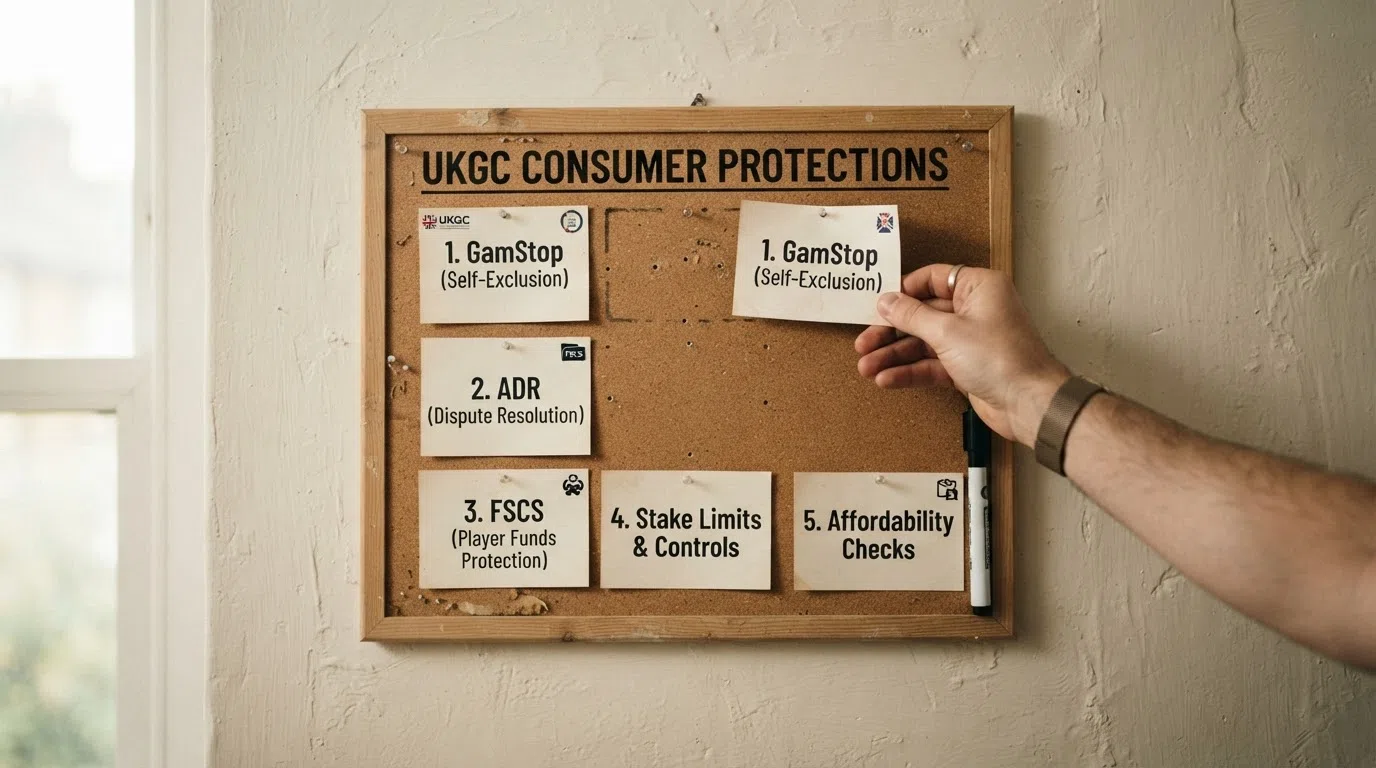
The protections a UKGC-licensed casino provides are layered, and the layers disappear together when the licence is absent. The list is worth reading once, in full, because the section that names each safeguard is also the section a reader refers back to later in the page.
| Protection | UKGC-Licensed Casino | Non-GamStop Casino |
|---|---|---|
| GamStop self-exclusion | Mandatory for all online licensees since 31 March 2020 | Not enrolled; a self-excluded player is not blocked |
| ADR (alternative dispute resolution) | Approved ADR provider binding on the operator | No approved ADR; disputes go through the operator’s own process or its home regulator |
| FSCS cover on customer funds | Segregated accounts; FSCS protection up to £85,000 | No FSCS; funds held on the operator’s balance sheet |
| UKGC complaints route | Full access to the Commission’s enforcement toolkit | No statutory route; complaints must go through the offshore operator |
| Credit card deposits | Banned since 14 April 2020 (including credit-card-funded e-wallets) | Commonly accepted |
| Auto-play on slots | Banned since October 2021 | Permitted |
| Spin-speed minimum | 2.5 seconds per game cycle | No minimum; games can run as fast as the provider allows |
| Reverse withdrawals | Permanently banned | May be available |
| Losses disguised as wins | Not permitted in game design | Not restricted |
| Stake cap | £5 per game cycle (25+) and £2 (18–24) from April/May 2025 | No statutory cap |
| Wagering requirements on bonuses | Capped at 10× from 19 December 2025 | No cap; 30–45× is common in the featured set |
| Mixed-product bonuses | Banned from 19 December 2025 | Permitted |
| Financial vulnerability check | Triggered at £150 net deposits in a rolling 30-day period | Not triggered |
| Deposit-limit prompt | Mandatory before first deposit from 31 October 2025 | Not required |
| Identity verification | Required before first deposit (since 7 May 2019) | Often triggered only at first withdrawal or above a cumulative threshold |
That is the bargain on its face. The reader can pick which rows matter to them. For the rest of the page, the only row that changes shape is the wagering-requirements cell — and that is because the next section turns it into a worked number.
10 British Casinos Not on GamStop, Compared: Bonuses, Games and Payout Speed
The table below sets the ten featured operators side by side. Where a value is not confirmed in the underlying sources for this review, the cell carries an em dash rather than an estimated number. Honest gaps are part of the comparison; an invented figure in an empty cell would not be.

| Operator | Licence | Welcome Bonus | Free Spins | Wagering | Game Providers |
|---|---|---|---|---|---|
| MyStake | Curaçao GCB (not UKGC) | 150% up to £750 (300% up to £1,500 across 3 deposits) | 30 FS no-deposit on registration | 30× (deposit + bonus) | Pragmatic Play, NetEnt, Evolution, others |
| Goldenbet | Curaçao GCB (not UKGC) | 300% up to £1,500 across 3 deposits | 100 FS | 35× (bonus funds) | Pragmatic Play, Evolution, NetEnt, others |
| Freshbet | Curaçao GCB (not UKGC) | 100% up to £500 first deposit (250%–300% up to £1,500–£3,000 total across 3 deposits) | 200 FS across deposits | 30× (bonus only) | Pragmatic Play, Evolution, NetEnt, others |
| Rolletto | Curaçao GCB (not UKGC) | 150% up to £500 | 200 FS (50 instant + 30/day for 5 daily logins) | 30× (bonus funds) | Pragmatic Play, Evolution, NetEnt, others (4,000+ games) |
| Donbet | Curaçao GCB (not UKGC) | 150% up to £750 | 50 FS | 30× | Pragmatic Play, Evolution, NetEnt, others |
| Winstler | Curaçao master licence 5536/JAZ (not UKGC) | 600% up to €9,500 across 5 deposits | — | 45× (bonus + deposit) | Pragmatic Play, Evolution, NetEnt, others |
| BetSwagger | Curaçao (not UKGC) | — | — | — | — |
| Cosmobet | Curaçao GCB (not UKGC) | 400% up to €2,000 | 1,000 FS | — | Pragmatic Play, Evolution, NetEnt, others |
| Winorio | Costa Rica (not UKGC) | Multi-deposit welcome package | Included | — | 10,000+ titles from broad providers |
| MadCasino | Not confirmed (not UKGC) | 100% up to £1,500 | 300 bonus spins | — | — |
Six of the ten brands — MyStake, Goldenbet, Freshbet, Rolletto, Donbet and Cosmobet — are operated by the Santeda group, a Curaçao-based company that dominated the British-facing non-GamStop market through 2025 and into 2026. In April 2026, The Guardian and Investigate Europe reported that the group had used a fake, AI-generated image of a “CEO” across its corporate materials. In June 2026, Bloomberg reported that two of the group’s brands, MyStake and DonBet, remained accessible to British users without a VPN, despite the UKGC having been alerted to them months earlier. The Santeda stable is the largest single cluster in the non-GamStop market for British players, and it is also the most exposed to questions about corporate transparency.
MyStake: 150% Welcome Bonus and the Santeda Group’s Flagship
MyStake is the brand most often named first in any review of the British-facing non-GamStop market, and the numbers explain why. A first-deposit match of 150% up to £750 on a £20 minimum deposit rises to a 300% package up to £1,500 across three deposits; 30 free spins are credited on registration, with no deposit required, carrying 30× wagering on deposit plus bonus. The game library runs through Pragmatic Play, NetEnt and Evolution, with a broad long tail of additional providers. The licence is Curaçao GCB, and the operator sits outside the UKGC’s public register.
The Santeda group context is the qualifier a serious reader needs. MyStake is the flagship of a stable exposed in April 2026 by The Guardian and Investigate Europe for a fake AI-generated CEO image, and named alongside DonBet in a June 2026 Bloomberg report as still accessible to UK users without a VPN. None of that is dispositive of any single player’s experience at the site, but it is the corporate backdrop the welcome bonus is set against. Reputation matters here, and MyStake remains the most high-profile choice for players who are unconcerned by the Santeda group’s recent corporate-transparency questions in 2026.
Goldenbet: 300% Across Three Deposits, 35× Wagering
Goldenbet runs a 300% welcome package up to £1,500 across the first three deposits, with 100 free spins and 35× wagering on bonus funds. The minimum deposit is £20, the licence is Curaçao GCB and the game library is the standard Santeda mix of Pragmatic Play, Evolution and NetEnt. The wagering multiple is higher than the 30× that dominates the featured set, and it sits on bonus funds only — a meaningful distinction in practice, since wagering on bonus funds alone is less punitive than wagering on deposit plus bonus.
For a player who is comparing the Santeda brands head to head, Goldenbet is the choice when the deposit pattern favours spreading the welcome across three top-ups rather than concentrating it on the first. The 100 free spins are a smaller free-spin allowance than MyStake’s 30, but the free spins here are tied to a deposit, not to registration — a different cost calculation sits behind them.
Freshbet: 100% First-Deposit Match and Up to 200 Free Spins
Freshbet opens with a 100% first-deposit match up to £500, rising to a 250%–300% package up to £1,500–£3,000 total across three deposits; sources vary on the headline total, which is itself worth noting. The free-spin allowance runs to 200 across deposits, and the wagering is 30× on bonus funds only — a friendlier calculation than deposit-plus-bonus wagering. Minimum deposit £20, Curaçao GCB licence, and the standard Santeda provider line-up.
The 30×-on-bonus-only structure is the operative line for a reader who is comparing. A £20 deposit at Freshbet produces a £20 bonus, and the 30× wagering applies to the £20 bonus alone (£600 turnover) — not to the £40 deposit-plus-bonus total. That is a meaningfully lighter threshold than MyStake’s 30× on deposit plus bonus at the same stake. Freshbet is the friendliest of the Santeda bonuses on this evidence, with the caveat that the headline total varies by source and should be confirmed at the cashier before committing.
Rolletto: 150% to £500 and 200 Spins Across Daily Logins
Rolletto runs a 150% first-deposit match up to £500 and structures its 200 free spins as 50 credited instantly and 30 per day for five consecutive daily logins. The wagering is 30× on bonus funds, the minimum deposit is £20 and the catalogue runs to 4,000+ games through the usual Pragmatic Play, Evolution and NetEnt mix. The Curaçao GCB licence places the brand inside the Santeda group alongside MyStake, Goldenbet, Freshbet and Donbet.
The daily-login free-spin structure is a retention mechanic dressed as a bonus. A player who logs in for five consecutive days collects the full 200; a player who misses a day forfeits that day’s batch. The 4,000-game library is the real draw here, and for those who enjoy consistent access to a wide catalogue, this retention structure is an added feature rather than a hurdle.
Donbet: 150% to £750 and 50 Free Spins
Donbet offers a 150% first-deposit match up to £750 with 50 free spins and 30× wagering, on a £20 minimum deposit. The Curaçao GCB licence and the Pragmatic Play, Evolution and NetEnt provider line-up mirror the other Santeda brands. The single feature distinguishing Donbet from the rest of the stable is its public profile: in June 2026, Bloomberg named Donbet alongside MyStake as accessible to UK users without a VPN, despite the UKGC having been alerted to the brands months earlier.
The Bloomberg reference is not a comment on the welcome bonus or the game library; it is a comment on the regulatory environment the bonus is offered in. For a reader weighing the Santeda brands, the choice between Donbet and MyStake comes down to the welcome structure and the game catalogue, because the regulatory posture is the same for both.
Winstler: The 600% Five-Deposit Package, at 45× Wagering
Winstler is the outlier in the featured set, in three ways. The headline figure is the highest: a 600% welcome package up to €9,500 across the first five deposits, with a €50 minimum deposit. The wagering multiple is the steepest at 45× on bonus plus deposit. The operator is not Santeda but Favorit United N.V., running on a Curaçao master licence 5536/JAZ, in operation since October 2022. The game library still runs through Pragmatic Play, Evolution and NetEnt.
The wagering maths is the line to read twice. A €50 first deposit at Winstler produces a €300 bonus, and 45× on the €350 total comes to €15,750 in required turnover. The 600% headline is real, but the clearance cost is the highest in the set, and the stake-per-spin economics that follow from that turnover are correspondingly heavy. This is a heavy-duty option that favours players who want to commit significant volume from the start rather than those looking for a casual test.
BetSwagger: Curaçao-Licensed, Bonus Terms Unconfirmed
BetSwagger appears in the featured set on the strength of a confirmed Curaçao licence and a confirmed absence from the UKGC public register. Beyond those two facts, the underlying sources for this review did not confirm a welcome bonus, a free-spin allowance, a wagering multiple, a minimum deposit or a game-provider line-up. The honest comparison is that those numbers could not be verified within the sources available, and a reader considering BetSwagger should confirm each of them at the cashier before depositing.
A brand with unconfirmed terms is not the same as a brand with bad terms; the absence of a number is a verification gap, not a verdict. The verification gap is itself information: a brand that publishes licence information but not bonus terms, or a brand whose terms are hard to confirm in independent review, is a brand that warrants more pre-deposit diligence than a brand whose terms are public and well documented.
Cosmobet: 400% Match and 1,000 Free Spins from the Santeda Stable
Cosmobet sits inside the Santeda group, with a Curaçao GCB licence and the standard Pragmatic Play, Evolution and NetEnt line-up. The welcome offer is 400% up to €2,000 alongside 1,000 free spins — the largest free-spin allowance in the featured set. The wagering multiple and the minimum deposit were not confirmed in the underlying sources for this review, and a player weighing Cosmobet should confirm both at the cashier before depositing.
The 1,000 free spins are the headline number, and the question to ask of them is the same as for any free-spin package: which slot title are they credited on, what is the per-spin stake, what is the wagering multiple on the resulting bonus, and what is the maximum cashout. Those four numbers are the conversion between “1,000 free spins” and the actual value of the offer, and the Cosmobet review has not been able to confirm them. The Santeda-group context — the April 2026 fake-CEO report, the June 2026 Bloomberg reference — applies here as it does to the other Santeda brands.
Winorio: Costa Rica-Licensed Newcomer with a 10,000-Title Library
Winorio is the only Costa Rica-licensed brand in the featured set, launched in March 2025 by AXENTRA LTD. The headline figure is the catalogue: 10,000+ game titles from a broad provider base, the largest library in the set by a wide margin. The welcome package is multi-deposit, the free spins are included, and the specific amounts and wagering were not confirmed in the underlying sources.
The Costa Rica licence is the structural difference. A Curaçao GCB sub-licence carries an identifiable regulator, a published register, and a defined complaint route. A Costa Rica data-hosting licence is a wrapper for an offshore operation, with a thinner regulatory apparatus and a complaint route that runs through the operator rather than a public register. Winorio prioritises catalogue size over the regulatory oversight that a Curaçao licence attempts to provide.
MadCasino: 100% to £1,500 with 300 Bonus Spins
MadCasino opens with a 100% first-deposit match up to £1,500 and 300 bonus spins. The licence jurisdiction, game providers, wagering multiple and minimum deposit were not confirmed in the underlying sources for this review. The operator sits outside the UKGC’s public register.
The headline figures are competitive on their face — a £1,500 first-deposit match is at the upper end of the featured set, and 300 bonus spins is the second-largest free-spin allowance. The verification gap is the operative caveat. A brand with a large welcome offer and no confirmed licence jurisdiction in the available sources is a brand that warrants the same pre-deposit diligence the BetSwagger review recommends: confirm the licence, the wagering, the slot the spins are tied to, and the maximum cashout, before committing any cash. The 100% to £1,500 is not a bad offer in the abstract; it is an unverified offer as it stands.
Why a 300% Bonus Outside GamStop Costs More Than It Gives
Welcome Packages: From 150% to 600% — What the Numbers Actually Mean
The welcome packages in the featured set run from 100% (Freshbet, MadCasino) to 600% (Winstler), with the Santeda brands clustered around 150% (MyStake, Rolletto, Donbet) and 300% (Goldenbet). The headline figures are genuinely larger than anything a UKGC-licensed casino can offer, and the reason is structural. From 19 December 2025, UKGC-licensed casinos face a 10× cap on wagering requirements and a ban on mixed-product promotional offers; a £100 welcome match at 10× wagering produces £1,000 in required turnover and a defined ceiling above which the operator cannot go. A non-GamStop operator has no such ceiling. The 40% Remote Gaming Duty from 1 April 2026 and the 1.1% statutory levy on remote operators from April 2025 widen the gap further by raising UKGC operating costs; an offshore operator pays neither and can pass the saving on as a higher headline match.
A representative comparison makes the gap concrete. A UKGC-licensed casino offering a £100 welcome match at 10× wagering requires £1,000 in turnover. A non-GamStop casino offering a 150% match up to £750 at 30× wagering on deposit plus bonus requires a £20 minimum deposit to produce a £30 bonus, £50 in qualifying funds and £1,500 in turnover. The headline numbers favour the offshore brand; the clearance cost is also larger. The wagering arithmetic is the line that turns a 300% match from a marketing claim into a real cost.
No-Deposit Bonuses and Free Spins: Deals That Cost Nothing to Claim
No-deposit bonuses are the cleanest offers in the set because the cost of testing them is zero. MyStake credits 30 free spins on registration, with no deposit required — the only friction is the 30× wagering on the resulting bonus. The free-spin allowance across the featured set runs from 30 (MyStake) through 50 (Donbet) and 100 (Goldenbet) up to 200 (Freshbet and Rolletto), 300 (MadCasino) and 1,000 (Cosmobet). Each of these is tied to a specific slot title in practice, on a per-spin stake set by the operator, with a wagering multiple and a maximum cashout that together determine the offer’s real value.
The honest use of a no-deposit bonus is as a test. A player who claims the MyStake 30 free spins, plays them through, and withdraws any winnings subject to the wagering and maximum-cashout terms, has learned something about the cashier and the KYC process that no review can teach. The same player who claims 1,000 Cosmobet free spins without checking the underlying slot, the per-spin stake, the wagering and the maximum cashout has not yet read the offer.
The Wagering Arithmetic: How a 30× Multiplier Eats Your Bonus Balance
The clearest worked example sits at MyStake. A £20 minimum deposit produces a £30 bonus at the 150% match; the qualifying total is £50; the 30× wagering multiplier applies to deposit plus bonus, producing a required turnover of £1,500. At a representative £1 stake per spin, that is 500 spins; at five seconds per spin, the time to clear the bonus is 2,500 seconds, or roughly 42 minutes of continuous play. The same £20 deposit at a UKGC-licensed casino capped at 10× would require £500 in turnover — one third of the offshore equivalent.
The takeaway is mechanical. Every extra 1× of wagering eats into the bonus’s value, because the additional turnover is real money risked on a game with a house edge. A 30× wagering multiple is three times the UKGC ceiling; a 45× multiple (Winstler) is four-and-a-half times the ceiling. The headline match sizes are larger at the same operators, but the clearance cost scales with them. The marketing word is “bigger”; the arithmetic is “longer”.
The same scenario, read in terms of expected loss, sharpens the picture. Assuming only the bonus amount is wagered through a representative slot at a published return-to-player figure, the expected loss to the house over £1,500 in turnover is turnover × (1 − RTP). For a 96% RTP slot, the expected loss is £60 on the MyStake scenario; for a 94% RTP slot, £90. These are statistical estimates over many spins, not guarantees, but they are the cost a player pays for the bonus before any cashout is considered. The 300% headline is a marketing word; the £60–£90 is the cost.
Fast Payouts, Fewer Guarantees: Banking at Non-GamStop Casinos
Pounds In: How to Deposit GBP at an Offshore Casino
Every featured operator accepts GBP, and most of them default to a sterling balance at the cashier. The minimum deposit across the Santeda brands (MyStake, Goldenbet, Freshbet, Rolletto, Donbet) is £20; Winstler runs to a €50 minimum; the minimums for BetSwagger, Cosmobet, Winorio and MadCasino were not confirmed in the underlying sources and should be checked at the cashier. The accepted payment methods are wider than at a UKGC site: debit cards, e-wallets, bank transfer and cryptocurrencies are standard, and credit cards — banned at UKGC sites since 14 April 2020 — are commonly accepted at non-GamStop brands. The credit-card acceptance is a regulatory gap, not a feature; it widens the deposit options for a player who can pay, and it widens the harm surface for a player who should not.
The KYC process is lighter at a non-GamStop site than at a UKGC brand. UKGC-licensed operators have been required to verify name, address and date of birth before the first deposit since 7 May 2019. Non-GamStop brands may not require verification until the first withdrawal is requested, or until cumulative deposits cross a threshold set by the operator. Frictionless registration is the trade-off here; for those who value consumer protection, the absence of upfront KYC is a clear exposure.
Pounds Out: Withdrawal Speed, Limits and the Operators That Pay Fastest
The honest line on payout speed at non-GamStop casinos is that the underlying sources for this review do not carry confirmed per-operator processing times. The available data is the range of operator-published figures and the customer reports aggregated by affiliate sites, neither of which is a clean source. A reader weighing payout speed should treat operator-published processing times as a ceiling rather than a floor, and should look for independent customer reports that name the operator, the method and the verified turnaround in days.
The structural risks are easier to pin down. UKGC-licensed casinos segregate customer funds to FSCS standards, with protection up to £85,000 per depositor; non-GamStop sites hold customer balances on the operator’s balance sheet, and FSCS cover does not extend to those balances. A non-GamStop casino that becomes insolvent mid-payout holds the player’s cash alongside its other liabilities, and the player becomes an unsecured creditor. That is the regulatory gap, and it is the single biggest consumer-protection difference between a UKGC and a non-GamStop brand.
Crypto withdrawals are the option non-GamStop brands offer that UKGC-licensed casinos do not. The processing is faster in many cases, the transaction is settled on a public ledger, and the casino’s KYC process is bypassed by the design of the payment rail. The trade-off is volatility, irreversibility, and the absence of a chargeback route. UK players pay no tax on gambling winnings — player-side betting duty was abolished in 2001 — and that is true of crypto-denominated winnings as it is of sterling.
Mobile Play Without the UK Rules: Apps vs Browser Compared
Dedicated Apps vs Mobile Browser: What the Non-GamStop Market Offers
The non-GamStop mobile experience is dominated by the mobile browser. Most of the featured operators run a responsive HTML5 lobby that adapts to phone and tablet screens; the game providers — Pragmatic Play, Evolution, NetEnt — build their titles mobile-first as standard, and the live-casino tables stream to a phone with no feature loss compared to desktop. Dedicated casino apps from non-GamStop brands are less common than at UKGC-licensed operators, partly because the UK and EU app stores have tightened their gambling-app policies, and partly because the responsive browser experience is now good enough that an app adds little.
The practical difference for the player is small. A modern HTML5 casino lobby runs identically in a mobile browser and in a dedicated app, and the game catalogue, the cashier, the live-chat support and the bonus-claim flow are the same in both. The advantage of the browser is the absence of a sideloading requirement — a non-GamStop app from an offshore brand is unlikely to be on the Google Play Store, and an iOS sideload is a more involved process than tapping a bookmark to the home screen. The advantage of the app, where one exists, is the small speed gain from a cached local install and the convenience of biometric login.
Compatibility, Speed and the Full Game Library on a Small Screen
The compatibility range across the featured set is broad. Pragmatic Play, Evolution and NetEnt all build their games for iOS and Android as standard, and the live-dealer tables stream in HTML5 to the mobile browser without a separate app install. The full 4,000-game catalogue at Rolletto and the 10,000+ titles at Winorio are accessible on a small screen in the same form as on desktop, and the search and filter functions are designed for thumb navigation.
The speed of a mobile spin at a non-GamStop casino is the line where the regulatory gap shows up most clearly. At a UKGC-licensed site, the Remote Technical Standards require a minimum spin cycle of 2.5 seconds, and auto-play is banned. At a non-GamStop brand, the same slot can run as fast as the provider allows, and auto-play is permitted. For a player who values faster session turnover, the mobile experience at a non-GamStop site is genuinely faster, though the absence of friction can quickly become a disadvantage.
Slots, Live Dealers and Jackpots: The Games You Can Actually Play
Slots: Provider Line-Ups and the Titles You Will Find
The slot catalogue across the featured set is dominated by Pragmatic Play, NetEnt and Evolution, with a long tail of additional providers. Pragmatic Play’s portfolio alone runs to several hundred titles; NetEnt’s catalogue includes the branded slots most British players will recognise; Evolution’s slot work has expanded since the NetEnt acquisition. The combined library at Rolletto runs to 4,000+ games; the combined library at Winorio runs to 10,000+ titles from a broader provider base. Where a player is choosing between brands on catalogue size alone, Winorio is the standout; where the choice is on the specific branded slots most likely to be in the lobby, every Santeda brand is comparable.
The regulatory gap is most visible in the game-design rules. UKGC-licensed sites cannot offer auto-play (banned since October 2021), cannot run a game cycle faster than 2.5 seconds, and cannot present losses as wins through sound and visual design. Non-GamStop sites are not bound by those rules. Auto-play is permitted, spin cycles can run as fast as the provider allows, and the game-design choices that the UKGC has restricted in Great Britain remain available offshore. The same slot title can therefore play differently in the two environments; the maths is the same, the experience is not.
The honest line on slot-level RTP is that the underlying sources for this review do not carry confirmed per-title return-to-player data for the non-GamStop market. The slot RTP at a non-GamStop site is set by the provider, not by a UKGC technical standard, and the per-title figure is not always published at the game level. A player who wants to weigh one slot against another should check the published RTP for the specific title on the provider’s site, and should note that the same title can be configured with different RTP settings across different operators.
Live Casino: UK-Facing Tables and Real Dealers Outside the UKGC
The live-casino offering across the featured set is dominated by Evolution and Pragmatic Play Live, with both providers running roulette, blackjack and baccarat tables, plus the game-show titles that have driven most of the live-casino growth in the British market: Crazy Time, Monopoly Live, Dream Catcher and the Lightning series. The dealers at these tables are based in studios across Europe, and the UK-facing tables — those branded in English and run in sterling — are a clear majority of the catalogue. The streaming quality is the same in a mobile browser as on desktop, and the bet limits run from a few pence at the low end to several thousand pounds at the high end.
The UKGC restrictions that shape slot play do not extend to live-dealer tables in the same form. Spin-speed minimums apply to slot game cycles, not to roulette wheel spin times; auto-play does not apply to live tables. The live-casino experience is closer to a UKGC site than the slot experience is, and the regulatory gap is narrower. Where a player is choosing between brands on live-casino quality, the provider line-up is the operative comparison; the licence jurisdiction is less load-bearing here than in the slot catalogue.
Progressive Jackpots and the Wider Game Library
Progressive jackpot slots run through the Pragmatic Play and NetEnt jackpot networks, both of which feed the same prize pools across operators that licence the games. A player at a non-GamStop casino playing a Pragmatic Play Drops & Wins title or a NetEnt Mega Fortune slot is contributing to the same network-wide prize as a player at a UKGC-licensed site, and the prize amounts are comparable across both environments. The difference is regulatory: at a UKGC site, the £5/£2 age-banded stake cap limits the rate at which a player can build a jackpot contribution; at a non-GamStop site, no such cap applies, and the same stake is the player’s choice.
Table games and video poker are standard across the featured set, with multiple variants of roulette, blackjack and baccarat, plus a range of video poker titles and the live-dealer versions of the same games. Bonus-buy and feature-buy mechanics — the option to pay a fixed multiple of the stake to trigger a slot’s bonus round directly — are available at non-GamStop casinos, where the UKGC has not restricted the mechanic. The wider game variety is the main reason a player moves between brands in the set, and the catalogue size — 4,000+ at Rolletto, 10,000+ at Winorio — is the operative number.
New Non-GamStop Casinos of 2026: Fresh Launches, Familiar Risks
The Newest Launches: Winorio, Cosmobet and the 2026 Cohort
The freshest operator in the featured set is Winorio, launched in March 2025 by AXENTRA LTD under a Costa Rica licence. The 10,000+ title library is the largest in the set, the multi-deposit welcome package is competitive, and the specific bonus amounts and wagering were not confirmed in the underlying sources. A player weighing Winorio should confirm the licence, the wagering and the free-spin terms at the cashier, and should treat the catalogue size as the principal advantage and the Costa Rica licence as the principal caveat.
Cosmobet is the second freshest of the featured brands, a Santeda-group entry with the largest free-spin allowance in the set (1,000 FS on a 400% match up to €2,000). The Santeda group is the dominant force in the British-facing non-GamStop market, and the April 2026 The Guardian/Investigate Europe report on a fake AI-generated CEO and the June 2026 Bloomberg report on accessibility to UK users apply to Cosmobet as they do to MyStake, Goldenbet, Freshbet, Rolletto and Donbet. Newer non-GamStop brands outside the featured set launch every quarter, and many are too new to appear in mainstream review databases; the same verification checklist that applies to BetSwagger and MadCasino applies to any unlisted brand.
New Casino vs Established Operator: What You Gain and What You Risk
A new casino often launches with an aggressive welcome offer to build a player base, and the headline number is the easiest lever to pull. The same bonus headline at an established operator (MyStake, Goldenbet) carries a longer payout and support track record; the same headline at a new launch carries a shorter one. A player weighing the trade-off should treat track record as a separate input from bonus size, and should not let one displace the other in the comparison.
The Santeda group controversy is the clearest example of why operator transparency matters at the new-launch end of the market. A fake AI-generated CEO image is not a regulatory breach in the Curaçao GCB’s published rulebook, and it is not a barrier to operating; it is a corporate-governance signal that the materials a player sees on the brand’s “About” page are not always what they appear to be. The Bloomberg report, finding that DonBet and MyStake were accessible to UK users without a VPN despite the UKGC having been alerted months earlier, is a second signal that the enforcement gap is real and current. Neither finding is a verdict on any individual player’s experience, but both are inputs the welcome bonus sits on top of.
The pre-deposit checklist for a newly launched non-GamStop casino is short. Confirm the licence on the regulator’s own register, not just on the brand’s “About” page. Confirm the bonus terms, the wagering multiple, the free-spin slot and the maximum cashout in the cashier’s terms-and-conditions. Search independent player feedback for withdrawal experiences in the last 90 days, and look for unresolved complaints rather than resolved ones. The four steps are not a guarantee; they are a tighter filter than a headline bonus alone.
Staying in Control When GamStop Is Not There
Self-Exclusion Without GamStop: Tools That Still Work Outside the UK System
GamStop’s mandatory coverage applies to UKGC-licensed sites. A player who has self-excluded through GamStop and is looking at a non-GamStop brand is, by definition, looking at a site the exclusion does not cover. The category exists in part to serve that gap, and the tools that work for a player who wants to block their own access to non-GamStop sites are different from the ones GamStop provides.
Individual casino self-exclusion is offered by most operators in the set, and the mechanism requests the casino to close the account and block the player from re-registration for a defined period. The mechanism is operator-by-operator; it does not extend to a second non-GamStop brand the player might open an account with the same week. Device-level blocking software is the more comprehensive alternative. Gamban and BetBlocker run on iOS, Android, Windows and macOS devices and block thousands of gambling sites at the device level, including the offshore operators covered here; neither is a perfect filter, and new sites can briefly evade the blocklist, but the cumulative coverage is wide. Bank-level gambling blocks, available through the major UK high-street banks, sit one level further back and prevent gambling transactions from clearing the account at all. The four tools — GamStop, individual casino self-exclusion, device-level blockers and bank blocks — are layered; each covers a different surface, and the strongest protection is the combination.
The 614,738 active exclusions on GamStop, with a 16% year-on-year rise in registrations during the first half of 2026, are the size of the population the national scheme covers. None of those exclusions extends automatically to a non-GamStop brand. A player who has self-excluded and is reading this section is in the group the tools above exist for, and the steps above are the practical alternatives.
Where to Get Help: Helplines, Clinics and Support Networks
The National Gambling Helpline, 0808 8020 133, is the single point of entry. The line is run by GamCare, is free, confidential and available 24 hours a day, every day. GamCare also runs live-chat counselling, one-to-one structured support and a network of group programmes across Great Britain; the same entry point connects a caller to all of them. The NHS runs specialist gambling harm clinics in England, Scotland and Wales, with referral routes from both GamCare and the National Gambling Helpline. Gamblers Anonymous holds peer-support meetings across the UK, on a fellowship model that requires no referral and no fee. GambleAware publishes self-assessment tools, treatment information and a directory of local services. GamStop itself remains the route for any player who wants to self-exclude from UKGC-licensed sites, and remains free at the point of use.
The treatment demand is rising faster than the headline prevalence. The National Gambling Support Network treated 11,960 clients between April 2024 and March 2025, an 11% increase on the 10,754 treated the year before. Nearly 30% of adults who experience gambling problems now say they want treatment, up from 17% in 2020; an estimated 8% of adults, around 4.3 million people in Great Britain, are negatively affected by a family member’s or friend’s gambling. The help infrastructure is funded, staffed and accessible. Reaching it is a single phone call.
How We Researched and Ranked These Casinos
Each of the ten featured operators was checked against the UK Gambling Commission’s public register, last updated 29 July 2026 with 2,663 licensed businesses, to confirm that none holds a GB operating licence. The evaluation criteria were licence jurisdiction, welcome-bonus value and wagering terms, free-spin allowance, game-provider breadth, and the operator’s published track record. The underlying sources are the UKGC’s enforcement data and biannual reports, the GamStop Annual Report 2025 and 2026 biannual data, the Gambling Act 2005 as extended by the Gambling (Licensing and Advertising) Act 2014, the LCCP and RTS, the reporting by The Guardian and Investigate Europe on the Santeda group, and the Bloomberg coverage of accessibility enforcement. Where a value was not confirmed in those sources — the welcome bonus at BetSwagger, the wagering at Cosmobet, the licence at MadCasino — the cell is left as a verification gap rather than filled with an estimated number. No invented weightings or percentage scores have been applied; the comparison is descriptive, not scored.
The enforcement data behind the picture is current to the end of 2025. The UKGC’s April 2024 to June 2025 reporting recorded 3,140 disruption notices, 447,778 URLs referred to search engines and 287,961 URLs removed. The full-year 2025 reporting recorded 741 cease-and-desist notices, 397,527 URLs reported and 266,667 removed, plus 1,134 websites disrupted. The proposed ISP-blocking powers in the Criminal Justice Bill and the £26 million over three years from the Treasury are the next layer of enforcement infrastructure. The cumulative effect is a regulator that is moving from voluntary cooperation towards binding orders, but that still relies on disruption rather than blocking at the time of writing.
Should You Play at a Non-GamStop Casino? The Trade-Offs, Laid Bare
The case for a non-GamStop casino is real. The £5/£2 age-banded stake cap does not apply. The 10× wagering ceiling does not apply. Auto-play is permitted. Credit cards are accepted. The welcome match runs to 150%, 300%, 400% or 600%, with free-spin allowances of 30, 50, 100, 200, 300 or 1,000 spins attached. The 40% Remote Gaming Duty and 1.1% statutory levy that constrain UKGC-licensed operators do not constrain these brands, and the welcome packages are larger as a result.
The case against is the same list, read the other way. A non-GamStop casino sits outside the UKGC’s public register, outside GamStop, outside the approved ADR process, outside FSCS fund protection, outside the financial-vulnerability check, outside the deposit-limit prompt, outside the spin-speed and auto-play restrictions, and outside the credit-card ban. The Santeda group — six of the ten featured brands — was exposed in April 2026 for a fake AI-generated CEO, and two of its brands were named in a June 2026 Bloomberg report as still accessible to UK users without a VPN. The UKGC’s proposed ISP-blocking powers are in the Criminal Justice Bill but not yet enacted. The enforcement is real, but it has not closed the gap.
The position the evidence supports is this. A non-GamStop casino is not a criminal risk for the individual player; the Gambling Act 2005 does not extend to the gambler. It is a consumer-protection vacuum. Every safeguard that the UKGC framework provides to a British player is conditional on the operator holding a GB licence, and a non-GamStop brand does not. The decision rests on whether the player values the larger bonus and the looser limits more than the safety net the UKGC provides, with full knowledge that the safety net cannot be reconstructed inside the non-GamStop environment. Neither side of that choice is hidden; the rest of the page is the comparison a reader needs to make it.
Frequently Asked Questions
Are British casinos not on GamStop legal for UK players?
Yes, for the individual player. Section 33 of the Gambling Act 2005 criminalises the operator providing unlicensed gambling facilities, not the customer using them, and the maximum penalty on the operator is 51 weeks’ imprisonment and an unlimited fine. A UK resident who places a real-money bet on a Curaçao- or Costa Rica-licensed offshore site commits no offence. The legal exposure is the operator’s, not the player’s. The trade-off is consumer protection: no GamStop, no ADR, no FSCS cover, and no UKGC complaint route at the offshore brand.
How do I self-exclude from non-GamStop casinos if I am not on GamStop?
Use the four layered tools. Request self-exclusion from each individual non-GamStop casino you have registered with, through the responsible-gambling page or live chat. Install device-level blocking software such as Gamban or BetBlocker on every device you use, to block thousands of gambling sites at the source. Set up a gambling block with your high-street bank, which prevents gambling transactions from clearing the account. The four tools cover different surfaces and work best together; none is as comprehensive as GamStop’s mandatory coverage of UKGC sites, but combined they close most of the gap.
What bonuses are available at non-GamStop casinos compared to UKGC-licensed sites?
Non-GamStop welcome packages run from 100% to 600% on the first deposit, with multi-deposit packages that can extend to a 300% total across three deposits or a 600% total across five. Free-spin allowances run from 30 no-deposit spins to 1,000 spins on the welcome package. Wagering multipliers run from 30× to 45×, against a 10× cap at UKGC sites from 19 December 2025. The headline numbers are larger because the offshore brands pay neither the 40% Remote Gaming Duty nor the 1.1% statutory levy, and because the 10× wagering ceiling and mixed-product ban do not apply to them. The clearance cost scales with the headline: every extra 1× of wagering is real money risked on a house edge.
Are non-GamStop casino winnings tax-free in the UK?
Yes. UK players pay no tax on gambling winnings of any kind; player-side betting duty was abolished in 2001, and gambling winnings sit outside income tax and capital gains tax. The tax exposure is the operator’s, not the player’s, and the 40% Remote Gaming Duty that took effect on 1 April 2026 is paid by the operator on its gross gaming yield. The tax position is the same at a UKGC-licensed site and at a non-GamStop brand; it does not change with the licence jurisdiction of the casino.
Is it safe to give my ID to a non-GamStop casino?
It depends on the operator. A Curaçao GCB-licensed or Costa Rica-licensed brand will request identity verification at first withdrawal or above a cumulative deposit threshold, and the documents required are the standard passport or driving licence plus a recent utility bill or bank statement. The data-handling practices of the operator are not regulated by the UKGC, and the player has no UKGC complaint route if documents are mishandled. The safer path is to verify the operator’s licence on the regulator’s own register before sending any documents, and to send only what the cashier explicitly requests through the in-account flow. A non-GamStop casino that requests documents by email outside the cashier flow is asking the player to take a risk the cashier flow is designed to remove.
Account – nodeposit-casinobonuses-uk
Content created by the «nodeposit-casinobonuses-uk» team