
Non-UK Registered Casinos: What "Offshore" Really Means When You Play from Britain
 Available in GB
The term sits in millions of search queries each year, and the meaning behind it is narrower than it looks. A “non-UK registered casino” is an online gambling site that takes bets from customers in Great Britain without holding a licence from the Gambling Commission, the body the Gambling Act 2005 sets up to regulate the British market. The site is typically licensed somewhere else: Curaçao, Malta, Costa Rica, Anjouan. It runs on a different rulebook, with different consumer safeguards and different bonus economics. A UK player who logs in is doing so outside the protection of the system that applies to bet365, Sky Vegas, Ladbrokes, Grosvenor, or any other operator on the Commission’s public register.

This page is a working analysis of that space: what the label actually signals, who the operators are, what their welcome offers cost to clear, and the protection a player trades away when they sign up. It is not a recommendation to play at any of them. The protection gap is real, and the section on responsible gambling below states it directly.
Data current as of: September 8, 2026. Licence and registration claims verified against the Gambling Commission’s public register and the Curaçao GCB public licence search.
What “Non-UK Registered Casino” Actually Means
In British regulation, “registered” and “licensed” are not synonyms. A casino that is “UK-registered” sits on the Gambling Commission’s register of operating licence holders. The Commission grants that licence only after the operator has passed fit-and-proper tests on its owners, key personnel, and software, and only after it has committed to the conditions set out in the Licence Conditions and Codes of Practice (LCCP) and the Remote Technical Standards. The licence is what authorises the operator to advertise to, accept deposits from, and pay out to customers in Great Britain.
Section 33 of the Gambling Act 2005 makes providing facilities for gambling without the required licence a criminal offence. The penalty is up to 51 weeks’ imprisonment (six months in Scotland), an unlimited fine, or both. The same section underpins the prosecution route that has been used against unlicensed operators. Section 33 sits on the operator side, not the player side, but it is the reason a “non-UK registered” site is, by definition, operating in a way the Gambling Act does not authorise for the British market.
The UK Registration System in One Paragraph
A GB operating licence requires the operator to commit to the three licensing objectives set out in section 1 of the Gambling Act 2005: preventing gambling from being a source of crime or disorder, ensuring it is conducted fairly and openly, and protecting children and other vulnerable people from harm. In practice that means segregation of player funds in accounts independent of the operator’s working capital, a complaints route that escalates to an alternative dispute resolution (ADR) provider, identity verification before first deposit, participation in GamStop, and adherence to the LCCP’s social responsibility codes. The Commission publishes a public register of every licence holder, which a player can check at any time.
Before 2014, an online casino licensed in another jurisdiction could still target UK customers as long as its servers and corporate base were offshore. The Gambling (Licensing and Advertising) Act 2014 closed that loophole by extending the licensing requirement to any operator that takes GB customers, wherever the operator is based. A Curaçao, Maltese, or Gibraltar licence is not a substitute for a GB licence; it is a separate authorisation, in a separate jurisdiction, with separate consumer protections.
Non-UK Registered — What That Label Tells You Before You Click
The label is shorthand for a regulatory status. It means the operator is not on the Gambling Commission’s register, not bound by the LCCP, not participating in GamStop, and not subject to the Commission’s enforcement powers in the way a GB-licensed operator is. It also means the operator holds a licence from somewhere else, and the value of that “somewhere else” varies enormously. A Malta Gaming Authority (MGA) licence carries segregated player funds, a real dispute process, and the threat of licence revocation. A Costa Rica registration is essentially a company registration: there is no gambling regulator to revoke anything.
The most significant loss a UK player absorbs at a non-UK registered casino is not a single safeguard but a stack of them, taken together. There is no GamStop coverage, no UKGC complaints route, no financial vulnerability check, no British consumer protection law, and no ADR provider. The bonus may be larger. The protection floor is lower. The next two sections go through both sides in detail.
Online Only — Why This Conversation Rarely Touches Land-Based Casinos
A land-based casino in Manchester, Glasgow, or Cardiff is regulated by the Gambling Commission by physical location. It does not need the word “registered” attached to it because its regulatory status is determined by where the building sits. The phrase “non-UK registered casino” is, in practice, an online-only concern. Online operators can host their servers and corporate base anywhere in the world, and the Gambling (Licensing and Advertising) Act 2014 was the legislative response to that geography problem: a GB licence is now required to take GB customers online, no matter where the operator is incorporated.
Why Your Non-UK Registered Casino Plays by a Different Rulebook
The UK regulatory system is a stack of deliberate constraints. Each one was introduced at a specific date, in response to a specific harm, and each one binds only operators on the Commission’s register. A non-UK registered casino is not bound by any of them, which is why the experience of playing at one feels looser, faster, and larger.
The headline mechanism is a cost structure. From 1 April 2026, a GB-licensed online casino pays Remote Gaming Duty at 40% of gross gaming yield, up from 21%. From 6 April 2025, it also pays a statutory levy of 1.1% of GGY, split between treatment (50%), prevention (30%), and research (20%). A Curaçao-licensed operator pays neither. The 40% RGD plus 1.1% levy is a structural cost the offshore operator escapes, and the saving flows directly into the bonus offers it can advertise: a 300% match across three deposits, 200 free spins, 25 no-deposit spins on registration. The arithmetic is the message.
A worked example makes the cost visible. Take MyStake’s first-deposit offer: a £100 deposit produces a £150 bonus at the 150% match rate, with 30× wagering applied to the deposit plus bonus combined. That £250 combined sum must be turned over 30 times, producing £7,500 of required wagering. On Gates of Olympus, an online slot with a published return-to-player of 96.5% (high volatility, 5,000× max win), the expected loss on £7,500 of wagering is £7,500 × (1 − 0.965) = £262.50. That figure is the statistical cost of clearing the bonus, the price the house charges for handing over the £150 in the first place. It is the same calculation at every online casino, but the wagering multiple changes the result: at a 10× cap (the GB-licensed ceiling from 19 December 2025) the expected loss on a £100 bonus would be £35, less than a seventh of the offshore cost. The bonus looks bigger; the clearing cost is heavier by the same factor.
The voice this page takes on the cost of a bonus is skepticism, because the cost is the whole point. A bigger match is not a gift. It is a more expensive loan. A 300% headline is the marketing equivalent of “free money”, and the wagering figure is the actual price.
GamStop — The Self-Exclusion Net That Stops at the UK Border
GamStop is the national multi-operator self-exclusion scheme for online gambling in Great Britain. Since 31 March 2020, participation has been a mandatory condition of every Gambling Commission online operating licence, which means every GB-licensed online casino, bingo site, and bookmaker is integrated with it. A player who registers can choose an exclusion period of six months, one year, or five years, with the option of a five-year period that auto-renews. The exclusion cannot be cancelled early. It continues for up to seven years after the chosen period expires if the person does not request removal.

The mechanism is online-only and licence-bound. A GB-licensed operator must check the GamStop database before allowing a customer to deposit, and the check rejects anyone currently excluded. An operator outside the GB licensing system has no obligation to integrate with GamStop, and the database is not available to it. The hard truth: a player who has registered with GamStop to protect themselves from gambling harm is not protected on a non-UK registered casino. The exclusion stops at the border of the Commission’s jurisdiction, which is the same border the offshore operator sits outside of.
Gamban is the device-level alternative. It is free for UK residents, blocks over 500,000 gambling websites and apps across Windows, Mac, iOS, and Android, and works regardless of where a site is licensed because the block sits on the device, not the operator. For a player who needs the protection GamStop cannot provide offshore, Gamban is the practical answer, and the section on responsible gambling below returns to it.
The £5 Stake Cap, No Auto-Play, and the 10× Wagering Ceiling — What the UK System Takes Away
The age-banded online slots stake cap is the single most distinctive feature of the British model. From 9 April 2025, players aged 25 and over can stake a maximum of £5 per game cycle on online slots, and from 21 May 2025, players aged 18 to 24 can stake a maximum of £2. The cap applies to a “game cycle”, defined as the period from initiation to when all money staked has been lost or all winnings delivered, and it cannot be defeated by splitting a spin across two button presses. The cap was imposed by SI 2025/215 and is, in international terms, unusually restrictive. A non-UK registered casino can offer any stake the operator chooses, and the choice is usually upward.
The game-design rules that came into force on 31 October 2021 are another layer. Auto-play is banned. Spin speed is capped at 2.5 seconds per game cycle. Features that speed up play are banned. Losses disguised as wins are banned. Reverse withdrawals are banned permanently. The session must display total losses, total wins, and time played. None of these restrictions apply at a non-UK registered casino: auto-play works, spin speed is not capped, losses disguised as wins are still a feature, and a player can reverse a withdrawal request back into their balance.
The wagering cap is the most recent addition. From 19 December 2025, LCCP Social Responsibility Code 5.1.1 caps wagering requirements at 10× the bonus amount at any GB-licensed casino, and bans mixed-product promotional offers. Offshore sites are not bound. Welcome bonuses at non-UK registered casinos commonly require wagering of 30× to 40×, and no-deposit free-spin winnings can carry 40× to 60×, with a maximum cashout cap of £50 to £200 on the win.
The credit card ban has been in force since 14 April 2020. LCCP licence condition 6.1.2 prohibits GB-licensed operators from accepting credit card payments for gambling, and the rule extends to credit-card-funded e-wallet payments. Offshore operators commonly accept Visa and Mastercard, because the UK ban does not apply outside UKGC jurisdiction. The financial vulnerability check, lowered to a £150 net deposit threshold in a rolling 30-day period from 28 February 2025, is another GB-only mechanism. Announced but not yet commenced are Stage 1 financial risk assessments at £5,000 (25+) and £2,500 (under 25) in net deposits over 24 hours. None of this infrastructure exists at a non-UK registered casino.
Curaçao, Malta, Costa Rica — What Each Offshore Licence Means for Your Safety
Not all offshore licences are equal. The four common tiers, ranked by player protection, look like this:
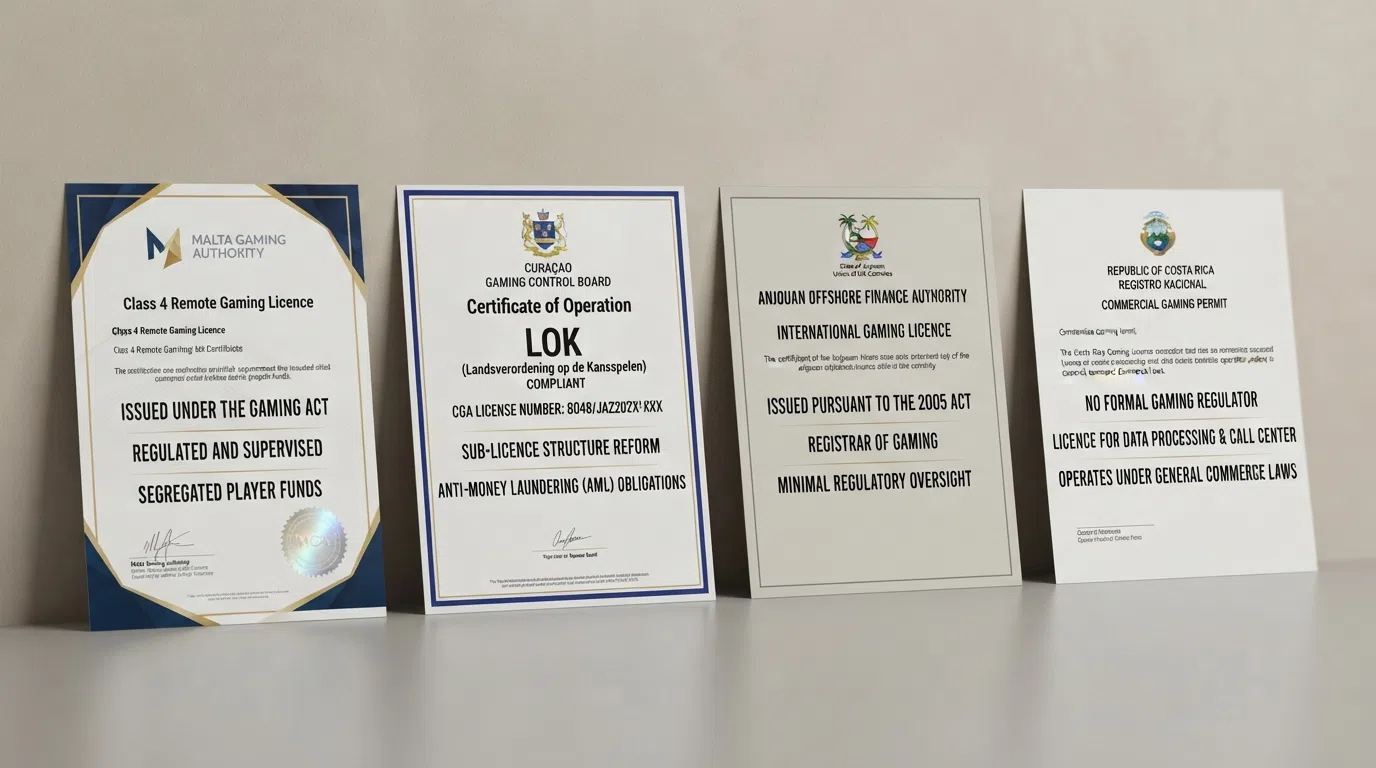
| Jurisdiction | Regulator | Player Fund Protection | Dispute Resolution | Public Register | UK Player Safeguard |
|---|---|---|---|---|---|
| Malta (MGA) | Malta Gaming Authority | Segregated player funds in licensed institutions | Approved ADR process; MGA-mediated | Yes, searchable | Most MGA operators also hold UKGC licences; pure non-GamStop MGA options narrow |
| Curaçao (GCB under LOK reform) | Curaçao Gaming Control Board | Required under new framework | No ADR equivalent to eCOGRA or IBAS; main gap | Yes, CGA numbers verifiable | Lighter than MGA; meaningful improvement over old sublicence model |
| Anjouan | Anjouan Licensing Services | Limited published oversight | Minimal | Limited | Newest and least proven; not a primary safety signal |
| Costa Rica | None — operators register as corporations | None | None | No gambling register | No formal regulator; operators incorporated locally only |
The honest reading of the table: a Curaçao GCB licence under the LOK reform is a meaningful improvement over the old sublicence model, and significantly better than no licence at all. The CGA licence numbers are verifiable on a public register, which the old master-licence system never offered. The gap that remains is dispute resolution. There is no ADR equivalent to eCOGRA or IBAS for a Curaçao-licensed operator, which means a player whose withdrawal is delayed, denied, or conditioned on further play has no independent escalation route short of litigation in Curaçao. That is a meaningfully harder route than an IBAS ruling.
A Costa Rica registration is a different category. There is no gambling regulator to revoke anything, no fund-segregation requirement, no dispute process. Operators register as corporations under Costa Rican company law and operate under the country’s general commercial framework. A player depositing at a Costa Rica-registered casino is relying on the operator’s commercial reputation, nothing else.
Getting Money In and Out — Payment Reality at Non-UK Casinos
The payment methods UK players expect from a licensed casino do not all work at non-UK registered sites. PayPal does not work at non-GamStop casinos because the provider restricts gambling transactions to licensed operators in regulated markets, and the UK is the relevant regulated market for a UK player. Boku pay-by-phone deposits, authorised via SMS and added to a phone bill or prepaid balance, do exist at a small number of offshore casinos, but Boku support is the exception rather than the rule.
Crypto is the dominant payment rail at non-UK registered casinos. Bitcoin, Ethereum, Litecoin, and USDT are commonly accepted; some operators extend the list to XRP and USDC. Withdrawals in crypto are typically faster than at GB-licensed operators, where 24-hour pending periods and verification steps slow payouts. WinSpirit offers crypto and e-wallet withdrawals in 0 to 24 hours, and Kaasino processes crypto withdrawals in under an hour.
Credit cards (Visa, Mastercard) are commonly accepted at offshore casinos because the UK credit card ban does not apply outside UKGC jurisdiction. E-wallets (Skrill, Neteller) and Apple Pay appear at selected operators. The payment picture at a non-UK registered casino is broader and faster than at a GB-licensed site, and the trade is the loss of the UK consumer protection framework that comes with regulated rails.
The Games You’ll Find — RTP, Providers, and What Offshore Libraries Actually Deliver
The slot libraries at non-UK registered casinos are supplied by the same studios that power UK-licensed sites. Pragmatic Play, NetEnt, BGaming, Nolimit City, Hacksaw Gaming, Betsoft, and Evolution (for live casino) are present at most of the operators in the featured set. Library sizes range from around 6,000 titles (MyStake) to over 12,000 (Emperia), with Freshbet and Winorio both at 10,000+. Mobile access is browser-based, with no app-store restriction, and works identically to UK-licensed mobile play.
The titles commonly referenced in non-UK welcome offers have published RTPs that are worth knowing, because the RTP is the closest thing to a hard number a player can use to compare two slots:
| Slot Title | Provider | RTP | Volatility | Max Win |
|---|---|---|---|---|
| Gates of Olympus | Pragmatic Play | 96.5% | High | 5,000× |
| Sweet Bonanza | Pragmatic Play | 96.49% | High | 21,175× |
| Big Bass Bonanza | Pragmatic Play | 96.71% | Not stated this run | Not stated this run |
| Blood Suckers | NetEnt | 98% | Low | Not stated this run |
| 1429 Uncharted Seas | Thunderkick | 98.6% | Medium | Not stated this run |
| White Rabbit Megaways | Big Time Gaming | 97.24%–97.77% | High | 13,000× |
Blood Suckers at 98% and 1429 Uncharted Seas at 98.6% are notably higher-RTP titles than the rest of the offshore library, and they appear in welcome offers precisely because a 98% RTP slot gives the player a better statistical return per spin than a 96% slot. The difference per spin is small; the difference over the volume of wagering a bonus requires is meaningful. The 96.5% on Gates of Olympus is the figure the calculation above uses, and it sits at the industry-standard end of the range.
The game-design restrictions that bind GB-licensed slots (auto-play ban, 2.5-second spin speed cap, losses-disguised-as-wins ban) do not apply at a non-UK registered casino. Auto-play is available, spin speed is not capped, and a slot can present a “win” of less than the stake as a celebratory feature. The difference is structural. The slots themselves are the same software; the regulatory frame around them is the change.
The 10 Non-UK Registered Casinos UK Players Are Using in 2026
The ten operators below were identified by reviewing the most prominent casinos for “non UK registered casinos” available to UK players in 2026, cross-referenced against affiliate reviews, player forums, and the operators’ own published terms pages. Every operator was checked against the Gambling Commission’s public register and confirmed to hold no GB operating licence. None participate in GamStop. They are not ranked by market share, because market-share data is not reliably publishable, and not ranked by safety, because the safety gap is the page’s subject rather than a competitive differentiator. They are ordered by prominence and the completeness of their bonus-term disclosure.
| Operator | Licence | Welcome Bonus | Free Spins | Wagering | Games & Providers |
|---|---|---|---|---|---|
| MyStake | Curaçao GCB | Up to £1,500 across 3 deposits (150%/100%/50%) | 30 no-deposit + spins with deposit | 30× (deposit + bonus) | 6,000+; Pragmatic Play, NetEnt, BGaming, Nolimit City, Hacksaw Gaming |
| Goldenbet | Curaçao GCB | 300% up to £1,500 across 3 deposits | 100 FS with welcome | 35× (bonus funds) | Pragmatic Play, NetEnt, Evolution, BGaming; sportsbook + casino |
| Donbet | Curaçao GCB | 150% up to £750 first deposit | 50 FS with welcome; 15 no-deposit FS | 30× (welcome); 100× (no-deposit) | Pragmatic Play, NetEnt, BGaming, Betsoft; VIP cashback up to 35% |
| Freshbet | Curaçao | 300% up to £3,000 across 3 deposits | 200 FS with welcome; 25 no-deposit on registration | 30×–40× (bonus) | 10,000+; Pragmatic Play, NetEnt, BGaming, Nolimit City; daily tournaments |
| Winstler | Curaçao master 5536/JAZ (Favorit United N.V.) | Large headline match | Not confirmed this run | Not confirmed this run | Slots, live casino, sportsbook; since 2022 |
| Emperia Casino | Curaçao (Fortuna Games N.V.) | Up to £3,000 + 325 FS across 4 deposits | 325 FS across 4 deposits | 40× | 12,000+; Pragmatic Play tournaments (€30,000); daily reloads |
| Kaasino | Costa Rica (Rabocse) | 225% up to £5,000 | Not confirmed this run | Not confirmed this run | BTC, ETH, LTC, USDT, XRP, USDC; Skrill/Neteller; crypto withdrawals <1 hour |
| Winorio Casino | Costa Rica (AXENTRA LTD) | Multi-deposit welcome | Not confirmed this run | 40× | 10,000+; launched March 2025; 24/7 live chat |
| Rolletto | Curaçao GCB | Not confirmed this run | Not confirmed this run | Not confirmed this run | Casino + sportsbook; crypto and e-wallet support |
| WinSpirit | Curaçao GCB (OGL/2024/923/0383) | 100% match + 100 FS + 20 no-deposit FS | 120 FS total | Not confirmed this run | Crypto + e-wallet payouts 0–24h; 11 cryptocurrencies; Visa, Mastercard, Skrill, Neteller, Apple Pay |
The table is honest about the gaps. Where a bonus figure, wagering multiple, free-spin count, or validity window was not confirmed in this run’s research, the cell reads “not confirmed this run”. The pages that did not document those terms in their public-facing welcome pages are the ones the table flags, because the absence is the information: a player who needs to know the wagering multiple before depositing is exactly the player who should not deposit without checking the operator’s current terms page.
MyStake: 6,000+ Games, a £1,500 Welcome Package, and a Curaçao GCB Licence
MyStake has the deepest search-engine presence among non-UK registered casinos targeting UK players, and its bonus terms are among the most transparently documented. The welcome package is staged across three deposits: 150% on the first deposit, 100% on the second, 50% on the third, totalling up to £1,500. Wagering is 30× on deposit plus bonus combined, with a £20 minimum deposit per stage, a £5 maximum bet while wagering, and a 30-day bonus validity. The package also includes 30 no-deposit free spins. The game library sits at 6,000+ titles from Pragmatic Play, NetEnt, BGaming, Nolimit City, and Hacksaw Gaming, which gives a player more variety than most UK-licensed sites.
The arithmetic on the first-deposit offer: a £100 deposit produces a £150 bonus, £250 combined, £7,500 of required wagering at 30×, and the £262.50 expected loss on Gates of Olympus that the calculation above walked through. That is the cost of clearing a £150 bonus at MyStake; whether the bonus is worth £262.50 in expected return is a separate question the wagering terms do not answer, because the wagering requirement applies to the bonus amount, not its expected value. MyStake is the operator in the featured set where the bonus math is most fully checkable, which is also why it sits at the top of the table.
Goldenbet: 300% Match, 100 Free Spins, and Casino-Plus-Sportsbook Under One Roof
Goldenbet’s 300% headline match is among the most aggressive welcome offers in the featured set, and its combined casino-and-sportsbook platform gives it a breadth most pure-casino competitors lack. The 300% match is staged across three deposits up to £1,500, with 100 free spins attached to the welcome package, 35× wagering on bonus funds, and a £20 minimum deposit. The platform is Curaçao GCB licensed and runs Pragmatic Play, NetEnt, Evolution, and BGaming alongside a full sportsbook.
The combined casino-sportsbook format is the practical draw: a player who wants to switch between slot sessions and sports bets without moving funds across operators can do it on one account. The 35× wagering on bonus funds is heavier than MyStake’s 30×, and the bonus funds wagering (rather than deposit-plus-bonus) means the multiple applies to a smaller base, so the comparison is not as straightforward as the headline numbers suggest. A player choosing between MyStake and Goldenbet is choosing between two different bonus structures and two different platform shapes, and the right answer depends on whether the player values the sportsbook or the slot library more.
Donbet: No-Deposit Spins with a 48-Hour Window and VIP Cashback up to 35%
Donbet is the only operator in the featured set whose no-deposit free-spin terms are fully documented in the welcome package, which makes it the reference point for what no-deposit offers at non-UK registered casinos actually cost to clear. The welcome package is 150% up to £750 on the first deposit plus 50 free spins, with 30× wagering on the welcome bonus. The 15 no-deposit free spins are the item worth examining: they carry 100× wagering on the resulting winnings, a 48-hour window in which to use them, and a £100 maximum cashout cap. The welcome bonus itself is valid for 30 days. Donbet is Curaçao GCB licensed, lists Pragmatic Play, NetEnt, BGaming, and Betsoft, and runs a VIP cashback programme with cashback rates up to 35%.
The no-deposit free-spin offer is the operator’s most expensive item in expected-loss terms. A player who wins £10 from the no-deposit spins must wager that £10 one hundred times, producing £1,000 of required wagering, and the expected loss on that £1,000 at 96.5% RTP is £35. The maximum cashout of £100 caps the upside, so the offer is a high-cost trial: a player who wins little loses little to the wagering requirement, and a player who wins a lot sees most of it consumed by the playthrough before the cap kicks in. The 48-hour window is the third constraint. A player who does not log in within two days of registration loses the spins, and the 100× wagering has to be completed in the same window.
Freshbet: A £3,000 Welcome Package Spread Across 10,000+ Titles
Freshbet carries the largest headline welcome package in the featured set at up to £3,000 across three deposits, and the largest game library at 10,000+ titles, with Pragmatic Play, NetEnt, BGaming, and Nolimit City alongside daily tournaments. The wagering climbs to 40× on later deposit stages, from 30× on the first, and the welcome includes 200 free spins with the deposit plus 25 no-deposit free spins on registration. The minimum deposit is £20 per stage. Freshbet is Curaçao licensed.
The 40× wagering on later stages is the operator’s heaviest figure in the featured set, and it is the number a player should look at before being impressed by the £3,000 headline. A 100% match on a £500 second deposit produces a £500 bonus with 40× wagering on the bonus amount, which is £20,000 of required turnover. The expected loss on that figure at 96.5% RTP is £700, against a £500 bonus. Freshbet is the operator that most clearly illustrates the gap between headline size and clearing cost, and it is the operator where the math matters most.
Winstler: One of the Largest Match Bonuses Among Non-UK Casinos Reviewed Here
Winstler trades on bonus size. The headline match is among the largest in the featured set for European players, the operator has been live since 2022, and the platform covers slots, live casino, and a sportsbook. The licence is a Curaçao master licence, 5536/JAZ, held by Favorit United N.V. The bonus wagering, validity, free-spin count, and per-spin value were not confirmed in this research run, and the operator’s terms page should be checked before depositing.
A player considering Winstler is choosing a brand that has not been fully documented in the public-facing welcome terms this run, which is a different decision from choosing MyStake or Donbet, where the numbers are on the table. The Curaçao master-licence structure (5536/JAZ is the umbrella licence, with individual operators authorised underneath) is the older model, predating the LOK reform. The LOK-era CGA licence numbers are the more verifiable marker, and Winstler’s 5536/JAZ sits on the older side of that line.
Emperia Casino: 12,000+ Games, €30,000 Tournaments, and a Four-Deposit Welcome
Emperia splits its welcome across four deposits, the most staged package in the featured set, and backs it with the largest game library at 12,000+ titles, Pragmatic Play tournaments with a €30,000 prize pool, and daily reload bonuses. The headline is up to £3,000 plus 325 free spins across the four deposits, with 40× wagering. The licence is Curaçao, under Fortuna Games N.V.
The four-deposit structure is the operator’s distinguishing feature. Most welcome packages run two or three stages; running four stages extends the commitment across a longer period and lets the operator offer a larger total. The 40× wagering matches Freshbet’s later stages, while bonus validity and specific spin-value terms were not provided. A player who wants the largest game library in the set and is comfortable with a four-deposit commitment is the player Emperia is built for.
Kaasino: Crypto Withdrawals in Under an Hour from a Costa Rica-Based Operator
Kaasino is the speed play. Its sub-one-hour crypto withdrawals and six-cryptocurrency cashier (BTC, ETH, LTC, USDT, XRP, USDC) make it the fastest-paying operator in the featured set, and the welcome bonus is a 225% match up to £5,000. The operator is registered in Costa Rica under Rabocse, and the section on licence tiers above explains what that means in practice: no formal gambling regulator, no fund-segregation requirement, no dispute process, no public register. The cashier also includes Skrill and Neteller.
The Costa Rica registration is the trade for the speed. A player who values payout speed above all else, and who is comfortable relying on the operator’s commercial reputation rather than a regulator, is the player Kaasino is built for. A player who wants the protection of a real dispute process is not. The bonus wagering, validity, free-spin count, and per-spin value were not confirmed this run, and the operator’s terms page should be checked before depositing.
Winorio Casino: Launched in 2025 with 10,000+ Games and Round-the-Clock Support
Winorio is the newest entrant in the featured set, having launched in March 2025, and it carries a 10,000+ game library, 24/7 live chat, and a multi-deposit welcome with 40× wagering. The bonus validity is five days, the shortest in the featured set, and the licence is Costa Rica under AXENTRA LTD. The bonus amount, free-spin count, and per-spin value were not confirmed this run.
The five-day validity is the structural warning. A player who deposits on a Monday and does not log in until Thursday has lost two days of the validity window already, and at 40× wagering on a multi-deposit package the wagering volume is large enough that two lost days materially shrink the time available to clear it. Check the five-day window before committing; this timeframe is exceptionally tight for the required wagering.
Rolletto: A Combined Casino and Sportsbook on a Curaçao GCB Licence
Rolletto’s dual casino-and-sportsbook proposition and crypto-and-e-wallet support make it a flexible all-rounder, and the Curaçao GCB licence is a meaningful improvement over the older sublicence model. The welcome bonus amount, wagering, free-spin count, validity, and per-spin terms were not confirmed in this research run, which is the row’s most honest feature: a player reading the table knows the gap before clicking through.
A player choosing Rolletto is choosing the casino-plus-sportsbook combination and the Curaçao GCB licence, with the explicit understanding that the bonus terms need to be checked on the operator’s current terms page. The crypto and e-wallet support is the payment angle, and the platform shape is the structural one.
WinSpirit: 120 Free Spins and 11 Cryptocurrencies on a Curaçao GCB Licence
WinSpirit’s OGL number is the only individually verifiable Curaçao licence reference in the featured set: OGL/2024/923/0383, which can be checked against the Curaçao GCB public register. The welcome offer is 100% match plus 100 free spins plus 20 no-deposit free spins, totalling 120 free spins, and the cashier supports 11 cryptocurrencies alongside Visa, Mastercard, Skrill, Neteller, and Apple Pay. Crypto and e-wallet withdrawals process in 0 to 24 hours. The wagering, validity, and per-spin value were not confirmed this run.
The verifiable OGL number is the operator’s distinguishing feature. It is the one licence in the set that a player can check themselves against a public register without going through an affiliate tracker, and it places WinSpirit in the post-LOK-reform bracket of Curaçao licensing rather than the older 5536/JAZ master-licence bracket. The crypto and e-wallet payment breadth is the operator’s payment angle, and the 120 free spins are the headline. A player who values verifiable licence data above all else, and who wants the broadest payment selection, is the player WinSpirit is built for.
The Protection You Leave Behind — Responsible Gambling at a Non-UK Registered Casino
The UK has built one of the world’s most comprehensive safer-gambling infrastructures. GamStop, GamCare, the NHS clinic network, mandatory deposit-limit prompts, financial vulnerability checks, the statutory levy funding treatment and research: it is a coordinated system, and a non-UK registered casino sits outside every layer of it. This section states the gap directly, because the gap is the information a UK player needs before signing up.
The data that motivates the infrastructure is real. GambleAware’s most recent Annual Treatment and Support Survey found 13.1% of GB adults who gamble (around 6.8 million adults) experience some level of gambling problems under the PGSI 1+ classification. The National Gambling Helpline received a record 55,228 calls and online chats in 2023-24, a 25% year-on-year increase. In January 2026 alone, GamCare made 996 referrals to treatment and peer-based support services, up 48% year-on-year from 674 in January 2025. The proportion of helpline contacts citing online forms of gambling hit a five-year high of 81.5% in 2026, of 3,053 contacts disclosing gambling type. The Gambling Survey for Great Britain measured overall participation in any gambling activity in the past four weeks at 47% in the September 2025 to January 2026 wave.
Self-Exclusion Without Borders — What Actually Works at a Non-UK Casino
GamStop is the gold standard for online self-exclusion in Great Britain. The mechanism is licence-bound: an operator must check the database before allowing a customer to deposit, and the check rejects anyone currently excluded. The exclusion cannot be cancelled early, regardless of how the player feels about it after registering, and it continues for up to seven years after the chosen exclusion period expires if the person does not request removal. The hard fact, stated again here because it is the central safety tension of this keyword: a player who has registered with GamStop has no GamStop protection on a non-UK registered casino. The exclusion stops at the GB licensing boundary, and the offshore operator is outside that boundary.
Gamban is the device-level alternative. It is free for UK residents, blocks over 500,000 gambling websites and apps across Windows, Mac, iOS, and Android, and works regardless of where a site is licensed because the block sits on the device, not the operator. Gamblock and BetBlocker are similar device-level options, with different platform coverage and pricing. The honest gap remains: no self-exclusion tool today can block a non-UK registered casino at the operator level the way GamStop blocks UK-licensed ones, because the operator is not part of the system the tool queries. Device-level blocking is the closest the UK infrastructure comes to closing the gap, and it is the practical answer for a player who needs the protection GamStop cannot extend offshore.
The UK Help Infrastructure — Who to Call and What to Use
- National Gambling Helpline (GamCare): 0808 8020 133 — free, confidential, 24 hours a day, 7 days a week. Available by phone, online chat, and WhatsApp.
- GambleAware: Self-assessment tools, gambling spend calculator, and a service finder for local support. GambleAware is transitioning to the statutory levy funding structure.
- NHS gambling treatment clinics (England): the National Problem Gambling Clinic, the Northern Gambling Service, the Southern Gambling Service, the West Midlands Gambling Harms Clinic, the East Midlands Gambling Harms Clinic, the East of England Gambling Service, and the South West Gambling Service. Self-referral is accepted.
- Gamblers Anonymous UK: peer-support groups across Great Britain.
- Blocking software: Gamban (free for UK residents, 500,000+ sites blocked across Windows, Mac, iOS, Android), Gamblock (Windows, Android), and BetBlocker (free).
The statutory levy, from 6 April 2025, funds 50% of its allocation to treatment, 30% to prevention, and 20% to research. Offshore operators contribute nothing to this system, and the infrastructure it funds is the same infrastructure a player at a non-UK registered casino may need to call. The asymmetry is worth noticing.
Setting Limits at a Casino That Doesn’t Require Them
At a GB-licensed operator, a player cannot make a first deposit without being prompted to set a financial deposit limit, and the rule has been in force since 31 October 2025. From 30 September 2026, the term “deposit limit” must mean a gross deposit limit based on money paid in, under RTS 12. The financial vulnerability check, lowered to a £150 net deposit threshold in a rolling 30-day period from 28 February 2025, runs in the background and uses publicly available data on county court judgments, bankruptcies, IVAs, and DROs. The announced-but-not-yet-commenced Stage 1 financial risk assessments would trigger at £5,000 (25+) or £2,500 (under 25) in net deposits over 24 hours.
None of this applies at a non-UK registered casino. Voluntary deposit limits, reality checks, and time-outs vary by operator and jurisdiction, with no regulatory floor. A player who wants to limit their own play at an offshore casino is doing it themselves, and the practical strategies are the same regardless of the casino: set a session time limit before logging in, cap the payment method at a specific amount, install Gamban as a device-level backstop, and treat any winnings as the reason to withdraw, not the reason to keep playing. The limits that exist at a GB-licensed casino exist because the regulator requires them. The limits at a non-UK registered casino exist only because the player imposes them.
How We Chose and Ranked These Non-UK Registered Casinos
- Search-engine results for “non UK registered casinos” and related queries in 2026 — the operators most visible to UK players searching the term, with prominence in the organic results as the primary filter.
- The Gambling Commission’s public register of operating licence holders — every operator listed was checked against the register and confirmed to hold no GB operating licence. None participate in GamStop.
- Operator websites and published terms pages — welcome bonus amount, wagering requirements, free-spin counts, validity windows, and per-spin values were transcribed from the operators’ own public-facing terms where they were documented in this run.
- Affiliate reviews and player forums — used to cross-check bonus terms, payment methods, and game-library sizes. Where an affiliate tracker and the operator’s own terms disagreed, the operator’s terms were preferred as the source of record.
- The Curaçao GCB public licence search — used to verify the one CGA licence number that was individually confirmable in this run (WinSpirit’s OGL/2024/923/0383). The register search was not feasible for every operator within this run’s budget; operators with a master-licence number (such as 5536/JAZ) are flagged as such.
The ranking is by search prominence and the completeness of bonus-term disclosure, not by safety, because the safety gap is the subject of the page. The honest framing: every operator on this list is outside the GB licensing system by design, and the comparison between them is on the terms of the offer, the shape of the platform, and the speed of the cashier, not on whether they protect a UK player the way a GB-licensed operator does.
The Honest Call: Keep Britain’s Protections, or Accept the Gaps of Playing Offshore
The decision sits on a scale. On one end is the UK licensed system: GamStop coverage, the UKGC complaints route, ADR access, the £5 stake cap as a structural brake, the 10× wagering cap, financial vulnerability checks, British consumer law, and a regulator with the power to fine or revoke. On the other end is the offshore alternative: no stake cap, larger headline bonuses, auto-play, credit card acceptance, crypto payouts, and no regulator holding the operator to anything beyond the licence in its own jurisdiction.
The case for staying within the UK licensed system is the safety architecture. A player who has registered with GamStop to manage their own play has no protection offshore, and a player who has not registered but values the option to do so is opting out of the only tool that operates at the operator level. The 10× wagering cap (from 19 December 2025) means a £100 bonus at a GB-licensed casino costs £35 in expected loss to clear, against £262.50 at a 30× Curaçao welcome offer on the same slot. The £5 stake cap is a structural brake on the size of any single spin, and the game-design rules (no auto-play, no losses-disguised-as-wins, no reverse withdrawals) remove features that an offshore casino offers by default. The financial vulnerability check at £150 net deposit runs without the player having to ask for it, and the ADR route is one step away if a withdrawal is delayed.
The case offshore casinos make is straightforward. A 300% match is three times a UK-licensed first deposit bonus, and the larger offer can be cleared if the player has the time and the bankroll. Auto-play speeds up a session. Credit cards are accepted. Crypto payouts land in minutes. The library is bigger. The wagering is heavier, the bonus can be worth it, and the player who values size over protection has a real reason to be offshore.
The honest cost of the offshore case is the list above. No GamStop. No UKGC complaints route. No fund-segregation guarantee (outside MGA). 30× to 60× wagering that consumes the larger bonus in expected loss. No financial vulnerability check. No British consumer law. No ADR. The £100 cap on Donbet’s no-deposit free-spin winnings, the 40× wagering on Freshbet’s later stages, the 100× wagering on Donbet’s no-deposit spins, the five-day validity at Winorio: these are the structural features of the offshore bonus model, and they are the reason the headline figures are not the offer.
A player who values the UK safety architecture should stay within it. A player who knowingly accepts the gaps should, at minimum, verify a Curaçao GCB (post-LOK-reform CGA number) or MGA licence on the operator’s public register, check the operator’s current terms page for the wagering multiple and validity window that apply to today’s welcome, install Gamban as a device-level backstop, and never deposit more than they can afford to lose without a complaints route to recover it. The arithmetic on a £100 bonus at 30× is £262.50 in expected loss; a player who is comfortable with that figure is making an informed decision. A player who is not has the licensed market to fall back on.
The page closes here without a recommendation, because the recommendation is the kind of thing the regulator is supposed to make, and the regulator is the body the offshore operator is sitting outside of.
Frequently Asked Questions
Is it legal for UK players to gamble at casinos not registered with the UK Gambling Commission?
It is not illegal for a UK player to place a bet at a non-UK registered casino. The offence under section 33 of the Gambling Act 2005 is on the operator providing facilities for gambling without a required licence, carrying up to 51 weeks’ imprisonment, an unlimited fine, or both. A player does not commit a criminal offence by depositing and playing. What the player does is operate outside the GB regulatory framework, which means the protections in the rest of this page do not apply.
What protections do I lose by playing at a casino not registered in the UK?
A non-UK registered casino does not provide GamStop self-exclusion coverage, a UKGC complaints route, financial vulnerability checks, an alternative dispute resolution provider, the 10× wagering cap, the £5 age-banded stake cap, the credit card ban, fund-segregation guarantees (outside MGA), the game-design rules (no auto-play, no losses-disguised-as-wins, no reverse withdrawals), or British consumer protection law. The list of what is missing is longer than the list of what is provided.
How does the UK’s £5 online slots stake limit compare to what non-UK casinos offer?
The UK cap is age-banded: £5 per game cycle for players aged 25 and over (from 9 April 2025) and £2 for players aged 18 to 24 (from 21 May 2025), imposed by SI 2025/215. A non-UK registered casino is not bound by the cap, and the stake ceiling is set by the operator. Some offshore slots accept stakes of £50, £100, or more per spin. The cap is the single most distinctive feature of the British model, and it is the reason some UK players seek offshore sites.
Are winnings from non-UK registered casinos tax-free in the UK?
Yes. UK gambling winnings, from any source, are outside income tax and capital gains tax, and player-side betting duty was abolished in 2001. The tax difference between a UK-licensed and a non-UK registered casino is on the operator side: GB-licensed operators pay 40% Remote Gaming Duty from 1 April 2026 and a 1.1% statutory levy on GGY from 6 April 2025. Offshore operators pay neither. The player keeps the same tax treatment either way.
How does the UK Gambling Commission enforce against illegal offshore operators?
Enforcement is disruption rather than blocking. The Commission’s Illegal Markets team issues cease-and-desist notices with a 48-hour deadline, refers URLs to Google and Bing for search-engine de-listing, refers domains to registrars and hosts, and refers payment providers. Between April 2024 and June 2025, the team issued 3,140 disruption notices, referred 447,778 URLs to search engines, achieved 287,961 URL removals, and measured an average 32% fall in engagement across 160 disrupted sites. The Commission does not currently hold statutory ISP or DNS blocking powers; legislation has been proposed but not enacted.
Account – nodeposit-casinobonuses-uk
Content created by the «nodeposit-casinobonuses-uk» team