
Non-GamStop Curacao Casinos: What UK Players Actually Get — and Give Up
 Available in GB
A Curacao casino that takes UK players is, by design, outside the British regulatory perimeter. No UK Gambling Commission licence. No GamStop coverage. No statutory deposit-limit prompt before a first deposit, no £5 maximum stake, no affordability check, no 10× wagering cap on bonuses. That is the entire selling proposition in a sentence, and the rest of the page is what it costs in return.

This guide is built for the UK player weighing that trade-off. It maps what a Curacao licence actually does and does not guarantee, why the number of UK-facing operators keeps growing, what the welcome bonuses are really worth once the wagering requirement and any max-cashout cap are applied, and where the legal and consumer-protection lines sit. The data current as of September 8, 2026 was checked against the Curaçao Gaming Authority (CGA) public register at portal.cga.cw, the UK Gambling Commission’s (UKGC) public licence register, and the Gambling Commission’s own enforcement disclosures.
Why Curacao Casinos Have Become the Default Offshore Choice for UK Players in 2026
The rise of Curacao-licensed casinos in the UK is a direct consequence of how the regulated market tightened. From April and May 2025, online slots have carried a statutory maximum stake of £5 per game cycle for players aged 25 and over and £2 for players aged 18 to 24. From 31 October 2025, every UKGC-licensed operator must prompt a customer to set a financial limit before their first deposit. From 28 February 2025, the same operators have to run a financial-vulnerability check once a player’s net deposits cross £150 in a rolling 30-day window. From 1 April 2026, Remote Gaming Duty (the operator tax on online casino profits) rose from 21% to 40%. From 1 April 2026, NHS England took commissioning responsibility for gambling-harms treatment in England, funded by the statutory levy on operators. A 10× cap on bonus wagering took effect in December 2025. Credit card deposits have been prohibited since April 2020. Auto-play and turbo-spin features are banned entirely.
None of those rules follow a Curacao licence. That is the entire economic logic of the category from the operator’s side, and the entire attraction from the player side. A UK player who has self-excluded via GamStop, who finds the stake limits too restrictive, or who simply prefers a different bonus and payment mix can reach a Curacao casino through an ordinary browser. The UKGC’s position is unambiguous: “A licensed operator (or an operator applying for a license) based in Curaçao is not permitted to offer gambling services within the UK without a license from us.” That is a statement about the operator, not the player, and the rest of this page unpacks the gap between the two.
What a Curacao Casino Is — and What It Is Not
Curacao has been licensing online gambling operators since the 1990s, longer than almost any other jurisdiction. The framework was overhauled in December 2024, when the National Ordinance on Games of Chance (LOK) took effect and the Curaçao Gaming Authority (CGA) replaced the old master-and-sub-licence model with a direct online gaming licence (OGL) issued to operators themselves. That change matters because the master-licence system had been widely criticised as a layer of indirection that diluted accountability; the OGL puts the licence number on the operator, on a public register, and on a new green B2C seal in the site footer. The previous orange seal is obsolete.
What the licence does not do is transfer to a British context. A Curacao licence is a permission to operate from the jurisdiction that issued it. It is not a passport to the UK market, not a substitute for UKGC oversight, and not a guarantee that a complaint filed by a UK player will land anywhere the player can act on. The CGA does not handle individual player complaints, fund segregation is not mandatory under Curacao rules, and the courts in the operator’s home jurisdiction are typically the only available redress route — which is the practical answer to “what happens if the casino withholds my winnings.”
Real-Money Play at Curacao Casinos: Stakes, Deposits and What to Expect
The most immediate difference a UK player feels is the absence of the friction the regulated market has built in. There is no £5 or £2 stake ceiling. There is no mandatory deposit-limit prompt, and no gross deposit limit being given primacy. There is no £150 net-deposit vulnerability check, and no automatic suspension of play while that check is run. Bonus wagering requirements can exceed 10×, often substantially, and the bonus terms are not policed by a domestic regulator.
The game library tends to be wider in one sense (a Curacao casino is not constrained by UKGC game-design or feature rules, so auto-play, turbo-spin, and rapid-play mechanics are present) and narrower in another (some major studios still restrict their UK-facing distribution, and a few top-tier providers do not license their games to every Curacao operator). RTP is published in the game file by the studio, not enforced by the licensing authority; a Curacao casino can in principle publish a game at a lower RTP than its UKGC counterpart, though major studios typically keep the two at parity.
Safety Signals: How to Tell a Legitimate Curacao Casino from a Risky One
A short checklist, in order of priority, before any deposit:
- Confirm the licence number on the CGA public register at portal.cga.cw. The current seal in the site footer should be the green B2C version. An orange seal, or no licence number at all, is a red flag rather than a branding choice.
- Read the bonus terms in full, with attention to the wagering multiple, the max-cashout cap on bonus winnings, and any per-bet cap while a bonus is active. A 30× requirement is at the player-friendly end of the Curacao range; 40× is common; anything above 40× deserves scrutiny.
- Check the operator’s corporate disclosure — a registered company name, a physical address, and a named licence holder behind the brand. The CGA register entry should match.
- Look for independent ADR or dispute-resolution coverage from a recognised body, even though it is not a Curacao requirement. A trustworthy operator often volunteers one.
- Search player forums for recent withdrawal reports. A track record of complaints about delayed or refused withdrawals is the most consistent warning sign, and one the CGA does not collect on the player’s behalf.
Why Curacao Casinos Sit Outside GamStop — and What That Trade-Off Really Costs You
GAMSTOP is a self-exclusion scheme that UKGC-licensed operators are required by their licence conditions to integrate. A player who signs up to GAMSTOP is blocked at every UKGC-regulated site simultaneously, for a minimum period they choose. It is one of the most consequential player-protection tools in the British system, and a Curacao licence places a casino entirely outside it.

What “Not on GamStop” Actually Means in Practice
The phrase is a description of a legal consequence, not a product feature. A Curacao-licensed casino is not bound by the LCCP or LCCP social responsibility codes that require GAMSTOP integration, because the LCCP only governs UKGC-licensed operators. A UK player who has self-excluded via GAMSTOP and then opens an account at a Curacao casino will not be blocked, because the casino has no obligation to check the GAMSTOP database, and many of them do not. The same applies to the other parts of the UKGC responsible-gambling stack: there is no automatic deposit-limit prompt, no friction at deposit thresholds, no intervention when play patterns change.
The market-mechanics side of the same gap is what most UK players notice first. A Curacao casino can run higher bonus percentages, higher wagering requirements, faster in-game features, and credit card deposits — all of which are prohibited or capped in the UKGC system. The freedom is real, and the asymmetry with the regulated market is not subtle.
What You Gain: No Self-Exclusion Barrier and Far Fewer Restrictions
The list of restrictions a Curacao casino is not subject to is, in practice, the list of reasons a UK player chooses one. No GAMSTOP block on access, regardless of self-exclusion status. No £5 or £2 per-spin ceiling. No mandatory deposit-limit prompt before a first deposit, and no gross deposit limit being shown prominently. No financial-vulnerability check at £150 of net deposits in 30 days. Credit card deposits are accepted, where the UKGC has banned them since 14 April 2020. Auto-play and speed-up features remain in the game, where the UKGC has banned them. Bonus wagering multiples are not capped at 10×, and bonus design is not policed by a domestic regulator.
These are the items the regulated market uses to constrain play. A Curacao casino’s competitive offer is to decline most of them. The degree to which that is an advantage depends on the player, and the rest of this page returns to who actually benefits.
What You Lose: UKGC Protections That Do Not Transfer Offshore
Every protection listed above has an equivalent that does not travel. There is no UKGC complaints process, no access to an approved Alternative Dispute Resolution (ADR) provider, and no British consumer redress route if a Curacao casino withholds funds. The CGA does not handle individual player complaints. Fund segregation is not mandatory under Curacao rules, so a player’s deposit sits in the operator’s general operating account rather than a ring-fenced player-funds account. The UKGC’s disruption activity targets the operator; it does not produce compensation for individual players. If a Curacao casino refuses a withdrawal, the player’s remedies are contractual (the site’s terms) and jurisdictional (the courts where the operator is licensed or registered) — not the British system.
That is the price of the trade-off, and it is the part of the deal that never makes it into the welcome-bonus headline. A UK player choosing a Curacao casino is accepting, in full, that the safety net they would have had under a UKGC licence does not exist at the destination, and that no amount of welcome bonus makes up for it if a dispute arises.
How to Choose the Best Non-GamStop Curacao Casino for Your Play Style
A useful sequence of checks, given the data the page already carries: start with the CGA register entry before any other consideration, because a casino with no verifiable licence is in a different category from a casino with an unfavourable bonus. Then look at the wagering multiple and the max-cashout cap rather than the percentage figure — a 150% match at 30× wagering with no cashout cap is worth more than a 400% match at 40× with a tight withdrawal ceiling. Match the payment method to your needs: every operator in the featured set accepts at least Bitcoin and Ethereum, and that is a material difference if you want a payment rail the UKGC’s payment-channel disruption does not reach. Assess the game library for the providers and titles you actually play, and check the live-dealer offering if table games matter to you. Read recent player-forum reports on withdrawal timelines, because the operator’s stated payout window and the player-experienced one are often not the same number.
The Legal Reality: Are Curacao Casino Sites Lawful for UK Players?
The short answer: the operator is acting unlawfully under the Gambling Act 2005, and the player is not. The rest of this section explains why that asymmetry exists and what it means in practice.
The Point-of-Consumption Rule: How the 2014 Act Changed Everything
Before the Gambling (Licensing and Advertising) Act 2014, an offshore operator could advertise to British customers from a server outside the UK without holding a UKGC licence, provided it had permission in its home jurisdiction. The 2014 Act changed the test from where the operator was based to where the customer was. Any operator providing facilities for gambling to customers in Great Britain needs a UKGC licence, regardless of where the operator is incorporated, where its servers sit, or where it holds a foreign licence. A Curacao licence is not a substitute. The principle is point-of-consumption licensing, and it has been the foundation of the British regime for over a decade.
Operator Risk vs Player Risk: Who the Law Actually Comes After
Section 33 of the Gambling Act 2005 creates a criminal offence for providing gambling facilities without a licence. The penalties on conviction are up to 51 weeks’ imprisonment, an unlimited fine, or both. That is the lever the UKGC pulls — through disruption notices, payment-channel referrals, and search-engine delistings — to make life harder for the operator. It is not a lever the regulator pulls against the player.
No UK statute criminalises the act of placing a bet on an unlicensed site. A player who wagers at a Curacao casino has not committed an offence under the Gambling Act 2005 and is not prosecuted, fined, or imprisoned for doing so. What the player loses is protection: no UKGC complaint route, no ADR, no British consumer court. The legal risk and the commercial risk are in different places, and the player sits on the commercial side.
How the UKGC Disrupts Offshore Casinos — and Why It Cannot Block Them
The Commission’s enforcement toolkit runs on disruption rather than blocking. Between April 2024 and June 2025, the UKGC sent 3,140 disruption notices to offshore operators, referred 447,778 URLs to search engines for delisting, and saw 287,961 of those URLs removed. Across 160 disrupted sites, average engagement fell by 32%. The toolkit also includes domain-registrar and hosting-provider pressure, test purchases, and payment-channel referrals to cut off transaction flow. Each lever reduces a site’s reach; none of them closes the site.
The Commission does not hold statutory powers to require ISPs to block domains, and there is no DNS-level filter on UK connections comparable to the lists some other jurisdictions maintain. A Crime and Policing Bill proposal to grant those powers has been discussed in Parliament and has not been enacted. Until it is, the technical path from a UK connection to a Curacao casino remains open, and the Commission’s role is to make that path more difficult to find rather than to remove it.
Curacao Licensing Explained: Master Licences, the LOK, and the New Direct OGL System
The Curacao licensing landscape changed in December 2024. Under the LOK, the Curaçao Gaming Authority took over direct licensing from the old master-licence holders, who had previously sub-licensed operators under their own umbrella. The change matters for two reasons. First, a Curacao OGL is now held by the operator, not by a master licensee, and the operator’s name appears on the CGA public register. Second, the old orange CGA seal, which was ubiquitous under the master-licence system, is no longer valid. The current seal for a player-facing operator is the green B2C version; the blue B2B seal is for software and service providers, not casino operators. An orange seal, or no seal at all, indicates either an outdated brand or an unlicensed one.
The new system improves accountability on paper, but it does not change the underlying offshore status of the licence. A Curacao OGL does not provide UK-level consumer protection, fund segregation is still not mandatory, and the CGA still does not handle individual player complaints. What it does provide is a register a player can actually check, and a seal that means something in 2026.
UKGC vs Curacao Licensing: What Each Regime Actually Gives the Player
| Protection Feature | UKGC-Licensed Casino | Curacao-Licensed Casino |
|---|---|---|
| UKGC complaints route | Yes | No |
| Approved ADR provider | Yes (e.g. IBAS) | Not required; varies by operator |
| Mandatory fund segregation | Yes | No |
| GAMSTOP integration | Yes | No |
| Mandatory deposit-limit prompt | Yes (from October 2025) | No |
| Financial-vulnerability check at £150 net deposits | Yes (from February 2025) | No |
| £5/£2 statutory stake cap | Yes (age-tiered, from April/May 2025) | No |
| Bonus wagering cap (10×) | Yes (from December 2025) | No |
| Credit card deposits | Banned (since April 2020) | Permitted |
| Auto-play / speed-up features | Banned | Permitted |
| British consumer court redress | Yes | No |
| Regulator handles individual complaints | Yes (UKGC) | No (CGA does not) |
The table is the clearest single statement of the trade-off. Each row is a protection a UK player gives up by moving offshore, or a restriction a UK player escapes by moving offshore. The operator’s pitch runs down the right-hand column; the player’s risk runs down the left.
Top 10 Curacao-Licensed Casinos for UK Players in 2026: Ranked and Compared
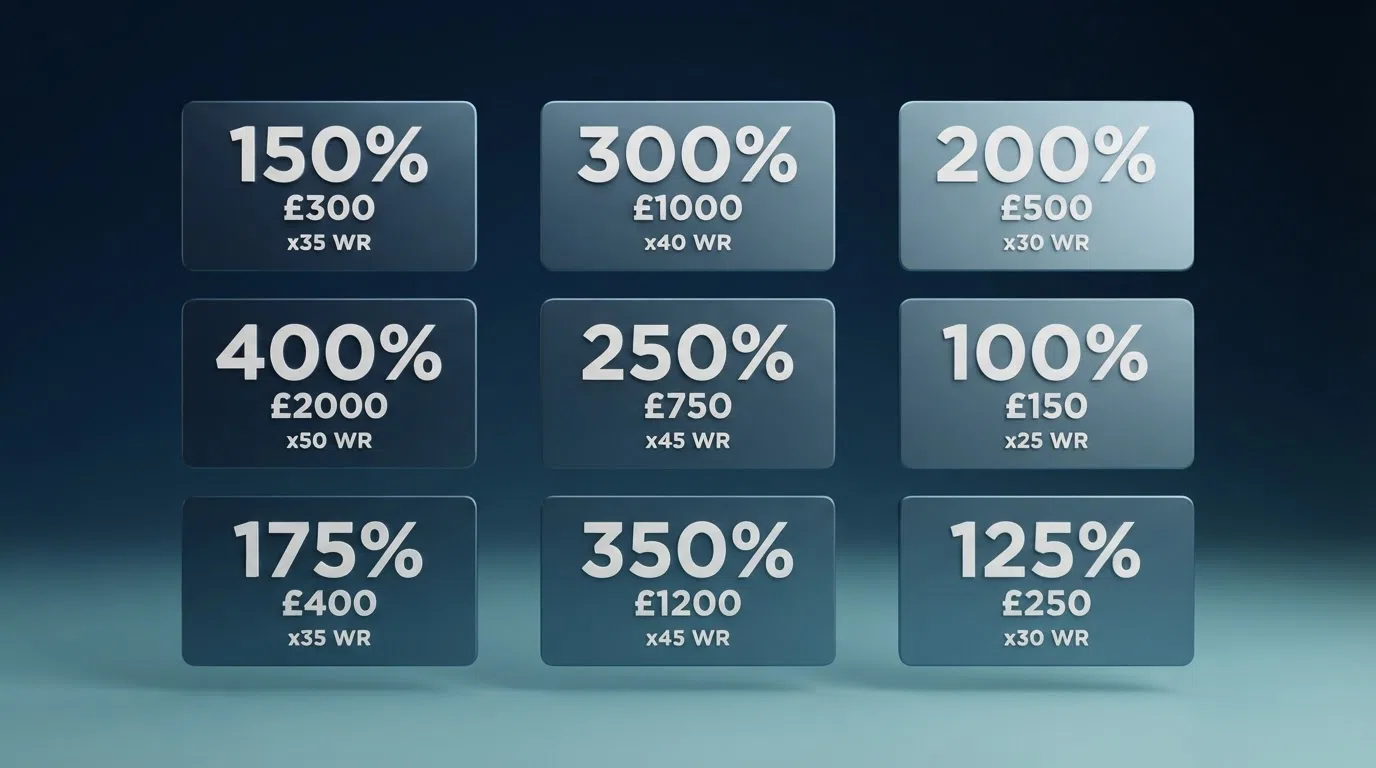
The ten operators below are Curacao-licensed, actively accepting UK players, and verifiable on the CGA public register (with one exception whose legacy licence status is noted). None of them hold a UKGC licence, and that is the entire point of the category. The ranking weighs bonus value against wagering fairness, because a 150% match at 30× is worth more in real terms than a 400% match at 40× with a tight max-cashout cap. The table is the side-by-side comparison; the profiles that follow are where the differences between them become legible.
| Operator | Curacao Licence | Welcome Bonus | Wagering | Crypto Support | Standout Feature |
|---|---|---|---|---|---|
| DonBet | OGL/2024/250/0115 (CGA register) | 150% up to £750 + 50 free spins | 30× | BTC, ETH, LTC, USDT | Established 2023; clean 30× terms |
| Cosmobet | CGA direct licence (active on register) | 400% up to £3,200 + 150 free spins | 40× | BTC, ETH, USDT, XRP | Largest percentage match in the set; multi-deposit |
| Rolletto | CGA direct licence (active on register) | 150% up to £1,500 + 50 free spins | 30× | BTC, ETH, LTC | Sportsbook alongside the casino |
| Seven Casino | CGA direct licence (active on register) | 150% up to £1,000 + 50 free spins | 30× | BTC, ETH, USDT | Slots-focused library |
| Zizobet | CGA direct licence (active on register) | Welcome package (details vary) | ~35× | Yes | Slots and live casino under one roof |
| Wildies | CGA direct licence (active on register) | 800% up to €7,800 + 1,000 free spins + 25% cashback | ~40× | Yes | Largest headline package; multi-deposit; euro-denominated |
| BetMac | CGA direct licence (active on register) | 100% up to £1,500 + 100 free spins | 30× | BTC, ETH | Newer 2025/26 launch |
| ZeSlots | CGA direct licence (active on register) | 250% up to £5,000 + 35% cashback (or 250% up to 5 BTC + 35% cashback) | 35× | BTC, ETH, LTC | Crypto-first welcome variant |
| 1xCasino | Legacy/master licence (verify on CGA register) | Up to €1,500 + 150 free spins | 35× | BTC, ETH, LTC, USDT, XRP | Broadest crypto support; €5 max bet while bonus active |
| CasinOK | OGL/2024/1800/1049 (CGA register; Ryker B.V.) | Up to $6,000 + 200 free spins | 35× | BTC, ETH | 5× max cashout cap on bonus winnings |
DonBet — Solid Mid-Range Welcome With a Manageable Wagering Multiple
DonBet runs a 150% match up to £750 with 50 free spins at 30× wagering, on a CGA direct licence (OGL/2024/250/0115) issued in 2024. The 30× multiple is the lowest in the featured set outside the other 30× operators, and the absence of a max-cashout cap on bonus winnings in the published terms puts DonBet among the cleaner offers on the page. Crypto support covers Bitcoin, Ethereum, Litecoin, and USDT. The brand has been operating since 2023, which is meaningful at a Curacao casino: a three-year track record is something a 2025/26 launch cannot offer, and the absence of a regulatory complaints forum means the player community is the main evidence base for withdrawal behaviour. For a UK player who wants a straightforward welcome with a manageable playthrough, DonBet is the obvious comparator. The 30× term is the part of the offer to weigh, not the 150% headline.
Cosmobet — The Biggest Percentage Match in the Set, With a Catch
A 400% match up to £3,200 with 150 free spins is the largest percentage figure in the featured set, but it is a multi-deposit package — the headline is reached across several deposits, not on the first one — and the wagering requirement is 40×, at the upper end of what this ranking has already weighed. The crypto support is broad: Bitcoin, Ethereum, USDT, and XRP, the last of which is unusual in this set. The CGA direct licence is active on the public register. For a UK player attracted to the percentage figure, the 40× requirement is the number to test against a realistic deposit. A 400% match at 40× asks for substantially more playthrough per pound of bonus than a 150% match at 30×, and the value calculation depends on how much of the headline the player actually claims and how long they are willing to grind the wagering.
Rolletto — The Sports-and-Casino Hybrid With a Flexible Welcome
Rolletto’s welcome is 150% up to £1,500 with 50 free spins at 30× wagering — the same multiplier as DonBet, with a higher cap and a different product mix. The distinguishing feature is the sportsbook: a UK player who wants a single wallet for casino and sports betting has a Curacao option here that most of the set does not offer. Crypto support runs to Bitcoin, Ethereum, and Litecoin. This licence is confirmed on the CGA register. For a player whose play is split between slots and sports, Rolletto is the cleanest fit in this set; for a casino-only player, the comparison with DonBet comes down to the cap and the game library.
Seven Casino — Slots-Focused With a Clean 150% Welcome
Seven Casino offers 150% up to £1,000 with 50 free spins at 30× wagering, on a slots-focused library. Crypto support is Bitcoin, Ethereum, and USDT. The operator’s status is verified on the CGA register. The wagering multiple matches DonBet and Rolletto, and the cap sits between the two. The library curation is the differentiator: a slots-first player will find a tighter provider mix here than at a generalist Curacao casino, and the absence of a sportsbook is a feature for a player who wants one tab open rather than four. The 30× term is the relevant figure; the 150% is the marketing.
Zizobet — Slots and Live Casino Under One Welcome Package
Zizobet’s welcome package details vary by period, which is itself a flag worth noting — a published offer that changes between visits is harder to evaluate against a published wagering multiple. The wagering requirement is approximately 35×, and the operator accepts crypto. The product offering is a slots and live-casino combination under one roof, which suits a player who wants both without a sportsbook complication. The CGA direct licence is active on the register. The honest summary: the welcome is competitive, the offer is variable, and the player should confirm the current terms on the operator’s site before depositing rather than rely on a cached version.
Wildies — The Highest Multi-Deposit Package on the List, Euro-Denominated
Wildies runs an 800% match up to €7,800 with 1,000 free spins and 25% cashback, spread across multiple deposits at approximately 40× wagering. The 800% headline is the largest in the set, and the structure of the offer is a multi-deposit package, so reaching the headline figure requires the player to fund several deposits rather than one. The offer is denominated in euros, which means a UK player depositing in pounds takes a currency-conversion hit on every transaction, and the conversion rate the operator’s payment processor applies may not be the rate the player expected. The CGA direct licence is active on the register. For a UK player, the 800% headline is a marketing figure rather than a direct pound-for-pound bonus; between the 40× wagering, the multi-deposit structure, and the euro-denominated balance, the real value is lower than it appears. It remains a viable option for players who can manage the conversion and the playthrough requirements, but the headline rate itself is not the final number.
BetMac — A Newer Launch With a Straightforward 100% Match
BetMac is a recent entrant in the 2025/26 window, offering 100% up to £1,500 with 100 free spins at 30× wagering. The 100% match is the leanest percentage in the set, but the 30× wagering matches DonBet, Rolletto, and Seven Casino, and the 100 free spins is the most generous spin allocation in the 30× cluster. Crypto support is Bitcoin and Ethereum. The trade-off is the one every new launch carries: a casino with a 2025/26 vintage does not have a multi-year track record, and the player-forum evidence on withdrawal behaviour is correspondingly thin. For a UK player comfortable with the lack of history, the terms are among the more accessible options listed. However, those who prioritise a proven track record may find an established 2023 operator like DonBet to be a more suitable benchmark.
ZeSlots — A Crypto-First Welcome With a Cashback Alternative
ZeSlots offers a fiat welcome of 250% up to £5,000 with 35% cashback, and a parallel crypto welcome of 250% up to 5 BTC with 35% cashback, both at 35× wagering. The 35% cashback is a meaningful structural feature: a percentage of net losses returned in cash (rather than as a bonus with its own wagering) reduces the effective cost of a poor run in a way a straight-up match does not. Crypto support is Bitcoin, Ethereum, and Litecoin. The CGA direct licence is active on the register. For a UK player who wants a crypto-denominated welcome, ZeSlots is the only operator in the set offering a dedicated BTC variant alongside the fiat offer; for a fiat-only player, the cashback is the feature to weigh against the higher wagering relative to the 30× cluster.
1xCasino — A Multi-Deposit Legacy Operator With a €5 Bet Cap While Bonus Is Active
1xCasino is a legacy Curacao brand, and the licence status should be verified on the CGA public register at the time of play, because legacy master-licence operators are precisely the category the LOK reform was designed to retire. The welcome is up to €1,500 with 150 free spins across multiple deposits at 35× wagering. The distinctive restriction is a maximum bet of €5 while the bonus is active, a per-spin cap that no other operator in the set imposes, and a meaningful constraint on a player who would otherwise stake higher. Crypto support is the broadest in the set: Bitcoin, Ethereum, Litecoin, USDT, and XRP. The combination of broad crypto, multi-deposit structure, and a per-bet cap makes 1xCasino the operator in the set where the bonus terms most directly affect how a player has to play, rather than just how much they have to wager.
CasinOK — A Large Multi-Deposit Package With a Hard 5× Max-Cashout Cap
CasinOK runs up to $6,000 with 200 free spins across multiple deposits at 35× wagering, on a CGA direct licence (OGL/2024/1800/1049, Ryker B.V.). The 5× max-cashout cap on bonus winnings is the tightest restriction in the featured set: a player who converts a large bonus balance can withdraw only five times their original deposit from the bonus-derived winnings, with the rest forfeited. For a player depositing $200, the maximum withdrawal from bonus play is $1,000, and the rest of any winnings on top of that does not pay out. Crypto support is Bitcoin and Ethereum. For a UK player reading the $6,000 headline, the 5× cap is the clause that decides what the offer is actually worth, and the player who treats the headline as the deal has not yet read the terms.
Getting Money In and Out: Banking and Withdrawal Realities at Curacao Casinos
The UKGC’s payment-channel rules do not follow a Curacao licence, so the payment mix at a Curacao casino is broader than what the regulated market allows. Credit cards are accepted, where the UK has banned them since April 2020. E-wallets function as they do elsewhere. Prepaid vouchers work for deposits, with the usual deposit-only limitation. The practical question for a UK player is not whether the methods exist — they do — but which combinations work for both deposit and withdrawal, and how long the withdrawal actually takes.
E-Wallets at Curacao Casinos: Neteller, Skrill and Trustly
Neteller, Skrill, and Trustly are confirmed at Curacao-licensed casinos across the featured set. Neteller and Skrill are near-interchangeable e-wallets with similar mechanics: deposit clears in minutes, withdrawal clears in hours to a day at most Curacao operators, and the e-wallet itself sits between the player and the casino, so the casino never sees the player’s bank details. Trustly is bank-linked and bypasses card networks entirely, pulling funds directly from a UK bank account and pushing withdrawals back to it. The e-wallet cluster is the closest analogue to the UKGC-regulated player’s familiar payment experience, with the same speed and the same separation from the card network.
Paysafecard and Prepaid Deposits: Deposit-Only Convenience
Paysafecard deposits work at Curacao casinos using a 16-digit PIN purchased from a UK retailer, and the deposit clears in the same way a card deposit would. The limitation is structural: a Paysafecard voucher is a deposit instrument, not a withdrawal instrument, and the player who funds their account with Paysafecard has to nominate a different method (a bank transfer, an e-wallet, or crypto) for the withdrawal. The appeal of the method is that it caps spending at the value of the PIN, which is a feature for a player who wants to set their own deposit ceiling without relying on the casino’s responsible-gambling tools.
Crypto at Curacao Casinos: More Speed, More Privacy, No Banking Middleman
Every operator in the featured set accepts at least Bitcoin and Ethereum, and most accept a broader range. The payment rail matters because it is the part of the transaction the UKGC cannot easily reach. Card networks and e-wallets can be referred to for payment-channel disruption; on-chain crypto transactions are not routed through a UK-licensed intermediary, and that is the structural reason crypto is the default at Curacao casinos rather than a niche.
Bitcoin and Ethereum at Curacao Casinos: How It Works
A BTC or ETH deposit goes from the player’s wallet to a casino-controlled wallet address, and the casino credits the player account once the transaction reaches the relevant number of network confirmations (typically one to three for BTC, faster for ETH). Withdrawals reverse the process: the player requests a withdrawal to their own wallet, the casino approves it, and the funds arrive in minutes to a few hours depending on network conditions. Crypto withdrawals are materially faster than fiat at most Curacao operators, where bank transfers can take several working days. The exchange-rate exposure is the part a UK player should price in: a withdrawal in BTC has a GBP value that depends on the rate at the moment of conversion, and a player who holds BTC between deposit and withdrawal takes the market risk.
Privacy and Anonymity: What Crypto Actually Delivers at Curacao Casinos
Crypto reduces the personal-data trail at the payment-rail level. A card deposit or a bank transfer creates a record visible to the card issuer or the bank; a crypto transaction does not. What crypto does not do is remove identity verification. KYC checks still apply at most Curacao casinos, particularly at withdrawal thresholds, and the casino typically asks for the same documents a UKGC operator would at cash-out. A UK player using crypto avoids bank-level transaction scrutiny but not operator-level identity verification, and the two should not be confused.
Slots and Live Games at Curacao Casinos: What Is Actually on Offer
The game libraries at Curacao casinos are not bound by the UKGC’s game-design rules, and the result is a different mix from a UKGC site in two directions. The slots catalogue tends to be wider in raw title count and narrower in the sense that some UK-facing studios do not license to every Curacao operator. Live dealer and table games are widely available, and crypto-native game providers (which often do not hold UKGC approval) appear more frequently.
Slot Providers and Game Libraries: Who Powers Curacao Casinos
The major slot providers — Pragmatic Play, Evolution (for live), NetEnt, Play’n GO, and several others — appear across the Curacao casino set, though not at every operator and not always at the same RTP configuration. Auto-play and turbo-spin features are present in the games, where the UKGC has banned them. A UK player moving from a UKGC site to a Curacao casino will see familiar titles and a familiar mechanic, with the difference being that the speed-up features the UKGC has removed are still in the game.
RTP and Volatility: What to Expect From Curacao Casino Slots
RTP (Return to Player) is the long-run percentage of stakes a slot returns to players, and volatility describes how that return is distributed — high-volatility slots pay out less often in larger amounts, low-volatility slots more often in smaller amounts. The UKGC requires slots to publish RTP; a Curacao casino is not under the same mandate, and a slot at a Curacao operator may publish its RTP, may not, or may publish a figure lower than the studio’s default. Volatility is rarely published as a number; it is usually read from a slot’s behaviour over time. The honest summary for a UK player: the major studios keep RTPs at parity across jurisdictions as a matter of commercial practice, but the player who needs to verify a specific figure should check the game information panel at the operator, and treat a missing RTP as a missing piece of information rather than a reason to assume parity.
New Curacao Casinos: Fresher Launches, Fresher Risks
A new Curacao casino in 2026 is, by virtue of the LOK reform, a direct CGA licensee from day one — which is a cleaner starting position than the legacy master-licence operators, and a meaningful one for due diligence. The newness, though, is itself the variable. A 2025/26 launch has no multi-year track record, and the player-forum evidence on withdrawal behaviour is correspondingly thin.
How to Evaluate a Brand-New Curacao Casino Before You Deposit
- Confirm the CGA register entry, including the green B2C seal — the LOK reform means a new licence in 2026 is a direct OGL, not a sub-licence.
- Check the operator’s corporate disclosure: a registered company name, a physical address, and a named licence holder behind the brand.
- Read the bonus terms in full, with attention to unusually high wagering multiples (above 40×) and unusually low max-cashout caps (a 5× cap on bonus winnings is the tightest the set has shown).
- Search player forums for early feedback and withdrawal reports, recognising that the evidence base is thin at a brand-new operator and weighting recent reports accordingly.
New vs Established Curacao Casinos: The Trade-Off That Matters
An established casino with a three-year track record offers evidence a new launch cannot: a multi-year run of player-forum reports, a known withdrawal pattern, and a tested dispute-resolution process. A new casino often deploys an oversized welcome bonus to compensate for the empty reputation ledger, and the size of the welcome is, in that context, the marketing budget rather than the value proposition. The CGA does not require fund segregation, which makes track record a more important signal offshore than it is at a UKGC-licensed site. The honest summary: a player who treats the welcome bonus as the whole deal is reading a press release rather than a casino; the casino itself is the thing being bought.
Staying in Control: Responsible Gambling When the UK Safety Net Is Absent
The UK responsible-gambling infrastructure is built around the UKGC licence. The protections — GAMSTOP, the deposit-limit prompt, the £150 vulnerability check, the 10× bonus cap — all attach to the operator through the licence, and a Curacao operator has no UKGC licence. The British support infrastructure, by contrast, is available to UK residents regardless of where they gamble, and that distinction matters.
Deposit Limits, Reality Checks and Cooling-Off: What Curacao Casinos Offer
Most Curacao casinos offer deposit limits, session limits, time-out periods, and self-exclusion at the account level, because the tools are cheap to implement and the operators that want a reputation worth having implement them. What the operator is not required to do is any of the following: prompt the player to set a financial limit before a first deposit; run a financial-vulnerability check at £150 of net deposits in a 30-day window; show a gross deposit limit with equal prominence to other limits; or apply any UKGC-defined intervention. The tools exist where the operator chooses to provide them, and the player who relies on the regulator to require them is relying on a regulator that has no jurisdiction over the site.
Self-Exclusion Beyond GamStop: What Exists and What It Actually Covers
There is no cross-operator self-exclusion scheme that reaches Curacao casinos. GAMSTOP is a UKGC licence condition and binds UKGC operators; it does not extend offshore. A player who self-excludes via GAMSTOP and then opens an account at a Curacao casino will not be blocked. The available alternative is per-operator self-exclusion, which a Curacao casino may offer as a feature but is not required to enforce uniformly or to share with other operators. The practical consequence is that a UK player who wants the equivalent of GAMSTOP coverage across offshore sites has to self-exclude at each operator individually, and the discipline is the player’s rather than the system’s.
Where to Get Help in the UK: Helplines, Clinics and Support Services
The UK help infrastructure is available to any UK resident, regardless of where they gamble. The National Gambling Helpline is 0808 8020 133, free, confidential, and staffed 24 hours a day, run by GamCare. NHS specialist gambling-harm clinics numbered 15 in England as of 2024, and from 1 April 2026 NHS England took commissioning responsibility for gambling-harms treatment in England, funded by the statutory levy on operators. The Adult Psychiatric Morbidity Survey 2023–24 records 0.4% of adults in England as problem gamblers (PGSI 8+) and 1.6% as at least moderate risk (PGSI 3+), with almost 1.6 million adults who may benefit from treatment or support. GambleAware, Gamblers Anonymous, and NICE guideline NG248 on gambling-related harms round out the support pillars. The decision to play at a Curacao casino is the player’s, and the help available if the decision goes wrong is the same help a UK player at a UKGC site would be pointed toward.
How We Selected and Ranked These Curacao Casinos
The ten operators were drawn from Curacao-licensed casinos actively accepting UK players and verifiable on the CGA public register at portal.cga.cw, with one exception (1xCasino) whose legacy licence status is flagged for verification at the time of play. Each operator was checked against the UKGC public licence register and confirmed as not holding a British licence, which is the precondition for inclusion in a page on the non-GamStop Curacao category.
The ranking criteria were bonus value weighed against wagering fairness, because a 30× requirement is the player-friendly end of the Curacao range and a 40× requirement is the common end, with the percentage figure meaningful only in relation to the multiplier. The presence or absence of a max-cashout cap and a per-bet cap while a bonus is active was weighted heavily, because those are the clauses that decide what the headline number is actually worth. Crypto support was used as a differentiator (broader support, including XRP, is unusual) rather than a primary criterion, because every operator in the set accepts crypto. The LOK reform was the basis for distinguishing CGA direct licences from legacy licences, with direct licences preferred where both are available.
The verification note on every CGA licence is a reminder, not a hedge: the CGA public register is the single authoritative source for a Curacao licence, and a player should confirm the number on the operator’s site against the register before depositing.
Should You Play at a Curacao Casino in 2026? The Verdict From the Data
The data on the page draws a line. The Curacao casino proposition is real: the operators are reachable, the welcome bonuses are larger than the UKGC equivalent, the wagering requirements are competitive within the set, and the payment mix is broader than anything the regulated market allows. The wagering multiples the set actually runs (30× at the cleanest, 40× at the common end) and the absence of a UKGC-mandated 10× cap mean the headline number is doing real work, not being clipped at a regulatory ceiling. The crypto support is universal across the set, and the privacy and speed advantages are not marketing.
The line is drawn by the columns the table on UKGC versus Curacao licensing puts in the right-hand column. Every UKGC protection a player would have at a regulated site is absent at a Curacao casino: no complaints route, no ADR, no fund segregation, no GAMSTOP, no statutory intervention, no British consumer redress. The legal asymmetry is real and intentional — the operator faces section 33 of the Gambling Act 2005, the player faces nothing under the criminal law, and the player who is wronged has nowhere in the British system to take the case. The CGA does not handle individual player complaints. Fund segregation is not mandatory. The 32% engagement fall the UKGC has driven across disrupted sites is a measure of how visible a site is, not how safe the funds in it are.
The decision is the player’s, and the framing the data supports is this: a Curacao casino is a reasonable choice for a UK player who has weighed the trade-off, understands what is given up, and treats the welcome bonus as a marketing number whose real value depends on the wagering multiple and the cashout cap behind it. It is a poor choice for a player who has self-excluded via GAMSTOP and is looking for a way around that decision, because the GAMSTOP decision is the decision and the Curacao casino does not undo it; it routes around it. It is a poor choice for a player who is treating the absence of UKGC rules as a reason to skip the responsible-gambling tools the operator does offer. And it is a poor choice for a player who reads the £3,200 or €7,800 or $6,000 headline as the deal, because the deal is in the small print, and the small print is where the 40× and the 5× cashout cap and the multi-deposit structure live.
The numbers on the page are current as of September 8, 2026 and were checked against the CGA public register, the UKGC public register, and the Gambling Commission’s own disclosures. The trade-off the page describes is the trade-off that exists in 2026.
Frequently Asked Questions
What does a genuine Curacao casino licence look like in 2026?
A genuine Curacao licence in 2026 is a direct online gaming licence (OGL) issued by the Curaçao Gaming Authority under the National Ordinance on Games of Chance (LOK), which took effect in December 2024. The current player-facing seal in the site footer is the green B2C version, and the licence number should be verifiable on the CGA public register at portal.cga.cw. The old orange seal is no longer valid.
How much do I really have to wager before I can touch a bonus payout?
It depends entirely on the operator, and that is the point. The wagering multiples across the featured set run from 30× to 40× on the bonus amount, with some operators also capping the maximum bet while a bonus is active (1xCasino caps it at €5) and some capping the maximum cashout from bonus winnings (CasinOK caps it at 5× the deposit). The published terms on the operator’s site are the only authoritative source, and a player who has not read them has not read the offer.
Can I block myself from every Curacao casino the way GamStop does?
No. GAMSTOP is a UKGC licence condition, and a Curacao casino has no UKGC licence. The available alternative is per-operator self-exclusion, which a Curacao casino may offer but is not required to enforce or share. A UK player who wants GAMSTOP-equivalent coverage offshore has to self-exclude at each Curacao casino individually, and the discipline is the player’s rather than the system’s.
Who do I call if gambling is becoming a problem, and what actually happens when I do?
The National Gambling Helpline is 0808 8020 133, free, confidential, and staffed 24 hours a day by GamCare. NHS specialist gambling-harm clinics (15 in England as of 2024) offer treatment, and from 1 April 2026 NHS England commissions the service. GambleAware, Gamblers Anonymous, and NICE guideline NG248 are additional routes. The help is available regardless of where a UK player has been gambling.
Why did Curacao overhaul its whole licensing system, and are players any safer for it?
The LOK took effect in December 2024 because the old master-and-sub-licence model had been widely criticised as a layer of indirection that diluted accountability. The new system puts the OGL on the operator and on the CGA public register, and replaces the old orange seal with a green B2C seal. Players are marginally safer in the sense that the licence is now directly attributable to the operator and the register is the authoritative source — but a Curacao licence is still an offshore licence, fund segregation is still not mandatory, and the CGA still does not handle individual player complaints.
Can UK Players Actually Access and Play at Curacao Casinos?
Yes, and that is precisely what makes the situation awkward. There is no UK requirement for ISPs to block offshore gambling sites, no British equivalent of a state-level DNS blocklist, and no technical barrier that stops a UK IP address from reaching a Curacao casino lobby. Players simply open a browser, register, deposit, and play. The UKGC does not ask ISPs to filter; it does not require card issuers to decline transactions to known operators (it can refer payment channels to enforcement, which is a different lever). The result is that the sites are reachable, even though the UKGC’s stated position is that they should not be targeting British customers at all.
The Commission’s enforcement toolkit, in the period from April 2024 to June 2025, sent 3,140 disruption notices, referred 447,778 URLs to search engines for delisting, and saw 287,961 of those URLs removed. Across 160 disrupted sites, average engagement fell by 32%. Those are real numbers, but they measure the Commission’s ability to make a site harder to find — not its ability to make it disappear. Legislation to grant statutory ISP or DNS blocking powers (a Crime and Policing Bill proposal) has been discussed and not enacted. Until it is, the technical reality is that UK players can reach these sites, and the Commission works to reduce their visibility rather than their availability.
Account – nodeposit-casinobonuses-uk
Content created by the «nodeposit-casinobonuses-uk» team