UK Crypto Casinos Without KYC: The Offshore Reality Behind the Label
 Available in GB
Current as of September 8, 2026 · Licence and operator data verified against the UK Gambling Commission’s public register and the Curaçao Gaming Authority’s LOK register.
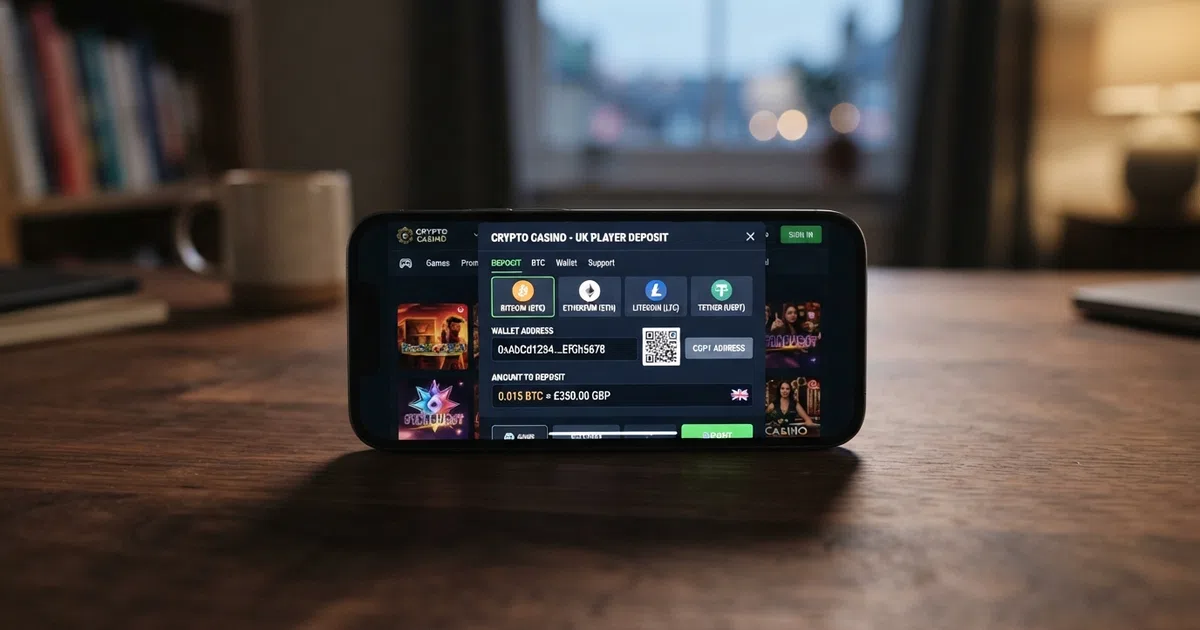
Every crypto casino that markets itself as “no KYC” to a British audience operates outside the UK Gambling Commission’s licensing regime. None of them holds a GB operating licence. The marketing word “anonymous” and the regulated word “verified” describe two different markets, and only one of them is permitted to take pounds from a player in Great Britain. This page is about the other one — who runs it, what it costs the person depositing, and what protections the player leaves behind when they sign up.
The starting point is the one every other claim on this page rests on: a crypto-only casino has never been granted a UKGC licence. The Commission’s published guidance on blockchain and crypto-assets puts the reason in plain terms — the anonymity afforded by some crypto-assets, along with weaknesses in the process of obtaining them, “have consistently caused problems for applicants, as in our experience they are unable to provide complete and satisfactory evidence to answer the questions we ask to determine applications.” A licence under the Gambling Act 2005, extended to remote operators by the Gambling (Licensing and Advertising) Act 2014, requires customer due diligence that anonymous crypto deposits cannot satisfy. The Commission’s CEO Andrew Rhodes put the policy position more bluntly at the IAGR 2025 Conference: “This is going to have to be government-level discussion… once you open that door, you cannot close it.” Until that door opens, the entire UK-accessible no-KYC crypto market is an offshore market by definition.
What a Crypto Casino Is — and What It Is Not
A crypto casino is an online gambling site that takes deposits and pays withdrawals in cryptocurrency rather than pounds, and substitutes some of the trust mechanisms a regulator would normally provide. The cashier is replaced by a wallet address. The slot reels, the live dealer tables, the sportsbook and the crash games look the same as they do anywhere else, but the rails under them are blockchain rails, the bank is a private key, and the licence on the footer is, almost always, Curaçao, Anjouan or Costa Rica.
For a UK player the trade looks simple from the outside: skip the upload of a passport, skip the source-of-funds check, deposit in BTC or USDT, play, withdraw. The reality is more layered. 77% of cryptocurrency-based casinos now offer provably fair titles, which means a SHA-256 or BLAKE2b hash chain lets a player check, after the round, that the operator did not alter the outcome. That is real, and it is one of the genuine improvements crypto gambling has brought to the table — but it verifies the round, not the operator. It does not check the operator will pay, that the stated RTP is honest, or that the site will still be in business next month. The house edge is still the house edge. The 3.5% of turnover a slot retains, the 1% a crash game retains, the rake a sportsbook retains — none of that disappears because the cashier shows a QR code instead of a card field.
Crypto vs Traditional Online Casinos
Five structural differences decide what playing at one actually feels like. The first is licensing: a UK player at a GB-licensed site is playing under UKGC licence conditions and codes of practice; at an offshore crypto casino, they are playing under whatever rules the operator’s home jurisdiction applies, which in the Curaçao case is a licence that is, in many cases, only months old under the new LOK regime. The second is KYC: a GB-licensed operator has verified the customer’s name, address and date of birth before any money moves — that requirement took full effect on 7 May 2019 — while an offshore operator’s “no KYC” promise is in practice a threshold-KYC promise, with documents requested only at withdrawal triggers. The third is payment rails: a bank transfer or a debit card at a licensed site becomes an on-chain transaction at a crypto casino, with the speed and cost consequences that brings. The fourth is game fairness: a GB-licensed site’s games run on RNGs tested by an approved testing house, with results the regulator can audit; a crypto casino’s provably fair titles let the player audit each round, but only for the games the operator chooses to make provably fair, and only for the round in question. The fifth is player protection: a GB-licensed site sits inside GAMSTOP, offers a UKGC complaints route and an approved ADR provider, applies a £5 or £2 per-spin stake cap, runs mandatory deposit-limit prompts and financial vulnerability checks. At an offshore crypto casino, none of those apply.
The legal commentary crystallises the divide in a single line. Excluding cryptocurrency from the licensed market, as one specialist firm has put it, “does not prevent its use in gambling, it simply determines where that gambling takes place.” The licensed pound stays inside the regulated ring; the crypto coin leaves it. Both belong to the same player; the rules under which each is treated are not the same rules.
Crypto Gambling Terminology
A dozen terms a UK player will hit within five minutes of opening an account.
- BTC and mBTC: Bitcoin and millibitcoin. 1 BTC = 1,000 mBTC; most slot stakes are quoted in mBTC because 0.0001 BTC sounds alarming and 0.1 mBTC does not.
- USDT and USDC: Two stablecoins pegged to the US dollar, the two most-deposited tokens at crypto casinos because they remove the price-volatility worry a player would otherwise have while a spin is in flight.
- TRC-20 vs ERC-20: Two networks USDT runs on. Tron-network USDT (TRC-20) typically settles in under a minute for a fraction of a cent in fees; Ethereum-network USDT (ERC-20) can cost $5–$30 in gas during congestion and takes one to three minutes.
- Altcoin: Anything that is not Bitcoin. At the largest operators, the altcoin list runs to 100 or 150 entries.
- Seed phrase: The 12 or 24 words that back up a private crypto wallet. The phrase is the wallet; whoever has the words has the coins.
- Hot wallet vs cold wallet: A hot wallet is connected to the internet and used for everyday play; a cold wallet is offline and used for storage. Operators hold player balances in hot wallets and move the float to cold storage.
- On-chain transaction: A transfer recorded on the blockchain itself, visible to anyone with the wallet address. Every deposit and withdrawal at a crypto casino is one.
- Lightning Network: A second-layer network on top of Bitcoin that settles transactions in seconds for fractions of a penny. A handful of operators (Betplay among the featured set) accept Lightning deposits.
- Provably fair: A cryptographic mechanism — most commonly a SHA-256 or BLAKE2b hash chain — that lets the player verify, after a round, that the operator did not change the result. It is described in more detail in the blockchain trust section below.
The UK Legal Reality: No Crypto Casino Holds a GB Licence
Online casino is licensable in Great Britain — unlike France, which prohibits it, or Poland, where one state-run brand holds the market. The Gambling Act 2005 created a three-objective framework: prevent crime, keep gambling fair, protect children and the vulnerable. The Gambling (Licensing and Advertising) Act 2014 extended the regime to remote operators, so any company taking GB customers, wherever based, must hold a GB licence. The Gambling Commission (UKGC), an executive non-departmental public body sponsored by DCMS, is the single regulator, and it publishes a public register of every licence holder. A search of that register returns no crypto-only casino.
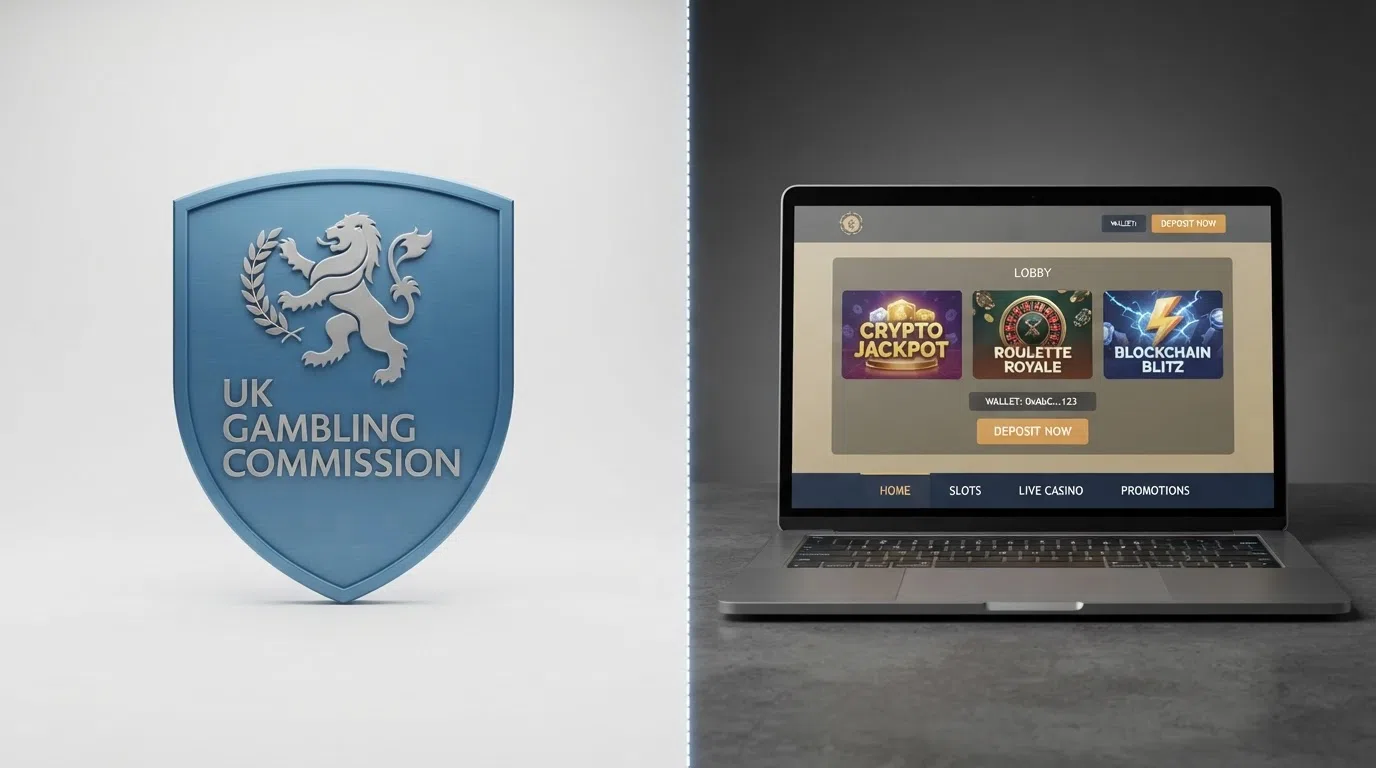
The Commission’s published view of crypto-assets puts the reason in the open. From the UKGC’s blockchain and crypto-assets guidance: the anonymity afforded by some crypto-assets, along with weaknesses in the process of obtaining them, “have consistently caused problems for applicants.” The Commission also rates cryptocurrency as a high-risk payment method from an AML perspective, and its CEO has made clear the door does not open by Commission decision alone. “Once you open that door, you cannot close it,” Rhodes told the IAGR 2025 Conference.
The player-side legal position is simpler than the operator-side one. A player who gambles on an unlicensed site commits no offence. The criminal liability sits with the operator, not the customer: section 33 of the Gambling Act 2005 carries up to 51 weeks’ imprisonment, an unlimited fine, or both for providing gambling facilities without a licence. The Commission’s enforcement against the illegal market runs through disruption — cease-and-desist notices, search-engine URL referrals, domain-registrar and payment-provider pressure — and the published figures for April 2024 to June 2025 give the scale: 3,140 disruption notices issued, 447,778 URLs referred to search engines for delisting, 287,961 URLs actually removed, with an average 32% fall in engagement across 160 disrupted sites. The Commission does not hold statutory ISP or DNS blocking powers, though legislation has been proposed, and the engagement figures show why it wants them: the average fall across disrupted sites is a third, and the rest keep their traffic.
What “No KYC” Means in the UK Context
A site that promises no KYC almost never means a site that will never ask for documents. The honest framing, used by the no-KYC specialist FruityFreeSpins, is that “no-KYC almost never means never any checks — for most crypto casinos it really means light-KYC or threshold-KYC.” The deposit goes through, the play happens, the small withdrawal goes through. The verification request arrives later, when one of a handful of triggers fires: a withdrawal crosses a threshold the operator sets internally; a “big-winner clause” flags an outsized payout; a fraud or AML flag hits; the player’s stake size or deposit pattern changes; or the funds themselves are flagged as high-risk on-chain.
Two of the operators in this page’s comparison set illustrate the spread. Jackbit reserves identity verification for genuine fraud and AML flags, not withdrawal thresholds, and is the operator most consistently described as genuinely no-KYC by the review sites; it also supports a built-in Monero wallet, the on-chain privacy coin that breaks the public-link chain Bitcoin and Ethereum leave behind. BC.Game, on the other hand, markets itself as no-KYC at signup but carries withdrawal-gated soft thresholds and a big-winner clause that can trigger document requests even after a long history of small, fast payouts. The “no” in no-KYC is, in practice, a threshold plus a list of exceptions; the size of the threshold and the breadth of the exceptions decide whether the promise holds for the player in question.
Why Crypto Casinos Cannot Hold a GB Licence
Three regulatory barriers lock crypto casinos out of the GB market, and the Commission’s own published language describes them. The first is AML and source-of-funds: licensed operators must monitor transactions, run customer due diligence under the Money Laundering Regulations, and answer the Commission’s questions about the source of customer funds. Anonymous crypto deposits cannot produce the evidence those answers require, and the Commission has said so on the record. The second is the pre-deposit KYC mandate: since 7 May 2019, a remote licensee must verify the customer’s name, address and date of birth before they can deposit or gamble, with their own money or with a free bet or bonus. The pre-2019 72-hour grace period is gone. A no-KYC operating model is, in the GB context, an unlicensed operating model by construction. The third is the Commission’s official rating of cryptocurrency as a high-risk payment method, which it published in April 2025, and which puts the Commission’s AML concerns on the public record rather than leaving them to a guidance page.
How Offshore Crypto Casinos Reach UK Players
The jurisdictional map of the offshore crypto market has shifted in the past year. Curaçao was, and remains, the dominant licensing jurisdiction, but the regime that issued the licences most offshore operators held for the last decade is gone. The Curaçao Gaming Authority’s Orange Seal — the Certificate of Operations under the old sublicence system — expired on 15 October 2025. Every operator that was operating under a sublicence must now hold a direct licence under the new LOK (National Ordinance on Games of Chance) regime. The transition has not been frictionless: BC.Game withdrew from its Curaçao licence on 5 December 2025, describing the operating environment as “increasingly hostile,” after the Curaçao Gaming Control Board signalled intent to revoke the licence of Small House B.V. (the entity trading as BC.Game) over disputed player claims. The CGA has published a crypto policy guideline for B2C licensees, requiring compliant crypto policies by June 2026 and risk assessments by December 2026.
Costa Rica is the second home of the offshore crypto market, but it is a home without a gambling-licence scheme. Betplay is operated by Lama Tech Limitada, registered in Costa Rica, and Costa Rica issues no gambling-specific licences at all. The legal status of an operator there is closer to “unlicensed” than “licensed under a weaker regime,” and the player-protection consequences follow from that. Anjouan is the third jurisdiction in active use. Bets.io is operated by TESSERA LIMITED S.R.L., a Costa Rican entity, and holds an Anjouan licence; Anjouan’s regime is younger than Curaçao’s and its enforcement record thinner.
The UKGC’s response to the offshore market is disruption, not blocking. The April 2024 to June 2025 figures — 3,140 disruption notices, 447,778 URLs referred, 287,961 removed, 32% average engagement fall across 160 disrupted sites — describe a real but partial pressure. The Commission does not hold statutory ISP or DNS blocking powers, and a third of engagement is not the same as zero. The reach of a URL referral depends on the search engine and the delisting cooperation it gets; the reach of a payment-provider referral depends on the operator’s banking relationships. Crypto deposits move on rails the Commission cannot pressure the same way, which is one of the reasons the offshore market keeps growing despite the disruption effort.
What a UK Player Gives Up at an Offshore Crypto Casino
The list is long enough to read in full once, here, and to refer back to in the operator reviews below. The protections a GB-licensed site provides by condition of its licence, an offshore crypto casino does not provide at all, because none of the conditions apply.
- No GAMSTOP self-exclusion coverage — the GB-licensed self-exclusion register, mandatory for every online operator since 31 March 2020, does not reach offshore sites.
- No UKGC complaints route — a player with a complaint against a GB-licensed site has a regulator to escalate to; an offshore player does not.
- No approved ADR provider — GB licensees must offer an alternative dispute resolution service; offshore operators do not.
- No British consumer redress if funds are withheld — a UK court order against an offshore operator is only as good as the operator’s assets and the jurisdiction’s enforcement.
- No £5 or £2 per-spin stake cap — the age-banded slot stake cap introduced in April and May 2025 does not apply offshore.
- No mandatory deposit-limit prompt before first deposit — a GB-licensed operator must prompt a customer to set a financial limit before their first deposit; an offshore operator is not required to.
- No financial vulnerability check at £150 net deposit in a rolling 30-day period — the LCCP Social Responsibility Code 3.4.4 check, in force since 28 February 2025, applies only to licensed sites.
- No ban on auto-play or fast spins — the game-design rules in force since 31 October 2021 do not apply offshore, and many crypto slot providers offer turbo modes a UK site cannot.
- No 10× wagering cap on bonuses — the hard cap introduced on 19 December 2025 applies only to GB-licensed operators; offshore operators set their own, often far higher.
- No credit card ban — the ban on credit cards for all remote gambling, in force since 14 April 2020, does not extend to an offshore crypto cashier.
The one partial trust substitute is the provably fair mechanism described in the blockchain trust section below. It is a real improvement, and it verifies a real thing. It does not verify any item on the list above.
UK-Accessible Crypto Casinos Compared
Ten offshore operators accessible to UK players sit in the comparison below. None of them holds a GB operating licence. None of them offers GAMSTOP coverage, a UKGC complaints route, an approved ADR provider or British consumer redress if funds are withheld. The table is honest about that. The licence column is the jurisdiction the operator is actually registered in — Curaçao, Anjouan, Costa Rica or “no confirmed gambling licence” for the operator that does not list one. Wagering is the multiplier that applies to the bonus (or “—” for the rakeback and wager-free models where the column does not apply). Free spins is the count bundled into the welcome offer. Game count is the operator’s own total, where stated; the research has it for the majority of the set and the column drops to a dash where the operator does not.
| Operator | Licence / Jurisdiction | Welcome Bonus | Wagering (Bonus) | Free Spins | Game Count |
|---|---|---|---|---|---|
| Jackbit | Curaçao Gaming Authority | 100 FS on first deposit (min $50) | 10× on FS winnings | 100 | — |
| BC.Game | Withdrew from Curaçao 5 Dec 2025; other licences unconfirmed | 120% up to $1,000 + 100 FS (first deposit); full multi-deposit up to $20,000 + 400 FS | 20× bonus / 40× FS | 100 (first); up to 400 (package) | 10,000+ |
| Betplay | Costa Rica — no gambling-specific licence | 100% up to 5,000 USDC | 80× | — | 6,000+ |
| Vave | No confirmed gambling licence | 150% up to 1.5 BTC + 100 FS (1st of 4 deposits; package up to 4 BTC) | 50× bonus and FS | 100 (first) | 7,000+ |
| Winz.io | Curaçao | Up to $10,000 or 130 mBTC | 0× | Variable (spin-the-wheel) | 6,000+ |
| Stake | Curaçao (Stake.com international) | 3.5% lifetime rakeback | 0× on rakeback | — | — |
| Duelbits | Curaçao (reported as blocking UK visitors) | Ace’s Rewards rakeback up to 50% of initial deposit | 0× on rakeback | — | 2,400+ slots + 180+ live tables |
| Bets.io | Anjouan (TESSERA LIMITED S.R.L., Costa Rica) | 225% up to 1 BTC + 225 FS across three deposits | 40× bonus and FS | 225 | 5,400+ |
| Casinobet | Curaçao (Mandarin Gaming N.V.) | 400% up to 1 BTC + 400 FS across three deposits | ~50× effective / 35× FS | 400 | — |
| FortuneJack | Curaçao | 500% in freespins | 30×–40× | Variable | 2,748+ slots |
Two figures in the table above are the kind of small-print details that decide whether a bonus is worth claiming and are worth carrying into the operator reviews. Jackbit’s 100 free spins are advertised as 0× wagering on the spins, but the winnings from the spins carry 10× wagering within seven days and a $100 maximum withdrawal cap. Vave’s no-deposit free-spin payout is capped at 50 USDT, separate from the four-deposit package total. The table compresses both into a single column; the operator sections spell them out.
Comparison Factors: How We Evaluated Each Operator
Five criteria ordered this ranking, and they are the five a player should weigh in the same order. The first is licence status and jurisdiction quality. A Curaçao direct LOK licence is a different object from a sublicence under the old Orange Seal, and a Costa Rica registration is a different object from a Curaçao LOK licence. Vave’s “no confirmed gambling licence” is a third object again. The second is bonus value net of wagering requirements. The 10× cap on bonuses at GB-licensed sites is the benchmark; the offshore market routinely exceeds it by a factor of four to eight, and a 400% match at 50× wagering is a different offer from a 100% match at 0×. The third is game depth and provider quality: a 10,000-game library with 38+ providers and 74 proprietary provably fair titles is a different product from a 2,400-slot library with one dominant live provider. The fourth is KYC policy: genuinely no-KYC (Jackbit, with verification reserved for fraud and AML flags) is a different commitment from threshold-KYC (BC.Game, with the big-winner clause sitting behind the marketing copy) from “reserves the right to verify at any time” (Vave). The fifth is withdrawal speed and payout limits: a five-minute Bitcoin test at Betplay is a different experience from a same-day cashback payout at Winz.io, and a no-upper-limit crypto withdrawal at Duelbits is a different ceiling from a $100 cap on free-spin winnings at Jackbit.
No real-money testing was conducted for this review. Operator terms and bonus conditions change; geo-blocks may apply to specific UK visitors at any of these operators. The licence status in the table was verified against the UKGC’s public register (where the absence of a GB licence was confirmed) and the Curaçao Gaming Authority’s LOK register; the bonus figures were taken from operator terms pages and the independent review sites cited in research.
Jackbit
Curaçao-licensed, and the operator most consistently described by review sites as genuinely no-KYC. Verification is reserved for genuine fraud and AML flags, not for withdrawal thresholds, which is the practical difference between Jackbit and a threshold-KYC operator. The site supports a built-in Monero wallet, the on-chain privacy coin that breaks the public-link chain Bitcoin and Ethereum leave on the blockchain, and the only one in the featured set to do so. The welcome offer is 100 free spins on a first deposit of at least $50; the spins themselves are advertised as 0× wagering, but the winnings from the spins carry 10× wagering within seven days and a $100 maximum withdrawal cap on the FS winnings. The package is honest about the small print, which is part of why review sites rate it the way they do. With its Monero support and lack of withdrawal-based triggers, Jackbit represents a distinct, privacy-focused path for the UK player.
BC.Game
The 10,000-game giant that walked away from its Curaçao licence on 5 December 2025, after the Curaçao Gaming Control Board signalled intent to revoke the licence of Small House B.V. over disputed player claims. The site now operates under other licences whose jurisdictions research did not confirm; the licence column of the table reflects that gap. The library is the deepest in the featured set: 10,000+ games from 38+ providers, 74 BC Originals in the provably fair section, and the altcoin spread is the widest in the market at 150+ cryptocurrencies supported. The welcome offer is 120% up to $1,000 plus 100 free spins on the first deposit, with 20× wagering on the bonus, 40× on the free spins, 30-day bonus validity, and a maximum win from free spins of $5; the full multi-deposit package reaches up to $20,000 + 400 FS. The minimum deposit is $5. The KYC story is the marketing word “no-KYC” in tension with the small-print words “withdrawal-gated soft thresholds” and “big-winner clause,” both of which can trigger document requests even on a long history of fast payouts. BC.Game provides an unmatched game library for those who value variety, though the evolving licence status and potential KYC triggers are factors to consider before diving in.
Betplay
Costa Rica-registered and Lightning Network-fast, which is the short version. The operator is Lama Tech Limitada, and Costa Rica is a jurisdiction that issues no gambling-specific licences at all, so the “licence” column is closer to “registered” than to “licensed.” The site carries 6,000+ games from roughly 70 studios, supports a no-KYC-by-default policy, and accepts Lightning Network deposits. The welcome bonus is 100% up to 5,000 USDC with 80× wagering — 7 days to activate, 30 days to clear, 10 USDT maximum bet while the bonus is active. The 80× is the highest in the featured set, and it is the reason the bonus is in the table and not in the verdict. A test Bitcoin withdrawal was paid within five minutes in the Bitranked test cited in research, which is the fast end of the market and the practical reason a player puts up with the 80× in the first place. Betplay is purpose-built for speed and Bitcoin users, provided they accept the lack of formal regulation.
Vave
A four-deposit welcome package totalling up to 4 BTC, with no confirmed gambling licence. Research’s entry for Vave describes “No License” and notes that the operator reserves the right to verify at any time, which is a meaningfully different policy from Jackbit’s fraud-and-AML-only verification or BC.Game’s threshold-gated approach. The site carries 7,000+ games across 100+ supported cryptocurrencies, which is the second-widest altcoin spread in the featured set. The welcome package breaks down as 150% up to 1.5 BTC + 100 free spins on the first deposit, 100% up to 1 BTC on the second, 50% up to 1 BTC on the third, and 25% up to 0.5 BTC on the fourth; 50× wagering applies to both the bonus and the free-spin winnings, with a 30-day redemption window. The maximum no-deposit free-spin payout is capped at 50 USDT. Vave focuses on high-volume bonus packages across its multi-deposit structure; players should read the terms to understand how its verification policy might impact withdrawals.
Winz.io
The wager-free outlier. Curaçao-licensed, with a welcome crypto bonus of up to $10,000 or 130 mBTC, zero wagering requirements on any of it, and a 20% daily cashback on net losses with no wagering and no cap, paid the following day between 09:00 and 10:00 UTC, with 14 days to use. The spin-the-wheel free-spin mechanic is the small-print surprise; the headline is the 0×. The site carries 6,000+ games and was awarded AskGamblers Best Online Casino 2025, which is a useful external signal in a market where award credibility varies. The 0× wagering makes every other number in this section read differently: a $10,000 bonus at 0× is worth what it says, with no expected-loss calculation required to find out what it costs. Winz.io stands out by removing the complexity of clearing requirements altogether.
Stake
The rakeback pioneer. Stake.com is the international crypto casino, Curaçao-licensed; the GB-licensed variant, Stake.uk, ran via TGP Europe and is now closed, which means a UK player reaching Stake.com is reaching the international site, not a regulated local product. There is no traditional welcome bonus. The model is 3.5% lifetime rakeback with zero wagering, applied from the first bet, alongside daily races, weekly raffles and a VIP rewards programme. The Stake Originals — Crash, Dice, Plinko, Mines and the rest — run on a provably fair SHA-256 hash chain, with Crash fixed at 99% RTP and 1% house edge. The absence of a deposit-match welcome is the visible difference from every other operator in this section; the rakeback model is the alternative, and it suits a player who would rather be paid for playing than be paid for depositing. Stake effectively replaces the traditional signup bonus with a long-term rewards structure.
Duelbits
A rakeback-first casino heavy on Evolution live tables, with a Curaçao licence and a geo-block that may apply to UK visitors. The Tokenist review cited in research describes Duelbits as “blocked in the US, UK, and Australia,” which is a meaningful caveat: a UK player may not be able to reach the site at all, and the bonus structure is irrelevant if the cashier does not load. The library is 2,400+ slots and 180+ live dealer tables, with Evolution Gaming providing approximately 75% of the live offering and high-volatility titles from Nolimit City and Hacksaw Gaming dominating the featured section. The welcome offer is Ace’s Rewards rakeback — up to 50% of the initial deposit returned (base rate 10% of the house edge per bet), with crypto withdrawals carrying no upper limit for verified accounts. The no-limit withdrawal is one of the genuinely different features in the set; the geo-block is the genuinely different caveat. Duelbits is a robust live-casino choice for those who can access it, though potential users should check for regional restrictions first.
Bets.io
An Anjouan-licensed operator with a 225% BTC bonus and no KYC on crypto deposits. The site is operated by TESSERA LIMITED S.R.L., a Costa Rican entity, holds an Anjouan licence, and carries 5,400+ games from 70+ studios including Amatic, Betsoft, Novomatic and Pragmatic Play, with 220+ live tables. The welcome offer is 225% up to 1 BTC plus 225 free spins across three deposits (100% up to 1 BTC + 100 FS on the first; 75% up to 1,000 USDT + 75 FS on the second; 50% up to 500 USDT + 50 FS on the third), with 40× wagering on both the bonus and the free spins, 7-day bonus validity, 20 USDT minimum deposit, 2 USDT maximum bet while the bonus is active, and up to 30% cashback. The 7-day bonus validity is the tightest in the featured set; the 225% is the highest single-deposit match. For a UK player who values a high-percentage match and is comfortable with Anjouan as a jurisdiction, Bets.io is the natural pick; the 7-day window is the cost, and the 40× is the other cost.
Casinobet
The 400% BTC welcome package from a 2023 Curaçao entrant, the newest operator in the featured set. The site is operated by Mandarin Gaming N.V. under a Curaçao licence, launched in 2023, and carries 6,000+ games from providers including Pragmatic Play, Hacksaw Gaming, Push Gaming and Play’n GO. The welcome package is 400% up to 1 BTC plus 400 free spins across three deposits, with approximately 50× effective wagering (10% of the cash bonus unlocks per 5× of the deposit wagered) and 35× on the free spins, a 21-day overall expiry, a 23-level VIP club reaching up to 65% combined rakeback and cashback, a $20 fiat minimum deposit, and no set crypto minimum. The 400% is the highest headline match in the set; the 50× effective is the cost; the 2023 launch is the other cost — a shorter track record, fewer resolved disputes on the public record, less community feedback to draw on. For a UK player who values a deep VIP structure and is comfortable with a newer operator, Casinobet is in the conversation; the recency of the launch is the reason to verify the licence and the withdrawal reports before depositing.
FortuneJack
The longest-running operator in the featured set, operating since 2014 under a Curaçao licence, and the entry with the deepest provably fair proprietary suite. The library is 2,748+ slots from 30+ providers, with Pragmatic Play (312 titles), Betsoft (211), Relax Gaming (194), Endorphina (192) and Hacksaw Gaming (183) leading the count, and the proprietary “Orbital Originals” suite covering Dice, Plinko, Mines, Crash, Hilo and Keno. The welcome offer is 500% in free spins, with 30×–40× wagering depending on the specific promotion, a 16-tier loyalty programme, up to 14% cashback, and a minimum deposit of 0.002 BTC. The longevity is the headline; the 500% in free spins is the bait; the 30×–40× is the cost. For a UK player who values a long track record and a strong provably fair proprietary suite, FortuneJack is the obvious pick in this set; the 500%-in-free-spins structure rewards volume rather than a single big deposit, and the wagering band is the constraint to clear.
Why Your 2026 Crypto Casino Bonus Is Smaller Than It Looks
The headline number on a crypto casino welcome page is a marketing number. The number a player ends up with is the expected value of the bonus after the wagering requirement, the game-weighting, the validity window and any maximum-win cap have done their work. The gap between the two is where the bonus’s real cost lives, and the GB-licensed market is the benchmark that shows how wide the offshore gap can get.
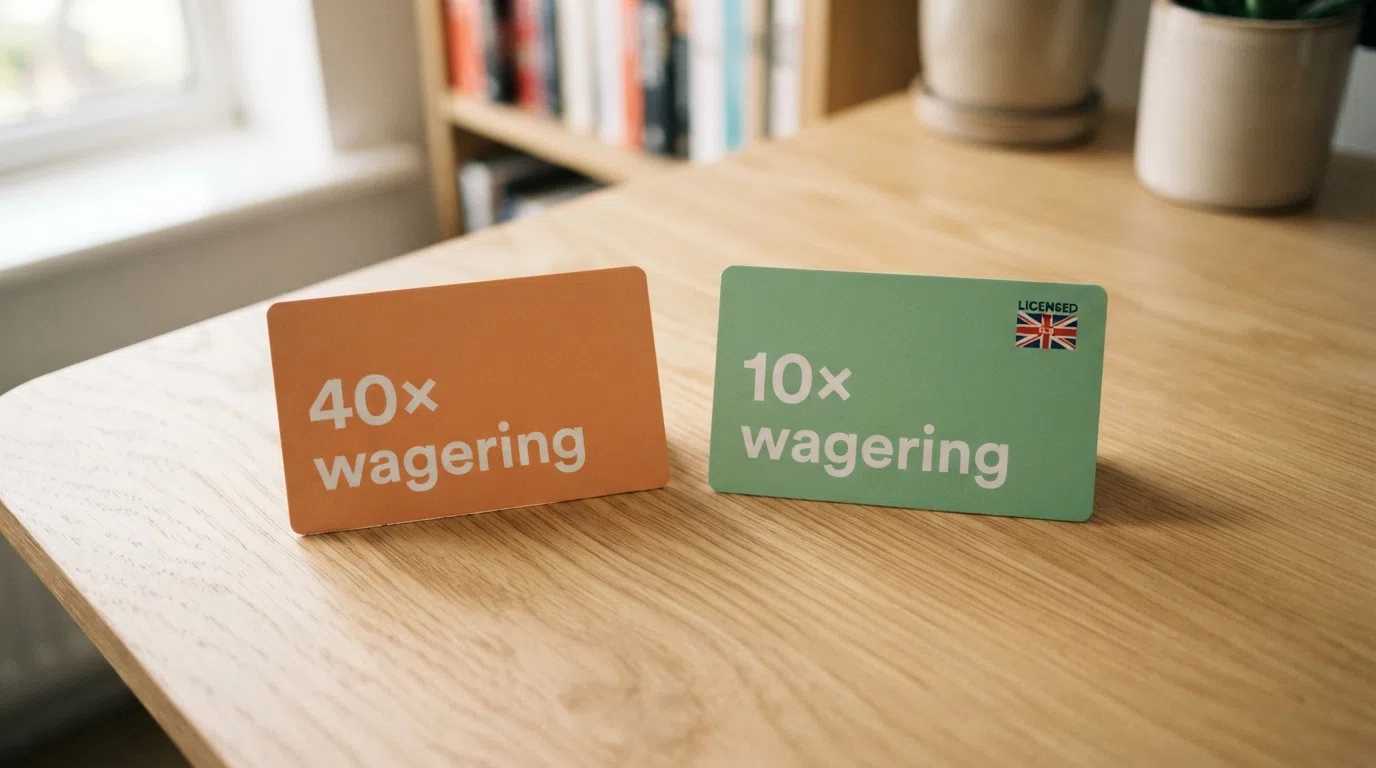
From 19 December 2025, wagering requirements at GB-licensed operators are capped at a hard 10× maximum under LCCP Social Responsibility Code 5.1.1, and mixed-product promotional offers are banned. Any page quoting 40× or 60× wagering at a GB-licensed casino is describing a pre-2025 market. The offshore market is not bound by that cap, and the wagering multiples across the featured set make the point. Betplay sits at 80× on the bonus; Bets.io at 40× on the bonus and free spins; BC.Game at 20× on the bonus and 40× on the free spins; Vave at 50× on both; FortuneJack at 30×–40×; Casinobet at an effective ~50×. Only Winz.io and the Stake and Duelbits rakeback models sit at 0×. The 10× cap, in other words, is a benchmark the offshore market routinely exceeds by a factor of four to eight.
A worked figure from the bonus-cost formula makes the cost legible. Take BC.Game’s 120% welcome offer up to $1,000, which on a $1,000 deposit becomes a $1,200 starting balance ($1,000 deposit + $200 bonus, with 20× wagering applying to the bonus). At 20× on the $200 bonus, the required turnover before withdrawal is $4,000. At 30 days to clear and a representative game with a 97% return-to-player (Aviator, the Spribe crash game provably fair at 97% RTP), the expected loss from $4,000 of wagering is $4,000 × (1 − 0.97) = $120. That is the statistical cost of clearing the bonus on the assumptions stated; it is an average over many spins, not a guaranteed outcome for any single player, and it says nothing about how likely a win is or what a payout would be worth.
The free-spin packages multiply the small print further. Jackbit’s 100 free spins come with a $100 maximum withdrawal cap on the FS winnings, which is a hard ceiling on what the package can ever be worth to the player regardless of what the reels do. Vave’s no-deposit free-spin payout is capped at 50 USDT, separate from the four-deposit package total. BC.Game’s free-spin winnings are capped at $5, the tightest cap in the set. The headline 225 free spins at Bets.io or the 400 at Casinobet read as volume; the win cap and the 40× wagering read as the cost of that volume.
Welcome and Sign-Up Bonuses at Crypto Casinos
The featured operators break into three groups on welcome structure. The deposit-match group runs from 100% (Betplay, up to 5,000 USDC) through 120% (BC.Game, up to $1,000 + 100 FS) and 150% (Vave, up to 1.5 BTC + 100 FS on the first of four deposits) through 225% (Bets.io, up to 1 BTC + 225 FS across three deposits) to 400% (Casinobet, up to 1 BTC + 400 FS across three deposits) and 500% in free spins (FortuneJack). The multi-deposit structures differ too: BC.Game offers up to $20,000 + 400 FS across four deposits, Vave up to 4 BTC across four, Bets.io and Casinobet across three. The second group is the wager-free model: Winz.io’s $10,000 welcome at 0×, with 20% daily cashback on top. The third is the rakeback-first model: Stake’s 3.5% lifetime rakeback with no traditional welcome, and Duelbits’s Ace’s Rewards rakeback up to 50% of the initial deposit. The deposit-match headline is what a player sees first; the wagering multiple and the win cap are what they should weigh.
No-Deposit Bonuses and Free Spins
True no-deposit bonuses — credit for the account, no deposit required — are scarce across the featured set. Most of what reads as a no-deposit offer is a deposit-triggered free-spin package, and the small print is the difference between an offer and a trap. Jackbit’s 100 free spins are deposit-triggered (minimum $50), advertised as 0× on the spins, but with 10× wagering on the FS winnings within seven days and a $100 maximum withdrawal cap on those winnings. BC.Game’s 100 free spins on the first deposit are paired with 40× wagering and a $5 maximum win from the free spins — the tightest cap in the set. Vave’s no-deposit free-spin payout, where one is offered, is capped at 50 USDT. Bets.io’s 225 free spins and Casinobet’s 400 free spins are both spread across three deposits, with the wagering multiples and validity windows described above. FortuneJack’s 500% in free spins is the largest headline; the 30×–40× wagering and the 16-tier loyalty path are the cost.
The critical distinction, the one that decides what “free” means, is between 0× wagering on the spins themselves and the wagering that applies to whatever the spins produce. Jackbit’s spins are 0×; the winnings are 10×. A 0× spin package with a 10× win cap is a small, fast offer with a hard ceiling; a 100× spin package with a $5 cap is a large, slow offer with a different hard ceiling. The audit a player should run before claiming any of them is the cap-to-wagering ratio, not the spin count.
Wagering Requirements — What to Watch For
Wagering requirements are the single number that decides whether a bonus is worth claiming. The mechanic is straightforward: a $200 bonus at 20× wagering requires $4,000 of qualifying bets before the bonus and any associated winnings become withdrawable. Two structural details decide the actual cost. The first is what the multiplier is applied to. A “bonus-only” wagering requirement applies the multiplier to the bonus amount; a “bonus-plus-deposit” requirement applies it to the combined balance, and is materially more expensive at the same headline multiplier. The second is game weighting: a 100% weighting on slots, 10–20% on table games, and 5–10% on live dealer tables is the standard, which means a $4,000 turnover requirement on slots requires $40,000 of blackjack at 10% weighting. The featured operators all weight slots at 100%; the live-dealer and table weighting is where a card game’s contribution collapses.
The GB-licensed 10× cap, in force from 19 December 2025, is the benchmark the offshore market routinely exceeds. Betplay’s 80× is the high end of the featured set, eight times the GB-licensed cap; Bets.io’s 40× is four times; BC.Game’s 20× bonus and 40× FS is twice on the bonus and four times on the spins. Winz.io’s 0× and Stake’s 0× on rakeback payouts are the only offers in the set that match the GB-licensed clarity, and they match it by being a different model rather than by being a smaller multiple of the same model.
Cashback and Rakeback Programmes
Cashback and rakeback are the bonus model that pays the player for playing rather than for depositing. The featured set’s coverage is wide. Winz.io offers 20% daily cashback on net losses, with no wagering, no cap, and a payout window between 09:00 and 10:00 UTC the following day. This is the most transparent cashback structure in our set. Stake offers 3.5% lifetime rakeback from the first bet, with no wagering on rakeback payouts, alongside daily races and weekly raffles. Casinobet runs a 23-level VIP club reaching up to 65% combined rakeback and cashback. FortuneJack’s 16-tier loyalty programme carries up to 14% cashback. Duelbits’s Ace’s Rewards returns up to 50% of the initial deposit through rakeback, with a base rate of 10% of the house edge per bet. Bets.io offers up to 30% cashback. The cashback-or-deposit-match split is the most important model-level decision a player makes: a cashback model is paid in proportion to play and carries no clearing risk; a deposit-match model is paid in proportion to deposit size and carries the wagering cost described in the section above.
How Fast Your Money Moves at a Crypto Casino
Crypto transactions move on rails a bank cannot match for speed, but the speed on the page is not always the speed in the wallet. The difference between the network confirmation time and the operator’s processing time is the gap that decides whether a withdrawal is “instant” in the marketing sense or “instant” in the practical sense.
The network layer is well-defined. Tron-network USDT (TRC-20) typically settles in under one minute for a fraction of a cent in fees; Ethereum-network USDT (ERC-20) can cost $5–$30 in gas during congestion and takes one to three minutes; Bitcoin’s first confirmation typically lands in 10–30 minutes, with subsequent confirmations stacking on top. The credit card ban for UK remote gambling, in force since 14 April 2020, removed the fiat instant-deposit route a UK player used to have at GB-licensed sites, and crypto is the only remaining instant-deposit rail for UK players at offshore sites.
The operator layer is where the marketing claim meets the wallet. The fastest operators in the featured set publish a five-minute test or a same-day cashback window; the slowest add a manual review for any withdrawal above a soft threshold or any withdrawal flagged by the big-winner clause. A small, frequent withdrawal at a genuinely no-KYC operator is the closest the offshore market gets to instant; a large one at a threshold-KYC operator is where the gap between the marketing page and the cashier opens up.
Withdrawal Speed Tiers
The tiers in the featured set run from “instant in practice” to “days, depending on review.” The instant end is Betplay, where a test Bitcoin withdrawal was paid within five minutes in the Bitranked test, and where the Lightning Network support makes small withdrawals settle in seconds. The daily 20% cashback is paid out between 09:00 and 10:00 UTC the following morning, with no wagering requirements or caps. Jackbit processes small withdrawals without documents, given the genuinely no-KYC policy and the fraud/AML-only verification reserve.
The slower end is where the threshold-KYC reality bites. BC.Game’s withdrawal-gated soft thresholds and big-winner clause can turn an instant-promise withdrawal into a multi-day document request, and the same applies at Vave, where the operator reserves the right to verify at any time. Duelbits’s no-upper-limit crypto withdrawal is fast on verified accounts; an unverified account is a different story. The audit a player should run is the same as the deposit one: small, frequent withdrawals at a genuinely no-KYC operator is the closest the offshore market gets to instant; a large first withdrawal at a threshold-KYC operator is where the wait lives.
Payout Limits and Unlimited-Withdrawal Platforms
The distinction between an offer’s win cap and a platform’s withdrawal limit is the one most often blurred in marketing copy. Jackbit’s $100 maximum withdrawal cap on free-spin winnings is an offer cap — a hard ceiling on what the bonus can ever be worth to the player — not a platform withdrawal limit. BC.Game’s $5 maximum win from free spins is the same kind of offer cap, smaller and tighter. Vave’s 50 USDT no-deposit free-spin cap is the same. Duelbits’s “no upper limit on crypto withdrawals” is a platform-level statement about verified accounts, not a statement about bonus winnings. Winz.io’s “no cap on cashback earnings” is a model-level statement about the cashback programme, not a statement about every withdrawal on the site.
The practical ceiling is verification. A high-value withdrawal at any operator — Jackbit included — tends to trigger KYC regardless of the operator’s stated policy, because the AML threshold the operator works to is set by its own licence conditions and payment-provider relationships, not by the marketing page. A player who plans to withdraw in large amounts should expect the request to come, and should expect the KYC process at an offshore operator to be slower and less standardised than the GB-licensed equivalent.
Blockchain Trust: Provably Fair and What It Actually Delivers
Provably fair is the cryptographic mechanism that lets a player check, after a round, that the operator did not change the result. 77% of cryptocurrency-based casinos now offer provably fair titles, up from a niche feature, and the mechanism is the genuine trust improvement crypto gambling has brought to the table. It deserves an honest description.
The mechanism most operators use is a SHA-256 or BLAKE2b hash chain. Before a round, the operator commits to a server seed by publishing its hash; the player provides a client seed; the round result is derived from both. After the round, the operator reveals the unhashed server seed, and the player can verify that the revealed seed matches the hash published beforehand — which proves the operator did not change the seed in response to the bet. BC.Game’s Crash and Stake’s Crash run on this model at a fixed 99% RTP (1% house edge), with win multipliers up to 100×; Aviator, the Spribe crash game, runs on its own provably fair implementation at 97% RTP with no fixed max multiplier cap.
What provably fair verifies, then, is narrow and specific: the round was not altered after the bet. It does not verify that the operator will pay out a winning. It does not verify that the stated RTP is what the game actually returns over a long session. It does not verify that the operator is solvent, that the bonus terms will be honoured, or that the operator will still be in business next month. The house edge the game retains is the house edge, and provably fair does not reduce it; it verifies the mechanic, not the operator. A player who treats provably fair as a substitute for a regulator’s oversight is overpaying for the audit; a player who treats it as a useful additional check on the rounds the operator runs is using it for what it is.
A second niche sits alongside provably fair: VPN-friendly access. Some operators explicitly allow VPN use, and the UK Online Safety Act has driven a general surge in VPN signups. The risk is that VPN use to circumvent geo-blocks can violate an operator’s terms, and the consequence named in those terms is confiscation of funds. A player who needs a VPN to reach an operator should read the terms before depositing, not after a withdrawal stalls. The decentralised and smart-contract casino niche is a third, smaller category, with on-chain game logic and no operator custody of the bankroll; it is real, it is small, and it is a different subject from the operators in the comparison above.
What You Can Actually Play: Games at Crypto Casinos
The game libraries at the featured operators are large by any standard, and the genre mix tilts toward slots, live dealer tables and the crypto-native crash and original games. The provider list is the more useful number than the total, because the same total at two operators can be a different product depending on which studios are in it.
Pragmatic Play, Evolution, Hacksaw Gaming, Nolimit City, NetEnt, Red Tiger and Yggdrasil are the names a UK player will recognise from a GB-licensed site, and the featured operators carry most of them. Pragmatic Play is the largest single-provider count at FortuneJack with 312 titles; Betsoft sits at 211, Relax Gaming at 194, Endorphina at 192, Hacksaw Gaming at 183. Evolution is the live-dealer leader, providing approximately 75% of the live offering at Duelbits (180+ live tables in total) and the live backbone at BC.Game and FortuneJack. The high-volatility slot studios — Nolimit City and Hacksaw Gaming — dominate the “featured” sections at Duelbits and Casinobet, and the titles that travel best across operators are the ones with the largest max-win multipliers.
The provably fair proprietary section is the genre crypto gambling has added to the standard casino library. BC.Game’s 74 BC Originals, Stake’s Stake Originals and FortuneJack’s Orbital Originals (Dice, Plinko, Mines, Crash, Hilo and Keno) cover the crypto-native formats: crash, dice, plinko, mines, hilo, keno. The RTP on these titles is high — 96–99% on crash games, with BC.Game Crash and Stake Crash at 99% RTP and 1% house edge — and the verification is per-round on the SHA-256 chain described above.
Slots: Classic, Jackpot and Megaways
The slot volumes across the set run from 2,400+ at Duelbits and 2,748+ at FortuneJack to 5,400+ at Bets.io, 6,000+ at Winz.io, Betplay and Casinobet, 7,000+ at Vave, and 10,000+ at BC.Game. The total is large; the figure that actually decides a slot’s worth to the player is the return-to-player, and only a handful of titles have independently verified RTP figures in the research base. The table below carries the three with verified figures, and the remaining slots sit outside the verified set.
| Slot Title | RTP | Provider | Volatility | Max Win |
|---|---|---|---|---|
| Gates of Olympus | 96.5% | Pragmatic Play | High | 5,000× |
| Wanted Dead or a Wild | 96.38% | Hacksaw Gaming | High | 12,500× |
| Sweet Bonanza | — | Pragmatic Play | — | — |
The volatility class and the max-win multiplier are the other two columns that decide a slot’s character. Gates of Olympus is high volatility with a 5,000× cap; Wanted Dead or a Wild is high volatility with a 12,500× cap. A high-volatility slot pays less often and in larger bursts; a low-volatility slot pays more often and in smaller amounts. The RTP is the long-run average, not the short-run experience, and the audit a player should run on a slot is the same one they would run on any other product: the verified RTP, the volatility class, and the max-win ceiling, all of which determine what “playing this slot” actually means over a session.
Crash Games and Plinko
Crash is the crypto-native format. A multiplier rises from 1.00× upward; the player cashes out before the multiplier “crashes” at a random point; the longer the wait, the higher the multiplier, and the larger the loss if the crash comes first. The format is instant, the rounds are short, and the verification is provably fair on a SHA-256 hash chain at every operator that runs the format. The RTP range is 96–99%, with BC.Game Crash and Stake Crash at the top end (99% RTP, 1% house edge) and Aviator, the Spribe title, at 97% RTP with no fixed max multiplier cap. The house edge on a 99% RTP crash game is 1% of turnover; on a 97% RTP crash game it is 3%. The 2% spread is the difference between a crash game that returns $99 of every $100 wagered over the long run and one that returns $97.
Plinko, dice, mines, hilo and keno are the other crypto-native formats, and they all sit in the proprietary “originals” sections of the major operators. The RTP band is similar — mid-to-high 90s for the provably fair titles, lower for the branded slots that are not provably fair. A player who wants the verification mechanic should look for the originals; a player who wants the brand-name slot should look for the Pragmatic Play and Hacksaw Gaming libraries, accepting that the verification mechanic on those is the testing-house audit, not the SHA-256 chain.
Live Dealer Casino and Sports Betting
The live dealer offering at crypto casinos is built on the same studios a UK player would recognise from a GB-licensed site. Evolution is the dominant provider across the set, providing approximately 75% of the live tables at Duelbits (180+ tables in total) and the live backbone at BC.Game and FortuneJack. Pragmatic Play Live is the second major name, with Roobet (the market benchmark at 500+ live tables) carrying it alongside Evolution, and the featured set’s larger libraries following the same mix. The game-design rules that apply at a GB-licensed site — the auto-play ban, the 2.5-second minimum spin speed, the ban on losses disguised as wins — do not apply at an offshore crypto casino, which means the live table experience is closer to a non-UK market product.
Sports betting is offered at some of the featured operators, often as a tab on the same site rather than a separate product. The odds and markets are not the subject of this page; the regulatory point is the same as for the casino. A sports bet placed at an offshore crypto casino from the UK is a bet placed without UKGC oversight, without GAMSTOP coverage and without the GB-licensed complaints and ADR routes; the protection a UK player has on a GB-licensed sportsbook does not extend to the offshore equivalent.
Playing on the Go: Mobile Access to Crypto Casinos
Native casino apps are rare in the offshore crypto market. The Apple App Store and Google Play restrict real-money gambling apps, and the offshore operators do not distribute through those channels the way the larger GB-licensed brands do. The standard delivery method is the mobile browser, and the experience is solid at the operators that have invested in it: the cashier scales to a wallet-address field, the slot reels and live tables render for portrait and landscape, the live chat support is reachable from the same screen.
The mobile-browser experience at a well-built crypto casino is close to a UKGC-licensed native app for navigation and game play, and behind it on a few details: native push notifications for bonus drops or race countdowns, biometric login in some cases, and the absence of the GB-licensed design constraints (auto-play and fast-spin bans do not apply, so the turbo modes a UK site cannot offer are available). Progressive web apps are the emerging alternative — a browser-based app that installs to the home screen without going through a store — and Telegram casinos are a smaller, separate niche that operates inside the Telegram messaging app. The Telegram niche carries its own operational and security considerations that are outside the scope of this page.
New Crypto Casinos: Fresh Faces, Familiar Risks
Casinobet, launched in 2023, is the newest operator in the featured set, and the only one whose launch postdates the Curaçao LOK transition. The risk profile of a newer operator is structural: a shorter track record, less community review history, fewer resolved disputes on the public record, and a thinner data set for a player to draw on before depositing. The Curaçao LOK regime, in force since the Orange Seal expired on 15 October 2025, requires a direct licence rather than a sublicence, and the CGA’s published crypto policy guideline for B2C licensees requires compliant crypto policies by June 2026 and risk assessments by December 2026. A new Curaçao casino in 2026 is operating under a different framework than a 2014 Curaçao casino, and the licence column is a different column than it was two years ago.
The audit a player should run on a new casino is the same one they should run on any operator, with more weight on the verification. The licence type and the licence number should be visible on the footer; the provider list should be checked against the providers’ own partner pages; independent withdrawal reports — Bitranked, NoKYC Vault, Clearcasinos — should be read for actual paid-withdrawal evidence, not marketing screenshots; community feedback on the operator’s responsiveness to disputes should be sought in the r/cryptocasino and r/gambling communities. The newness is not a reason to avoid; it is a reason to verify.
Staying in Control: Safer Gambling When the Safety Net Is Gone
The single most important fact on this page for a UK player who is reading it because gambling has become harder to control is the one in the section above: GAMSTOP does not reach offshore crypto casinos. The exclusion register is mandatory for every GB-licensed online operator since 31 March 2020, with exclusion periods of six months, one year, five years, or five years with auto-renewal, and an exclusion cannot be cancelled early. None of that applies to an offshore site, and the protection does not extend by signing up. The player who needs a self-exclusion tool at an offshore crypto casino has to use the operator’s own self-exclusion function (where it is offered), and to combine it with the practical step of self-barring via wallet address — sending funds only from a wallet the player cannot easily access, or closing the wallet.
The GB-licensed protections that do not extend offshore are described in the section above on what a UK player gives up. The list is long: no mandatory deposit-limit prompt before first deposit, no financial vulnerability check at £150 net deposit, no £5 or £2 per-spin stake cap, no ban on auto-play or fast spins, no 10× wagering cap on bonuses, no ban on credit cards. None of those apply at an offshore crypto casino. The player who would have been stopped by any of them, at a GB-licensed site, is not stopped by it at an offshore one.
The problem gambling context is the reason the protections exist. The Adult Psychiatric Morbidity Survey 2023–24 puts the prevalence in England at 0.4% of adults for PGSI 8+ (problem gambling) and 1.6% for PGSI 3+ (at least moderate risk). The proportion of adults who gamble in Great Britain and are experiencing problems and who want treatment has almost doubled, from 17% in 2020 to 30% in 2024 according to the GambleAware Annual GB Treatment and Support Survey 2024. The demand for help is rising, and GamCare’s National Gambling Helpline made 996 referrals to treatment and peer-based support in January 2026, up 48% year-on-year from 674 in January 2025.
Self-Exclusion and GAMSTOP
GAMSTOP is free, runs across every GB-licensed online gambling operator, and excludes for six months, one year, five years or five years with auto-renewal. The exclusion cannot be cancelled early, and the operator is required to refuse the customer for the duration. It is the single most effective self-exclusion tool available to a UK player, and it is the tool that does not reach offshore crypto casinos. A player who signs up to GAMSTOP and then deposits at an offshore crypto casino has not breached the GAMSTOP terms (the offshore site is not a participant), but has bypassed the protection GAMSTOP was set up to provide. The practical alternative at an offshore site is the operator’s own self-exclusion function, which is offered at most of the featured operators, combined with the wallet-address step described above. The statutory levy that funds the GB-licensed help infrastructure — 1.1% of gross gambling yield from remote operators, in force since 6 April 2025, split 50% to NHS treatment, 30% to prevention and 20% to research — does not flow from offshore operators, because offshore operators are not liable for it.
UK Support Resources
GamCare runs the National Gambling Helpline (0808 8020 133, daily 8am to midnight), and the line made 996 referrals to treatment and peer-based support in January 2026, up 48% year-on-year. GambleAware funds the National Gambling Support Network and publishes the annual statistics. NHS gambling harm clinics operate in England, Scotland and Wales, with referral routes through GPs or self-referral. Gamblers Anonymous runs peer-support meetings across the country. The statutory levy, in force since 6 April 2025 at 1.1% of gross gambling yield for remote operators, is the funding model under which the NHS clinics, the prevention work and the research are resourced, and it is the model that does not reach treatment for harm caused by offshore play. A UK player who is experiencing harm from gambling at an offshore crypto casino can use the same help resources as a player harmed at a GB-licensed site, and is encouraged to do so.
How We Selected and Ranked These Crypto Casinos
Ten offshore crypto casinos accessible to UK players were identified through review-platform research and community reports, and the comparison table above is the result. The sources consulted were the operator terms pages (for bonus and wagering figures, KYC policy and withdrawal limits), the independent review platforms cited in research (NoKYC Vault, Bitranked, Clearcasinos, CasinoPie, Betzoid, Krypto-Casinos, CoinCasinoHub, FruityFreeSpins), the UK Gambling Commission’s public register and published enforcement data, the Curaçao Gaming Authority’s LOK register, and the published statistics from GamCare and GambleAware. No real-money testing was conducted; the bonus and wagering figures were taken from the operator terms pages and the independent reviews; the licence status in the table was verified against the UKGC register (absence of a GB licence confirmed) and the Curaçao register; the geo-block information on Duelbits came from the Tokenist review.
The five evaluation criteria are described in the comparison-factors section above. The limits of this review are worth stating openly. Operator terms and bonus conditions change, and the figures in the table are a snapshot. Geo-blocks may apply to specific UK visitors at any of these operators, and a player who cannot reach the site cannot use the bonus. Licence status is dynamic — BC.Game’s withdrawal from Curaçao on 5 December 2025 is the live example, and the Vave entry’s “no confirmed gambling licence” is the other end of the same spectrum. A reader treating this page as a one-stop source rather than a snapshot is reading it wrong.
Your Money, Your Risk: What to Decide Before You Play
The decision a UK player makes at an offshore crypto casino is the same decision any consumer makes when they buy from an unregulated seller: the convenience of a faster, lighter transaction against the absence of the protections a regulated seller would provide. The convenience is real. The absence is real. The pages above describe both.
The bonus maths is the other thing to weigh with eyes open. A $1,000 bonus at 20× wagering on a 97% RTP game, using the expected-loss formula, costs roughly $120 in expected loss to clear, on the assumptions stated. A $1,000 bonus at 80× wagering on the same game costs roughly $2,400 in expected loss, again on the same assumptions. The headline number is the same; the cost differs by a factor of twenty. The free-spin caps — Jackbit’s $100, BC.Game’s $5, Vave’s 50 USDT — are the second small print that decides what a package is worth, and they are the third decision the bonus terms force.
The operator-specific differences that matter are the genuinely no-KYC operators (Jackbit, with Monero wallet support and fraud/AML-only verification), the threshold-KYC operators (BC.Game, with the big-winner clause sitting behind the marketing copy), the wager-free model (Winz.io, with 0× on everything and 20% daily cashback), and the rakeback-first model (Stake and Duelbits, with 3.5% lifetime rakeback and Ace’s Rewards respectively). The reader has to decide which model fits their play, and they have to decide it with the knowledge that none of the operators offers GAMSTOP coverage, a UKGC complaints route, an approved ADR provider, British consumer redress, a per-spin stake cap, a deposit-limit prompt, a financial vulnerability check, the 10× wagering cap, the auto-play and fast-spin ban, or the credit card ban. The page does not tell the reader which operator to pick; the page tells the reader what each operator is, what each one costs, and what each one does not provide. The decision is the reader’s.
Frequently Asked Questions
How does threshold-KYC actually work at a crypto casino?
A crypto casino that markets itself as no-KYC almost always operates a threshold-KYC model: identity verification is not required at signup or for small withdrawals, but documents can be requested when a withdrawal crosses an internal threshold, when a “big-winner clause” flags an outsized payout, when a fraud or AML flag hits, or when deposit or stake patterns change suddenly. The genuinely no-KYC operators in the offshore market — Jackbit among them — reserve verification for fraud and AML flags only, not withdrawal thresholds. The audit a player should run on any “no-KYC” claim is which triggers the operator’s terms actually name.
Does GAMSTOP protect me at an offshore crypto casino?
No. GAMSTOP is the self-exclusion register mandatory for every GB-licensed online operator since 31 March 2020, and it does not reach offshore or unlicensed sites. A UK player who signs up to GAMSTOP and then deposits at an offshore crypto casino has not breached the GAMSTOP terms, but has bypassed the protection they were set up to provide. The practical alternative at an offshore site is the operator’s own self-exclusion function, combined with self-barring via wallet address. The full list of GB-licensed protections that do not extend offshore is in the section on what a UK player gives up.
What happens if a crypto casino refuses to pay my winnings?
An offshore crypto casino sits outside the UKGC’s complaints and enforcement route, outside any approved ADR provider, and outside British consumer redress. A UK player with a complaint against a GB-licensed site has the regulator to escalate to; an offshore player has the operator’s own internal dispute process, and after that, the legal system of the operator’s home jurisdiction. The practical implications are: a UK court order against an offshore operator is only as good as the operator’s assets and the jurisdiction’s enforcement, and the absence of a regulator means there is no escalation step beyond the operator itself. The risk is real, and it is the one the threshold-KYC reality does most to expose.
Are my deposits protected at a no-KYC crypto casino?
Not in the way a GB-licensed site protects them. A GB-licensed operator holds customer funds in segregated accounts, is subject to UKGC oversight on solvency and is required to comply with the Gambling Commission’s rules on customer fund protection. An offshore crypto casino is not subject to those rules; the protections vary by jurisdiction, by operator, and by the terms the player agreed to at signup. A player who keeps their bankroll at an offshore casino in a balance they cannot afford to lose is taking a risk the GB-licensed equivalent would not expose them to. The practical alternative is the one the GB-licensed system was designed to enable: a segregated account, a regulator to escalate to, and a complaints route that does not end at the operator’s customer service inbox.
How long do crypto casino withdrawals actually take?
The range in the featured set runs from minutes to days. Network-level settlement is fast — TRC-20 USDT settles in under a minute, ERC-20 in one to three minutes, Bitcoin in 10–30 minutes for first confirmation. Operator-level processing is the variable. A test Bitcoin withdrawal at Betplay was paid within five minutes; Winz.io’s daily cashback is paid the following day between 09:00 and 10:00 UTC; Jackbit processes small withdrawals without documents. The slow end is where threshold-KYC triggers fire: BC.Game’s big-winner clause and Vave’s reserves-the-right-to-verify language can turn an instant-promise withdrawal into a multi-day document review. The audit a player should run is the same one they would run on any payment method: small, frequent withdrawals at a genuinely no-KYC operator is the closest the offshore market gets to instant.
How do I independently verify that a crypto casino game is fair?
Provably fair verification is per-round, and the operator publishes the server seed hash before the bet. After the round, the operator reveals the unhashed server seed, and the player checks that the revealed seed matches the hash published beforehand — which proves the operator did not change the seed in response to the bet. The player also provides a client seed, and the round result is derived from both. BC.Game’s Crash and Stake’s Crash run on this model at 99% RTP, and Aviator runs on its own provably fair implementation at 97% RTP. The audit verifies the round was not altered; it does not verify the operator will pay, that the stated RTP is the actual long-run return, or that the operator is solvent. Provably fair is a useful additional check on the games the operator makes verifiable; it is not a substitute for a regulator’s oversight.
Which Cryptocurrencies Can You Use and How Do You Deposit?
Bitcoin is the universal acceptance; every operator in the featured set takes it, and the minimum at FortuneJack is 0.002 BTC, which is the smallest in the set. Ethereum and ERC-20 tokens are next; the gas costs make them less attractive for small deposits, but the altcoin breadth at BC.Game (150+) and Vave (100+) is built largely on ERC-20 and BEP-20 tokens. USDT on TRC-20 is the fastest and cheapest option for a player who wants stablecoin value; the network fee is fractions of a cent and the settlement is under a minute. Litecoin, Dogecoin and Bitcoin Cash sit in the middle of the altcoin pack — fast, cheap, widely accepted, but smaller in number. The altcoin ceiling is at BC.Game and Vave; the floor, for the altcoin-curious, is the operator that takes BTC, ETH, USDT and LTC and stops.
Deposit minimums across the set vary by currency and operator. BC.Game sits at $5, the lowest in the set. Jackbit’s first-deposit free-spin trigger is $50. Bets.io’s is 20 USDT. FortuneJack’s is 0.002 BTC. Betplay accepts Lightning Network deposits, which is the on-chain privacy-friendly fast rail and the one that settles in seconds. The minimums are small enough that a player can test the cashier with a token amount before committing a full bonus-eligible deposit, which is the practical first step at any new operator.
Account – nodeposit-casinobonuses-uk
Content created by the «nodeposit-casinobonuses-uk» team