Anonymous Crypto Casinos for UK Players — What the No-KYC Market Actually Looks Like
 Available in GB
The UK Gambling Commission closed the door on anonymous online gambling in 2019. Every operator it licenses must now verify a customer’s name, address and date of birth before that customer can deposit a penny, place a bet, or even claim a free-spin bonus. The rule extends to free-to-play games on the licensee’s own site, and there is no grace period. Anonymous play at any GB-licensed casino is, by regulation, impossible.

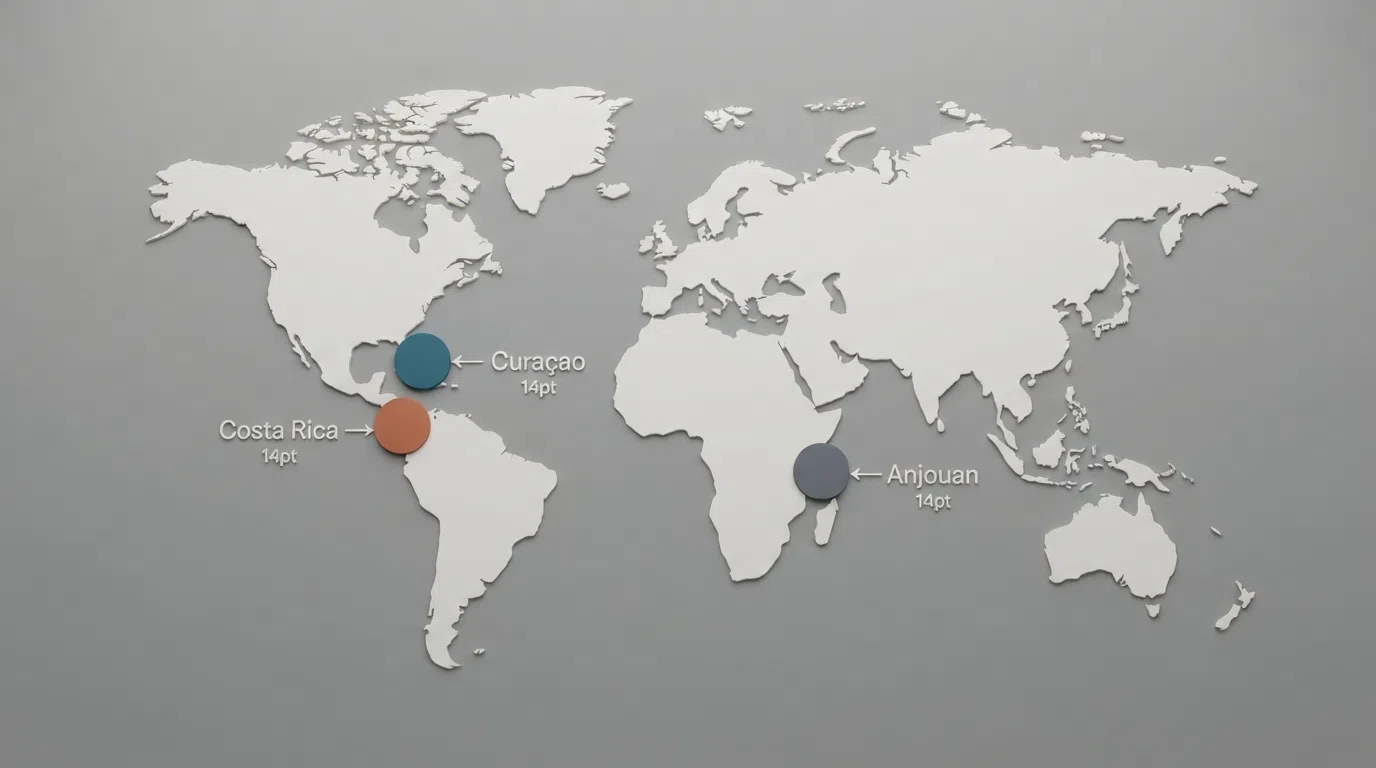
A market has grown up on the other side of that wall. A University of Bristol-linked study of forty crypto casinos accessible from the UK found that 92.5% accepted deposits without identity checks, and roughly half of them were reachable directly from a UK IP address, with the remainder accessible via free VPNs. None of the operators examined here hold a UKGC licence. All are licensed in Curaçao, Costa Rica, or — in the case of newer entrants — Anjouan. All offer something no British-licensed casino is permitted to offer: a sign-up that takes an email address and a wallet connection, and a deposit that clears before any document is requested.
This guide ranks ten of those operators, sets out the bonus and wagering terms each one attaches to its welcome offer, and lays out the regulatory consequences of stepping outside the British licensing perimeter. The shape of the trade is straightforward. A player who chooses one of these casinos trades every structured protection the UK system provides — GAMSTOP coverage, the UKGC complaints route, approved ADR, statutory stake limits, the £150 financial vulnerability check, the auto-play ban, the reverse-withdrawal ban, the 10x wagering cap — for what the licensed market cannot deliver: a crypto wallet, an email address, and a game. Whether that exchange is worth it depends on what the player values more.
Data current as of September 8, 2026, checked against the UK Gambling Commission’s public register of licence holders (2,663 records, last updated 29 July 2026).
What an Anonymous Crypto Casino Actually Is — and What It Isn’t
The phrase does a lot of work in the marketing of these sites, and it is worth pinning down before any operator is named. An anonymous crypto casino is, at base, a gambling site that lets a customer deposit, play, and withdraw using cryptocurrency without first submitting government-issued identification. The mechanism is straightforward: registration takes an email address (or, in the most stripped-back setups, a wallet connection alone), the deposit arrives from a self-custody crypto wallet rather than a bank account, and the operator has no document to verify because none has been requested.
Two distinctions matter. The first is between *pseudonymous* and *anonymous*. A crypto wallet is a string of letters and numbers; the person controlling it is not named on any blockchain. Every transaction, however, is recorded on a public ledger, and chain-analysis firms exist to link wallets to identities. A wallet that has never touched a KYC exchange, that funds itself through mining or through a privacy-preserving on-ramp, is closer to anonymous than a wallet that has bought Bitcoin through Coinbase with a passport scan. Most players at most casinos land somewhere in the middle, and the marketing word “anonymous” describes the casino’s verification policy, not the player’s actual untraceability.
The second distinction is between sign-up anonymity and withdrawal-gated anonymity. Some operators keep verification light for the entire customer lifecycle; others apply identity checks only when a withdrawal crosses an internal threshold, a large win is flagged, or a fraud signal appears. BC.Game, for example, runs what it calls anonymous signup, but its withdrawals are gated by soft thresholds, monthly caps, and a big-winner clause that can pull a customer into KYC after the fact. The marketing language does not always tell a player which model they are at.
How Anonymous Sign-Up Works at a No-KYC Crypto Casino
The flow at most featured operators runs in three steps. A prospective player visits the site, enters an email address, sets a password, and chooses a cryptocurrency from a list that usually includes Bitcoin, Ethereum, Litecoin, and a handful of stablecoins. The site generates a deposit address tied to the new account. The player sends funds from a self-custody wallet — software like MetaMask or Trust Wallet, or a hardware wallet — and the balance appears after the first blockchain confirmation, which for Bitcoin typically takes around ten minutes and for Litecoin closer to two and a half.
Some operators, like Jackbit, reserve KYC for genuine fraud and AML flags and let most players stay no-KYC for the full life of the account. Anonymous Casino, the standalone brand at anonymous-casino.com, runs a similar model: registration by email only, deposits processed after first blockchain confirmation, and document checks reserved for situations the operator’s risk team flags. CoinCasino and BC.Game also describe their signup as anonymous, though with the caveat noted above on BC.Game’s withdrawal-gated verification. Flush is the operator in this set with a documented test withdrawal that cleared without KYC: a $250 Bitcoin deposit produced a $390 Bitcoin withdrawal forty-one minutes later, with no document request at the cashout.
The point at which verification typically arrives, when it arrives at all, is the withdrawal. Triggers vary: a withdrawal above a stated threshold, a first withdrawal after a series of deposits, a pattern that looks like money laundering, a request to convert crypto to fiat through the operator’s own payment provider. The casino’s terms will state its policy in broad terms, and a player who plans to withdraw more than a casual amount should expect to be asked, eventually, for at least a photograph of an ID document and a proof of address.
Degrees of Anonymity — From Pseudonymous to Truly Anonymous
The cleanest version of the marketing word “anonymous” describes a player who has never been identified, to anyone, in connection with the casino account. In practice the spectrum runs from pseudonymous — the casino has an email and a wallet address, and could in principle be compelled to hand them to a regulator — through lightly verified, where a phone number or social account sits on file, to fully identified, where the operator holds a passport scan and a utility bill. The University of Bristol-linked finding that 92.5% of UK-accessible crypto casinos allowed deposits without identity checks describes a market in which most operators default to the pseudonymous end of the spectrum, with verification reserved for edge cases.
The privacy ceiling, in any case, is set not by the casino but by the wallet’s history. A wallet that funded itself through a KYC exchange carries that exchange’s record of the player’s identity. A wallet that bought its first coins from another wallet, or that earned them through mining, leaves a thinner trail. The honest version of “anonymous crypto casino” is therefore “a casino that does not require identity verification,” not “a casino that cannot be traced back to a real-world identity” — the latter is true only for a subset of players, and only for as long as no one asks.
The UK Anonymous Casino Landscape at a Glance
The British demand for no-KYC gambling is a function of the British licensing regime. A player who wants a casino that does not ask for documents, does not check the GAMSTOP register, and does not impose a £5 or £2 per-spin stake cap is, by definition, looking for a casino the UKGC does not license. The Commission has no statutory power to block websites at the ISP or DNS level; it works by disruption, and around half of the forty sites tested in the Bristol study were reachable from a UK IP address without any circumvention tool. The other half required a free VPN, which is itself trivially available.
The operators that fill this space are mostly Curaçao licensees (the CGCB, reformed in 2023 and 2024, is the most common framework) and Costa Rica data-processing licensees (Costa Rica does not issue a gambling-specific licence, and the data-processing permit that some operators hold is not a regulatory substitute). Anjouan, in the Comoros, has emerged as a third jurisdiction, particularly for newer entrants. None of the operators reviewed here appears on the UKGC’s public register of licence holders, and none is regulated in Great Britain. As the London law firm Costigan King put it in 2026: “Excluding cryptocurrency from the licensed market does not prevent its use in gambling, it simply determines where that gambling takes place.” The market exists because the regulation pushes it offshore; the regulation pushes it offshore because the market exists. Neither side has, in 2026, forced the other to give way.
The 10 Anonymous Crypto Casinos UK Players Can Access in 2026 — Compared
The table below sets out the ten featured operators side by side. Three things to read into it. First, the wagering column is where the headline bonus number meets reality — a 500% match at 80x is a very different proposition from a 100% match at 10x, and the licensed-market cap is 10x. Second, the free-spins column carries whether the spins are genuinely wager-free (winnings paid as cash) or carry their own clearing requirement. Third, the licence column lists what the operator actually holds, which is not a UKGC licence, and the table should be read with that in mind.
| Casino | Licence | Welcome Bonus | Wagering | Free Spins | Game Count |
|---|---|---|---|---|---|
| Jackbit | Curaçao | 100 FS on Sky Lanterns | 1x deposit turnover; wager-free FS | 100 | 5,000+ |
| CoinCasino | Costa Rica | 200% up to $30,000 + 50 FS | 60x on bonus | 50 | 4,000+ |
| BC.Game | Curaçao (CGCB) | 470% up to $1,600 + 400 FS | Varies by tier; withdrawal-gated KYC | 400 | 10,000+ |
| Cryptorino | Costa Rica | 100% up to 1 BTC | 66x on deposit | None | 6,000+ |
| Betpanda | Costa Rica | 100% up to 1 BTC | 80x on deposit | None | 5,000+ |
| Flush | Curaçao | Tiered across 3 deposits | 30x first, 35x subsequent | None | — |
| TrustDice | Curaçao | 500% up to 3 BTC + 25 no-deposit FS + $25 free | 45x on bonus only | 25 (no deposit) | — |
| FortuneJack | Curaçao | 500% deposit bonus + 5,000 no-wagering FS | 30x–40x on bonus | 5,000 | 2,748 slots |
| Duelbits | Curaçao | 200% up to $1,000 | 35x | — | — |
| Betplay | Not confirmed | 100% up to 5,000 USDC | 80x | — | — |
The ranking below this table is editorial, weighing bonus value, wagering fairness, withdrawal speed, game catalogue breadth and KYC approach. It is not a recommendation to play at any of them, and the value of any individual operator depends on the player’s own priorities.
Jackbit — Wager-Free Spins and a Light-Touch KYC Model
Jackbit’s welcome offer is the unusual one in this set because the winnings on the free spins are paid as cash, not as bonus funds. A player who deposits $50 — the minimum — receives 100 free spins on Sky Lanterns, and anything those spins return is credited to the real-money balance, withdrawable subject only to a 1x turnover on the deposit itself. There is no wagering requirement on the spin winnings, and a $100 cap on what the spins can pay out. The spins must be activated within 24 hours of the deposit and used within 24 hours of activation, which is a tight window for a player who logs in casually.
The verification approach is the second leg of the offer. Jackbit reserves KYC for genuine fraud and AML flags, and the bulk of its customer base never sees a document request. The game catalogue runs above 5,000 titles from Pragmatic Play, Evolution, Hacksaw Gaming, BGaming, Push Gaming, and Relax Gaming, which covers the slots, live casino, and crash games a UK player would expect. The licence is Curaçao, which means the regulatory fallback is the operator’s own internal dispute process and whatever the Curaçao framework provides — neither of which is a UKGC complaints route. For a player who values getting spin winnings out as cash rather than running them through a clearing loop, Jackbit is the standout of the set.
TrustDice — The Only Genuine No-Deposit Offer in This Ranking
TrustDice is the operator in the featured set where a UK player can claim something without depositing first. The package runs to 500% up to 3 BTC (roughly $90,000 at the rates used in the published review) on the deposit side, alongside 25 no-deposit free spins and a $25 free chip that requires no funding. The 45x wagering requirement applies to the bonus amount only — the player’s own deposit is not added to the clearing base, which is the player-friendly construction a player should look for and rarely finds.
The platform is also one of the few that runs its own provably-fair in-house originals alongside third-party slots and a sportsbook, and the TXT token staking programme offers a yield-bearing angle that the slots-only operators in the set do not. The licence is Curaçao, and the same caveats on regulatory fallback apply. The defining feature here is the no-deposit offer: a player can register, claim the 25 spins and the $25 chip, and test the platform with house money rather than their own. The 45x multiplier is on the bonus only, which keeps the clearing cost lower than it looks, but the 45x still has to be worked through before any winnings convert to withdrawable cash.
CoinCasino — Telegram-Native With a Low Entry Barrier
CoinCasino’s $10 minimum deposit is the lowest in the set, and its Telegram-native platform lets a player move from a message thread to a hand of blackjack without leaving the messaging app. The welcome offer is a 200% match up to $30,000 with 50 free spins attached, and the 60x wagering requirement is released in instalments — meaning a portion of the bonus unlocks at each milestone rather than the full amount becoming available at once.
The game catalogue is around 4,000 titles from roughly sixty studios, with Evolution Gaming and Pragmatic Play Live covering the live casino and a sportsbook sitting alongside. On-site crypto purchase with a card is supported, which is a privacy trade-off a player should understand: buying Bitcoin through the casino’s own on-ramp ties the card to the wallet, and that link is in the casino’s records. The licence is Costa Rica, and the documented Bitcoin withdrawal test cleared in twenty-five minutes. CoinCasino suits a player who wants the lowest entry ticket in the set and is comfortable inside a Telegram client rather than a web browser.
BC.Game — The Biggest Game Catalogue and a Massive Multi-Deposit Bonus
BC.Game’s 10,000+ game count is the highest in the set, and the 150+ supported coins are too. The welcome package is a 470% match up to $1,600 plus 400 free spins spread across multiple deposit tiers, and the platform runs its own provably-fair originals alongside a full live casino. The licence is Curaçao under the reformed CGCB framework.
The caveat sits in the verification model. BC.Game markets anonymous signup, and the signup itself is — the player provides an email and a wallet, and the account is open. Withdrawals, however, are gated by soft thresholds and a big-winner clause, and a player who lands a significant win or who has been depositing and withdrawing in patterns the risk team flags will be pulled into a KYC review. This is the trade-off the headline number buys: a massive catalogue, a large bonus, and an anonymity ceiling that turns out to be lower than the marketing language suggests. The 10,000+ games make BC.Game the natural choice for a player who values catalogue breadth, and the warning is that the catalogue is not, on its own, a reason to expect the platform to be anonymous at withdrawal.
FortuneJack — The Most Established Name With the Largest Bonus
FortuneJack has been running since 2014, which makes it the longest-established name in the set. The welcome package is a 500% deposit bonus plus 5,000 no-wagering free spins, with a minimum deposit of 0.5 mBTC on the first and second deposits and 1 mBTC on the third and fourth. The deposit bonus carries 30x to 40x wagering depending on the tier, and the free spins are paid as cash rather than as bonus funds.
The game catalogue runs to 2,748 slots from 30+ providers including NetEnt, Play’n GO, and Microgaming, with a 16-tier loyalty programme offering up to 14% cashback on losses. The licence is Curaçao. For a player who values longevity and the no-wagering-spins construction, FortuneJack delivers the strongest combination in the set: an established operator, a bonus that pays the spin returns as cash, and a loyalty programme that returns a percentage on the back end. The minimum-deposit figures in mBTC are a small friction point for a player who does not already hold Bitcoin, since converting from another coin or a stablecoin involves a swap.
Flush — Tested No-KYC Withdrawal in Under an Hour
Flush is one of the few operators in the set with a documented test withdrawal that cleared without KYC. The welcome offer is a tiered deposit bonus across the first three deposits, with 30x wagering on the first tier rising to 35x on the subsequent deposits, a 30-day validity window, and a $5 maximum bet that counts toward the wagering. Bonus Buy games are permitted with the same $5 cap applied.
The verification record is the headline. A $250 Bitcoin deposit was turned into a $390 Bitcoin withdrawal in forty-one minutes, with no document request at the cashout. That single test is not a guarantee that the next withdrawal will land as quickly or as cleanly — the test was one transaction, and risk teams at any operator reserve the right to flag any transaction they choose. But it is the cleanest evidence in the set that the no-KYC model works in practice at this operator, at least at this size of withdrawal. The licence is Curaçao. Flush suits a player who is willing to commit a real deposit and wants the documented record of a fast, unverified payout.
Cryptorino — Clear Terms With a Max-Bet Rule and a Tight Validity Window
Cryptorino’s terms are unusually legible for an offshore operator. The welcome bonus is a 100% match up to 1 BTC, with 66x wagering on the deposit, a 7-day validity window to clear it, and a €12 maximum bet per spin that counts toward the wagering. Slots contribute 100% to the clearing requirement, and live casino contributes 20%. The minimum deposit is €10.
The 7-day validity is the shortest in the set, and the €12 max bet is the highest explicit cap among operators that state one — both of which are double-edged. A player who plays in long sessions and wagers large amounts per spin will hit the €12 ceiling immediately and find their wagering rate capped by it; a player who plays shorter sessions and lower stakes may not clear the 66x within the 7-day window at all. The game catalogue is 6,000+ titles from 70+ providers, including a sportsbook, and the documented Bitcoin withdrawal test cleared in twenty minutes. The licence is Costa Rica. For a player who understands the constraints and can plan their play accordingly, Cryptorino offers a clear, structured bonus environment.
Duelbits — Crypto-Native With Provably Fair Games and a Lower Wagering Bar
Duelbits’ 35x wagering requirement is the lowest among the operators in the set that apply a deposit-bonus multiple. The welcome offer is a 200% match up to $1,000, and the platform is built crypto-first — its provably-fair games let a player verify each round’s outcome against the seed, and the live casino sits alongside. Withdrawals are described as instant.
The published review rated Duelbits 8.6 out of 10 for crypto-savvy players, which is a useful summary of its positioning: an operator built for someone who already holds crypto, already understands provably-fair verification, and is not looking for a soft on-ramp. The licence is Curaçao. Players who prefer a lower wagering requirement to an inflated headline bonus will find Duelbits’ structure particularly compelling. With a 35x multiple, it avoids the extreme clearing hurdles found elsewhere, positioning the operator as a pragmatic choice for those who want accessible terms.
Betpanda — Lightning Network Withdrawals in Under Two Minutes
Betpanda’s claim is speed. The platform supports Bitcoin Lightning Network withdrawals that land in under two minutes and cost sub-penny fees, which is a step change from the on-chain Bitcoin withdrawals that take ten to sixty minutes and cost whatever the mempool charges. The welcome offer is a 100% match up to 1 BTC, with 80x wagering on the deposit — one of the highest multiples in the set — and 13 coins are supported across 5,000+ games from 80+ studios. A sportsbook with esports sits alongside the casino.
The wagering is the trade-off. 80x is the higher end of the multiplier scale in this set, and a player who plans to clear the bonus rather than withdraw the deposit quickly should expect to play through the 80x before the bonus funds convert. The licence is Costa Rica. Betpanda is the operator for a player who values fast payouts and supports the Lightning Network, and who is willing to play through a high wagering multiple to get there.
Betplay — Lightning Fast Deposits, But a Weak Reputation
Betplay’s Lightning Network infrastructure works. A €30 Bitcoin deposit arrived instantly in the documented test, and a withdrawal reached the wallet within five minutes. The welcome offer is a 100% match up to 5,000 USDC, with 80x wagering on the deposit. The platform is otherwise thin on documented detail in the research — the licence jurisdiction is not confirmed this run, the game count and provider list are not confirmed, and no information on free spins or minimum deposit is on the public record.
What is on the public record is a Trustpilot score of 2.8 out of 5, the lowest in the set. A weak Trustpilot score at a gambling operator usually reflects a mixture of complaint types — slow withdrawals, confiscated winnings, account closures on bonus-abuse grounds, unresponsive support — and a single score is not a verdict. But the gap between Betplay’s technical infrastructure (instant Lightning deposits, sub-five-minute withdrawals) and its public reputation is wide enough that a player should weigh the two against each other. The 80x wagering is also at the top of the set. Betplay is the operator for a player who has seen the Trustpilot page, has read the complaints, and has decided what they mean — not the one for a player who has not.
The Games You Can Actually Play — Slots, Live Casino and Provably Fair Originals
The game catalogues at these operators cover a wider range than a UKGC-licensed casino is allowed to. FortuneJack lists 2,748 slots; BC.Game claims 10,000+ titles across its combined casino, live, and originals verticals; CoinCasino runs around 4,000 games from sixty studios; Cryptorino runs 6,000+. The slot providers overlap heavily — Pragmatic Play, Evolution, Hacksaw Gaming, BGaming, Push Gaming, Relax Gaming, NetEnt, Play’n GO, Microgaming — and the live casino is dominated by Evolution and Pragmatic Play Live, the same two studios that supply most of the British licensed market. A UK player who walks into a CoinCasino or FortuneJack lobby will recognise most of what they see.
The category that is genuinely different is provably-fair in-house originals. These are games — typically dice, crash, plinko, and simple card-and-wheel formats — whose outcomes are generated by a server seed and a client seed that the player can verify after the round. The mechanic is not available at UKGC-licensed operators, and the games themselves are not a substitute for the licensed market’s slots catalogue: the variance is high, the RTP is often lower than the equivalent slot, and the format is closer to a crypto exchange’s price-bet product than to a video slot. But the category exists at most of the featured operators, and a player who is looking for it is looking for something the British licensed market does not offer.
The licensed market’s game-design rules do not apply at these sites. The UKGC banned auto-play on online slots from 31 October 2021, set a 2.5-second minimum spin speed, prohibited losses disguised as wins, and banned reverse withdrawals. None of these rules bind an offshore operator. A player who wants auto-play, fast spin, or the ability to cancel a withdrawal in progress will find those features at most of the casinos listed here. Conversely, a player seeking the safety of UK-standard friction may find the offshore experience unsettling.
New Anonymous Crypto Casinos to Watch in 2026
The market is not static. AnonGame.io launched in March 2026, and Hyper Lucky opened in 2025, both positioning themselves at the no-KYC end of the crypto casino space. Newer entrants sometimes bring improved anonymity models — a more carefully scoped verification policy, a wallet-only sign-up with no email at all, a clearer withdrawal framework — and sometimes they bring the same wrapper over a less-tested operational backbone. The risk a new casino carries is the same risk a new casino has always carried: there is no track record of payouts, no history of dispute resolution, no community memory of how the operator behaves in the edge cases. A player who values longevity picks an established name; a player who values the latest product picks a new one and accepts that they are part of the test.
Is It Legal? The Uncomfortable Truth About Anonymous Crypto Casinos and UK Law
The legal picture has two layers, and they pull in opposite directions. The operator-facing layer is unambiguous. Section 33 of the Gambling Act 2005 makes it a criminal offence to provide facilities for gambling in Great Britain without the required licence, and the offence carries up to 51 weeks’ imprisonment, an unlimited fine, or both. The 2014 Gambling (Licensing and Advertising) Act extended the licensing requirement to any operator serving GB customers, wherever the operator is based. The penalty is aimed at the operator, the advertiser, and the intermediary — not at the player. As one legal analysis of the Act puts it: “The Gambling Act 2005 does not create any offence for a person who participates in gambling provided by an unlicensed operator. The offences in Part 3 of the Act — Sections 33 through 44 — are directed at those who provide, facilitate, or promote gambling without the appropriate licences.”
The player-facing layer is therefore a matter of protection, not prosecution. No penalty has been traced for a GB player who merely gambles on an unlicensed site. What the player loses is the framework the UK system has built around licensed play: no GAMSTOP coverage, no UKGC complaints route, no approved ADR provider, no British consumer redress, and no statutory protection if funds are withheld. The trade is one-sided in the sense that the regulator has not come for the player, but it is one-sided in the other direction too: the player has no regulator to come to them.
Why No UKGC-Licensed Casino Can Offer Anonymous Play
The pre-verification mandate that closed the door at the licensed end was the Commission’s 7 May 2019 rule, requiring every remote licensee to verify a customer’s name, address and date of birth before any deposit or gamble. The rule extends to free bets, bonuses, and free-to-play games on the licensee’s site. There is no grace period and no opt-out. A second rule, in force since 7 April 2025, makes GAMSTOP participation a mandatory condition of every online operating licence — exclusion periods run from six months to five years, and cannot be cancelled early. A third rule, the 2014 point-of-consumption reform, requires any operator serving GB customers to hold a GB licence, wherever the operator is incorporated. The three rules together leave no room for a UKGC-licensed casino to offer anonymous play, free-bet signup, or unsupervised self-excluded access.
The Commission has said it plans to explore whether cryptoassets can be introduced as a payment method for licensed gambling, following the government’s introduction of the Financial Services and Markets Act 2000 (Cryptoassets) Regulations 2025. The current position is that anonymity afforded by crypto-assets causes problems for licence applicants who cannot provide complete evidence of source of funds, and the Commission will not consider operating licence applications with a crypto funding element without full source-of-funds history. The position is, in other words, the inverse of what these offshore operators offer.
The Offshore Reality — Where These Casinos Are Actually Licensed
The licences these operators carry are not substitutes for a GB licence under the 2014 Act. Curaçao, the most common jurisdiction in the set, operates the CGCB framework reformed in 2023 and 2024, which is a more developed regulatory structure than Curaçao’s previous set-up but is still not the equivalent of a UKGC licence in scope, enforcement, or player recourse. Costa Rica does not issue a gambling-specific licence; the data-processing permit that some operators hold is a business registration, not a gambling regulator’s authorisation. Anjouan, in the Comoros, has emerged as a third jurisdiction, particularly for newer entrants, and the regulatory depth there is shallower again. None of the ten operators in this ranking appears on the UKGC’s public register of licence holders, and the register held 2,663 records when last updated on 29 July 2026.
A player who reads an offshore licence as a signal of safety is reading the wrong signal. The licence says the operator has met the minimum bar of whatever jurisdiction issued it; it does not say the operator is regulated in Great Britain, and it does not give the player any of the British protections the UKGC framework provides.
What the UKGC Can — and Cannot — Do About Unlicensed Crypto Casinos
The Commission’s enforcement toolkit is built around disruption, not blocking. The Commission has no statutory ISP or DNS blocking power; blocking legislation has been proposed but is not enacted. What it can do, and does, is issue cease-and-desist notices with a 48-hour deadline, refer URLs to search engines for delisting, apply pressure to domain registrars and hosting providers, and refer payment providers handling the operator’s deposits. Between April 2024 and June 2025, the Commission issued 3,140 disruption notices, referred 447,778 URLs to search engines, and achieved 287,961 removals, with an average 32% fall in engagement across 160 disrupted sites. Between October 2024 and September 2025, the Commission recorded 208,088 enforcement actions against illegal online gambling.
The numbers are large, and the 32% engagement fall is real, but the underlying reality is that new sites appear faster than the disruption pipeline can dismantle them. The Bristol study’s finding that around half of tested sites were reachable directly from a UK IP address is consistent with a market that lives one step ahead of the enforcement. Reliance on the Commission to have blocked a site before access is gained often results in disappointment for the player.
What UK Players Risk — The Protections They Lose
The list of what disappears when a UK player steps outside the licensed perimeter is the practical answer to the legal question. It runs to every structured protection the UKGC has built into the British market:
- GAMSTOP coverage is lost. A self-excluded player is not protected on an offshore crypto casino, because crypto wallets are pseudonymous and the operator cannot cross-check the register.
- The UKGC complaints route is gone. The Commission will not take a complaint about an unlicensed operator; there is no approved ADR provider; there is no British court with straightforward jurisdiction over a Curaçao or Costa Rica company.
- Statutory stake limits do not apply. The £5 per-spin cap for players aged 25 and over, and the £2 cap for players aged 18 to 24, are not in force at these sites.
- Auto-play is not banned. A player can run slots on auto-play, at speeds below the 2.5-second minimum the UK rules require.
- Losses disguised as wins are not prohibited. Sound design and visual cues the UKGC has banned are present in the games.
- Reverse withdrawals are not banned. A player who requests a withdrawal can cancel it and play the balance back, a feature the licensed market removed in 2021.
- Financial vulnerability checks at the £150 net deposit threshold are not run. The check the Commission now mandates — publicly available data on CCJs, bankruptcies, IVAs, and DROs — is absent.
- Mandatory deposit-limit prompts are absent. The licensed operator’s obligation to prompt a customer to set a financial limit before first deposit is not enforced offshore.
- Credit-card deposits are not banned. The 14 April 2020 ban on credit-card gambling does not bind an offshore operator; a player who wants to deposit on credit can find a site that lets them.
The one protection a player does not lose is their liberty. No penalty has been traced for a GB player who merely gambles on an unlicensed site. The penalty was always the operator’s, and remains the operator’s.
Why Your 2026 Anonymous Casino Bonus Is Smaller Than It Looks
A 500% match up to 3 BTC reads, on the banner, as a different kind of offer from a 100% match up to £100 at a UKGC-licensed casino. The arithmetic says otherwise. Wagering requirements at GB-licensed operators are capped at 10x — a hard ceiling in force since 19 December 2025. The multipliers at the operators in this set run from 30x (Flush, first-deposit tier) to 80x (Betpanda, Betplay), with most sitting between 35x and 66x. A 500% bonus at 66x is not “five times more bonus at six times the wagering” — it is a clearing requirement that costs the player more than the headline number, on a bonus that is harder to walk away with than the licensed-market alternative.
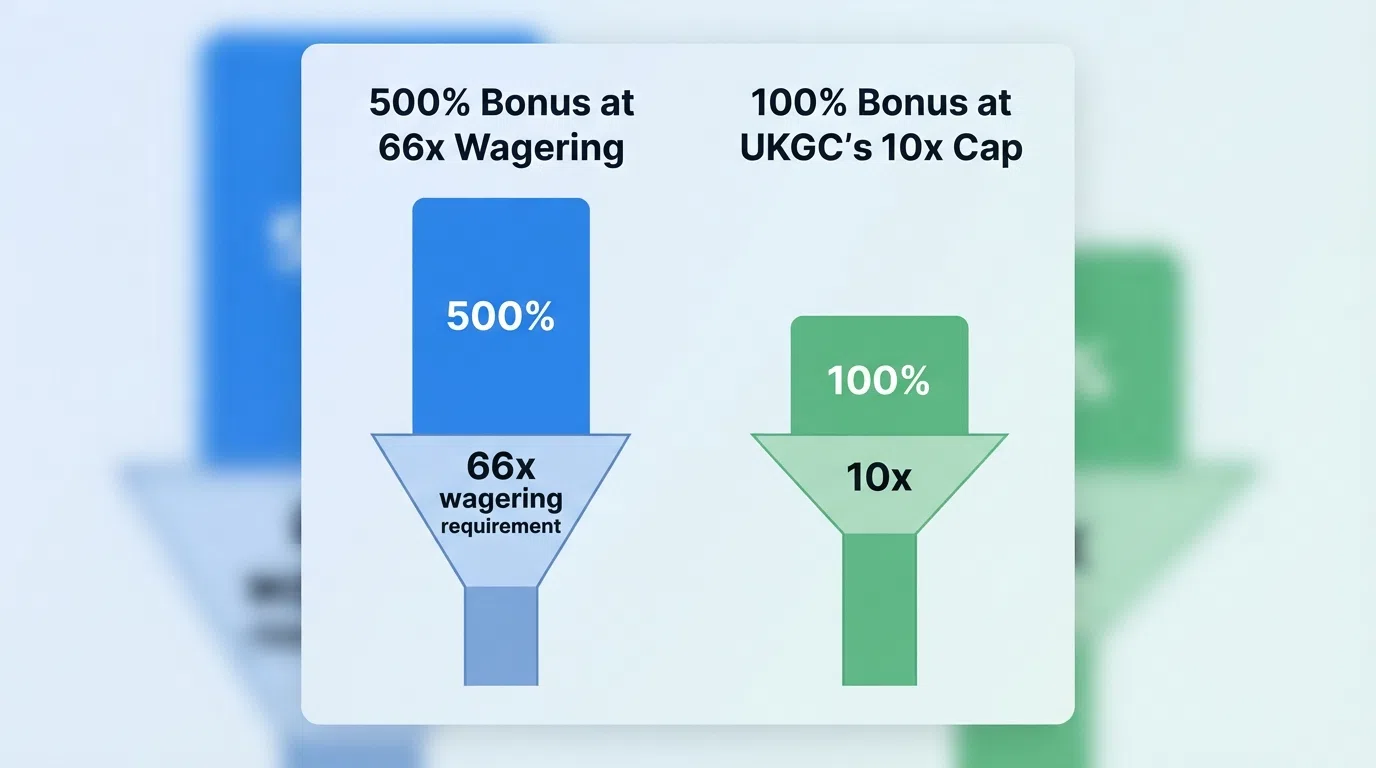
A worked example brings the comparison onto the same page. Cryptorino’s 100% up to 1 BTC bonus, with 66x wagering on the deposit and a €12 max bet, requires a player to wager the deposit 66 times before the bonus funds convert. A player who takes the maximum 1 BTC bonus at €12 per spin, assuming only the bonus amount is wagered, faces 1 BTC in required turnover, 5,000 €12-spins at 5-second intervals, and roughly 6.9 hours of play to clear. The expected loss across that play, at a representative slot RTP of 96%, is roughly 0.04 BTC on the clearing alone. The bonus is real, the time is real, and the loss is the cost of the offer. Betpanda’s 80x wagering on the same 1 BTC bonus, at the same €12-per-spin ceiling, raises the clearing turnover to 1.1 BTC and the time to clear to roughly 7.6 hours, with a higher expected loss in proportion. The 500% match at FortuneJack, by contrast, is paid on a 0.5 mBTC minimum deposit, not on 1 BTC, and the wagering runs 30x to 40x rather than 66x — the same shape of offer, with a smaller clearing burden on the player who takes the minimum.
The validity window is the second lever. Cryptorino’s 7-day window is the shortest in the set; Flush’s 30-day window and Jackbit’s 24-hour activation-and-usage window sit at the other extremes. A player with a short attention span and a long session loses the wagering race against a 7-day clock; a player who logs in once a fortnight loses the 24-hour Jackbit window before they find it. The bonus terms reward a particular pattern of play, and a player who does not match that pattern pays for the bonus without clearing it.
The exceptions to the rule are the wager-free and bonus-only offers. Jackbit’s free spins pay cash, with only a 1x deposit turnover before withdrawal — the bonus has no wagering on its winnings. FortuneJack’s 5,000 free spins are also no-wagering. TrustDice applies its 45x to the bonus amount only, not the deposit plus bonus — a construction that halves the clearing base compared with the equivalent offer at a casino that adds the deposit in. These are the genuinely player-friendly constructions in the set, and a player who wants to keep their bonus should look for them.
No-Deposit Bonuses at Anonymous Casinos — Who Actually Offers One
A no-deposit bonus is a free-spin or free-chip offer that requires no funding of the account to claim. The category is rare in the anonymous casino space, because the operators that profit from the no-KYC model also profit from the deposit that follows the no-KYC sign-up, and a no-deposit offer cuts against that flow. TrustDice is the only operator in the featured set with a genuine no-deposit offer: 25 free spins and a $25 free chip, claimable without funding the account, with 45x wagering on the bonus amount only. A player who registers at TrustDice, claims the package, and runs the spins can keep what the wagering leaves — subject to the 45x, the maximum cashout cap (if any), and the games the bonus applies to.
The category of offer to be wary of is the deposit-triggered welcome package that markets itself as “free.” A 200% match with 50 free spins is not a no-deposit offer; it is a deposit-gated offer that includes free spins as a sweetener. The distinction is worth keeping clear, because the wagering conditions on the two are very different.
Free Spins Offers Compared — Wagering, Caps and Real Value
The free-spins column in the operator table compresses a real spread. The table below sets out the operators that include free spins in their welcome offer, with the wagering treatment and the cap on what the spins can pay.
| Operator | Free Spins | Wagering on Winnings | Minimum Deposit | Maximum Win Cap |
|---|---|---|---|---|
| Jackbit | 100 on Sky Lanterns | None (wager-free, paid as cash) | $50 | $100 |
| FortuneJack | 5,000 across four deposits | None (wager-free) | 0.5–1 mBTC | — |
| BC.Game | 400 across deposit tiers | Varies by tier | Varies by crypto | — |
| CoinCasino | 50 | 60x on bonus | $10 | — |
| TrustDice | 25 no-deposit | 45x on bonus only | None (no deposit) | — |
The distinction that decides the value is whether the winnings are paid as cash or as bonus funds. Wager-free spins — Jackbit, FortuneJack — credit the spin returns to the real-money balance, where they are withdrawable subject to the deposit turnover and the win cap. Spins with wagering attach a clearing requirement to the winnings, and the player works through the multiplier before any of it converts. TrustDice sits between the two: the spins are no-deposit, but the winnings carry 45x wagering on the bonus amount.
Crypto-Specific Bonuses — What Makes Them Different From Fiat Casino Offers
The structural differences in crypto bonus design are predictable once the regulatory ceiling on the licensed side is held in mind. The UKGC’s 10x wagering cap and its ban on mixed-product offers do not bind an offshore operator, so the headline match percentages run higher (200% to 500% versus the 100% norm at UKGC licensees), the wagering multiples run higher (30x to 80x versus 10x), and the validity windows run shorter (7 days versus 30). The higher match is a genuine marketing advantage to the player who can clear it; the higher multiplier and shorter window are the cost of clearing it. The licensed market’s ban on credit-card deposits also does not apply, and a player who wants to fund a crypto casino with a credit card can find an operator that lets them — typically through a third-party payment processor that adds its own fees and verification.
TrustDice’s bonus-only wagering is the player-friendly construction the licensed market cannot match without breaking its own rules. A 45x on the bonus, rather than 45x on the deposit plus bonus, halves the clearing base and roughly halves the expected loss across the play. The other operators in the set apply their wagering to the deposit, the bonus, or both, and the player should read the terms to find out which.
How Fast Do Anonymous Crypto Casinos Really Pay Out — and What Slows Them Down
The blockchain, not the casino, is the main bottleneck on a crypto withdrawal. A Bitcoin transaction on the base layer takes around ten minutes per confirmation, and most operators require a small number of confirmations before crediting the withdrawal — typically one to three, which means ten to thirty minutes of network time, on top of whatever the operator’s own processing window adds. The documented test withdrawals in this research reflect that profile: CoinCasino twenty-five minutes, Cryptorino twenty minutes, Flush forty-one minutes for a withdrawal that included no-KYC verification, Betplay within five minutes on Lightning Network.
The Lightning Network is the speed differentiator. Lightning transactions settle off-chain and push to the player’s wallet in seconds, with sub-penny fees, and Betpanda’s documented Lightning withdrawal in under two minutes is the headline figure. The trade-off is that the receiving wallet has to support Lightning — most major self-custody wallets do, but a player holding Bitcoin on a custodial exchange that does not support Lightning receives a Lightning payment as an on-chain transaction after the operator closes the channel, which negates the speed advantage. A player who wants the two-minute payout needs a Lightning-capable wallet, and the choice of wallet is itself a privacy decision.
What slows a withdrawal down, when it does, is rarely the blockchain. The more common delays are the operator’s processing queue (a manual review for a first withdrawal, a risk-team review for a larger amount, a maintenance window on the payment system), the KYC review the operator triggers on a flagged transaction, and the conversion step when a player is withdrawing a coin the casino does not natively hold. A player who has registered, deposited small, and withdrawn small will typically find the queue shorter; a player who lands a large win on the first withdrawal after a series of deposits should expect at least a delay, and possibly a document request.
Which Anonymous Crypto Casinos Pay Out Fastest
The table below sets out the operators with a documented test withdrawal in this research, ranked by time from withdrawal request to funds in the wallet.
| Operator | Network | Test Result | Conditions |
|---|---|---|---|
| Betpanda | Bitcoin Lightning | Under 2 minutes | Sub-penny fees; 13 coins supported |
| Betplay | Bitcoin Lightning | Within 5 minutes | Lightning deposit instant; €30 test |
| Cryptorino | Bitcoin (on-chain) | 20 minutes | €10 minimum deposit; no KYC at withdrawal |
| CoinCasino | Bitcoin (on-chain) | 25 minutes | $10 minimum deposit; no KYC at withdrawal |
| Flush | Bitcoin (on-chain) | 41 minutes | $250 in, $390 out; no KYC at withdrawal |
A single test withdrawal is evidence, not a guarantee. The next withdrawal at any of these operators could be slower, faster, or blocked at the verification stage, and the player should plan for the slower case.
The Crypto Payment Methods That Keep You Anonymous
The coin support landscape at these operators spans the major cryptocurrencies, the privacy coins in a handful of cases, and the stablecoins at the larger end. Betpanda supports 13 coins; BC.Game supports 150+; CoinCasino and FortuneJack run the major coins plus the leading stablecoins. Bitcoin is pseudonymous on a public ledger, which means every transaction is traceable in principle but unattributed in practice; the Lightning Network adds a layer of off-chain privacy by keeping most of the transaction detail off the base blockchain. Monero, the leading privacy coin, is supported at a small number of operators, and the larger ones tend to stick to the more liquid coins.
The privacy ceiling is set not by the casino or the coin, but by the on-ramp. Buying Bitcoin through a KYC exchange and sending it to a casino wallet ties the exchange’s record of the player’s identity to the casino’s record of the wallet. Buying through a non-KYC on-ramp, or funding the wallet through mining or through a peer-to-peer trade, leaves a thinner trail. The honest version of “anonymous crypto casino” describes a casino that does not require identity verification — the player’s actual untraceability depends on the wallet’s history, not on the casino’s policy.
Mobile Access — Apps, Browsers and Telegram Casinos
Most anonymous casinos skip the app store. The reason is structural: Apple and Google require app developers to comply with local regulations in the markets they serve, and a casino app offering gambling to UK users without a UKGC licence does not clear that bar. The result is that the default mobile experience at these operators is the mobile browser — a responsive web app that works on any device and requires no download. CoinCasino takes the mobile experience further with a Telegram-native platform, accessible without leaving the messaging app, and WalletConnect integration lets a player connect a mobile self-custody wallet directly to the casino without copying addresses.
The trade-off for skipping the app store is the absence of features app users take for granted: no push notifications, no biometric login, no native integration with the phone’s security model. The advantage is the absence of the data collection that comes with a native app install, and the absence of the app store’s review and approval overhead. A player who values a downloadable app will not find one here; a player who values a mobile browser experience and a wallet-to-casino connection will.
Seven Questions to Ask Before You Deposit at an Anonymous Crypto Casino
The evaluation framework below is the one a UK player needs before risking money at an unlicensed operator. Each question is one the operator’s own marketing will not answer cleanly, and each one is one a single review site will not answer for the next reader.
1. What licence does the operator hold, and which jurisdiction issued it? A Curaçao licence is the most common baseline; a Costa Rica data-processing permit is a less rigorous registration; an unconfirmed licence is a red flag. Cross-check the licence number against the regulator’s public register rather than taking the operator’s word.
2. What is the operator’s withdrawal record, and is it independently documented? A single affiliate review of a single test withdrawal is one data point; multiple tests across operators of similar size are a thicker record; a complete absence of test data is the thinnest record of all.
3. What are the bonus terms in full, and what do they cost in time and money? The headline number is not the offer. The wagering multiple, the validity window, the max-bet rule, the game contribution table, and the maximum cashout cap are the offer.
4. What triggers a KYC request, and at what stage of the customer lifecycle? Some operators keep verification for the entire lifecycle; others apply it at withdrawal above a threshold; others apply it only when the risk team flags. A player who plans to withdraw more than a casual amount should expect a request eventually.
5. What is in the game catalogue, and which providers supply it? A 10,000-game catalogue is meaningless without a provider list. Pragmatic Play, Evolution, Hacksaw Gaming, NetEnt, Play’n GO and Microgaming are the names a UK player will recognise; a catalogue without them is thinner than the headline number suggests.
6. What does the community say, and is the pattern consistent? A Trustpilot score is one signal. A pattern of complaints about withheld winnings, confiscated bonuses, or closed accounts is a stronger signal, and a single one-star review is the weakest signal of all.
7. Is the privacy policy clear about what data is collected, retained, and shared? An anonymous casino that logs every IP address, every wallet address, and every session timestamp is not as anonymous as the marketing language suggests. The policy is the test.
How to Read an Anonymous Casino Review — What Matters and What Is Noise
Most reviews in this space are affiliate content. The affiliate model pays the reviewer a share of the player’s losses, which sets up an incentive to recommend the operator that pays the highest commission rather than the operator that pays out the fastest. The signal that matters in a review is the withdrawal test data — a reviewer who tested a deposit and a withdrawal, and reports the time, the KYC request (or absence of one), and the final balance, has done the work a reader cannot do alone. The signal that does not matter is the star rating without a methodology, the “top pick” badge without criteria, and the comparison table that omits wagering requirements.
A review that does not mention the operator is unlicensed in Great Britain is incomplete. A reviewer who lists the welcome bonus and the game count without flagging that the operator does not appear on the UKGC’s public register has missed the single most important fact a UK reader needs.
Head-to-Head Testing — What the Withdrawal Data Actually Shows
The five documented test withdrawals in this research cover a useful range. Betpanda’s Lightning withdrawal in under two minutes is the speed benchmark; Betplay’s Lightning withdrawal within five minutes is a near-second; Cryptorino’s twenty-minute on-chain withdrawal is a representative time for the standard Bitcoin flow; CoinCasino’s twenty-five minutes is comparable; Flush’s forty-one minutes including the no-KYC verification is the slowest of the set, and the most informative because it shows the cost of the verification layer even when verification does not produce a document request.
What a single test proves is that the withdrawal worked once. What it does not prove is that the next withdrawal will work as cleanly. The operators with no test data — Betplay, in the game-count and provider-list fields if not in the withdrawal field, FortuneJack in the withdrawal field — carry the same uncertainty any review of an unverified operator carries. A player who plans a large withdrawal should test the operator with a small one first, and a player who cannot afford to lose the test amount should not be at the operator at all.
Responsible Gambling When the UK Safety Net Is Not There
Every protection the UKGC has built into the British licensed market disappears at an anonymous crypto casino. The list, written out in full once and referred back to in the operator write-ups above, runs: GAMSTOP coverage, the UKGC complaints route, approved ADR, British consumer redress, statutory stake limits, the financial vulnerability check at £150, the auto-play ban, the 2.5-second minimum spin speed, the losses-disguised-as-wins ban, the reverse-withdrawal ban, the mandatory deposit-limit prompt, the credit-card ban, and the 10x wagering cap. None of these binds an offshore operator. A player who steps outside the licensed perimeter is, in respect of every one of these protections, on their own.
The data on why the protections exist is worth restating. NHS gambling treatment referrals in England reached 4,355 in 2024/25, up 90.7% from 2,284 in 2023/24. The National Gambling Helpline, operated by GamCare, handled 71,267 calls and chats in 2021/22. The Gambling Survey for Great Britain (Year 3, 2025) found 47% of adults had gambled in the past four weeks, with 38% gambling online. In Scotland, 8.6% of adults have a PGSI score of 1 to 2 and 3.3% score 3+. These are not reasons not to play; they are reasons the framework exists, and reasons the framework’s absence is the cost of the alternative.
The GAMSTOP Gap — Self-Exclusion Means Nothing Offshore
GAMSTOP is mandatory for every GB-licensed online operator, and the exclusion periods run from six months to five years, with a five-year auto-renewal option, none of which can be cancelled early. The register is the central plank of the British self-exclusion system. It is also, by design, limited to the licensed market. Crypto wallets are pseudonymous, and the operators that accept them cannot cross-check the GAMSTOP register even if they wanted to. A self-excluded player who opens an anonymous crypto casino account can be playing within minutes of the decision to play, with no legal obligation on the operator to honour the exclusion, and no recourse for the player or for the Commission if the operator does not.
The gap is the single most consequential protection loss on this list. Every other protection can be partially replicated by the player’s own discipline — a self-imposed deposit limit, a self-imposed time-out, a refusal to use auto-play. A self-imposed substitute for GAMSTOP requires a player to enforce a rule on themselves that they have already, by registering for self-exclusion, demonstrated they cannot. The gap is real, and the gap is the reason the rest of the framework exists.
The Responsible Gambling Tools That Disappear Offshore
The structured protections the UKGC mandates are:
- The mandatory deposit-limit prompt before a customer’s first deposit, in force from 31 October 2025 — a prompt the operator must offer and the customer must be required to engage with.
- Reality checks during play, displaying session time, session loss, and session win — required at GB licensees since 31 October 2021.
- Financial vulnerability checks at the £150 net deposit threshold in a rolling 30-day period, in force since 28 February 2025, using publicly available data on CCJs, bankruptcies, IVAs, and DROs.
- Statutory stake limits of £5 per game cycle for players aged 25 and over, and £2 for players aged 18 to 24, in force from April and May 2025 respectively.
- The auto-play ban on online slots, in force since 31 October 2021.
- The 2.5-second minimum spin speed, alongside the auto-play ban.
- The losses-disguised-as-wins ban, removing sound and visual cues that frame a losing spin as a win.
- The reverse-withdrawal ban, preventing a player from cancelling a withdrawal request and playing the balance back.
- The 10x wagering cap on bonuses, in force since 19 December 2025.
- The credit-card ban for all remote gambling, in force since 14 April 2020.
- The mixed-product bonus ban, preventing an offer that conditions a casino bonus on playing a different product type.
None of these binds an offshore operator. Some of the operators in this ranking offer voluntary equivalents — a self-set deposit limit, a self-exclusion request to support, a session timer — but the obligation to honour them is contractual rather than regulatory, and the player has no UKGC to complain to if the operator changes its mind. A player who values these protections as protective measures, rather than as restrictions, will find the licensed market the only place that provides them.
Where to Get Help — UK Support Services That Still Apply
The support services available to a UK player do not depend on where the player has been gambling. GamCare operates the National Gambling Helpline, a 24/7 service by phone and online chat across Great Britain. NHS gambling harm clinics operate in England, Scotland, and Wales, and referrals nearly doubled year on year to 4,355 in 2024/25. Gamblers Anonymous runs peer support meetings. GambleAware funds the National Gambling Support Network. NICE guideline NG248 sets out the NHS clinical approach to identification, assessment, and management of gambling-related harms. The statutory levy that funds much of this infrastructure — 1.1% of gross gambling yield from remote casino licences, split 50% to treatment, 30% to prevention, 20% to research — is paid by licensed operators, not by offshore ones, and the offshore operators in this ranking contribute nothing to the support the player may need.
How We Selected and Ranked These Anonymous Crypto Casinos
The operators were selected from the UK-accessible anonymous crypto casino market, defined as offshore-licensed operators that accept UK players, allow crypto deposits, and do not require identity verification at sign-up. Every operator was checked against the UK Gambling Commission’s public register of licence holders (2,663 records, last updated 29 July 2026), and none of them appears on it. Licence jurisdictions were verified against operator websites and regulator databases. Bonus terms were sourced from operator promotions pages and cross-checked against published affiliate reviews where available. Withdrawal speeds are documented from the published test withdrawals referenced in the research; the five operators with test data are the five in the speed table, and the five without it carry the uncertainty that absence of testing implies.
The ranking weighs bonus value, wagering fairness, withdrawal speed, game catalogue breadth, and KYC approach. It does not endorse any operator as safe, regulated, or recommended for UK players. Every operator listed is unlicensed in Great Britain, and using one means foregoing every UKGC-mandated protection the licensed market provides. The ranking is an ordering of what is on offer, not a recommendation to take it.
The Bottom Line: What UK Players Should Know Before They Play
The trade is the trade, and the trade has not changed since the Commission closed the door in 2019. An anonymous crypto casino offers what no UKGC-licensed casino can: a no-KYC sign-up, a crypto deposit, a provably-fair original, and a welcome bonus that is, by percentage and headline number, larger than anything the licensed market runs. The same operator removes every structured protection the UK regulatory system provides, from the £5 stake cap to the GAMSTOP register, from the 10x wagering ceiling to the £150 financial vulnerability check. A player who chooses the offshore option takes the larger bonus and the missing protections together; the two are not separable.
The bonus numbers do not survive a close reading. A 500% match at 80x wagering costs more to clear than a 100% match at 10x, even though the 500% number is five times larger, because the 80x is eight times the licensed-market cap and the time-to-clear scales with the multiple. The worked example above — a 1 BTC bonus at 66x, €12 per spin, 5,000 spins, roughly seven hours of play, and an expected loss in the low single-digit percent of the bonus — is the shape of a representative offer in this set, and the player who takes it pays that loss for the chance to clear the bonus. A 100% match at 10x, by contrast, takes 100 spins at €12 and roughly eight minutes of play, with a smaller expected loss in proportion. The licensed-market offer is smaller in headline, cheaper in time, and cheaper in money. The crypto offer is larger in headline and more expensive in every other dimension.
The GAMSTOP gap is the protection that matters most, and it is the one no offshore operator can replicate. A self-excluded player is not protected at any of the casinos in this ranking, and the Commission’s enforcement toolkit does not extend to blocking access. A player who has registered with GAMSTOP and is reading this guide is reading the wrong guide.
The enforcement reality is the third leg. The Commission can disrupt — 3,140 notices, 447,778 URLs, 287,961 removals, a 32% engagement fall in the most recent reporting period — but it cannot block, and no player has been penalised for gambling on an unlicensed site. The penalty is the operator’s, and remains the operator’s. The player who plays at one of these casinos is not committing an offence under the Gambling Act 2005. They are also not protected by it.
The decision framework is the one the operator reviews above are built around. Check the licence, not the marketing page. Check the withdrawal record, not the star rating. Check the bonus terms, not the headline. Check the KYC trigger conditions, not the signup flow. Set personal limits before the platform will not set them. Use the support services that apply regardless of where the play happened, and recognise that the offshore operator contributes nothing to the funding of those services. The British regulatory safety net exists because the data on gambling harm is what it is, and stepping outside it means providing your own.
Frequently Asked Questions
Are anonymous crypto casinos legal for UK players?
The Gambling Act 2005 does not create an offence for a player who gambles on an unlicensed site; the offences in Part 3 of the Act are directed at operators, advertisers, and intermediaries. No penalty has been traced for a GB player who merely gambles on an unlicensed site. What the player loses is protection: no GAMSTOP, no UKGC complaints route, no ADR, no British consumer redress. Anonymous play is not possible at any UKGC-licensed casino, because pre-verification of name, address and date of birth has been mandatory since 7 May 2019.
What does “no KYC” actually mean — will an anonymous crypto casino ever ask me for ID?
“No KYC” at signup means the operator does not require identity documents before a player can deposit and play. It does not mean the operator will never ask. Most operators in this set reserve KYC for fraud and AML flags, and a withdrawal that triggers the risk team, a first withdrawal above a threshold, or a flagged pattern can produce a document request. The marketing language describes the signup policy, not the lifetime policy. A player who plans a significant withdrawal should expect a request eventually, and should have documents ready.
Can a self-excluded UK player gamble at an anonymous crypto casino?
Yes. GAMSTOP is mandatory for UKGC-licensed online operators, but it has no reach beyond the licensed market. Crypto wallets are pseudonymous, and the operators that accept them cannot cross-check the GAMSTOP register. A self-excluded player who opens an account at any of the operators in this ranking can be playing within minutes, with no legal obligation on the operator to honour the exclusion. The self-exclusion periods at licensed operators — six months to five years, with auto-renewal — do not bind an offshore site.
How do anonymous crypto casino welcome offers compare to UKGC-licensed casino bonuses?
The headline numbers are larger — 200% to 500% match versus 100% at most UKGC-licensed casinos — and the wagering multiples are higher, running 30x to 80x versus the UKGC’s 10x cap. The validity windows are shorter — 7 days at Cryptorino versus the 30-day norm at UKGC licensees. The player-friendly exceptions are wager-free free spins (Jackbit, FortuneJack) and bonus-only wagering (TrustDice’s 45x on the bonus amount only, not the deposit plus bonus). A worked example: a 1 BTC bonus at 66x wagering, €12 per spin, requires roughly 5,000 spins and around 7 hours of play to clear, with an expected loss in the low single-digit percent of the bonus across that play. The licensed-market equivalent at the 10x cap is roughly 100 spins and 8 minutes.
Is it safe to deposit cryptocurrency at an offshore casino without a UKGC licence?
“Safe” in this context has two layers. The first is custody: the operator holds the balance in its own wallet during play, and a player is exposed to the operator’s solvency and honesty in the same way a player at any online casino is. The second is recourse: a UKGC-licensed operator answers to the Commission and to an approved ADR provider, while an offshore operator answers to its own regulator and its own internal dispute process. The ten operators in this ranking are not on the UKGC’s public register; a player who deposits at one of them has no Commission complaints route and no British court with straightforward jurisdiction. The withdrawal tests in the research show that the operators in question can pay out — five documented tests cleared without KYC — but the test record is not a guarantee for the next withdrawal.
What happens if an anonymous crypto casino refuses to pay out my winnings?
The operator’s own terms set out the dispute process, and the operator’s own regulator — Curaçao, Costa Rica, Anjouan — has whatever complaint mechanism the relevant framework provides. A UK player has no UKGC complaints route, no approved ADR provider, and no British consumer redress. The practical options are to escalate through the operator’s support, to file a complaint with the licence-issuing regulator if the operator holds one, and to seek legal advice in the jurisdiction where the operator is incorporated. None of these is a fast or certain route, and the absence of a UK-level backstop is the cost of the unlicensed model.
Account – nodeposit-casinobonuses-uk
Content created by the «nodeposit-casinobonuses-uk» team