
Online Casino Without ID UK: The Offshore Route in 2026
 Available in GB
A UKGC-licensed casino cannot let a player deposit a penny without first checking who they are. That has been the rule since May 2019, and it is the reason an entire sub-market of offshore casinos has grown up to serve British players who want a different experience: an email address, a crypto wallet, a game. The speed and the privacy are real. So is the price, and the price is not a fee — it is a list of protections the player stops being able to claim the moment they sign up offshore.
This guide explains what “no ID casino” means in practice for a UK player in 2026, names the ten offshore sites that occupy this space, and sets out, with figures, what a player gives up to use them. The market is honest about itself: every casino ranked here is unlicensed in Great Britain, and that fact is the first thing the page says.
*Data current as of September 8, 2026 and checked against the UK Gambling Commission’s public register of operating licence holders.*
What “No ID Casino” Actually Means for UK Players in 2026
What “No ID Casino” Promises — and What It Actually Delivers
The marketing pitch is clean: register with an email, deposit, play, withdraw. No passport scan, no utility bill, no waiting while a compliance team looks the player over. It sounds like a return to the pre-internet version of a casino account, and at the offshore end of the market, the registration screen genuinely is that short.
The operational reality adds a clause. Most offshore casinos that promise “no KYC” do skip verification at sign-up, but the verification window is deferred, not abolished. It resurfaces at the moment of withdrawal, or when a player clears a certain cashout threshold, or when the payment team flags an account. Wild.io, BC.Game, Thunderpick and Cryptorino all advertise email-only registration, and all of them retain the right to ask for documents when a withdrawal looks unusual. CoinCasino’s KYC, run through Veriff, is triggered only for flagged accounts or for withdrawals above $10,000. BC.Game’s threshold is lower: a single withdrawal of $2,000–$3,000, or roughly €10,000 across a month. Jackbit reports KYC on approximately 10% of withdrawals, biased toward the larger cashouts.
The promise is therefore “no ID at the door”, not “no ID, ever.” A player who intends to win a few hundred pounds and withdraw weekly will probably never see a document request. A player who lands a five-figure win may see one the same week.
At any UKGC-licensed casino, by contrast, the verification happens before the first deposit. The 72-hour grace period that once let a player deposit and play while their documents were in the post was abolished in May 2019 under LCCP Condition 17.1.1, and LCCP Condition 3.2.11 layers an age check on top of it: name, address and date of birth must be confirmed before any deposit, any free-to-play game, any free bet or bonus. The promise of “no ID” cannot, structurally, exist at a licensed British site. The whole offshore sub-market is built on the gap that rule created.
Who This Guide Is For — and Who It Is Not
Four reader types find this page useful. The first is the privacy-conscious player who would rather not upload a passport to a site they found through a search engine. Their objection is principled, and the offshore route honours it at registration. The second is the speed-seeker, the player who values the difference between an account in sixty seconds and an account in twenty minutes — the difference between playing tonight and playing tomorrow. The third is the player who wants higher slot stakes than the UKGC allows, or auto-play, or any of the game-design features the Commission has banned since October 2021. The fourth is the curious: someone who has read about crypto casinos and wants to know what is on the other side of the border.
Three reader types should close this page. Anyone in active self-exclusion — through GAMSTOP, through a single-operator self-exclusion, or through a personal decision to stop — should not use offshore casinos to bypass it. GAMSTOP’s 561,983 active exclusions at the end of 2025 do not reach a single offshore site, and the architecture is deliberate: a player registered with GAMSTOP can open an account at Wild.io, BC.Game or CoinCasino the same afternoon. The offshore route is a way around self-exclusion, and a player using it that way is using it against their own interest. Players who cannot afford to lose disputed funds, or who would be financially damaged by a withdrawal being held for six weeks while a Curaçao ADR process runs its course, should also stay at a licensed site where withheld winnings can be escalated to an Alternative Dispute Resolution provider and, ultimately, complained about to the UKGC. Anyone in a vulnerable financial position — recent CCJs, an IVA, a bankruptcy order on file — is precisely the player the UKGC’s £150 financial-vulnerability check is designed to catch, and an offshore site will not catch them at all.
There is no British penalty for a player who simply gambles on an unlicensed site. The Criminal offence sits with the operator, under section 33 of the Gambling Act 2005. What a player loses is recourse: no UKGC complaints route, no ADR, no protection of segregated player funds.
Why Every UKGC-Licensed Casino Must Check Your ID — and Where They Do Not
The 2019 Rule Change That Ended No-ID Play at UK-Licensed Casinos
Before 7 May 2019, the British model allowed a 72-hour window. A player could register, deposit, and play, and submit their passport or driving licence within three days. The grace period was supposed to balance player convenience against the regulator’s need to keep minors and self-excluded people out. In practice, the Commission concluded that the grace period was a hole: it let under-18s play for up to three days before age was checked, and it let excluded players gamble for the same window.
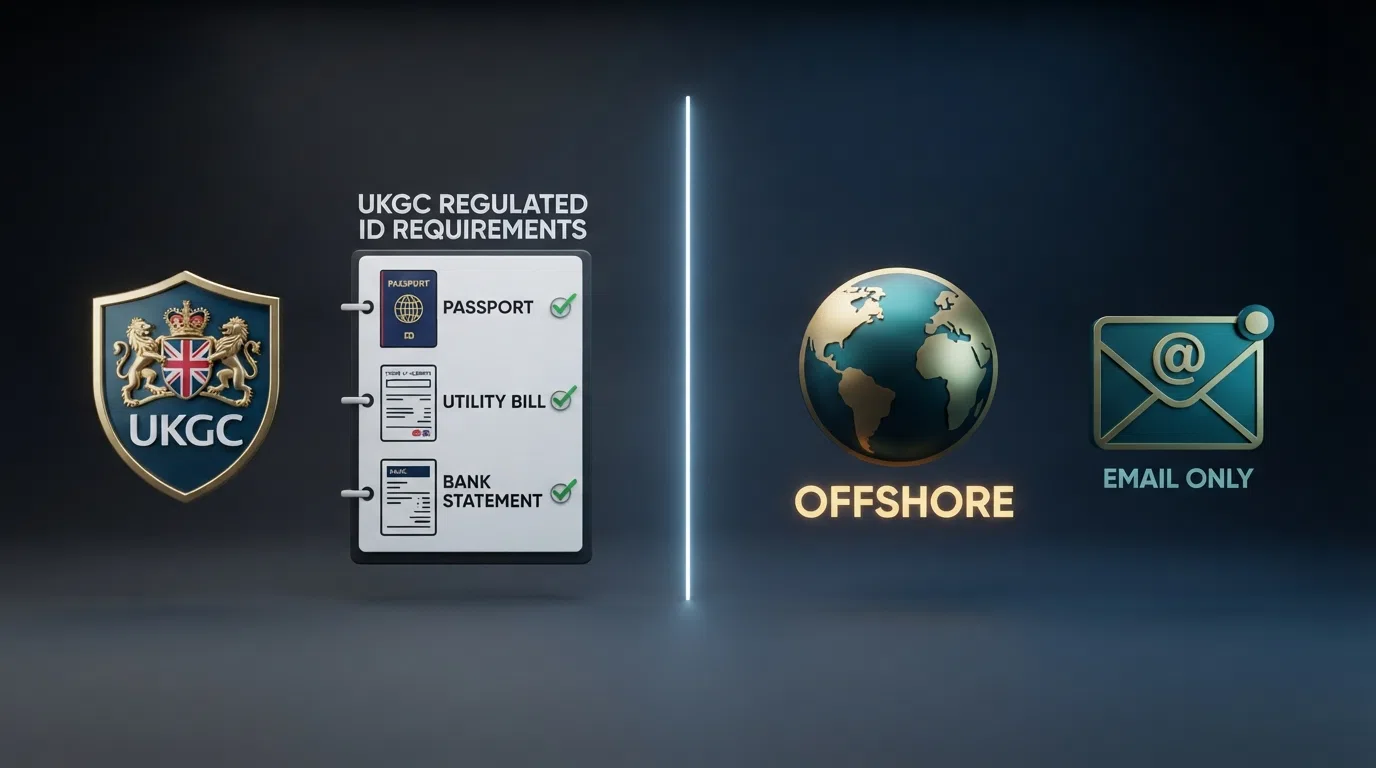
The change in 2019 closed both. Under LCCP Condition 17.1.1, name, address and date of birth must now be confirmed before the customer can deposit, free-play, or gamble. LCCP Condition 3.2.11 layers the age requirement on top. A UKGC-licensed casino that lets a player deposit without verifying those three data points is breaking its licence conditions, and the Commission has been active about it: between April 2024 and June 2025, the Illegal Markets Team issued 3,140 cease-and-desist and disruption notices, referred 447,778 URLs to search engines for removal, and saw 287,961 of those URLs taken down. The average engagement on 160 disrupted sites fell by 32%. The British regulator cannot block ISPs, but it can make the unlicensed market harder to find.
That enforcement pressure is the reason an entire sub-market exists offshore. Players who want a no-ID experience in 2026 have nowhere to find one in the licensed British market, because the licensed British market is not allowed to offer one. The offshore route is the route.
Automated Checks, Soft Checks, and the “No Document” UK Casino That Is Not Actually No-ID
There is a halfway house at the licensed end, and it is worth describing so a reader does not confuse it with the offshore product. Several UKGC-licensed casinos now run “soft” identity checks at registration: a credit-reference-agency lookup against Equifax or a similar bureau, returning a yes/no on name, address and date of birth without the player uploading a document. The process is invisible to the player — a screen, a second or two, and a verified account.
The experience feels like no-ID play, but it is not. The data is checked electronically rather than by a human with a passport, but the verification still happens, and it still happens before the first deposit, in line with LCCP Condition 17.1.1. A player who has ever taken out a loan, a mobile contract, or a council tax bill has a trail at the credit reference agencies. One who has not — a young adult, a recent arrival, a player who has never had a UK address — will be asked for documents anyway, the same way they would have been in 2018.
The licensed casinos have also begun layering a financial-vulnerability check on top. From 28 February 2025, any player who has deposited a net £150 in a rolling 30-day period is screened against publicly available insolvency data: county court judgments, individual voluntary arrangements, bankruptcy orders. A hit does not block play, but it does trigger an interaction: a conversation, a limit suggestion, a flagged account. The screen runs in the background; the player sees only the result.
None of this makes a licensed casino “no ID.” It makes it fast. A reader who values speed above all else will find the licensed fast-verification product more honest: same-day registration, regulated dispute resolution, GAMSTOP coverage, mandatory deposit-limit prompt from 31 October 2025. A reader who values not being asked at all is in the offshore market, and no automated check at a UKGC casino will get them there.
What You Lose When You Leave the UKGC Safety Net
| Protection | UKGC-Licensed Casino | Offshore No-KYC Casino |
|---|---|---|
| GAMSTOP self-exclusion | Mandatory coverage since 31 March 2020 (561,983 active exclusions) | Not covered — no cross-operator self-exclusion offshore |
| UKGC complaints route | Yes — the Commission can investigate | No — falls outside the Commission’s jurisdiction |
| Alternative Dispute Resolution (ADR) | Independent ADR provider mandated | Depends on the offshore regulator (Curaçao, Anjouan) |
| Statutory stake cap on slots | £5 per game cycle (25+), £2 (18–24) | No cap |
| Mandatory deposit-limit prompt | Required from 31 October 2025 | Not required |
| Financial vulnerability check (£150 / 30 days) | Mandatory from 28 February 2025 | Not run |
| Auto-play ban | In force since 31 October 2021 | No ban |
| 2.5-second minimum spin speed | In force since 31 October 2021 | No minimum |
| Losses-disguised-as-wins ban | In force since 31 October 2021 | Not banned |
| Reverse-withdrawal ban | Permanent | No ban |
| Credit card ban | In force since 14 April 2020 | Not enforced at most operators |
| 10× wagering cap on bonuses | In force since 19 December 2025 | No cap — 40×–66× standard |
| Mixed-product promotional offers | Banned since 19 December 2025 | Permitted |
| Segregated player funds | Required | Varies by operator |
| Statutory levy contribution | 1.1% of GGY (since 6 April 2025) | None |
| Remote Gaming Duty (operator tax) | 40% from 1 April 2026 | None to HMRC |
The British model leaves no room for operator discretion on core protections. Those reliant on the full list of fifteen safeguards should remain within the UKGC system, while others may find the trade-off manageable.
No Photo ID Versus No Verification At All — the Partial KYC Reality at Offshore Casinos
“No KYC” is, in this market, a marketing phrase more than a contractual one. The honest read of the term is “no KYC at sign-up, KYC at withdrawal if triggered.” The triggers vary by operator and they vary by withdrawal size.
CoinCasino’s published terms put KYC at withdrawals above $10,000, or earlier for accounts the payment team flags. BC.Game’s trigger is a single withdrawal of $2,000–$3,000, or roughly €10,000 across a calendar month. Jackbit reports KYC on approximately 10% of its withdrawals, weighted toward the larger cashouts. Wild.io, Thunderpick and Cryptorino all reserve the right to verify identity at any point; Flush states no KYC for standard play. None of the ten operators in this ranking publishes a binding promise of “no KYC, ever, at any withdrawal size.” The phrase on the landing page is a register, not a contract.
A player should read the withdrawal terms before depositing. The relevant clauses are the KYC trigger threshold, the document list the operator will accept, and the stated payout time once verification is complete. The fastest advertised payout speed — CoinCasino’s “instant”, Thunderpick’s four minutes, Cryptorino’s twenty — assumes a clean KYC. A flagged withdrawal can take days, and a document review that turns into a manual investigation can take weeks.
Crypto and Bitcoin: the Payment Rail That Makes No-KYC Play Possible
The infrastructure of the offshore no-ID market is, in practice, the cryptocurrency network. Bitcoin, Ethereum, Litecoin and Tether (USDT) are the standard deposit and withdrawal methods across the ten operators in this ranking; Monero shows up at the privacy-focused end. The reason is structural: a bank transfer carries the bank’s KYC, a card payment carries the card issuer’s KYC, and an e-wallet carries the e-wallet’s KYC. A crypto transfer carries only the blockchain’s.
Payout speed reflects that. Jackbit’s BTC withdrawals process in 1–4 hours; a test run came back in 2 hours 14 minutes. Thunderpick advertises up to 5 minutes; a test came back in 4. Wild.io runs instant or auto-payouts. Cryptorino sits at around 20 minutes. Flush’s BTC withdrawals take under an hour. For a player who has waited three business days for a UKGC-licensed casino to push a debit-card refund, the difference is the point.
The tradeoffs are real. There is no chargeback on a crypto transaction: once a withdrawal is sent, it cannot be reversed by the player’s bank, because the player’s bank is not in the loop. Balances are denominated in BTC or USDT, not GBP, so a player carries exchange-rate exposure on every deposit and every withdrawal. And the on-ramp itself — buying crypto with GBP before depositing it at the casino — involves a KYC step at the exchange (Coinbase, Kraken, Binance UK and similar), so the on-ramp is identified even if the casino is not. The privacy gain is between the casino and the player, not at the fiat edge.
Pay by Mobile: Reduced-Friction Deposits Inside the UKGC System
Pay-by-mobile is the licensed market’s answer to the same problem crypto solves offshore. A player deposits at a UKGC-licensed casino by charging the amount to their mobile phone bill or deducting it from their pay-as-you-go balance. The casino never sees a bank account or a card number. The mobile network is the intermediary.
The friction reduction is genuine. The ID reduction is not. A pay-by-mobile casino is still a UKGC-licensed casino, and it must still verify the player’s identity before the first deposit under LCCP Condition 17.1.1, and it must still run the £150 financial-vulnerability check, and it must still cover the player under GAMSTOP. The credit card ban does not catch pay-by-mobile, but everything else does. The daily deposit cap is set by the mobile network rather than the casino — typically £10–£40 per day, depending on the carrier — which is a tighter limit than most UKGC-licensed sites would impose but a looser experience than the offshore model.
Crypto’s offshore dominance makes mobile carrier billing a rarity in no-KYC markets. Balancing speed with protection requires sticking to mobile billing at licensed sites; once you move to crypto, the ID-free trade-off is permanent.
Bonuses at No-ID Casinos: 40×–66× Wagering Versus the UKGC 10× Cap
The single largest hidden cost of going offshore is the bonus. Since 19 December 2025, every UKGC-licensed casino has been bound by a 10× wagering cap on bonus funds and a ban on mixed-product promotional offers. The cap is hard, the ban is hard, and a British player who has been inside the licensed market for the last quarter has been watching welcome offers collapse to a fraction of their old size.
The offshore market has no such cap, and the bonus sizes show it. Wild.io runs a 350% match up to $5,000 plus 200 free spins across three deposits, with 40× wagering on the bonus funds and on the free spin winnings. CoinCasino runs a 200% match up to $30,000, with 60× wagering on the deposit bonus released in 10% instalments, 35× on the free spin winnings capped at $200, and a 14-day validity window. BitStarz runs up to 5 BTC plus 180 free spins across four deposits, at 40× wagering. Thunderpick runs a 100% match up to €600 at 40× on deposit plus bonus. Cryptorino runs 100% up to 1 BTC at 66× wagering with a 7-day validity. Flush is the outlier in the other direction: a 150% match with 1× deposit wagering. Jackbit’s 100 wager-free spins on Hot Chilli Bells sit on a 1× deposit-and-winnings playthrough.
The cost of clearing a bonus scales with the wagering multiple, and the multiples do not lie. A £100 deposit with a £100 bonus at a UKGC-licensed site, post-December 2025, requires £2,000 of total wagering to clear. A £100 deposit with a £100 bonus at CoinCasino requires £12,000. At Cryptorino, the same bonus requires £13,200, and the player has seven days to do it. The arithmetic below makes the point more sharply than any sentence can.
A £100 first deposit at Thunderpick takes the full advertised 100% match, giving a £200 bonus-and-deposit balance subject to 40× wagering on deposit plus bonus, so £8,000 of total wagering is required to clear it. On a typical slot with a 5-second interval between spins, that works out to 1,600 spins — just over two hours of continuous play if the spin rate is sustained. The same player at a UKGC-licensed site clearing a £100 bonus at 10× would need £1,000 of wagering, or 200 spins, in about 17 minutes. The bonus is larger offshore by a factor of eight, and the time to clear it is larger by the same factor. A player who plans to clear should clear a licensed bonus; a player who does not plan to clear should not take either.
The wagering gap is the gap that should decide the choice. Every other difference between licensed and offshore — the speed, the stake cap, the auto-play ban, the spin-speed floor — is a design preference. The wagering gap is a four-to-six-fold difference in the real cost of taking a bonus, and it is the one a careful player should measure.
What You Can Actually Play Without Sending Your Passport
Live Dealer Tables Without ID Verification
The live dealer product at the offshore end of the market is, in practical terms, the same product the player has seen at a UKGC-licensed casino. Evolution Gaming runs the dominant studio: Wild.io and Casinopunkz both list Evolution alongside Pragmatic Play and Hacksaw Gaming, and the table catalogue is the standard mix of blackjack, roulette, baccarat and game-show titles. MadCasino carries Vivo Gaming for approximately 30 live dealer tables. Pragmatic Play Live is present at several operators. The streams are the same streams.
The differences are the rules around the tables. A UKGC-licensed live casino must enforce the £5 or £2 stake cap on slots, but live dealer table games fall outside that statutory cap; the cap applies to online slots, not to live roulette or live blackjack. That means the live-dealer experience at an offshore casino is functionally close to the licensed one in terms of stake flexibility. The RTP is the same. The dealing is the same. The only meaningful absence is the UKGC dispute route if a hand is mis-dealt, which a player will never actually need.
Online Slots Without ID: Thousands of Titles, No £5 Limit
The slot catalogue is where the offshore operators differentiate most clearly. MadCasino lists 2,000+ slot titles, CoinCasino 4,000+, Thunderpick 5,000+, Jackbit 7,000+, Wild.io 9,000+. Every one of them is a real game from a real studio: Pragmatic Play, Hacksaw Gaming, NetEnt, Play’n GO, NoLimit City, Nolimit, ELK, BTG, plus a long tail of smaller suppliers. The catalogue is broader than most UKGC-licensed casinos because offshore operators are not restricted by the Commission’s game-design rules.
Those rules are not visible to the player as a list. They show up as design choices the player can no longer make. Auto-play is banned at UKGC-licensed sites since 31 October 2021 — a player cannot press “start 100 auto-spins” and walk away. The 2.5-second minimum spin speed is in force, so a slot cannot be played faster than that interval. The “losses disguised as wins” presentation is banned, so a slot cannot show a celebratory animation on a spin that cost more than it returned. The reverse-withdrawal ban stops a player from cancelling a withdrawal and putting the money back into play. None of these bans applies at an offshore casino. A player at Wild.io can run 500 auto-spins at the maximum stake, with no minimum interval, on a game that celebrates every spin regardless of outcome, and then cancel a pending withdrawal without restriction. That is the game-design freedom offshore.
The stake cap, £5 for players 25 and over and £2 for players 18 to 24, is the headline difference. Offshore slots can be played at any stake, and progressive jackpots can be chased at the bet level the player chooses rather than the bet level the regulator permits. The high-stakes slot player who has felt the British cap as a constraint has a clear reason to be offshore; the casual player who plays at £1 a spin has no reason at all.
Table Games, Crash Games, and the Full Casino Line-Up
Beyond slots, the offshore product is the same library a UK player has seen in any regulated casino. Blackjack, roulette, baccarat — RNG and live-dealer versions, across all ten operators. The differences are the proprietary titles and the sportsbook overlays.
BC.Game’s BC Originals line is the most distinctive: Plinko, Craps, Keno, Roulette, dice, and a handful of crash-style games that the casino itself publishes rather than licensing from a third party. The Originals use a provably-fair mechanism, where each round’s outcome is generated from a server seed, a client seed and a nonce, all of which the player can verify against the blockchain after the bet settles. The pitch is that a casino running its own provably-fair games cannot rig them, because the player can check. That argument is more credible at a crypto-native casino with a published algorithm than at a traditional operator asking the player to trust the maths.
Thunderpick and Jackbit both run a sportsbook alongside the casino. Thunderpick carries esports as a first-class product, with Counter-Strike, Dota 2 and League of Legends markets running alongside football and tennis. Jackbit carries a more conventional sportsbook. The combined casino-plus-sportsbook model is the norm offshore: the player holds one balance, one account, and switches between slots and sports with a tap.
The Studios Behind the Games: Who Powers No-ID Casinos
The same studios supply both markets. Pragmatic Play, Evolution, Hacksaw Gaming, NetEnt and Play’n GO appear at almost every offshore operator in the ranking, and they appear at every UKGC-licensed casino in the country. The games are the same games; the rules around them are different. A player at Wild.io playing a Pragmatic Play slot is playing the same game a player at bet365 is playing, with a different stake limit, a different spin-speed minimum, a different auto-play rule, and a different dispute route if a bonus misfires.
SoftSwiss is the platform provider behind several offshore casinos, including BitStarz. A platform provider is the B2B software the casino runs on; the casino is the brand, the platform is the engine. The platform determines the cashier, the KYC plumbing, the bonus engine, the game aggregator. A player who recognises SoftSwiss across multiple offshore brands is recognising the platform underneath, not the brand on top.
A note on verification. Provably fair is a real mechanism, and at crypto-native casinos it is a genuine alternative to regulator-tested RNG. A provably-fair casino publishes the algorithm, lets the player set or supply part of the seed, and lets the player verify each round after the fact. The maths is sound. The marketing is sometimes louder than the maths, and not every operator that claims provably fair actually exposes the verification tool to the player. A player who wants to check should look for the verification interface before depositing, not after.
The 10 Offshore Casinos UK Players Use to Skip ID Verification
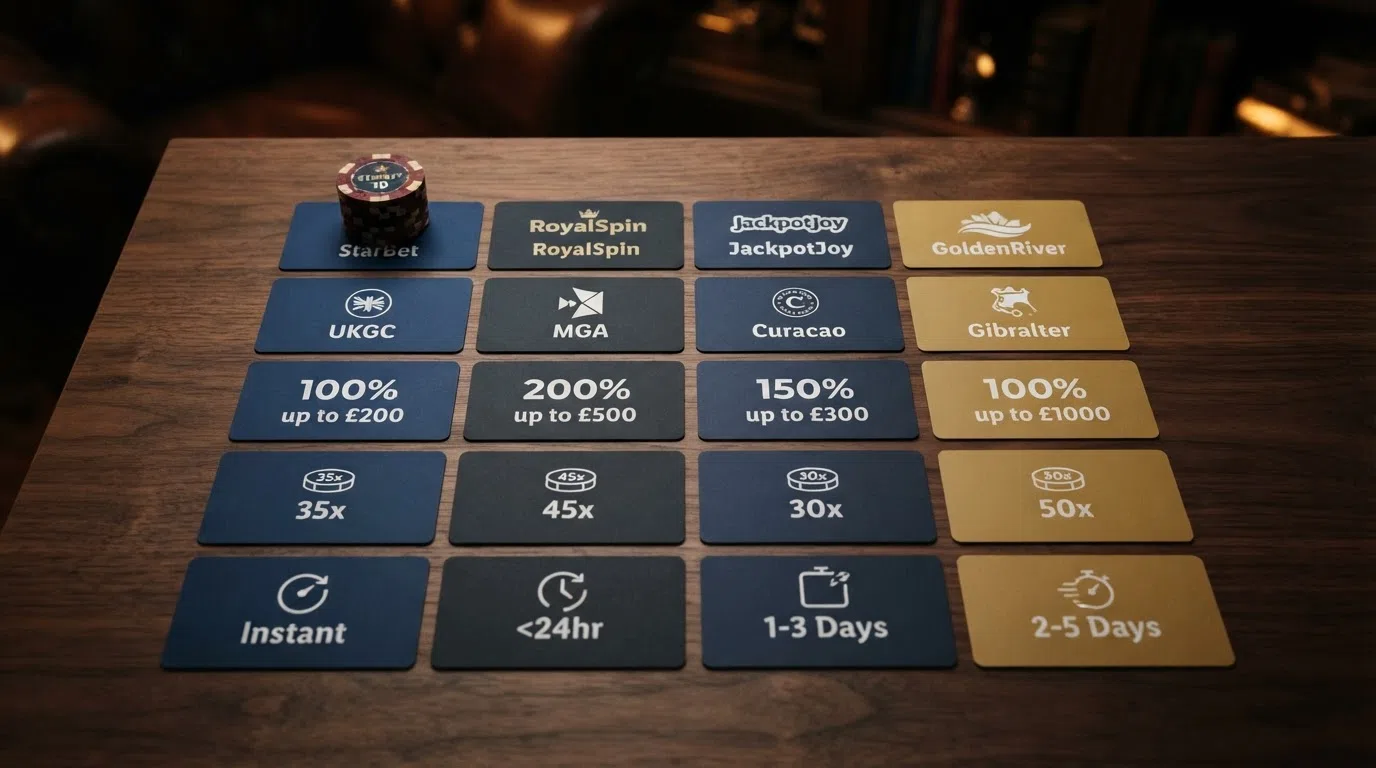
The ten operators below are ranked by fit to the no-ID topic — fastest registration, most transparent no-KYC marketing, strongest game library — rather than by market share, and none of them holds a UKGC operating licence. All ten were checked against the UKGC public register of operating licence holders (gamblingcommission.gov.uk/public-register); none appears on it. Playing at any of them means leaving the protections described in the comparison table above.
| Operator | Licence | Welcome Bonus | Wagering Requirement | Payout Speed |
|---|---|---|---|---|
| Wild.io | Curaçao | 350% up to $5,000 + 200 FS (3 deposits) | 40× on bonus, 40× on FS winnings (50 USDT cap) | Instant / auto-payouts |
| CoinCasino | Offshore (UK players blocked in T&Cs) | 200% up to $30,000 + 50 Super Spins | 60× on bonus (10% instalments), 35× on FS winnings ($200 cap) | Instant crypto |
| BitStarz | Curaçao | Up to 5 BTC + 180 FS (4 deposits) | 40× on bonus funds | ~10 min crypto, 1–3 business days fiat |
| BC.Game | Curaçao | Multi-tier (from $1 first deposit) | 35× casino, 45× sports | Crypto payouts |
| Thunderpick | Curaçao (CGA) | 100% up to €600 (crypto) or €2,000 (fiat) | 40× on deposit + bonus | Up to 5 min (tested 4 min) |
| Jackbit | Curaçao | 100 wager-free FS on Hot Chilli Bells | 1× deposit + winnings to withdraw | 1–4 hours BTC (tested 2h 14m) |
| Flush | Curaçao | 150% match | 1× deposit wagering | Under 1 hour BTC |
| Cryptorino | Costa Rica (data-processing registration) | 100% up to 1 BTC | 66× on deposit, 7-day validity | ~20 min BTC |
| Casinopunkz | SBM S.R.L. (offshore) | 100% up to €5,000 + 15% weekly cashback | Not specified in published terms | 0–1 hour crypto |
| MadCasino | Anjouan | 777% welcome bonus | Not specified in published terms | Not specified in published terms |
Where the wagering or payout speed is not published, the operator’s own terms page is the source a player should consult before depositing; the table above is what is verifiable from research, not what the operator necessarily advertises at the top of the homepage.
Wild.io — 9,000+ Games, 350% Welcome Package, Email-Only Sign-Up
Wild.io is the broadest catalogue in the no-KYC market. Nine thousand-plus games from Pragmatic Play, Evolution, Hacksaw Gaming and a long tail of studios, on a Curaçao licence, with an email-only registration that takes under a minute. The welcome package is 350% up to $5,000 plus 200 free spins, spread across three deposits: 120% plus 75 free spins on the first, 110% plus 50 on the second, 120% plus 75 on the third. Wagering sits at 40× on the bonus funds and 40× on free spin winnings, with a 50 USDT cap on free spin cashout — a real ceiling on the upside of the spins.
Crypto withdrawals are the standout. Wild.io runs instant or auto-payouts on BTC, ETH, LTC and USDT; the casino describes the process as “instant” and the model matches that. The combination of a large catalogue, a large bonus, and instant withdrawals is the reason Wild.io opens the ranking. The reason to hesitate is the wagering: 40× on a three-deposit package means a player who takes the full $5,000 bonus is committing $200,000 of wagering before any withdrawal. That is a clearing job, not a casual bonus, and a player who does not plan to clear should not take the full package.
Wild.io suits the volume player who prioritises game breadth over bonus simplicity. If 40× wagering feels heavy, however, the leaner playthroughs at Flush and Jackbit are the logical alternatives.
CoinCasino — 200% to $30,000, 60× Wagering, KYC Only at Five-Figure Withdrawals
CoinCasino runs the highest bonus ceiling in the ranking — 200% up to $30,000 plus 50 Super Spins — and the highest effective wagering cost. The bonus is released in 10% instalments, with each 10% unlocking after the player has wagered 6× the deposit amount, which means a $1,000 deposit clears in chunks rather than all at once. Free spin winnings carry 35× wagering and a $200 cap. The whole offer has 14 days of validity.
The published terms block UK players outright (clause 4.1.3), which CoinCasino enforces by geolocation. Independent testing reports the block is bypassable via VPN, which is technically possible but explicitly violates the operator’s own terms. A UK player who proceeds on those terms is accepting the position that the casino can refuse withdrawals on the basis of the violation.
The KYC structure is the most permissive at the high end. CoinCasino only triggers identity verification through Veriff for flagged accounts or for withdrawals above $10,000. The escalation clause is the cost: deposits over $10,000 face 75× wagering and a 14-day manual credit delay, which makes a large first deposit significantly worse than a large bonus. A player who plans to deposit small and withdraw small has the cleanest path through CoinCasino’s terms. A player who plans to deposit $10,000 has been warned.
For a player who can access the site and is comfortable with a $30,000 bonus ceiling at 60× wagering, CoinCasino is the largest no-KYC offer in the ranking. For a UK player specifically, the VPN question is the one to resolve first.
BitStarz — Up to 5 BTC Welcome Bonus, Curaçao-Licensed, 40× Wagering
BitStarz is the most established crypto-native brand in the no-KYC set, operating on the SoftSwiss platform with a Curaçao licence. The welcome package runs up to 5 BTC (or €500 / $2,000 fiat equivalent) plus 180 free spins, spread across four deposits. Wagering is 40× on the bonus funds, with a $5 / €5 maximum bet during wagering and a $20 minimum deposit. Each deposit bonus has seven days of validity.
The registration experience is the standard SoftSwiss path: an email, a password, an account. KYC can be triggered at any point during account activity, not only at withdrawal, so a BitStarz player should not assume that account age protects them from a document request. The risk surface is real; the timing is unpredictable.
Crypto withdrawals on BitStarz process in approximately ten minutes, which is the slowest instant in the ranking (Wild.io and CoinCasino are faster). Fiat withdrawals — where available — take 1–3 business days, the same as a UKGC-licensed casino. The catalogue is wide, the platform is mature, and the bonus is competitive on its face. The 40× wagering is the same as Wild.io’s; the bonus is smaller in headline terms but pays out in BTC rather than USDT, which matters if a player is already holding bitcoin.
BitStarz delivers the reliability of a mature platform, making it the conservative pick for this market. Those chasing maximum withdrawal speed should stick to the instant-payout profiles of Wild.io or Thunderpick.
BC.Game — Anonymous Registration Under 1 Minute, 35× Wagering, BC Originals
BC.Game is the closest to true anonymous play in the ranking. The registration is an email and a password; the clock is under a minute. The casino does not run KYC at sign-up, and it does not run KYC to play. KYC is risk-based, triggered at roughly $2,000–$3,000 on a single withdrawal or about €10,000 across a calendar month, which is the lowest threshold in the ranking and a real constraint on cashout size.
The welcome bonus is multi-tier: BC.Game runs an ongoing series of first-deposit, second-deposit, third-deposit and fourth-deposit offers, with the entry level at a $1 first deposit. Wagering is 35× on the casino bonus and 45× on the sports bonus, which is the lowest casino wagering in the offshore set. The catalogue mixes BC Originals — Plinko, Craps, Keno, Roulette and a handful of crash-style proprietary games — with the mainstream studio product.
BC.Game excels as an anonymous entry point for casuals avoiding high-volume withdrawal thresholds. Once cashouts hit five figures, however, the compliance reality of KYC triggers becomes unavoidable.
Thunderpick — 5,000+ Games, Esports and Sportsbook, 40× Wagering
Thunderpick is the casino-plus-esports hybrid in the ranking. The casino carries 5,000+ games, and the sportsbook runs esports (Counter-Strike, Dota 2, League of Legends) alongside the conventional football, tennis and basketball markets. The Curaçao CGA licence sits underneath, the registration is email-only, and the welcome offer is 100% up to €600 in crypto (or €2,000 in fiat), with 40× wagering on deposit plus bonus and a €20 minimum deposit.
The payout speed is the headline. Thunderpick’s crypto withdrawals process in up to 5 minutes; a test run came back in 4. That is faster than every other operator in the ranking, and the only one close is Wild.io’s instant. For a player who measures a casino by how quickly winnings arrive, Thunderpick is the top of the list.
The wagering is mid-pack at 40×. The bonus ceiling is lower than Wild.io’s or CoinCasino’s, but the sportsbook and the esports product are real differentiators. A player who wants esports and slots on one balance has a strong case for Thunderpick; a player who wants the biggest bonus should look at Wild.io or CoinCasino instead.
Jackbit — 100 Wager-Free Spins and 1× Wagering to Withdraw
Jackbit is the only featured operator with genuinely wager-free free spins. The 100 spins on Hot Chilli Bells have no playthrough on the spins themselves; the spins land as cash, subject to a 1× deposit-plus-winnings playthrough before withdrawal. A £50 minimum deposit is the only entry threshold.
Registration is a username, an email and a password, with a Google sign-up option. KYC is triggered on approximately 10% of withdrawals, biased toward the larger cashouts. Crypto withdrawals process in 1–4 hours; a BTC test came back in 2 hours 14 minutes. The catalogue runs 7,000+ games, including slots, live dealer and a sportsbook.
Jackbit is the lowest-friction welcome offer in the ranking, and the closest to a no-strings-attached promotion. The 1× playthrough means a player who wins £50 from the free spins and has deposited £50 can withdraw £100 immediately. The 7,000+ game catalogue means the wager-free spins sit on a real product, not a token slot. The £50 minimum is a higher entry than most operators in the set, but the lack of wagering on the spins makes the effective value significantly higher.
For a player who wants the free-spin welcome without the 40× playthrough that usually attaches to one, Jackbit is the answer. The position at the top of the no-strings bonus table is well earned.
Flush — 150% Match With 1× Deposit Wagering, Crypto-Native
Flush is the other end of the wagering spectrum. The welcome offer is a 150% match with 1× deposit wagering before withdrawal, which is the lowest effective wagering in the offshore set. The casino is Curaçao-licensed, crypto-native, and operates without KYC for standard play. BTC withdrawals process in under an hour.
The catalogue is the standard multi-provider mix, without the distinctive Originals line of BC.Game or the breadth of Wild.io. The 150% match is a generous percentage on a smaller absolute ceiling than Wild.io or CoinCasino offers. A player who values low wagering and fast BTC withdrawals has a clear case for Flush; a player who values the largest bonus ceiling will look at Wild.io or CoinCasino.
Flush serves the minimalist who prefers avoiding rollover complications altogether. Trading a lower bonus ceiling for 1× wagering is the smartest compromise for a straightforward withdrawal experience.
Cryptorino — 100% to 1 BTC, 66× Wagering, 7-Day Validity
Cryptorino is registered in Costa Rica — a data-processing registration, not a gambling licence — and runs a 100% welcome bonus up to 1 BTC at 66× wagering. The 66× is the highest in the ranking, the 7-day validity is the shortest, the €10 minimum deposit is the most accessible, and the €12 maximum bet during wagering is the highest. A player who takes the full 1 BTC bonus has committed 66 BTC of wagering in seven days, which is a clearing job that runs to thousands of spins per day at the €12 max bet.
The KYC approach is case-by-case. Anonymous registration at sign-up; verification on demand. BTC withdrawals process in around 20 minutes, which is fast but not the fastest. Slots contribute 100% to wagering, which is the standard.
Cryptorino targets the low-entry, high-ceiling player, though the aggressive 66× wagering requirement essentially neutralises the bonus for most. The deposit floor is accessible, but the clearing math remains punitive.
Casinopunkz — 100% to €5,000, Weekly Cashback, Major Studio Games
Casinopunkz is the lesser-known operator in the ranking, operated by SBM S.R.L. and not integrated with GAMSTOP. The welcome bonus is 100% up to €5,000, with a weekly cashback of up to 15%. The studio list is strong: Pragmatic Play, Evolution, Hacksaw Gaming, NetEnt and Play’n GO. Crypto withdrawals process within 0–1 hour.
The wagering requirement on the welcome bonus is not specified in any public source, and a player should check the operator’s terms page before depositing. The 15% weekly cashback is a structural advantage that softens the cost of an unclear main bonus, but a clearing cost a player cannot calculate in advance is a clearing cost a player should not commit to without seeing the math. The cashback is the more transparent part of the offer; the headline bonus is the part a player needs to verify.
Casinopunkz relies on weekly cashback to hedge its lack of public wagering data. Serious hunters of fixed terms should defer until the operator publishes its full turnover requirements.
MadCasino — 777% Welcome Bonus, Anjouan-Licensed, 2,000+ Slots
MadCasino runs the highest advertised welcome percentage in the ranking — 777% — under an Anjouan iGaming authority licence. The catalogue is 2,000+ slot titles, around 30 live dealer tables powered by Vivo Gaming, and a sportsbook. The bonus ceiling in absolute terms and the wagering requirement are not specified in any public source; the payout speed is not specified either. A player should treat the 777% as a marketing number until the operator’s terms page confirms the wagering and the payout time.
Anjouan is the newer of the offshore licensing jurisdictions in the ranking, and its enforcement record is shorter than Curaçao’s. The presence of Evolution, Pragmatic Play and Vivo Gaming at the operator is a positive sign on the game-quality side, but the missing numbers on the bonus and the payouts are a gap a player should close before committing funds.
For a player willing to verify terms on the operator’s own pages and who values the 777% headline percentage, MadCasino is a possibility. For a player who wants every figure verified in advance, the offer should remain on the read-only list until the missing numbers are published.
Staying Safe When the UKGC Safety Net Is Gone
Self-Exclusion Without GamStop — What Actually Works Offshore
GAMSTOP’s 117,756 new registrations in 2025 brought the active exclusion list to 561,983 at year-end, with April 2025 setting a single-month record at 10,281. The exclusion periods run six months, one year, five years, or five years with auto-renewal; none of them can be cancelled early. The scheme is mandatory for every UKGC-licensed online operating licence.
It does not cover a single offshore casino. A player registered with GAMSTOP can open an account at Wild.io, BC.Game, CoinCasino or any of the other nine operators the same afternoon, because the operators are not connected to the scheme. The architectural gap is deliberate: GAMSTOP is a UKGC-licensed-only database, and an offshore operator without a UKGC licence has no obligation to consult it.
What offshore casinos offer instead is site-level self-exclusion. Wild.io, BC.Game, Thunderpick and most of the others will honour an account closure or a self-exclusion request sent to support, but the exclusion covers that one brand. A player who excludes at Wild.io can open an account at BitStarz the same day. There is no cross-operator exclusion scheme offshore, and the Curaçao and Anjouan regulators do not run one. The burden of staying stopped sits entirely with the player, and an offshore casino is the wrong place for a player who is trying to stop.
The honest framing is that offshore casinos are a tool for bypassing self-exclusion, and any player who has registered with GAMSTOP — or who has self-excluded at a UKGC-licensed site, or who has decided personally to stop gambling — should not use them. The fact that the offshore route exists is the reason the section on safety is here. The fact that the route is open to anyone is the reason the warning is repeated.
Deposit Limits, Reality Checks, and the Tools Offshore Casinos Actually Offer
The responsible-gambling infrastructure at UKGC-licensed casinos has been built up over five years. From 31 October 2025, every operator must prompt a customer to set a financial limit before the first deposit; from 30 September 2026, a standardised gross deposit limit must be offered. From 28 February 2025, the £150 net-deposit threshold has triggered a financial-vulnerability check using CCJs, IVAs and bankruptcy orders. From 31 October 2021, auto-play has been banned, spin speeds have been floored at 2.5 seconds, and losses-disguised-as-wins presentations have been prohibited. Reverse withdrawals have been permanently banned. None of these obligations applies offshore.
What offshore casinos offer varies by operator. Most have a deposit-limit tool in the cashier; most have a reality-check pop-up; some have time-out periods. None of them is required to have any of it, and the tools that exist are operator-specific rather than regulator-mandated. A player who sets a deposit limit at Wild.io has set it at Wild.io, not at BC.Game. A player who closes an account at CoinCasino has closed it at CoinCasino, not at any other operator.
By moving offshore, you assume full responsibility for tools the UKGC otherwise mandates. The help infrastructure remains available to everyone, but the proactive oversight you might expect from a licensed operator is entirely absent.
Recognising Problem Gambling When the Operator Is Not Watching
The NHS Adult Psychiatric Morbidity Survey 2023–24 puts the headline number at 0.4% of adults — roughly one in 250 — experiencing problem gambling (PGSI score of 8 or higher), with 1.6% at moderate risk or above (PGSI 3+). The 4.6% figure for online-only gamblers is the number that matters on this page: among people who gamble online, the moderate-or-higher rate is almost three times the general population rate. The problem is concentrated in the channel the offshore market serves.
The PGSI itself is a nine-item screening instrument, freely available through GamCare, and it takes about five minutes. The questions cover chasing losses, gambling to escape mood, lying about gambling, spending beyond means, and the rest of the standard pattern. A score of 3+ is the threshold for moderate risk, 8+ for problem gambling. A player who scores in either band and is gambling offshore is gambling without any of the operator-side intervention the UKGC requires at a licensed site: no spend alert, no interaction trigger, no mandatory limit prompt, no vulnerability check at the £150 threshold.
Recognising these common indicators is critical when the standard automated interventions are missing. If you detect any of these behaviours, it is an urgent cue to stop — regardless of which site you are using.
Where to Get Help — UK Support That Works Regardless of Where You Gamble
The help infrastructure is the one part of this page that does not change when a player crosses from licensed to offshore. The National Gambling Helpline, run by GamCare, is free, 24/7, and reachable on 0808 8020 133, by online chat, by WhatsApp, or by email at [email protected]. The helpline received over 52,000 calls in 2024–25, and 82% of those who disclosed a form of gambling cited online gambling — the highest rate since 2021.
NHS gambling harm clinics operate in England, Scotland and Wales, with specialist treatment available through GP referral or self-referral. Gamblers Anonymous runs peer-support groups across the UK, free to attend. GambleAware funds the National Gambling Support Network, which holds treatment waiting times under two weeks and reports that 9 in 10 people who complete treatment show improvement. GamCare also runs a free online self-assessment tool for anyone unsure whether their gambling is becoming a problem.
Every one of these services is accessible to a player who has been gambling offshore. None of them requires the player to have been at a UKGC-licensed casino. None of them is improved or worsened by where the player has been playing. The phone number is the same; the email is the same; the clinics are the same. A player who has read this far and is unsure about their own gambling has one practical step, and it is to ring 0808 8020 133 or to take the GamCare self-assessment before opening another account anywhere.
How We Evaluated These No-ID Casinos
The verification source for the GB-licensed status of every operator in the ranking is the UKGC’s public register of operating licence holders, at gamblingcommission.gov.uk/public-register. None of the ten brands appears on it. The register is the single source for whether a casino holds a GB operating licence, and the conclusion from checking each name is the same: offshore, unlicensed in GB, available to UK players without a GB licence.
The ranking is built on five criteria, in this order of weight: transparency about when KYC is actually triggered (sign-up, withdrawal, threshold), game library breadth and provider quality, bonus fairness as measured by the wagering multiplier and the validity window, payout speed and reliability, and the cost of clearing the welcome offer in expected time at a typical slot’s spin rate. There are no percentage scores and no weightings: the assessment is comparative and descriptive, and the table above shows the underlying numbers.
The research is drawn from each operator’s own published terms, from independent testing reports on payout speed, and from the regulator’s enforcement statistics. Where a number is not specified — the wagering on the Casinopunkz and MadCasino welcome bonuses, the payout speed at MadCasino — the gap is marked as a gap, and a player is pointed to the operator’s own terms page. Inventing a number to fill the cell is the kind of error this page is designed to avoid, and the audit that reads this file downstream will catch a fabricated figure the way it would catch a wrong one.
The page does not endorse any operator. The tradeoffs are presented honestly: speed, privacy and stake flexibility offshore; UKGC protection, GAMSTOP coverage and the 10× wagering cap at home. A reader who reads both sides of the comparison and decides the licensed market fits their needs has used this page well. A reader who decides the offshore trade is worth it for their situation has also used it well. The job is to show the choice clearly, not to make it.
Speed, Privacy, or Safety — What Should a UK Player Choose?
The three-way trade at the heart of this page is not a marketing construct. It is real, and each leg of it has a number. The speed leg is the difference between a Wild.io crypto withdrawal in two hours and a UKGC-licensed debit-card withdrawal in three business days. The privacy leg is the difference between an email address at an offshore casino and a passport scan plus a credit-reference-agency soft check at a licensed one. The safety leg is the difference between a Curaçao ADR process that can take weeks and a UKGC complaints route backed by an Alternative Dispute Resolution provider and, ultimately, the Commission.
The wagering leg is the largest single cost. Since 19 December 2025, a UKGC-licensed welcome offer is capped at 10× wagering. An offshore welcome offer sits at 40× to 66×, with Flush and Jackbit at the 1× end. A player who plans to clear a bonus is paying four to six times more in required turnover to do it offshore, and the cost scales with the bonus size. The same offer that looks generous at 200% up to $30,000 at CoinCasino looks less generous when the clearing job runs to $1.8 million of wagering at 60×.
The stake-cap leg is the draw for high-stakes slot players. The UKGC’s £5 (25+) and £2 (18–24) per-game-cycle stake cap is the most distinctive feature of the British model; the freedom to bet £50 or £500 a spin is the most distinctive feature of the offshore model. A casual player at £1 a spin has no stake-cap reason to leave. A serious high-stakes player has a clear reason to consider it, alongside every other cost the move carries.
The protection leg is the long list. GAMSTOP’s 561,983 active exclusions do not reach a single offshore site. The UKGC’s mandatory deposit-limit prompt from 31 October 2025 does not exist offshore. The £150 financial-vulnerability check does not run offshore. The auto-play ban, the 2.5-second spin-speed floor, the losses-disguised-as-wins ban, the reverse-withdrawal ban: none of them applies offshore. A player who values one of them is paying a cost to leave. A player who values all of them is paying a wall.
The verdict depends on the reader. A player with a disposable budget, gambling for entertainment, comfortable with crypto, with no active self-exclusion and no need for a UKGC complaints route has a coherent reason to use the offshore market, and Flush, Jackbit or Wild.io is the place the wagering numbers point to. A player in active self-exclusion, or one who cannot afford a six-week fund dispute, or one who values the UKGC’s deposit-limit and vulnerability-check architecture, is reading the wrong page. The offshore trade is not for them, and the licensed market is the only honest answer.
Professional support remains entirely independent of your choice of casino. If you have any hesitation about your gambling patterns, the helpline is the priority step before any further registration.
Frequently Asked Questions
Can I play at an online casino in the UK without providing ID?
Not at a UKGC-licensed casino. Since 7 May 2019, every licensed operator must verify a player’s name, address and date of birth before the first deposit, under LCCP Condition 17.1.1, with the age check sitting on top under Condition 3.2.11. The offshore casinos ranked on this page — Wild.io, CoinCasino, BitStarz, BC.Game, Thunderpick, Jackbit, Flush, Cryptorino, Casinopunkz and MadCasino — offer email-only sign-up and defer or skip the document check until withdrawal, which is why they appear on a “no ID” page at all.
Are no KYC casinos legal for UK players?
A UK player is not committing an offence by gambling on an unlicensed site. The criminal liability sits with the operator, under section 33 of the Gambling Act 2005. A Curaçao, Anjouan or Costa Rica licence is not a substitute for a UKGC operating licence for any operator taking GB players. What a player loses by going offshore is recourse: no UKGC complaints route, no ADR provider, no British consumer protection if funds are withheld.
What happens if I gamble at an unlicensed casino and they refuse to pay out?
A player has to pursue the dispute through the offshore operator’s own customer service, then through the offshore regulator’s complaint process — Curaçao’s, Anjouan’s or Costa Rica’s, depending on the licence. None of those regulators has the UKGC’s enforcement capacity, and a fund dispute can take weeks. The UKGC cannot intervene in a dispute with an operator it does not regulate, and no British ADR provider has jurisdiction.
How fast are withdrawals at no ID casinos compared to UKGC-licensed sites?
Crypto withdrawals at the offshore operators process in minutes to a few hours. Wild.io runs instant or auto-payouts, Thunderpick has been tested at 4 minutes, Cryptorino at around 20 minutes, Jackbit at 1–4 hours (a test came back in 2 hours 14 minutes), Flush under an hour. UKGC-licensed casinos that support debit-card withdrawals typically take 1–3 business days, with e-wallets faster. The speed gap is real and is the main reason a UK player chooses the offshore route.
Can I use GamStop to self-exclude from no KYC casinos?
No. GAMSTOP covers every UKGC-licensed online operator, and offshore casinos are not on the scheme. The 561,983 active GAMSTOP exclusions at the end of 2025 do not block a single offshore site. A player who has registered with GAMSTOP and then opens an account at Wild.io or BC.Game has bypassed their own self-exclusion. Self-excluding at one offshore casino does not exclude a player from any other.
Are there any UK-licensed casinos with minimal or automated ID checks?
Several UKGC-licensed casinos use credit-reference-agency soft checks at registration, which verify name, address and date of birth without the player uploading a document. The experience feels like no-ID play, but the verification still happens and still happens before the first deposit. A player whose trail is thin at the credit reference agencies — a young adult, a recent arrival, someone who has never had a UK address — will be asked for documents anyway. The licensed “no-document” casino is fast, but it is not no-ID.
Account – nodeposit-casinobonuses-uk
Content created by the «nodeposit-casinobonuses-uk» team