
Pay by Phone Bill UK Casinos: A Practical Guide to Charge-to-Mobile Funding
 Available in GB
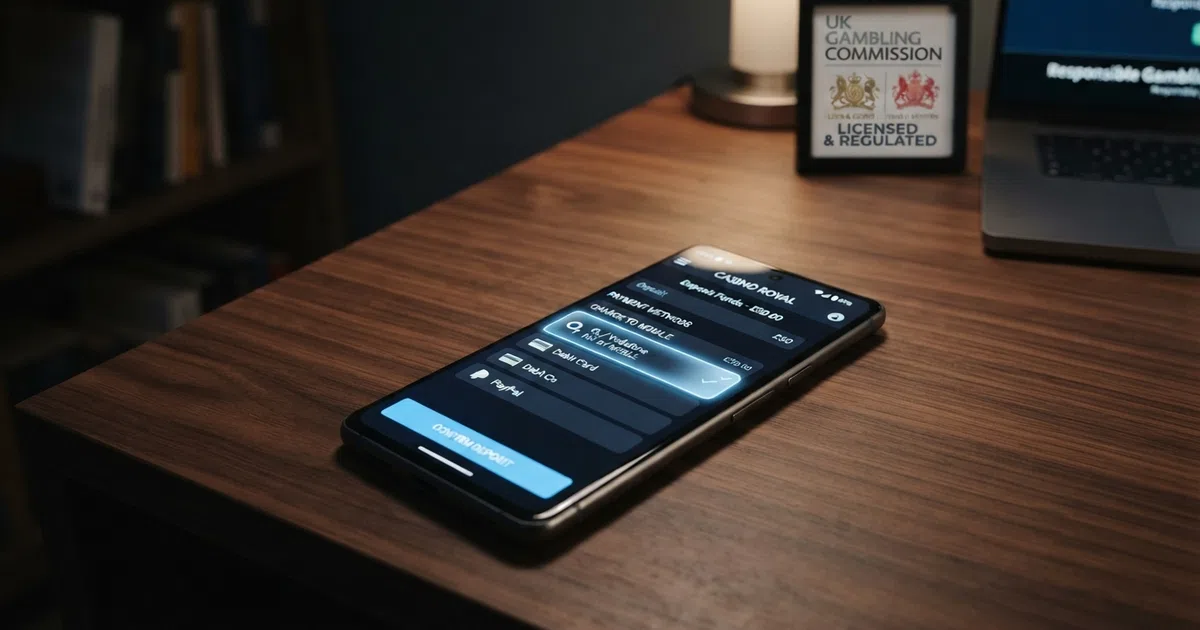
Pay by phone bill deposits have become the quiet alternative to the debit card at UK online casinos: the funding source is your mobile network rather than your bank account, the deposit appears on your phone bill or your prepaid credit rather than on a bank statement, and the transaction is capped by statute before a player can overspend in a single session. They are not, however, a free-for-all funding rail. The Payment Services Regulations 2017, enforced by the Phone-paid Services Authority, place a hard ceiling on every charge-to-mobile transaction in the UK. Several operators take a slice off the top before the deposit ever reaches a casino balance. And the processor layer that sits between a casino cashier and a mobile network has narrowed sharply over the past year.
Data current as of September 8, 2026, verified against the UK Gambling Commission’s public licence register and operator cashier pages.
Pay by Mobile Billing Casinos: A Funding Method That Keeps Your Bank Card Out of It
A pay by phone bill casino accepts deposits funded through the player’s mobile network rather than a bank card or e-wallet. The casino never sees a card number; the player’s phone number, confirmed by an SMS code, is the only identifier the cashier needs. The deposit is then either added to the next monthly phone bill for contract customers or deducted from prepaid credit for pay-as-you-go users. On the player’s bank statement, nothing appears at all: only a generic line on the phone bill, often labelled as a mobile services charge rather than by the casino’s name. That privacy is the reason most UK players reach for phone bill deposits in the first place: no card-based tracking, no gambling descriptor on a shared bank statement, and no record that survives in a banking app’s transaction history.
The £40 ceiling on a single transaction and the £240 monthly ceiling across all phone-bill services, both set under the Payment Services Regulations 2017 and enforced by the Phone-paid Services Authority, are what make the method workable for the kind of player who wants a hard monthly limit. The typical minimum deposit is £10, though some operators floor at £5, and most UK phone bill deposits land in a casino balance within seconds of SMS confirmation. That speed, combined with the no-bank-card angle, is the core appeal. What changes over time is the processor landscape behind the cashier: Boku, once the default, has stepped back from direct UK casino integration, and Fonix now handles the bulk of charge-to-mobile deposits at UK-licensed operators. Payforit and Siru Mobile remain available, though with narrower operator coverage.
What a Pay by Phone Bill Casino Actually Is
A pay by phone bill casino is any UK Gambling Commission-licensed online casino that lists charge-to-mobile as a deposit method in its cashier. The mechanic is straightforward: a player selects Pay by Mobile (or Pay by Phone Bill, depending on the label the cashier uses), enters their mobile number, receives an SMS with a verification code, confirms the amount, and the deposit lands in their casino balance, usually within thirty seconds. The casino never handles a bank card; the processor sitting between the casino and the mobile network handles the funds transfer and reconciles the charge with the network. For contract customers the charge lands on the next monthly phone bill. For pay-as-you-go customers it is deducted from prepaid credit at the time of deposit, which means a PAYG player needs enough credit on their SIM to cover the deposit before they tap confirm. The transaction shows on the phone bill as a generic mobile services payment: the casino’s name is not displayed to anyone who later picks up the bill.
How a Phone Bill Deposit Reaches Your Casino Balance
The flow runs through a payment processor rather than directly between the casino and the mobile network. Four processors handle almost every UK phone bill casino deposit: Boku, Fonix, Payforit and Siru Mobile. Boku, which once dominated the space, no longer integrates directly with UK online casinos; it can still appear at the cashier, but only as a rail that funnels into an e-wallet such as Neteller before the funds reach a casino balance. Fonix now handles the majority of direct charge-to-mobile deposits at UK-licensed operators. Payforit and Siru Mobile round out the field, with Siru Mobile notably the processor behind Mr Vegas’s £5.12 minimum deposit, the lowest phone bill floor in the featured set.
The actual steps at the cashier are consistent across processors. The player selects phone bill as the deposit method, enters their mobile number, and receives an SMS containing a one-time code. Entering the code confirms the transaction; the processor bills the mobile network, the network adds the charge to the player’s bill (or deducts it from prepaid credit), and the processor credits the casino. The casino receives the funds, minus any processing fee the operator has chosen to pass on, and the player’s balance updates within seconds. None of the four processors is a gambling operator. They are payment intermediaries regulated by the PSA under the Payment Services Regulations 2017, and they hold no Gambling Commission licence, because they do not need one: they never take a bet or hold a player’s funds on behalf of a gambling operator.
Phone Bill vs Debit Card vs E-Wallet: What You Gain and What You Lose
Phone bill, debit card and e-wallet deposits differ on three axes that matter to a UK player: privacy, speed, and withdrawal capability. On privacy, phone bill wins. No bank statement entry, no card-based tracking, no descriptor revealing the casino’s name. A player who shares a bank account with a partner, or who monitors their own spending through a banking app, sees nothing of the deposit at all, only a generic mobile services charge on the phone bill. On speed, all three are effectively instant: phone bill and e-wallet deposits land within thirty seconds, debit card deposits within sixty. Where they diverge is on withdrawals. Phone bill is a depositing method, not a withdrawal method: UK mobile networks offer no standard merchant refund route that credits casino winnings back to a phone bill. A player who deposits by phone bill must withdraw to a debit card or bank transfer, which means a second payment method has to be set up before the first cashout. On fees, phone bill is the worst of the three for some operators. Where a processing fee applies, it can reach 15% of the deposit: a £30 deposit with the maximum 15% fee yields only £25.50 in playable credit, while the phone bill still shows £30. E-wallet and debit card deposits do not carry this fee at the operators on this page.
The UK Phone Bill Casino Landscape in 2026
Boku is no longer directly available at UK online casinos. The processor that once handled the majority of phone bill deposits at British operators has retreated to indirect integration: a player who wants to use Boku today routes the deposit through an e-wallet, with all the friction that adds, before the funds reach a casino. Fonix has filled the gap and now processes most UK phone bill casino deposits directly. Payforit and Siru Mobile remain available, though with narrower operator coverage than Fonix. The practical effect for a player is a narrower set of processors to choose between, and less competition on fees. The operator set has not contracted to match: most of the major UKGC-licensed casinos that accepted phone bill deposits when Boku was active still accept them through Fonix, Payforit or Siru Mobile. What has changed is the variety behind the cashier, and that matters more for a player who shops around on processing fees than for one who simply wants a working phone bill deposit.
What Charge-to-Mobile Funding Actually Costs: Limits, Fees and Carrier Rules
Three numbers define what a phone bill deposit actually costs a UK player: the per-transaction cap, the monthly cap, and the processing fee that some operators take before the deposit lands. The first two are statutory. The £40 single-transaction limit and the £240 per-calendar-month limit apply to every charge-to-mobile payment in the UK, regardless of the operator, the processor, or the player’s network. They are set by the Payment Services Regulations 2017 and enforced by the Phone-paid Services Authority, which means no casino can offer a higher phone bill ceiling and no network can authorise one. The processing fee, by contrast, is operator-set. Some UK casinos absorb it and pass the full deposit through to the player; others deduct up to 15% before crediting the casino balance. That fee is the silent cost of phone bill funding, and it is rarely disclosed until the player reaches the cashier confirmation screen.
Deposit minimums sit below the £40 cap. Most operators set £10 as the floor, though the range across the UK market runs from £5 to £40. Mr Vegas accepts Siru Mobile deposits as low as £5.12, which is the lowest phone bill minimum among the featured operators. Carrier support is broad. O2, EE, Vodafone and Three all process phone bill casino deposits through the major processor rails, and mobile virtual network operators such as Sky Mobile, Tesco Mobile, giffgaff and BT Mobile generally inherit phone bill capability from their host network, though individual support should be checked before depositing. Network-level blocks on premium-rate or charge-to-mobile services can cause a deposit to decline even when the casino and processor both support the method, and that is the most common reason a phone bill deposit fails at a supported operator.
Top-Up vs Direct Billing: Two Paths to the Same Deposit
Phone bill deposits split into two funding paths, depending on the player’s mobile contract. Contract customers are billed directly: the deposit is added to the next monthly phone bill, alongside the line rental and any device costs, and the player settles the full bill at the end of the billing cycle. Pay-as-you-go customers are topped up: the deposit is deducted from prepaid credit at the time of the transaction, which means the SIM needs sufficient credit to cover the deposit before the player confirms at the cashier. The underlying casino deposit mechanics are identical on both paths: same processor flow, same SMS verification, same casino balance credit. What differs is the funding source and the timing. A PAYG player pays upfront, and the deposit fails immediately if there isn’t enough credit on the SIM. A contract player pays at the end of the month, and a deposit that exhausts the £40 single-transaction cap or the £240 monthly cap will decline at the cashier even if the contract has no other spending limit.
The £5 Floor and the £40 Ceiling: Phone Bill Deposit Limits Explained
Three limits apply to every phone bill casino deposit in the UK, and they sit at different levels. The first is the operator’s minimum deposit, which most UKGC-licensed casinos set at £10, though a handful go as low as £5. The second is the £40 single-transaction cap, set by the Payment Services Regulations 2017 and enforced by the PSA. The third is the £240 per-calendar-month cap, which applies per subscriber across all phone-bill services, not per casino. A player who deposits £40 twice a week through Fonix at one casino exhausts the monthly cap in three weeks and cannot make another phone bill deposit anywhere in the UK until the calendar month resets. The cap is statutory, not an operator choice, and it cannot be raised. The £240 ceiling is what gives phone bill deposits their structural spending control: no matter how many casinos a player opens accounts at, the total phone bill deposits in any calendar month are bounded.
The 15% Fee Most Players Never See Coming
Some phone bill casino operators apply a processing fee of up to 15% on deposits, deducted before the funds reach the casino balance. The fee is operator-set: a £30 deposit with a 15% fee yields £25.50 in playable credit, while the phone bill still shows the full £30. The player has paid £30 and can play with £25.50; the missing £4.50 is the operator’s take. Whether a given operator charges the fee is not always disclosed on the promotions page, and it is rarely flagged before the player reaches the final confirmation step at the cashier. A player who deposits by phone bill without checking the terms is gambling on the size of the deduction as well as on the slot. Some operators absorb the fee and pass the full deposit through. The cashier’s deposit confirmation screen, or the operator’s payment-method terms page, is where the answer lives.
Mobile Bill vs Phone Bill: What the Terms Actually Mean
“Pay by phone bill” and “pay by mobile” refer to the same deposit method at UK casinos: charge-to-mobile, billed through the player’s network. “Carrier billing” is the technical name for the payment rail that sits between the casino and the mobile network; “phone bill” is the consumer-facing label that UK casino cashiers use most often. “Mobile billing” appears occasionally as a catch-all term, particularly on older cashier pages, but the underlying mechanism is identical. A player who sees any of these labels at a UKGC-licensed casino is looking at the same payment method. What can differ is the processor: Fonix, Payforit and Siru Mobile each present slightly differently at the cashier, and the confirmation SMS arrives from a different shortcode depending on which one is in use. The deposit mechanics, the limits, and the fee structure are all governed by the same statutory framework regardless of which label the casino uses.
Depositing by Phone Bill from a Casino App
Phone bill deposits from a mobile casino app work the same way as on desktop, with one shortcut: the app can pre-fill the player’s mobile number from the device, removing one of the steps in the cashier flow. The player opens the casino app, navigates to the cashier, selects Pay by Mobile, confirms the pre-filled number, receives an SMS with a verification code, and the deposit lands in the balance. Some iOS and Android casino apps support fingerprint or face-ID confirmation of the SMS step, which shortens the flow further. The deposit range is identical: £5 or £10 minimum at most operators, £40 per-transaction cap, £240 monthly cap. The withdrawal constraint is identical: phone bill is a depositing method only, and cashouts go to a debit card or bank transfer. What the app adds is speed, not new functionality.
The Slots Worth Playing at Pay by Mobile Casinos — and the Titles to Skip
Phone bill casino lobbies carry the same game libraries as their debit-card-funded equivalents, because the deposit method does not change which games the casino offers. A player funding their account through Fonix at MrQ, through Payforit at PlayOJO, or through Siru Mobile at Mr Vegas gets access to the full slot catalogue at that operator, including the high-RTP titles that dominate the welcome offers. Seven slot names appear across the featured operators’ bonus terms, and they are worth knowing because most UKGC-licensed casinos rotate their free spin offers around the same shortlist. Big Bass Splash and Big Bass Bonanza, both from Pragmatic Play, lead the list: they are the free spin titles at MrQ, Midnite, LeoVegas, 32Red and PlayOJO, and they sit at the top of the RTP range among the seven. Book of Dead, Starburst, Gonzo’s Quest, Gates of Olympus and Sweet Bonanza round out the group, each with a different profile on volatility, max win and provider. Table games and live dealer streams are available too, though the £40 phone bill deposit cap makes a high-stakes session at blackjack or roulette impractical to fund from a single phone bill deposit.
Online Slots by Phone Bill: The Titles That Deliver
Seven slot titles appear across the welcome offers of the featured phone bill casinos, and their RTPs cluster in a tight band. Big Bass Splash and Big Bass Bonanza both return 96.71%, the highest in the group, and both are Pragmatic Play titles in the fishing-themed series that has dominated UK free spin offers since 2020. Book of Dead, a Play’n GO title, returns 96.21% with high volatility and a 5,000× max win, which makes it the alternative for a player chasing bigger payouts at the cost of longer dry spells. Gates of Olympus, another Pragmatic Play slot, returns 96.50% with a 5,000× max win and high volatility, sitting between the two Big Bass titles on RTP and matching Book of Dead on upside. Sweet Bonanza returns 96.48% with a 21,175× max win, the largest in the group by a wide margin, though the high volatility means most sessions will not see anything close to the ceiling. Starburst and Gonzo’s Quest, both NetEnt titles, sit at the lower end of the RTP range: Starburst at 96.09% with low-to-medium volatility, Gonzo’s Quest at 95.97% with medium-to-high volatility. For a player choosing a free spin offer by RTP, the Big Bass titles lead. For a player choosing by max win, Sweet Bonanza leads. For a player who wants a calmer session with frequent small wins, Starburst is the outlier in the group.
| Slot | RTP | Volatility | Provider | Max Win | Release |
|---|---|---|---|---|---|
| Big Bass Bonanza | 96.71% | High | Pragmatic Play / Reel Kingdom | 2,100× | 2020 |
| Big Bass Splash | 96.71% | High | Pragmatic Play / Reel Kingdom | 5,000× | 2022 |
| Gates of Olympus | 96.50% | High | Pragmatic Play | 5,000× | 2021 |
| Sweet Bonanza | 96.48% | High | Pragmatic Play | 21,175× | 2019 |
| Book of Dead | 96.21% | High | Play’n GO | 5,000× | 2016 |
| Starburst | 96.09% | Low-Medium | NetEnt | 500× | 2012 |
| Gonzo’s Quest | 95.97% | Medium-High | NetEnt | 2,500× | 2011 |
Casino Table Games and Live Dealer with Phone Bill Deposits
Phone bill deposits unlock the full casino lobby, including table games and live dealer streams from Evolution, Playtech and Pragmatic Play. Blackjack, roulette, baccarat and the full live dealer catalogue are available to a phone bill depositor at any of the featured operators. The constraint is funding, not access. A £40 phone bill deposit is the maximum a single transaction can carry, and live dealer minimums at UKGC-licensed tables typically start at £0.50 to £1 for auto-roulette and around £5 for hosted blackjack. A player who wants to sit at a £10 blackjack table for an hour needs multiple deposits, each one capped at £40 and each one eating into the £240 monthly ceiling. The statutory slot stake cap of £5 per spin for players aged 25 and over does not apply to table games, so live dealer stakes are governed by the table’s own minimums rather than the slot cap. Phone bill works for low-stakes table sessions; for anything approaching mid-stakes play, the deposit ceiling forces the player to fund most of the session from a debit card.
The Slot Providers Behind UK Phone Bill Casinos
Pragmatic Play dominates the slot lobbies at UK phone bill casinos, and it is the bonus-slot provider at every featured operator that names a free spin title. Play’n GO and NetEnt are close behind, with the Book of Dead and Starburst franchises appearing across the operator set. Beyond the top three, Microgaming, Nolimit City, Big Time Gaming, Hacksaw Gaming, ELK Studios, Red Tiger and Yggdrasil all appear at one or more of the featured operators, with PlayOJO’s ten-provider roster the widest in the set. Provider mix matters for game variety: an operator with eight or more studios offers meaningfully more choice than one with three, because each provider brings its own mechanics, volatility profiles and bonus structures. A player who wants Megaways, Bonus Buy, or a particular studio’s signature feature should check the provider list before depositing.
UK Casinos Rated: Mobile Billing Support Compared (2026)
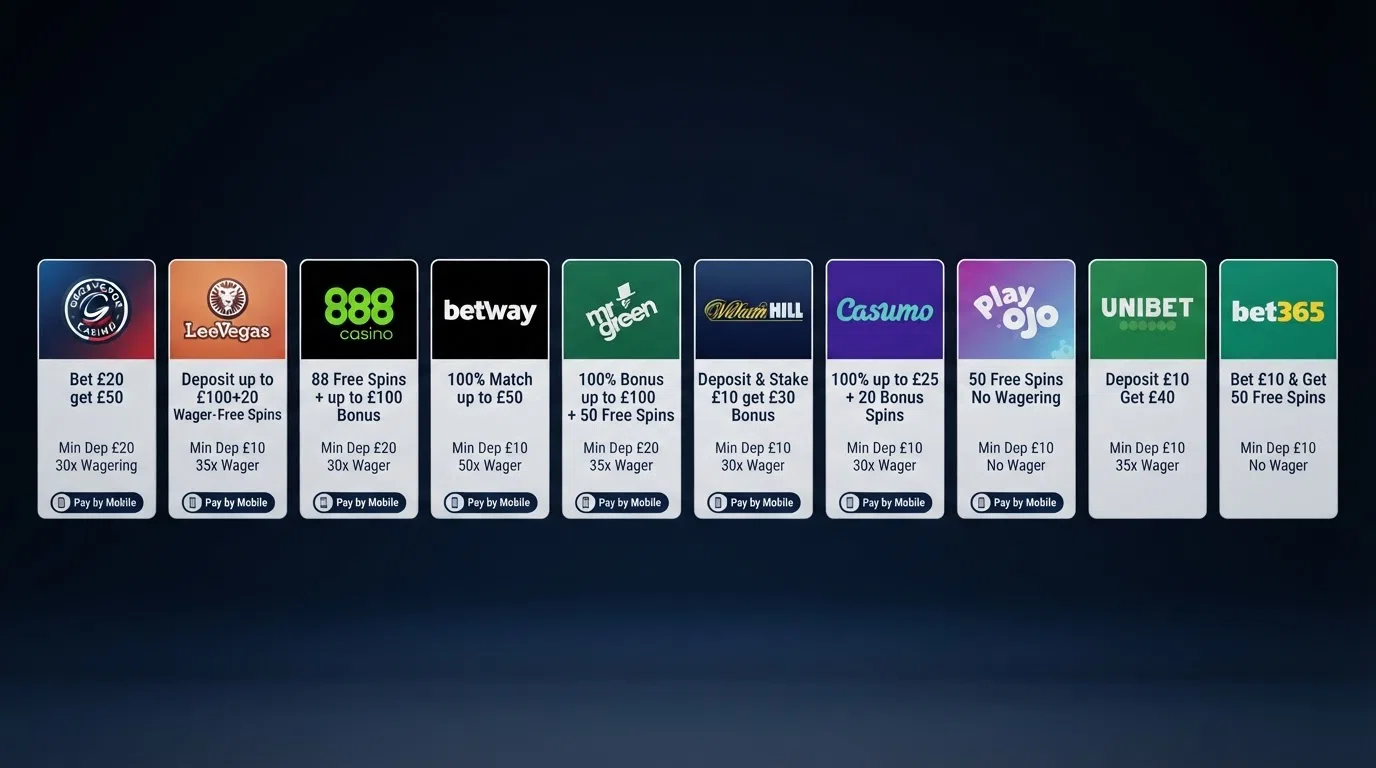
Ten UKGC-licensed casinos appear in the comparison below. Eight accept phone bill deposits directly at the cashier. Two, 32Red and Betway, are included as licensed benchmarks: 32Red because it carries the largest free spin count in the featured set, Betway because it is one of the fifteen largest UK operators by revenue. Both are missing a confirmed phone bill deposit option in the verification done for this page, and that gap is the reason they sit outside the core recommendation set. The table ranks by phone bill deposit support first, then by bonus fairness (wagering terms and whether winnings are paid as cash), then by minimum deposit floor.
| Casino | UKGC Licence | Phone Bill Deposit | Min Deposit | Welcome Offer | Wagering |
|---|---|---|---|---|---|
| MrQ | 60629 | Yes (Fonix) | £10 | 100 FS on Big Bass Splash | 0× |
| Midnite | UKGC-licensed | Yes | £20 (qualifying wager) | 100 FS on Big Bass Splash | 0× |
| PlayOJO | SkillOnNet Limited | Yes | £10 | 50 FS on Big Bass Bonanza | 0× |
| LeoVegas | LeoVegas Gaming plc | Yes | £10 | 50 FS on Big Bass Splash | 0× |
| 32Red | Kindred Group | Not confirmed | £10 (typical) | 320 FS on Big Bass Splash | 0× |
| Mr Vegas | Videoslots Limited | Yes (Siru Mobile) | £5.12 (Siru) / £10 (other) | 100% match up to £50 + 11 no-wager FS | 10× |
| Duelz | SuprPlay Limited | Yes | £25 | Up to 140 FS over 7 days | 10× |
| Peachy Games | UKGC-licensed | Yes | £10 | Not confirmed | — |
| Pub Casino | UKGC-licensed | Yes | £10 | 50 FS for £10 slot spend | Not confirmed |
| Betway | Betway Limited | Not confirmed | £10 (typical) | Not confirmed | — |
How We Compared These Phone Bill Casinos
Four criteria separate the operators on this page. The first is confirmed phone bill deposit support at the cashier: an operator that lists Pay by Mobile on its banking page, not just on a third-party affiliate review, is the standard for inclusion. The second is bonus fairness, measured by the wagering multiple and whether winnings are paid as cash or as locked bonus funds. The UKGC’s 10× wagering cap, in force since 19 January 2026, sets the regulatory ceiling: an offer at 0× is the best the framework permits, and the closer an offer sits to 10× the worse it is for the player. The third criterion is minimum deposit, because a phone bill depositor is by definition working within the £40 transaction cap, and a £25 minimum leaves less room for a deposit than a £10 minimum does. The fourth is game selection, measured by provider count and total title count as a proxy for lobby quality: Mr Vegas’s 8,000+ titles and PlayOJO’s 5,000+ titles are at the wide end, MrQ’s 900+ and Peachy Games’ 700+ at the curated end.
The 0× Wagering Advantage: Operators That Pay Winnings as Real Cash
Five operators in the featured set offer free spins with zero wagering: MrQ, Midnite, PlayOJO, LeoVegas and 32Red. The mechanic is simple. A free spin is awarded, the player uses it on a named slot, any winnings land in the casino balance as real cash, and the player can withdraw immediately. There is no playthrough, no bonus-to-cash conversion, no locked funds. The 0× wagering model sits at the bottom of the regulatory range: the UKGC’s 10× cap, in force since 19 January 2026, is the ceiling, and anything below it is a player-friendly choice the operator has made. Most 0× offers in the featured set still carry time limits. MrQ’s 100 free spins expire 48 hours after crediting. Midnite gives 7 days from crediting and 14 days from registration to claim. PlayOJO and LeoVegas do not specify a wagering deadline because there is no wagering, though the free spins themselves usually carry a short validity window. 32Red’s 320 free spins have 30 days from claim and a 7-day window from registration to opt in.
MrQ
MrQ is the cleanest 0× wagering offer in the featured set: 100 free spins on Big Bass Splash, winnings paid as real cash, no maximum cashout, and a £10 minimum deposit via Fonix. The spin value is £0.10 each, which puts the headline value of the offer at £10 before any winnings, but the value the player actually cares about is the uncapped cash withdrawal at the end. Free spin validity is tight: 48 hours from crediting, after which unused spins expire. UKGC licence account 60629, game providers include NetEnt, Pragmatic Play, Play’n GO, Blueprint Gaming and Nolimit City, with 900+ games in the lobby. For players prioritising simplicity and a 48-hour window, MrQ sets the standard.
Midnite
Midnite’s offer runs on a qualifying-wager trigger rather than a deposit threshold: wager £20 on any game to unlock 100 free spins on Big Bass Splash, winnings paid as withdrawable cash, no maximum cashout. The £20 is play, not deposit, so a player who deposits £10 and wagers it on a single blackjack hand at £10 has met the trigger. The 7-day free spin validity from crediting and 14-day window to claim from registration give more breathing room than MrQ’s 48-hour deadline. Game providers include Pragmatic Play, NetEnt and Evolution, with a solid live dealer and slot mix. Players who prefer wagering over depositing, or who need a flexible schedule for their spins, will find Midnite particularly suitable.
PlayOJO
PlayOJO offers 50 free spins on Big Bass Bonanza with 0× wagering, all winnings paid as cash, on a £10 minimum deposit. The 5,000+ game library from ten providers, including NetEnt, Pragmatic Play, Play’n GO, Microgaming, Big Time Gaming, ELK Studios, Red Tiger, Hacksaw Gaming, Yggdrasil and Evolution, makes it the widest game selection among the 0× wagering operators. The headline consideration is bonus eligibility: one source flags that PlayOJO accepts mobile billing but does not specifically offer the welcome bonus via phone bill, and other sources do not confirm the exclusion. A player depositing by phone bill should verify at the cashier that the welcome offer is attached to the deposit before confirming. With such an extensive catalogue, PlayOJO appeals most to those for whom game variety is the deciding factor.
LeoVegas
LeoVegas offers 50 wager-free free spins on Big Bass Splash on a £10 minimum deposit, with all winnings paid as cash and no maximum cashout. The operator is one of the most recognised casino brands in the UK, publicly listed as LeoVegas Gaming plc, with a 3,000+ game library from Evolution, Playtech, Pragmatic Play, NetEnt, Microgaming, Play’n GO, Nolimit City, Big Time Gaming and Hacksaw Gaming. The headline consideration is the welcome bonus’s qualifying deposit: the offer terms reference debit card and Open Banking rather than phone bill, and a player funding through Fonix or Payforit should verify at the cashier that the welcome offer is attached before confirming the deposit. It is a premier destination for players who prioritize established brand reliability and deep provider rosters.
32Red
32Red carries the largest free spin count in the featured set: 320 spins on Big Bass Splash, winnings paid as cash, no wagering, with a 30-day spin validity and a 7-day window from registration to opt in. The trigger is a £30 stake on slots rather than a deposit, and the operator is a Kindred Group brand, one of the longest-established online casinos in the UK, with a Microgaming-, NetEnt- and Evolution-led library. The headline gap is the deposit method: phone bill support was not confirmed for 32Red in the verification done for this page, and the welcome offer terms reference debit card and instant bank transfer for the qualifying deposit. A player who wants 32Red’s free spin offer will need a non-phone-bill deposit method. This platform remains a top contender for players willing to use a debit card for the sake of a massive free spin volume.
Mr Vegas
Mr Vegas is the only featured operator offering a deposit match: 100% up to £50, plus 11 no-wager free spins, on a £10 minimum deposit via most methods or a £5.12 minimum via Siru Mobile. The £5.12 floor is the lowest phone bill minimum in the featured set, and the match bonus is paid in 10% increments as the player wagers, which means the bonus funds convert to withdrawable cash progressively rather than as a single lump at the end of the playthrough. The wagering requirement is 10×, the regulatory ceiling, and the completion window is 60 days, the longest in the set. The 8,000+ title library, the largest in the featured set, comes from NetEnt, Play’n GO, Microgaming and Nolimit City. For those seeking the lowest barrier to entry and a longer-term deposit match, Mr Vegas offers the most competitive package.
Duelz
Duelz runs the highest free spin count in the set that is attached to a phone bill deposit: up to 140 spins, delivered as 20 per day over 7 consecutive days, with a £12 minimum deposit equivalent to the 12-minute claim time. The 10× wagering requirement applies to bonus funds, the 7-day completion window is the tightest in the 10× group, and the £100 per day maximum cashout from free spin winnings is the only published cashout cap in the featured set. Game providers include Pragmatic Play, Play’n GO and NetEnt. This offer serves players who enjoy a daily ritual of spins and are unfazed by moderate wagering constraints.
Peachy Games
Peachy Games is one of the few smaller UK slot sites with confirmed Pay by Phone billing support, and it runs a curated 700-slot library from Pragmatic Play, Play’n GO and NetEnt. The headline gap is the welcome offer: the site’s Saturday spins promotion for regular players is confirmed, but the new-player bonus was not surfaced in the verification done for this page. A player signing up should check the promotions page for current terms. Peachy Games is the right choice for a player who values a curated slot selection over a large lobby, and who is happy to look up the current welcome offer at the promotions page.
Pub Casino
Pub Casino offers 50 free spins for a £10 slot spend, with phone bill deposit support confirmed. The headline gap is everything else: wagering requirement, bonus validity, cashout cap, bonus slot and spin value were not publicly confirmed in the verification done for this page. UKGC-licensed, £10 minimum deposit, and the cashier lists Pay by Mobile as a deposit method, which is enough to include the operator in the ranked set, but not enough to compare it on bonus terms. Pub Casino is the right choice for a player who is willing to read the cashier and promotions page in full before depositing, and who is comfortable with bonus terms that have not been independently verified.
Betway
Betway sits in the featured set as a benchmark, not a recommendation. The operator is the 13th-largest UK casino by revenue at £192.26M and 2.04% market share, UKGC-licensed through Betway Limited, with a £10 typical minimum deposit. The headline gap is the deposit method: phone bill support was not confirmed in the verification done for this page, and Betway’s promotions are not surfaced in phone bill deposit guides. A player who wants Betway’s brand recognition and game selection should check the cashier for a Pay by Mobile option before signing up, but the operator does not earn a place in the core recommendation set on the strength of phone bill deposit support that has not been verified. Betway is included because a market-share benchmark is a useful reference point, not because it is a phone bill casino first.
Is Paying by Phone Bill at a UK Casino Legal? The Licence and Protection Framework
Phone bill casino deposits are fully legal in the UK, provided the casino holds a Gambling Commission operating licence. The legal framework runs through two regulators. The UK Gambling Commission licenses the casino itself under the Gambling Act 2005, extended to all remote operators serving GB customers by the Gambling (Licensing and Advertising) Act 2014, the point-of-consumption reform that made a GB licence compulsory for any operator taking GB players regardless of where the operator is based. The Phone-paid Services Authority regulates the payment processor layer under the Payment Services Regulations 2017, which is where the £40 and £240 charge-to-mobile caps come from. A player who deposits by phone bill at a UKGC-licensed casino is operating inside both frameworks simultaneously, and that is the only configuration in which every player-facing protection applies.
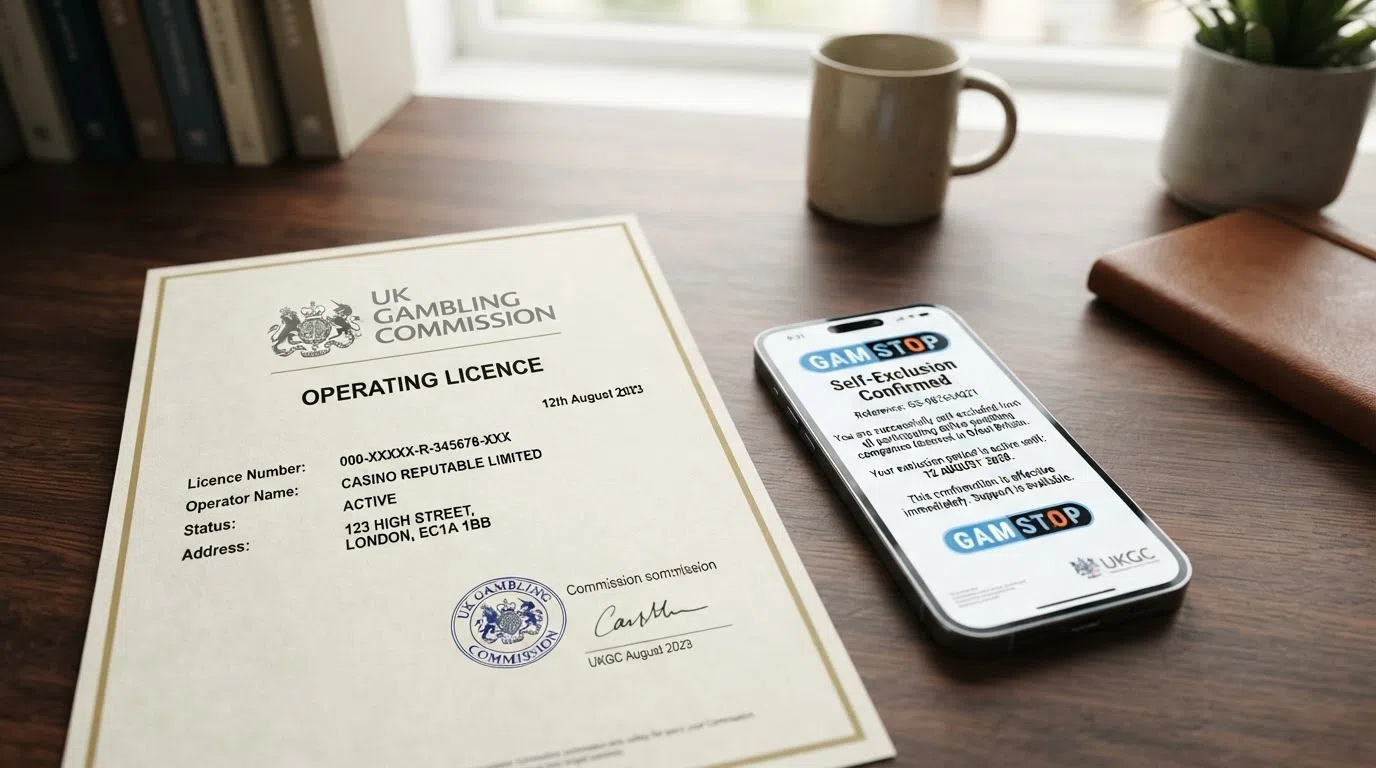
The UKGC’s three licensing objectives, set out in section 1 of the Gambling Act 2005, define what protection actually means: preventing gambling from being a source of crime or disorder, ensuring gambling is conducted in a fair and open way, and protecting children and other vulnerable persons from being harmed or exploited by gambling. The day-to-day obligations sit in the Licence Conditions and Codes of Practice and the Remote Technical Standards, and they are not optional. A licensed operator must verify a player’s identity before the first deposit, must offer a deposit limit before that first deposit goes through, must hold player funds in segregated accounts, must submit to ADR for unresolved complaints, and must honour the GAMSTOP self-exclusion register. A player who deposits by phone bill at an unlicensed offshore casino loses every one of these protections. No GAMSTOP coverage, no Commission complaints route, no British consumer redress, and no guarantee that winnings will be paid at all. The phone bill deposit works at an unlicensed casino, but the legal framework that makes the rest of the experience safe does not reach it.
The UK Gambling Commission Licence: What It Actually Means for Your Deposit
A UKGC operating licence is not a rubber stamp on the operator’s business model. It imposes a set of mandatory obligations that directly shape the deposit experience, including the phone bill deposit experience. Since 7 May 2019, a remote licensee must verify the customer’s name, address and date of birth before the first deposit or any gambling can take place, which means anonymous phone bill deposits are not possible at a licensed casino. The verification is not optional, and the operator faces enforcement action for letting a customer deposit before the check is complete. Since 31 October 2025, the operator must also prompt the customer to set a financial deposit limit before the first deposit is processed, with a decrease taking effect immediately. The credit card ban, in force since 14 April 2020 under LCCP 6.1.2, prevents the operator from accepting credit card payments including credit-card-funded e-wallet deposits; phone bill deposits are debit-funded, which keeps them on the right side of the ban. A series of game-design rules, all in force since 31 October 2021, ban auto-play, cap spin speed at 2.5 seconds per game cycle, ban features that speed up play, ban losses disguised as wins, and ban reverse withdrawals. Every one of these rules applies to a phone bill depositor exactly as it applies to a debit card depositor. The funding method does not change the protection.
GAMSTOP, KYC and Age Verification: The Three Barriers Between a Player and a Problem
Three mandatory checks stand between a UK player and a phone bill deposit at a licensed casino. The first is Know Your Customer verification: name, address and date of birth must be confirmed before the first deposit, using documents the operator checks against third-party databases. A player who cannot pass KYC cannot deposit by any method, including phone bill. The second is age verification: the minimum gambling age in Great Britain is 18, and operators must confirm it. The third is GAMSTOP, the national multi-operator self-exclusion register that has been mandatory for every GB-licensed online operator since 31 March 2020. A player who has registered with GAMSTOP for six months, one year, five years, or five years with auto-renewal cannot deposit or play at any GB-licensed online casino, regardless of the deposit method. Exclusion cannot be cancelled early under any circumstances. The three checks layer on top of each other. KYC confirms identity, age verification confirms adulthood, and GAMSTOP confirms the player has not self-excluded. The gap in the framework is that GAMSTOP is licence-bound: it cannot reach operators outside the GB licensing system, and a player who self-excludes via GAMSTOP can still deposit at an unlicensed offshore casino. The mobile carrier’s payment layer, where Boku, Fonix, Payforit and Siru Mobile sit, is not a gambling regulator and does not enforce GAMSTOP. That check happens at the casino.
Financial Vulnerability Checks and the £150 Net Deposit Threshold
Since 28 February 2025, every UKGC-licensed operator must run a financial vulnerability check on a player who has deposited £150 net in a rolling 30-day period. The check uses publicly available data only: county court judgments, individual voluntary arrangements, debt relief orders and bankruptcy orders. If a player crosses the threshold, the operator runs the background check and decides what to do with the result. Phone bill deposits count toward the £150 threshold exactly as card deposits do. The funding method does not exempt the player, and a player who funds their account through Fonix, Payforit or Siru Mobile will trigger the check at the same net deposit level as a debit card depositor. A second tier of affordability checks, financial risk assessments, has been announced but not yet commenced; the proposed Stage 1 thresholds are £5,000 net deposits in 24 hours for players aged 25 and over and £2,500 for those under 25, with final thresholds lower. The start date is not confirmed.
What the UK Licensed Market Prohibits or Caps — The Full List
The UKGC’s prohibition and cap list is long, and it is the strictest set of player-facing restrictions among major gambling jurisdictions. Auto-play has been banned since 31 October 2021. Spin speed is capped at 2.5 seconds per game cycle, also since 31 October 2021, and any feature that speeds up play, gives the illusion of control, or celebrates a loss as a win is banned. Online slots carry a statutory maximum stake of £5 per game cycle for players aged 25 and over, in force since 9 April 2025, and £2 for players aged 18 to 24, in force since 21 May 2025. Credit card deposits have been banned since 14 April 2020. Wagering requirements on bonuses are capped at 10×, in force since 19 January 2026, and mixed-product promotional offers, the cross-sell between sports betting and casino bonuses, are banned since 19 December 2025. Direct marketing is opt-in by product and by channel, in force since 1 May 2025. Reverse withdrawals are permanently banned. The effect for a phone bill depositor is the same as for a debit card depositor: the operator cannot design a product that subverts the protections, and the regulator can enforce against any operator that tries. A player who funds their casino account through Fonix inside this framework is more protected than a player who funds through a card at an offshore casino outside it.
When Charge-to-Mobile Play Becomes a Problem: UK Protections and Where to Get Help
The numbers behind UK gambling harm are moving in one direction. NHS gambling treatment referrals in England totalled 4,355 in 2024/25, up 90.7% year-on-year from 2,284 in 2023/24. The 2023/24 Adult Psychiatric Morbidity Survey found 1.6% of UK adults at moderate risk of gambling harm on the PGSI scale and 0.4% at problem-gambling level. The NHS now operates 15 specialist gambling treatment clinics across England, with service use up 130% over the preceding year. GamCare made 996 referrals in January 2026 alone, up 48% year-on-year, and the National Gambling Support Network treated 11,960 clients in 2024/25, an 11% increase on the prior year, with the rate of problem gambling falling from 87% to 27% between first and final assessment. Treatment works, and more people are reaching it, but the underlying population of at-risk gamblers is not shrinking.
Every UKGC-licensed casino must offer the responsible-gambling tools that make treatment reachable. Deposit limits, reality checks, session time-outs, and self-exclusion through GAMSTOP are mandatory, not optional, and they apply to phone bill depositors exactly as they apply to everyone else. The £40 transaction cap and £240 monthly cap are not a substitute for active limit-setting. They are structural ceilings that prevent catastrophic loss in a single session; they do not stop a player from spreading phone bill deposits across multiple casinos until the cumulative spend is far beyond what they intended. A player who recognises the signs in themselves, or in someone they live with, can reach free confidential help at any hour through the National Gambling Helpline, online through GamCare or GambleAware, or in person through an NHS specialist clinic.
Deposit Limits, Reality Checks and Session Time-Outs: The Tools You Already Have
Every UKGC-licensed casino offers a set of mandatory responsible-gambling controls, and from 31 October 2025 the operator must offer a financial deposit limit before a player’s first deposit goes through. A decrease in a deposit limit takes effect immediately, which means a player who decides mid-session to cut their limit does not have to wait for the change to apply. Reality checks, the pop-up that displays time played, wins and losses during a slots session, are mandatory, and the player chooses the interval. Time-outs run from 24 hours to six weeks, available directly from the account settings without contacting support. Self-exclusion, the longer commitment, runs through GAMSTOP and covers every GB-licensed operator. None of these tools is disabled by the deposit method. A phone bill depositor sets limits, takes time-outs, and excludes from GAMSTOP on the same terms as a debit card depositor. The standardised gross deposit limit required by RTS 12, originally due 30 June 2026 and extended to 30 September 2026, will further tighten how operators present the limit-setting flow.
GAMSTOP: The National Self-Exclusion Register and How It Works
GAMSTOP is free, national, and online. A single registration blocks the player from every GB-licensed online gambling operator for the period they choose: six months, one year, five years, or five years with auto-renewal. Exclusion cannot be cancelled early under any circumstances, and a player who registers does not get the option to change their mind. The registration covers online operators only, not land-based betting shops or casinos, and it is licence-bound, which means it reaches every GB-licensed online operator but cannot reach unlicensed offshore operators. A player who has self-excluded via GAMSTOP cannot deposit at a UKGC-licensed casino by phone bill, debit card, or any other method, because the casino’s own checks catch the registration. They can still deposit at an offshore casino that does not check GAMSTOP, and that is the limitation of the system.
Where to Get Help: UK Gambling Support Services at a Glance
The National Gambling Helpline, run by GamCare, is free, confidential and available 24 hours a day on 0808 8020 133. GamCare also offers online counselling, live chat, forums and self-assessment tools through its website, and it runs the helpline. GambleAware provides information, self-assessment and treatment referral through its own site. The NHS operates 15 specialist gambling treatment clinics across England, with equivalent services in Scotland and Wales, and the National Gambling Support Network treated 11,960 clients in 2024/25, with the problem-gambling rate falling from 87% at first assessment to 27% by the end of treatment. Gamblers Anonymous UK runs peer-support meetings. Treatment works, the routes into it are free, and the data says more people are using them than at any point in the last five years.
The Phone Bill Deposit Trap: Why Low Limits Do Not Mean Low Risk
The £40 transaction cap and £240 monthly ceiling look like a safety net, and at the single-casino level they are. A player cannot blow a month’s wages on a single phone bill deposit. The trap is that the caps are per subscriber, not per casino, and a player who opens accounts at three UKGC-licensed casinos can deposit up to £240 per month at each one. Spread across four operators, the statutory ceiling becomes £960 per month in phone bill deposits alone, and the 15% processing fee that some operators charge sharpens the cost: four £30 deposits with a 15% fee at four operators come to £120 charged to the phone bill, but only £102 lands as playable credit. The same feature that makes phone bill deposits appealing, no bank card, no bank statement entry, no card-based tracking, also makes them harder to monitor. A budgeting app connected to a bank account will not see a phone bill deposit at all, and a partner who reviews a shared bank statement will see only the generic mobile services charge on the phone bill. For a player who is trying to keep their own spending in view, that invisibility is the cost the £40 cap does not pay for.
How We Selected and Ranked the Best Phone Bill Casinos
Every operator on this page was sourced from the UK Gambling Commission’s public register of licence holders, cross-checked against the UKGC account number where one was available, and verified for phone bill deposit support at the cashier level, not on a third-party affiliate page. The UKGC public register lists more than 2,660 licensed businesses, and the operators featured here are a subset selected for fit with the phone bill topic, not for completeness. No operator paid for inclusion or priority placement, and the ranking criteria, confirmed phone bill deposit support, UKGC licence status, bonus fairness measured by wagering multiple and cashout terms, minimum deposit, and game selection, were applied in that order. Competitor pages on the same topic were used as cross-references, not as primary sources, and any operator data point that could not be confirmed against the UKGC register or the operator’s own cashier page is marked as not confirmed in the operator write-up. Where a source flagged a phone bill bonus eligibility question, the question is carried into the operator’s section rather than smoothed over.
The Phone Bill Casino Deposit: What Every UK Player Should Decide Before They Tap ‘Deposit’
Phone bill deposits are a real answer for a player who wants a hard monthly ceiling, values privacy, and is comfortable routing withdrawals to a separate method. The £40 transaction cap and £240 monthly cap, set by statute and enforced by the Phone-paid Services Authority, are the strongest spending controls available at any UKGC-licensed casino, and they apply before the player has to think about setting their own deposit limit. The deposit lands within seconds, the bank statement stays clean, and the same funding method works at eight of the ten operators in the comparison table. The 0× wagering free spin offers at MrQ, Midnite, PlayOJO, LeoVegas and 32Red sit at the best end of the regulatory range, and the welcome bonus at each of them is available on a phone bill deposit at the cashier, though a couple of operators flag terms that may exclude phone bill from the welcome match and should be checked before confirming.
The costs are real too. The 15% processing fee that some operators charge shrinks the effective deposit before a single bet is placed, and the operator-by-operator variation means the same £30 deposit can land as £30 at one casino and £25.50 at another. The withdrawal constraint is the bigger one: phone bill is a depositing method, and a player who funds their account through Fonix, Payforit or Siru Mobile must cash out to a debit card or bank transfer, which means a second payment method has to be set up before the first withdrawal. The invisibility on bank statements is an advantage for a player who wants it and a blind spot for a player who does not. A budgeting app will not flag a phone bill deposit, and a player monitoring their own spending through bank transactions will not see the casino charges at all. The £240 monthly cap does not track cumulative spend across multiple casinos, and a player who opens accounts at three or four operators can run phone bill deposits well above what a single £240 ceiling suggests.
The verdict depends on what the player is optimising for. Phone bill deposits are the right choice for a player who wants a hard statutory monthly cap, values the no-bank-card angle, and is happy to manage a separate withdrawal method; the comparison table above is where to match those priorities against the operator set. They are the wrong choice for a player who plans to deposit frequently, chase bonuses with complex wagering, or rely on the £40 cap as their only spending control without setting an active deposit limit. The casino does not care which funding rail the player picks. The regulator has decided what the rail can carry. The rest of the choice is the player’s.
Frequently Asked Questions
Can I withdraw my casino winnings to my phone bill?
No. Phone bill is a depositing method, not a withdrawal method. UK mobile networks do not offer a standard merchant refund route that credits casino winnings back to a phone bill. A player who deposits by phone bill must withdraw to a debit card or a bank transfer, which means setting up a second payment method before the first cashout.
Do I pay any fees when depositing by phone bill at a UK casino?
Some operators charge a processing fee of up to 15% on phone bill deposits. A £30 deposit with a 15% fee yields £25.50 in playable credit while the phone bill still shows £30. The fee is operator-dependent: some casinos absorb it, others deduct it before the deposit lands. The cashier’s confirmation screen or the operator’s payment-method terms page is where the answer lives for any specific operator.
Is there a difference between pay-as-you-go and contract phone bill deposits?
The deposit mechanics are identical, but the funding source differs. Contract customers are billed on the next monthly phone bill; pay-as-you-go customers have the deposit deducted from prepaid credit at the time of the transaction, so a PAYG SIM needs enough credit to cover the deposit before the player confirms at the cashier. A PAYG deposit fails immediately if there is not enough credit on the SIM.
Can I claim a welcome bonus when depositing by phone bill?
Most UKGC-licensed casinos that accept phone bill deposits allow the welcome offer on a phone bill deposit, but a couple of operators in the comparison table, including PlayOJO and LeoVegas, flag terms that may restrict the welcome bonus to debit card or Open Banking deposits. The cashier’s bonus terms or the operator’s promotions page will confirm whether a phone bill deposit qualifies.
What happens if my phone bill deposit is declined at a UK casino?
The most common cause is a network-level block on premium-rate or charge-to-mobile services, which some mobile virtual network operators enforce. The second most common cause is the £240 monthly cap being exhausted across all phone bill services. The third is insufficient prepaid credit on a PAYG SIM. The cashier will show a decline reason; switching to a different phone bill processor, a different network, or a different deposit method are the usual fixes.
Which UK mobile networks support pay by phone bill casino deposits?
O2, EE, Vodafone and Three all process phone bill casino deposits through the major processor rails. Mobile virtual network operators such as Sky Mobile, Tesco Mobile, giffgaff and BT Mobile generally inherit phone bill capability from their host network, but individual operator support should be confirmed before depositing, because some MVNOs block premium-rate or charge-to-mobile services at the network level.
Which Mobile Networks Let You Deposit by Phone Bill?
Four major UK networks support phone bill casino deposits: O2, EE, Vodafone and Three. Each routes charge-to-mobile transactions through the major processor rails, Fonix, Payforit and Siru Mobile, and a deposit at a UKGC-licensed casino that supports the method will work on any of them provided the player has not exhausted their monthly cap. Mobile virtual network operators, including Sky Mobile, Tesco Mobile, giffgaff and BT Mobile, generally inherit phone bill capability from their host network, so an O2-based MVNO should support deposits that work on O2, and a Vodafone-based MVNO should support deposits that work on Vodafone. Individual operator support should be confirmed before depositing, because some MVNOs block premium-rate or charge-to-mobile services at the network level. A network-level block is the most common reason a phone bill deposit fails at a supported casino: the cashier is ready, the processor is ready, but the network refuses the charge.
Mobile Slots: Do They Play Differently on a Phone?
The maths do not change between mobile and desktop. Return to player and volatility are properties of the game engine, not the device, and the UKGC’s Remote Technical Standards require that mobile and desktop versions of the same game run on the same random number generator and return the same profile. A Big Bass Splash spin on an iPhone at 10p returns the same expected value as a Big Bass Splash spin on a desktop browser at 10p, and the difference between the two is the interface. Mobile play runs on touch controls, portrait-mode layouts and simplified menus that drop the desktop’s multi-panel display for a single-column view. Some older titles, built before mobile-first design was standard, have a reduced feature set on phone, but every slot named on this page was released between 2011 and 2022, and all are mobile-optimised. The RTP does not move; what moves is the size of the buttons.
Payments – nodeposit-casinobonuses-uk
Content created by the «nodeposit-casinobonuses-uk» team