
Casinos that accept Revolut in the UK — the £0 fees, FSCS-backed, no-wagering reality of 2026
 Available in GB
The short version: Revolut is not a cashier option at any major UK casino. It is a Visa and Mastercard debit card, and every UKGC-licensed operator that takes Visa and Mastercard debit takes Revolut. The reason this page exists is that the *kind* of card Revolut has become matters, and the kind of bonus the UK now permits matters more. Revolut Bank UK Ltd became a fully authorised UK bank in March 2026, supervised by the PRA and FCA, with eligible deposits protected by the Financial Services Compensation Scheme up to £85,000. That puts FSCS cover behind the current account a player funds a casino from. At the same time, the rules that govern what a UK casino bonus can demand changed in December 2025: wagering requirements on promotional credits are now hard-capped at 10×, and six of the ten operators on this page have gone all the way to 0×. A “no-wagering” offer in 2026 is the default, not the exception, and a Revolut deposit triggers exactly the same welcome package as any other Visa debit card. What follows is a ranking of ten UKGC-licensed operators built around that reality, with the figures the marketing pages leave out, and the rules the cashier pages quietly inherit.

This page is current as of September 8, 2026 and the licence and bonus claims were checked against the Gambling Commission’s public register.
What a Revolut casino actually is (and why that matters in 2026)
A “Revolut casino” is a search-term, not a product category. The casino’s cashier sees a Visa or Mastercard debit transaction from a UK-licensed e-money institution or, since March 2026, a PRA-authorised bank. The Revolut app the player holds is a thin client on top of that card. The reason the page exists is that two things changed at once: Revolut crossed the threshold from e-money institution to bank, and the UK bonus market was restructured around a statutory ceiling.
The first change is about trust at the funding end. Revolut Bank UK Ltd’s PRA and FCA authorisation means the current account sits inside the FSCS scheme, with the standard £85,000 cover on eligible deposits. A Revolut prepaid or Standard card before March 2026 held funds as e-money, which carries a different protection regime. A player depositing from a Revolut current account today is depositing from a UK bank account, even if Revolut itself never names the casino.
The second change is the bonus market. The UK Gambling Commission’s Social Responsibility Code 5.1.1 set a 10× ceiling on wagering requirements from 19 December 2025 and banned mixed-product promotional offers (the “bet on football, get free spins” construction) at the same time. The pre-2025 norm on UK-licensed sites was 30× to 50× on bonus credits; that range is now structurally off the table. A player comparing offers in 2026 is comparing mostly 0× packages against a 10× ceiling, not 30× and 50× packages against each other. The marketing word “fair” in this context is doing less work than it used to.
A third, quieter fact: the market is large. 47% of adults in Great Britain gambled in the past four weeks and 38% gambled online, according to the Gambling Survey for Great Britain Year 3. The Revolut user base overlaps that figure heavily — Revolut reports more than ten million UK customers — so the practical question for most readers is not “where can I use my card” but “where is the bonus worth the deposit”.
How a Revolut casino deposit actually works
Every Revolut deposit at a UKGC-licensed casino is a Visa or Mastercard debit transaction. The player enters the card details into the casino’s cashier — or, more often, the card sits inside Apple Pay or Google Pay and the casino never sees the number — and the funds clear through the card network in seconds. There is no “Revolut” button in the cashier, no branded integration, no Revolut Pay-by-bank redirect (the Revolut Pay open-banking route does exist, but it is one option among several and not the default at most featured operators). The deposit is a card payment and the casino treats it as one.
Three technicalities shape what actually happens at the cashier. First, 3D Secure: the casino’s payment processor triggers an issuer check, and Revolut’s app prompts the player to approve the transaction with a biometric or PIN. Second, the gambling block: Revolut’s in-app gambling block, which has been available since April 2020, is disabled by default. A player who has enabled it will see the deposit fail at the issuer check stage — the block intercepts card payments identified as gambling and refuses them before they reach the operator. Third, the credit card ban: since 14 April 2020, UKGC-licensed operators must not accept credit card payments for gambling, and the ban extends to credit-card-funded payments through e-wallets and fintechs. A Revolut credit card — Revolut does issue them on some paid plans — cannot be used at any featured operator on this page. The Revolut Standard, Plus, Premium, Metal and Ultra cards issued as debit cards are not affected; the credit card ban targets the credit variant specifically.
The open-banking route is the alternative almost no comparison page covers. Revolut Pay — a pay-by-bank integration — lets a player authorise a direct bank transfer from the Revolut current account to a merchant, bypassing the card rails entirely. The gambling block does not cover open-banking transfers, so a player who has the block on and tries to deposit via Revolut Pay will succeed. The trade-off is that the deposit shows up in the Revolut app as a bank transfer to a named payee, not a card payment, and disputes work through a different channel. This matters more for offshore operators than for the featured UKGC-licensed set: the offshore route is covered in the section on unlicensed casinos, and the difference in protection is significant.
Real-money play, reviews and the player experience
What UK players actually report about Revolut casino play reduces to three points. First, the deposit is fast and the verification is already done: since 7 May 2019, a GB remote licensee must verify the customer’s name, address and date of birth before they can deposit or gamble. The pre-2019 “72 hours” grace period is gone. A player registering at a featured operator goes through the same document check whether they fund with Revolut, a high-street bank, or a different e-wallet. Second, the session itself is tightly engineered: UKGC game-design rules ban auto-play, cap spin speed at 2.5 seconds per game cycle, ban features that celebrate losses as wins, and require the operator to display total losses and wins and time played during a slots session. A player who has used offshore sites will notice the difference immediately — there is no turbo mode, no auto-spin, no way to mask losses as wins. Third, the review-site consensus on the featured operators is that Revolut is treated as just another Visa debit card at the cashier. There is no Revolut-specific friction reported in player-experience write-ups beyond the standard 3D Secure prompt and the gambling block if the player has enabled it.
A point the keyword raises that the UK market has effectively answered: account-free and no-registration casinos. These are sites where a player can deposit and play without creating an account, typically via open-banking or Trustly pay-by-bank. The UKGC’s age and identity verification rules make the account-free model incompatible with a GB licence in practice — a player must be verified before they can deposit, and that requires an account. A reader who has used account-free casinos in other European markets will not find that product at a UKGC-licensed operator.
How Revolut deposits and withdrawals really work
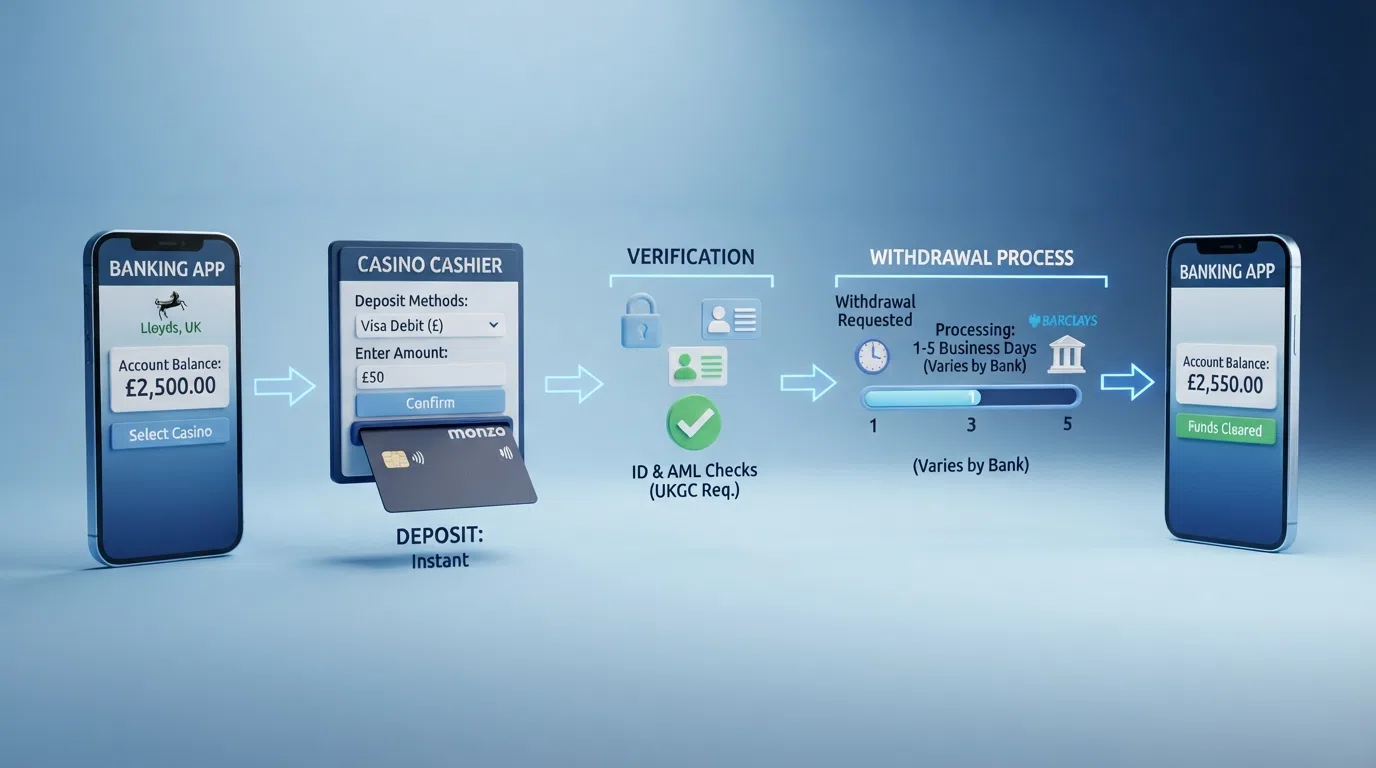
The deposit is the easy half. The withdrawal is where a UK casino’s processing schedule shows up against Revolut’s own settlement speed, and where the 1-5 business day window that every guide quotes comes from.
Deposit speed, limits and what to expect
A Revolut debit card deposit at any featured operator clears in seconds. The transaction is a Visa or Mastercard debit authorisation, the casino’s payment processor confirms the funds, and the player sees the balance in their casino account almost immediately. The minimum deposit varies by operator: £5 at Betfred, £10 at bet365, Paddy Power, Sky Vegas, LeoVegas, 888, Kwiff and QuinnBet, and £20 at Casimba and Playzee. The variation reflects the operator’s commercial choice, not a Revolut-imposed limit — Revolut itself does not set a minimum on card transactions.
A second timing factor has been added since 31 October 2025. UKGC-licensed operators must now prompt every customer to set a financial deposit limit before they can make a first deposit, and any decrease request must be actioned immediately. The “gross deposit limit” standardisation, which is a more detailed framework around how limits are presented and adjusted, takes effect from 30 September 2026. A Revolut player registering at a new casino today will see a deposit-limit prompt before the first deposit screen; the prompt is the same regardless of the funding method, but the timing matters because it inserts a step into a flow that used to be one tap from card to balance.
The 3D Secure prompt is the last delay. The casino’s payment processor triggers an issuer check, Revolut’s app pushes a biometric or PIN confirmation to the player’s phone, and the deposit clears once that is approved. In practice this adds a few seconds, not a meaningful wait — but it is the reason a deposit sometimes shows as “pending” in the casino cashier before it lands in the balance.
Withdrawal speed: why “instant” never means instant
The withdrawal window is where the marketing word “fast” meets the operator’s processing schedule. Revolut’s own settlement is fast on the receiving end: once the card network pushes the funds to Revolut, the balance in the Revolut app updates near-instantly. The variable is the operator’s internal processing time — the period between the player requesting the withdrawal and the operator instructing the card network to push the funds.
The 1-5 business day window the market quotes covers both halves: the operator’s processing schedule (anywhere from a few hours to several days, depending on the operator and the payment team’s working hours) and the card network’s settlement (typically one business day for UK domestic transactions). Reverse withdrawals were permanently banned by the UKGC, so a player cannot cancel a withdrawal to put the funds back into play once it has been requested — the operator is required to action it.
QuinnBet is the outlier in the featured set, with a reported withdrawal time of under one hour on the operator side. That figure is for the operator’s processing alone; the full settlement to the Revolut account still depends on the card network, but the operator-side delay collapses to a fraction of the 1-5 day range. For a player who values withdrawal speed above bonus size, QuinnBet’s reported processing time is the headline.
bet365, Paddy Power, Sky Vegas and the other major Flutter and bet365 group operators run processing schedules that typically land at 24-48 hours on the operator side, with the card network adding another business day. The 1-5 day window in the table below is the realistic range across the featured set, not a guarantee for any specific operator.
Fees, currency conversion and what you actually pay
Revolut itself does not charge fees on casino deposits or withdrawals in GBP. A Revolut player funding a UKGC-licensed casino — which charges in GBP — pays nothing on the Revolut side for the transaction. The only cost that recurs is currency conversion, and the rule is simple: if the casino’s cashier charges in a currency other than GBP, the standard Revolut FX rate applies, and on standard plans that rate carries a weekend markup that can add a meaningful percentage to a large transaction.
Operator-side fees are rare at UKGC-licensed casinos and are usually signposted at the cashier. The high-street and large online operators on this page do not charge deposit or withdrawal fees on Revolut transactions; the structural reason is the Remote Gaming Duty, which rose to 40% from 1 April 2026 and is the operator-side cost pressure that already eats into margin, with no obvious case for the operator to levy a separate processing fee on top.
A practical consequence: a Revolut player who funds a UK casino in GBP pays nothing beyond the stake. A player who funds a non-GBP casino through Revolut pays the weekend markup on top of any exchange-rate movement between request and settlement. The featured set is all GBP, so the rule matters most when a player steps outside it.
Revolut card vs open banking: two routes, different risks
The card route is what every guide covers. The open-banking route is what almost none of them do, and the gap is the most useful single fact on the page.
The debit card route — Visa or Mastercard, 3D Secure, gambling-block-controlled — is the standard path at every featured UKGC-licensed operator. Funds clear in seconds, the gambling block intercepts the payment at the issuer stage if the player has it on, and the casino treats the transaction as a standard card payment. The protection layer is Revolut’s, and the chargeback mechanism is the card network’s standard dispute process.
Revolut Pay and other pay-by-bank integrations route the deposit as a direct bank transfer from the Revolut current account to a named payee. The funds clear through Faster Payments or SEPA, the casino receives a bank transfer rather than a card payment, and Revolut’s gambling block does not intercept it. For UKGC-licensed casinos, the practical difference is small — the deposit still works, the casino still treats the player as a Revolut-funded customer, and the verification requirements still apply.
The practical difference becomes large for offshore and unlicensed operators. Offshore casinos have been documented routing deposits through Revolut’s open-banking rails, with Revolut appearing as the funding bank even where the platform operates without UKGC authorisation. A player who has the gambling block on is protected against the card route into those operators, but not against the open-banking route. The block is a single-layer defence, and the layer it covers is not the layer that most unlicensed operators use.
Frequently Asked Questions
Can I use Revolut to deposit at UK online casinos?
Yes, you can use a Revolut debit card at any UKGC-licensed casino, as it functions as a standard Visa or Mastercard. The casino’s cashier processes your transaction through the card network just like any other high-street bank card. Revolut itself does not restrict these transactions, provided your gambling block is disabled.
Is Revolut safe to use for online gambling in the UK?
Revolut is considered safe for UK gambling, especially now that Revolut Bank UK Ltd is PRA-authorised and covered by the FSCS up to £85,000 for eligible deposits. When used at a UKGC-licensed operator, your funds benefit from the full range of UK regulatory protections, including mandatory deposit limits and safer gambling tools.
Can I use a Revolut credit card at UK online casinos?
No, you cannot use a Revolut credit card for online gambling. Since 14 April 2020, UKGC-licensed operators have been strictly prohibited from accepting credit card payments, including those funded via e-wallets or fintech products. This ban applies to all Revolut credit variants; however, Revolut debit cards remain fully accepted.
What is the Revolut gambling block and how does it work?
The gambling block is an optional security feature you can enable inside your Revolut app settings. When turned on, it automatically declines any card payment identified as gambling before it reaches the operator. It operates as a global switch for your account, and you must toggle it off to deposit successfully.
Do I get a welcome bonus if I deposit with Revolut at a UK casino?
Yes, depositing with a Revolut debit card at a UKGC-licensed casino qualifies you for the same welcome bonus as any other Visa or Mastercard deposit. Operators do not differentiate between Revolut and other debit cards, so you are eligible for any welcome offer or free spins promotion provided by the casino.
The best Revolut casinos in the UK: reviewed and compared
Ten UKGC-licensed operators, all active on the Gambling Commission’s public register as of 29 July 2026, all accepting Revolut for both deposits and withdrawals. The table summarises the core attributes; the write-ups below take each one in turn.
| Casino | UKGC Licence | Welcome Offer (free spins) | Wagering on Free Spins | Game Providers |
|---|---|---|---|---|
| bet365 Casino | 39563, active | Up to 500 free spins | 0× | Playtech, Microgaming, NetEnt, IGT, bet365 Originals |
| Paddy Power Games | Flutter group | 60 no-deposit + 200 on £10 wager | 0× | Playtech, IGT, NetEnt, Blueprint, Paddy Power exclusive |
| Sky Vegas | Flutter / Sky Betting & Gaming | 50 no-deposit + 200 on £10 stake | 0× | NetEnt, Microgaming, IGT, Pragmatic Play, Sky exclusive |
| Betfred Casino | Betfred group | Up to 200 on £10 slot stake | 0× | Playtech, IGT, Microgaming, Blueprint, Pragmatic Play |
| LeoVegas Casino | LeoVegas Gaming plc / MGM Resorts | 50 on Big Bass Splash | 0× | NetEnt, Microgaming, Evolution, Pragmatic Play, Play’n GO |
| 888 Casino | 39028, active since 1 November 2014 | 100 on selected Pragmatic Play slots | 0× (max withdrawable £50) | NetEnt, Playtech, Evolution, Pragmatic Play, 888 proprietary |
| Kwiff Casino | Kwiff group | 200 on Book of Dead | 10× | NetEnt, Play’n GO, Pragmatic Play, Evolution |
| Casimba Casino | White Hat Gaming 52894 | — | — | NetEnt, Microgaming, Evolution, Pragmatic Play, Red Tiger |
| QuinnBet Casino | QuinnBet group | — | — | NetEnt, Microgaming, Evolution, Pragmatic Play |
| Playzee Casino | White Hat Gaming 52894 | — | — | NetEnt, Microgaming, Evolution, Pragmatic Play, Red Tiger, Play’n GO |
Ranking logic: bonus fairness (0× wagering beats 10×, which beats anything with a max-cashout cap), then bonus size, then Revolut-specific fit (minimum deposit, withdrawal speed, whether the operator has a no-deposit element). bet365 leads on raw spin count and the zero-wagering structure; Paddy Power and Sky Vegas follow on the no-deposit component; 888 and Kwiff carry caveats worth knowing about; Casimba, QuinnBet and Playzee round out the set on provider breadth and (for QuinnBet) withdrawal speed.
bet365 Casino: the volume play with 500 free spins
bet365’s welcome offer is a prize-reveal mechanic across ten days rather than a single drop. A player who has made a lifetime deposit of at least £10 with the operator can claim up to 500 free spins on selected titles — Book of Horus, Curse of the Bayou, Magic Forge and Wrath of the Deep — at 5 to 20 spins per selection, with a maximum gap of 2 minutes between selections and a 30-day window to claim. Winnings from those spins are credited as cash, with 0× wagering. Spins expire 7 days after they land in the account.
The bet365 Originals range is the structural differentiator: in-house exclusive slots that no other UK operator can offer. The provider mix — Playtech, Microgaming, NetEnt, IGT alongside the Originals — covers the bulk of the UK market’s high-traffic titles. UKGC account 39563, active as of the public register’s 29 July 2026 update.
The friction is the prize-reveal mechanic itself. A player who wants the headline 500 spins has to log in on ten separate days, claim each batch, and use the spins within seven days of credit. A player who deposits once and forgets about the offer for a fortnight will collect a fraction of the package. The bet365 write-up is for a player who is going to log in regularly for the first month; for a one-deposit player, the 500-spin headline is not the experience.
Paddy Power Games: 60 no-deposit spins before you spend a penny
Paddy Power is one of two operators in the featured set offering genuinely deposit-free spins, and the offer structure is unusually generous by the post-December 2025 bonus market. A new player receives 60 free spins on registration — no deposit required — with 10 of those spins on Paddy’s Mansion Heist and the balance on selected games, at £0.10 per spin. A further 200 spins unlock after a £10 deposit and £10 wager, all at 0× wagering and 7-day expiry.
Paddy Power sits inside Flutter Entertainment, the same parent as Sky Bet, Betfair and Sky Vegas, which means the operator is one of the largest in the UK by player volume. The provider mix — Playtech, IGT, NetEnt, Blueprint and exclusive Paddy Power games — covers the bulk of the UK slot market, and the no-deposit element makes this the entry point in the set for a player who wants to test the lobby before funding.
The catch is the 7-day expiry. A player who registers for the 60 no-deposit spins and waits more than a week to use them loses them. The Paddy Power write-up suits a player who is going to log in within seven days of registration; the offer is structured for that, and the 7-day clock starts at credit, not at registration.
Sky Vegas: 50 free spins, no deposit, no wagering
Sky Vegas runs the same Flutter playbook as Paddy Power with a slightly different headline. A new player receives 50 free spins on registration with no deposit required, and a further 200 spins unlock after a £10 deposit and £10 stake on slots. All 250 spins carry 0× wagering, the no-deposit spins expire 7 days after credit, and the deposit-and-spend requirement has a 30-day window.
The Sky Vegas game mix leans on NetEnt, Microgaming, IGT, Pragmatic Play and a slate of Sky-exclusive titles. The 50 no-deposit spins work on the first eligible game the player opens, which is standard for the format but means the specific title is not always visible at registration. The Flutter / Sky Betting & Gaming backing places Sky Vegas alongside Paddy Power in the parent group, with the same operational infrastructure behind the cashier.
The trade-off against Paddy Power is the lower free-spin count and the different deposit mechanic. Sky Vegas offers a broader 30-day window to unlock the spins, which some players prefer. Your choice depends on whether you prioritize the no-deposit headline or the longer activation window.
Betfred Casino: 200 free spins across 2,000+ slots
Betfred’s welcome offer is stake-gated rather than deposit-gated: a player stakes £10 on slots to unlock up to 200 free spins on selected titles, with spins credited within 48 hours and valid for 7 days. The 0× wagering on free-spin winnings and £0.1 minute spin value are competitive with the rest of the set, and Betfred’s £1 minimum deposit is the lowest in the featured set.
The structural differentiator is catalogue size. Betfred runs more than 2,000 slot titles, against a typical UKGC-licensed competitor’s 500-1,500, drawn from Playtech, IGT, Microgaming, Blueprint and Pragmatic Play. For a player who values variety over bonus headline, the slot count is the argument. The Betfred group is one of the UK high-street names with a long operating history, and the operator is the entry point in the set for a player who wants the lowest minimum deposit.
The friction is the stake-to-unlock mechanic. A player who deposits £10 and plays it through on a low-volatility slot at small stakes will trigger the offer, but the 200-spin headline depends on the stake threshold. Betfred’s terms are competitive with the rest of the set, but the offer rewards a player who plans to play rather than one who plans to deposit.
LeoVegas Casino: 50 spins on Big Bass Splash, MGM-backed
LeoVegas’s welcome offer is the focused one in the set: 50 free spins on Big Bass Splash, a Pragmatic Play title with a standard RTP around 96.07%, at £0.10 per spin and 0× wagering. The unlock mechanic is a £10 minimum deposit with 1× wagering on the deposit, and the spins expire 3 days after credit — the tightest expiry window in the featured set.
LeoVegas sits inside MGM Resorts, the US casino group, which makes it the only operator in the featured set with a US casino group as a parent. The provider mix — NetEnt, Microgaming, Evolution, Pragmatic Play and Play’n GO — covers the slots, table games and live dealer segments, and the operator’s mobile-first positioning is the reason it is on the list at all. A player who has used LeoVegas on mobile will recognise the platform; a player who has not is in for a cleaner mobile experience than most desktop-first operators offer.
The 3-day spin expiry is the trade-off. A player who deposits on Monday and does not log in until Thursday loses the spins. The 1× deposit wagering is also a small friction most of the set has dropped. The LeoVegas write-up suits a player who is going to deposit and play in the same session; for a player who likes to deposit on a Tuesday and play on a Friday, the 3-day clock is too tight.
888 Casino: 100 spins and a £50 win cap
888 is the veteran of the featured set. UKGC account 39028 has been active since 1 November 2014, and the operator runs casino, bingo and betting products under the same licence. The welcome offer is 100 free spins on selected Pragmatic Play slots after a £10 deposit and £10 stake, with £0.10 per spin, 0× wagering, and a 7-day expiry.
The structural caveat is the win cap. Free-spin winnings at 888 are paid as cash after all spins are used, but the maximum withdrawable winnings from the offer are capped at £50. A player who lands a large win on the bonus spins gets £50; the rest is forfeit. The provider mix — NetEnt, Playtech, Evolution, Pragmatic Play and 888 proprietary games — is broad, and 888’s proprietary content is the operator’s own in-house titles, which is a structural differentiator against the rest of the set.
The £50 cap is the entire point. A player who values the zero-wagering structure will read the cap and either accept it or move on. A player who does not notice the cap will discover it at withdrawal, and the discovery is the moment the offer reveals its real cost. The 888 write-up is for a player who plans to spin through a small-stakes session, not chase a headline payout.
Kwiff Casino: 200 spins on Book of Dead — but with 10× wagering
Kwiff is the holdout in the set. The welcome offer is 200 free spins on Book of Dead, a Play’n GO title with a standard RTP around 96.21%, at a £10 minimum deposit and £20 wager requirement, with 10× wagering on free-spin winnings — the statutory ceiling that the rest of the featured set sits below.
The provider mix — NetEnt, Play’n GO, Pragmatic Play and Evolution — covers the slot and live dealer segments, and Book of Dead is one of the most-played slots in the UK market, which is the offer’s structural appeal. A player who wants Book of Dead spins specifically and does not mind the 10× wagering has found the right offer; a player who wants the 0× structure that dominates the rest of the set will look elsewhere.
The 10× wagering is the only friction the offer carries. The spin value is not confirmed in the published terms, which is itself a transparency gap — a player comparing the offer against 888’s 100-spin package at £0.10 per spin has to estimate the Kwiff equivalent. The Kwiff write-up is for a player who has read the terms, accepts the 10× ceiling as the cost of Book of Dead spins, and does not need the spin value published to take the offer.
Casimba Casino: White Hat Gaming’s Revolut-ready option
Casimba sits inside White Hat Gaming, the operator group that runs multiple UKGC-licensed casino brands under account 52894. The provider mix — NetEnt, Microgaming, Evolution, Pragmatic Play and Red Tiger — is broad, and the £20 minimum deposit is the floor in the featured set alongside Playzee. The welcome offer specifics are not confirmed in the published terms that research surfaced, which is itself a transparency gap to flag.
A player who chooses Casimba over a Flutter or bet365 group operator is choosing the White Hat Gaming platform: a multi-brand operation that runs the same backend across several UKGC-licensed casinos. The practical consequence is consistency — the cashier, the verification flow and the game library look the same as at other White Hat properties. The £20 minimum deposit is the structural cost of that platform relative to the £5-£10 floor at most of the rest of the set.
Casimba provides a consistent, multi-brand experience that appeals to players who prioritize platform stability and familiar navigation over specific welcome bonuses. It is a solid choice for those who value broad provider libraries and don’t require a high-profile incentive to get started.
QuinnBet Casino: the sub-1-hour withdrawal outlier
QuinnBet’s headline is withdrawal speed. The operator has a reported processing time of under one hour on the operator side, against the 1-5 business day window that covers the rest of the featured set. The £10 minimum deposit, the NetEnt / Microgaming / Evolution / Pragmatic Play provider mix, and the UKGC licence under the QuinnBet group place the operator inside the same product range as the rest of the set; the withdrawal speed is what sets it apart.
The welcome offer specifics are not confirmed in the published terms that research surfaced, which means a player comparing QuinnBet against bet365 or Paddy Power is comparing on infrastructure rather than on bonus headline. For a player who values withdrawal speed above bonus size — someone who plans to deposit, play a session, and withdraw the balance in a single sitting — the under-one-hour processing is the structural argument.
The QuinnBet write-up is for a player who has decided withdrawal speed is the deciding factor. The rest of the set closes the gap on processing time in practice, but QuinnBet is the operator that publishes a sub-one-hour figure as a competitive claim.
Playzee Casino: White Hat’s second entry with a £20 floor
Playzee is the second White Hat Gaming casino in the featured set, running under the same UKGC account 52894 as Casimba. The provider mix is the broader of the two: NetEnt, Microgaming, Evolution, Pragmatic Play, Red Tiger and Play’n GO, against Casimba’s five without Play’n GO. The £20 minimum deposit is identical. The welcome offer specifics are not confirmed in the published terms that research surfaced.
A player choosing between Casimba and Playzee is choosing between two White Hat properties with effectively the same operational backbone. The structural differentiator is the provider mix: Playzee adds Play’n GO, which is the studio behind Book of Dead and a meaningful slice of the UK slot market. A player who wants Play’n GO content picks Playzee; a player who does not have a specific studio preference picks the higher-spin-count bonus elsewhere in the set.
The Playzee write-up is for a player who values the Play’n GO inclusion in the provider mix. The £20 minimum deposit is the structural cost, and the unconfirmed welcome offer is the transparency gap that sits alongside Casimba’s.
Revolut casino bonuses: why your 2026 welcome offer costs less than it used to
The 10× wagering cap that took effect on 19 December 2025 restructured the UK bonus market in a way that no marketing page describes accurately. Before the cap, a UK casino welcome offer could carry 30× to 50× wagering on bonus credits, and the comparison a player had to make was between similar packages at similar multiples. After the cap, the ceiling is 10× and the floor — at seven of the ten operators on this page — is 0×. The comparison is no longer between similar packages; it is between 0× and 10×, with 0× being the market norm at the major operators and 10× being the statutory ceiling rather than a competitive position.
The expected loss calculation makes the difference visible. Take the £10 deposit and £10 wager at 888, Paddy Power or Sky Vegas. At 0× wagering, the free-spin winnings are paid as cash and the player faces no turnover requirement — the expected loss on the bonus itself is zero by design. Take the same £10 at Kwiff: the 10× wagering on free-spin winnings means a player must turn the bonus winnings over ten times before withdrawal, and the expected loss on the bonus, at the Book of Dead RTP of around 96.21%, is turnover multiplied by (1 minus RTP) — that is the offer’s real cost.
A worked figure: £20 in free-spin winnings at Kwiff requires £200 of wagering at 10×. At a 96.21% RTP, the expected loss on the wagering alone is £200 × (1 − 0.9621) = £7.56. That is the offer’s real cost, before the stake. A player who compares 888’s 0× 100-spin offer against Kwiff’s 10× 200-spin offer is comparing zero expected bonus cost against £7.56 of expected bonus cost on the wagering, before the spin-value difference is even factored in. The 0× structure is not a marketing detail; it is the entire economics of the bonus.
The “expected loss” framing is the right one. A bonus is a statistical estimate over many spins under stated assumptions — it is not a guaranteed outcome for any individual player. The £7.56 figure is the average cost across a large number of Kwiff players, not the cost a single player will pay on their next session. But it is the cost the bonus is priced to deliver, and a 0× bonus is priced to deliver zero.
Welcome bonuses: free spins have replaced the deposit match
The UK welcome offer in 2026 is overwhelmingly a free-spin package. A cash-match bonus — the format that dominated the market five years ago — is largely absent from the featured set, and the structural reason is the 10× wagering cap. A 100% cash match at 10× is still a real cost, and the cash match format makes that cost transparent in a way the free-spin format does not. Operators have moved to free spins because the perceived value is higher at the same wagering cost: 200 spins at £0.10 looks like £20 of stake, against a 100% match on £10 which is also £10 of bonus. The marketing headline writes itself, and the wagering cost is the same.
The data point: six of the ten operators on this page carry 0× wagering on their free-spin welcome offers (bet365, Paddy Power, Sky Vegas, Betfred, LeoVegas and 888), one carries the 10× ceiling (Kwiff), and three (Casimba, QuinnBet and Playzee) do not publish the welcome offer specifics in a form research could verify. The 0× cluster is the structural norm; the 10× outlier is a player choice, not a market position.
bet365’s prize-reveal mechanic is the novel variant. A 500-spin headline is built out of 5-20 spin drops over ten days, with a 30-day claim window and a 7-day expiry from credit. A player who logs in daily and claims each drop gets the full 500; a player who deposits once and walks away collects a fraction. The mechanic rewards engagement, and the engagement requirement is part of the offer’s structure.
No-deposit free spins: what you can actually claim without funding
Two operators in the featured set offer genuinely deposit-free spins, and the rest do not. Paddy Power offers 60 no-deposit spins at £0.10 per spin with 0× wagering, 7-day expiry, and 10 of the 60 on Paddy’s Mansion Heist. Sky Vegas offers 50 no-deposit spins with 0× wagering and 7-day expiry on the first eligible game. The other eight operators in the set require a deposit to trigger the welcome offer, and that is the structural reality of the post-2025 UK bonus market: a no-deposit offer at a UKGC-licensed operator is the exception, not the rule, and the two operators that offer it are the entry point for a player who wants to test the lobby before funding.
The 7-day expiry is the offer’s only structural friction. A player who registers and waits more than a week to use the no-deposit spins loses them. A player who plans to test the lobby within seven days of registration gets the full value; a player who does not, does not.
No-wagering offers and why they matter
The 0× wagering structure is the post-2025 norm, and the structural reason is the 10× cap. A 0× offer is a marketing claim that the bonus is “paid as cash” — no turnover, no playthrough, no cap on winnings in most cases. The difference from the pre-2025 era is the 30× to 50× multiples that dominated the market. At 30×, a £10 bonus requires £300 of wagering; at 50×, £500. The expected loss on a 30× bonus at a 96% RTP is £300 × 0.04 = £12; on a 50× bonus, £20. The 0× offers that dominate the featured set reduce that cost to zero by removing the turnover requirement entirely.
The 10× ceiling is the backstop. A player who finds an offer above 10× is looking at a non-UKGC-licensed operator, since the cap is statutory and applies to every operator legally serving Great Britain. The 888 £50 withdrawal cap is the exception that proves the rule: 0× wagering with a max-cashout cap is a different offer from 0× wagering with no cap, and a player comparing the two should compare the cap as a real ceiling on winnings.
Promo codes, bonus codes and the reality
Most featured operators do not require a code to unlock their welcome offers. The welcome bonus is the default; the code, where one exists, is a distribution mechanic that lets an affiliate or a partner channel pass credit back to a player, not a value-add that changes the offer’s underlying terms. A code at bet365 or Paddy Power does not unlock a materially better bonus than the public welcome offer; it routes the player through a partner channel and credits the same package.
The research surfaced no confirmed code that unlocks a better offer at any featured operator. A player who has been told a code unlocks a “200% match” or a “200 free spins with no wagering” at one of the operators on this page is being told something the published terms do not support, and the published terms are the authoritative source. The right move is to register through the operator’s site directly and take the offer as written.
The games you can play with a Revolut deposit
A Revolut deposit funds the same games as any other Visa or Mastercard debit deposit at a UKGC-licensed operator. The games themselves are governed by the UKGC’s product rules, not by the funding method, and the rules shape every session in a way that is more visible at UK-licensed sites than at offshore ones.
Slots that take Revolut: what you can spin and what it costs
The UK slots market in 2026 is age-banded at the stake level. The statutory maximum stake per game cycle is £5 for players aged 25 and over (in force from 9 April 2025) and £2 for players aged 18-24 (in force from 21 May 2025). The age band means two adults at the same casino can face different maximum bets on the same slot, and the 18-24 limit is roughly 40% of the 25+ limit. Both bands apply to online slots only — there is no statutory stake cap on table games, live casino, bingo or any other online product.
The spin speed and game-design rules compound the stake cap. Auto-play is banned, spin speed may not exceed 2.5 seconds per game cycle, features that speed up play are banned, and losses disguised as wins (a return of stake or less presented with celebratory graphics) are banned. A player who has used offshore sites will notice the difference immediately: there is no turbo mode, no auto-spin, no way to mask a loss as a win. The session is slower by design, and the slower session is part of the safer-gambling framework rather than a friction point for its own sake.
The bonus-linked slot titles across the featured set are recognisable to anyone who has played the UK market. bet365’s offer runs on Book of Horus, Curse of the Bayou, Magic Forge and Wrath of the Deep. LeoVegas runs on Big Bass Splash, a Pragmatic Play title with a standard RTP around 96.07%. Kwiff runs on Book of Dead, a Play’n GO title with a standard RTP around 96.21%. Paddy Power’s no-deposit component runs partly on Paddy’s Mansion Heist. Betfred’s 2,000+ slot catalogue is the scale benchmark for the featured set, and the rest of the operators run between 500 and 1,500 slots across their provider rosters.
Table games and live dealer: roulette, blackjack and beyond
The table and live-dealer segments carry no statutory stake cap. A player at roulette, blackjack, baccarat or a live-dealer game can wager above the £5 / £2 slot limit, and the live-dealer bet limits at the major UK operators routinely run into the high four figures per hand. The reason is structural: the age-banded stake cap applies specifically to online slots under SI 2025/215, and the safer-gambling case for capping slots is the structural product design — auto-play, spin speed, the visual reinforcement of near-miss outcomes — that does not translate to table games in the same form.
Evolution is the dominant live-dealer provider across the featured set, present at LeoVegas, 888, Kwiff, Casimba, QuinnBet and Playzee. NetEnt, Microgaming and Pragmatic Play round out the table-games coverage at the rest of the set. A player who values live dealer specifically will find Evolution’s full portfolio at most featured operators; a player who values the slots catalogue will look at Betfred’s 2,000+ count as the benchmark.
The providers behind the reels
The provider list is the structural argument for catalogue size. NetEnt, Microgaming, Playtech, Pragmatic Play, Evolution, IGT, Play’n GO, Blueprint and Red Tiger recur across the featured set, with bet365 Originals and 888 proprietary as the in-house content that no other operator can offer. A player who values a specific studio — Play’n GO for Book of Dead and the cascading-grid slots, Evolution for live dealer, Pragmatic Play for the high-volatility cluster — finds the studio at most featured operators.
The provider count is also the proxy for game variety. Betfred’s 2,000+ slot count is the high-water mark; the rest of the set runs between 500 and 1,500. The variation reflects commercial choices about how many long-tail titles to carry, and the long tail is where the niche and high-volatility slots sit. A player who wants a specific title will find it at multiple operators; a player who wants the broadest possible library will find Betfred the most extensive.
Revolut casinos on mobile: apps, browsers and what works
A Revolut deposit at a UKGC-licensed casino works identically on mobile browser and on a dedicated casino app. The deposit is a Visa or Mastercard debit transaction regardless of the platform, the 3D Secure prompt comes through the Revolut app on the player’s phone, and the gambling block (if enabled) intercepts the payment at the issuer stage the same way. The “mobile” question is about the casino’s platform, not about Revolut’s.
The dedicated app cluster is bet365, Paddy Power, Sky Vegas, LeoVegas and 888, all of which run native apps on Android and iOS. The browser experience at the rest of the set is functionally equivalent — HTML5 responsive design, no platform-specific restrictions on Revolut deposits, the same cashier and the same game library. A player who values the dedicated app experience picks one of the five; a player who is happy with a mobile browser is unrestricted in the set.
The Revolut app is the funding hub regardless of which casino platform the player uses. The gambling block toggle sits inside the Revolut app’s “Settings → Security” section, disabled by default, and a player who has it on will see the deposit fail at the issuer stage on any casino platform. The toggle does not distinguish between operators; the block is a global “no gambling card payments” setting, and a player who has it on and wants to deposit must turn it off first.
New Revolut casinos in 2026: what to look for
A new UK casino launch accepting Revolut is a UKGC-licensed operator that has cleared the Commission’s application process and holds an active licence on the public register. The licence is the structural answer to “is this site safe to play at”, and the register is the structural answer to “how do I check”. The register was last updated on 29 July 2026 and lists licence statuses as Active, Expired, Forfeited, Lapsed, Pending or Surrendered. A player evaluating a new operator runs the name through the register and confirms the status is Active; anything else is a reason to walk away.
The regulatory floor applies regardless of launch date. The 10× wagering cap, the credit card ban, the deposit-limit prompt and the game-design rules all apply to operators that launched after the rules came into force. A new operator cannot offer a 50× bonus, accept a credit card deposit, skip the deposit-limit prompt, or run auto-play on slots, and a player who sees any of these in a new operator’s terms is looking at a site that is not UKGC-licensed, regardless of what the homepage claims.
Evaluating a new Revolut casino: the four-point check
A practical checklist for a player looking at a Revolut-accepting casino they have not used before:
- Verify the UKGC licence on the public register. Search the operator’s legal name on the Gambling Commission’s register at gamblingcommission.gov.uk/public-register. Confirm the status is Active. If the status is Pending, Surrendered, Expired, Forfeited or Lapsed, the site is not operating under a current GB licence and the rest of the checklist does not apply.
- Confirm Revolut debit card acceptance with a test deposit. Enter the Revolut card details into the cashier and run a small deposit (£5 or £10). A 3D Secure prompt confirms the card is being processed as a debit card; a refusal at the issuer stage suggests the gambling block is on (toggle it off in the Revolut app if so) or the operator has a different friction point. A successful deposit is the structural confirmation the operator treats Revolut as a standard Visa or Mastercard debit.
- Read the bonus wagering and withdrawal cap terms against the 10× ceiling. The 10× wagering cap is the maximum a UKGC-licensed operator can offer. Anything above 10× is either a misprint or a non-licensed operator. A £50 or similar withdrawal cap on free-spin winnings is legal under a 0× structure but a real ceiling on the offer’s value, and the cap is a feature of the offer to read, not a footnote.
- Check the provider list for recognisable studios. NetEnt, Microgaming, Playtech, Pragmatic Play, Evolution, IGT, Play’n GO, Blueprint and Red Tiger are the studios that recur across the UK market. An operator with none of these on the lobby page is either running a very long-tail catalogue or running a non-licensed platform with cloned content. The provider list is a structural proxy for the operator’s standing in the market.
The four points are not exhaustive but they are the structural filter. A new operator that passes all four is operating inside the UK regulatory framework; a new operator that fails any of them is operating outside it, and the rest of the comparison does not matter.
Crypto, Revolut and online casinos: what the rules actually say
Revolut lets users buy cryptocurrency inside the app. The UKGC does not let any of its licensed casinos accept it. No UKGC-licensed casino accepts cryptocurrency deposits in 2026, because the Commission’s source-of-funds, anti-money-laundering and LCCP requirements make direct crypto deposits effectively impossible at any operator legally serving Great Britain. A player who buys Bitcoin or Ethereum inside Revolut cannot deposit it at bet365, Paddy Power, Sky Vegas, Betfred, LeoVegas, 888, Kwiff, Casimba, QuinnBet or Playzee.
The structural reason is the source-of-funds check. A UKGC-licensed operator must verify where a player’s funds come from, and crypto’s anonymity properties make that verification impossible at the point of deposit. The same requirement applies to traditional e-wallets in a softer form — Revolut is acceptable because the funds clear through a regulated UK e-money institution or, since March 2026, a PRA-authorised bank; crypto is not acceptable because the funding source does not clear through any regulated UK entity. A player who wants to use crypto at an online casino is using an offshore-licensed platform, and the offshore platform is not covered by GAMSTOP, UKGC complaints or alternative dispute resolution.
The offshore route has a Revolut-specific dimension. Offshore casinos have been documented routing deposits through Revolut’s open-banking pay-by-bank mechanisms, with Revolut appearing as the final funding bank even where the platform operates without UKGC authorisation. The Revolut gambling block covers card payments, not open-banking transfers, so a player who has the block on is not protected against the open-banking route into those operators. The block is a single-layer defence, and the layer it covers is not the layer that most unlicensed operators use.
Is it legal? UK regulation, Revolut and your protections
The legal framework for Revolut casino play in the UK is a three-layer structure: the operator’s UKGC licence, the funding method’s regulatory status, and the player’s own safer-gambling protections. Each layer has its own rules, and the gap between them is where most of the reader’s questions actually live.

The Gambling Act 2005 established the Gambling Commission as the regulator for gambling in Great Britain, with three licensing objectives under section 1: preventing crime, ensuring gambling is fair and open, and protecting children and vulnerable persons. The Gambling (Licensing and Advertising) Act 2014 extended the regime to remote operators at the point of consumption, which means a GB licence is compulsory for any operator serving GB customers, wherever the operator is based. The point-of-consumption rule is the structural reason the featured set exists: every operator on this page holds a UKGC remote operating licence and is legally serving GB customers.
Revolut’s role in the framework is as a payment method, not as a regulated gambling entity. Revolut Bank UK Ltd’s PRA and FCA authorisation puts the current account inside the FSCS scheme with £85,000 of cover on eligible deposits. A player depositing from a Revolut current account today is depositing from a UK bank account. The credit card ban is the only Revolut-specific rule at the cashier level, and it targets the credit variant of Revolut’s card products rather than the debit variant that most users hold.
UKGC licensing: what it requires and what it gives you
A UKGC licence is not a rubber stamp. The Commission’s LCCP and RTS set detailed requirements on operator conduct, and the licence is contingent on continued compliance. The licensing objectives are the substantive standards: preventing crime (anti-money-laundering, source-of-funds checks, no credit card payments), fair and open gambling (no reverse withdrawals, no auto-play, no spin-speed manipulation, no losses disguised as wins), and protecting children and vulnerable persons (age verification before deposit, deposit-limit prompts, reality checks, GAMSTOP integration). The enforcement toolkit is real: the Commission can revoke licences, issue fines, and refer cases to law enforcement, and the public register is the standing record of who is and is not authorised to serve GB customers.
The Remote Gaming Duty at 40% from 1 April 2026 is the operator-side cost context. The duty is paid by the operator on its gross gambling yield, not by the player, and the rise from 21% is a structural pressure on operator margins that the player sees as fewer generous welcome offers and tighter bonus terms. The featured set’s move to 0× wagering is partly a response: with the duty eating margin, the operator’s incentive to demand high wagering on bonuses has weakened, and the marketing message of “no wagering” is structurally cheaper to deliver than the equivalent cash match at 10×.
UK statutory restrictions at a glance
| Restriction | Applies To | In Force Since | Key Detail |
|---|---|---|---|
| Credit card ban | All UKGC-licensed operators | 14 April 2020 | LCCP 6.1.2; extends to credit-card-funded e-wallet payments |
| Online slots stake cap (£5 for 25+, £2 for 18-24) | Online slots only | 9 April 2025 / 21 May 2025 | Per game cycle; SI 2025/215 |
| 10× wagering cap | All UKGC-licensed operators | 19 December 2025 | LCCP SR Code 5.1.1; mixed-product offers banned |
| Deposit-limit prompt | All UKGC-licensed operators | 31 October 2025 | Mandatory before first deposit; decrease requests immediate; gross deposit limit standardisation 30 September 2026 |
| Auto-play ban, ≤2.5s spin speed, no losses disguised as wins | Online slots (and extended to other products 17 January 2025) | 31 October 2021 | RTS 14 |
| Reverse-withdrawal ban | All UKGC-licensed operators | 31 October 2021 | Operator must action withdrawal on request |
| KYC before deposit | All GB remote licensees | 7 May 2019 | Name, address, DOB verified before any gambling |
| £150 net-deposit vulnerability-check threshold | All UKGC-licensed operators | 28 February 2025 | Rolling 30-day period; financial risk assessments pending |
| GAMSTOP | All GB-licensed online operators | 31 March 2020 | Mandatory national self-exclusion; 6 months / 1 year / 5 years / 5 years auto-renewal |
The table is the rules of the game in one place. A player who knows the table knows what every operator must do, and what every player is protected against. The rows that are not in the table — and there are many — are the rules the operator sets itself, not the rules the regulator sets.
GAMSTOP, self-exclusion and what happens when you sign up
GAMSTOP is the UK’s national self-exclusion register, and every UKGC-licensed online operator has been required to integrate with it since 31 March 2020. A player who signs up for GAMSTOP chooses an exclusion period — 6 months, 1 year, 5 years, or 5 years with auto-renewal — and cannot cancel it early. Every GB-licensed online casino is required to check the register and refuse service to self-excluded players, and the integration is a standing licence condition.
GAMSTOP does not cover unlicensed or offshore sites. A player who self-excludes via GAMSTOP can still deposit and play at an offshore operator that is not integrated with the register, and the offshore operator has no obligation to honour the exclusion. The protection GAMSTOP provides is real, but the protection is bounded by the regulatory perimeter, and a player who steps outside the perimeter is outside the protection.
The Revolut gambling block is a second layer that works differently. The block is a card-payment setting inside the Revolut app, not a self-exclusion register, and it only intercepts card transactions identified as gambling. A player who has the block on and the GAMSTOP exclusion in place has both layers working for them on the card route, but the open-banking route at an offshore site is not covered by either. The two layers compose; neither covers everything.
Offshore and unlicensed casinos: the Revolut connection
The offshore casino market is real and accessible to GB players, but it operates outside the UK regulatory framework. The UKGC’s enforcement toolkit is disruption-focused: cease-and-desist notices, search-engine delisting, domain suspension, payment-provider referrals. Between April 2024 and June 2025, the Commission issued 3,140 disruption notices, referred 447,778 URLs to search engines, and saw 287,961 URLs removed. The Commission does not have statutory power to order ISP-level blocking; legislation has been proposed but not enacted. The criminal offence sits with the operator: section 33 of the Gambling Act 2005 makes unlicensed operation punishable by up to 51 weeks’ imprisonment, and the offence is the operator’s, not the player’s. There is no confirmed penalty for the act of playing at an unlicensed site.
The Revolut-specific dimension is the open-banking route. Offshore casinos have been documented routing deposits through Revolut’s pay-by-bank mechanisms, with Revolut appearing as the final funding bank. The gambling block does not cover open-banking transfers, so a player who has the block on and tries to deposit at an offshore site via Revolut Pay will succeed. The protection the block provides is real but bounded, and the boundary is the card-versus-open-banking distinction.
What a player loses at an offshore site is structural: no GAMSTOP integration, no UKGC complaints process, no alternative dispute resolution, no FSCS cover on the funds (the FSCS covers the Revolut current account, not the offshore operator’s balance), and no recourse if the operator refuses to pay out. The product may look the same as a UKGC-licensed site, and the bonuses may look more generous, and the protections are absent in a way that becomes visible only when something goes wrong.
Safety, scams and how to verify a casino is genuine
A practical verification sequence for a Revolut player at a UKGC-licensed casino:
- Run the operator’s legal name through the Gambling Commission’s public register. The status must be Active. Anything else is a reason to leave.
- Confirm the operator’s listed domain matches where you are playing. Phishing sites run on lookalike domains; the register lists the operator’s authorised domain, and the URL bar is the place to check it.
- Expect KYC before the first deposit. A site that lets you deposit and play before verifying your name, address and date of birth is not a UKGC-licensed operator, because the pre-deposit verification requirement has been in force since 7 May 2019. The KYC prompt is a safety signal, not a friction point.
- Expect a deposit-limit prompt before the first deposit. A site that lets you deposit without offering to set a limit is not compliant with the 31 October 2025 requirement. The prompt is mandatory, and its absence is a structural red flag.
- Expect to be asked for a vulnerability check at £150 net deposits in a rolling 30-day period. The threshold has been in force since 28 February 2025. A site that does not prompt at this level is not running the current safer-gambling framework.
- Look for the safer-gambling links. GamCare, GAMSTOP, the National Gambling Helpline, the operator’s self-exclusion page. A site that buries these or omits them is signalling that the safer-gambling framework is not a priority.
The red-flag list is the negative space of the verification. No UKGC badge, no GamCare link, no GAMSTOP registration, no UK contact address, no pre-deposit KYC, no deposit-limit prompt — any combination of these is a reason to walk away.
Staying in control: safer gambling tools for Revolut casino players
The UK regulatory framework puts a set of safer-gambling tools in the player’s hands, and Revolut adds one on top. The framework is built around the licensing objective of protecting children and vulnerable persons, and the tools are mandatory at the operator level: deposit limits, reality checks, time-outs, self-exclusion via GAMSTOP. Revolut’s contribution is the gambling block, which is a card-payment setting rather than a self-exclusion register, and which adds a layer that operates at the funding source rather than at the operator.
The structural caveat is that the tools are mandatory at UKGC-licensed operators and absent at offshore ones. A player who stays inside the UKGC perimeter has the full toolset; a player who steps outside it has whatever the offshore operator chooses to offer, which is usually nothing. The choice the player makes about which perimeter to play in is the single biggest determinant of which protections apply.
The prevalence figures put the risk in proportion. 0.4% of adults in England screen as problem gamblers (PGSI 8+), 1.6% as moderate risk (PGSI 3+), and the highest rate is among 25-34 year olds at 3.5%. 47% of adults in Great Britain gambled in the past four weeks. The risk is real for a non-trivial minority, the majority of players do not develop problems, and the safer-gambling tools are designed for the minority who do. A player who knows the prevalence and recognises their own position in it is the player the tools are built for.
Where to get help: numbers, services and what they offer
The GamCare National Gambling Helpline (0808 8020 133) provides treatment, peer support, and debt advice, having made 996 referrals in January 2026. NHS gambling harm clinics in England, Scotland, and Wales saw 4,355 referrals in 2024/25. GambleAware funds prevention and treatment services, including GamCare. Gamblers Anonymous offers peer support through fellowship-model meetings. Finally, GAMSTOP provides a national self-exclusion register for all GB-licensed operators, with periods ranging from 6 months to 5 years.
A player who has stopped finding gambling entertaining has crossed a line the safer-gambling tools are designed to address. The tools are free, confidential, and structurally outside the operator’s commercial interest in retaining the player — the GAMSTOP exclusion is irrevocable for its period, and the operator loses the player’s custom by honouring it. That is the design, and it is the right design for the situation it is built for.
How we chose and ranked these Revolut casinos
The evaluation basis for the ranking is the UKGC public register for licence verification, operator websites for bonus terms and Revolut acceptance, and review-site synthesis for player-experience context. The criteria are UKGC licence status (all ten featured operators hold an active licence on the register), Revolut deposit and withdrawal support (all ten), bonus fairness benchmarked against the 10× wagering cap, game-provider range, and withdrawal speed.
The ranking is qualitative. There are no weightings or percentage scores; the ordering reflects the bonus fairness and Revolut-specific fit described in the table and the write-ups, and a player who weighs a different criterion — provider breadth over bonus size, withdrawal speed over bonus structure — will reorder the operators accordingly. The table is the comparison; the write-ups are the reasoning.
No operator is paid for inclusion, and no operator has had input into the ranking. The featured set is drawn from UKGC-licensed operators that accept Revolut for both deposits and withdrawals, and the limits of the set are the limits of the research: there are other UKGC-licensed casinos that accept Revolut, and a player looking beyond the ten featured here will find them by running the same verification sequence on the public register.
What to do with your next Revolut casino deposit
The page’s argument reduces to five points. First, 0× wagering free spins are the genuine value play in 2026, and seven of the ten operators in the featured set offer them. The 10× cap is the statutory backstop, and the gap between 0× and 10× is the gap between zero expected bonus cost and a real cost a player can calculate in advance. Second, a Revolut debit card deposit is instant and fee-free in GBP, and the 3D Secure prompt is the only meaningful delay. Third, the Revolut gambling block is a free second layer of protection that works on the card route but not the open-banking route, and the open-banking route is the one most offshore operators use. Fourth, the UKGC public register is the definitive licence check, and a player who has not verified the operator’s status on the register has not finished registering. Fifth, the expected-loss calculation makes the bonus’s real cost visible: 0× wagering means zero expected bonus cost, 10× wagering at 96% RTP means roughly 40p of expected cost per pound of bonus turnover, and the calculation is the difference between a marketing headline and a real number.
The pages that should be in a player’s tabs before the first deposit are the public register, the operator’s own bonus terms, and the GamCare Helpline number. The pages that should not be are affiliate sites promising a code that unlocks a better offer than the one the operator publishes. The bonus terms are the offer; the code is a distribution mechanic; the two are not the same.
For a player who values bonus size and the 0× structure: bet365, Paddy Power and Sky Vegas are the structural answers, with the no-deposit element at Paddy Power and Sky Vegas as the entry point. For a player who values withdrawal speed: QuinnBet is the outlier. For a player who values the lowest minimum deposit: Betfred at £5. For a player who values the broadest provider mix: Betfred’s 2,000+ catalogue. For a player who wants the table games and live dealer without the slots stake cap: every operator in the set, since the cap applies to slots only. The ranking orders the operators by bonus fairness and Revolut-specific fit, but the right operator for a given player is the one that matches the criterion the player weighs most, and the table is the place to make that comparison.
Payments – nodeposit-casinobonuses-uk
Content created by the «nodeposit-casinobonuses-uk» team