Casinos That Accept Tether in the UK: A Honest Map of the Offshore Market
 Available in GB
Every Tether casino that accepts a UK player in 2026 sits outside the British regulatory framework. That single fact shapes this page. The operator comparison below is a factual market map of offshore sites, not a list of places to play; the consumer protections a UK player takes for granted at a licensed casino (GamStop coverage, an independent complaints route, statutory stake caps, a UKGC point of contact) do not exist at any of them. What follows is the arithmetic behind that statement, the operators currently serving UK players, and the trade-offs each one carries.

*Current as of September 8, 2026 · Licence and bonus terms cross-checked against UK Gambling Commission public register data and independent review publications.*
What a Tether Casino Actually Is, and Why UK Players Use One
A Tether casino is an online casino that accepts USDT (Tether’s ticker symbol) as a deposit and withdrawal method. USDT is a stablecoin pegged 1:1 to the US dollar, which means one USDT is designed to stay worth one US dollar regardless of what happens in the wider crypto market. A player who deposits £200 worth of Tether today, plays for an hour, and withdraws in USDT will receive roughly £200 back in dollar-equivalent value (minus the casino’s house edge and any network fees). That price stability is the entire reason Tether has become a deposit method of choice at offshore crypto casinos: Bitcoin and Ethereum balances can move 5% or more in a single session, eroding a bankroll before a single bet is placed.
UK players use Tether casinos because no GB-licensed operator accepts cryptocurrency deposits. The UK Gambling Commission’s source-of-funds requirements for licence applicants make crypto funding effectively impossible to approve, so every Tether casino a UK resident can actually use is licensed in Curaçao, Anjouan, or Costa Rica. That places the player in a different legal and regulatory environment: no GamStop coverage, no UKGC complaints route, no approved alternative dispute resolution (ADR) provider, and no British consumer protection if the operator refuses to pay out. The choice to play at an offshore Tether casino is, in other words, a choice to step outside the British safety net.
Tether and USDT: The Same Stablecoin, Two Names
Tether is the company that issues the token; USDT is the token’s ticker symbol. They are the same thing. The 1:1 dollar peg is maintained by Tether Limited, which holds reserves (a mixture of cash, Treasury bills, and other short-term instruments) equal to the number of USDT in circulation. That structure removes the price-volatility risk that Bitcoin and Ethereum carry during a casino session: a Bitcoin deposit worth £500 on Monday can be worth £470 on Tuesday before the player has placed a single bet. A USDT deposit worth £500 on Monday is still worth £500 on Tuesday, in dollar terms.
USDT runs on multiple blockchains. The token is the same asset, but the transport layer differs: TRC20 (Tron), ERC20 (Ethereum), and BEP20 (BNB Smart Chain) are the three networks most casinos support. Choosing a network is a fee-and-speed decision, not a “different currency” decision. A USDT balance on TRC20 and a USDT balance on ERC20 represent the same claim on the same reserves; the difference is what it costs and how long it takes to move the balance from one wallet to another. Transferring between networks requires a bridge or an exchange; the token itself does not convert.
Why UK Players Turn to Tether Casinos, and How to Start
The licensing reality drives the choice. The UKGC’s published position is unambiguous: any operator proposing crypto funding must provide a “full and complete history of SoF” at the application stage, a standard the Commission says it will not waive. The result is that no GB-licensed casino accepts crypto deposits in 2026, and the Commission’s own Industry Forum has only recently begun to explore a “sensible pathway” for crypto payments. None of that has changed the fact on the ground for a UK player today.
The practical onboarding is straightforward. A new player buys USDT on a cryptocurrency exchange that serves UK residents, transfers the USDT to a personal wallet, and then sends it to the casino’s deposit address. The network choice (TRC20, ERC20, or BEP20) is made at the transfer step and cannot be reversed. TRC20 is the default recommendation for casino deposits: fees are typically a few cents to around a dollar, and confirmation takes seconds to a minute. ERC20 works as a fallback, with fees that climb into the $2 to $15 range when the Ethereum network is busy. The casino must support the chosen network; sending USDT on TRC20 to a casino that only accepts ERC20 will lose the funds.
Evaluating a Tether casino before depositing is where the arithmetic matters. The licence, the operator’s track record, the bonus terms, and the withdrawal limits matter more than the headline bonus percentage. A 300% match with 40× wagering on deposit plus bonus costs more in expected losses to clear than the bonus is worth; a 100% match with 25× bonus-only wagering is a different proposition entirely. The section on bonus mechanics below shows the arithmetic.
Which Tether Casinos Accept UK Players in 2026, and Which Do Not
Ten operators appear across the search results and review sites for this keyword. Five accept UK players without restriction, three explicitly restrict UK players in their own terms and conditions, and two carry mixed or unconfirmed signals. The table below orders the operators as the research prioritised them (UK accessibility first, then USDT support, then payout speed, then bonus terms), and uses an em dash where a figure was not confirmed by the research pass.
| Operator | Licence / Regulator | UK Players Accepted? | Welcome Bonus | Wagering Requirement |
|---|---|---|---|---|
| Donbet | Curaçao GCB | Yes | Crypto-specific bonus (terms unconfirmed) | — |
| Jackbit (Jack.com) | Curaçao OGL | Yes | 100 free spins, 0× wagering | 0× (free spins only) |
| Kaasino | Costa Rica (no licence issued) | Yes | — | — |
| Bilucky | Costa Rica (no licence issued) | Yes | — | — |
| Velobet | Likely Curaçao (unconfirmed) | Yes | 160% up to €1,000 | 35× |
| MyStake | Likely Curaçao (unconfirmed) | Mixed signals | 300% up to €1,500 / 170% up to €1,000 | 30× (deposit + bonus) |
| Playbet.io | Anjouan and Curaçao | Not confirmed | — | — |
| BC.Game | Anjouan (UKGC licence revoked Dec 2024) | No | 180%/240%/300%/360% across 4 deposits (crypto track) | 40× (deposit + bonus) |
| TrustDice | Curaçao CGA | No | 100% up to 3 BTC equivalent | 25× (bonus only) |
| BitStarz | Curaçao | No | Up to 5 BTC or $500 + 180 free spins | 40× |
Three things stand out from the table. First, every operator is offshore-licensed, and the offshore status is the structural fact, not a footnote: GamStop, ADR, and UKGC complaints routes do not exist at any of them. Second, the operators that restrict UK access (BC.Game, TrustDice, BitStarz) still appear in the search results for this keyword and still get recommended on affiliate pages; the restriction lives in the operator’s own terms and conditions, where most readers never look. Third, the bonus landscape skews heavily toward crypto-native brands, and the wagering multiples (25× to 40×) sit two-and-a-half to four times higher than the 10× cap the UKGC imposes at GB-licensed sites.
Donbet: Multi-Crypto Casino With Fast Payouts and UK Access
Donbet operates under a Curaçao GCB licence, sits outside GamStop and the UKGC framework, and accepts UK players without restriction. The casino supports ten cryptocurrencies, including USDT, BTC, ETH, LTC, XRP, BCH, Dash, Monero, USDC, and DOGE. Crypto withdrawals settle in under an hour; e-wallet withdrawals clear within twelve hours; card withdrawals take 48 to 72 hours. The minimum deposit is £20. Game providers confirmed at Donbet include Pragmatic Play and NetEnt, the two studios that supply most of the slots at the casino.
The welcome bonus picture is incomplete. Donbet runs a crypto-specific welcome bonus, but the exact match percentage, wagering multiple, and free-spin allocation were not confirmed by a primary source in this research pass. Where a research fact was not confirmed, this page does not invent a figure; the reader should check the cashier page before depositing. On the speed-to-cashout axis, Donbet is competitive with the best of the featured set. On the bonus-terms axis, the position depends on which track the reader is offered at sign-up.
Jackbit (Jack.com): Zero-Wagering Free Spins for Tether Depositors
Jackbit holds a Curaçao Gaming Authority (OGL) licence, accepts UK players, and rebranded to Jack.com in May 2026. The headline offer is the standout in the featured set: 100 free spins with zero wagering, meaning every win is withdrawable cash with no playthrough requirement. No other featured operator publishes a no-wagering free-spin bonus.
The deposit flow is near-instant, and the minimum deposit sits at approximately £20 in the chosen cryptocurrency. Jackbit supports BTC, ETH, XRP, LTC, USDT, DOGE, BCH, ADA, SOL, and TRX. Where Jackbit falls short is breadth: a free-spins-only welcome is a thin welcome for a player depositing £200 in Tether, and the operator does not run a confirmed deposit-match bonus to pair with it. The arithmetic is that the free spins are valuable on their own terms, and they should be treated as a free-spin opportunity rather than as a deposit bonus.
Kaasino: Costa Rica-Based Operator With Dual-Network USDT Support
Kaasino is Costa Rica-based, which means it operates under no formal gambling licence at all: Costa Rica does not issue gambling licences, so the operator sits outside any recognisable regulatory framework. UK players are accepted. USDT is supported on both ERC20 and TRC20, the two networks research confirmed; BEP20 is unconfirmed.
The payout picture is competitive. Crypto withdrawals clear in under an hour; e-wallet withdrawals (MiFinity) take 12 to 24 hours; UK card withdrawals take one to three business days. The minimum deposit is £30, higher than Donbet’s £20. Game providers confirmed at Kaasino are Pragmatic Play and NetEnt. Welcome-bonus terms were not confirmed for this operator; the bonus claim, if any, should be verified at the cashier.
Bilucky: Operator-Level Responsible Gambling Tools at an Offshore Casino
Bilucky is Costa Rica-based, accepts UK players, and supports Tether alongside BTC, ETH, LTC, DOGE, XRP, TRX, and BNB Pay. What sets Bilucky apart in the featured set is the responsible-gambling offering: deposit limits, loss limits, session limits, stake limits, time-out, and self-exclusion are all confirmed, and they sit at the operator level rather than through GamStop. That is unusual for an offshore casino and the single point on which Bilucky outranks the rest of the featured set on player protection.
Game providers are Pragmatic Play and NetEnt. Welcome-bonus terms were not confirmed for Bilucky in this research pass; the player should check the casino’s bonus page before depositing. The Costa Rica base, like Kaasino’s, means no licence register to verify; the player has fewer external reference points than they would for a Curaçao-licensed operator.
Velobet: 160% Crypto Welcome Bonus With Monthly No-Wagering Cashback
Velobet runs the highest confirmed deposit-match percentage in the featured set for a single deposit: 160% up to €1,000 for crypto depositors, with 35× wagering. The licence is likely Curaçao but was not confirmed by a primary source in this research pass; UK players are accepted, and the minimum deposit is £20 or €20. Velobet supports BTC, ETH, LTC, Monero, XRP, Tether, and additional altcoins.
The recurring value proposition is the 10% monthly no-wagering cashback for crypto depositors, which sits alongside the welcome offer rather than replacing it. A player who clears the 35× wagering on the welcome bonus and continues depositing in Tether can recover 10% of net monthly losses as cash, not as bonus funds. That is a meaningfully different shape from the deposit-match-only model most competitors run. The wagering multiple (35×) is high relative to the UKGC’s 10× cap, but the cashback gives the bonus a second-life structure that some players will value more than a lower headline percentage.
MyStake: 300% Welcome Match With Mixed UK-Access Signals
MyStake’s headline number is the highest in the featured set: 300% up to €1,500 on one source, or 170% up to €1,000 on another. The two figures likely represent different bonus tracks; the research could not confirm a single canonical offer, so both are stated with the source discrepancy. Wagering is 30× on deposit plus bonus, with a 30-day validity window. The minimum deposit is £20.
The licensing picture is uncertain (likely Curaçao but unconfirmed), and the UK-access signal is mixed. One source (Digitalausten.org) confirms UK player experience; another (Punter2pro.com) states UK is restricted. This page does not assume access. The responsible move is to check the operator’s terms and conditions at sign-up before depositing, because the regulatory position is the kind of fact that changes between research runs. The bonus structure is the principal draw; the regulatory ambiguity is the principal risk.
Playbet.io: Web3 Registration and 96.8% Claimed RTP
Playbet.io holds a dual licence (Anjouan and Curaçao) and accepts WalletConnect and MetaMask sign-up, the only operator in the featured set offering one-click non-custodial registration. No email or password is required for a crypto-native onboarding. UK player status was not explicitly confirmed or restricted in the snippets reviewed for this research pass; the player should verify access at the casino’s registration page.
The claim of 96.8% average RTP is the only figure of its kind in the featured set, and it is the operator’s own claim rather than an independently audited number. USDT deposits confirm in under a minute across supported cryptocurrencies, and the casino supports USDT among ten or more cryptocurrencies. Bonus terms were not confirmed; the player should check the cashier. Playbet.io is the most “crypto-first” of the featured operators in terms of architecture, even if the bonus mechanics are unconfirmed.
BC.Game: UKGC Licence Revoked, Now Anjouan-Only
BC.Game held a UKGC licence until December 2024, when the Commission revoked it. The operator now runs under an Anjouan (Comoros) offshore licence with no player-fund protection mandates comparable to the UKGC or the MGA. UK players are restricted: BCGame.uk redirects without crypto functionality, and the operator actively limits UK access. BC.Game is the cautionary tale in the featured set, a brand that once held a British licence and now does not.
The bonus track remains a useful benchmark for what the crypto-native market offers. The crypto bonus track runs 180%/240%/300%/360% across four deposits (maximum 20,000/40,000/60,000/100,000 BCD), with 40× wagering on deposit plus bonus combined and a 30-day validity. The fiat track runs 120%/100%/80%/80% across four deposits (up to $1,000 each, $4,000 total) plus 400 free spins, with free-spin winnings capped at $10. The cap on free-spin winnings is the detail most readers miss: 400 free spins at average slot RTP produces winnings well above $10, and the $10 cap is the operator’s way of pricing the headline. For the UK reader, BC.Game is listed for comparison only; access is not available.
TrustDice: 25 No-Deposit Free Spins but a UK Restriction in the Fine Print
TrustDice runs a Curaçao CGA licence and restricts UK, US, and Australian players per its own terms and conditions, despite a UK-targeted promotional campaign in July 2026 announcing 25 no-deposit free spins. The campaign and the restriction coexist, and the reader should understand which one applies at sign-up.
The bonus terms, for comparison: 100% deposit match up to 3 BTC equivalent with 25× bonus-only wagering, the lowest match-wagering figure in the crypto casino segment. USDT is supported on TRC-20 and ERC-20. The 25× bonus-only figure is the favourable part of the offer; the casino calculates wagering on the bonus amount alone, not on deposit plus bonus, which halves the turnover obligation relative to a 30× deposit-plus-bonus structure on a 100% match. For the UK reader, the arithmetic is interesting; the access is not.
BitStarz: The Search Results Benchmark Brand That Does Not Accept UK Players
BitStarz is the most-featured USDT casino across search results for this keyword, and it is the brand most affiliate listicles recommend. It is also explicitly restricted to UK players. The welcome bonus is up to 5 BTC or $500 plus 180 free spins across four deposits, with 100% up to $100 or 1 BTC on the first deposit plus 180 free spins credited as 20 instantly and 20 per day for eight days. Wagering is 40× on the bonus amount and on free-spin winnings, with a 14-day validity window. The minimum deposit is $10 in USDT, the lowest threshold in the featured set.
BitStarz is included here because its bonus terms serve as the market benchmark. The 14-day validity is the shortest in the set, the $10 minimum is the lowest, and the 40× wagering is at the high end. A reader comparing any other Tether casino’s terms against BitStarz’s terms has a useful reference point. For actual play, the casino is not available to UK residents.
How Tether Casino Payments Work: Networks, Speed, and What You Actually Pay
A Tether casino payment involves three stages, and the cost and speed differ at each one. The first stage is buying USDT on an exchange that serves UK residents, which is a fiat-to-crypto conversion at the prevailing USDT/USD rate (always 1:1 by design, but exchanges apply a spread). The second stage is moving the USDT from the exchange to a personal wallet, which incurs a network fee. The third stage is moving the USDT from the wallet to the casino’s deposit address, which incurs another network fee. A fourth stage, the withdrawal, reverses the flow from the casino back to the player’s wallet.
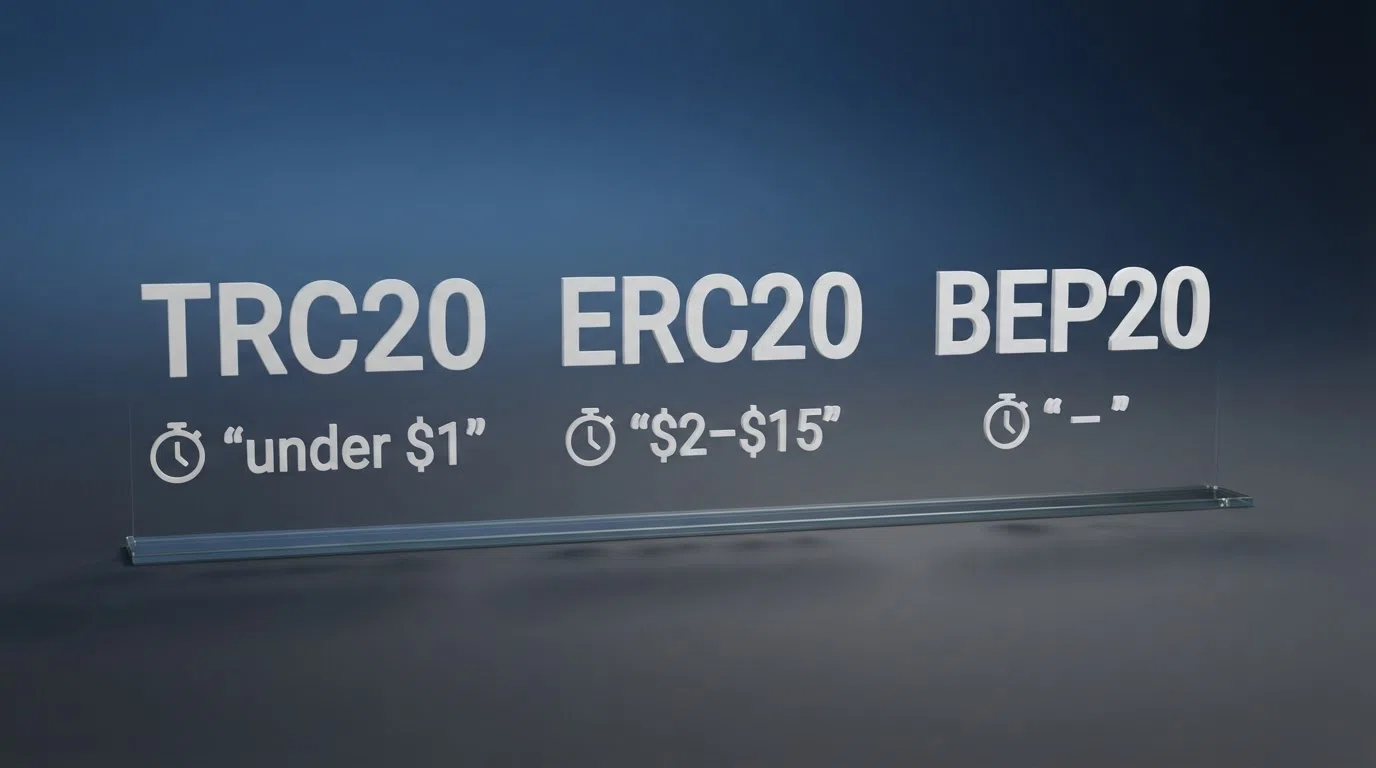
Network choice is the variable the player controls. TRC20 costs a few cents to around a dollar and confirms in seconds to about a minute. ERC20 costs $2 to $15 and confirms in one to several minutes, with the fee driven by Ethereum network congestion. BEP20 sits between the two on cost but was not measured in this research pass; the network is available at some casinos and typically charges lower fees than ERC20 with comparable speed to TRC20. Choosing TRC20 where the casino supports it is the cheapest and fastest route; choosing ERC20 where TRC20 is unavailable is the fallback; choosing the wrong network entirely (sending on TRC20 to a casino that only credits ERC20 deposits) loses the funds.
Buying USDT and Making Your First Casino Deposit
The deposit flow follows a fixed order, and the order matters. First, buy USDT on an exchange that serves UK residents. The exchange will require identity verification before the first fiat deposit, in line with UK AML rules; this is a separate process from any verification the casino may require. Second, withdraw the USDT from the exchange to a personal wallet. Third, choose the network. TRC20 is the default recommendation for casino deposits because of the near-zero fees and fast confirmation, but the casino must support the chosen network. Fourth, send the USDT from the wallet to the casino’s deposit address. The address is a long alphanumeric string, and copying it by hand is the most common way to lose funds: a single wrong character sends the transfer to an unreachable wallet.
- Confirm the network before sending. A TRC20 transfer to an ERC20-only deposit address is not recoverable.
- Send a small test transaction first if the casino balance will be substantial. The network fee is trivial relative to the cost of a wrong address.
- Double-check the address character by character. Most wallets offer a QR-code scan, which removes the manual-entry error.
TRC20, ERC20, or BEP20: Which Network Costs You Least
| Network | Typical Fee per Transfer | Confirmation Time | Casino Support |
|---|---|---|---|
| TRC20 (Tron) | $0–$1 | Seconds to ~1 minute | Widely supported |
| ERC20 (Ethereum) | $2–$15 | One to several minutes | Widely supported |
| BEP20 (BNB Smart Chain) | — | — | Available at some casinos |
TRC20 is the clear winner on cost and speed. A $0.50 transfer that confirms in thirty seconds beats a $10 transfer that takes five minutes every time, and the difference compounds across multiple deposits and withdrawals. ERC20 is the fallback when TRC20 is unavailable; the higher cost is a function of Ethereum network congestion, and the fee fluctuates with gas prices. BEP20 was not measured in this research pass; the casino-specific support column reflects availability at some operators rather than a confirmed figure for every casino. The reader should check the cashier page to see which networks the chosen casino accepts before sending.
How Fast You Actually Get Paid: Withdrawal Speed and Limits
Crypto withdrawals at the featured operators clear in under an hour once approved. Donbet and Kaasino both confirm sub-one-hour crypto payout times; Playbet.io confirms USDT deposits in under a minute, which sets the speed benchmark. The hidden delay is the first-withdrawal manual review: identity verification, source-of-funds checks, and operator processing add time before the blockchain transaction even starts. A player who registers at an offshore Tether casino, deposits £200, plays, and requests a withdrawal on day one will likely wait longer than the headline “instant withdrawal” promise suggests, because the casino will request documents before approving the first cashout.
Withdrawal limits and minimums vary by operator and by currency. Some operators impose daily or weekly caps; some allow unlimited crypto withdrawals; some require a minimum withdrawal amount that exceeds the player’s remaining balance. The player should check the cashier page for the operator’s specific limits before depositing, because a casino that pays in under an hour but caps withdrawals at $50 per day is not the same proposition as a casino that pays in under an hour with no cap. Research did not confirm per-operator withdrawal caps for the full featured set; the figure varies and the player should verify.
Why Tether Beats Fiat and Other Cryptos for Casino Payments
Tether against fiat bank transfers means no three-to-five business day withdrawal window, no card declines from UK banks blocking gambling transactions, and no intermediary. A bank transfer from a UK current account to an offshore casino account is likely to be flagged or rejected; a Tether transfer moves directly from the player’s wallet to the casino’s wallet with no bank in the loop. The trade-off is the loss of chargeback rights: a bank transfer can be reversed in cases of fraud, a crypto transfer cannot.
Tether against Bitcoin and Ethereum means price stability. A player who deposits 0.01 BTC at £500 and plays for two hours while BTC drops 4% has lost 4% of the bankroll before accounting for the house edge. A player who deposits £500 in USDT plays at the same dollar value throughout. The stablecoin removes the second source of variance (price volatility) and leaves only the first (the house edge), which is a cleaner bet in the mathematical sense.
Tether against other stablecoins (USDC, DAI) means casino acceptance. USDT is supported across all ten featured operators; USDC is supported at several; DAI is less common. The widest acceptance is itself a feature, because a player who wants flexibility across operators will find USDT the most portable stablecoin choice. The other stablecoins share the same 1:1 dollar peg and the same network choices; the difference is liquidity and casino integration.
Why Your 2026 Tether Casino Bonus Is Smaller Than It Looks
The welcome bonus is the casino’s primary marketing tool, and the headline percentage is designed to obscure the conditions attached. A 300% match sounds dramatic; a 300% match with 40× wagering on deposit plus bonus combined, a 30-day validity, and free-spin winnings capped at $10 is a different proposition once the arithmetic is done. The bonus is real money, and the conditions are real costs; the question is whether the bonus exceeds the cost, and the answer depends on the wagering multiple, the game weighting, the validity window, and the cashout cap.
For context, GB-licensed operators are subject to a 10× wagering cap under LCCP Social Responsibility Code 5.1.1, in force from 19 December 2025. That cap does not bind offshore Tether casinos, where wagering multiples of 25× to 40× are standard. A player comparing a 35× offshore offer against a 10× GB-licensed offer is comparing a bonus that demands three and a half times the play-through, which translates directly into expected losses at the table.
Welcome Bonuses for Tether Depositors: What Is Actually on Offer
The deposit-match offers in the featured set range from Velobet’s 160% up to €1,000 at 35× wagering to MyStake’s 300% up to €1,500 at 30× wagering on deposit plus bonus. TrustDice offers 100% up to 3 BTC equivalent at 25× bonus-only wagering, the lowest match-wagering figure in the crypto casino segment. Multi-deposit packages extend the offer across four deposits: BC.Game structures 180%/240%/300%/360% across four deposits at 40× deposit-plus-bonus wagering, and BitStarz structures up to $500 plus 180 free spins across four deposits at 40× bonus wagering with a 14-day validity window. The multi-deposit structures lock the player into continued depositing, which is the point of the structure from the operator’s side.
Operators with unconfirmed bonus data in this research pass: Donbet (crypto-specific bonus exists, exact terms not confirmed), Kaasino, Bilucky, and Playbet.io. The research did not produce a primary source for the welcome offer at these operators, and this page does not invent a figure. A player considering one of these operators should check the bonus page at sign-up; the headline number is typically displayed, and the conditions are typically accessible before the first deposit.
No-Deposit Bonuses and Free Spins: The Terms That Matter
Free spins look like free money, and the wagering on the winnings is the term that decides what they are worth. Jackbit’s 100 free spins with zero wagering is the clearest proposition in the featured set: every win is withdrawable cash with no playthrough. No other operator matches that structure. TrustDice’s 25 no-deposit free spins are available on registration but UK players are restricted; the offer exists, and the access does not.
The catch on free-spin packages at other operators is the cashout cap and the wagering multiple. BC.Game caps free-spin winnings at $10, which is the operator’s way of pricing a 400-free-spin headline. BitStarz applies 40× wagering to free-spin winnings, with the spins credited as 20 instantly and 20 per day for eight days. The 14-day validity on the BitStarz bonus is the shortest in the featured set, which means the player has two weeks to clear the wagering or the bonus expires. A player who treats the 180 free spins as worth £180 is mistaken; the actual accessible value depends on the slot’s RTP, the wagering on winnings, and the cap.
Wagering Requirements: How Many Times You Really Need to Play Through
A wagering requirement is a turnover obligation: the player must wager the bonus amount (or the deposit plus bonus) a stated number of times before a withdrawal is possible. A 35× wagering requirement on a €1,000 bonus means €35,000 must be wagered before the bonus and any associated winnings can be withdrawn. That is the headline number, and the conditions beneath it (game weighting, validity, max bet per spin) are the variables that turn a bonus from “worth claiming” to “worth ignoring.”
The featured-set wagering range, lowest to highest: Jackbit 0× (free spins only), TrustDice 25× bonus-only, MyStake 30× deposit-plus-bonus, Velobet 35×, BC.Game 40× deposit-plus-bonus, BitStarz 40× bonus. For reference, the UKGC caps wagering at 10× at GB-licensed operators. A player choosing between a 10× GB-licensed bonus and a 35× offshore bonus is choosing between a turnover obligation of €10,000 on a €1,000 bonus and €35,000 on the same bonus; the offshore multiple is three and a half times the British one.
The distinction between bonus-only and deposit-plus-bonus wagering is the detail most readers miss. A 30× bonus-only wagering on a €1,000 bonus means €30,000 in turnover on the bonus alone. A 30× deposit-plus-bonus wagering on a €1,000 deposit plus a €1,000 bonus means €60,000 in turnover on the combined amount. The same headline multiple (30×) on the same headline bonus (€1,000) produces a turnover obligation that is twice as high under the deposit-plus-bonus structure. The reader should always check whether the wagering applies to the bonus alone or to the deposit plus bonus, and the answer is in the bonus terms, not the bonus headline.
Slots, Live Dealers, and Crash Games: What Tether Casinos Actually Offer
The game library at a Tether casino looks much like the game library at a fiat casino, with the addition of crypto-native categories that fiat casinos rarely carry. Slots from Pragmatic Play and NetEnt dominate the libraries at Donbet, Kaasino, and Bilucky, the three operators where the research confirmed providers; the studios that supply GB-licensed casinos supply offshore Tether casinos as well, so the game quality is comparable. Live dealer tables from Evolution and Pragmatic Play Live stream to Tether casinos in the same way they stream to licensed operators. The difference is in the extras: crash games, provably fair titles, and crypto-native slot variants that are rare or absent at fiat sites.
The UK statutory slot stake caps (£5 for players aged 25 and over, £2 for players aged 18 to 24) do not bind offshore Tether casinos. The caps, the auto-play ban, and the 2.5-second minimum spin speed are GB-only rules imposed by SI 2025/215 and the LCCP; an offshore operator has no obligation to apply them. A player who wants to spin at £10 per cycle can do so at an offshore Tether casino, and a player who is accustomed to the £5 ceiling at a GB-licensed site will find the higher limit available elsewhere. The absence of the cap is part of the attraction for some players, and the absence of the harm-prevention guardrail is the corresponding cost.
Tether Slots: What UK Stake Caps Mean and Why Offshore Casinos Sit Outside Them
UK slot stake caps are among the strictest in the world. The £5 ceiling for adults aged 25 and over came into force on 9 April 2025; the £2 ceiling for adults aged 18 to 24 came into force on 21 May 2025. Both apply per game cycle, and both are backed by the LCCP and the Remote Technical Standards. Auto-play is banned, spin speed has a 2.5-second minimum, and “losses disguised as wins” (a slot animation that celebrates a payout smaller than the stake) is prohibited. The package is a harm-prevention design, and the GB regulatory system is the only one in the world to mandate all of these features together.
Offshore Tether casinos have no statutory stake cap. A player can wager more per spin, and the absence of the cap removes the guardrail that was designed to limit harm. Pragmatic Play and NetEnt slots are available at the same RTP bands the studios publish for their GB-licensed deployments; the game is the same. The setting is different: no auto-play ban, no spin-speed minimum, no cap on losses disguised as wins. If you prefer the British guardrails, they are absent offshore; if you prefer higher stake limits, they are unrestricted.
Live Dealer and Table Games With Tether Stakes
Live dealer games stream from Evolution and Pragmatic Play Live studios to Tether casinos in the same way they stream to licensed operators. Blackjack, roulette, baccarat, and game-show variants (Crazy Time, Monopoly Live, Deal or No Deal Live) are available. The player bets in USDT or in a fiat-equivalent display, depending on the casino’s interface; the underlying game is the same.
No statutory stake cap applies to non-slot products even in the UK, so the offshore-onshore difference is smaller for table games than for slots. A live blackjack table at a Tether casino can accept the same stake ranges as a live blackjack table at a GB-licensed site. What differs is the regulatory backdrop: a complaint about a withheld live-dealer payout at a GB-licensed casino can go to the operator and then to ADR; a complaint about a withheld live-dealer payout at an offshore Tether casino has no independent adjudicator. Game availability is provider-driven, and a casino with Pragmatic Play and NetEnt in the slot lobby typically carries a full live-dealer lobby as well.
Crash Games and the Providers Powering Tether Casinos
Crash games are a crypto-native category: the player bets, a multiplier climbs, and the player must cash out before the multiplier crashes. Aviator (Spribe), Spaceman (Pragmatic Play), and similar titles are standard at Tether casinos and rare at fiat casinos. The mechanic is fast, the variance is high, and the house edge is built into the distribution of crash points. A player who enjoys the format will find it widely available offshore; a player who prefers slots and table games can ignore the category.
Provably fair games are a separate crypto-native concept: the player can verify each round’s outcome independently using a cryptographic seed hash published by the casino. The system is verifiable in principle, and it removes the need to trust the operator’s RNG alone. The research did not confirm per-operator provably-fair support across the full featured set; the reader should check the casino’s game lobby for a “provably fair” or “verify” tab. Provider lists vary, and the depth of the game catalogue depends on the operator’s integration with studios beyond Pragmatic Play and NetEnt.
Crypto-First vs Crypto-Friendly: What Tether Casinos Actually Deliver
The crypto casino market sits on a spectrum between two poles. Crypto-first casinos are built around blockchain deposits: they offer WalletConnect registration, non-custodial wallet connection, provably fair games, and crypto-native features like on-chain settlement. Crypto-friendly casinos are traditional operators that accept USDT as a payment method but run a fiat-era backend, with the crypto stopping at the cashier. The distinction matters for custody, anonymity, and the features a player can actually use.
Playbet.io is the clearest crypto-first example in the featured set: WalletConnect and MetaMask one-click registration, no email or password required, and a stated 96.8% average RTP. BitStarz sits at the crypto-friendly end: it accepts multiple cryptocurrencies, has an established brand, and runs a traditional casino backend. Most featured operators sit closer to the crypto-friendly pole, with USDT accepted at the cashier and fiat-era account management around it.
Provably Fair, Custody, and Blockchain Settlement: What Changes
Three features define a crypto-native casino. Provably fair means the player can verify each game round independently: the casino publishes a server seed, the player provides a client seed, and the resulting hash determines the outcome. The player can check the hash after the round and confirm the casino did not change the seed mid-round. The system is verifiable in principle; whether a given casino implements it correctly is a separate question.
Custody is the question of who holds the player’s balance. A fiat casino holds the balance in an internal account; a crypto-first casino lets the player connect a non-custodial wallet and place bets directly from the wallet. The non-custodial model means the player retains control of the funds between bets, which is a different security posture from the fiat model where the operator holds the running balance.
Blockchain settlement is the transparency layer: deposits and withdrawals settle on-chain with public transaction records. The player can see the transaction on a block explorer and confirm the funds have moved. The trade-off is irreversibility: a wrong address or a wrong network choice loses the funds with no chargeback route. A bank transfer can be reversed in cases of fraud; a crypto transfer cannot. While offshore sites lack the bank-backed security of chargebacks, they offer the transparency of on-chain verification for those who know how to use it.
Anonymity at Tether Casinos: What You Get and What You Give Up
Tether casinos promise anonymity, and the reality is partial. A casino that requires no email, no phone number, and no identity document at sign-up lets a player deposit and play anonymously, which is impossible at any GB-licensed site (the UKGC requires identity verification before the first deposit). The anonymity holds until the first withdrawal, where most offshore casinos request identity documents: passport or driving licence, proof of address, sometimes a source-of-funds questionnaire or a selfie with the ID.
The KYC trigger is the boundary. A player who deposits £500 in USDT, plays, and requests a £400 withdrawal will likely face a document request before the withdrawal is approved. The casino’s automated review flags first withdrawals for verification; once verified, subsequent withdrawals are typically faster. The first cashout is the bottleneck, and the “instant withdrawal” promise applies after KYC is cleared, not before.
Truly no-verification casinos exist in the offshore market. They carry heightened risk: no regulator, no ADR, no complaints route, no fund-segregation guarantee, and a meaningful chance that the operator disappears with player balances. A player trading privacy for protection should understand the trade, and a player who needs both privacy and protection will not find both at a single offshore site. The structure of the offshore market does not support it.
Crypto-Only vs Hybrid Casinos: Which Model Suits You
Crypto-only casinos accept only cryptocurrency deposits. The player must onboard through an exchange before playing, and all balances and bets are in crypto. Hybrid casinos accept both fiat (cards, e-wallets, bank transfer) and crypto deposits, and they often run separate bonus tracks for each. BC.Game is the clearest example: the crypto track offers 180%/240%/300%/360% across four deposits, and the fiat track offers 120%/100%/80%/80% up to $1,000 each plus 400 free spins. The two tracks are not interchangeable; the player chooses a deposit method and is bound to the corresponding bonus structure.
The trade-off is speed and flexibility. Crypto-only casinos tend to have faster withdrawals and fewer fiat-era restrictions (no card declines, no bank processing delays). Hybrid casinos offer more deposit flexibility but may treat crypto as a secondary payment rail rather than the primary one. A player who has already bought USDT and wants to deposit immediately will find a crypto-only casino faster; a player who wants to deposit in fiat today and switch to crypto later will find a hybrid casino more accommodating.
The Legal Reality: Every Tether Casino That Takes UK Players Is Offshore
The UKGC’s position on cryptocurrency at licensed operators is not ambiguous. The Commission’s published guidance states: “If you are considering using crypto-assets to fund a gambling business, we recommend that unless you are able to provide a full and complete history of SoF with your application, do not submit as we will not consider Operating Licence applications with a crypto funding element without this evidence provided in full at application stage.” That statement is the regulatory foundation for the fact that no GB-licensed casino accepts Tether (or any cryptocurrency) deposits in 2026.

Offshore licensing means no GamStop coverage, no UKGC complaints route, no approved ADR provider, and no statutory consumer protections. The Gambling Act 2005 protections (identity verification before first deposit, mandatory deposit-limit prompts, financial vulnerability checks at £150 net deposit in a 30-day period, statutory slot stake caps, the 10× wagering cap) do not apply to offshore operators. A UK player at an offshore Tether casino has access to the games but not to the regulatory framework.
The UKGC’s enforcement reach is disruption-based, not blocking-based. The Commission can issue cease-and-desist notices, refer URLs to search engines for delisting, and pressure domain registrars and payment providers. The data from April 2024 to June 2025: 3,140 disruption notices issued, 447,778 URLs referred to search engines, 287,961 URLs removed, with an average 32% fall in engagement across 160 disrupted sites. The Commission does not hold statutory ISP-blocking power; legislation has been proposed but not enacted. A UK player who reaches an offshore Tether casino is not blocked, but the casino is operating outside the British framework, and the player’s protection is correspondingly reduced.
| Licensing Body | Player Fund Protection | Dispute Resolution | Crypto Deposits Accepted |
|---|---|---|---|
| UK Gambling Commission (GB) | Segregated player funds, medium/high protection ratings | Approved ADR providers, UKGC complaints route | No |
| Curaçao GCB / CGA / OGL | Limited; no mandatory segregation equivalent to UKGC | No ADR obligation | Yes |
| Anjouan (Comoros) | No mandate comparable to UKGC or MGA | No ADR obligation | Yes |
| Costa Rica | No gambling licence issued; no regulatory framework | No ADR obligation | Yes |
The table shows the structural difference. GB-licensed operators are required to segregate player funds and to subscribe to an approved ADR scheme; offshore operators are not. The UKGC’s disruption-based enforcement can delist a casino from search results and pressure its payment providers, but it cannot compel an operator to return a UK player’s funds. Legislation to grant ISP-blocking power has been proposed but not enacted, and the Commission’s own data shows that delisting pressure reduces engagement by an average of 32%, not 100%.
Why No UKGC-Licensed Casino Accepts Tether in 2026
The barrier is not a policy choice by operators; it is a structural incompatibility between crypto deposits and UKGC source-of-funds requirements. A licence applicant proposing crypto funding must provide a “full and complete history of SoF” at application stage, a standard the Commission says it will not consider without. The Commission’s published guidance is the direct quote cited earlier; it is not a negotiating position or a working assumption but a stated threshold.
The AML dimension adds pressure. On 30 July 2026, the UKGC raised gambling software from low to medium risk in its money-laundering and terrorist-financing risk assessment, explicitly citing rising use of e-wallets, pre-paid cards, and cryptoasset-linked funds in remote sectors. The risk reclassification does not ban crypto funding, but it raises the documentation bar, and the SoF threshold already sits at “do not submit without full evidence.” The practical result is that no licensed operator accepts crypto today, and the Commission’s Industry Forum is exploring a “sensible pathway” for crypto payments at an early stage. No operator is likely to accept Tether deposits at a GB-licensed casino in the near term.
GamStop and Offshore Casinos: Why Self-Exclusion Does Not Cross the Border
GamStop is mandatory for every GB-licensed online operator since 31 March 2020. A player who registers with GamStop chooses an exclusion period (six months, one year, five years, or five years with auto-renewal), and every GB-licensed operator is required to check the register and refuse service. Exclusion cannot be cancelled early, and an exclusion that is not acted on after expiry continues for up to a further seven years.
GamStop coverage stops at the GB licence. Offshore Tether casinos (Curaçao, Costa Rica, Anjouan) are not part of the scheme, and a self-excluded UK player can register and deposit at an offshore casino without the block activating. The non-GamStop status is a marketing point for some offshore operators, and the explicit targeting of self-excluded UK players is a genuine harm vector. The National Gambling Helpline data shows that 81.5% of callers disclosing a form of gambling cited online forms in 2026, a five-year high, and GamCare made 996 referrals to treatment in January 2026, up 48% year-on-year. The infrastructure exists for UK players who want help; it does not reach the offshore market.
KYC at Offshore Casinos: What Verification You Face and When
The KYC timeline at offshore Tether casinos differs from GB-licensed sites in one specific way: verification is deferred to the first withdrawal rather than applied at the first deposit. A player can register with an email address, deposit £200 in USDT, and play without submitting identity documents. The verification request arrives when the player requests a withdrawal for the first time.
The documents requested are standard: passport or driving licence, proof of address (utility bill or bank statement, typically within the last three months), and sometimes a source-of-funds questionnaire or a selfie with the ID document. The verification can delay the first withdrawal by 24 to 72 hours beyond the blockchain settlement time, which is the gap between the “instant withdrawal” marketing and the operational reality. Once verification is cleared, subsequent withdrawals are typically processed within the headline time (under an hour for crypto at most featured operators).
The Risks You Take: What Offshore Means for Your Money and Your Rights
Playing at an offshore Tether casino means surrendering every consumer protection a UK player takes for granted at a GB-licensed site. No ADR provider is obliged to hear disputes; no fund-segregation mandate protects balances in the event of operator insolvency; no UKGC complaints route exists; no statutory slot stake caps apply. The trade is privacy and flexibility on one side, regulatory protection on the other.
The UKGC’s enforcement reach stops at the border. The Commission can disrupt, delist, and pressure payment providers and domain registrars, but it cannot compel an offshore operator to return a UK player’s funds. The Commission’s enforcement data (3,140 disruption notices, 447,778 URLs referred, 287,961 URLs removed, 32% average engagement fall across 160 disrupted sites) is meaningful at the market level but does not help an individual player whose withdrawal is withheld. BC.Game’s UKGC licence revocation in December 2024 is a concrete case: a formerly licensed operator now offshore, with no player fund protection mandate comparable to the UKGC or MGA. The Commission’s action removed the operator from the licensed market; it did not create a recovery route for existing players.
A UK player who chooses to deposit at an offshore Tether casino is making a decision that involves more than the casino’s bonus terms. It involves accepting that GamStop does not cover the deposit, that ADR does not exist if the operator refuses to pay out, and that the UKGC’s enforcement reach is disruption, not recovery. The decision is the player’s; the framework is the one this section has described.
New Tether Casinos in 2026: Worth the Risk or Stick With What Works?
New Tether casinos launch regularly, typically with larger welcome bonuses and modern interfaces designed to attract players who are not yet committed to an established brand. The trade-off is track record: a new casino has no payout history, no player-complaint record, and no operational reputation a player can check. The bonus headline is the only verifiable data point at launch, and the bonus headline is the casino’s marketing, not its operational quality.
The Jackbit rebrand to Jack.com in May 2026 is the recent example in the featured set rather than a new launch. Beyond the featured set, the research did not confirm specific new-casino launch dates or operator names for this pass. The category is real, and the criteria below apply to any new Tether casino a UK player encounters, not to a specific brand.
What to Check Before You Join a Brand-New Tether Casino
Three checks matter before depositing at a casino with no established reputation. The licence check looks up the operator on the regulator’s register; a Curaçao-licensed operator appears on the Curaçao GCB register, and a Costa Rica-based operator has no public licence record to verify (because Costa Rica does not issue gambling licences). The player-complaint history search runs through casino forums and review aggregators; an unresolved pattern of withdrawal complaints is a stronger signal than any number of positive reviews. The bonus-term audit reads the full terms before depositing, looking for higher wagering, shorter validity windows, or lower cashout caps than the headline suggests.
A Costa Rica-based casino is the harder case to verify. Kaasino and Bilucky are both Costa Rica-based, and neither has a public licence record to look up. The player who chooses a Costa Rica-based operator is trusting the operator’s claims and the player-complaint history rather than a regulatory register. The risk is correspondingly higher, and the player should treat the first deposit as a test rather than a commitment.
Staying in Control: Responsible Gambling at Tether Casinos
Offshore Tether casinos sit outside the UK’s responsible-gambling infrastructure. The UKGC’s social responsibility codes, mandatory deposit-limit prompts, financial vulnerability checks, and the GamStop safety net do not apply. The player is responsible for setting their own limits, and the operator’s responsible-gambling tools (where they exist) are operator-level rather than regulator-mandated. The UK support infrastructure (GamCare, BeGambleAware, the National Gambling Helpline, NHS gambling harm clinics) is available regardless of where the player gambles, and a UK player at an offshore Tether casino who needs help can access it.
The infrastructure exists. The GamCare data shows the demand: 81.5% of National Gambling Helpline callers in 2026 cited online forms of gambling, a five-year high, and GamCare made 996 referrals to treatment in January 2026, up 48% year-on-year. The Gambling Survey for Great Britain (GSGB Year 3, 2025) estimates that approximately 2.4% of adults in GB aged 18 and over had a PGSI score of 8 or more (problem gambling), equivalent to approximately 1.3 million adults. The reader who recognises the pattern in themselves or someone they know is not alone, and the resources below are the route to help.
Deposit Limits, Loss Caps, and Session Tools: What Offshore Casinos Offer
GB-licensed operators must prompt the customer to set a financial limit before their first deposit, run light-touch financial vulnerability checks at a net deposit threshold of £150 in a rolling 30-day period, and apply the 2.5-second minimum spin speed with auto-play banned. The framework is mandatory and uniform. Offshore Tether casinos have no equivalent framework, and the responsible-gambling tools that exist are operator-by-operator.
Bilucky is the only featured operator with confirmed responsible-gambling tools in this research pass: deposit limits, loss limits, session limits, stake limits, time-out, and self-exclusion, all operator-level and not linked to GamStop. Other featured operators may offer fewer tools or none at all. The player should check the responsible-gambling page before depositing, and the absence of tools is itself information: a casino that does not offer deposit limits is a casino where the player must self-impose them. The practical gap is the absence of a prompt. A GB-licensed casino is required to ask the player to set a limit; an offshore casino is not. The player who wants the prompt must seek it out.
UK Support Resources: Where to Get Help Regardless of Where You Play
The National Gambling Helpline (run by GamCare) offers free, confidential support by phone and live chat. The 81.5% figure for online gambling among helpline callers in 2026 and the 48% year-on-year increase in GamCare referrals in January 2026 indicate that the infrastructure is operating at scale; the calls are being answered, and the referrals are being made. BeGambleAware funds research, prevention, and treatment; its 2024 Treatment and Support Survey found that 30% of adults who gamble and are experiencing any level of problems want treatment, support, or advice, nearly double the 17% figure from 2020. NHS gambling harm clinics operate in England, Scotland, and Wales, and Gamblers Anonymous peer-support groups are available nationwide.
The resources serve UK residents regardless of where the gambling took place. A player at an offshore Tether casino who decides to seek help faces no additional barrier at the help line or clinic; the support is the same. The decision to use it is the player’s, and the infrastructure is in place to receive them.
How We Evaluated These Tether Casinos
The featured set was drawn from the research pass and cross-checked against UKGC public-register data and independent casino-review publications. Every operator’s licence status, UK-player access, and bonus terms were verified against at least one external review source. Where the research did not confirm a figure (a bonus percentage, a wagering multiple, a withdrawal limit), the entry is marked as unconfirmed or left as an em dash. No figure on this page was invented to fill a gap.
The ranking criteria were licence and regulatory standing, UK-player accessibility, bonus value adjusted for wagering burden, withdrawal speed and payment-method support, and the presence or absence of responsible-gambling tools. The ranking is a factual market map, not a recommendation. No operator on this page holds a GB Gambling Commission licence or participates in GamStop. The evaluation is a description of what is available; the decision to use it is the reader’s.
What UK Players Should Actually Do About Tether Casinos
The market picture, honestly stated, is this. Six of ten featured operators accept UK players. All ten are offshore-licensed. None offers the consumer protections a GB-licensed casino provides: GamStop, ADR, the UKGC complaints route, and statutory stake caps do not apply. The welcome bonus is smaller than the headline suggests, because the wagering obligation is two-and-a-half to four times the GB-licensed cap of 10×.
The bonus arithmetic, applied to the Velobet offer as an example. A 160% match on a €1,000 crypto deposit adds a €1,600 bonus at 35× wagering, producing a turnover obligation of €56,000. At the 96.8% RTP claimed by Playbet.io (and used here only as a reference figure for what a crypto casino slot library might return), the expected loss from clearing that turnover is €56,000 × (1 − 0.968) = €1,792. The bonus is worth €1,600, and the expected cost of clearing it is €1,792. The offer, on those inputs, is marginally negative even before the player’s own play decisions are layered on. The arithmetic changes with the wagering multiple: a 25× bonus-only offer produces a lower turnover and a correspondingly lower expected loss, and a 40× deposit-plus-bonus offer produces a higher turnover and a correspondingly higher expected loss. The reader can apply the same formula to any offer on this page: turnover times (1 minus RTP) gives the expected cost of clearing, and the comparison against the bonus amount is the net value of the offer.
The actionable checklist, before depositing at any Tether casino. Verify the operator’s licence on the regulator’s register (Curaçao GCB, Curaçao CGA, Curaçao OGL, or Anjouan; Costa Rica has no register to check). Read the full bonus terms before depositing, paying particular attention to the wagering multiple, the game weighting, the validity window, and any cashout cap. Set a deposit limit on the casino’s responsible-gambling page if one exists; the absence of a limit-setting option is information. Know that GamStop does not cover the deposit, and that ADR does not exist if the operator refuses to pay out. Save the National Gambling Helpline number (0808 8020 133) before the first deposit, not after.
The decision is the reader’s. The framework is the one this page has laid out: a market that operates outside the British regulatory system, bonuses that demand more turnover than their GB-licensed equivalents, withdrawals that are fast after KYC is cleared and slow before, and a support infrastructure that exists regardless of where the gambling takes place. The reader who chooses to deposit at an offshore Tether casino is making a deliberate choice with the facts in front of them, and that is the only basis on which the choice is worth making.
Frequently Asked Questions
Are Tether casinos legal for UK players?
Tether casinos serving UK players are offshore-licensed (Curaçao, Anjouan, or Costa Rica), and no GB-licensed operator accepts cryptocurrency deposits. It is not illegal for a UK resident to gamble at an offshore casino; the UKGC’s remit covers operators, not players. What the player loses is protection: no GamStop coverage, no UKGC complaints route, and no approved ADR provider.
How much do Tether casino deposits actually cost in fees?
Network fees depend on the chosen blockchain. TRC20 (Tron) transfers typically cost $0 to $1 and confirm in seconds to about a minute. ERC20 (Ethereum) transfers cost $2 to $15 and confirm in one to several minutes, depending on network congestion. The exchange that sold the USDT may also apply a spread on the fiat-to-crypto conversion.
Will a Tether casino ask for my passport before I can withdraw?
Most offshore Tether casinos defer identity verification to the first withdrawal rather than the first deposit. A player can register, deposit, and play without documents, and the casino requests a passport or driving licence, proof of address, and sometimes a source-of-funds questionnaire before approving the first cashout. The verification can add 24 to 72 hours beyond the blockchain settlement time.
What can I do if an offshore Tether casino refuses to pay out?
There is no ADR provider obliged to hear the dispute, no UKGC complaints route, and no British consumer redress. The operator’s own regulator (Curaçao GCB, Curaçao CGA, Curaçao OGL, or Anjouan) may accept a complaint, but enforcement capacity varies. The practical protection is the choice not to deposit in the first place; once a withdrawal is withheld at an offshore casino, recovery is difficult.
What is the difference between a Tether casino and a Bitcoin casino?
Both accept cryptocurrency deposits, but Tether is a stablecoin pegged 1:1 to the US dollar, so the balance does not fluctuate with crypto-market moves. A Bitcoin balance worth £500 on Monday can be worth £470 on Tuesday. A Tether balance worth £500 on Monday is worth £500 on Tuesday, in dollar terms. The stablecoin removes the price-volatility variable and leaves only the house edge.
Does GamStop cover me if I only play at crypto casinos?
No. GamStop applies to GB-licensed online operators and does not extend to offshore Tether casinos. A player who has registered with GamStop can still register, deposit, and play at a Curaçao-licensed, Anjouan-licensed, or Costa Rica-based casino. The exclusion protects against GB-licensed sites only; offshore sites are not part of the scheme.
Payments – nodeposit-casinobonuses-uk
Content created by the «nodeposit-casinobonuses-uk» team