Non-UKGC Licensed Casinos: What UK Players Actually Get (and Give Up) Outside the UKGC
 Available in GB
Most comparison guides treat offshore casinos as a single bucket: bigger bonuses, fewer rules, end of story. That bucket is wrong. The licence a non-UKGC casino holds is the difference between a complaints route that actually works and a logo on a footer — and the UKGC licence a UK player is leaving behind bundles a protection stack it took two decades to build. This page separates those tiers, names the operators, and shows what the trade-off costs a person paying for it.
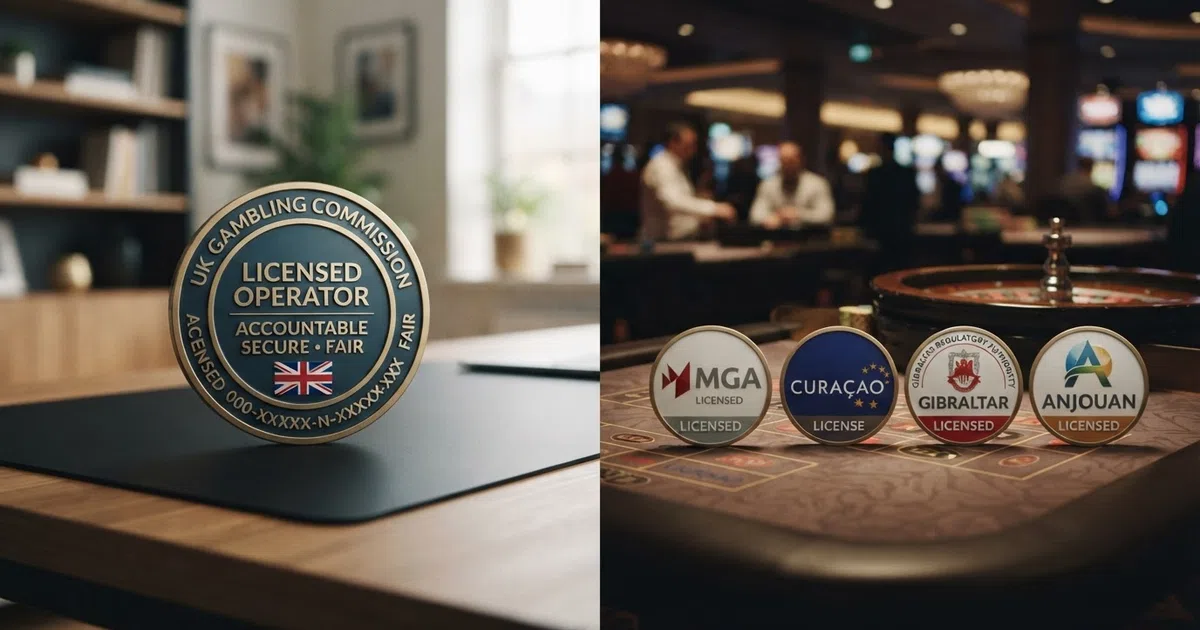
Currency note: data current as of September 8, 2026 and verified against the UK Gambling Commission’s public register, the Malta Gaming Authority’s licensee register, the Curaçao Gaming Authority register, and the Gibraltar Gambling Division register.
What “Non-UKGC” Means — and What It Doesn’t
The UK Gambling Commission is the single regulator of commercial gambling in Great Britain. A “non-UKGC casino” is any operator that accepts UK customers without holding a Gambling Commission licence. That is a regulatory fact, not a moral one. The operator may still hold a licence from another jurisdiction — Malta, Curaçao, Gibraltar, Anjouan — and the strength of that licence is the entire game.
The UKGC System at a Glance
Great Britain runs on one statute and one regulator. The Gambling Act 2005 established the framework; the Gambling (Licensing and Advertising) Act 2014 extended it to remote operators by requiring any business serving GB customers at the point of consumption to hold a GB operating licence. The Commission sits under the Department for Culture, Media and Sport and administers the Licence Conditions and Codes of Practice (LCCP) and the Remote Technical Standards (RTS) that flow from the Act.
Three licensing objectives run through everything the Commission does. First, keeping gambling free of crime and disorder. Second, ensuring it is conducted fairly and openly. Third, protecting children and other vulnerable people from harm. Great Britain means England, Scotland and Wales; Northern Ireland sits outside the Commission’s remit under a separate regime.
The Three Tiers of Non-UKGC Casino
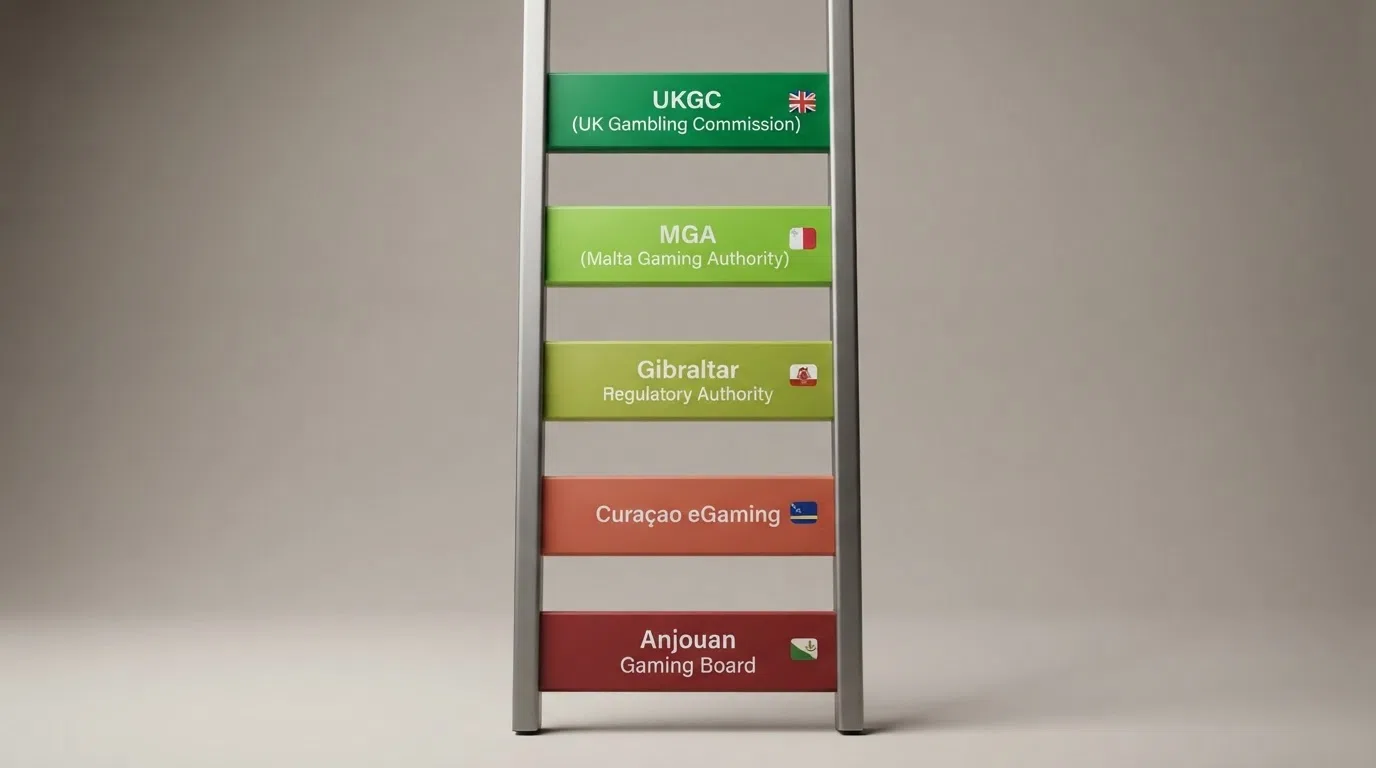
Offshore operators cluster into roughly three tiers by the licence they carry. The Malta Gaming Authority and the Gibraltar Gambling Division sit at the top — MGA enforces ring-fenced player balances, requires regular independent audits, and runs a formal complaints route; Gibraltar hosts the remote-licence operations of major UK-facing groups under Gambling Division oversight. Curaçao sits in the middle, improving after the LOK reform consolidated oversight under the Curaçao Gaming Authority and tightened requirements for licensed legal entities, but still below the MGA/UKGC standard. Anjouan sits at the bottom — minimal oversight, few enforceable protections, and a register that publishes almost nothing useful for a player checking up on an operator.
Who Operates These Casinos — and Why They Target the UK
The offshore market splits between crypto-native operators built around digital-asset rails from day one, and established international groups that hold parallel licences in jurisdictions where their home regulator does not let them advertise the full product suite. Gibraltar hosts remote-licence entities for several major UK-facing groups; bet365, Entain and Betfred all run Gibraltar-licensed operations as a matter of routine. These are not shadowy operators — they are the same groups UKGC-licensed players already know, marketing the same brands from a different licence angle.
The pitch is straightforward. GB-licensed sites now cap online slots at GBP 5 per spin for players 25 and over and GBP 2 for ages 18-24, ban credit cards entirely, cap wagering at 10×, and require mandatory identity and affordability checks before a deposit clears. An offshore site can offer a 200% match, a 35× playthrough, and a same-hour crypto withdrawal. Every protection the UKGC built over twenty years shows up in that comparison as friction — and the offshore site sells itself as the friction-free version.
The Legal Reality: What You Gain and Lose Outside the UKGC
A UK player at a non-UKGC casino sits in a defined legal grey zone. The operator commits the offence. The player loses every statutory protection. The gap matters because the protections are not cosmetic — they are the mechanism by which a player who is owed money, who has been excluded, or who has been over-challenged by a bonus actually gets recourse.
Is It Legal? What the Law Actually Says
Section 33 of the Gambling Act 2005 makes it a criminal offence to provide unlicensed gambling facilities to customers in Great Britain. The penalty runs to 51 weeks’ imprisonment and a level-5 fine (six months in Scotland). UK players, by contrast, are not generally held criminally liable for gambling at overseas-licensed sites — the legal weight falls on the operator, not the customer. That is the legal position. It is not the same as “safe”.
Enforcement is disruption-led rather than blocking-led. The UKGC issues cease-and-desist notices, refers unlicensed operators to search engines for removal, and works with domain registrars and payment providers to choke off the supply side. There is no wholesale ISP or DNS block. A site the Commission has acted against may still load in a browser the next day; what changes is whether payment processors will route money to it.
What the UKGC Licence Delivers — Protections You Get at Home
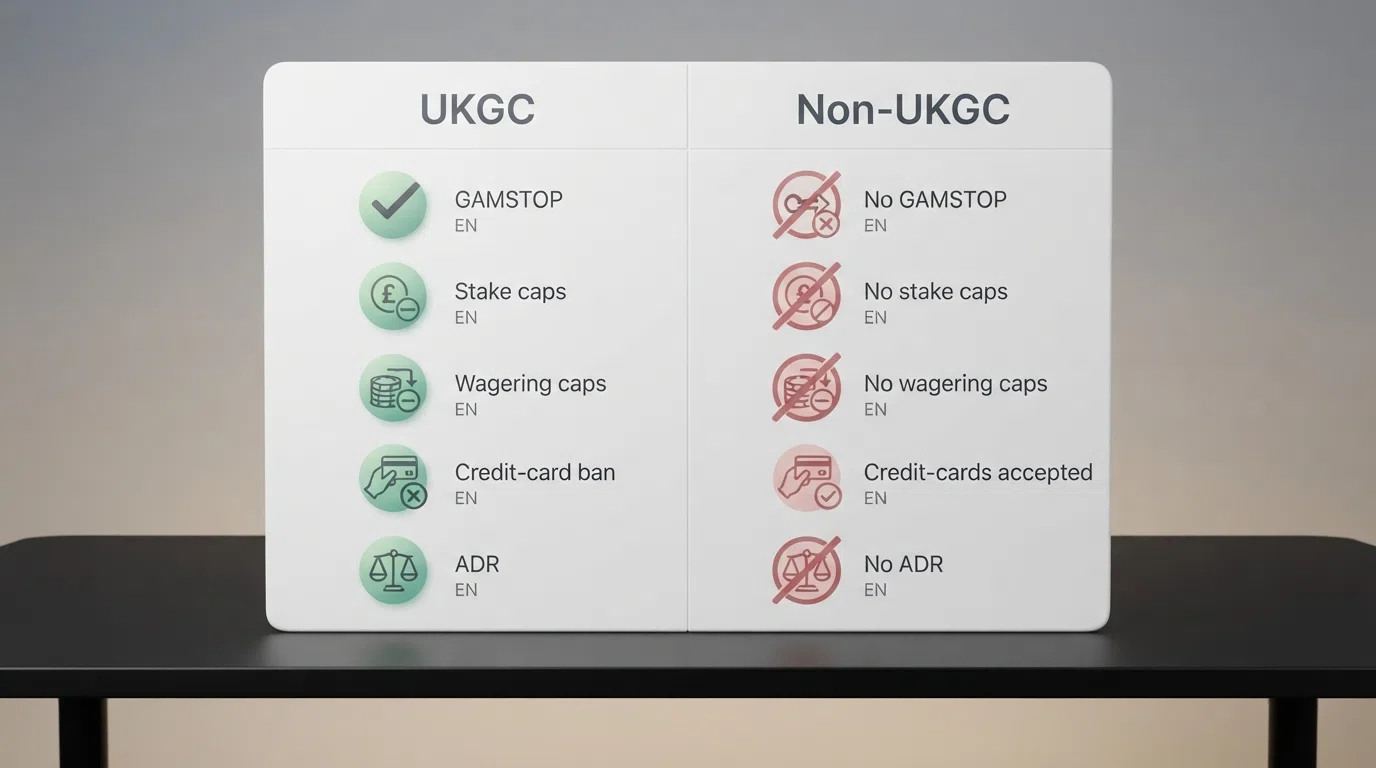
A UKGC licence is not a rubber stamp. It is a contract with the state, enforceable through the Commission. Mandatory GAMSTOP self-exclusion has applied to every GB-licensed online operator since 31 March 2020 — one registration blocks the player from every UKGC site simultaneously, for six months, one year, or five years with an auto-renewal option, and cannot be cancelled early. Alternative Dispute Resolution (ADR) plus a formal UKGC complaints route is available for any dispute that the operator’s own team cannot resolve.
Statutory protection extends to the mechanics of play. Since 9 April 2025 the maximum stake on an online slot game cycle is GBP 5 for players aged 25 and over; from 21 May 2025 it dropped to GBP 2 for players 18 to 24. From 19 January 2026, bonus wagering requirements at GB-licensed sites are capped at 10×, and mixed-product promotional offers — the “bet on football to get free spins” construction — are banned outright. Since 14 April 2020, credit cards have been banned for gambling at GB-licensed sites, including credit-funded e-wallet payments. Since 7 May 2019, identity must be verified before any deposit or gambling activity, including free bets and bonuses. Operators must prompt customers to set a financial limit before the first deposit, must apply any decrease immediately, and must run light-touch financial vulnerability checks on customers crossing GBP 150 in net deposits over a rolling 30-day period.
What You Give Up at a Non-UKGC Casino
- No GAMSTOP integration — a self-exclusion registered with GAMSTOP cannot reach an offshore operator, and a player can open an account and deposit at a non-UKGC site without any barrier.
- No UKGC ADR or formal complaints route — disputes are handled under the offshore jurisdiction’s own process, which is weaker in MGA cases and effectively absent in Anjouan cases.
- No statutory stake cap on slots — the operator sets its own ceiling or none at all, which is how a single spin on a non-UKGC site can carry a stake the UKGC market prohibits.
- No credit-card ban enforcement — offshore sites may accept credit cards and crypto in cases where UKGC sites cannot, because the GB ban binds GB-licensed operators, not the offshore operator.
- No mandatory deposit-limit prompt or financial-vulnerability checks at the same thresholds — a player who set a GBP 200 weekly deposit cap on a UKGC site has no equivalent pre-set friction at the offshore site.
- No enforceable bonus-wagering cap — the GB 10× cap does not bind offshore sites, and 20× to 50× wagering is the typical structure offshore players encounter.
How to Verify Any Casino Licence in Five Minutes
Every serious offshore casino lists a licence number somewhere on its site. The verification step is to take that number to the regulator’s own public register and check it. The UKGC public register covers GB-licensed operators; the Malta Gaming Authority’s licensee register covers Malta-licensed operators; the Curaçao Gaming Authority register covers Curaçao-licensed operators; the Gibraltar Gambling Division register covers Gibraltar-licensed operators.
Red flags are easy to read. A missing licence number. A licence seal that is an image rather than a link to the register. A number that returns no result on the official register. A jurisdiction that does not publish a public register at all. Anjouan has historically been the hardest jurisdiction to verify, because the licensing authority has not maintained a public register comparable to the UKGC, MGA or Gibraltar registers — and that opacity is itself the answer to whether to trust a licence on the strength of its seal alone.
The Offshore Jurisdiction Risk Ladder
The five jurisdictions a UK player encounters offshore fall into a clear ranking by what each one actually delivers when something goes wrong. The numbers behind it matter: a player with a complaint at an MGA-licensed site has a fund-segregated balance and an ADR route; a player with the same complaint at an Anjouan-licensed site has neither.
| Jurisdiction | Protection tier | Fund segregation | ADR and complaints route | Regulatory body | Typical wagering seen |
|---|---|---|---|---|---|
| UKGC | Strongest | Mandatory under LCCP | UKGC ADR plus formal complaints route | UK Gambling Commission | 10× (statutory cap from January 2026) |
| MGA | Strong | Mandatory ring-fenced player balances | Formal complaints route with independent ADR | Malta Gaming Authority | 30×–40× |
| Gibraltar | Strong | Operator-licensed under Gambling Division oversight | Established remote-licence hub, Gambling Division oversight | HM Government of Gibraltar, Gambling Division | 20×–35× |
| Curaçao | Improving middle tier | Improving under LOK/CGA reform | CGA-mediated, weaker than MGA | Curaçao Gaming Authority | 30×–50× |
| Anjouan | Weakest | Minimal | None established in public register | Anjouan Licensing Authority | 40× and above |
Top 2026 Non-UKGC Casinos vs UKGC Sites: What UK Players Actually Get
The protection gap becomes concrete when an actual operator sits beside an actual UKGC anchor. The seven offshore operators below were ranked by licence strength and offer transparency; the three UKGC-licensed anchors sit alongside as the GB market’s largest consumer-facing brands. Welcome-bonus values and wagering terms reflect the available data at research time; operator terms govern in all cases.
| Operator | Licence | UKGC licensed? | Welcome bonus | Wagering | Free spins |
|---|---|---|---|---|---|
| Stake | Curaçao (CGA) | No | No traditional welcome offer; daily races and reloads | — | — |
| BC.Game | Anjouan | No | Up to USD 4,000 across first four deposits | 40× (deposit + bonus); separate 40× on free-spin winnings | 400 |
| Cloudbet | Curaçao / Anjouan | No | Up to USD 2,500 | Zero wagering on primary offer (rakeback structure) | 200 |
| King Billy | MGA + Curaçao | No | Up to EUR 2,500 | 30× (bonus only) | 250 |
| WinSpirit | Curaçao (OGL/2024/923/0383) | No | 100% first-deposit match | Not confirmed in available data | 100 + 20 no-deposit |
| Wildz | MGA | No | 100% up to EUR 500 | 35× (bonus only) | 200 |
| Jackbit | Curaçao | No | 100 free spins wager-free on Hot Chilli Bells (minimum deposit GBP 50) | 1× on deposit + winnings to withdraw | 100 |
| bet365 | UKGC | Yes | Operator T&Cs govern | Under GB cap | — |
| Betway | UKGC | Yes | Operator T&Cs govern | Under GB cap | — |
| 888casino | UKGC | Yes | Operator T&Cs govern | Under GB cap | — |
The wagering column shows the clearest single signal. Every offshore operator in this table requires 30× playthrough or higher, except Cloudbet (zero on its primary offer) and Jackbit (1× on deposit plus winnings, with the free spins themselves wager-free). Every UKGC anchor sits under the 10× statutory cap that takes effect in January 2026. A 30× bonus at a EUR 1 stake per spin generates thirty times the spin volume the same EUR 1 stake generates at a 10× GB-licensed bonus — and each of those spins carries the house edge the slot itself charges.
Stake
Stake runs on a Curaçao licence under the post-LOK CGA framework and is the operator that markets itself on what it does not do. There is no traditional welcome bonus — the brand’s pitch is daily races, reload promotions, and a crypto-centric product built around Bitcoin, Ethereum and stablecoins. Withdrawals are reported as fast by community sources, and the minimum deposit sits around USD 10 in crypto equivalent. The trade-off is exactly what the absence of a welcome offer implies: a player who values the welcome-package route is in the wrong place; a player who wants a low-friction crypto platform with a known payout reputation is in the right one.
BC Game
BC Game holds an Anjouan licence — the weakest of the four tiers — and runs the largest headline package in this set: up to USD 4,000 plus 400 free spins spread across the first four deposits. The 40× wagering applies to deposit plus bonus, and free-spin winnings carry a separate 40× playthrough. Free-spin max cashout is reported at USD 10 per batch, which is the kind of fine-print cap that turns a 400-spin headline into a much smaller realised value once the cashout ceiling applies. Bonus validity is 30 days. The package looks generous on the marketing page; the wagering and the free-spin cashout cap together decide what it is actually worth.
Cloudbet
Cloudbet is the outlier in this set — the welcome package is reported as up to USD 2,500 plus 200 free spins with zero wagering on the primary offer, structured as a rakeback. The platform is crypto-only, and some sources describe UK access as variable by feature. The zero-wagering construction is the closest an offshore welcome gets to a GB-licensed equivalent — but the absence of a UKGC licence still means no GAMSTOP, no UKGC ADR, and a complaint path that runs through Curaçao or Anjouan rather than through the Commission.
King Billy
King Billy holds an MGA licence plus a Curaçao licence — the strongest dual-licence combination outside the UKGC system. The welcome package runs up to EUR 2,500 plus 250 free spins, with 30× wagering on the bonus only (deposit is not wagered), and a reported daily withdrawal cap of USD 4,000 with a weekly cap of USD 15,000. For a player who wants the strongest protection tier that exists outside the UKGC system, King Billy is the closest the offshore market comes to a defensible pick.
WinSpirit
WinSpirit holds a Curaçao licence (reported CGA reference OGL/2024/923/0383) and runs a 100% first-deposit match plus 100 free spins plus 20 no-deposit free spins — the no-deposit sweetener is unusual in the offshore set. Eleven cryptocurrencies are accepted. Wagering terms were not confirmed in the available data, which is itself the point: a welcome package whose wagering is not published up-front is a package a player cannot price before they accept it.
Wildz
Wildz holds an MGA licence only and runs a 100% welcome match up to EUR 500 plus 200 free spins, with 35× wagering on the bonus only and a maximum EUR 5 bet during the bonus period. Bonus validity runs 21 days. The MGA-only licence puts Wildz firmly in the stronger non-UKGC tier; the lower headline value versus King Billy is the trade-off a player pays for the cleaner European-protections profile.
Jackbit
Jackbit holds a Curaçao licence and runs 100 free spins wager-free on Hot Chilli Bells on first deposit, with a 1× wagering requirement on the deposit plus winnings to withdraw — and a GBP 50 minimum deposit. The wager-free free spins are the structural rarity in this set: every spin pays out at face value with no playthrough. The 1× on the deposit-plus-winnings is the small print that catches the player who skips the terms.
bet365 (UKGC Anchor)
bet365 is the GB market leader by share and the anchor of the UKGC side of the table. Welcome-offer details were not refreshed this run; operator terms govern. The relevant comparison is not the bonus — it is the protection stack: full UKGC consumer protections apply, including GAMSTOP self-exclusion, UKGC ADR and the formal complaints route, the GBP 5 / GBP 2 stake cap on online slots, the 10× wagering cap on bonuses, the credit-card ban, and mandatory identity verification before deposit.
Betway (UKGC Anchor)
Betway is a major UK-facing brand under full UKGC regulation and sits in the comparison set as the baseline against which the offshore packages can be measured. Welcome-offer details were not refreshed this run; operator terms govern. The protection stack is identical to bet365’s: GAMSTOP, UKGC ADR, stake caps, wagering caps, credit-card ban, and mandatory deposit-limit prompts.
888casino (UKGC Anchor)
888casino is an established UK-facing brand under Evoke, with full UKGC consumer protections. Welcome-offer details were not refreshed this run; operator terms govern. The brand sits in the comparison set for the same reason as Betway — to anchor what the UKGC side of a like-for-like comparison actually delivers.
The Bonus-Cost Calculation: What 30× vs 10× Actually Costs a Player
The wagering cap gap translates directly into time and volume. Take King Billy’s published package of EUR 2,500 at 30× wagering on bonus only — at a GBP 1 stake per spin and a 5-second interval, the required turnover of EUR 75,000 runs to 75,000 spins, which at 5 seconds per spin works out to roughly 104 hours of continuous play. A hypothetical GB-licensed equivalent at the same EUR 2,500 bonus under the 10× cap requires EUR 25,000 in turnover, 25,000 spins, and roughly 35 hours. The offshore bonus costs the player about three times the spin volume and three times the time-on-site to clear — and every spin carries the house edge of the slot itself.
This is a statistical estimate averaged over many spins. It promises no win, no payout, no return. The figure is also why a bigger headline bonus is not the same as a better offer — the player is paying the wagering multiple with their time and the house edge with their stake.
GamStop Won’t Stop These Casinos — Here’s What Will
GamStop is the national self-exclusion scheme for Great Britain, mandatory for every GB-licensed online gambling business since 31 March 2020. A player who registers with GamStop is blocked from opening an account or making a deposit at any UKGC site for the chosen exclusion period — six months, one year, or five years with an auto-renewal option. The exclusion cannot be cancelled early. It continues up to seven years beyond the minimum period if the player does not contact GamStop at the end of it.
What GamStop Is and Who It Covers
GamStop is online-only and licence-bound. It is the operational expression of a UKGC licence condition, not an internet-wide block. Every GB-licensed online operator is required to integrate with the scheme and to refuse service to anyone on the register. The Commission has taken enforcement action against businesses that failed to participate — the obligation is real and the consequence for non-participation is real.
UKGC Casinos Not on GamStop — How That Works
There is no narrow exception. GAMSTOP participation is mandatory for GB-licensed online gambling businesses, and the Commission has acted against operators that failed to integrate. A GB-licensed site claiming to operate outside GAMSTOP is either unlicensed or in breach — and either way, a player should treat the claim as a red flag, not a workaround.
Non-UKGC Casinos and GamStop — Why It Cannot Reach Them
An offshore operator with an MGA, Curaçao or Anjouan licence has no legal obligation to connect to GAMSTOP — the scheme is a UKGC condition, not a global rule. A player registered with GAMSTOP can open an account and deposit at a non-UKGC site without any barrier. That is the structural limit of the scheme, and it is the reason the responsible-gambling page on a non-UKGC site cannot promise what a UKGC site does.
Self-Exclusion and Blocking Tools Beyond GamStop
The tools that work regardless of jurisdiction are device-level and bank-level rather than operator-level. Gambling-blocking software such as BetBlocker, Gamban and the in-built Apple Screen Time / Google Family Link gambling-site blocks run on the device or the router and stop a player from reaching the offshore sites the same way they stop a player from reaching UKGC sites. Several UK high-street banks now offer gambling blocks at the account level — a one-call block that declines gambling transactions at the bank’s payment rail rather than at the casino’s. Self-imposed deposit and time limits can be set directly with the operator where the operator offers them, but a player who has self-excluded at a UKGC site should treat any voluntary limit on a non-UKGC site as a personal rule rather than a contractual one.
The free UK help infrastructure is available regardless of where the player plays. GamCare’s National Gambling Helpline (0808 8020 133) runs 24/7 by phone, live chat and WhatsApp and costs nothing to use. GambleAware operates the broader treatment and support pathway. NHS gambling harms clinics operate in England, Scotland and Wales. Telling someone — a partner, a friend, a counsellor — is not a tool but it is the action that holds the rest of the plan together.
How to Tell a Safe Non-UKGC Casino from a Risky One
A licence is the starting point. Reputation, payment behaviour and red flags do the rest of the filtering — and a licence a player cannot verify is worth less than no licence at all.
Beyond the Licence: Reputation Signals That Matter
Player forums and community complaint threads are the early-warning system the regulator’s own register is not. An operator that has been paying reliably for three years leaves a different trail than an operator that launched six months ago with a generous welcome package. Operator age and track record matter: an established brand with consistent payouts across multiple bonus cycles carries more weight than a fresh launch with no payout history. Withdrawal-speed reports from actual users — hours versus weeks — are the most honest signal an offshore site sends, because every withdrawal is a transaction that either completed or did not. Responsiveness to disputes and transparency about terms round out the picture.
Red Flags: How to Spot a Risky Non-UKGC Casino
- A missing or unverifiable licence number on the official register of the jurisdiction the casino claims to hold.
- An Anjouan-only licence with no stronger jurisdiction backing — Anjouan is the weakest tier in the offshore ladder.
- Withdrawal complaints forming a pattern across forums and complaint sites rather than isolated incidents.
- Terms that allow the operator to reduce max cashout retroactively after a player wins.
- No responsible-gambling page, no self-exclusion option, no deposit-limit tool, no reality check.
Payment Reliability and Cashout Speed at Non-UKGC Sites
How an operator handles a withdrawal is the single most honest signal it sends. Crypto withdrawals are typically faster at non-UKGC operators — hours, not days — because the rails are not the same as the bank rails a UKGC operator uses. Fiat withdrawals via e-wallet and bank transfer are subject to operator-specific processing times and to any daily or weekly withdrawal cap the operator imposes. The UKGC’s permanent ban on reverse withdrawals does not bind offshore operators — a player may be able to cancel a pending withdrawal at an offshore site, which is a feature some players want and others do not.
How Payments Work at Non-UKGC Sites
Crypto deposits — Bitcoin, USDT and a long tail of altcoins — are widely accepted at non-UKGC operators, including all seven in this comparison set. E-wallets such as Skrill and Neteller are available at offshore operators in cases where UKGC sites face payment-provider friction on the same rails. Credit cards are not banned at offshore operators because the GB credit-card ban applies to GB-licensed sites only; an offshore site can accept a credit card and a crypto deposit in the same checkout. GBP deposits are possible at some non-UKGC operators but currency conversion fees may apply if the account runs in EUR or USD — the fee is small per transaction and adds up over a year of regular play.
New Non-UKGC Casinos Worth a Look in 2026
The fresh crop of non-UKGC sites is dominated by crypto-native and hybrid (crypto plus fiat) operators built for a digital-asset-first customer base. Newer Curaçao operators are running under the post-LOK CGA framework, with the new legal-entity and local-resident-management requirements the reform introduced. Newer brands lack the multi-year payout track record that established operators carry — and that gap is what a player should price in, not the headline welcome package.
The Newest Non-UKGC Sites on the Market
The trend is clear. The offshore market is leaning into crypto rails and into the post-LOK Curaçao framework, with operators launching under the new CGA oversight rather than the older master-licence structure the LOK reform replaced. Newer operators are competing on payment speed and on bonus size — the same arms race that has driven the offshore market for a decade — but with cleaner entity structures behind the licence seal than the previous generation of Curaçao operators carried.
What to Check Before Joining a Brand-New Casino
A new brand has no reputation, so the check has to do more work. Verify the licence on the official register before depositing — do not trust a seal on the site alone. Read the withdrawal and bonus terms in full; max-cashout caps, per-week limits, and wagering on free-spin winnings are where new operators hide the catch. Check whether the operator discloses ownership and a registered address. Look for any player complaint threads even for a weeks-old brand — a complaint pattern on a brand that has been live for fourteen days is a louder signal than the same pattern on a brand that has been live for fourteen months.
How We Evaluated These Non-UKGC Casinos
Operators were checked against the UKGC public register, the Malta Gaming Authority licensee register, the Curaçao Gaming Authority register, and the Gibraltar Gambling Division register. Licence status was verified as of the research date, and every jurisdiction callout traces to the official register rather than to a seal on the operator’s own site.
The evaluation ran on four criteria. Licence strength — the jurisdiction tier from MGA down to Anjouan — set the floor. Offer transparency — wagering terms published and verifiable, max cashout disclosed, bonus validity stated — set the next layer up. Payment reputation, drawn from withdrawal-speed reports and complaint patterns in player forums, was the third filter. Responsible-gambling provision — at minimum a self-exclusion option and a deposit-limit tool — was the fourth. The three UKGC-licensed anchors were selected as the GB market’s largest consumer-facing brands for a like-for-like comparison baseline. No operator paid for inclusion, and the ranking reflects the research data collected, not commercial arrangements.
Your Next Move: Choosing a Non-UKGC Casino With Your Eyes Open
The non-UKGC market offers bigger bonus headlines, faster payments and fewer friction points — and it strips away every statutory protection the UKGC system built over two decades. The single most important decision is the licence jurisdiction. An MGA-licensed or Gibraltar-licensed operator gives a player a complaints route and fund segregation that an Anjouan-licensed operator does not. The five-minute licence check on the official register, run before any deposit, catches the worst operators before they catch the player.
A player registered with GAMSTOP should understand that no non-UKGC operator will honour that exclusion, and should plan a personal blocking strategy accordingly — device-level gambling-blocking software, a bank-level gambling block, and the free UK help infrastructure. GamCare’s National Gambling Helpline (0808 8020 133) is available 24/7 and costs nothing to use, regardless of where the player is playing from.
Frequently Asked Questions
Is it legal for UK players to use non-UKGC licensed casinos?
UK players are not generally held criminally liable for gambling at overseas-licensed sites. The legal weight falls on the operator under section 33 of the Gambling Act 2005, not on the customer. That legal position is not the same as full protection — a UKGC licence bundles a stack of consumer safeguards that do not apply offshore, and the trade-off is the player’s to make knowingly.
Which non-UKGC licences are considered safer (MGA vs Curaçao vs Anjouan)?
The Malta Gaming Authority sits at the top of the non-UKGC tier, with ring-fenced player balances, mandatory audits and a formal complaints route. Curaçao has improved under the LOK reform and the Curaçao Gaming Authority, but remains below the MGA and UKGC standard. Anjouan is described as the weakest tier, with minimal oversight and few enforceable protections. The licence a casino holds is the protection tier a player is buying when they deposit.
Can I deposit by crypto or e-wallet at non-UKGC casinos if UKGC sites block credit cards?
Crypto deposits — Bitcoin, USDT and a range of altcoins — are widely accepted at non-UKGC operators, and e-wallets such as Skrill and Neteller are available offshore in cases where UKGC sites face payment-provider friction. Credit cards are not banned at offshore operators because the GB credit-card ban binds GB-licensed sites only, not the offshore operator. The choice is real, but it is a choice that trades UKGC protections for payment-method access.
Are bonuses at non-UKGC casinos actually better once wagering and max cashout are included?
A 30× offshore wagering requirement on a EUR 2,500 bonus at a EUR 1 stake per spin runs to about 75,000 spins and roughly 104 hours of continuous play, against about 25,000 spins and 35 hours for a 10× GB-licensed equivalent. Free-spin max-cashout caps — reported at USD 10 per batch at BC.Game — cut the realised value of headline spin packages sharply. Bigger headline bonuses are not the same as better offers once wagering and cashout caps are priced in.
Do UK players pay tax on winnings at non-UKGC casinos?
UK players do not pay tax on gambling winnings in the UK, regardless of where the operator is licensed. The tax burden sits with the operator — Remote Gaming Duty rose from 21% to 40% effective 1 April 2026 for GB-licensed operators. Offshore operators do not pay RGD to HMRC; that revenue gap is part of how the offshore bonus structure is funded.
Licence – nodeposit-casinobonuses-uk
Content created by the «nodeposit-casinobonuses-uk» team