
Casinos Without a UK Licence: The Honest 2026 Guide for British Players
 Available in GB
A British player typing “casino without a Swedish licence” has usually landed on the page by accident, then stayed on it. The phrase is wrong for the United Kingdom — there is no Swedish regulator on a UK player’s screen — but the question underneath is precisely right. It asks what a UK-resident gambler gets, and what they give up, when they play somewhere that the Gambling Commission in London does not police.

The short answer is the short answer. It is not a criminal offence for a UK player to gamble on a site licensed outside the UK. Criminal penalties under section 33 of the Gambling Act 2005 target the operator, not the punter. What the punter loses is the entire British safety net: GAMSTOP, the mandatory deposit-limit prompt, the financial vulnerability check, the approved alternative dispute resolution route, the pre-verification that confirms a player is who they say they are before any money moves. “Not illegal,” as one industry observer put it, “isn’t the same as safe.”
What follows is a description of what the rest of this page actually delivers. The body is built around three questions a UK player comparing offshore casinos should be asking: which operators, what protection gap, and what does the bonus really cost. The featured set of ten operators is the ranking the rest of the page defends, each entry checked against the Gambling Commission’s public register. Every figure and licence reference below is current as of September 8, 2026, against the Gambling Commission’s licence register and the Curaçao Gaming Control Board’s portal.
What “Casino Without a UK Licence” Actually Means If You Are Playing from Britain
A casino without a UK licence is a casino licensed somewhere else. That is the whole technical definition. Since the Gambling (Licensing and Advertising) Act 2014, any operator that wants to take a single customer based in Great Britain needs a Gambling Commission remote operating licence, regardless of where the operator is incorporated. A Curaçao, Maltese or Anjouan licence gives the operator the right to run a casino from that jurisdiction; it does not give them the right to advertise to or accept custom from someone sitting in Liverpool, Cardiff or Edinburgh. The British licence is the only one that does that.
The labels a UK player actually meets in search results are noisier than that definition. “Offshore casino” usually means the operator is incorporated and licensed outside the UK. “International casino” is a softer phrase, often used by the same operators to imply broad reach rather than a specific licence. “Foreign-licensed casino” is the literal description: Curaçao GCB, Malta Gaming Authority, Anjouan. None of these are substitutes for a UKGC licence. The strongest non-UK licence a UK player will meet is the MGA; the rest sit a step or two further from British consumer standards.
Curaçao changed its framework on 24 December 2024. The old NOOGH master-licence system was replaced by the LOK — the National Ordinance on Games of Chance — with direct OGL-series licences issued to operators. Existing NOOGH licences were converted into six-month provisional licences pending full LOK compliance. The change tightened the structure but did not close the gap to the UKGC; a Curaçao GCB operator now operates under more scrutiny than before, but the player still has no UK complaints route and no British consumer protection.
The distance between a UKGC-licensed site and a Curaçao-licensed one is not a single dimension. It is a stack. A UKGC licence binds the operator to GAMSTOP, to mandatory deposit-limit prompts before the first deposit, to financial vulnerability checks at £150 of net deposit in a rolling 30-day window, to alternative dispute resolution through an approved ADR provider, to a 10× cap on bonus wagering requirements, and to identity verification before any deposit or play. An offshore licence binds the operator to nothing of the sort. The next few sections spell out what each of those obligations means in practice, why some UK players still choose to go without them, and what the trade really looks like.
Offshore and International — What the Labels Mean for UK Players
“Offshore casino” describes an operator based and licensed outside the UK — typically Curaçao, Malta, Gibraltar, the Isle of Man, or, increasingly, Anjouan. “International casino” is the same idea dressed up. Both are euphemisms for a single fact: the operator does not hold a Gambling Commission licence and is not bound by the LCCP (Licence Conditions and Codes of Practice) or the Remote Technical Standards that govern a UK-licensed site.
The spectrum within “offshore” is wider than the single word suggests. An MGA-licensed casino is required to segregate player funds, to maintain a working complaints process, and to submit to a regulator with real enforcement teeth; it is the closest non-UK experience to a UKGC one. A Curaçao GCB operator under the new LOK framework sits in the middle — the direct-licence structure is tighter than the old NOOGH system, but enforcement remains lighter than Malta or Britain. An Anjouan licence is the lightest touch in the set; BC Game, the one Anjouan-licensed operator in the featured set, migrated there from Curaçao in December 2025 after its UKGC licence was revoked in December 2024.
What none of these licences deliver is a UK statutory route. A player whose winnings are withheld at an MGA casino can complain to the MGA. A player in the same position at a Curaçao casino can attempt a Curaçao court action, which is what happened in the Santeda International case where a Curaçao court ordered €246,500 in winnings paid to a player in March 2025, a decision under appeal. A UKGC-licensed player with the same dispute would file with the operator, escalate to an approved ADR provider if necessary, and have the Gambling Commission as a backstop. That last leg of the ladder is what the offshore category removes.
Foreign-Licensed Versus UKGC-Licensed — the Real Difference
A UKGC licence is the only one that pulls the full British safety net over the player. The obligations that come with it are not optional and they are not brand-specific. GAMSTOP participation is mandatory for every UKGC online licence, and has been since 31 March 2020. Pre-verification of name, address and date of birth before any deposit or play has been mandatory since 7 May 2019. The deposit-limit prompt, in force from 31 October 2025, is a customer-set financial limit that the operator must surface before the first deposit and treat as the default. The 10× wagering cap on bonuses, in force from 19 December 2025, prevents a UKGC operator from attaching a 30× or 40× turnover requirement to its welcome offer. Every ADR provider that an operator points a complaining player at must be on the Gambling Commission’s approved list.
An offshore licence carries none of these. A Curaçao GCB operator can offer a 40× wagering requirement because no rule prevents it. A Curaçao GCB operator can run a 300% welcome offer because no rule caps the headline percentage. A Curaçao GCB operator can refuse to verify a player’s identity before their first deposit because no rule demands it. These are the trade a UK player makes when they sign up offshore. The next sections describe the upside that comes with the trade, and the precise catalogue of protections the player leaves behind.
Why UK Players Look Beyond the UK Gambling Commission
The push factors are concrete, recent, and largely unwelcome to the operators on the wrong side of them. A £5 maximum stake on online slots came into force on 9 April 2025 for players aged 25 and over; a £2 maximum followed on 21 May 2025 for players aged 18 to 24. The two-tier limit is unusual: two adults at the same slot game can face different maximum bets because of the year on their birth certificate. The reason it matters for this page is the bet ceiling. A player who wants to spin at £20 a go has no UKGC-licensed option in slots; the only route to that stake is an offshore casino.
The 10× bonus wagering cap from 19 December 2025 has reduced the size of welcome offers at UKGC-licensed sites. The headline £200 bonus with 10× turnover, the kind a UK operator can now legally offer, is a fraction of the 300% matches some offshore casinos still run. The mandatory deposit-limit prompt, in force from October 2025, requires every UKGC operator to ask a customer to set a financial limit before the first deposit. The financial vulnerability check at £150 of net deposit in a rolling 30-day window, in force from 28 February 2025, requires the operator to run a check against publicly available data — County Court Judgments, IVAs, bankruptcy orders — when a customer’s deposits cross the threshold. None of these are wrong by design; each is a tool aimed at reducing harm. The cumulative effect is that the UKGC-licensed product has narrowed, in stake size, in bonus size, and in the friction a player meets at the cashier.
A 2.5-second minimum spin speed has been mandatory since 31 October 2021, along with the ban on auto-play, on turbo/quick-spin features, on losses disguised as wins, and on reverse withdrawals. None of these restrictions bind an offshore operator. A remote casino licensed in Curaçao can still run an autoplay button, can still let a player cancel a withdrawal and put the money back into play, and can still offer a slot the player can spin as fast as they can click. The cumulative effect is faster sessions and looser friction, and that is the appeal for a player who feels the British product has become over-engineered.
The statutory levy, in force from 6 April 2025, sits behind the scenes. It applies at 1.1% of gross gambling yield to remote casino, remote bingo and remote general betting operators — the top tier of the new scheme. Combined with the Remote Gaming Duty rise from 21% to 40% from 1 April 2026, the operator tax burden on a UKGC licence has moved sharply upward, and that cost lands somewhere in either tighter margins, smaller offers, or both.
The Positive Case for Foreign-Licensed Casinos — What They Get Right
The honest counterweight to the catalogue of restrictions is the catalogue of attractions. The Scottish Review, which spent fourteen months comparing offshore casinos for UK players, concluded that the best non-GamStop casinos in 2025 offered a “genuinely competitive product — fast withdrawals, broad game libraries, functional mobile experiences, and customer support that, at the upper end of the market, compares favourably with many UKGC-licensed operators.” The “at the upper end” is doing real work in that sentence; the comment is not a clean bill of health. It is a verdict on the top of the market.
What the top of the market delivers is recognisable. Crypto withdrawals at SoftSwiss-built offshore casinos routinely process in 10 to 30 minutes; USDT on the Tron network can arrive in under five. E-wallet withdrawals through Skrill, Neteller or MiFinity typically take 12 to 24 hours. The credit-card ban that has applied to UK gambling since 14 April 2020 does not reach every offshore casino; the ban extends to credit-card-funded e-wallet payments at UKGC sites, but an offshore operator that accepts Visa and Mastercard credit-card deposits directly has no British rule to follow. Game libraries at the larger offshore casinos run to 4,000 or 8,000 titles, against the 1,000-2,000 a UKGC-licensed site typically carries. Customer support at the upper end of the offshore market runs 24/7 live chat with English-speaking agents, and at the very top tier is faster and more responsive than a UKGC equivalent. None of this changes the protection gap. It explains why some UK players accept the gap.
The Best Non-UK Casinos for British Players in 2026
The ten operators ranked below are the featured set. Every one is offshore-licensed; none holds a Gambling Commission licence; none is connected to GAMSTOP. The ranking is built on four criteria: the strength of the licence jurisdiction, the headline value of the welcome offer, the wagering terms that determine the real cost of that offer, and the size of the game library measured in provider count. Withdrawal speed and the published withdrawal caps are secondary filters. Every operator was checked against the Gambling Commission’s public register of licence holders; the entries below are limited to what the research snapshot supports, with the Curaçao GCB portal consulted via the LOK snapshot of December 2024.
The table is the ranking. The operator write-ups below it describe what each row means in plain English. Where a cell in the table reads —, the data point was not published by the operator at the snapshot date and has not been reconstructed from other sources.
| Casino | Licence Jurisdiction | Welcome Bonus | Wagering | Min Deposit | Game Providers |
|---|---|---|---|---|---|
| MyStake | Curaçao GCB (OGL/2024/1798/1048) | 150% to £750 + 30 no-deposit free spins | 30× | £20 | 80+ |
| GoldenBet | Curaçao GCB (OGL/2024/1587/0365) | 300% to £1,500 + 100 free spins | 35× | £20 | 4,000+ games |
| Freshbet | Curaçao GCB | 250% to £1,500 + 25 no-deposit free spins | 30× | £20 | — |
| Donbet | Curaçao GCB | 150% to £750 + 50 free spins + 15 no-deposit free spins | 30× | £20 | — |
| VeloBet | Curaçao GCB | 150% to £500 + 70 free spins (or 100% to £1,000 + 70 free spins) | 30× bonus / 35× free spins | £20 | 80+ |
| Stake | Curaçao GCB (OGL/2024/1451/0918) | No welcome bonus; daily races and reloads | — | — | 100+ |
| BC Game | Anjouan (Comoros) | Up to $20,000 across 4 tiers (360% first) | 40× deposit + bonus | — | 8,000+ games |
| Winstler | Curaçao master licence 5536/JAZ | 300% to £500 across 5 deposits | — | £50 | — |
| Roobet | Curaçao GCB | No welcome match; 20% weekly cashback, no wagering | — | — | — |
| FoxSlots | No formal licence | — | — | — | — |
What the Comparison Table Tells You at a Glance
The licence column tells you which jurisdiction protects your funds if something goes wrong. Curaçao GCB under the LOK framework is the dominant entry in the table; Anjouan sits at the lighter end, with BC Game the only operator there; the no-formal-licence entry at the bottom — FoxSlots — is the risk floor of the set and the only operator a UK player cannot verify against any register. The welcome bonus column carries the headline offer; the wagering column carries the real cost. A 300% match looks like three times the value of a 100% match, but at 35× wagering on a £1,500 bonus, the turnover is £52,500 — and the expected loss on that turnover at a 96% RTP slot is £2,100. The wagering column is where the comparison is actually made. The minimum-deposit column is the entry barrier: most operators sit at £20, Winstler at £50. The game-provider column is breadth; 80+ providers is broad, 8,000+ games is wider, “—” means the count was not published at the snapshot date.
What the table does not show is whether an operator holds a UKGC licence. None of them do, and that is the point. The table is the offshore set ranked against itself, not a comparison with the licensed British market.
The Slots Worth Playing — RTP and Volatility at a Glance
Return to player is the long-run percentage of stake that a slot returns to the player; the house edge is the gap to 100%. Volatility is the shape of the payout distribution: a low-volatility slot pays often and small, a high-volatility slot pays rarely and large. The table below lists the four slot titles for which the research snapshot carries a verified RTP. These are titles available across most of the featured offshore casinos.
| Slot Title | Provider | RTP | Volatility | Max Win |
|---|---|---|---|---|
| Gonzo’s Quest | NetEnt | 95.97% | Medium-high | 2,200× bet |
| Book of Dead | Play’n GO | 96.21% | High | 5,000× stake |
| Big Bass Bonanza | Pragmatic Play | 96.71% | High | 2,100× stake |
| Starburst | NetEnt | 96.09% | Low | 500× stake |
The choice between these is not a choice between good and bad; it is a choice between shape. A player who wants long sessions on a small bankroll sits closer to Starburst. A player chasing the 5,000× top payout at Book of Dead is accepting longer dry spells. The expected loss over a fixed number of spins is the same on a percentage basis at the same RTP; what changes is how the loss is distributed.
MyStake — Curaçao-Licensed Powerhouse with a 150% Welcome Match
MyStake is operated by Santeda International B.V. under a Curaçao GCB licence (OGL/2024/1798/1048) and has been live since 2020. The headline offer is a 150% match up to £750 on the first deposit, with the headline climbing to 300% across three deposits totalling £1,500. The bonus carries a 30× wagering requirement. The minimum deposit to trigger the offer is £20.
What sets MyStake apart from the rest of the field is the no-deposit free-spin offer: 30 free spins credited on registration, with no code required. That is the strongest no-deposit entry in the featured set, and the only one above 25 free spins. The bonus terms are standard Curaçao: 30× wagering, 80+ game providers, no published weekly withdrawal cap.
MyStake is the strongest entry-point offer in the set for a player who values volume over headline percentage. The 30 free spins cost the player nothing to claim; the 150% match is mid-pack on percentage but aggressive on the no-deposit side. The verdict, for a player weighing MyStake against a UKGC site: it is the most generous onboarding in the featured set, with a standard Curaçao wagering burden underneath.
GoldenBet — 300% Match, 4,000+ Games and the Biggest Welcome Package
GoldenBet, also an Santeda International B.V. brand, carries a Curaçao GCB licence (OGL/2024/1587/0365) and runs the largest percentage match in the featured set: 300% up to £1,500 across three deposits, plus 100 free spins. The wagering requirement is 35×, a step above the 30× standard. The minimum deposit is £20. The game library runs to 4,000+ titles across providers that include Pragmatic Play, NetEnt, Evolution, Red Tiger and Microgaming.
The catch is the withdrawal cap. GoldenBet publishes a weekly limit of €7,500 and a monthly limit of €15,000. A player who hits either cap is waiting until the next cycle, not the next business day, before they can withdraw further. The percentage match is the largest in the set; the wagering is a notch above standard; the withdrawal ceiling is the most restrictive in the set.
The verdict: GoldenBet is the right pick for a player who values the headline match and the game library over fast, large withdrawals. A player expecting a €50,000 monthly cashout needs a different operator.
Freshbet — 25 No-Deposit Free Spins Before You Deposit a Penny
Freshbet is operated by Ryker B.V. under a Curaçao GCB licence. The standout term is the no-deposit offer: 25 free spins on registration, with no code required. The welcome offer on deposit is 250% up to £1,500 across three deposits at 30× wagering, with a minimum deposit of £20.
Freshbet is the cleanest no-deposit entry in the set after MyStake. The 25 free spins are a lower count than MyStake’s 30, but the deposit-side offer is 250% against MyStake’s 150% on the first deposit, and the wagering is the standard 30×. The providers include Pragmatic Play, NetEnt, Play’n GO, Evolution and BGaming.
The verdict: Freshbet is the right pick for a player who wants to test the casino with zero deposit before committing. The 25 free spins are the second-strongest no-deposit offer in the set; the deposit-side terms are standard Curaçao; the operator does not publish a withdrawal cap, which is a softer ceiling than GoldenBet’s published €15,000 monthly limit.
Donbet — 15 No-Deposit Free Spins and a Real-Money Cap Worth Knowing
Donbet is also part of the Santeda International B.V. group and holds a Curaçao GCB licence. The no-deposit offer is 15 free spins on registration, with a maximum withdrawal from free spins capped at €100. The deposit-side welcome is 150% up to £750 plus 50 free spins at 30× wagering, with a minimum deposit of £20. The maximum bet while a bonus is active is €5 per spin.
The €100 cashout cap on the no-deposit free spins is the cleanest, most transparent restriction in the featured set. A player who wins €500 on the free spins walks away with €100. The €5 maximum bet during a bonus is a tighter limit than the no-cap default at most offshore casinos and prevents the bonus-clearing tactics that some players use on unrestricted offers.
The verdict: Donbet is the right pick for a player who values published restrictions over headline generosity. The €100 cap is honest; the €5 bet limit is a real safety rail. A player who wants a more generous free-spin cap will look elsewhere; a player who wants to know exactly where the ceiling sits before they start will read Donbet’s terms.
VeloBet — Dual-Track Bonus with a Crypto Tier and 80+ Providers
VeloBet is another Santeda International B.V. property, regulated under a Curaçao GCB licence, and offers two parallel bonus tracks. The casino track gives 150% up to £500 plus 70 free spins on deposits under £500, or 100% up to £1,000 plus 70 free spins on deposits of £500 and above. The crypto track gives 160% up to €1,000. The wagering is 30× on the bonus and 35× on free-spin winnings, with a £100 maximum cashout from free spins. The minimum deposit is £20.
The dual-track structure is the distinguishing feature. A player depositing in fiat has two options under £500 and over; a player depositing in crypto has a separate 160% line. The library runs to 80+ software providers, in line with MyStake.
The verdict: VeloBet is the right pick for a crypto player who wants a bonus structure aimed at their deposit method. A fiat-only player gets a competitive but unremarkable 150%; a crypto player gets a stronger 160% on a separate track.
Stake — the Former UKGC Licensee That Walked Away
Stake is operated by Medium Rare N.V. under a Curaçao GCB licence (OGL/2024/1451/0918) and is the only operator in the featured set with direct UKGC history: it surrendered its Gambling Commission licence in March 2025. There is no traditional welcome bonus; promotions run through daily races and reload offers. The game library runs to 100+ providers including Pragmatic Play, Evolution, Hacksaw and Push Gaming.
The responsible-gambling profile is the one to read carefully. Stake does not offer deposit limits, loss limits, or session time limits on its platform. It is not registered with GamStop or GamCare. A player who wants a deposit limit has to enforce it themselves, externally, because the platform does not provide the tool.
The verdict: Stake is the right pick for a player who specifically wants Stake’s product, accepts the absence of UKGC-mandated safety tools, and has their own external limit-setting discipline. It is not the right pick for anyone who values a self-imposed deposit ceiling enforced by the platform.
BC Game — 8,000+ Games, Anjouan Licence and a UKGC Revocation
BC Game is operated by BlockDance B.V. under an Anjouan (Comoros) licence, after migrating from Curaçao in December 2025. Its UKGC licence was revoked in December 2024. The welcome offer runs up to $20,000 in matched deposit bonuses across four tiers, starting at 360% on the first deposit. The wagering requirement is 40× on deposit plus bonus combined — the highest in the featured set. Free-spin winnings carry 40× wagering with a $10 maximum withdrawal cap per batch. The game library runs to 8,000+ titles from 38+ providers, plus 75+ provably fair BC Originals. The casino supports 150+ cryptocurrencies.
The 40× wagering combined with the 360% first-deposit match produces a turn of $200 × 40 = $8,000 on a $200 deposit to clear the first tier. At a 96% RTP slot the expected loss on that turnover is $320. The library is the largest in the set; the licence is the lightest; the wagering is the steepest.
The verdict: BC Game is the right pick for a crypto player with a large bankroll and a high tolerance for wagering burden. The library and the crypto range are the attractions; the 40× wagering and the Anjouan licence are the costs. A player who values a strong regulatory framework will look at the MGA-licensed options outside the featured set rather than BC Game.
Winstler — 300% Spread Across Five Deposits with a Higher Entry Barrier
Winstler is operated by Favorit United N.V. under a Curaçao master licence (5536/JAZ) — the older NOOGH-style framework, with the LOK conversion status not confirmed in the snapshot. The welcome offer is 300% up to £500 spread across five deposits. The minimum deposit is £50, the highest in the featured set. The withdrawal limits are €1,000 per day, €2,500 per week, and €10,000 per month.
The minimum deposit is the headline difference. A £50 entry point filters out the £10-and-up player; the 300% spread across five deposits is structured for a player planning to fund the account over time rather than in a single transaction. The published withdrawal cap is the most restrictive in the set on a daily basis.
The verdict: Winstler is the right pick for a player who is planning multi-deposit play and who is comfortable with the published withdrawal ceiling. The lower total bonus ceiling (£500 against GoldenBet’s £1,500) is the trade for the higher entry point and the daily cap.
Roobet — No Welcome Match, Just 20% Weekly Cashback with Zero Wagering
Roobet is operated by Raw Entertainment B.V. under a Curaçao GCB licence. There is no welcome deposit match. The headline ongoing offer is 20% weekly cashback on net casino losses with no wagering requirement. The providers include Pragmatic Play, Evolution, Hacksaw, Push Gaming and Play’n GO.
The cashback structure is the differentiating offer. A player who loses £100 in a week receives £20 back with no turnover requirement — the £20 is theirs, withdrawable, with no bonus to clear. That is the cleanest ongoing offer in the featured set; the absence of a welcome match is the trade.
The verdict: Roobet is the right pick for a player who values cashback over a welcome match. The 20% weekly cashback with no wagering is the most player-friendly ongoing term in the set; the absence of a first-deposit match means a new player should not expect the same onboarding volume as MyStake or GoldenBet.
FoxSlots — the Cautionary Entry That Carries No Licence at All
FoxSlots launched in 2025 and operates without a formal gambling licence from any jurisdiction. The operator’s stated trust signals are SSL and SHA-256 encryption and a set of responsible-gambling links. Most operator details — provider list, bonus terms, withdrawal policy — were not published at the snapshot date. The casino is not connected to GAMSTOP and does not have a default deposit-limit prompt.
The absence of a licence is the entire story. An MGA-licensed casino has a regulator; a Curaçao GCB casino has a regulator; FoxSlots has neither. The encryption and the responsible-gambling links are table stakes, not substitutes for licensing. A player depositing at FoxSlots has no regulator to complain to and no court system outside the operator’s own to escalate to.
The verdict: FoxSlots is included in the featured set so that the risk floor is visible. A player who values any of the protections catalogued in the next section will not choose an unlicensed operator; a player who values only the size of the welcome offer and is comfortable with the absence of any external regulator will find the same offer, with at least a licence attached, at every other entry in the table.
What You Really Lose When You Step Outside UKGC Regulation
The UKGC licensing regime is the most demanding in the world for player protection. That is not a partisan claim; it is the design. Every safeguard itemised below is mandatory at a GB-licensed casino and absent at every operator in the featured set. This section does not argue that offshore casinos are unsafe. It states what the UK system requires and what it costs to go without it.
“Without a UK Licence” — What That Phrase Actually Means
The Gambling Act 2005 sets three licensing objectives: prevent gambling from being a source of crime or disorder, ensure gambling is conducted fairly and openly, and protect children and other vulnerable persons. Those three sentences are the entire purpose of the statute; everything else is machinery. The Gambling (Licensing and Advertising) Act 2014 added the machinery that brings every operator serving British customers into the same regulatory perimeter, regardless of where the operator sits physically. A Curaçao, MGA or Anjouan licence is not a substitute for a GB licence; it is a separate licence, with a separate regulator, and the operator has chosen to operate under the separate regime because the separate regime is less demanding.
The criminal architecture is the part most often misread. Section 33 of the Gambling Act 2005 makes it a criminal offence to provide facilities for gambling without the required licence, carrying up to 51 weeks’ imprisonment, an unlimited fine, or both. The penalty is aimed at the operator, not the player. There is no parallel offence for the player who uses the unlicensed site. That is the legal position, and it is the position the rest of this page works with.
UKGC — the Gatekeeper and What Its Absence Changes
The Gambling Commission is the single statutory regulator for gambling in Great Britain, an executive non-departmental public body sponsored by the Department for Culture, Media and Sport. It licenses operators, key personnel and software. It publishes a public register of every licence holder, which is the verification route a UK player should use before depositing anywhere that claims to be UKGC-licensed. The register is searchable, free, and definitive; a brand that claims a UKGC licence and does not appear on the register is misrepresenting itself.
The Commission’s enforcement is disruption, not blocking. From April 2024 to June 2025, the Commission issued 3,140 disruption notices, referred 447,778 URLs to search engines, achieved 287,961 URLs removed, and recorded an average 32% fall in engagement across 160 disrupted sites. The mechanism is pressure: cease-and-desist notices with a 48-hour deadline, test purchases, search-engine delisting, payment-provider referrals, and registrar/host pressure. The Commission does not currently hold statutory ISP or DNS blocking powers; that legislation has been proposed but not enacted. The player side of this is the absence of a court order a UK player can invoke. A player with a complaint against a UKGC-licensed operator has a defined escalation path: operator complaints team, then an approved ADR provider, then the Commission as a backstop. A player with the same complaint against an offshore operator has none of that.
GamStop — What “Not on GamStop” Means in Practice
GAMSTOP is the national multi-operator online self-exclusion scheme for Great Britain. Participation has been a mandatory condition of every UKGC online operating licence since 31 March 2020. Exclusion periods run six months, one year, five years, or five years with auto-renewal. The exclusion cannot be cancelled early. It does not silently switch off at the end of the period; if the excluded player does not contact GAMSTOP, the exclusion continues for up to seven years after expiry. The mechanism is built to be hard to walk back from, on the theory that people who have asked to be excluded at one moment may not be in a position to reverse the decision at a later moment.
No offshore casino in the featured set is connected to GAMSTOP. That is not a glitch; the architecture makes it impossible. GAMSTOP integration is a UKGC licence condition, and a casino that does not hold a UKGC licence cannot integrate the system. The consequence is the core harm. A UK player who has self-excluded through GAMSTOP can register and deposit at any operator on this page. That is the entire reason the “not on GamStop” label exists as a search term, and it is the reason the responsible-gambling section later in this page exists.
The Player-Protection Gap — Six Safeguards You Leave Behind
Six specific UKGC-mandated protections are absent at every offshore casino in the featured set. The list is not a vague “fewer safeguards”; it is six named obligations with dates and thresholds.
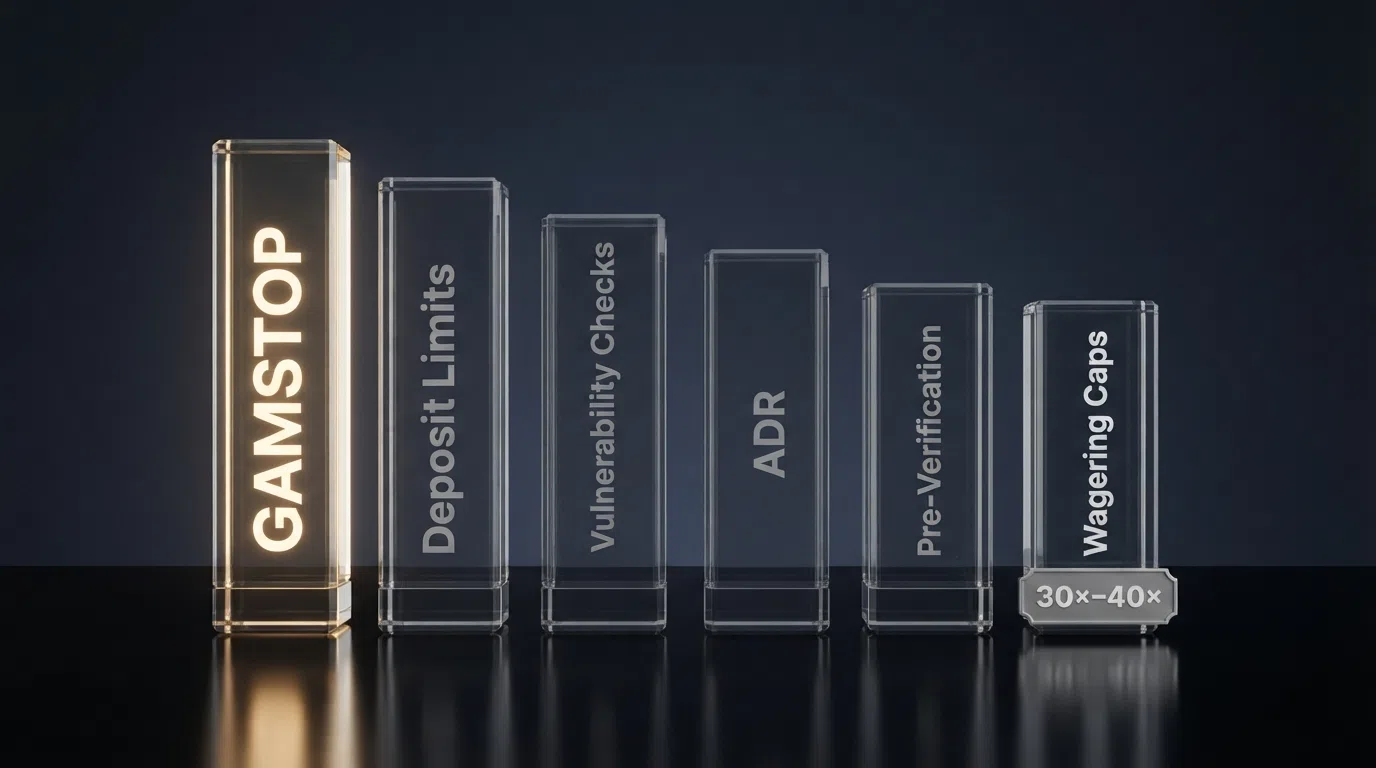
Protection one is the deposit-limit prompt. From 31 October 2025, every UKGC operator must prompt a customer to set a financial limit before the first deposit, and a gross deposit limit (based solely on money paid in) must be offered and given at least equal prominence. Only that form may be called a “deposit limit.” At an offshore casino, there is no such mandatory prompt; a player who wants a deposit limit has to find the responsible-gambling settings, set the limit voluntarily, and check whether the operator allows the limit to be raised quickly.
Protection two is the financial vulnerability check. From 28 February 2025, a UKGC operator must run a light-touch check at a net deposit threshold of £150 in a rolling 30-day window, using publicly available data — County Court Judgments, bankruptcy orders, IVAs, DROs. It is not a credit check. At an offshore casino, the check does not exist.
Protection three is the ADR route. A UKGC-licensed casino must belong to an approved alternative dispute resolution provider, and a player with an unresolved complaint can escalate to that provider. At an offshore casino, the dispute resolution is whatever the operator chooses to provide, with no statutory backstop behind it.
Protection four is the GAMSTOP integration. Mandatory at every UKGC online licence since 31 March 2020. Unreachable from any offshore casino in the featured set.
Protection five is the 10× wagering cap on bonuses, in force from 19 December 2025. At every operator in the featured set, the wagering requirement is higher — 30× at MyStake, Freshbet and Donbet; 35× at GoldenBet; 40× at BC Game on deposit plus bonus combined.
Protection six is pre-verification. Since 7 May 2019, every UKGC remote operator must verify name, address and date of birth before any deposit or any gambling. There is no grace period. At an offshore casino, the verification regime is whatever the operator chooses to operate, and the thresholds at which it kicks in vary.
The auto-play ban and the 2.5-second minimum spin speed, in force since 31 October 2021, are not numbered above because they are game-design rules rather than player-protection mechanisms in the same category. They are also absent at every offshore casino in the featured set.
Alternative Licensing Jurisdictions — MGA, Curaçao and Anjouan Compared
The licensing regimes a UK player meets at offshore casinos fall into three tiers. The Malta Gaming Authority sits at the top of the non-UK set: fund segregation is mandatory, an ADR process is in place, and compliance obligations are detailed. An MGA-licensed casino is the closest non-UK experience to a UKGC one. None of the operators in the featured set holds an MGA licence.
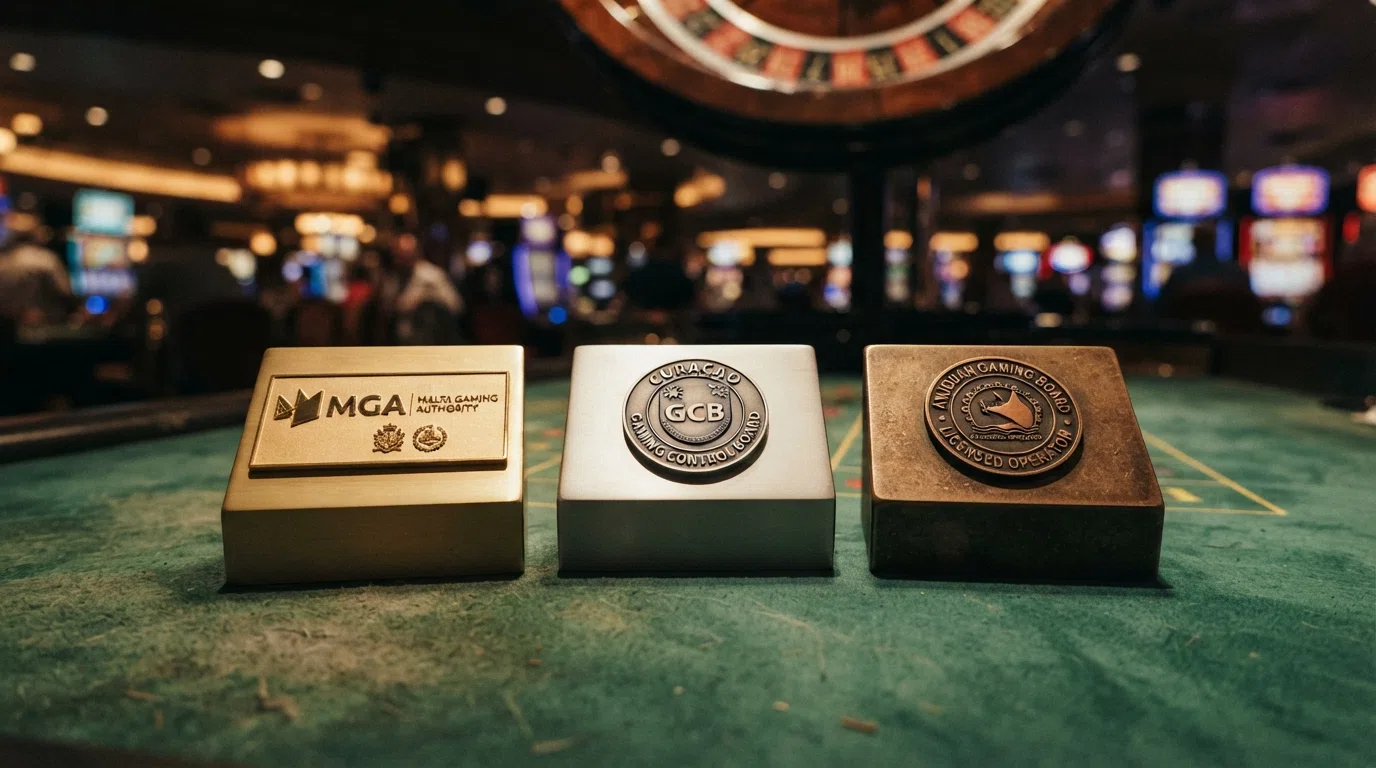
Curaçao GCB sits in the middle. The LOK framework, in force since 24 December 2024, replaced the old NOOGH master-licence system with direct OGL-series licences. Existing NOOGH licences were converted to six-month provisional licences. The structure is tighter than before, but enforcement remains lighter than Malta or Britain. Eight of the ten operators in the featured set hold a Curaçao GCB licence.
Anjouan sits at the bottom of the set. The licence is the lightest regulatory touch of the three, with minimal supervision. BC Game is the only operator in the featured set under an Anjouan licence, having migrated there from Curaçao in December 2025 after its UKGC licence was revoked in December 2024.
The further down the column an operator’s licence sits, the more player protections the player leaves behind at the cashier. The only operator in the featured set that sits below even the Anjouan tier is FoxSlots, which holds no formal licence at all.
Is It Legal? What UK Law Says About Playing at Non-UK Casinos
It is not a criminal offence for a UK player to gamble on a site licensed outside the UK. That is the legal position and it has been the legal position since the Gambling Act 2005. The criminal penalties under section 33 of the Act target operators providing unlicensed facilities; they do not target individuals using those facilities. A UK player at an offshore casino is not committing a crime.
What the UK player loses is protection. The GAMSTOP integration, the Commission complaints route, the ADR access, the British consumer redress route — none of these apply at an offshore casino. A player with a complaint at an offshore casino has whatever the operator’s own complaints process provides, and whatever the licensing jurisdiction’s court system can deliver if the dispute escalates. The Santeda International case, where a Curaçao court ordered €246,500 in winnings paid in March 2025 with the case under appeal, is what that escalation looks like in practice.
The honest summary is the one this page opened with. Not illegal is not the same as safe. The legal position is permissive; the protection position is not.
Why Offshore Casino Bonuses Look Bigger — and What They Actually Cost
The headline figures on the featured set are larger than the headline figures at UKGC-licensed casinos by a factor of three to fifteen. A 300% match at GoldenBet or Winstler; a 360% first-deposit match at BC Game; a 30 no-deposit free-spin offer at MyStake. None of these are possible at a UKGC-licensed site because the wagering cap and the mixed-product ban make them uneconomic. The headline is real, and the wagering requirement underneath it is what determines what the player actually keeps.
The expected-loss calculation makes the cost concrete. Take the MyStake welcome offer as the worked example. A £100 deposit at 150% match gives a £150 bonus. The wagering requirement is 30× on the bonus amount: £150 × 30 = £4,500 in required turnover. The slot choice matters; on Gonzo’s Quest at 95.97% RTP, the expected loss is £4,500 × 0.0403 = £181. On Book of Dead at 96.21% RTP, the expected loss is £4,500 × 0.0379 = £170. On Big Bass Bonanza at 96.71% RTP, the expected loss is £4,500 × 0.0329 = £148. On Starburst at 96.09% RTP, the expected loss is £4,500 × 0.0391 = £176. In every case the expected loss on the turnover is larger than the bonus itself. The bonus is the marketing word. The expected loss is the arithmetic.
A 30× wagering requirement on a £150 bonus means £4,500 must be staked before any withdrawal. At a 96% RTP slot, the expected loss on that turnover is £180. That figure is a statistical average over many spins under the stated assumptions; it is not a guaranteed outcome for any single player, and it promises no win, no payout and no return. What it does promise is that the bonus costs the player, on average, more than the bonus is worth. The 10× UKGC cap exists because the arithmetic above is the arithmetic at every bonus the British regulator has ever reviewed.
No-Deposit Bonuses at Non-UK Casinos — Free Play with Strings Attached
The most common no-deposit offer at offshore casinos is 10 to 25 free spins on a selected Pragmatic Play or BGaming slot. The wagering requirement on free-spin winnings runs 35× to 50×, and the cashout cap sits between £50 and £100. Three operators in the featured set run a no-deposit free-spin offer: MyStake at 30 spins, Freshbet at 25 spins, and Donbet at 15 spins with a transparent €100 maximum cashout.
The economics of a no-deposit offer work the same way as a deposit bonus, scaled down. The free spins are not free money; they are a few spins on a slot with a cashout ceiling. A player who wins £50 on a no-deposit free spin at a 40× wagering requirement must stake £2,000 before withdrawing, and the projected loss for that turnover at 96% RTP is £80. The expected loss exceeds the cap. The no-deposit offer is a route into the casino; it is not, on average, profitable.
Free-Spins Offers — What Is Really on the Table
Deposit-triggered free spins and no-deposit free spins are the two tiers. The deposit-triggered spins come with the deposit match and carry 30× to 40× wagering on the winnings; the no-deposit spins are the low-risk entry point but cap winnings at £50 to £100. VeloBet’s 70 free spins with a 35× wagering on winnings and a £100 max cashout is a representative example. GoldenBet’s 100 free spins at 35× is the largest in the set on a deposit-triggered basis. The slot the spins must be played on is usually pre-selected, and Pragmatic Play and BGaming titles dominate because of the providers’ distribution deals with offshore operators.
Welcome and Match-Deposit Bonuses Compared
The headline percentages across the featured set run from 150% to 300%, with BC Game’s 360% first-deposit match as the outlier. The wagering underneath runs 30× to 40×, with GoldenBet at 35× and BC Game at 40× on deposit plus bonus combined. The minimum deposit to trigger the offer is £20 at most operators and £50 at Winstler. The headline percentage is the marketing figure; the wagering requirement is the cost. A 300% match at 35× on a £500 deposit requires £52,500 in turnover; the expected loss on that turnover at 96% RTP is £2,100.
Bonus Terms and Wagering — the Fine Print That Eats Your Bonus
A 30× wagering requirement on a £150 bonus means £4,500 in turnover. At a 96% RTP, the expected loss on that turnover is £180. The wagering requirement is the single most important number in any bonus term; the percentage match is the second. Game-weighting rules sit underneath. Slots usually contribute 100% to wagering; table games may contribute 0% to 10%, meaning a player who tries to clear a bonus at blackjack is barely moving the turnover counter. The maximum bet while a bonus is active can be as low as €5 per spin, as at Donbet, or uncapped, as at the other operators. A cap of €5 stops the high-stake clearing tactics that some players use on unrestricted offers; a player who values unrestricted play will prefer the no-cap operators, at the cost of needing stronger personal discipline.
New-Casino Promotions, Reload Bonuses and Cashback
Beyond the welcome offer, the ongoing value at offshore casinos is built on three structures. Reload bonuses keep the deposit-match structure but at lower percentages than the welcome. Stake runs daily races and reload promotions instead of a traditional welcome bonus, with no first-deposit match. Roobet’s 20% weekly cashback on net casino losses with no wagering is the standout ongoing offer in the featured set: the cashback is the player’s, withdrawable, with no turnover requirement. Cashback offers at non-UK casinos rarely carry the 10× UKGC wagering cap because the cap does not apply to them.
How Offshore Casinos Handle Your Money — and How Fast You Actually Get Paid
The payment rails available at an offshore casino are not the same as the payment rails at a UKGC-licensed site. The credit-card ban that has applied to UK gambling since 14 April 2020 extends to credit-card-funded e-wallet payments at UKGC sites; an offshore casino that accepts Visa and Mastercard credit-card deposits directly has no British rule to follow. The withdrawal speeds differ by method, and the differences are large enough to determine which operator a player picks.
Crypto withdrawals at SoftSwiss-built offshore casinos process in 10 to 30 minutes. USDT on the Tron network can arrive in under five minutes. E-wallet withdrawals through Skrill, Neteller or MiFinity take 12 to 24 hours. UK card withdrawals take 1 to 3 business days. The crypto speed is the headline; the card friction is the constraint for a player who has no crypto wallet.
Pay-and-Play Casinos — No Registration, No Friction
Pay-and-play casinos use Trustly or a similar open-banking rail to verify identity and process deposits without a traditional registration form. The model is common at UKGC-licensed sites and is available at some offshore casinos. The trade-off is faster onboarding against a thinner KYC record: the operator holds less identity data on the player because most of the verification is done by the bank rail. For a player who values speed at the cashier, the pay-and-play structure is appealing; for a player who values the formal pre-verification that the UKGC mandates from May 2019, the same structure is the gap.
Deposit Methods Available Outside the UKGC System
The full menu at an offshore casino covers four rails. Cryptocurrencies — Bitcoin, Ethereum, USDT, and 150+ coins at BC Game — dominate the deposit side because of speed and the absence of card-network friction. E-wallets — Skrill, Neteller, MiFinity — are widely accepted and process withdrawals in 12 to 24 hours. Debit cards and bank transfer are available but slower, with UK card withdrawals at 1 to 3 business days. The credit-card ban of April 2020 extends to credit-card-funded e-wallet payments at UKGC sites; offshore casinos may or may not enforce the equivalent, and most do not. The choice between rails is a choice between speed and traceability. Crypto is fast and largely outside the UK payments perimeter; cards are slower and leave a domestic banking trail.
Withdrawal Speed and Limits — What the Fine Print Says
GoldenBet publishes a weekly withdrawal limit of €7,500 and a monthly limit of €15,000. Winstler publishes €1,000 per day, €2,500 per week, and €10,000 per month. Most other operators in the featured set do not publish hard caps; speed depends on the payment method and the player’s verification status. A player who expects a €50,000 monthly cashout will hit GoldenBet’s monthly limit on the third week and wait for the cycle to reset; a player with the same expectation at Roobet or VeloBet has no published ceiling to navigate.
The Santeda International dispute, where a Curaçao court ordered €246,500 in winnings paid to a player in March 2025 with the case under appeal, is the illustration of what dispute resolution looks like in practice. The order exists. The appeal is live. The resolution timescale is measured in years, not weeks. A UKGC player with the same dispute would escalate to the operator, then to ADR, and the Commission would track the process. The escalation route is the difference.
Staying in Control When the UK Safety Net Isn’t There
No operator in the featured set is connected to GAMSTOP. Most lack the mandatory deposit-limit prompt that has been a UKGC obligation since October 2025. The British help infrastructure, by contrast, is open to every UK resident regardless of where they played. The responsible-gambling resources below do not check the licence of the casino where a player deposited; they check the player.
Self-Assessment Tools at Non-UK Casinos — What to Look For
Some offshore casinos offer voluntary deposit limits, loss limits and session time limits through the account settings. Stake offers none of these. A casino that offers no self-assessment tools at all is a red flag; a casino that offers voluntary tools is closer to the UKGC standard but without the mandatory prompt. GamCare provides a free self-assessment tool online that works regardless of where a player gambled; the tool is at the bottom of every page in the responsible-gambling help network.
Setting Deposit and Loss Limits Yourself
The UKGC requires every operator to prompt a customer to set a financial limit before the first deposit from October 2025. Offshore casinos lack this mandatory prompt; the player must find the responsible-gambling settings, set limits voluntarily, and check whether the operator allows the limit to be raised quickly. A fast-raise mechanism undermines the limit entirely. The practical step, at the moment of registration, is to set a deposit limit and to set the raise-cooldown period to the longest available. Some operators will let a player raise a limit instantly; the right setting is one that does not.
Recognising Problem-Gambling Signs
The Health Survey for England 2024 found 5% of adults score PGSI 1 or higher — at-risk or problem gambling — and 0.4% score 8 or higher, indicating problem gambling. The Gambling Survey for Great Britain Year 3 found 47% of adults had gambled in the past four weeks, falling to 27% excluding the National Lottery; 38% had gambled online. The warning signs are behavioural: spending more than planned, chasing losses, gambling to escape stress, hiding gambling from family, borrowing to fund play. None of these is diagnostic on its own; the combination, over time, is.
The help infrastructure exists regardless of which casino the player used. The numbers are below.
Where to Seek Help in the UK — Numbers That Work Regardless of Where You Played
The National Gambling Helpline, operated by GamCare, is on 0808 8020 133 — freephone, 24 hours a day, seven days a week. The NHS operates 15 specialist gambling treatment clinics in England as of December 2024. GamCare offers live chat, group chat, counselling and a self-assessment tool online. Gamblers Anonymous UK runs face-to-face and online meetings. GambleAware funds the National Gambling Support Network, which treated 11,960 clients in 2024-25 with 93% of completers seeing improvement. The NHS reported 4,355 gambling-related referrals in 2024-25, up 91% year-on-year; GamCare made 996 referrals in January 2026, up 48% year-on-year.
Every one of these services is available regardless of whether a player deposited at a UKGC-licensed site or at an offshore casino. The licence on the casino does not determine access to help. The decision to call does.
How We Selected and Ranked These Casinos
Every operator was checked against the Gambling Commission’s public register of licence holders to confirm offshore status. The licence check used the Curaçao GCB portal at portal.cga.cw with the LOK snapshot of December 2024. No operator paid for inclusion, and the ranking reflects the research snapshot alone. The ranking criteria, in order, are: licence jurisdiction strength, welcome-offer value, wagering terms, game-provider count, and withdrawal speed. The Curaçao GCB register snapshot is the reference for the licence numbers cited in the operator write-ups; the Gambling Commission’s public register is the reference for confirming that none of the ten operators holds a UKGC licence.
Your Move — What to Actually Do About Casinos Without a UK Licence
If the priority is the largest welcome bonus, the offshore casinos offer 3× to 15× the match percentage of a UKGC operator. The expected-loss calculation above shows what that bonus really costs. The 30× wagering requirement on a £150 bonus turns into £4,500 in turnover, and the expected loss on that turnover at 96% RTP is £180. The bigger the headline, the bigger the turnover, the bigger the expected loss.
If the priority is protection, a UKGC licence delivers GAMSTOP access, the mandatory deposit-limit prompt, the financial vulnerability check at £150, and the statutory ADR route. No offshore casino in the featured set can match any of those.
The middle ground is to choose an MGA-licensed operator for stronger player protections without a UKGC licence, or a Curaçao GCB operator under the new LOK framework for a balance of offer size and regulatory oversight. None of the ten operators in the featured set is MGA-licensed; the MGA option is on the broader market, not on this page.
The page has given the numbers. The expected loss on a 30× bonus is a number. The weekly withdrawal cap at GoldenBet is a number. The cashout ceiling on a no-deposit free spin is a number. The decision from those numbers is the player’s.
Frequently Asked Questions
Is it legal for a UK resident to play at a casino without a UK Gambling Commission licence?
Yes. There is no criminal offence for a UK player who gambles on a site licensed outside the UK. Section 33 of the Gambling Act 2005 makes it a criminal offence for an operator to provide facilities for gambling without the required licence, with penalties of up to 51 weeks’ imprisonment and an unlimited fine, but those penalties target the operator, not the individual. What the player loses in the transaction is the British protection regime: GAMSTOP, the Commission complaints route, approved ADR access, the mandatory deposit-limit prompt, financial vulnerability checks, pre-verification, and the 10× wagering cap. Not illegal is not the same as safe, and that is the gap the rest of this page has been describing.
What specific player protections do I lose when I gamble at a casino without a UK licence?
Six UKGC-mandated protections are absent at every operator in the featured set. The mandatory deposit-limit prompt before the first deposit, in force at UKGC sites from October 2025. The financial vulnerability check at £150 of net deposit in a rolling 30-day window, in force from February 2025. The approved ADR route for unresolved complaints. GAMSTOP integration, mandatory for every UKGC online licence since March 2020. The 10× wagering cap on bonuses, in force from December 2025. Pre-verification of name, address and date of birth before any deposit or play, mandatory since May 2019. None of these apply at an offshore casino. The auto-play ban, the 2.5-second minimum spin speed, and the reverse-withdrawal ban are also UKGC rules that offshore operators do not follow.
What gambling licences do non-GamStop casinos typically hold, and how do they compare to the UKGC?
The three tiers a UK player meets are MGA, Curaçao GCB, and Anjouan. The Malta Gaming Authority sits at the top of the non-UK set, with fund segregation mandatory, ADR built in, and detailed compliance obligations. Curaçao GCB sits in the middle, reformed under the LOK framework since December 2024 with direct OGL-series licences replacing the old NOOGH master-licence structure. Anjouan sits at the bottom, with the lightest regulatory touch of the three. None of these is a substitute for a UKGC licence; all sit below the UKGC for player protection. The non-GamStop label is a consequence of the licence: GAMSTOP integration is a UKGC licence condition, so a casino without a UKGC licence cannot connect to GAMSTOP.
Are my gambling winnings from a non-UK casino still tax-free in the United Kingdom?
Yes. UK players pay no tax on gambling winnings, whether the casino is licensed in the UK or offshore. Player-side gambling duty was abolished in the UK in 2001, and winnings are not treated as income or as capital gains. The tax is paid by the operator, not by the player: Remote Gaming Duty was 21% and rose to 40% from 1 April 2026, with a separate statutory levy on operators of up to 1.1% of gross gambling yield. None of those operator taxes reaches the player. The currency in which the winnings are paid, and the exchange-rate risk on converting back to pounds, is a separate question from the tax treatment.
How can I self-exclude from non-GamStop casinos if I have a gambling problem?
The offshore casino’s own self-exclusion tool is the first step, and its effectiveness varies by operator. Stake does not offer deposit limits, loss limits or session time limits, so the platform-level self-exclusion at Stake is the only tool. The British help infrastructure works regardless of where a player gambled. GamCare runs the National Gambling Helpline on 0808 8020 133, freephone 24/7, with live chat, group chat, counselling and an online self-assessment tool. The NHS operates 15 specialist gambling treatment clinics in England. Gamblers Anonymous UK runs face-to-face and online meetings. The decision to call is the one that determines whether the help reaches the player.
What payment methods are available at offshore casinos, and can I still deposit in pounds sterling?
Cryptocurrencies — Bitcoin, Ethereum, USDT — dominate the deposit side, with 150+ coins supported at BC Game. E-wallets — Skrill, Neteller, MiFinity — are widely accepted and process withdrawals in 12 to 24 hours. Debit cards and bank transfer are available but slower, with UK card withdrawals at 1 to 3 business days. Pounds sterling deposits are supported at most operators, though the deposit is often processed in euros or US dollars with the casino applying the exchange rate. The UK credit-card ban that has applied since April 2020 does not bind offshore casinos; an operator that accepts Visa and Mastercard credit-card deposits directly has no British rule to follow. The choice between rails is a choice between speed and traceability, and it determines how fast withdrawals arrive.
Do non-GamStop casinos offer no-deposit bonuses or free spins to UK players?
Yes. Three operators in the featured set run a no-deposit free-spin offer: MyStake at 30 free spins on registration, Freshbet at 25, and Donbet at 15. The standard market terms on no-deposit offers are 35× to 50× wagering on free-spin winnings and a cashout cap between £50 and £100; Donbet publishes a €100 maximum cashout. The economics of a no-deposit offer are the same as a deposit bonus, scaled down. A player who wins £50 on a no-deposit free spin at 40× wagering must stake £2,000 before withdrawing, and the expected loss on that turnover at 96% RTP is £80. The expected loss exceeds the cap. The no-deposit offer is a route into the casino; it is not, on average, profitable.
Licence – nodeposit-casinobonuses-uk
Content created by the «nodeposit-casinobonuses-uk» team