
Trusted Casinos Not on GamStop in the UK: What Trust Actually Requires
 Available in GB
A player searching for “trusted casinos not on GamStop UK” usually wants a single answer: a list of brands they can use. The honest answer is more uncomfortable. Almost every brand that delivers what trust really demands — segregated funds, a working complaints route, age-banded stake limits, mandatory affordability checks, real self-exclusion coverage — sits inside the UK Gambling Commission’s perimeter, and therefore inside GamStop. The keyword points one way; the evidence points the other.

We take this search seriously. This guide walks through what “trusted” actually buys a UK player in 2026, what is lost the moment a casino operates without a GB licence, and how the ten GB-licensed brands most UK players actually use compare on the verifiable signals — licence status, licence vintage, fund protection, payout rails, real-money game catalogue — that matter when real money is at stake.
*Verified against the UK Gambling Commission public register as of September 8, 2026.*
Trust in a Casino Isn’t a Badge — It’s What You Verify
A casino’s homepage will tell you it is trusted. The footer will carry a badge. Neither proves anything. The Gambling Act 2005 regulates operators rather than players, and that single distinction decides where the trust work actually happens — on the operator’s side, against the regulator’s own register, not on the casino’s own marketing page. Since 2014, any operator actively targeting UK players has had to hold a UKGC remote gambling licence regardless of where it is incorporated, and supplying gambling to GB customers without one is a criminal offence under section 33 of the Act. That makes the licence the first and non-negotiable filter, not the last.
GAMSTOP, the UK’s national online self-exclusion scheme, has been a mandatory condition of every UKGC online operating licence since 31 March 2020. A “casino not on GamStop” is therefore, by definition, a casino outside the UKGC perimeter. That does not make every such casino dishonest. It does mean the player stands on different ground: a different dispute-resolution route, different fund-protection standards, different responsible-gambling infrastructure, and in the worst cases no enforcement backstop at all.
What “Trusted Casino” Actually Means in 2026
A trusted casino is one whose licence can be verified on the issuing regulator’s own public register. A GB licence is verifiable on the Gambling Commission’s register by account number, with the licence type, status and start date visible to anyone with a browser. An MGA licence is verifiable on the Malta Gaming Authority’s register. A Gibraltar licence sits in the Gibraltar Gambling Commissioner register. A Curaçao licence is verifiable on the Curaçao Gaming Control Board register, though the granularity of what that register shows varies. A badge on a casino footer proves none of this — only the regulator’s own register does.
Three trust signals sit beneath the licence check. The first is fund protection: UKGC-licensed casinos must disclose whether player funds are held at basic, medium or high protection, with the highest level involving trust accounts with independent trustees. The second is independent dispute resolution: the Independent Betting Adjudication Service (IBAS) handles roughly 90% of UK gambling disputes, with binding decisions on operators for disputes up to £10,000 and an average resolution time of 54 days. The third is responsible-gambling integration: deposit-limit tools, reality checks, time-out features and a working self-exclusion route, all backed by the regulator’s licence conditions. None of these are marketing copy. Each is enforceable.
Real-Money Play at UK-Facing Trusted Casinos
The shift from demo play to real-money play triggers an entirely separate layer of regulation. Remote licensees must verify a customer’s name, address and date of birth before they are permitted to gamble, and that check is the gate every other protection stands behind. Once a player is depositing, financial vulnerability checks kick in when net deposits exceed £150 in a rolling 30-day period — a threshold tightened from £500 in February 2025. From 30 September 2026, operators will be required to offer a gross deposit limit with at least equal prominence to any other limit, and only that form may be called a “deposit limit.”
The payment method a player chooses is itself a trust signal. Credit cards have been banned for gambling since 14 April 2020, and the ban extends to credit-card-funded e-wallet payments, which means a player cannot route a credit card through PayPal to fund a deposit at a GB-licensed casino. Pay by Bank and Trustly are open-banking rails that skip e-wallet registration entirely. Apple Pay and PayPal sit at the regulated end of the e-wallet spectrum because each carries its own compliance review before an operator can list it. A casino that offers only obscure rails and no major e-wallet is sending a message, even if it is not the message the marketing intends.
What You Give Up When You Step Outside the UKGC’s Safety Net
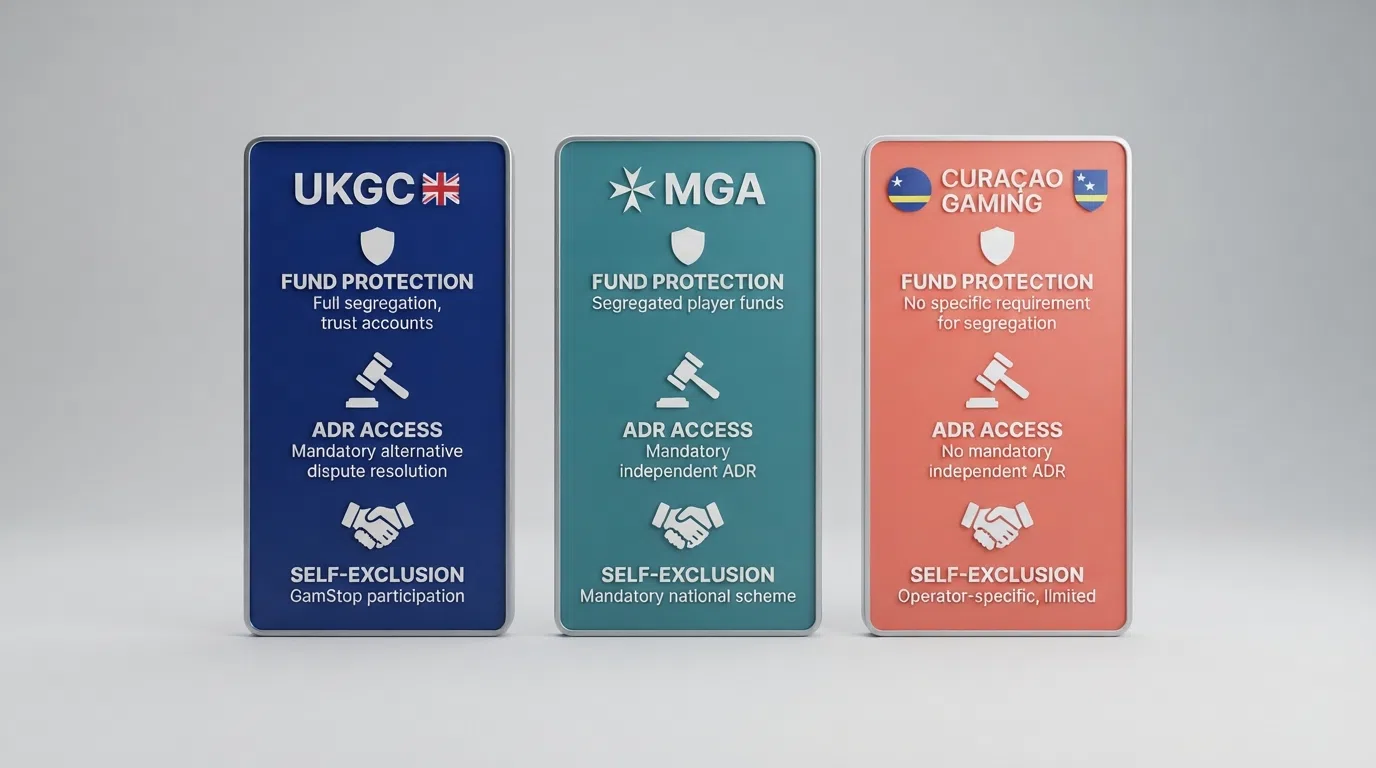
The UKGC framework is the most protective in the world. That is not British exceptionalism; it is the conclusion every comparative study of gambling regulation lands on, because no other jurisdiction stacks mandatory affordability checks, age-banded stake caps, a national self-exclusion register, mandatory ADR, fund-segregation disclosure and a bonus wagering cap into one licensing regime. Each of these is a protection a player loses — or partially loses — when the casino operates outside it.
What “Not on GamStop” Means — and What It Doesn’t
GAMSTOP is a self-exclusion tool, not a casino blacklist. Registering with GAMSTOP means choosing an exclusion period of six months, one year, five years, or five years with auto-renewal, none of which can be cancelled early. If the person does not contact GAMSTOP after the minimum period expires, the exclusion remains active for up to a further seven years. That makes GAMSTOP a serious commitment, and it explains the demand for casinos outside it: people whose exclusion has not yet expired, or who registered in a moment they no longer endorse, look for routes that bypass the tool.
A casino outside GAMSTOP is not automatically untrustworthy. It is, however, automatically outside the UKGC perimeter, and therefore outside the protections the perimeter delivers. The distinction matters. A casino licensed in Malta, Gibraltar or Curaçao may still operate to high standards; it simply does not deliver the specific protections UK regulation requires, and it does not accept the enforcement reach that makes those protections real. “Not on GamStop” describes the self-exclusion status, not the integrity of the operator.
The UKGC Safety Net: What Every GB-Licensed Casino Must Provide
The UK’s regulatory stack is layered. From 9 April 2025, online slots carry a maximum stake of £5 per game cycle for players aged 25 and over; from 21 May 2025, the cap is £2 for players aged 18 to 24. Both limits are imposed by The Gambling Act 2005 (Operating Licence Conditions) (Amendment) Regulations 2025 (SI 2025/215). The UKGC’s market overview now describes this as the fourth quarter since the maximum stake limit for online slots was introduced, which means the rule has had time to settle into the operating reality of every GB-licensed casino.
The bonus landscape changed alongside the stake caps. Under LCCP Social Responsibility Code 5.1.1, wagering requirements are capped at a maximum of 10 times the bonus amount, and mixed-product promotional offers — the kind that bundle free spins with deposit matches on different game types — are banned. The Gambling Commission originally scheduled these bonus changes for 19 December 2025, then pushed implementation back to 19 January 2026. Several featured operators moved to wager-free free-spin models in response; others have not yet been audited in detail for the comparison.
The other mandatory protections sit beneath the headlines. The credit-card ban (extended to credit-card-funded e-wallet payments). The pre-gambling identity verification that makes age checks real. The fund-protection disclosure with basic, medium and high tiers — the highest tier being trust accounts with independent trustees. And the levy that funds treatment and prevention: the statutory gambling levy came into effect on 6 April 2025 and is expected to raise around £0.1 billion each year.
From 1 April 2026, Remote Gaming Duty rose from 21% to 40% of a gaming provider’s profits from remote gaming with UK persons. Players do not pay that tax. Operators do. The increase tells a reader how seriously the licensed market is treated as a regulated sector, and it shapes what kind of bonus and promotional spend a regulated casino can sustain.
Offshore Licences Compared: MGA, Gibraltar and Curaçao
An offshore licence is not a single category. The MGA, Gibraltar and Curaçao regimes deliver very different levels of player protection, and the differences are concrete rather than theoretical.
| Licensing Regime | Regulator | Player Fund Protection | Independent ADR | Core Player Safeguards |
|---|---|---|---|---|
| UKGC (GB) | Gambling Commission | Mandatory disclosure (basic / medium / high); high tier uses trust accounts with independent trustees | IBAS (binding up to £10,000) | GAMSTOP, vulnerability checks, age-banded stake caps, 10x bonus cap, mixed-product ban |
| Malta (MGA) | Malta Gaming Authority | Required segregation of player funds from operating capital; regular audits | MGA-supported ADR; reputation for proportionate enforcement | Responsible gambling standards, dispute resolution |
| Gibraltar | Gibraltar Gambling Commissioner | Proportionate framework; requires physical establishment in Gibraltar, raising the barrier to entry | Regulator-supported ADR | Compliance and RG standards |
| Curaçao | Curaçao Gaming Control Board | Variable; least protective of the major offshore options | Limited | Variable; widely used by non-GamStop sites |
MGA-licensed casinos are required to segregate player funds from operating capital, submit to regular audits and adhere to responsible gambling standards, which is why the MGA is widely treated as the strongest non-UKGC option. Gibraltar requires licensees to be physically established in Gibraltar, which raises the barrier to entry and gives the jurisdiction a reputation for proportionate enforcement within the industry. Curaçao is the most common non-GamStop jurisdiction and the least protective of the major offshore options, with the framework varying across the licences issued under its newer and older structures.
The comparison is not academic. A player who picks a Curaçao casino over an MGA casino over a GB-licensed casino is trading away progressively more protection, and the cost is not visible until something goes wrong: a withheld withdrawal, a missing fund-segregation guarantee, an ADR that turns out not to bind the operator.
What a Player Loses Outside the UKGC’s Reach
The protections a UKGC licence guarantees are concrete and enforceable. Without one, the player stands on different ground. IBAS decisions are binding on operators up to £10,000 and resolution averages 54 days; outside IBAS, the alternative dispute resolution routes the player can access depend on which regulator, if any, has jurisdiction over the casino. The fund-segregation rules that make a player balance recoverable in a wind-up apply only where the regulator requires them.
The Gambling Commission’s enforcement against unlicensed operators targeting GB consumers is real and ongoing. For April 2024 to June 2025, the Commission reported 3,140 cease-and-desist and disruption notices, 447,778 URLs referred to Bing and Google, and 287,961 URLs removed, with an average 32% fall in engagement across 160 disrupted sites. That is not a ban on offshore supply. It is the regulator pushing back on operators that target British customers without a GB licence, which is the supply-side counterpart to the protection gap on the player side.
A section 33 offence under the Gambling Act 2005 attaches to the operator, not the player. No evidence surfaced this run of a penalty for a UK resident merely gambling on an unlicensed site. What the player loses is protection, not liberty — and that is the trade-off a player choosing an offshore casino is making.
Responsible Gambling Tools and Where to Get Help
The help infrastructure exists whether a casino is on GamStop or not, and every player should know how to reach it. The National Gambling Helpline, run by GamCare, is available on 0808 8020 133 for free, 24 hours a day, every day of the year. NHS support for gambling harm in England includes the National Gambling Helpline, GambleAware / the National Gambling Support Network and specialist NHS gambling treatment clinics in England. The statutory levy, in effect from 6 April 2025, is expected to raise around £0.1 billion each year to fund that treatment and prevention work.
Within a regulated casino, the responsible-gambling tools sit alongside the games. Deposit limits — required to be set before the first deposit, with decreases actioned immediately. Reality checks that interrupt play at intervals. Time-out features for short breaks. Self-exclusion that routes through GAMSTOP at a GB-licensed site. None of these tools work the same way at an offshore casino, and at a casino that takes no licence at all they may not exist at all.
10 GB-Licensed Casinos UK Players Actually Trust
The most trusted casinos available to UK players hold a GB licence. That is not a marketing line; it is the conclusion that follows from the protection stack above. The table below compares the ten featured operators on the two verifiable signals that matter most when a player starts evaluating trust: licence status and licence vintage. Other dimensions of comparison — bonus terms, slot count, withdrawal speed — are covered in the operator reviews that follow, where research surfaced the data.
| Casino | GB Licence Status | Licence Active Since |
|---|---|---|
| 888casino | Active (888 UK Limited, account 39028) | 1 November 2014 |
| Ladbrokes | Active (Ladbrokes Betting & Gaming Limited, account 1611) | 1 November 2014 |
| Betway | Active (Betway Limited, account 39372) | 1 November 2014 |
| Betfair | Active (PPB Entertainment Limited, account 39426) | 1 November 2014 |
| Paddy Power | Active (PPB Entertainment Limited, account 39426) | 1 November 2014 |
| LeoVegas | Active (LeoVegas Gaming PLC, account 39198) | 1 November 2014 |
| Virgin Games | Active (Virgin Bet Limited, account 54310) | 21 May 2019 |
| bet365 | Active (precise account not confirmed from a register page surfaced this run) | Verify on the public register |
| Sky Vegas | Active (precise account not confirmed from a register page surfaced this run) | Verify on the public register |
| PartyCasino | Active (precise account not confirmed from a register page surfaced this run) | Verify on the public register |
The 1 November 2014 cluster is the original remote-gambling cohort: the date the UKGC’s point-of-consumption regime took effect, and the date every operator that wanted to keep serving UK customers had to convert or apply afresh. Six of the ten featured brands sit in that cohort. Virgin Games’ 21 May 2019 date is the most recent licence vintage in the featured set. The three operators whose exact account data was not confirmed from a register page this run are GB-licensed for remote casino; a reader who needs precise licence metadata for those brands should verify the account number on the Gambling Commission’s public register.
Ladbrokes
Ladbrokes carries one of the deepest slot catalogues among the featured operators: 1,800+ slots, with demo play available on every RNG title — the only brand in the featured set for which this run confirmed universal demo play. The provider mix is anchored by NetEnt, Pragmatic Play, Big Time Gaming and Play’n GO, which is the kind of tier-one roster that signals compliance budget as much as game choice, because each of those suppliers runs its own technical and regulatory review before a casino can host it.
Welcome-offer detail, free-spin count and wagering terms did not surface this run. For a player evaluating trust rather than promotion value, that gap matters less than the catalogue breadth and the demo-mode confirmation, because both are directly verifiable. Ladbrokes is the operator for the player who wants to test-drive a slot before committing a deposit.
bet365
bet365 is the UK’s highest-volume betting brand. The licence is GB and confirmed active for remote casino, though the precise account number was not confirmed from a register page surfaced this run — a player who needs that detail should look it up on the Gambling Commission’s public register. Paysafecard deposits are supported, but the operator’s own terms state that Paysafecard deposits are not eligible for the advertised offer, which is a useful test of how carefully a reader is reading the cashier screen.
Slot count, game providers, welcome-bonus detail and demo-mode availability did not surface this run, and the absence matters more at bet365 than at most operators because of the brand’s sheer scale — a reader expects a major operator’s catalogue to be fully documented. The right move for a player evaluating bet365 is the public register check and a direct look at the operator’s current terms page.
Betfair
Betfair and Paddy Power share their licence: PPB Entertainment Limited, UKGC account 39426, with Remote Casino and Remote Bingo active since 1 November 2014. Betfair’s live-casino provider mix is anchored by Evolution, Playtech and Pragmatic Play, which covers the high-trust end of the live-dealer market. Payment rails include PayPal, Pay by Bank, debit cards and Paysafecard — a wide spread that includes the open-banking route and the major e-wallet, and that makes the cashier both fast and familiar.
Welcome-bonus detail, free-spin count and slot catalogue data did not surface this run. The licence vintage and the live-casino provider roster are the verifiable trust anchors here, and Betfair sits comfortably in the cohort of brands where the casino offering benefits from the betting-exchange heritage — built-in payment infrastructure, established compliance posture, real-money volume.
Paddy Power
Paddy Power’s welcome offer carries zero wagering. Up to 50 free spins with no playthrough on winnings is a structural break from the deposit-match-plus-wagering model that dominated the UK market until the 10x cap landed, and it puts Paddy Power in the same wager-free cohort as Sky Vegas and Virgin Games. Payments include PayPal, Trustly, debit cards and Apple Pay, with deposits instant and withdrawals within 2 hours on supported methods, which is among the fastest confirmed withdrawal timeframes in the featured set.
The shared PPB Entertainment Limited licence means Paddy Power and Betfair run on the same regulatory spine. For a player who wants wager-free free spins and a fast withdrawal path, Paddy Power is the wager-free alternative to the brands whose bonus data did not surface this run, and the 2-hour withdrawal on supported methods is the concrete speed signal.
Sky Vegas
Sky Vegas offers the largest free-spin welcome package in the featured set: up to 200 free spins for a £5 qualifying stake, with no wagering on winnings. The slot catalogue is 1,500+ titles in a slots-first lobby with Sky Vegas-branded exclusives, which means a player gets the breadth of a tier-one casino plus a content angle a pure aggregator cannot match. Payments include PayPal, Trustly, debit cards and Apple Pay, with deposits instant and withdrawals within 6 hours on supported methods, and one review notes limited e-wallet options compared with rivals.
Licence date was not confirmed from a register page surfaced this run — verify on the public register for precise account metadata. The welcome offer, the slot catalogue and the slots-first design make Sky Vegas the operator for a player who wants a wager-free free-spin package at scale, with the trade-off being a narrower e-wallet mix than some competitors.
Virgin Games
Virgin Games holds the most recent GB licence vintage in the featured set: Remote Casino active from 21 May 2019 under Virgin Bet Limited, account 54310. That is five years younger than the 2014 cohort, which means a younger compliance file but a GB-licensed file nonetheless. The welcome offer is free spins with winnings credited as withdrawable cash — no playthrough obligations — and a 30-day expiry window, with a £10 deposit threshold to qualify.
Slot catalogue, game providers and demo-mode availability did not surface this run. The combination of a recent licence vintage, a wager-free free-spin offer and a 30-day expiry window that is longer than several bonus windows in the offshore market makes Virgin Games the operator for a player who values the most current licence date in the set and a clean free-spin structure.
888casino
888casino is one of the longest continuously GB-licensed casino brands globally: 888 UK Limited, account 39028, with Remote Casino and Remote Bingo active since 1 November 2014. The brand’s longevity is the trust signal here, and it cuts both ways — the licence file is deep, and the regulator’s relationship with the operator is established.
Game providers, welcome-bonus detail, free-spin count and slot catalogue did not surface this run. The public register confirms the licence; this run did not surface offer-level detail. For a player who values brand longevity and a regulator-tested operator over a fresh promotional structure, 888casino fits, though the comparison on bonus value will require a direct look at the current operator terms.
Betway
Betway is GB-licensed under Betway Limited, account 39372, with Remote Casino active since 1 November 2014. It is a globally recognised brand with a long UK presence, which gives it the trust anchors a brand-new operator cannot replicate: regulator-tested, public-register-confirmed, operating under the same regime since the point-of-consumption transition.
Game providers, welcome-bonus detail, free-spin count and slot catalogue did not surface this run. The Betway case is similar to the 888casino case: the register confirms the licence, the brand recognition is high, and the offer-level detail is the gap a player fills by going directly to the operator’s current terms.
LeoVegas
LeoVegas is the mobile-first operator of the featured set: GB-licensed under LeoVegas Gaming PLC, account 39198, with Remote Casino active since 1 November 2014. The welcome offer is 50 wager-free free spins on Big Bass Splash, with each spin worth £0.10 and a £10 minimum deposit. Big Bass Splash is a named slot title, and that matters: the wager-free structure means the player keeps the winnings as cash, but the slot itself is high volatility, so the variance is real.
Slot catalogue and game providers did not surface this run. LeoVegas appeals to the player who wants a named slot title on a wager-free package and appreciates a mobile-first layout, keeping in mind that the slot’s inherent volatility shapes the session outcome.
PartyCasino
PartyCasino is the only featured operator carrying a site-wide audited RTP figure verified by an independent testing house: 1,680+ games including 150+ exclusive slots, with an eCOGRA site-wide audited average RTP of 95.42%. That is the rarest verifiable trust signal in the comparison — not a single title’s RTP, but the casino-wide audited figure. Licence date was not confirmed from a register page surfaced this run; verify on the public register for precise account metadata.
Welcome-bonus detail and demo-mode availability did not surface this run. PartyCasino is the operator for a player who wants a casino whose overall RTP has been independently audited, with the trade-off being that the audited figure is an average across the catalogue rather than a guarantee on any specific title.
How to Spot a Trustworthy Casino Before You Deposit a Penny
Trust is not something a casino declares — it is something a player verifies. The tools to do that verification are free and public, and the entire check takes less time than reading a casino’s “About Us” page.
The Licence Check: Your First and Fastest Filter
A casino’s licence claim means nothing until you verify it on the regulator’s own register. The Gambling Commission’s public register is the primary verification route for GB licensing — search by operator name or by account number, and the register shows the licence type, status and start date. The account numbers for the featured set sit in the comparison table above; the three operators whose precise account data was not surfaced this run should be verified directly on the register.
The same approach works for offshore licences. The MGA’s public register confirms Malta-licensed operators. The Gibraltar Gambling Commissioner’s register confirms Gibraltar-licensed operators. The Curaçao Gaming Control Board’s register confirms Curaçao-licensed operators. A licence badge image on a casino footer proves nothing by itself; a regulator’s own register entry proves everything that matters. The distinction between a holding-company licence and an operating-company licence matters too: a brand group can hold licences in one jurisdiction while a specific casino site operates under a subsidiary, and the player is interested in the operating licence, not the holding company.
Red Flags That Should Make You Walk Away
Some signals are so reliably correlated with risk that a single one should end the evaluation. Here are the ones that matter:
- Licence information absent or unverifiable. If a casino cannot be located on the issuing regulator’s own public register, the licence claim is not credible. A regulator’s register is the only place a licence claim is actually verified.
- Withdrawal complaints forming a pattern. One complaint is a data point. A pattern across independent review platforms is a signal. Look for repeated complaints about withheld withdrawals, reversed wins, or stalling on identity checks at the payout stage.
- Bonus terms that obscure the real cost. A welcome offer that hides a 50x wagering multiple behind small print, or carries a maximum cashout cap that swallows the advertised headline, is built to disappoint. The 10x cap at GB-licensed casinos sets a ceiling; an offshore casino running 40x or 50x is operating on a different footing.
- Missing or vague responsible-gambling tools. A casino with no deposit-limit prompt, no reality check, no time-out and no clear self-exclusion route is signalling that player protection is not part of its offer.
- No publicly reachable complaints process or ADR provider. A casino with no ADR route — no IBAS, no MGA alternative dispute resolution, no equivalent — has no external backstop when an internal complaints team fails. That is the gap a player notices only when something has already gone wrong.
Why Your 2026 Bonus Looks Bigger Than It Really Is
A headline bonus number is the least important figure on the page. The wagering requirement, the game weighting and the validity window determine what you actually keep, and a free-spin package without wagering is structurally different from a deposit match with 10x playthrough. The UKGC’s bonus rules, originally due on 19 December 2025 and pushed back to 19 January 2026, drew a hard line: wagering capped at 10x and mixed-product promotions banned. The featured set split sharply in response.
Welcome Offers at Trusted Casinos: Free Spins vs. Deposit Matches
The featured set splits between wager-free free-spin offers and operators whose bonus data did not surface this run. That split is itself a useful piece of information for the reader.
Paddy Power runs up to 50 free spins with no wagering on winnings. Sky Vegas runs up to 200 free spins with no wagering, for a £5 qualifying stake. Virgin Games runs free spins with winnings credited as cash, a 30-day expiry window and a £10 deposit threshold. LeoVegas runs 50 wager-free free spins on Big Bass Splash at £0.10 per spin with a £10 minimum deposit. These are the wager-free cohort, and they are a clean structural break from the deposit-match-plus-wagering model that dominated the UK market before the bonus rules changed.
For the operators whose welcome-offer data did not surface this run — Ladbrokes, bet365, Betfair, 888casino, Betway, PartyCasino — the right move is to go directly to the operator’s current terms page and read the wagering multiple, the game weighting and the validity window there. A £5 or £10 qualifying stake on free spins is not a “no-deposit” offer; it is a token-deposit package, and the difference matters because a deposit triggers affordability checks that a token stake does not.
The structural difference is sharp. A deposit match with 10x wagering turns a £50 bonus into £500 of required turnover, with the actual cost depending on the slot’s RTP. A wager-free free-spin package turns the same offer into whatever the spins actually win, paid as cash. The wager-free model is closer to what a player thinks a bonus is, and the deposit-match-plus-wagering model is what the casino’s marketing copy usually describes.
Wagering Requirements: The Fine Print That Eats Your Bonus
The 10x cap is the ceiling, not the floor. Below it, the slot you play to clear the bonus changes the real cost because of the RTP difference between titles. Book of Dead sits at 96.21% RTP; Starburst sits at 96.09%. Over £500 of required turnover to clear a £50 bonus at 10x wagering, the expected loss from playing Book of Dead is £500 × (1 − 0.9621) = £18.95, and from playing Starburst is £500 × (1 − 0.9609) = £19.55. The headline figure is the same; the underlying cost shifts by roughly 60 pence per £500 of turnover depending on which slot the player runs.
The expected-loss calculation, applied to a representative £50 welcome bonus at the 10x UKGC cap with Book of Dead’s 96.21% RTP, gives £500 of required turnover and an expected loss of £18.95. That is the statistical cost of clearing the bonus over many spins under the stated assumptions. It is not a guaranteed outcome for any single session, and it assumes only the bonus amount is wagered. It is the figure a player should hold against the advertised bonus headline before deciding whether the offer is worth taking.
The validity window is a second hidden cost. A bonus that expires in 7 days costs more per day of play than one with a 30-day window, because the player either compresses the turnover into a shorter period (raising variance and the risk of busting out before clearing) or loses the bonus entirely. Virgin Games’ 30-day expiry is at the longer end of the windows surfaced in the comparison. Some offshore offers run on 14-day windows and shorter, which compresses the play further.
Fast Payouts Are a Trust Signal — Here’s What to Look For
A casino that pays slowly is sending a signal — and the payment method a player chooses shapes both the speed and the trust equation. The UKGC framework does not dictate withdrawal timeframes directly, but the underlying infrastructure — mandatory verification at the deposit stage, banned reverse withdrawals, regulated payment rails — sets the conditions in which fast payouts are realistic.
E-Wallets, Paysafecard and the Payment Methods Trusted Casinos Offer
PayPal is the highest-trust e-wallet signal in the comparison, because operators must pass PayPal’s own compliance review before they can list it as a deposit rail. Paddy Power and Sky Vegas both list PayPal alongside Trustly, debit cards and Apple Pay, with deposits instant on every method and withdrawals within 2 hours (Paddy Power) or within 6 hours (Sky Vegas) on supported methods. Betfair lists PayPal alongside Pay by Bank, debit cards and Paysafecard.
Trustly and Pay by Bank are the open-banking alternatives that skip e-wallet registration entirely. Both sit at the regulated end of the payment-method spectrum and both are common at the featured operators.
Paysafecard carries a bonus-exclusion caveat that the cashier screen does not always make obvious: bet365 supports Paysafecard deposits but states that Paysafecard deposits are not eligible for its advertised offer. A player depositing via Paysafecard to claim a welcome bonus at bet365 will discover the exclusion only at the terms stage, and that is the kind of friction a regulated casino is supposed to minimise.
The payment-method mix at a casino is itself a trust signal. A casino offering PayPal, Trustly, debit cards and Apple Pay is sending one message. A casino offering only obscure rails and no major e-wallet is sending another. The credit-card ban since 14 April 2020 — extended to credit-card-funded e-wallet payments — is the regulatory floor beneath both.
The Slot Titles and Providers That Signal a Trustworthy Casino
A casino that publishes real RTPs and carries audited titles from tier-one providers is showing its work. A casino that does not is hiding something — either from the player or from the regulator.

Trusted Slot Titles and Their Real RTPs
The five titles below are among the most-played slots in the UK, and their RTP, volatility and maximum-win figures are verifiable. The figures matter because the UKGC does not mandate that a casino use the highest RTP setting for a given title, which means the same slot can run at different RTPs at different casinos, and the only place to check is the in-game rules section.
| Slot Title | RTP | Volatility | Max Win |
|---|---|---|---|
| Big Bass Bonanza | 96.71% | High | 2,100x |
| Book of Dead | 96.21% | High | 5,000x |
| Starburst | 96.09% | Low | 500x |
| Gonzo’s Quest | n/a | n/a | 2,500x |
| Rainbow Riches | 95.00% | Medium | — |
Two slots with similar RTPs produce very different session experiences because of volatility. Starburst at 96.09% with low volatility returns frequent small wins; Book of Dead at 96.21% with high volatility returns fewer, larger wins. Over £500 of turnover, the expected loss from each is close (roughly £19 from Starburst and £19 from Book of Dead), but the variance is different. A player clearing a wagering requirement wants the low-volatility option; a player chasing entertainment variance may prefer the high-volatility one. The arithmetic is the same; the experience is not.
Max-win figures are marketing. RTP is maths. A 5,000x max win on Book of Dead is the headline that draws the player; the 96.21% RTP is the figure that determines what the player keeps over time. Both belong on a casino page; only one belongs in a player’s calculation.
Live Casino and Table Games at Trusted Operators
Live-dealer games carry their own trust signals — the provider, the studio transparency and the game-fairness audit trail. Evolution and Playtech anchor the high-trust end of the live-casino market, and both surface in Betfair’s provider mix alongside Pragmatic Play. A live casino from a tier-one provider carries more trust weight than an unbranded table from an unrecognised studio, because the tier-one providers run their own regulatory and technical reviews and because their games are independently audited.
For virtual table games, the trust dimension is RNG auditing. PartyCasino carries an eCOGRA site-wide audited average RTP of 95.42%, which is the rarest verifiable signal in the comparison — not a single title’s RTP but the casino-wide audited figure. A casino that publishes an audited site-wide RTP is doing more than its peers; a casino that does not is not necessarily worse, but it is making a different choice about transparency.
Software Providers as a Trust Signal: What the Featured Set Reveals
The providers a casino hosts are themselves a trust signal, because tier-one providers — NetEnt, Pragmatic Play, Big Time Gaming, Play’n GO, Evolution, Playtech — require their own compliance checks before supplying a casino. A casino hosting tier-one providers has passed those checks; a casino hosting only unknown providers has not necessarily done so.
Ladbrokes’ provider mix — NetEnt, Pragmatic Play, Big Time Gaming, Play’n GO — is the most fully surfaced in the featured set, alongside its 1,800+ slot catalogue and demo play on every RNG slot. Sky Vegas’ 1,500+ slots in a slots-first lobby with branded exclusives is a different angle: the casino builds its own content alongside the third-party supply. PartyCasino’s 1,680+ games with 150+ exclusive slots is a third variant of the same trust signal. The providers surfaced at Betfair — Evolution, Playtech, Pragmatic Play — anchor its live-casino position.
The gap between a casino that names its providers and one whose game lobby carries no manufacturer labels is the gap between a verifiable supply chain and one that is not. Ladbrokes is the only featured operator with confirmed demo play on every RNG slot this run, and that is a separate signal — the casino lets the player test the game before staking real money, which is a transparency feature, not a marketing one.
Trusted Mobile Casino Apps and Browser Play
A mobile casino’s trustworthiness is about the licence behind it, not the platform it runs on. The GB licence covers app and browser identically, and the encryption and verification requirements apply on both. The experience gap is real but it sits in usability, not in regulatory standing.
Casino Apps vs. Mobile Browser: Which Delivers the Safer Experience
Both an app and a mobile browser connect to the same licence, but the security and usability differences are concrete. The Apple App Store and Google Play Store review processes are an additional gate that unlicensed operators cannot pass — Apple’s review in particular has tightened consistently over the past several years for gambling apps, and an unlicensed casino simply does not get listed. A licensed casino listed on the app store has cleared that review; a licensed casino operating only via mobile browser has not been through it.
Mobile-browser play at a licensed casino carries the same encryption and the same verification as desktop. The practical differences are in payment flows and biometric login: a native app can use Face ID or Touch ID for authentication, and can store payment credentials in a way that a mobile browser cannot. An APK download from a casino’s own site — outside the official app stores — is a different signal from an official app-store listing, and the difference is whether the casino has cleared a third-party review or has chosen to skip it.
For a player evaluating mobile play, the right question is not “app or browser” but “is the casino GB-licensed on the platform I’m using.” If yes, both are covered; if no, neither is safe.
Crypto Casinos Promise Anonymity — Trust Requires More Than a Blockchain
A casino that accepts Bitcoin is not automatically trustworthy. The anonymity that crypto offers strips away the player-protection infrastructure a licence provides, and the trade-off is not symmetrical — the player gives up age verification, self-exclusion, affordability checks and ADR access, and gains only the privacy of an on-chain payment.
Bitcoin and Ethereum Casinos: What Makes a Crypto Casino Trustworthy
The same trust criteria apply to crypto casinos as to fiat ones — licence, audit trail, payout record — but the verification path is narrower. Many crypto casinos carry a Curaçao licence, which is the least protective of the major offshore regimes, and the operator may be incorporated in one jurisdiction, licensed in another and targeting UK players from a third. The cross-jurisdiction structure makes verification harder, not easier.
Provably fair algorithms are unique to crypto casinos and are sometimes cited as a trust signal. They prove that the game outcome was not manipulated after the bet was placed, which is a meaningful guarantee — but it is not a guarantee that the operator will pay out, that the operator is licensed, that the operator is solvent, or that the player has any route to dispute resolution if something goes wrong. Provably fair is a game-fairness signal, not a casino-trust signal.
The withdrawal-speed promise of crypto casinos is often faster than fiat, but the reality depends on whether the operator runs manual approval holds. A crypto casino that processes withdrawals instantly is doing more than most; a crypto casino that holds withdrawals for review is doing the same as a slow fiat casino, just with extra steps.
The No-KYC Trade-Off: Anonymity vs. Consumer Protection
Skipping KYC sounds like a privacy win — until a player needs to prove their identity to withdraw, dispute a withheld balance or self-exclude. Remote licensees must verify name, address and date of birth before the customer is permitted to gamble, and that check is the foundation of every other UKGC protection. Without it, there is no age verification, no GAMSTOP participation, no financial vulnerability check at £150, no IBAS access.
A “no-KYC” casino cannot offer any of these. Many casinos that advertise reduced KYC still demand documents at the withdrawal stage — a different category of friction from the GB-licensed model, where verification happens at deposit rather than at payout. True no-KYC means no identity verification at any stage, and that means no recourse when something goes wrong.
For a UK player evaluating a no-KYC or crypto casino, the calculation is not “privacy versus inconvenience.” It is “the entire UKGC protection stack versus a faster deposit and an on-chain payment record.” The first option costs a few minutes of verification; the second option costs every safeguard the regulator provides.
New Casinos Carry No Track Record — Here’s What Replaces It
A casino that launched last month has no payout history, no user reputation and no regulatory track record. The licence and ownership structure do all the work that an established brand’s reputation would otherwise carry, and the player evaluating a new casino is doing the job the casino’s history has not yet had time to do.
What to Verify Before You Join a Brand-New Casino
Three checks take five minutes and replace a track record that does not yet exist. The first is the licence lookup on the issuing regulator’s register — not the casino’s own licence page, which is the marketing version, but the regulator’s register, which is the verified version. The second is the operator-group check: who owns this casino, what other brands do they run, and what does that tell you about compliance posture and longevity. A new brand from an established operator group is a different proposition from a standalone launch with no parent history.
The third is the terms-and-conditions audit, focused on the clauses an established casino’s reputation would already have tested. Withdrawal caps. Bonus wagering multiples and game weighting. Account-closure procedures and the timeframe for returning a player balance. Maximum-cashout caps on bonus winnings. A casino offering only obscure payment rails on day one is not building for longevity; a casino offering PayPal, Trustly, debit cards and Apple Pay from launch is making a different statement.
Virgin Games’ 21 May 2019 licence date is the most recent vintage in the featured set, and even it is now six years old — long enough for a regulator-tested record. A casino that launched this month has none of that, and the three checks above are the substitute.
How We Selected and Ranked These Trusted Casinos
Every operator in this comparison was evaluated against a fixed set of verifiable trust criteria. No affiliate deals, no paid placement, no unverified claims. The Gambling Commission’s public register was the primary licence-verification source, with the account numbers confirmed against the register pages surfaced in this run for the operators where that data was available.
The trust criteria applied were: GB licence status (the binary floor), licence vintage (the compliance-file depth), game-fairness auditing (PartyCasino’s eCOGRA site-wide audited RTP being the only surfaced example), bonus-term transparency (the wager-free cohort versus the operators whose offer-level detail was not surfaced this run), payment reliability (the e-wallet mix and confirmed withdrawal timeframes at Paddy Power and Sky Vegas) and provider quality (the tier-one rosters surfaced at Ladbrokes, Betfair and the slots-first design at Sky Vegas).
The sources used were the UKGC public register, operator-published terms, independent review data and player-feedback patterns. The limitations are real: this run did not surface bonus or provider data for every operator, and licence dates for three operators — bet365, Sky Vegas and PartyCasino — were not confirmed from a register page surfaced in this run and require verification on the public register. Where research lacked a specific figure, the comparison was written qualitatively, and the reader never sees a fabricated number in its place.
Your Trust Checklist: What to Do With What You Now Know
This article has laid out the criteria, the comparison and the tools. Here is the action a player takes before depositing a single pound.
Run the three-step verification. Look up the casino on the Gambling Commission’s public register — search by name or by the account numbers in the table above. Read the terms and conditions, focusing on bonus wagering, game weighting, withdrawal caps and account-closure clauses. Check the payout record across independent review platforms for a pattern, not a single complaint.
For the player whose search began with “not on GamStop,” the evidence in this comparison points back to the GB-licensed set. The MGA and Gibraltar options offer partial overlap; the Curaçao option offers the least. The wager-free cohort at Paddy Power, Sky Vegas, Virgin Games and LeoVegas shows that the GB-licensed market has moved on the bonus structure in response to the January 2026 rules. The fast-withdrawal set at Paddy Power (2 hours) and Sky Vegas (6 hours) shows that the GB-licensed market delivers on payout speed.
The one figure on every casino page that matters more than the bonus headline is the RTP of the game the player will actually play. The bonus headline is the marketing layer; the slot RTP is the maths. A player who picks a 96.71% RTP slot over a 95.00% RTP slot over £500 of turnover keeps roughly £8.55 more, and that is the difference between the bonus costing £18.95 and costing £27.45 to clear. Both are reasonable arithmetic; only one is the right starting point.
Trust is verified per session, not declared once. The licence that was valid yesterday is the one a player checks today, and the public register is where that check happens. The rest of this article is the reasoning; the register is the action.
Frequently Asked Questions
Can a UK resident be prosecuted for gambling on an offshore casino site?
No. UK law regulates operators rather than players, and the Gambling Act 2005 attaches criminal liability to operators supplying gambling to GB customers without a licence, not to the players using those sites. The penalty for unlicensed supply under section 33 is up to 51 weeks’ imprisonment, an unlimited fine, or both, but that penalty attaches to the operator’s side, not the player side. What a UK resident loses at an offshore casino is the UKGC protection stack — fund segregation, IBAS ADR access, GAMSTOP coverage, vulnerability checks — not liberty.
If a casino has no UKGC licence, which specific protections are no longer available to me?
The list is long and concrete: GAMSTOP self-exclusion coverage (mandatory only for UKGC online licensees since 31 March 2020), IBAS binding dispute resolution up to £10,000, mandatory financial vulnerability checks at £150 net deposits in a rolling 30-day period, the £5/£2 age-banded online slots stake caps, the 10x bonus wagering cap and the mixed-product promotion ban, the credit-card ban including e-wallet extensions, and the fund-protection disclosure with basic/medium/high tiers. Each of these is a UKGC licence condition; without the licence, none of them applies.
Beyond the badge on the footer, what does an offshore licence actually deliver to the player?
An MGA licence delivers fund segregation from operating capital, regular audits and responsible-gambling standards — the strongest non-UKGC option, widely treated as the closest equivalent in the offshore set. A Gibraltar licence requires physical establishment in Gibraltar and offers proportionate enforcement. A Curaçao licence is the most common non-GamStop jurisdiction and the least protective, with variable standards. The verification path is the regulator’s own register in each case; a badge image on a footer proves nothing.
Do casinos outside GamStop actually process withdrawals, and how long do they take?
Some do and some don’t; the answer depends on which regulator, if any, has jurisdiction and whether the operator has an internal track record of paying out. Among the GB-licensed set, Paddy Power confirms withdrawals within 2 hours on supported methods and Sky Vegas within 6 hours, with PayPal, Trustly and Apple Pay the typical fast rails. At offshore casinos the timeframe is operator-dependent and not subject to UKGC enforcement. The credit-card ban including e-wallet extensions applies only at GB-licensed sites; offshore casinos operate on their own rails.
Are the bonus terms at non-GamStop casinos genuinely fair, or is there a hidden catch?
Both can be true. The 10x wagering cap and mixed-product ban apply at UKGC-licensed casinos only; offshore casinos can run 40x or 50x wagering requirements and bundled multi-product offers. Some offshore casinos offer favourable terms to compete; many do not. The structural difference is that the UKGC cap is enforceable, while an offshore casino’s headline terms depend entirely on the operator’s own compliance posture. A wager-free free-spin package at a UKGC-licensed casino is a clean offer with no hidden catch; a deposit-match-plus-wagering offer at an offshore casino requires reading the small print.
When a casino launched last month, what can you actually verify about its trustworthiness?
Three checks replace a track record that does not yet exist. First, the licence lookup on the issuing regulator’s register — the public register for GB, the MGA register for Malta, the Gibraltar register for Gibraltar. Second, the operator-group check — who owns the casino and what other brands do they run, with established operator groups carrying a different compliance posture from standalone launches. Third, the terms-and-conditions audit, focused on withdrawal caps, bonus wagering and account-closure clauses. A new casino cannot have a payout history yet; it can have a verifiable licence, a transparent ownership structure and clean terms, and those three together are the closest substitute.
Account – nodeposit-casinobonuses-uk
Content created by the «nodeposit-casinobonuses-uk» team