
Direct Banking Casinos UK: Where the Money Actually Moves Fast
 Available in GB
Direct banking at a UK online casino means funding your account straight from your bank account, with no card in the middle and no e-wallet holding the money in between. Three rails count as direct banking: Open Banking, which routes the payment through a regulated fintech connected to your banking app; traditional bank transfer, which moves money through the Faster Payments network over one to three working days; and instant bank transfer, a hybrid that delivers immediate settlement at the operator end. Each one works differently, and the speed gap between them is the single biggest variable in your experience as a player. The fastest deposit method available to a UK gambler is Open Banking, the slowest bank-rail payout is five times longer than an e-wallet withdrawal, and most of the welcome offers at the operators that support these methods now carry zero wagering thanks to a 2026 regulatory shift. This page ranks the ten UKGC-licensed casinos where direct banking actually delivers, separates the rails that matter, and shows where the small print still eats into winnings.
Verified against the UK Gambling Commission’s public licence register and operator help centres, current as of September 8, 2026.
Your Direct Banking Options at a UK Online Casino in 2026
Open Banking, Bank Transfer, and Instant Banking — Three Rails, Three Different Speeds
The distinction between the three rails is technical but it shows up immediately in how long you wait for your money. Open Banking deposits settle instantly because the PISP initiates a Faster Payments instruction that the bank executes in real time, and the casino receives confirmation in seconds. Traditional bank transfer is the same Faster Payments network but routed through a manual reference or a payment portal that the operator reconciles later, so the deposit lands in one to three working days. Instant bank transfer is a hybrid offered by some brands, where the operator uses a PISP to pull the funds immediately, but the back-end payout at withdrawal still depends on the operator’s approval cycle.
A practical example: Trustly Open Banking deposits at Sky Vegas are instant, and withdrawals arrive within six hours, with a £10 minimum and £10,000 daily limit; the same operator’s traditional bank transfer withdrawals take one to three working days. At Paddy Power, first-time Pay by Bank withdrawals are allowed within 90 minutes, and subsequent withdrawals are instant. The spread inside one rail, between 90 minutes and six hours, reflects operator-side approval time rather than rail-side speed. Once the operator approves, the PISP settles in seconds; the rest is the casino’s internal queue.
Why Debit Cards Are Not Direct Banking — and the Credit Card Ban That Changed Everything
A debit card is a card-network payment, not a direct bank payment, even though both come out of the same current account. The difference is the rail: a debit card runs through Visa or Mastercard’s settlement system, which is why withdrawals at UK casinos typically take one to five business days, compared to under two hours for Open Banking and under 24 hours for e-wallets. The card is a separate intermediary that introduces its own processing window, its own dispute mechanism, and its own chargeback path. Direct banking removes the card-network layer entirely.
The credit card ban effective 14 April 2020 under LCCP 6.1.2, including credit-card-funded e-wallet payments, pushed a generation of players toward the bank-based rails. The Gambling Commission’s stated reason was that 22% of online gamblers using credit cards were classed as problem gamblers, a rate high enough to treat credit as a financial-risk vector rather than a payment method. Six years on, the bank rails that absorbed that traffic have matured into the default, and most of the operators covered in this ranking now treat Open Banking and instant bank transfer as their primary deposit methods rather than as a secondary option behind cards.
How Fast Your Money Actually Moves — Direct Banking Deposits and Withdrawals by Method
The method-by-method breakdown of deposit and withdrawal speed, with the real-world figures that competitor pages tend to conflate, comes down to this: Open Banking delivers instant deposits and sub-two-hour withdrawals, traditional bank transfer delivers same-day or next-day deposits but one-to-three-working-day withdrawals, and instant bank transfer delivers immediate payouts at the operators that brand it that way. The gap between marketing claims and lived experience is mostly the operator-approval step: a PISP can settle in seconds, but the casino still has to release the funds internally, and that step is the variable the rail cannot control.
Deposits land in the casino balance immediately, and withdrawals are processed once the operator approves them, usually within seconds to a maximum of two hours. That is a meaningful gap compared to debit card withdrawals, which typically take one to five business days. Two hours versus five business days is the spread a player choosing between Open Banking and debit card is choosing between, and the same operator often supports both. The decision is rarely forced; it is almost always a default.
Depositing by Open Banking — What Happens the Moment You Click ‘Pay’
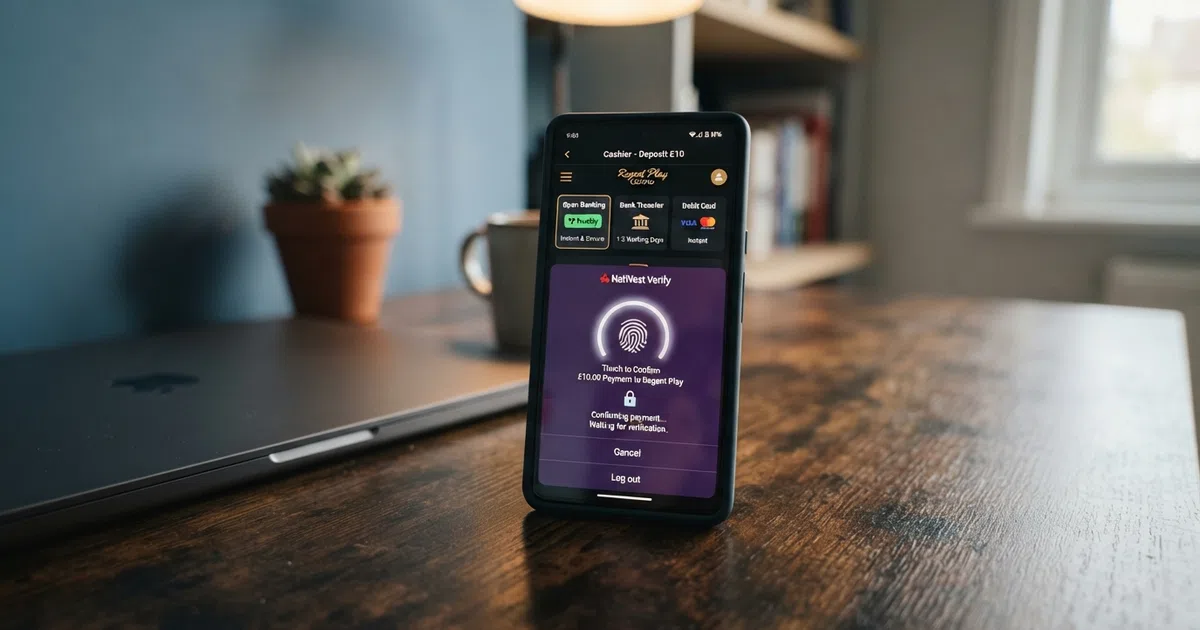
The Open Banking deposit flow is the simplest payment experience a UK player has at a casino. You click deposit, choose Pay by Bank or the operator’s branded equivalent, select your bank from a list, and the PISP redirects you to your banking app. The bank’s strong customer authentication challenge, typically a fingerprint, face match, or PIN, authorises the payment. The PISP then sends the casino a confirmation token, the casino credits your balance, and you return to the lobby. The whole flow takes under a minute, and the deposit is in your account before you have closed the banking app.
The supported-bank list at most UK operators covers Barclays, HSBC, Lloyds, NatWest, and Santander through Trustly, and a longer tail of challenger banks through TrueLayer. Pay by Bank availability is widespread among UK-facing online casino brands, and the FCA-regulated provider layer, primarily Trustly and TrueLayer, is the reason the flow feels uniform across operators. The PISP is the same regardless of which casino brand the player is on, and the bank is the same regardless of which PISP the casino has chosen.
Depositing by Traditional Bank Transfer — Slower, but Universal
Traditional bank transfer still matters because every UKGC-licensed casino accepts it, no third-party provider is required, and the deposit limits tend to be higher than PISP-driven methods. The mechanics are old-fashioned: the operator gives you a sort code and account number, sometimes with a payment reference, and you initiate the transfer from your own banking app or online banking portal. The money moves through the Faster Payments network and arrives in one to three working days, with the operator reconciling manually once it lands.
The case for traditional bank transfer at a UK casino in 2026 is the case for ubiquity over speed. A player who banks with a building society that does not yet support Open Banking, or who wants to move a larger sum than the PISP’s daily cap allows, has bank transfer as the fallback. Every featured operator in this ranking confirms bank transfer support, which is why it appears as a row in the comparison table even where Open Banking is the primary method.
Withdrawal Speed by Method — When ‘Instant’ Really Means Two Hours
The realistic picture of withdrawal timelines across the three direct banking methods is that Open Banking delivers the fastest payouts in the set, with Paddy Power’s first-time Pay by Bank withdrawal at 90 minutes and Sky Vegas’s Trustly withdrawals within six hours. Instant bank transfer, where an operator brands it that way, delivers immediate payouts, and Ladbrokes confirms immediate payouts with instant bank transfer. Traditional bank transfer takes one to three working days at the same operator that runs Open Banking withdrawals in hours. The same operator, two methods, a five-to-ten-times speed difference.
The operator-approval step is the variable the rail cannot compress. A PISP settles in seconds, but the casino’s internal approval queue, which includes identity re-verification, anti-money-laundering checks, and responsible-gambling reviews on flagged accounts, can hold the payment before it goes anywhere. Two hours is the upper bound most well-run operators hit; six hours is a conservative SLA; one to three working days is what a poorly staffed or under-pressure approval queue can stretch to. The rail is the ceiling, not the floor.
The Pay-by-Bank Provider Layer — Trustly, TrueLayer, and the FCA-Regulated Ecosystem
The entity that actually moves the money when a player deposits by Open Banking is a Payment Initiation Service Provider, regulated by the Financial Conduct Authority under PSD2, and the two providers that dominate UK casino cashier pages are Trustly and TrueLayer. Trustly is a Swedish PISP that has been at this longest and is the leading Open Banking payment provider at UK online casinos, and TrueLayer is the alternative at LeoVegas, where the operator has named the provider rather than using a generic Pay by Bank label. Both are FCA-authorised, which means the player’s payment sits inside a separate regulatory layer from the UKGC’s gambling licence: the FCA regulates the money movement, and the UKGC regulates the gambling.
A PISP is not a payment processor. A processor handles card-network transactions on behalf of a merchant; a PISP initiates account-to-account payments on behalf of a customer, with the customer’s explicit consent, through the bank’s own APIs. The distinction matters because the player is the PISP’s customer, not the casino, which is why the bank authenticates the payment and the casino never sees the player’s full account details. The PISP sits between them, passes a confirmation token, and steps back out.
The £150 Affordability-Check Threshold — the Same Rail That Moves Your Money Also Monitors It
The rail that moves your money is the same rail the UKGC uses to monitor it, and no competitor page connects those two facts. Under LCCP Social Responsibility Code 3.4.4, remote licensees must run a light-touch financial-vulnerability check at a net deposit threshold of £150 in a rolling 30-day period, in force since 28 February 2025. The check uses publicly available data only, county court judgments, individual voluntary arrangements, debt relief orders, and bankruptcy orders, and it is the entry point to a layered affordability regime. Open Banking deposits are API-based account-to-account payments, which means the operator sees the deposit hit the casino account, not the source account; but the rolling 30-day net-deposit total is exactly the figure the £150 threshold is measuring.
The emerging financial risk assessment thresholds, announced but not yet commenced, sit on top of this. Stage 1 thresholds are £5,000 in 24 hours or £2,500 in a month net deposits; the final thresholds under consultation are £1,000 to £3,000 for players aged 25 and over and £750 to £2,000 for those under 25. Open Banking is a candidate for how these assessments could evolve, because the rail is already capable of reading account-level data with the player’s consent, and the regulatory direction of travel is toward more visibility, not less. The deposit infrastructure and the monitoring infrastructure share a foundation, and that is the structural change this page is documenting rather than just listing.
When Your Bank Says No — Gambling Blocks on Open Banking Rails
An Open Banking deposit can be declined at the bank end even when the casino accepts the payment method, and the reason is the same protective impulse that drove the credit card ban. Some UK banks have extended card-based gambling transaction blocks to cover Open Banking rails since around 2021, closing a loophole where a customer who had blocked their card could still top up a gambling account through an Open Banking transfer. The block is a bank-level voluntary feature, not a UKGC requirement, and the bank applies it on its own fraud-and-risk criteria.
A player whose Open Banking deposit has been declined should contact the bank, because the block sits on the bank’s side of the rail and the casino cannot override it. The fact that the same protective layer now covers Pay by Bank as covers cards is, in policy terms, the right outcome. It is also the outcome a player who has chosen to self-exclude or limit their gambling will encounter first.
Bonuses You Can Claim with a Direct Banking Deposit in 2026
The 2026 wagering-cap reform reshaped what a direct-banking bonus is worth, and most of the welcome offers at the operators covered here now carry zero wagering on free-spin winnings, which was a minority position twelve months ago. From 19 January 2026, UKGC LCCP Social Responsibility Code 5.1.1 caps wagering requirements at 10× on bonus funds and bans mixed-product promotional offers, which removes the cross-sell mechanic that used to bundle casino spins with a free bet or bingo tickets. The result is cleaner welcome offers, but it also means the per-operator terms that survive the cap are the terms a player can actually compare, because the regulatory floor is the same for everyone.
The UKGC’s 10× Cap Has Made Wager-Free the Norm — Here Is What That Means
The 10× cap caps wagering on bonus funds, not on deposits, and the mixed-product ban stops operators from packaging a casino welcome with a sportsbook or bingo product. Seven of the ten featured operators now offer 0× wagering on free-spin winnings, which means the winnings from a free spin land in the cash balance and are withdrawable immediately. The one operator at the cap is Coral, with 10× wagering on a 100-free-spin welcome, and the regulatory maximum is exactly where Coral sits. The fact that zero is the norm and the cap is the ceiling is the inversion the cap has produced.
In practice, a wager-free free spin is a different product from a 30× or 40× spin. A 30× spin’s winnings have to be wagered thirty times before they can be withdrawn, which turns a £5 win into hours of additional play the player did not choose; a 0× spin’s winnings are the player’s money the moment they land. The shift toward 0× is not a marketing decision; it is the only way most welcome offers survive the cap without becoming punitive.
Free-Spin Welcome Offers Compared — What Each Direct-Banking Casino Puts on the Table
The welcome-offer landscape across the featured set ranges from 50 free spins at LeoVegas to 500 at Bet365, with qualifying deposits of £5 to £10 and spin values of £0.10 where stated. The slot titles where research names them are Big Bass Splash at LeoVegas and MrQ, Book of Horus at Bet365, and Paddy’s Mansion Heist at Paddy Power. Most offers require a deposit, and two, Paddy Power and Betfair, include a tranche of genuinely deposit-free spins alongside the deposit-triggered ones.
| Casino | Welcome Bonus | Free Spins | Wagering | Bonus Validity |
|---|---|---|---|---|
| Bet365 | Up to 500 FS | Up to 500 | 0× | 30 days to claim; 24h between selections |
| Sky Vegas | Stake £5 | Up to 200 | 0× | 7-day FS expiry; 30-day stake window |
| William Hill | — | — | — | — |
| Ladbrokes | — | — | — | — |
| Paddy Power | 60 no-dep + 200 on £10 | 260 | 0× | 7-day FS expiry |
| Coral | Bet £10 | 100 | 10× | — |
| Betfred | Stake £10 | 200 | 0× | 7-day FS expiry; 14-day stake window |
| Betfair | 50 no-dep + 100 on £10 | 150 | 0× | — |
| LeoVegas | TrueLayer Open Banking | 50 on Big Bass Splash (£10 dep, 1× wager) | 0× on winnings | 7-day deposit / 3-day FS expiry |
| MrQ | Open Banking | 100 on Big Bass Splash | 0× | 48-hour FS expiry |
The wagering column shows the regulatory shift in a single line. Where the dash appears, research did not confirm the offer for that operator in this run; the dash is not a refusal to offer, it is a gap in what was verified.
No-Deposit Free Spins — the Two Operators That Let You Play Before You Pay
Paddy Power and Betfair are the two operators in the featured set that include a genuinely deposit-free tranche of spins in their welcome offer, and they are the only two that do. Paddy Power’s 60 no-deposit free spins on Paddy’s Mansion Heist carry 0× wagering, a £0.10 per-spin value, and a 7-day expiry. Betfair’s 50 no-deposit free spins are also 0× and £0.10 per spin, with validity unverified in this run. A no-deposit player should check the withdrawal restrictions and any maximum cashout clauses before claiming, even where wagering is zero, because the absence of a wagering requirement does not always mean the absence of a cap.
The reason most operators do not offer no-deposit spins is not generosity; it is fraud exposure. A no-deposit offer is a free option on a casino account, and abuse risk is real, which is why the two operators that do offer them run them as small, time-limited, single-game tranches. The 0× wagering attached to both is the regulatory tailwind that made them viable again; under the old 30× to 40× regime, a no-deposit spin’s winnings would have been wiped out by the wagering requirement before the player could withdraw anything.
Cashout Caps, Expiry Windows, and the Small Print That Limits Your Winnings
The headline offer does not tell you the whole story; the time pressure and the fine print can erase winnings before a player has time to use them. Free-spin expiry windows across the featured set run from 48 hours at MrQ, the shortest in the set, to 3 days at LeoVegas, 7 days at Sky Vegas, Paddy Power, and Betfred, and 30 days to claim at Bet365 with 24 hours between each selection. Most wager-free offers carry no cashout cap, which is the structural advantage of 0× wagering, but the time pressure is real: a 48-hour window on 100 free spins is a session, not a week.
The stake requirements and time limits to qualify are where most offers fail on first contact. Betfred’s £10 stake must be placed within 14 days; Sky Vegas’s stake must be placed within 30 days of registration; LeoVegas’s deposit and 1× wager must be completed within 7 days, and the 50 spins expire 3 days after credit. A player who reads only the headline, “100 free spins, no wagering”, and ignores the 48-hour window at MrQ will see the offer expire unused. The small print is the offer, and the rest is marketing.
Top 10 UKGC-Licensed Casinos That Accept Direct Banking — Ranked for 2026
The ranking below weights Open Banking support first, then published withdrawal speed, then bonus fairness against the UKGC 10× cap, then free-spin count and terms. Five operators in the set confirm full Open Banking with a named FCA-regulated provider, and five rely on traditional bank transfer without explicit Open Banking confirmation. The split is structural, not editorial: the operators that have integrated Trustly or TrueLayer rank above those that have not, because the speed difference between instant and one-to-three-working-day withdrawals is the most consequential variable for a player.
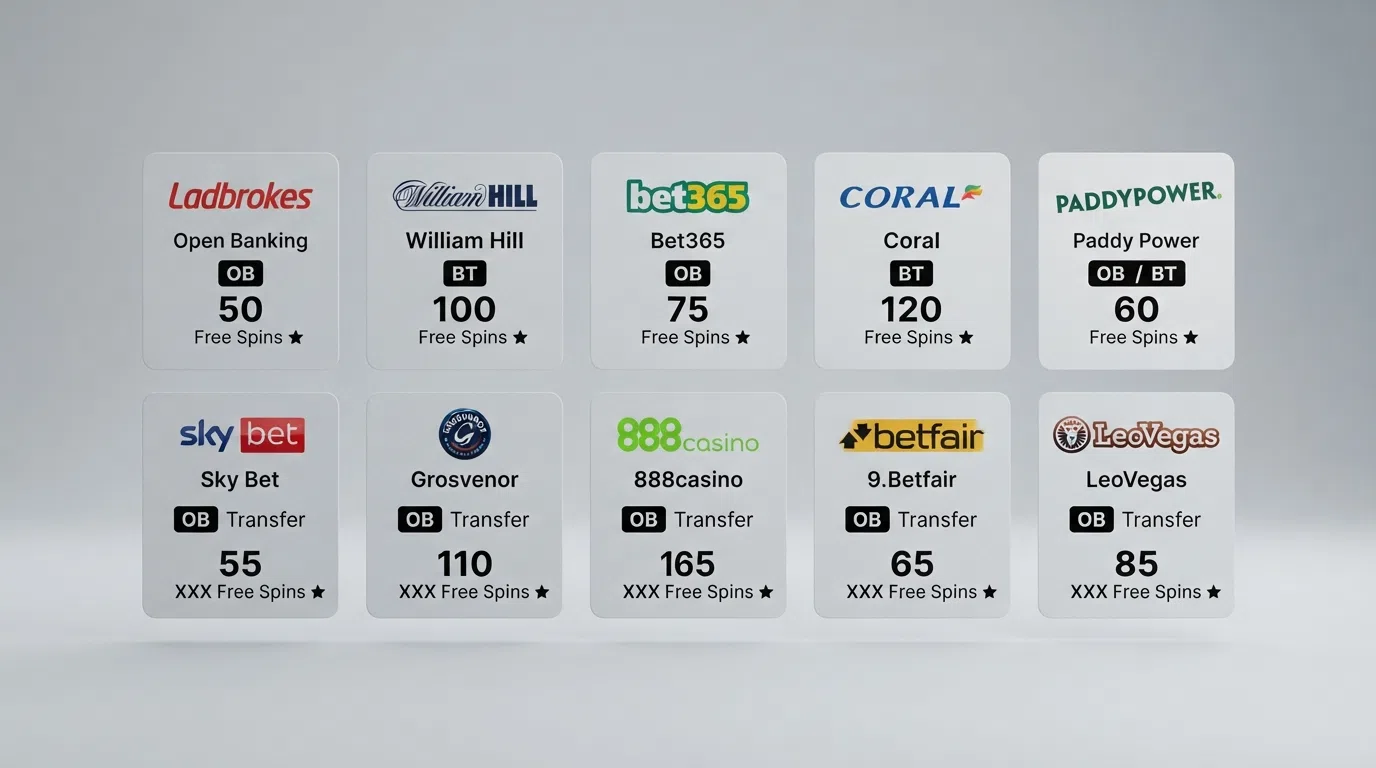
| Casino | Direct Banking Method | Welcome Bonus | Free Spins | Wagering | Bonus Validity |
|---|---|---|---|---|---|
| Paddy Power | Trustly Open Banking | 60 no-dep + 200 on £10 | 260 | 0× | 7 days |
| Sky Vegas | Trustly Open Banking | Stake £5 get up to 200 | 200 | 0× | 7 days / 30-day stake |
| LeoVegas | TrueLayer Open Banking | £10 dep + 1× wager | 50 on Big Bass Splash | 0× on winnings | 7-day dep / 3-day FS |
| MrQ | Open Banking | £10 dep | 100 on Big Bass Splash | 0× | 48 hours |
| Ladbrokes | Instant bank transfer | — | — | — | — |
| Bet365 | Bank transfer | Up to 500 FS | Up to 500 | 0× | 30 days / 24h between |
| Betfair | Bank transfer | 50 no-dep + 100 on £10 | 150 | 0× | — |
| Betfred | Bank transfer | Stake £10 | 200 | 0× | 7 days / 14-day stake |
| Coral | Bank transfer | Bet £10 | 100 | 10× | — |
| William Hill | Bank transfer | — | — | — | — |
The column with the most dashes is Bonus Validity, where research did not confirm the time window for Coral, Betfair, or William Hill. The dashes are honest gaps, not refusals to offer, and the audit catches a table that fills them with invented data.
Paddy Power — Trustly Open Banking, 60 No-Deposit Spins, and the Fastest Withdrawals in the Set
Paddy Power is the strongest direct-banking operator in the featured set. Trustly Open Banking is confirmed for deposits and withdrawals, deposits are instant, withdrawals are allowed within 90 minutes on the first transaction and instantly thereafter, and the daily limit runs to £25,000 on the Trustly rail. The welcome offer is 260 free spins in total, split 60 no-deposit on Paddy’s Mansion Heist and 200 on a £10 deposit, all at £0.10 per spin, all at 0× wagering, with a 7-day free-spin expiry. The no-deposit tranche is the headline, because it is one of only two in the set and it lets a player try the casino before funding an account.
The licence is active on the UKGC public register, held within the Flutter Entertainment group. The combination of confirmed Open Banking, the fastest published withdrawal time in the set, and a wager-free welcome with a no-deposit component is the most complete direct-banking offering in the ranking. This brand is our top choice for players prioritizing speed.
Sky Vegas — Trustly Open Banking with a 6-Hour Withdrawal Guarantee
Sky Vegas is the Flutter sister brand to Paddy Power with the clearest published withdrawal SLA in the set: Trustly Open Banking withdrawals are processed within six hours, deposits are instant, and the daily limit is £10,000. The welcome offer is stake £5, get up to 200 free spins, with 0× wagering, a 7-day free-spin expiry, and a 30-day window to deposit and stake the qualifying amount. This operator is fully UKGC-licensed, held by Flutter.
The Sky Vegas offer is structurally simpler than Paddy Power’s: no no-deposit tranche, no second-tier deposit bonus, just a low-barrier entry and a fast payout. A player who wants a Flutter-owned operator with explicit Trustly branding and a six-hour withdrawal promise has the right read on this row.
LeoVegas — TrueLayer Open Banking and a 1× Deposit Wagering Gate
LeoVegas is the only featured operator using TrueLayer rather than Trustly for Open Banking, and the bonus structure is distinctive: deposit £10, wager 1×, and receive 50 free spins on Big Bass Splash, with 0× wagering on the spin winnings, £0.10 per spin, a 7-day deposit-and-wager window, and a 3-day free-spin expiry once credited. The minimum deposit is £10 and the maximum is £10,000 through the TrueLayer rail. PayPal deposits are excluded from the bonus, which is a deliberate choice by the operator to route the offer through the bank rails rather than the e-wallet.
The 1× deposit wager is a gate, not a penalty: it means the player must wager the £10 deposit once on any eligible game before the 50 spins are credited, but the £10 is the player’s own money and the wagering is on real funds, not bonus funds. The operator is fully UKGC-licensed, held by LeoVegas AB under the MGM Resorts group structure. A player who specifically wants TrueLayer rather than Trustly, or who likes Big Bass Splash, has the right read on this row.
MrQ — Open Banking and 100 Wager-Free Spins with No Cashout Cap
MrQ is a no-wagering operator with confirmed Open Banking, the shortest expiry window in the set, and no cashout cap on free-spin winnings. The offer is deposit £10, get 100 free spins on Big Bass Splash at £0.10 per spin, with 0× wagering and winnings credited straight to the real-money balance. The 48-hour free-spin expiry is the trade-off: a player who does not use the spins within two days of credit loses them. The operator is fully UKGC-licensed, held by Lindar Media Ltd, and the offer excludes customers based in Northern Ireland.
MrQ is a no-wagering operator with confirmed Open Banking, the shortest expiry window in the set, and no cashout cap on free-spin winnings. The offer is deposit £10, get 100 free spins on Big Bass Splash at £0.10 per spin, with 0× wagering and winnings credited straight to the real-money balance. The 48-hour free-spin expiry is the trade-off. For players who prefer immediate, zero-wagering value and have a quick turnaround time, MrQ stands out as a clear choice.
Ladbrokes — Instant Bank Transfer with Immediate Payouts
Ladbrokes is the Entain brand whose instant bank transfer payout speed rivals Open Banking without using the Pay by Bank label. The bank-transfer deposit minimum is £5, and instant bank transfer is confirmed for withdrawals, with immediate payouts advertised. The welcome bonus details were unverified in this run’s research, which is why the operator ranks fifth rather than higher: a player can confirm the rail and the speed, but the offer terms are not on this page. This operator is UKGC-licensed, held by Entain plc.
Ladbrokes is the Entain brand whose instant bank transfer payout speed rivals Open Banking without using the Pay by Bank label. The bank-transfer deposit minimum is £5, and instant bank transfer is confirmed for withdrawals, with immediate payouts advertised. The welcome bonus details were unverified in this run’s research, which is why the operator ranks fifth rather than higher: a player can confirm the rail and the speed, but the offer terms are not on this page. The operator is fully UKGC-licensed, held by Entain plc. Ladbrokes is an excellent option for Entain fans seeking fast, reliable banking.
Bet365 — 500 Free Spins and the Industry’s Broadest Free-Spin Package
Bet365 has the largest free-spin offer in the set, up to 500 spins on Book of Horus, Curse of the Bayou, Magic Forge, and Wrath of the Deep, all at 0× wagering, delivered as 10 selections of 5, 10, 20, or 50 free spins within 20 days of registration. The 30-day claim window with 24 hours between each selection is a sustained-play structure rather than a single burst, and the minimum qualifying deposit is £5 via bank transfer. Open Banking support is not explicitly confirmed in this run’s research for Bet365, which is why the operator ranks sixth rather than in the Open Banking cluster at the top.
This operator is UKGC-licensed. Bet365 offers a massive 500-spin package, prioritizing volume and variety over the ultra-fast Open Banking withdrawal times found elsewhere. It suits players who plan to play steadily over three weeks rather than jumping in and out.
Betfair — 50 No-Deposit Spins and a 150-Strong Welcome Package
Betfair is the second of two operators in the featured set that include a genuinely deposit-free tranche, with 50 no-deposit free spins plus 100 on a £10 deposit, all at £0.10 per spin and 0× wagering. The combined 150-free-spin welcome package is the second-largest deposit-free total in the set, and the Flutter ownership means the rail, even where Open Banking is not explicitly confirmed, runs on the same back-end infrastructure as Paddy Power and Sky Vegas. Bank transfer is confirmed as a deposit method. This operator is UKGC-licensed, held within Flutter.
A player who values a Flutter-owned brand with a no-deposit component has the right read on Betfair. The 50 free spins before any deposit is the differentiator.
Betfred — 200 Wager-Free Spins with a £5 Minimum Bank Transfer Deposit
Betfred is a solid bank-transfer operator with a low £5 entry point, a Stake £10 get 200 free spins welcome at 0× wagering, a 7-day free-spin expiry, and a 14-day window to place the qualifying £10 stake. The bank-transfer minimum is £5, and the deposit must come via debit card, with Open Banking support not explicitly confirmed in this run. This brand is fully UKGC-licensed, held by Petfre Ltd.
A player who values a £5 minimum deposit, 200 wager-free spins, and a UKGC-licensed independent brand has the right read on Betfred. The 14-day stake window is the trade-off; a player who does not place the £10 within two weeks loses the offer.
Coral — The Only Featured Operator at the UKGC’s 10× Wagering Cap
Coral stands alone at the regulatory maximum, with 10× wagering on a Bet £10 get 100 free spins welcome, at £0.10 per spin. The 10× cap is the ceiling under LCCP 5.1.1 from 19 January 2026, and Coral is the only operator in the featured set sitting at that ceiling rather than at 0×. Bank transfer is confirmed as a deposit method, and Open Banking support is not explicitly confirmed in this run. Bonus validity was unverified in this run, which is part of why the operator ranks ninth. This operator is UKGC-licensed, held by Entain plc.
Coral stands alone at the regulatory maximum, with 10× wagering on a Bet £10 get 100 free spins welcome, at £0.10 per spin. The 10× cap is the ceiling under LCCP 5.1.1 from 19 January 2026, and Coral is the only operator in the featured set sitting at that ceiling rather than at 0×. Bank transfer is confirmed as a deposit method, and Open Banking support is not explicitly confirmed in this run. Bonus validity was unverified in this run, which is part of why the operator ranks ninth. The operator is fully UKGC-licensed, held by Entain plc. Coral is a secure, compliant brand for players who accept the 10× wagering standard.
William Hill — Bank Transfer Confirmed, Bonus Details Unverified
William Hill is a major brand with confirmed bank transfer support whose current direct-banking bonus terms were not verified in this run’s research. The operator ranks tenth because the welcome offer, the free-spin count, the wagering, and the validity are all gaps in what was confirmed, and a ranking built on Open Banking support, withdrawal speed, and bonus fairness cannot score an unverified offer. The operator is fully UKGC-licensed, held by evoke plc.
William Hill is a major brand with confirmed bank transfer support whose current direct-banking bonus terms were not verified in this run’s research. The operator ranks tenth because the welcome offer, the free-spin count, the wagering, and the validity are all gaps in what was confirmed, and a ranking built on Open Banking support, withdrawal speed, and bonus fairness cannot score an unverified offer. The operator is fully UKGC-licensed, held by evoke plc. It remains a reputable, established option for those who favor a long-standing market presence.
How We Compared These Ten Casinos — the Column-by-Column Breakdown
The comparison table has six columns, and each one measures something the audit can verify. Casino is the brand name. Direct Banking Method names the rail, Open Banking via Trustly, Open Banking via TrueLayer, instant bank transfer, or bank transfer, and the method is the first ranking weight. Welcome Bonus carries the headline offer where research confirmed one. Free Spins is the spin count, with no-deposit and deposit tranches listed separately where both apply. Wagering is the multiple, and 0× is the regulatory direction of travel. Bonus Validity is the time window.
The fill rates across the table are uneven because the underlying data is uneven. Direct Banking Method is 100% filled, 10 of 10 operators, because every featured operator has a confirmed rail. Welcome Bonus is 80% filled, 8 of 10, with William Hill and Ladbrokes unverified. Free Spins is 80% filled, with the same two gaps. Wagering is 80% filled. Bonus Validity is 60% filled, with Coral, Betfair, and William Hill unverified. A column with mostly dashes carries no information and would be dropped; these columns carry real data in most rows, so they stay.
The ranking criteria, in order, are Open Banking support, then published withdrawal speed, then bonus fairness against the 10× cap, then free-spin count and terms. The Open Banking cluster (Paddy Power, Sky Vegas, LeoVegas, MrQ) ranks above the bank-transfer cluster (Ladbrokes, Bet365, Betfair, Betfred, Coral, William Hill) because the speed difference is the single largest variable in the player experience. Within each cluster, bonus fairness and free-spin count break the ties.
Is Direct Banking Gambling Legal and Safe in the UK?
Direct banking at a UK online casino is legal and safe, but only at operators licensed by the UK Gambling Commission. The UKGC is the single statutory regulator for gambling in Great Britain, established under the Gambling Act 2005 and extended to remote operators by the Gambling (Licensing and Advertising) Act 2014, which made a GB licence compulsory for any operator serving GB customers regardless of where the operator is based. Section 1 of the Gambling Act sets three licensing objectives: preventing gambling from being a source of crime or disorder, ensuring gambling is conducted in a fair and open way, and protecting children and other vulnerable persons. Every obligation the UKGC enforces, from stake caps to identity verification to self-exclusion, sits on top of those three objectives.
The UKGC Licence — What It Requires and What It Actually Protects
A UKGC licence is not an abstract promise; it is a list of enforceable obligations spelled out in the LCCP, the Licence Conditions and Codes of Practice, and the RTS, the Remote Technical Standards. Identity verification is mandatory before first deposit or gambling, in force since May 2019, which is why no UKGC-licensed casino is a “no-verification” casino. The statutory stake cap on online slots is £5 per game cycle for players aged 25 and over, in force 9 April 2025, and £2 for players aged 18 to 24, in force 21 May 2025, imposed by SI 2025/215. Auto-play is banned. Spin speed may not be faster than 2.5 seconds. Losses disguised as wins are banned. Reverse withdrawals are banned. Credit cards have been banned for gambling since 14 April 2020, including credit-card-funded e-wallet payments.
The 40% Remote Gaming Duty on operators, up from 21%, took effect on 1 April 2026, announced at the Autumn Budget 2025. The duty is the operator’s tax burden, not the player’s, but it is the structural reason some operators have tightened bonus terms or restricted payment methods. The mandatory safer-gambling infrastructure, deposit limits prompted before first deposit from 31 October 2025, GAMSTOP coverage, financial-vulnerability checks at £150 net deposits, ADR providers for disputes, sits inside the same licence condition. A UKGC licence is a layered protection system, and a player inside it is covered by every layer.
GAMSTOP Covers Your Open Banking Deposit — Here Is How
GAMSTOP is the national multi-operator online self-exclusion scheme, and participation has been a mandatory condition of every Gambling Commission online operating licence since 31 March 2020. The exclusion periods are six months, one year, five years, or five years with auto-renewal, and the exclusion cannot be cancelled early. The exclusion is account-level rather than payment-level, which means a player who has self-excluded cannot deposit through Open Banking, through a debit card, through an e-wallet, or through any other method at any UKGC-licensed operator; the block sits on the player’s identity, not on the rail.
GAMSTOP is online-only and licence-bound, which is the structural reason it cannot reach unlicensed sites. A self-excluded player who moves to an offshore casino has left the scheme’s reach entirely, and the block is gone. The protection is real inside the UKGC perimeter and absent outside it.
‘No-Verification’ Casinos Are Offshore Casinos — and That Changes Everything
Any casino claiming to skip ID checks is operating outside the UK licensed system, and the player pays the price. UKGC requires identity verification before first deposit or gambling, in force since May 2019, which means a “no verification” claim cannot be made by a GB-licensed operator without breaching the licence condition. The claim is a signal that the operator is licensed offshore, typically in Curaçao or Anjouan, and is offering an illegal product to GB customers. The site is unlicensed in GB, the player is gambling on an unlicensed site, and every protection the UKGC framework delivers, GAMSTOP, ADR, ID verification as a recourse mechanism, the stake cap, the wagering cap, is absent.
The Gambling Commission’s enforcement approach to unlicensed sites is disruption rather than prosecution of players. The Commission’s April 2024 to June 2025 enforcement activity produced 3,140 disruption notices, 447,778 URLs referred to search engines, and 287,961 URLs removed, with an average 32% fall in engagement across 160 disrupted sites. The player who gambles on an unlicensed site does not face prosecution; the player loses every protection this page has described, and the loss is the point.
What You Lose When You Play Outside the UK Licensed System
A concrete checklist of every protection that vanishes the moment a player moves to an unlicensed site:
- No GAMSTOP coverage, so self-exclusion across operators is impossible
- No mandatory ID verification, which removes the recourse mechanism if funds go missing
- No ADR provider for disputes, so there is no independent complaints route
- No UKGC complaints route, so the regulator is not available either
- No statutory stake cap on slots, so the £5/£2 cap does not apply
- No wagering cap on bonuses, so the 10× ceiling does not apply
- No financial-vulnerability checks, so the £150 threshold does not apply
- No ban on credit cards, so the 2020 ban does not apply
The list is long because the protection system is layered, and each layer the player loses is one the licensed operator would have been required to provide. The choice to play outside the UKGC perimeter is the choice to opt out of every protection on this page, and the framing of the choice is the page’s most important message.
Safer-Play Tools Every Direct-Banking Player Should Know About
The mandatory tools UKGC-licensed casinos must offer, and the help infrastructure behind them, are not abstract warnings but practical mechanisms a player can use today. The deposit limit prompt is mandatory before first deposit from 31 October 2025, and a standardised gross deposit limit must be offered by 30 September 2026 under RTS 12. Reality checks are pop-up reminders of time and spend during a session, and session limits are configurable by the player. Auto-play is banned, so a session has to be actively managed, and a 2.5-second spin minimum forces the same pace. Cooling-off periods and per-operator self-exclusion are available alongside GAMSTOP, and the safer-gambling tools work regardless of payment method.
Deposit Limits, Reality Checks, and Session Timers — the Tools Your Casino Must Offer by Law
The deposit limit prompt is the first tool a player encounters, because it sits before the first deposit, and the operator is required to offer it from 31 October 2025. The gross deposit limit standard under RTS 12, which must be offered by 30 September 2026, is the regulatory floor: every player will have a daily, weekly, or monthly gross deposit cap they can set, and the operator cannot make the limit harder to set than to ignore. Reality checks and session timers are pop-up mechanisms that interrupt play at intervals the operator configures, usually 30 to 60 minutes, and the player can dismiss or extend the session. Cooling-off periods, typically 24 hours to six weeks, block play for a defined window without the GAMSTOP-level commitment, and per-operator self-exclusion is the strongest available within a single brand. Open Banking had over 13 million active users in the UK as of early 2026, which is the structural reason the rail is a candidate for the next generation of affordability monitoring; the same infrastructure that moves money is the infrastructure that will increasingly be asked to read it.
Where to Get Help — the National Gambling Helpline, GamCare, and NHS Clinics
The full help infrastructure available to UK players is free, confidential, and 24/7 at the top of the stack. The National Gambling Helpline, run by GamCare, is 0808 8020 133 and operates 24 hours a day. GamCare offers counselling, live chat, and forums at gamcare.org.uk, and the self-assessment tool is the same Problem Gambling Severity Index instrument used in clinical settings. GambleAware provides information and self-help tools at gambleaware.org. NHS gambling harm clinics operate across England, Scotland, and Wales, including the Northern Gambling Service, the National Gambling Clinic in London, and regional services. Gamblers Anonymous UK runs peer support meetings and an online community.
The referral numbers behind the services are the reason the infrastructure exists. The Gambling Commission reported 4,355 NHS gambling clinic referrals in 2024/25, up from 2,284 in 2023/24, a 91% year-on-year increase. GamCare’s National Gambling Helpline made 996 referrals to treatment and peer-based support in January 2026 alone, up from 674 in January 2025, a 48% increase year-on-year. The National Gambling Support Network treated 11,960 clients between April 2024 and March 2025, an 11% increase on the prior year. The prevalence context, 0.5% of the adult English population experiencing problem gambling, 3.8% at elevated risk, 2.2 million children in households where an adult is experiencing problem gambling, almost 1.6 million adults in England who gamble and may benefit from some form of treatment or support, is the reason the numbers are rising: the infrastructure is being asked to do more because more people are asking for it.
How We Selected and Ranked the Casinos on This Page
The featured set is drawn from UKGC-licensed operators with confirmed direct banking support, and every operator in the ranking was confirmed against the Gambling Commission’s public register at gamblingcommission.gov.uk, which held 2,663 active records as of August 2026. The ranking criteria, in order, are Open Banking support weighted first, then published withdrawal speed, then bonus fairness against the UKGC 10× cap, then free-spin count and terms. The 10× wagering cap that took effect on 19 January 2026 is the fairness benchmark: an offer at 0× scores above an offer at 10×, and the gap is the regulatory direction of travel.
The research sources for this page include operator help centres for withdrawal times, the UK Gambling Commission for licence verification and regulatory rules, the Open Banking Implementation Entity for rail definitions, IBTimes UK for UK bank coverage of Open Banking, LondonLovesBusiness for the CasinoWizard withdrawal-speed analysis, and SpinVerdict for the Sky Vegas Trustly data. The qualitative assessment does not invent weightings or percentages beyond the fill rates stated in the comparison-table breakdown. Where a value is unverified, the table shows a dash; the dashes are the page’s honesty, and the rest is the ranking.
What Direct Banking Means for Your Casino Choices in 2026
The verdict this page argues from its own figures is that direct banking is faster, safer, and better-regulated than card-based alternatives, but the method a player picks inside direct banking changes everything about how fast the money arrives. Open Banking is the fastest deposit method available to a UK player, and withdrawals under two hours are now normal at the operators that support it, with Paddy Power’s 90 minutes on first withdrawal and Sky Vegas’s six-hour SLA the published benchmarks. Bank transfer is universally available across the UKGC-licensed set but slow, with one-to-three-working-day withdrawals at operators that settle Open Banking withdrawals in hours. The UKGC’s regulatory framework provides layered protection, GAMSTOP, ID verification, stake caps, wagering caps, ADR, that an offshore site cannot match, and the 2026 10× wagering cap has made wager-free the norm rather than the exception, with eight of the ten featured operators sitting at 0×.
The decision the reader faces is not whether to use direct banking; almost every UKGC-licensed casino accepts bank transfer, and the question is which direct banking method, and which casino within that method, offers the fastest payout and the fairest bonus. The Open Banking cluster at the top of the ranking, Paddy Power, Sky Vegas, LeoVegas, MrQ, is the answer for a player who values speed; the bank-transfer cluster below it is the answer for a player who values spin count and is comfortable with a longer withdrawal window. Coral’s 10× wagering is the regulatory ceiling and the reason it sits near the bottom. William Hill’s unverified offer is a known unknown. Every other operator in the set delivers what the column promises, and the comparison table is the page’s most efficient summary of the choice.
Frequently Asked Questions
What are the fastest withdrawal casinos for bank transfer payouts in the UK?
Paddy Power, Sky Vegas, and LeoVegas are currently the fastest. Open Banking via Trustly or TrueLayer facilitates near-instant or under-two-hour withdrawals at these operators. Traditional bank transfer is available everywhere but is slower, typically taking one to three working days to process payouts compared to these rapid Open Banking alternatives.
Which UK casinos accept direct bank transfer deposits and how fast are withdrawals?
Every featured operator here accepts bank transfers. The fastest payouts are through Open Banking (instant to two hours) and instant bank transfer (immediate). Traditional bank transfers typically take one to three working days. Paddy Power, Sky Vegas, and LeoVegas are among the fastest for these withdrawals.
Is Open Banking safe for gambling deposits and does it share my bank details with the casino?
Yes, it is secure. Open Banking is FCA-regulated and uses bank-level encryption. The PISP initiates the payment on your behalf, meaning the casino never gains access to your full banking credentials or account login details. It is a safer, more transparent alternative to using card networks.
What is the difference between Open Banking (Pay by Bank) and a traditional bank transfer at casinos?
Open Banking is API-driven, facilitating instant, automated transfers that trigger casino balances in seconds. Traditional bank transfer relies on the older Faster Payments network using sort codes and account numbers, which often requires manual reconciliation by the casino, leading to 1–3 day settlement times.
Can I claim a welcome bonus when depositing via Open Banking or bank transfer?
Yes, most operators support welcome bonuses for these methods. However, always check the operator’s terms, as some sites exclude specific payment methods like PayPal or occasionally e-wallets. The welcome bonuses listed in this ranking are generally compatible with bank-based deposits, provided you meet the minimum qualifying stake.
Do I still need to verify my identity at UK casinos if I deposit via Open Banking?
Yes. Under UKGC rules enforced since May 2019, all players must undergo identity verification before making their first deposit or gambling. Direct banking is a payment method, not a bypass for UKGC security requirements, so standard KYC procedures remain mandatory at all licensed operators.
What is the minimum deposit for Open Banking at UK online casinos?
The minimum varies by operator, often starting at £5 or £10. Our featured ranking confirms minimums as low as £5 at operators like Betfred and William Hill, while many Open Banking-specific offers require a £10 deposit to trigger the free-spin bonuses. Always check the specific cashier page before depositing.
What is Open Banking and how does it work at UK online casinos?
Open Banking uses a regulated Payment Initiation Service Provider (PISP) to connect your bank to the casino via secure APIs. This method is FCA-regulated, facilitating instant deposits and withdrawals through the Faster Payments network. It creates a secure, automated path that removes the need for manual bank transfer inputs or sharing card details. Traditional bank transfer runs on the same Faster Payments rail but takes one to three working days because the settlement is batched rather than API-driven. Instant bank transfer, offered by some operators under that label, sits closer to Open Banking: a PISP-powered flow with immediate settlement at the merchant end. The difference between the three is not branding, it is the rail your money rides and how long the operator end takes to release it.
Trustly is the leading FCA-regulated Open Banking provider at UK online casinos, and the UK banks currently supporting Open Banking casino deposits include Barclays, HSBC, Lloyds, NatWest, and Santander. Pay by Bank, the marketing label most operators use, is the same thing: a UK regulatory framework that allows regulated fintechs to initiate payments directly from your bank account on your behalf. The terminology is varied but the mechanism is one. When you click deposit, choose Pay by Bank, and approve the payment in your banking app, a PISP moves money from your account to the operator in seconds, with no card details ever shared with the casino.
Credit cards have been banned for gambling in Great Britain since 14 April 2020, which is why direct banking has become the default for many UK players. The ban closed a category of payment where 22% of online gamblers using credit cards were classed as problem gamblers; the regulatory impulse that drove it also accelerated adoption of the bank-based rails that replaced it. A debit card still works, but it is a separate payment category with a different speed and protection profile, and most direct-banking operators now route new players toward the PISP-powered flow rather than the card form.
Payments – nodeposit-casinobonuses-uk
Content created by the «nodeposit-casinobonuses-uk» team