
Casinos That Accept Citadel in the UK: Where the Bonus Still Beats the Playthrough
 Available in GB
The honest version of the search starts with a number that shrinks every quarter. Citadel Instant Banking remains a functional way to move money from a bank account into a UK casino balance without opening an e-wallet, but the brand has all but vanished from operator cashier pages. Videoslots is the only UKGC-licensed brand with a publicly confirmed Citadel-by-name deposit and withdrawal route. 32Red, once a Citadel name, switched to Trustly in April 2024 and never looked back. Most major UK operators now route the same bank-to-casino transfer through “Instant Banking” or “Pay by Bank” labels that may or may not be Citadel underneath. Picking a casino on the strength of Citadel alone is the wrong way around the decision. Pick on licence, bonus and games first, then check whether Citadel (or a sensible equivalent) appears in the cashier.

Current as of September 8, 2026 and verified against the Gambling Commission’s public register of operating licences.
What Citadel Instant Banking is — and why it is harder to find at UK casinos in 2026
Citadel Instant Banking is a direct bank-to-casino transfer rail. No e-wallet sign-up, no third-party balance to fund, no stored-value account standing between the player’s bank and the casino cashier. The service is available in the UK and 17 other countries, and it has been pitched as a “reliable, easy-to-use payment method … available to UK players to make transfers, payments, and deposits whenever they desire” by the affiliate pages that once led with the Citadel brand. That pitch is still true in 2026, but the market it described is thinner.
The wider UK instant-banking picture is now dominated by Trustly. Trustly’s open-banking rail moves deposits in seconds and same-day withdrawals through Faster Payments, sits behind an FCA registration (FRN 1005703), and is supported by Barclays, HSBC, Lloyds, NatWest and Santander. A player searching for “Citadel casinos” today is in practice looking at a market that has migrated to Trustly, with Volt, Token and TrueLayer filling the open-banking lanes behind it. The UK online sector is healthy by every headline measure — Q1 2026 gross gambling yield ran to £1.55 billion, with slots up 12% year on year — but the Citadel brand name is being carried by fewer and fewer of the cashier pages that fund it.
What Citadel Instant Banking actually is
The mechanics are deliberately thin. The player picks Citadel (or an “Instant Banking” label that resolves to Citadel) in the cashier, authenticates with their bank via a hosted page, authorises the transfer, and the balance updates on the casino side. There is no Citadel account to top up first, no app to download, no password to remember beyond the bank’s own credentials. The four Citadel product variants — Instant Banking, the Citadel debit card, the pay-by-link flow and Citadel Go — are not equally relevant to UK casino deposits; Instant Banking is the one that shows up in cashier pages, and it is the only one a UK player normally encounters.
Geographically, Citadel operates across the UK and 17 other markets. That is wider than the UK presence alone suggests, and it is one reason a non-UK player landing on a UK-licensed brand may still see the rail. Within the UK, the practical question is no longer “does Citadel work here” but “is Citadel the rail that this operator has chosen to expose under that name.”
Where Citadel still works at UK casinos right now
Videoslots is the clearest confirmation in research. Its terms publish a £10 minimum, a £10,000 maximum, instant processing and zero deposit fees on the deposit side, plus a 1–3 business day withdrawal route with a £1.50 fee on the way back — a rare case where Citadel is not strictly deposit-only. No other brand in the research carries a published Citadel-by-name confirmation with both deposit and withdrawal terms.
The 32Red precedent is the more instructive signal. 32Red replaced Citadel with Trustly in April 2024, and that swap is now the cleanest example in the market of an operator deciding the brand is no longer worth the cashier slot. The wider pattern is “Instant Banking” or “Pay by Bank” labels in the cashier that may or may not be Citadel underneath. A player who finds a brand on a top-10 list and walks to the cashier to deposit will, more often than not, see one of those generic labels. The list and the cashier rarely match by name.
The pros and cons of using Citadel at online casinos
The single advantage is the one Citadel was built for: a deposit moves from a bank account to the casino in seconds, with no e-wallet account standing in the middle. There is nothing to fund first, nothing to top up, no second password to forget. The mechanic feels closer to a debit card than to a Skrill or Neteller deposit.
The central limitation is the withdrawal gap. Citadel is a transfer medium rather than a stored-value wallet, so it cannot receive money from a casino. “Unfortunately, you cannot use Citadel for casino withdrawals. Most casinos accepting Citadel Instant Banking allow only deposits because you don’t need to open an account to use it” is the working rule at every UK operator except Videoslots. The player who deposits by Citadel pays out by debit card, bank transfer or Trustly.
The shrinking-acceptance risk is the one that hurts over time. The branded Citadel experience is harder to find in 2026 than it was 18 months ago, and the industry has been moving to open-banking rails with broader UK bank coverage. A player who chooses a brand specifically to use Citadel is choosing a thinner pool of operators and a rail that may be quietly replaced on a cashier page with no announcement.
The best UK casinos for Citadel deposits — ranked by what their bonuses actually deliver
| Casino | UKGC Licence | Welcome Bonus | Free Spins | Wagering | Game Providers |
|---|---|---|---|---|---|
| Videoslots | Active | 100% up to £50 | 11 wager-free (Starburst) | 10× bonus | NetEnt, Microgaming, Play’n GO, Pragmatic Play, Evolution, 180+ providers |
| Betway | Active | 100% up to £50 | 150 (50/day × 3 days) | 10× bonus | Microgaming, NetEnt, Evolution, Pragmatic Play |
| LeoVegas | Active | — | 50 wager-free (Big Bass Splash) | 1× deposit to qualify | NetEnt, Evolution, Pragmatic Play, Play’n GO |
| 888 Casino | Active | 100% up to £100 | — | 10× bonus | NetEnt, Evolution, Playtech, Pragmatic Play, 888 Holdings |
| BetMGM UK | Active | 100% up to £50 | 125 (selected slots) | 10× bonus | Evolution, Pragmatic Play, NetEnt, Playtech |
| Sky Vegas | Active | — | 250 (50 no-deposit + 200 on £10) | 0× | NetEnt, Evolution, Pragmatic Play, Playtech |
| Casumo | Active | 100% up to £100 | 50 | 10× bonus | NetEnt, Evolution, Microgaming, Play’n GO, 4,200+ games |
| Paddy Power | Active | — | 260 (60 no-deposit + 200 on £10) | 0× | Playtech, Evolution, IGT |
| BetVictor | Active | Not publicly specified | — | — | NetEnt, Evolution, Pragmatic Play, Playtech, 4,000+ games |
| Grosvenor | Active | 100% deposit bonus | 100 | Not publicly specified | NetEnt, Evolution, Playtech |
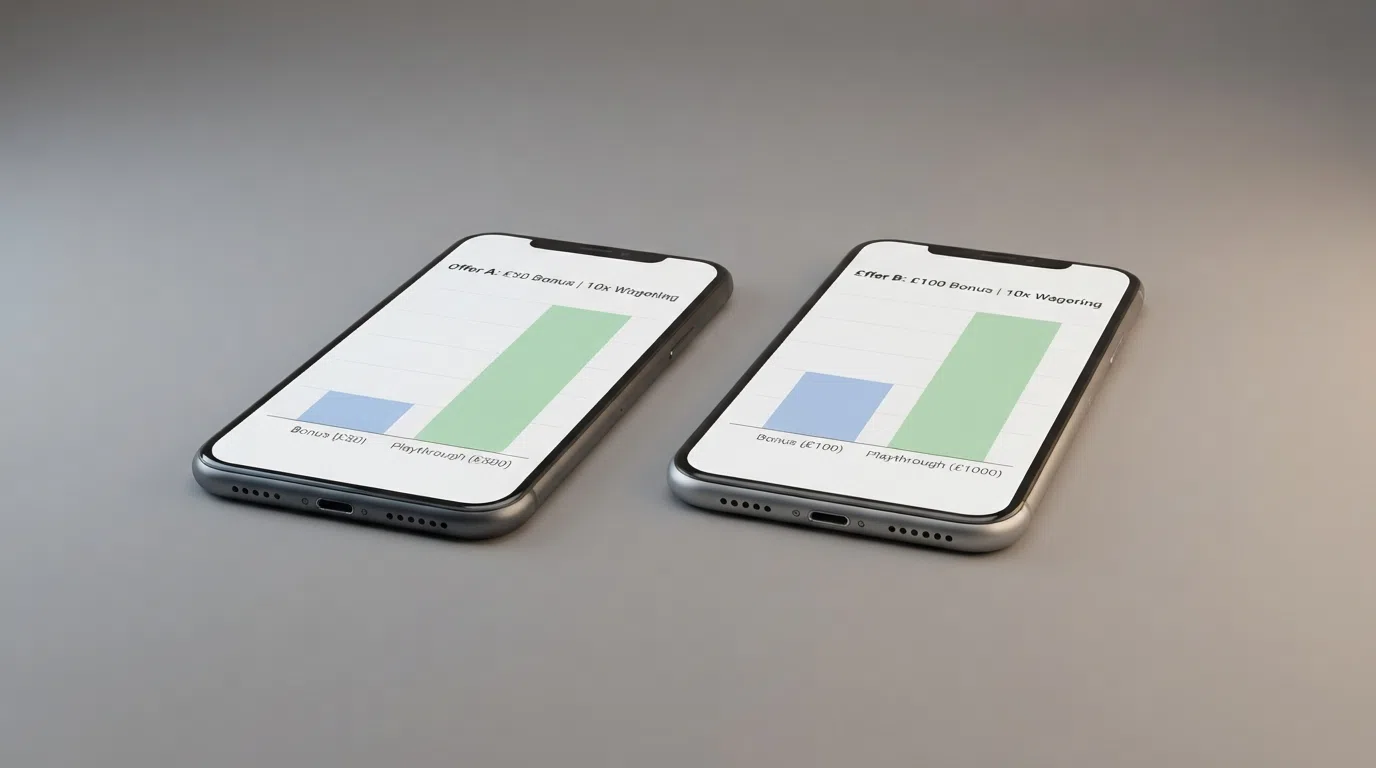
The table reads best as a comparison of three different welcome structures: deposit-match bonuses (Videoslots, Betway, 888, BetMGM, Casumo, Grosvenor), pure free-spin welcomes (LeoVegas, Sky Vegas, Paddy Power) and bonus terms not publicly listed (BetVictor). A £100 match at 10× wagering is not automatically a better deal than a £50 match at the same rate — it is a larger number that costs more in expected loss to clear, and a player picking on the bigger cap is paying for the privilege of clearing a bigger bonus. Wager-free free spins are the cleanest structure in the comparison because the winnings arrive as withdrawable cash with no playthrough attached.
How we compare Citadel casinos — our ranking criteria
Licensing is the entry requirement. Every operator in the table above holds an active GB remote casino operating licence, verified against the Gambling Commission’s public register on 29 July 2026. Bonus value comes second and is assessed by match percentage, free-spin count and the wagering multiplier rather than the headline number alone. Game-provider quality and library size are the third differentiator, with a NetEnt-and-Evolution backbone treated as the floor of a serious UK casino. The Citadel-availability caveat is the last filter: only Videoslots carries an explicit published confirmation in the research, and the other nine are most likely to be reached under an “Instant Banking” label in the cashier. A player should verify at the cashier before depositing, not trust a public top-10 list.
The 10× UK wagering cap, in force from 19 December 2025, sets a ceiling every welcome offer in this table is now legally required to meet. Mixed-product promotions are banned, so a casino cannot dangle a sports-bet leg as part of a casino welcome. Both rules are felt in the table above: every deposit-match bonus sits at 10× on the bonus, and no operator is cross-selling a sports leg to sweeten the casino offer.
Videoslots — the most clearly confirmed Citadel casino
Videoslots is the operator the rest of this page circles back to. Its published Citadel terms (£10 minimum, £10,000 maximum, instant processing, zero deposit fees) are the only deposit-side figures a reader can take to the bank without checking the cashier first, and the same operator processes Citadel withdrawals at 1–3 business days with a £1.50 fee. That combination — a confirmed deposit and a confirmed withdrawal — is unmatched in the research and is the reason the brand tops the list.
The welcome bonus is a 100% match up to £50 with 10× wagering, plus 11 wager-free spins on Starburst, valid for 30 days. £50 in bonus cash means £500 in required turnover, which is the kind of playthrough a player with a normal bankroll can clear in a weekend on a 96% slot. The 11 wager-free spins on Starburst are a small number, but they are paid as cash and carry no playthrough — a sharper trade than a larger free-spin bundle with wagering attached. The game library runs to 180+ providers including NetEnt, Microgaming, Play’n GO, Pragmatic Play and Evolution, which is the deepest in the comparison. Videoslots is the top recommendation for anyone prioritising a confirmed Citadel deposit route alongside a massive, 180+ provider library.
Betway — strong all-rounder with a deposit match and 150 free spins
Betway pairs a 100% match up to £50 with 150 free spins, delivered as 50 per day over three days on selected slots. The free-spin winnings carry no wagering, and each spin is worth £0.10. The welcome bonus has a 7-day validity window, which is short: £50 in bonus cash means £500 in required turnover, and clearing that in seven days is a real ask on a single bankroll. Game providers include Microgaming, NetEnt, Evolution and Pragmatic Play.
The wrinkle is the payment-method restriction. Betway restricts the welcome offer to debit card deposits. A Citadel deposit is functionally closer to a bank transfer than to a debit card, and a player planning to fund with Citadel should check the cashier before claiming — there is no public confirmation in the research that a Citadel deposit triggers the welcome, and the safer assumption is that the bonus is debit-card-only. Betway works best for players who hold a debit card and can commit to a 7-day bonus clearing schedule.
888 Casino — the highest deposit-match bonus at £100
888 runs the highest match cap in this comparison, at 100% up to £100 with 10× wagering on the bonus and a £10 minimum deposit. The 90-day validity window is the longest in the comparison and is the single biggest advantage in the offer — a £100 bonus means £1,000 in required turnover, and 90 days is the time most players will need to clear it without burning through a bankroll. The welcome excludes Skrill and Neteller deposits, but does not publicly exclude Citadel; a player funding by Citadel should still confirm at the cashier before claiming.
The game library combines NetEnt, Evolution, Playtech, Pragmatic Play and 888 Holdings’ proprietary titles, with a heavier live-dealer and progressive-jackpot tilt than the other brands in the comparison. 888 offers the most flexible timeline, making it a strong choice for those who prefer a long-term approach to meeting wagering requirements.
BetMGM UK — £50 match plus 125 free spins
BetMGM UK runs a 100% match up to £50 with 125 free spins on selected slots, 10× wagering on the bonus and a £10 minimum deposit. The provider mix — Evolution, Pragmatic Play, NetEnt and Playtech — covers the four studios that matter for slots and live dealer. Citadel is not publicly confirmed by name; the cashier is most likely to expose the rail under an “Instant Banking” or “Pay by Bank” label. BetMGM UK excels for players seeking a balanced structure that combines a deposit match with a substantial free-spin offer.
Casumo — 4,200+ games and a £100 match bonus
Casumo runs the largest game library in the comparison, with 4,200+ titles from NetEnt, Evolution, Microgaming, Play’n GO and others, and pairs it with a 100% match up to £100 and 50 free spins. The wagering requirement is 10× on the bonus, in line with the UK statutory cap. The £20 minimum deposit is also the highest in the comparison. Citadel is not publicly confirmed by name. Casumo suits deep-dive players who want access to a vast library and can verify the latest terms before play.
Grosvenor — land-based heritage with an online deposit bonus
Grosvenor is the only featured operator with a nationwide chain of physical casino venues behind the online brand. The online welcome is a 100% deposit bonus plus 100 free spins, with wagering terms not publicly specified in the research — a player should check the on-site terms page before claiming. Game providers include NetEnt, Evolution and Playtech. Citadel is not publicly confirmed by name. Grosvenor appeals to those who enjoy the crossover between land-based venue heritage and a solid online gaming library.
LeoVegas — 50 wager-free spins, no deposit-match required
LeoVegas runs a pure free-spin welcome: 50 wager-free spins on Big Bass Splash (Pragmatic Play, RTP 96.71%) at £0.10 each. The qualifying condition is a £10 deposit and 1× deposit wagering within 7 days; the free spins expire 3 days after crediting. There is no deposit-match bonus component — the welcome is the free spins and nothing else. Game providers include NetEnt, Evolution, Pragmatic Play and Play’n GO. Citadel is not publicly confirmed by name but LeoVegas supports multiple Instant Banking options. LeoVegas is the right pick for a player who wants the cleanest possible welcome — deposit £10, wager it once, take the spins, and either win or walk — with no match bonus to clear.
Sky Vegas — 250 free spins including 50 with no deposit
Sky Vegas runs the largest free-spin count in the comparison, at 250 spins: 50 with no deposit required, and a further 200 triggered by a £10 spend. Every spin carries zero wagering, so any winnings land as withdrawable cash with no playthrough. There is no deposit-match bonus — the welcome is the free spins. Game providers include NetEnt, Evolution, Pragmatic Play and Playtech. Citadel is not publicly confirmed by name. Sky Vegas is the right pick for a player who wants the highest free-spin count in the list and a no-deposit element that lets them try the casino before funding it.
Paddy Power — 260 free spins including 60 no-deposit
Paddy Power runs 260 free spins: 60 with no deposit required, and 200 on a £10 deposit, all with zero wagering. It is the largest free-spin package in the comparison and the one with the largest no-deposit element. There is no deposit-match bonus. Game providers include Playtech, Evolution and IGT. Citadel is not publicly confirmed by name. Paddy Power provides an excellent option for those who want to test a casino via free spins without needing a deposit.
BetVictor — 4,000+ games, bonus terms not publicly listed
BetVictor runs a 4,000+ game library from NetEnt, Evolution, Pragmatic Play, Playtech and others. The welcome bonus terms were not publicly specified at the time of review, and a player should check the BetVictor promotions page for the current Citadel-eligible offer. Citadel is not publicly confirmed by name. BetVictor is the right pick for a player who values game depth and is comfortable sourcing the current welcome terms on-site before claiming.
How Citadel deposits work — and why you cannot withdraw the same way
| Method | Deposit Speed | Withdrawals | Withdrawal Speed | Notes |
|---|---|---|---|---|
| Citadel Instant Banking | Instant | No (most operators) | — | Videoslots exception: 1–3 business days, £1.50 fee |
| Trustly (open banking) | Instant | Yes | Same day via Faster Payments | FCA-regulated (FRN 1005703); Barclays, HSBC, Lloyds, NatWest, Santander |
| Volt / TrueLayer / Token | Instant | Varies by operator | Same day to 1–2 business days | Newer open-banking entrants; coverage varies |
| Debit card (Visa / Mastercard) | Instant | Yes | 1–3 business days | Universally accepted; standard for UK casino withdrawals |
The table shows the practical shape of the UK market in 2026. Citadel is the fastest deposit on the first row and a near-blank on the second. Trustly is the only rail that competes with Citadel on deposit speed and adds same-day withdrawals. Debit cards are the fallback. The two newer open-banking providers (Volt, TrueLayer, Token) are slot-machine results — instant on the way in, but withdrawal support depends on what the operator has wired up.

How to deposit with Citadel at a UK casino — step by step
The deposit path runs in three steps. The player picks Citadel or “Instant Banking” in the cashier, authenticates with their bank on a hosted Citadel page, and authorises the transfer. The casino balance updates within seconds. The experience is closer to paying by debit card than to using an e-wallet: there is no Citadel account to log into, no balance to top up first, no pre-funding step that delays the deposit.
The differences between Citadel Instant Banking, the Citadel debit card and the pay-by-link variant are mostly invisible to a UK player. Instant Banking is the rail that shows up in cashier pages, and the other variants matter in markets where the bank-account flow is less common. The bank-authorisation step is the one that varies in shape — some banks use a one-tap push in their mobile app, others fall back to card-reader or passcode authentication — but the time-to-balance is the same.
Why you cannot withdraw casino winnings using Citadel
The structural reason is the simplest one. Citadel is a transfer medium, not a stored-value wallet, so there is no Citadel account to receive money from a casino. “Unfortunately, you cannot use Citadel for casino withdrawals. Most casinos accepting Citadel Instant Banking allow only deposits because you don’t need to open an account to use it” is the working rule at every UK operator except one.
The exception is Videoslots. Videoslots processes Citadel withdrawals at 1–3 business days with a £1.50 fee, and it is the only confirmed Citadel withdrawal route in the research. The rest of the market routes withdrawals through debit card, bank transfer or Trustly (where the operator has wired it up). Trustly is the practical answer for a player who wants the same bank-to-bank feel on the way out: same-day settlement via Faster Payments, supported by the five major UK banks, and FCA-regulated.
Citadel deposit limits, minimums and fees at UK casinos
The published minimum at Videoslots is £10, with a £10,000 maximum per transaction, instant processing and zero deposit fees. Most other operators do not publish Citadel-specific limits because they expose the rail under a generic “Instant Banking” label — the minimum and maximum the player sees are the operator’s instant-banking limits, not Citadel’s.
Deposit fees are not the place to find a margin. The published norm across the UK instant-banking category is zero fees, and Citadel sits inside that norm. The player pays no surcharge to use Citadel at the operators that publish terms, and the wider market treats instant-banking fees as a competitive disadvantage. Where a player does hit a fee on a deposit, it is worth a second look at the cashier label — it may not be Citadel at all.
Citadel payment alternatives — Trustly, debit cards and open banking compared
Trustly is the dominant UK instant-banking alternative. Deposits clear in seconds, withdrawals settle the same day via Faster Payments, the rail is FCA-regulated (FRN 1005703), and the five major UK banks (Barclays, HSBC, Lloyds, NatWest, Santander) sit behind it. For a player who likes the bank-to-casino feel of Citadel but wants withdrawals to work too, Trustly is the most direct substitute. The 32Red swap from Citadel to Trustly in April 2024 is the cleanest example of an operator coming to the same conclusion.
Debit cards (Visa and Mastercard) are the universal fallback. Deposits are instant; withdrawals take 1–3 business days. No UK casino declines a debit card, and the welcome bonuses that exclude e-wallets almost always accept debit cards. The newer open-banking providers — Volt, TrueLayer, Token — sit behind Trustly in coverage and offer the same instant deposit with varying withdrawal support. The wider shift in the UK market is from a branded instant-banking experience (Citadel) to a generic Pay-by-Bank rail, and the practical effect is that a player no longer needs to know which open-banking provider is wired up at their chosen casino — the cashier label does the work.
What a 2026 Citadel casino bonus is actually worth after wagering
The 10× UK wagering cap, in force from 19 December 2025, is the single biggest change to how UK welcome bonuses work in years. Every welcome offer at a GB-licensed casino is now legally required to carry a wagering multiplier at or below 10× on bonus funds. The result is a market where the £50 match is a £500 turnover problem rather than a £2,000 one, and a player who was put off by the old 30× to 40× playthroughs is looking at offers that clear in a long weekend rather than a long month.
The other change is the mixed-product ban. An offer can no longer condition a casino bonus on also betting on sport, buying a lottery ticket or playing bingo, and the four product types (casino, betting, bingo, lottery) must be promoted and cleared separately. A player at a Citadel casino sees only a casino welcome, not a cross-sell into the sportsbook.
The deposit-match bonuses in the featured set all sit at 10×. Videoslots (£50), Betway (£50), 888 (£100), BetMGM (£50), Casumo (£100) and Grosvenor (terms not publicly specified) all run on the same multiplier, which makes the wagering requirement the easy comparison and the bonus size, validity window and free-spin bundle the harder one. The pure free-spin welcomes (LeoVegas, Sky Vegas, Paddy Power) carry no bonus cash and zero wagering on the spin winnings, which makes them the cleanest deals in the set by expected loss per pound deposited.
The expected-loss math on the £50 match at Videoslots is the worked example. A £50 bonus at 10× wagering means £500 in required turnover, and on a slot with a 96.21% RTP (Book of Dead), £500 in turnover carries a statistical expected loss of about £19 — a £19 cost in exchange for a £50 bonus and 11 wager-free Starburst spins, before the value of the free spins is counted. The result is a number, not a guarantee: an expected loss is an average across many spins under the stated assumptions, and the actual session can land anywhere on the distribution. A player who clears the bonus at the slot machine has paid roughly £19 in expected value for the £50 of bonus cash; High-RTP slots generally carry a lower statistical cost for bonus clearing.
Deposit-match bonuses — how they work and what they really cost
A 100% match up to £50 means the casino adds £50 to the player’s balance when the player deposits £50, leaving a starting balance of £100 split between £50 of real cash and £50 of bonus funds. Only the £50 of real cash is withdrawable; the £50 of bonus funds is locked behind the wagering requirement. The 10× wagering cap means a £50 bonus carries £500 in required turnover before the bonus portion is released. A £100 bonus at 10× carries £1,000 in turnover, which is twice the cost to clear in expected value at the same RTP.
The expected-loss reality runs as follows. On a 96.21% RTP slot, £500 in turnover carries a statistical expected loss of about £19, and £1,000 in turnover carries a statistical expected loss of about £38. The numbers are averages — actual sessions land above and below the expected value depending on variance — but they are the right figures to weigh when comparing a £50 match against a £100 match. A player who clears the bigger bonus pays roughly twice the expected cost for twice the headline bonus, with no change in the percentage return on the deal.
The validity window is the second variable that decides whether a bonus is actually clearable. Videoslots runs 30 days on a £50 bonus, which is a comfortable window for £500 in turnover. Betway runs 7 days on the same £50 bonus, which is tight — £500 in turnover over a week is roughly 70 spins a day at £1 per spin, doable for a focused player, stressful for anyone with a job. 888 runs 90 days on a £100 bonus, which is the most generous window in the comparison and the one that gives a casual player the most room to clear without burning through a bankroll.
Free spins at Citadel casinos — wager-free vs standard
The split between wager-free and standard free spins is the most important variable in the free-spin comparison. A wager-free spin pays its winnings as cash with no playthrough; a standard free spin pays its winnings as bonus funds subject to the same wagering multiplier as the deposit match. Wager-free spins are worth more per spin, even at the same £0.10 denomination, because every penny of the win is withdrawable rather than locked.
The cleanest wager-free offers in the featured set are Sky Vegas and Paddy Power. Sky Vegas gives 50 spins with no deposit and 200 more on a £10 spend, all with zero wagering; Paddy Power gives 60 spins with no deposit and 200 on a £10 deposit, all with zero wagering. Both are pure free-spin welcomes with no deposit-match component, and both let a player try the casino with a no-deposit element before committing a pound. LeoVegas’s 50 wager-free spins on Big Bass Splash are the highest-RTP single-spin welcome in the comparison, with a 96.71% return on each spin. Betway’s 150 wager-free spins are the largest wager-free bundle in the deposit-tied category, even though the deposit-match component of the welcome carries a 7-day validity window.
A smaller number of wager-free spins at a higher RTP usually outperforms a larger number of standard spins with wagering attached. A 50 wager-free spin bundle at 96.71% RTP pays out, on average, more withdrawable cash than a 250-spin bundle at 96% RTP with 30× wagering on the winnings. The trade is a smaller headline number, a smaller number of sessions and a much cleaner bottom line.
Bonus terms that matter — wagering, validity, game restrictions and excluded payment methods
The four variables that decide whether a UK welcome bonus is claimable and clearable are wagering, validity, game weighting and payment-method exclusions. Wagering is the easiest: every GB-licensed operator sits at or below 10× on bonus funds, with the caveat that an offer may pre-date the December 2025 cap and a player should verify the current terms. Validity is the second: 7 days (Betway), 30 days (Videoslots), 90 days (888), and not publicly specified at the rest. A short window makes the bonus harder to clear and more likely to expire with bonus funds still locked.
Game weighting is the third. Slots typically contribute 100% of the stake to wagering; live-dealer games and RNG table games often contribute 5% to 20%. A player who tries to clear a £500 turnover on live blackjack at 10% weighting needs to put £5,000 through the tables, which is a fundamentally different deal. The wagering contribution table is the page to read before changing games mid-clear.
Payment-method exclusions are the last. Betway restricts its welcome to debit card deposits; 888 excludes Skrill and Neteller. Citadel is not publicly named as excluded at any featured operator, but “debit card only” rules (Betway) and “excluded e-wallets” rules (888) leave a grey area for Citadel — it is neither a debit card nor a classic e-wallet, and the operator’s payment-method list is the place to check before depositing. A player who deposits with the wrong method and tries to claim the bonus after the fact will find the bonus voided or the winnings confiscated.
The games worth playing with a Citadel deposit — slots, live dealer and tables
| Slot Title | RTP | Provider | Volatility | Max Win |
|---|---|---|---|---|
| Book of Dead | 96.21% | Play’n GO | High | 5,000× |
| Starburst | 96.09% | NetEnt | Low | 500× |
| Big Bass Bonanza | 96.71% | Pragmatic Play | Medium | 2,100× |
| Gates of Olympus | 96.50% | Pragmatic Play | Very High | Not stated |
The four titles in the table are the slots in the research with published per-title RTP data. A higher RTP means a lower expected loss per pound of turnover, which makes the slot a better vehicle for clearing a bonus. Big Bass Bonanza is the highest-RTP option in the comparison and the right slot for a player who wants to clear a bonus at the lowest statistical cost. Book of Dead is the higher-volatility alternative for a player who wants a chance at the 5,000× max win. Starburst is the low-volatility bankroll preserver. Gates of Olympus is the very-high-volatility gamble.
The slots you can play with a Citadel deposit — and the RTPs that matter
Book of Dead (Play’n GO, 96.21%, High, 5,000× max win) is the highest-RTP slot of the four in bonus-clearing terms, with a volatility rating that swings harder than the other three. A £500 turnover on Book of Dead is statistically expected to lose £19.50 and to deliver most of that loss in a small number of high-variance spins. The 5,000× max win is the prize the volatility is paying for.
Starburst (NetEnt, 96.09%, Low, 500× max win) is the classic low-variance slot and the bankroll-preserver’s choice. A £500 turnover on Starburst lands most of the loss across many small wins and few big ones, and the variance is the friend of a player who wants to clear a bonus without burning through a bankroll in a single unlucky session. Big Bass Bonanza (Pragmatic Play, 96.71%, Medium, 2,100× max win) is the highest-RTP option in the researched set and the right choice for a player who wants the lowest expected loss per pound of turnover. Gates of Olympus (Pragmatic Play, 96.50%, Very High) is the right choice for a player who wants the volatility — most of the loss lands in a small number of high-multiplier spins, and the player is buying exposure to the big-win tail.
A slot’s RTP directly affects the cost of clearing a bonus. A 96.71% slot costs about 3.29% of turnover in expected loss; a 96.09% slot costs about 3.91%. On a £500 turnover, the difference is about £3, which is the size of a coffee and a sandwich. On a £1,000 turnover, it is twice that, and on the kind of turnover a high-roller runs in a single session, the RTP difference is the line between a manageable bonus cost and an expensive one.
Live dealer games at Citadel casinos — blackjack, roulette and baccarat
Evolution is the dominant live-dealer provider across the featured operators, with Playtech and Pragmatic Play Live as the secondary studios. The Evolution catalogue covers live blackjack, live roulette, live baccarat and the game-show titles (Monopoly Live, Crazy Time, Lightning Roulette) that have become the centre of gravity for live casino play in the UK. The live tables at 888, BetMGM, BetVictor and Grosvenor tend to run on Playtech; the live tables at Videoslots, Betway, LeoVegas, Sky Vegas and Casumo tend to run on Evolution.
The wagering contribution is the variable a bonus-clearing player needs to watch. Live-dealer games commonly contribute 5% to 20% toward bonus wagering, which means a player who tries to clear a £500 turnover on live blackjack at 10% weighting needs to put £5,000 through the tables. The clearing is technically possible, but the effective cost is ten times the headline turnover. The right way to clear a bonus is on a high-RTP slot at 100% weighting; the right way to play live dealer is with real cash, not bonus funds.
The statutory £5 (£2 for 18–24) stake cap applies to online slots and not to live casino or table games. A live-dealer player is not bound by the cap and can stake the table minimum (often £1) or the table maximum (often £10,000 or more) without statutory interference. The cap is a slot-only rule and a player who migrates to live dealer for a session is leaving the cap behind.
RNG table games and video poker
RNG blackjack, roulette and baccarat sit behind the live-dealer offering at every featured operator, with minimum stakes that start at £0.10 and run up to the table’s published maximum. The digital tables resolve instantly, which matters when a player is clearing a wagering requirement against a short validity window — a hand of RNG blackjack takes seconds, where a hand of live blackjack takes 20 to 30 seconds plus dealing time. Video poker titles (Jacks or Better, Deuces Wild, Joker Poker) are available at operators with Microgaming or Playtech catalogues and run on a separate RTP profile from the slot library.
The provider ecosystem for RNG table games overlaps with the slot provider ecosystem — NetEnt, Microgaming, Play’n GO and Playtech all supply RNG table games alongside their slot catalogues. A player who is happy on a slot library is usually happy on the RNG table games at the same operator, with the same cashier and the same withdrawal route.
Citadel casinos on mobile — apps are optional, the deposit flow is not
The mobile shape of a Citadel deposit is the same as the desktop shape. The player opens the casino’s mobile site or app, hits the cashier, picks Citadel or Instant Banking, authenticates with the bank on a hosted page or in the bank’s own app, and the balance updates. The deposit flow uses the bank’s own mobile authorisation, not anything inside the casino’s app, which is why the mobile experience is consistent across operators that differ wildly on their app strategy.
Native casino apps vs browser play
LeoVegas and Betway run dedicated iOS and Android apps for the UK market. The app gives push notifications, faster re-entry, and a tighter integration with the phone’s biometric authentication. Videoslots and Casumo are browser-first operators, with the full library delivered through a mobile-optimised site that requires no download and updates automatically. The practical difference is small for a player who plays two or three times a week and large for a player who plays daily and values the re-entry speed of a native app.
The Android/iOS split is not a split at all for the deposit flow. Citadel requires no e-wallet and no app-specific authentication, so the deposit step is identical on iPhone, iPad and Android. These factors are consistent regardless of the mobile device or browser used.
The Citadel mobile deposit flow and mobile bonuses
The mobile flow runs in three steps. Pick Citadel (or Instant Banking) in the mobile cashier, authenticate with the bank on a hosted page or via the bank’s own app, and watch the balance update within seconds. Most UK banks support in-app push approval, which is the fastest path; older bank flows fall back to a one-time passcode or a card-reader. None of the three paths changes the time-to-balance, which is the same as the desktop time-to-balance.
The research carries no specific app-only or mobile-free-spin offer at any featured operator. A player who is shopping for a mobile-specific bonus should check the operator’s promotions page rather than assume a deal exists. The deposit flow is the same on mobile as on desktop, and the welcome offer is the same on mobile as on desktop, and the player who optimises for a mobile-specific deal is optimising for a deal that probably does not exist.
New UK casinos that take Citadel in 2026 — what to check before you join
The honest state of the new-casino market is that no research-backed list exists of a newly launched UK casino with a confirmed Citadel-by-brand listing. The market has migrated to generic “Instant Banking” and “Pay by Bank” rails, and new launches are most likely to expose Citadel (if at all) under a label that does not name the provider. Seeking a specific Citadel-branded new casino is unlikely to yield results in the current market.
Where new Citadel casinos stand today
No specific newly launched Citadel casino is named in the research. The 32Red precedent is the cleanest signal: a major UK operator that previously supported Citadel-by-name replaced it with Trustly in April 2024, and the industry-wide pattern since has been migration rather than expansion. A new casino that supports Citadel in 2026 is most likely to expose the rail under “Instant Banking” or “Pay by Bank” in the cashier, and a player who is not willing to dig into the cashier should assume the new brand is on Trustly, Volt, TrueLayer or Token rather than Citadel.
The pre-join checklist for a new casino
Five checks protect a first deposit at a brand-new site. Verify the operator’s UKGC remote casino operating licence on the public register before depositing a pound. Confirm the cashier names Citadel, Instant Banking or a recognised open-banking provider before committing. Read the welcome offer in full — wagering at or below 10×, validity window, game eligibility, payment-method exclusions — before opting in. Set a deposit limit when the cashier prompts for it, which is mandatory before the first deposit since 31 October 2025. And know the help routes: GamStop, the National Gambling Helpline and NHS clinics are free and available 24/7 if play stops being fun.
Bitcoin and crypto casinos that take Citadel — a small, mostly offshore niche
The hybrid crypto-plus-Citadel overlap is a small niche and an almost entirely offshore one. A casino that supports both cryptocurrency and Citadel typically uses Citadel as the fiat leg of a crypto-friendly payment panel, with crypto handling the on-chain side and Citadel moving the player’s pounds into the platform. The combination is rare because very few operators support both, and the regulatory reality is that GB-licensed operators offering cryptocurrency are exceptionally rare. Most hybrid crypto-fiat casinos operate from Curaçao or Malta Gaming Authority licences and accept UK players without holding a UKGC licence.
Hybrid crypto + Citadel casinos — what the overlap looks like
The hybrid model pairs a crypto deposit and withdrawal rail with Citadel or an instant-banking rail as the fiat option. The player deposits pounds via Citadel and the casino credits a balance that can be paired with a crypto balance on the same account. The opposite — depositing in crypto and withdrawing to a UK bank account via Citadel — is the rarer flow, because Citadel does not support withdrawals at most operators. The combination is small enough that research names no confirmed hybrid casino with a published Citadel-by-name deposit route.
Using Citadel as the fiat leg — and what protections you forfeit
A Citadel deposit at an offshore crypto casino moves the player’s pounds into an account that is not covered by a UKGC licence. The protections that disappear are the ones a GB licence guarantees: GAMSTOP coverage, the Gambling Commission’s complaints route, Alternative Dispute Resolution (ADR) and the mandatory KYC safeguards that go with a GB licence. The financial-vulnerability checks (£150 net deposit / 30-day rolling threshold) and the 10× wagering cap do not apply. The player is funding an account under the operator’s own house rules, and the recourse for a dispute is the operator’s own customer service.
A crypto-plus-Citadel combination is, in practice, a signal that the operator sits outside the British regulatory framework. A player who values the UKGC protections — and the survey numbers suggest most UK players do, given that 614,738 consumers are currently on GAMSTOP — is better off at a GB-licensed brand that exposes Citadel (or a Citadel-equivalent rail) under a UK cashier.
Is Citadel legal in the UK? Licensing, GamStop and offshore rules explained
The UK online casino market is legal and regulated. Online casino is licensable in Great Britain under the Gambling Act 2005, and any operator serving GB customers must hold a UKGC remote casino operating licence. The framework is one of the strictest in the world: pre-deposit KYC, a statutory stake cap on online slots, a 10× wagering cap on bonus funds, a credit card ban, an auto-play ban, a deposit-limit prompt and a national self-exclusion scheme (GAMSTOP) are all in force. The question for a UK player is not whether the market is legal but which operators are licensed inside it and which are sitting outside it.
UKGC licensing — what the Gambling Commission requires and why it matters for Citadel players
The Gambling Act 2005, extended to remote operators by the Gambling (Licensing and Advertising) Act 2014, is the statute. The Gambling Commission (UKGC) is the regulator, sponsored by the Department for Culture, Media and Sport. The three licensing objectives are preventing crime, ensuring fair and open gambling, and protecting children and vulnerable persons. The Licence Conditions and Codes of Practice (LCCP) and the Remote Technical Standards (RTS) are the working instruments that translate those objectives into day-to-day rules.
The player-facing protections a UKGC licence imposes include identity verification before any deposit or gambling (since 7 May 2019), a credit card ban (since 14 April 2020), an auto-play ban and a 2.5-second minimum spin speed (since 31 October 2021), a mandatory gross-deposit-limit prompt before the first deposit (since 31 October 2025), a 10× wagering cap on bonus funds (since 19 December 2025) and a statutory online slots stake cap of £5 per game cycle for players aged 25+ (from 9 April 2025) and £2 for ages 18–24 (from 21 May 2025), imposed by SI 2025/215. The stake cap applies to online slots only; live casino and table games are not capped by statute. Mixed-product promotions are banned. A 1.1% statutory levy on gross gambling yield took effect from 6 April 2025, and Remote Gaming Duty rose from 21% to 40% on 1 April 2026.
The cumulative effect of those rules is that a Citadel deposit at a UKGC-licensed casino in 2026 is one of the more heavily regulated bank transfers a UK consumer can make. The same pound moving through the same rail at an offshore casino is none of those things, and the protections that exist at the licensed brand simply do not exist at the unlicensed one.
GamStop and self-exclusion — what it covers and where it does not reach
GAMSTOP is the national online self-exclusion scheme, mandatory for all GB-licensed online operators since 31 March 2020. Exclusion periods cover six months, one year, and five years (including an auto-renewal option), and registration cannot be cancelled early. The scheme is large, with 614,738 consumers registered as of the first half of 2026—a 16% year-on-year increase—and more than half opting for the five-year maximum. The SENSE scheme provides parallel self-exclusion for land-based casinos in Great Britain, allowing players to cover both physical and online venues.
GAMSTOP’s reach stops at the GB-licence boundary. An operator without a UKGC licence is not required to participate in GAMSTOP, and a self-excluded UK player who deposits via Citadel at an offshore site has no protection. The offshore operator has no obligation to check the GAMSTOP database, no obligation to enforce an exclusion, and no obligation to refund a deposit that was placed during an active exclusion. Those currently registered should avoid all non-GB-licensed sites regardless of payment method.
Offshore and unlicensed operators — what “not on GamStop” actually means for a Citadel deposit
“Not on GamStop” or “no-licence” labels mean the operator does not hold a UKGC licence and is typically registered in Curaçao, Malta (MGA) or Gibraltar. The protections a player loses are the ones a GB licence guarantees: no GAMSTOP coverage, no Gambling Commission complaints route, no ADR, no statutory stake or wagering caps, no mandatory KYC safeguards, and no access to the financial-vulnerability checks that exist at GB-licensed brands. Unlicensed operation is a criminal offence under section 33 of the Gambling Act 2005 — up to 51 weeks’ imprisonment, an unlimited fine, or both — though the penalty falls on the operator rather than the player.
The Gambling Commission’s enforcement approach runs through disruption rather than ISP blocking. Between April 2024 and June 2025, the Commission issued 3,140 disruption notices and referred 447,778 URLs to search engines for delisting. ISP blocking powers have been proposed but are not yet enacted. There is no penalty for a UK player who merely gambles on an unlicensed site; the cost is the loss of every regulatory safeguard, not a criminal record.
No-verification and no-registration casinos — why the claim does not work with a GB licence
Since 7 May 2019, all GB-licensed remote operators must verify name, address and date of birth before the first deposit or any gambling. Anonymous play is impossible at a legitimate UK site, and any casino advertising “no KYC” with a Citadel deposit is either unlicensed or misrepresenting its process. The Trustly Pay N Play model used in some European markets runs instant KYC via bank credentials, but it is rare in the UK and is not the same as “no verification” — the bank credentials are the verification.
The financial-vulnerability check layer sits on top of the KYC baseline. From 28 February 2025, operators must run a check at a £150 net deposit threshold over a rolling 30-day period, using publicly available data only. The check is automated, runs in the background, and triggers a safer-gambling review where it flags a concern. A player who is genuinely able to fund a casino account with no identity check is at a brand that has decided to ignore its GB licence conditions, and that decision is the single most important signal that the brand is not what it says it is.
How to spot a safe Citadel casino — red flags and trust signals that matter
The 60-second licence test is the single most important safety check. Every featured operator in this comparison holds an active GB remote casino operating licence, verified against the Gambling Commission’s public register on 29 July 2026. A player who runs the same test on any new brand before depositing can avoid the worst of the market. The red flags that signal an unlicensed or high-risk operator are the same ones that have signalled risky operators for years; the difference in 2026 is that the UK market is more strictly policed and the delisting volume is higher.
Licence verification and safety checks — the 60-second test
Four steps confirm a UKGC licence in under a minute. Search the operator name on the Gambling Commission’s public register and confirm the remote casino operating licence is active. Check the operator’s own website displays its UKGC licence number, which is a licence condition, typically in the footer or the “About Us” page. Verify a responsible-gambling page links to GamStop, GamCare and the National Gambling Helpline, which is another licence condition. Check the cashier for Citadel or Instant Banking before depositing, because the operator’s payment panel may have changed since the public list was published.
Red flags — signs a Citadel casino is not worth the risk
The single most important red flag is no UKGC licence number displayed, or a licence that does not verify on the public register. No GamStop or responsible-gambling links is the second — a GB-licensed operator is required to carry both. Bonus terms promising zero wagering on a huge deposit match are the third — the 10× cap means any GB operator’s offer must be at or below 10×, so a 200% match with “no wagering” from a site claiming a GB licence is either misrepresented or unlicensed. No KYC before deposit is the fourth — any casino that lets a player deposit via Citadel and play without identity verification is not GB-licensed, regardless of what the homepage says. Payment-provider opacity is the fifth — a cashier that does not name its instant-banking provider, or uses vague labels without explaining which bank partner processes the transaction, is a brand to avoid.
Independent reviews vs affiliate listings — how to read both
An independent review tests the deposit and withdrawal process, times the KYC verification, and records the actual bonus-clearing experience. An affiliate listing ranks by commission tier and often copies the operator’s own marketing copy. The distinction shows up in three places: identical operator descriptions across multiple sites (a sign the same affiliate feed is being recycled), no mention of withdrawal times or KYC friction (a sign the review never tested the operator), and a ranking that changes every few weeks (a sign the operator is paying for placement, not earning it).
The player-experience signals a real review captures are withdrawal processing times, KYC document turnaround, customer-support responsiveness and how the casino handles bonus-term disputes. The ADR (Alternative Dispute Resolution) requirement is the easiest test of whether a review has done any work — every GB-licensed operator must provide access to an approved ADR provider, and a review that never mentions ADR is a surface-level one. The 32Red payment-method switch in April 2024 is a useful case study: a real review would have noted the Citadel-to-Trustly migration at the time, an affiliate listing would have updated the headline and left the body copy unchanged.
Staying in control — responsible gambling tools and where to find help
The mandatory controls at every UKGC-licensed casino are not optional for the operator and should not be optional for the player. The deposit-limit prompt is the most important of them: from 31 October 2025, every operator must prompt a customer to set a financial limit before the first deposit, and only the gross-deposit form (money paid in, not net of withdrawals) may be called a “deposit limit”. Failing to set a limit means ignoring a critical safeguard.
The tools every Citadel casino must give you — deposit limits, reality checks and time-outs
The deposit-limit prompt is the entry-point tool. Set a weekly or monthly limit that matches the bankroll, not the welcome bonus, and stick to it. Reality checks are mandatory pop-ups that display session time, wins and losses at intervals set by the player. Time-out periods (24 hours to 6 weeks) temporarily block access without triggering a full self-exclusion. Session-loss and win displays have been mandatory since 31 October 2021, and the operator must show session-level financial outcomes at the end of every session. The financial-vulnerability check at the £150 net deposit / 30-day rolling threshold (from 28 February 2025) is a background safeguard, not a player-controlled one, and the player can choose to engage with the safer-gambling review it triggers.
Where to get help — helplines, self-exclusion and treatment
The National Gambling Helpline (run by GamCare) is free, confidential and available 24 hours a day: 0808 8020 133 in England and Scotland, 0808 2819 265 in Wales. GamStop is the national online self-exclusion scheme, with 614,738 current registrations, a 16% year-on-year increase in the first half of 2026, and more than half of registrants choosing the five-year maximum exclusion. The National Gambling Support Network (NGSN) handles more than 52,000 calls a year to the helpline, with treatment waiting times under two weeks; nine in ten who complete treatment see improvement. The NHS runs gambling harm clinics in England, Scotland and Wales. Gamblers Anonymous and GambleAware are the other free, confidential routes.
The prevalence context is worth knowing. The NHS Adult Psychiatric Morbidity Survey 2023–24 found 0.4% of UK adults experience problem gambling (PGSI 8+) and 1.6% are at moderate risk (PGSI 3+). The number is small, the impact is not, and the help infrastructure is free, confidential and available 24/7. A player who feels the play is no longer fun has more routes out than the marketing pages suggest.
How we chose the best Citadel casinos — our review methodology
The licence-first approach is the single most important editorial rule. Every operator in the featured set was checked against the Gambling Commission’s public register on 29 July 2026, and only those holding an active GB remote casino operating licence were included. The bonus evaluation compared offers by match percentage, free-spin count, wagering multiplier and validity window, not by headline number alone. The game-quality assessment weighed provider mix, library size and the availability of high-RTP slots alongside bonus terms. The Citadel-availability check reviewed published payment-method pages and publicly available operator cashier listings; where not confirmed, the “Instant Banking” likelihood is stated and the reader is advised to verify at the cashier.
The sources are the Gambling Commission public register, operator websites, UKGC market data to March 2026, and the research references cited in the article. No proprietary weighting or scoring formula was applied; the ranking reflects a qualitative assessment of the criteria above. The evaluation is updated when UKGC licence status changes, when an operator changes its Citadel policy, or when the underlying bonus terms are refreshed.
Your Citadel casino game plan — what to actually do next
Six concrete steps, drawn from every section above, cover the next move. Verify the operator’s UKGC licence on the public register before depositing a pound. Check the cashier for Citadel or Instant Banking and confirm the deposit minimum and any fees. Read the full bonus terms — wagering multiplier, validity window, game eligibility and payment-method exclusions — before opting into any welcome offer. Use the expected-loss lens from the bonuses section to decide whether a welcome offer is worth the playthrough. Set a deposit limit before the first transfer, which the cashier will prompt for. And know that if it goes wrong — GamStop, the National Gambling Helpline and NHS clinics are free and available 24/7.
The concluding judgement: Citadel remains a functional and fast way to fund a UK casino account, but the brand is shrinking in visibility and the market has moved toward open-banking rails. The smart move is to pick a UKGC-licensed operator with strong bonus terms and solid game providers first, then check whether Citadel (or an equivalent) is in the cashier — not the other way around. A player who leads with the payment method is choosing from a pool that gets smaller every quarter. Diversifying the payment strategy is wiser than relying on a single, shrinking rail.
Frequently asked questions
Can I still use Citadel to deposit at UK online casinos?
Yes, but the brand-by-name list is shorter than it was two years ago. Videoslots is the only UKGC-licensed operator with a published Citadel-by-name deposit and withdrawal route. Other major UK brands expose the same bank-to-casino transfer under “Instant Banking” or “Pay by Bank” labels, which may or may not be Citadel underneath. Always check the cashier before depositing.
What is the minimum deposit when using Citadel at a UK casino?
The published minimum at Videoslots is £10, with a £10,000 maximum per transaction. Other operators do not publicly publish Citadel-specific limits because they expose the rail under a generic instant-banking label. The cashier is the source of truth on minimums and maximums at any operator, and the figure to check before committing a deposit.
Are Citadel casino deposits instant?
Yes. Citadel deposits clear in seconds once the bank authorises the transfer. The balance update is the same speed as a debit card deposit and faster than a traditional bank transfer. The only delay is the bank’s own authentication step, which is typically a one-tap push in the bank’s mobile app.
Is Citadel safe to use at online casinos?
At a UKGC-licensed operator, yes. The transfer is protected by the bank’s own authentication and the operator’s UKGC licence conditions. At an unlicensed operator, no: the bank transfer is no safer than the operator holding the funds, and the loss of UKGC protections is the real cost. The licence check is the single most important safety step before any deposit.
What is the best alternative to Citadel for UK casino deposits?
Trustly is the dominant UK alternative. Deposits clear in seconds, withdrawals settle the same day via Faster Payments, the rail is FCA-regulated (FRN 1005703) and is supported by Barclays, HSBC, Lloyds, NatWest and Santander. Volt, TrueLayer and Token are the newer open-banking providers that fill the same lane at some operators. Debit cards are the universal fallback for both deposits and withdrawals.
Payments – nodeposit-casinobonuses-uk
Content created by the «nodeposit-casinobonuses-uk» team