Non-UK Licence Casinos: What UK Players Actually Keep and What They Give Up
 Available in GB
Current as of September 8, 2026 · Licence status verified against the UK Gambling Commission’s public register of licence holders and the Malta Gaming Authority public register.

A Curaçao licence does the same job as a UKGC licence the way a foreign driving permit does the same job as a UK one: it proves the holder can drive somewhere, not that they meet the rules of the road where you are. That is the entire argument of this page in one sentence. Everything below unpacks what it means for the £100 you deposit, the 200 free spins you claim, and the wagering requirement that quietly triples the cost of taking the bonus. A “non-UK licence casino” is a real category, not a pejorative — but it is a category defined by what is missing, and the gaps are the point.
What a Casino Licence Actually Means for Your Money
A licence is a regulatory contract. It is the operator’s promise to a third-party enforcer that certain standards are met, paired with the enforcer’s power to punish breaches. It is not a recommendation, a quality mark, or a guarantee that you will be paid. The Gambling (Licensing and Advertising) Act 2014 made a UK Gambling Commission licence compulsory for any operator serving customers in Great Britain, regardless of where the operator is based, and that one sentence is why a Curaçao, Malta or Anjouan licence, on its own, does not make a casino “licensed” in the UK. The Gambling Act 2005, the framework the 2014 Act extended to remote gambling, sets three licensing objectives in section 1: preventing crime, ensuring fair and open gambling, and protecting children and other vulnerable persons. Those objectives, plus the Licence Conditions and Codes of Practice that flow from them, are what a UKGC licence certifies that an operator meets.
What a Casino Licence Certifies — and What It Doesn’t
A licence certifies four things. The operator has been judged fit and proper, meaning the people behind it have passed background checks on source of funds, criminal record, and financial history. Player funds are held in segregated accounts, so a balance is not a working-capital line for the operator. The games have been independently tested for fairness, typically by a lab like eTech Labs or Gaming Laboratories International, with the result published in a return-to-player figure a player can read. And the operator has submitted to a continuing supervisory relationship — reporting, audits, and the right of the regulator to inspect, fine, suspend or revoke.
A licence does not certify that you will win, that the casino is the “best” of its kind, that disputes always resolve in your favour, or that a welcome bonus is generous in any meaningful sense. The marketing word “licensed” sits on the homepage to signal that a regulator exists; the marketing word “generous” sits next to the bonus number, and the second word is doing much heavier lifting than the first. A licence is a floor, not a ceiling. Playing at an unlicensed casino removes every certification at once — no segregated funds promise, no fit-and-proper test, no third-party game audit, and no regulator to complain to. The 2014 Act closed the door on the “we hold a Curaçao licence, so we’re fine” defence for any operator taking GB customers.
The Tiers of Casino Licences and How Operators Earn Them
A UK casino licence is not one document; it is a stack of three. The operating licence covers the activities the operator is permitted to run — remote betting, remote casino, pool betting, and so on — and comes with the bulk of the compliance burden. The personal management licence vets the people who run the operation: directors, the person with overall responsibility for social responsibility, the money-laundering reporting officer. The fit-and-proper test these individuals sit is not a formality. The premises licence applies to physical casinos and is largely irrelevant to this page, which is about online, but it exists and it is part of the structure.
Earning the operating licence takes months. The applicant submits policies on social responsibility, anti-money-laundering, and customer interaction, plus source-of-funds documentation for the people behind the company, plus technical documentation for the software and games. The Commission charges a fee, reviews the submission, and either grants or refuses. The cost and time explain why established UK-facing brands rarely start from scratch; they acquire an existing licensed shell, and the new owner runs the same gauntlet. A non-UK operator is not running a parallel gauntlet. They are running a different, lighter gauntlet, and the difference is what this page measures.
The UKGC Safety Net: Protections You Only Notice After They’re Gone
The UKGC’s safety net is not one thing. It is a stack of nine rules that together cost a UKGC-licensed operator money, slow their marketing, cap their stakes, and stop them from doing things a non-UK operator is doing right now. Each rule has a number behind it. Stated together, they describe what you walk away from when you cross the border.
The UKGC: Remit, Objectives, and Enforcement Power
The Commission is an executive non-departmental public body sponsored by the Department for Culture, Media and Sport, with a statutory remit set by the Gambling Act 2005. It licenses operators, personnel, and software in Great Britain, and it publishes a public register anyone can search. Northern Ireland runs on older, separate law and is not covered — a point that occasionally surfaces when a UK-facing brand lists its Northern Irish customer base as outside the regime.
The Commission’s enforcement tools run from soft to hard. Licence conditions in the LCCP, social responsibility code provisions, and the remote technical standards set the day-to-day rules. Breaches bring financial penalties, licence suspension, or revocation. Section 33 of the Gambling Act 2005 makes it a criminal offence to provide facilities for gambling without a Commission licence — punishable by up to 51 weeks’ imprisonment, an unlimited fine, or both. The published enforcement record for October 2024 to September 2025 lists 208,088 enforcement actions on illegal online gambling, including 3,140 disruption notices, 447,778 URLs referred to search engines, and 287,961 removals; across 160 disrupted sites measured from April 2024 to June 2025, the average fall in engagement was 32%. The Commission has no statutory power to block sites at ISP level. What it has is the ability to make the sites harder to find, harder to fund, and harder to advertise, and the numbers show that disruption bites.
The Protections UK-Licensed Players Rely On — Stake Caps, GamStop, ADR, and the Rest
Statutory stake limits on online slots came in under the Gambling Act 2005 (Operating Licence Conditions) (Amendment) Regulations 2025, known as SI 2025/215. From 9 April 2025 the cap for players aged 25 and over is £5 per game cycle; from 21 May 2025 the cap for players aged 18 to 24 is £2. The age banding reflects the Commission’s view that younger adults face higher harm risk, and the cap applies per cycle, not per minute, so it constrains how a slot session can be paced.
The credit card ban has been in force since 14 April 2020 under LCCP licence condition 6.1.2. UKGC-licensed operators cannot accept credit cards for gambling, and the ban extends to credit-card-funded e-wallet payments, closing the obvious workaround. The motivation was a 2019 survey finding that a striking share of problem gamblers were using credit to fund play, and the rule cut that route off at the cashier.
GAMSTOP, the national multi-operator self-exclusion scheme, has been mandatory for every UKGC online operating licence since 31 March 2020. Exclusion periods run six months, one year, five years, or five years with auto-renewal, and none can be cancelled early. The Commission has confirmed over 530,000 registered users. GAMSTOP is the single most important player-protection tool in the UKGC framework, and the single biggest gap a player steps into at a non-UK casino. There is no non-UK equivalent with the same reach.
Bonus restrictions hardened in December 2025. From 19 December 2025, wagering requirements at UKGC-licensed casinos are capped at 10× under LCCP SR Code 5.1.1, and mixed-product promotional offers — the “bet on football, get free spins” construct — are banned. The 10× figure is the ceiling. Some UK bonuses run lower, and the cap reshapes what is offered; it does not stop operators from offering bonuses at all.
The deposit-limit framework sits behind the bonus rules. From 31 October 2025, operators must prompt customers to set a financial limit before their first deposit and action decrease requests immediately. From 30 September 2026, a “gross deposit limit” must be offered with at least equal prominence to the deposit button, per RTS 12B. The aim is to push the limit-setting decision in front of the player, not behind a settings menu.
Financial vulnerability checks arrived on 28 February 2025 under LCCP SR Code 3.4.4. The threshold for a light-touch check, using publicly available data, is £150 in net deposits over a rolling 30-day period. Full financial risk assessments have been announced but not yet commenced, with Stage 1 thresholds drafted at £5,000/£2,500 in net deposits over 24 hours. ADR, or alternative dispute resolution, is mandatory for every UKGC licensee. The route is through an approved provider such as IBAS. The mechanism is what every player loses when they leave the UKGC: a regulator-backed binding complaints process.
Banned game features have been in force since 31 October 2021. Auto-play is banned. The minimum spin speed on slots is 2.5 seconds, against which a non-UK casino can run as fast as its software allows. Features that speed up play are banned. Losses disguised as wins — slot animations celebrating a payout that is smaller than the stake — are banned. Reverse withdrawals, the “cancel my withdrawal and let me play” button, are banned permanently. The session must show the player their total time played, total staked, and total won or lost. None of these protections require the player to opt in. They are the floor.
What You Leave Behind When You Play Outside the UK Licence
The trade-off is not subtle. A non-UK licensed casino offers bigger bonus headlines, no statutory stake cap, credit card deposits, and cryptocurrency rails, and in return the player gives up every protection listed above. The mechanics of that exchange sit in the bonus terms.
What “Non-UK Licensed” Means — and What It Does Not
A non-UK licensed casino is one operating without a UKGC licence, regardless of what other licence it holds. A Curaçao-licensed casino taking GB customers is non-UK licensed. An MGA-licensed casino taking GB customers is non-UK licensed. The 2014 Act closed the door on the assumption that holding a respected offshore licence substitutes for a GB licence, and the closure is total: there is no carve-out for being “also” licensed elsewhere. Anjouan, Curaçao, Kahnawake, Malta, none of them convert into a UKGC licence. The reason, per industry compliance commentary, is that the UKGC is a separate application with its own framework, timeline, and cost structure, and the operator that wanted to enter the GB market by way of one of those four licences does not, in fact, hold a UKGC licence at all.
The player’s legal position is different. The sanctions in section 33 of the Gambling Act 2005 target operators, advertisers, and intermediaries. No penalty has been traced this run for a player who merely gambles on an unlicensed site. The player loses protection, not liberty, and that distinction matters when reading headlines about “illegal” gambling sites aimed at UK players. The word “illegal” describes the operator, not the customer.
The label “non-UK licensed” is also not interchangeable with “unlicensed.” A non-UK licensed casino holds a licence from another jurisdiction; an unlicensed casino holds no licence at all and is operating purely at the mercy of its own terms. The two categories are not the same, and a player checking the small print of a casino’s footer will see the difference: a licence number from Curaçao GCB, the Malta Gaming Authority, or the Anjouan Offshore Finance Authority is a real document, even if the protection it provides is not the UKGC’s.
The Nine Protections You Leave at the UKGC Door
- No GAMSTOP coverage. Self-exclusion under the UKGC system does not reach non-UK sites. A player who has registered with GAMSTOP can open an account and deposit at a non-UK casino the same afternoon, because the operator is not part of the scheme. Blocking software such as Gamban is the recommended complement for players who want the protection to follow them offshore.
- No UKGC complaints route. The Commission’s complaints process is open only to users of UKGC-licensed operators. Once a player is at a non-UK casino, the UKGC is not a destination.
- No approved ADR or IBAS provider. Disputes go through the offshore regulator’s process, which is generally slower and less binding, and in some jurisdictions largely informal.
- No statutory stake caps. A non-UK casino can offer £20 spins, £50 spins, or any other figure the operator chooses, with no £5/£2 per-game-cycle cap in force.
- No ban on credit card deposits. Credit cards and credit-card-funded e-wallets are typically accepted, which is the single most-cited reason UK players cite for going offshore in the first place.
- No mandatory deposit-limit prompts. There is no requirement to set a limit before the first deposit, and no gross deposit limit with at least equal prominence to the deposit button.
- No financial vulnerability checks. A player depositing large amounts at a non-UK casino is not routed into a financial vulnerability process at any threshold.
- No pre-verification of identity before first deposit. Many non-UK casinos allow deposits before identity documents are submitted, and several operate a no-KYC model for cryptocurrency play.
- No British consumer redress if funds are withheld. Pursuing a claim against a Curaçao- or Anjouan-licensed operator is a foreign legal process under foreign law, and the cost and complexity dwarf the value of most player balances.
Offshore vs Non-UK Licensed — What the Labels Actually Mean
“Offshore” is a location. “Non-UK licensed” is a legal status. The two overlap but are not identical. Offshore describes a casino licensed in a jurisdiction other than the one it targets. All non-UK licensed casinos targeting UK players are offshore; not all offshore casinos are non-UK licensed, because some operators hold multiple licences including a UKGC one, and a casino that holds a UKGC licence alongside, say, an MGA licence is fully licensed in the UK. In the marketing copy, “offshore” is a softer term used to evoke distance from regulation; “non-UK licensed” is the factual description of the legal position. The former is a vibe; the latter is a status.
Bonuses at Non-UK Casinos: Bigger Headlines, Tougher Fine Print
The structural gap shows up in the bonus terms. UKGC-licensed casinos are capped at 10× wagering from 19 December 2025; non-UK casinos commonly impose 30× to 45×, a multiple that the 10× cap is specifically designed to make unattractive. The arithmetic is what makes the headline less generous than it reads. Take a representative £100 welcome bonus. At 10× wagering, the required turnover is £1,000. At 30×, the same bonus requires £3,000 of turnover. At 35×, £3,500. At 45×, the figure most relevant to a UK player considering the largest headline offers, £4,500. The bigger the multiple, the more the player has to spin through before the bonus converts to withdrawable cash, and the more the house edge compounds against them during the clearing process.
The bonus landscape outside the UKGC also includes offer types the UK market has been pushed to suppress. No-deposit free spins on registration exist at several featured operators, and wager-free spins exist at others. A wager-free welcome is the rarest offer in the UK and one of the more common headline offers in Curaçao-licensed casinos. Bonus validity windows, maximum cashout caps on bonus winnings, and minimum odds requirements on sportsbook bonuses are all features that appear in non-UK terms more aggressively than UKGC terms. The fine print is the offer. A non-UK casino headline is a marketing word; the bonus terms are the contract, and the two can describe different things.
UKGC-Licensed vs Non-UK Licensed Casino Protections at a Glance
| Protection | UKGC-Licensed Casino | Non-UK Licensed Casino |
|---|---|---|
| GAMSTOP self-exclusion | Mandatory, reaches all UKGC sites | Not covered; player must use blocking software |
| Statutory stake caps (online slots) | £5 per cycle (25+), £2 per cycle (18–24) | No statutory cap |
| Credit card deposits | Banned, including via e-wallets | Generally accepted |
| Mandatory deposit-limit prompts | Required from 31 October 2025 | Not required |
| Financial vulnerability checks | Light-touch at £150 net deposits / 30 days | None |
| Identity verification before first deposit | Mandatory | Often deferred or absent |
| Wagering requirements | Capped at 10× (from 19 December 2025) | Typically 30×–45× |
| Approved ADR/IBAS route | Mandatory | Offshore route, slower and less binding |
| British consumer redress | UKGC complaints process available | Foreign legal process under foreign law |
The table is the floor. Across nine safeguards, the UKGC-licensed column shows what a regulator enforces; the non-UK column shows what an operator chooses to offer. The two columns do not match. That is not an error; it is the architecture of the offshore market, and the architecture is what a player is buying into when they open an account at one of the brands ranked below.
How Much Does the Bigger Bonus Actually Cost? A Worked Example
The plan for this section sets out a representative calculation: a £100 welcome bonus at a non-UK casino running 30× wagering, played at £1 per spin with the UK’s 2.5-second minimum spin speed as a conservative estimate. The required turnover is £100 × 30 = £3,000, and the spins needed to clear the bonus are £3,000 ÷ £1 = 3,000 spins. At 5 seconds per spin, that is 15,000 seconds of play, or roughly 4 hours and 10 minutes. A UK player looking at a 300% welcome match on a £50 deposit might, in a different comparison, run the same calculation under the UKGC’s 10× cap: turnover of £1,500 (10× the £150 bonus), 1,500 spins, 3,750 seconds, just over 42 minutes. The comparison is the entire market, in numbers.
It is worth being honest about what the figure is and is not. A required turnover is a threshold you must cross before the bonus becomes withdrawable; it is not a guarantee of loss. The bonus’s actual cost, expressed as expected loss, depends on the return to player of the games you play through the wagering. A reasonable working assumption is that the casino’s average slot RTP, weighted across the games a player is likely to use for clearing, sits between 94% and 96%. At 95%, the expected loss on £3,000 of turnover is £150. At 96%, it is £120. The £100 bonus, after a £120 to £150 expected loss through clearing, has cost the player between £20 and £50 net. That is the honest price of the bigger headline, and it is the comparison a UK player should make before claiming.
The result is a statistical estimate over many spins under the stated assumptions, not a guaranteed outcome. A given player may finish £200 ahead or £400 behind. What the figure buys is a sense of scale, and the scale is that a non-UK bonus often costs more to clear than it pays out. The marketing word and the contract are not the same.
The Offshore Licence Landscape: Four Jurisdictions Compared
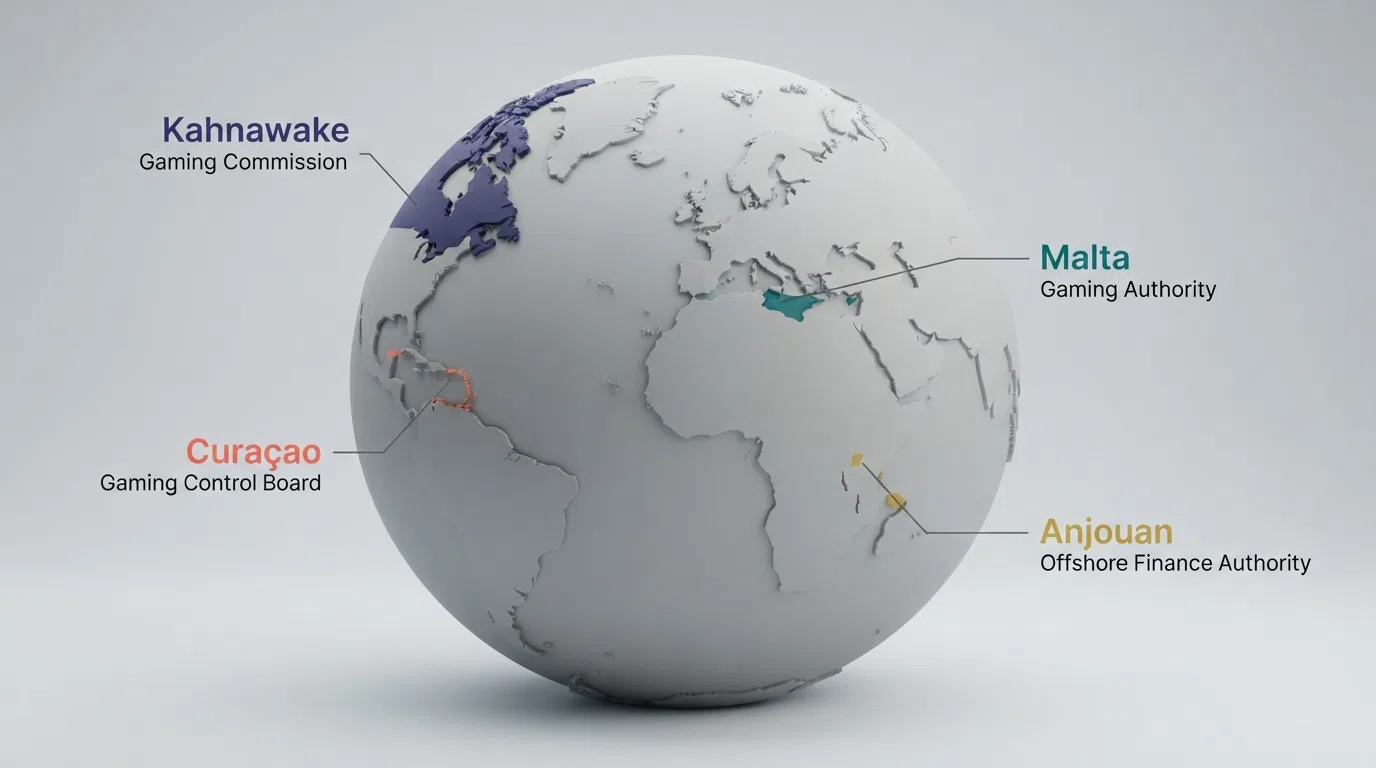
Four jurisdictions account for almost every non-UK licensed casino a UK player will encounter. Curaçao, Malta, Anjouan and Kahnawake differ in tax, audit rigour, application timeline, and the level of player protection they require. A licence number in a casino’s footer is the only signal many players check; the four jurisdictions are not equivalent signals, and the differences matter.
Curaçao: The Dominant Offshore Licence, Rebuilt Under LOK
Curaçao is the most common licence among non-UK casinos targeting UK players, and the reason is simple arithmetic. The Curaçao Gaming Control Board, the regulator under the reformed LOK framework, charges 0% gaming tax, runs a 6 to 12-month application timeline, and conducts biennial plus on-demand audits. The cost of entry is low and the speed is faster than the MGA’s. Almost every featured operator in this ranking holds a Curaçao licence for that reason.
What Curaçao does not require is the more important question. There is no mandatory responsible-gambling toolkit, no affordability check framework, and a dispute-resolution process that does not include a binding player-facing mechanism of the kind the MGA and UKGC mandate. The 0% tax rate is genuinely attractive to operators, and the absence of mandatory player-protection infrastructure is the cost the player pays for it. The jurisdiction is rebuilding its regulatory reputation after the LOK reform, and that work is ongoing.
The cautionary tale sits in the operator’s bankruptcy. The operator migrated its licence from Curaçao to Anjouan in 2024, but a Curaçao Court of First Instance declared it bankrupt in November 2025 over approximately $2.5 million in unpaid player claims, and it withdrew its Curaçao licence in December 2025. The case shows what a Curaçao licence does and does not guarantee. It licensed a company that owed players money. It did not ensure the players were paid. The Santeda group, which operates MyStake, Velobet, Donbet, Rolletto, Goldenbet and Cosmobet, all Curaçao-licensed, has been described in industry coverage as a “black market operator” targeting UK players; the description is not a regulator finding but a market observation, and it is part of the wider picture of who chooses Curaçao and why.
MGA / Malta: The EU Gold Standard Among Offshore Regulators
The Malta Gaming Authority is the strongest non-UK licence a UK player can encounter. The MGA’s public register lists 311 licence records, 302 of them active, and is searchable by licensee name, authorisation status, URL or gaming service. The MGA demands annual plus unannounced audits, charges a 5% GGR tax, and runs a 6 to 12-month application timeline. The cost is the highest among offshore regulators and the timeline is among the longest, which is why most MGA-licensed operators also hold, or seek, a UKGC licence if they want GB customers.
For a player, the MGA badge is the strongest trust signal outside the UKGC. The regulator’s EU recognition, banking access, and audit rigour together produce a higher floor than any other non-UK jurisdiction. MGA-licensed casinos are rare in non-UK rankings targeting UK players for a structural reason: an operator that has done the work to earn an MGA licence has usually done the work to earn a UKGC licence too, and the MGA-only operator is unusual. When one does appear, it is worth the extra verification step.
Anjouan: Cheap, Fast, and Under Official Scrutiny
Anjouan, in the Union of the Comoros, offers the cheapest and fastest path to an offshore e-gaming licence: 0% GGR tax and a 3 to 4-month application timeline. The jurisdiction has appeared more frequently in operator footers since 2024, partly because of operators migrating from other jurisdictions.
The Anjouan Offshore Finance Authority was named by the Comorian Ministry of Finance on 10 December 2025 as conducting illegal offshore banking activity, with the matter referred to prosecutors. The statement is not a UK regulator finding; it is the licensing jurisdiction’s own government questioning the body that issues the licence. For a player, the practical question is what enforcement capacity Anjouan has when an operator fails to pay. The answer, on the public record, is limited. The case of a major operator’s migration from Curaçao to Anjouan in 2024 illustrates the pattern: an operator that ran into trouble elsewhere, looked for a cheaper home, and found one. A licence is a regulator’s promise to enforce its rules, and a regulator under government scrutiny at home is unlikely to be the one a UK player wants to rely on for a disputed withdrawal.
Kahnawake: The Long-Standing Niche Alternative
The Kahnawake Gaming Commission is one of the oldest alternative licensing bodies, based in a Mohawk territory in Quebec, and has issued licences to a narrower set of operators over a longer period than most offshore jurisdictions. Its adoption among UK-facing non-UK casinos is small, and it appears in keyword data far more often than it appears in operator rankings for this market. The reason is partly historical: Kahnawake’s regulatory style sits closer to a North American market focus, and the operators it licences have not built the kind of UK-facing marketing infrastructure that the Curaçao-licensed brands have. The comparison to Curaçao is straightforward on the dimensions a player cares about: similar cost and compliance burden, a longer track record, similarly limited player-recovery mechanisms. Kahnawake is mentioned here to complete the landscape, not because it is a likely choice for a UK player.
How to Weigh One Offshore Jurisdiction Against Another
Four dimensions separate a meaningful licence from a marketing badge. The first is regulatory independence: is the regulator a separate body with its own budget and powers, or an arm of the operators it licences? The second is audit frequency and rigour: annual plus unannounced visits, as the MGA runs, is a different floor from biennial plus on-demand, as Curaçao runs. The third is dispute resolution: is the process binding and player-facing, as the MGA and UKGC offer, or informal and operator-sided? The fourth is enforcement track record: when an operator failed, did the regulator’s machinery return money to players, or did it document the failure and move on? The case of the bankrupt operator sits on that fourth dimension, and the answer it offers is the answer a player should carry into any Curaçao-licensed casino.
Offshore Licence Comparison: Curaçao vs MGA vs Anjouan vs Kahnawake
| Jurisdiction | Regulator | GGR Tax | Audit Frequency | Player Protections | Dispute Resolution | Application Timeline |
|---|---|---|---|---|---|---|
| Curaçao | Curaçao Gaming Control Board (GCB) | 0% | Biennial + on-demand | No mandatory RG toolkit; no affordability checks | Process exists; lacks binding player-facing mechanism | 6–12 months |
| Malta | Malta Gaming Authority (MGA) | 5% | Annual + unannounced | EU recognition; strong banking access | Binding, player-facing; ADR-style | 6–12 months |
| Anjouan | Anjouan Offshore Finance Authority (AOFA) | 0% | Limited public detail | No mandatory RG toolkit; AOFA under Comorian government scrutiny | Limited; no recovery track record | 3–4 months |
| Kahnawake | Kahnawake Gaming Commission | Not stated | Not stated in research | Niche regulator; limited UK adoption | Limited public detail | Not stated |
The table leaves real gaps on Kahnawake, because the public record on the jurisdiction is thinner than on the other three, and because a UK player is unlikely to face the choice. A research-anchored page does not paper over those gaps with a guess; the cells stay empty rather than wrong.
Top Offshore Casino Brands Ranked for 2026
The ranking below covers ten offshore-licensed casinos that target UK players. All hold Curaçao licences. None hold a UKGC licence. None participate in GAMSTOP. The ranking is ordered by fit to the keyword topic, by bonus terms that a UK player can act on, and by the breadth of the game catalogue; it is not ordered by market share, and the operators are not equal in how honestly their offers are written. Each write-up below ends with a verdict for a specific reader, because the choice depends on what a player values, and one casino cannot be the best for everyone.
Non-UK Licensed Casino Comparison: 2026
| Operator | Licence | Welcome Bonus | Wagering | Free Spins | Min Deposit |
|---|---|---|---|---|---|
| MyStake | Curaçao GCB (Santeda International B.V.) | 150% up to £750 (300% up to £1,500 across 3 deposits) | 30× | 30 no-deposit | £20 |
| Velobet | Curaçao GCB (Santeda International B.V.) | 150% up to £500 + 70 FS (or 100% up to £1,000 + 70 FS at £500+); 160% up to €1,000 crypto | 30× casino / 35× crypto | 70 | £20 |
| Donbet | Curaçao GCB (Santeda International B.V.) | 150% up to €750 + 50 FS (or 170% up to €1,000 + 100 FS crypto) | 30× combined | 50 / 100 crypto | €20 |
| Rolletto | Curaçao GCB (Santeda International B.V., OGL/2024/1798/1048) | 150% up to £500 + 200 FS (50 instant + 30/day for 5 daily logins) | 30× | 200 | £20 |
| Goldenbet | Curaçao GCB (Santeda International B.V., OGL/2024/1587/0365) | 300% up to £1,500 across 3 deposits + 100 bonus spins | 35× | 100 | £20 |
| Freshbet | Curaçao eGaming (OGL/2024/1800/1049) | 300% up to £3,000 across 3 deposits + 200 FS | 30× welcome / 40× no-deposit FS | 200 + 25 no-deposit | £20 |
| Jackbit | Curaçao eGaming (1668/JAZ, Ryker B.V.) | 100 FS wager-free on Hot Chilli Bells | 0× on FS; 1× deposit + winnings to withdraw | 100 | £50 |
| Cosmobet | Curaçao GCB (Santeda International B.V., OGL/2024/1798/1048) | 100% up to €500 + 250 FS | 30× on bonus + 30× on FS winnings | 250 | €20 |
| Winstler | Curaçao eGaming (5536/JAZ, Favorit United N.V.) | 600% up to €9,500 across 5 deposits | 45× | Not specified | €25 |
| Winz | Curaçao eGaming | Spin-to-win: Bronze (€25 up to €2,000) / Silver (€50 up to €4,000) / Golden (€100 up to €10,000) | 0× | Included in spin prizes | €25 |
MyStake — 6,000+ Games and a 150% Welcome Bonus
MyStake is the Santeda group’s flagship, licensed by the Curaçao Gaming Control Board through Santeda International B.V. and operating since 2020. The headline offer is a 150% match up to £750 on the first deposit, extending to a 300% match up to £1,500 across the first three deposits, plus 30 no-deposit free spins on registration. Wagering on the bonus amount is 30×, with 30 days to clear and a £20 minimum deposit. The game catalogue is the largest in the ranking at 6,000+ titles, with major providers including Pragmatic Play, NetEnt and Evolution in the mix. MyStake is a casino-and-sportsbook hybrid, which is a feature for a player who wants both under one account and an inconvenience for a player who wants to keep the two budgets separate. The verdict for a UK player: this is the volume play, the operator that wins on catalogue size and on having every game type on one site, and the right choice for a player who values breadth over bonus terms.
Velobet — Casino-Meets-Sportsbook with a Crypto Track
Velobet runs a tiered welcome bonus through the same Curaçao GCB licence held by the Santeda group. For a first deposit under £500, the casino track is 150% up to £500 plus 70 free spins; for £500 or more, the casino track becomes 100% up to £1,000 plus 70 free spins. A separate crypto track offers 160% up to €1,000. Wagering is 30× on the casino bonus and 35× on the crypto bonus, and free-spins winnings are capped at £100. The £20 minimum deposit is standard for the group, and the provider list includes Pragmatic Play, Evolution and NetEnt. Velobet is the right choice for a UK player who wants a fiat-and-crypto bonus under one roof, and who reads the wagering terms carefully enough to understand that the 35× crypto multiple is a higher cost than the 30× casino multiple, regardless of the headline size.
Donbet — 150% Casino Bonus with a Crypto Alternative
Donbet is another Curaçao GCB-licensed Santeda group brand, with a casino welcome bonus of 150% up to €750 plus 50 free spins and a crypto welcome bonus of 170% up to €1,000 plus 100 free spins. Wagering is 30× combined on deposit, bonus, and free-spin winnings, which is the structure that makes a “combined” multiple harder to estimate than a bonus-only multiple; a player who reads the standard 30× figure and assumes it applies only to the bonus is in for a surprise. The minimum deposit is €20. Maximum cashout from the offer is not specified in the public sources reviewed. Donbet suits a UK player who values the multi-sport and casino breadth of the Santeda group, and who reads “combined wagering” as a code for a higher cost than the headline alone suggests.
Rolletto — 200 Free Spins and a 150% Welcome Match
Rolletto carries Curaçao GCB licence OGL/2024/1798/1048 through the Santeda group, launched 2020, and runs a welcome bonus of 150% up to £500 plus 200 free spins — 50 instant and 30 per day for five daily logins. Wagering on the bonus is 30×, with 30 days to clear, a £20 minimum deposit, and a maximum cashout from the offer of 10× the bonus amount for standard players, with higher or uncapped limits for VIP tiers. The 200 free spins is the highest spin count on a single welcome in the Santeda stable, and the daily drip is the part a player has to plan around: claiming and not logging in for five days leaves 120 spins on the table. Rolletto is a solid pick for a UK player who prioritises free-spin volume and is comfortable managing the daily login structure required to claim the full offer.
Goldenbet — 300% Across Three Deposits
Goldenbet is Curaçao GCB-licensed under OGL/2024/1587/0365 through the Santeda group, with a welcome package of 300% up to £1,500 across three deposits plus 100 bonus spins. Wagering is 35× on the bonus, slightly above the 30× that dominates the rest of the group, and the maximum cashout from the offer is not specified in the public sources reviewed. The 300% headline is the highest match percentage in the Santeda stable, and the trade is the higher multiple: a £50 first deposit becomes £200 in bonus funds that must be wagered 35×, or £7,000 of turnover, before any of it is withdrawable. The right pick for a UK player who values the percentage headline and who has read the wagering terms closely enough to know what 35× does to a 300% match.
Freshbet — 300% up to £3,000 and 200 Free Spins
Freshbet holds Curaçao eGaming licence OGL/2024/1800/1049, with a game catalogue of 3,000+ slots plus live dealer and mini-games. The welcome package is 300% up to £3,000 across three deposits (150% + 100% + 50%) plus 200 free spins, with an additional 25 no-deposit free spins on registration. Wagering is 30× on the welcome bonus and 40× on the no-deposit free spins winnings; the cap on those no-deposit winnings is not specified in the public sources reviewed, and a cap is the more common structure at this end of the market. The minimum deposit is £20. Freshbet is a strong contender for a UK player seeking the largest total bonus package in the ranking, provided they account for the significant turnover requirements generated by a 300% match at 30× wagering.
Jackbit — Wager-Free Spins and a Crypto-Native Platform
Jackbit is the only featured operator offering zero-wagering free spins. The platform launched in 2022 under Curaçao eGaming licence 1668/JAZ, operated by Ryker B.V., and is built crypto-native, with 7,000+ games including provably fair titles. The welcome offer is 100 free spins on Hot Chilli Bells, wager-free; the 0× wagering on the spins means the winnings are bonus balance, withdrawable after a 1× turnover of the deposit plus winnings. The minimum deposit is £50, which is the highest in the ranking and a deliberate filter: Jackbit is built for a player who deposits in Bitcoin or Litecoin and wants the crypto experience end-to-end, not as an add-on. The verdict for a UK player: this is the cleanest offer in the ranking, the one that does the least to dress up the small print, and the right pick for a crypto-first player who values transparent terms over the largest bonus.
Cosmobet — 250 Free Spins with a 100% Welcome Match
Cosmobet runs the Curaçao GCB licence OGL/2024/1798/1048 through the Santeda group, with a 100% welcome match up to €500 plus 250 free spins. Wagering is 30× on the bonus amount and a separate 30× on the free-spin winnings, which is the structure that doubles the effective turnover a player must clear before the offer converts. The minimum deposit is €20. Cosmobet is an attractive option for a UK player who values a higher volume of free spins, though it requires careful management of the distinct wagering requirements that apply to the bonus and the spins.
Winstler — 600% up to €9,500 Across Five Deposits
Winstler is the largest headline number in the ranking: 600% up to €9,500 across five deposits, with the breakdown 300% up to €500 + 100% up to €1,000 + 100% up to €2,000 + 100% up to €2,500 + 100% up to €3,500. The Curaçao eGaming master licence 5536/JAZ is held by Favorit United N.V., and the operator launched in October 2022. Wagering is 45×, the highest multiple in the ranking, and the maximum cashout from the offer is not specified in the public sources reviewed. A first deposit of €500 turns into €2,000 in bonus funds that must be wagered 45×, which is €90,000 of turnover before anything is withdrawable. The arithmetic is what the marketing word “600%” obscures, and the verdict for a UK player is that the largest number in the ranking is also the most expensive number in the ranking, once the wagering is multiplied through. A player who values the headline above all else will pick Winstler; a player who reads the small print should not.
Winz — Zero-Wagering Prizes with a Spin-to-Win Mechanic
Winz is the second zero-wagering offer in the ranking and the more unusual structure. The welcome is a spin-to-win wheel with three tiers: Bronze at a €25 deposit with prizes up to €2,000, Silver at €50 up to €4,000, and Golden at €100 up to €10,000. Wagering is 0× on all prizes, there is no time limit, no maximum bet cap, and no maximum cashout. The 7,140+ game catalogue is the largest after Jackbit, and the platform holds a Curaçao eGaming licence. The verdict for a UK player: this is the cleanest bonus structure in the ranking, the only one that combines zero wagering with no time limit and no cashout cap, and the right pick for a player who values certainty over size.
Why Crypto Casinos Almost Always Carry an Offshore Licence
Crypto gambling and UKGC licensing are fundamentally incompatible. The UKGC requires identity verification before the first deposit, and pre-deposit identity verification is exactly what crypto users are usually trying to avoid. The two requirements cannot be reconciled inside a single licence. Every crypto casino a UK player encounters is, by definition, non-UK licensed, and most hold a Curaçao licence because Curaçao’s regulator imposes no mandatory responsible-gambling toolkit, no affordability checks, and runs a 0% gaming tax on a jurisdiction that is openly crypto-friendly. Jackbit, Velobet and Donbet are the three featured operators that lean into the crypto track, and Jackbit is the one that builds the entire product around it.
No-KYC Crypto Casinos — How They Work and What You Trade Away
A no-KYC casino accepts a cryptocurrency deposit, lets the player play, and processes a withdrawal in the same currency, without the player submitting identity documents at any point. The model is technically legal under the casino’s licensing regime, and the UKGC framework makes it impossible under a UKGC licence. The trade is what the player gives up for the convenience. No identity check means no way to prove you are you in a dispute. No responsible-gambling intervention is triggered by deposit patterns. No self-exclusion enforcement runs in the background. The cryptocurrency dimension is genuine: Bitcoin and Litecoin casinos that accept UK players exist, and all operate under Curaçao or equivalent licences. The marketing word “anonymous” and the contract the player signs are not the same, and the difference is everything a UK player relies on at a UKGC site.
How to Check a Non-UK Casino’s Licence — and Spot a Fake
A licence number in a casino footer is the start of a check, not the end of one. Three regulators run public registers a player can search in under a minute, and the register entry should match what the casino’s footer claims. The verification step is the one thing a player can do in seconds that meaningfully changes the risk of the deposit.

How to Verify a Casino’s Licence — Step by Step, Regulator by Regulator
For a UKGC licence, the public register on the Commission’s website allows a search by operator name or URL, and the entry should list the licence number, status, and authorised activities. The licence status must be active, not suspended, cancelled, or lapsed. For an MGA licence, the public register lists 311 records, 302 of them active, searchable by licensee name, authorisation status, URL, or gaming service, and the entry should match the operating company behind the casino, not just the brand name. For a Curaçao GCB licence under the LOK framework, the register is post-reform and verifies direct operator licensing rather than the old master-licence structure; an entry referencing a master licence that no longer exists is a red flag, not a green light.
The universal step runs across all three. The licence badge on the casino’s website, usually at the foot of the homepage, should be a clickable link that opens the regulator’s own register entry. If the link goes to the casino’s own homepage, to a static image, or to a 404, the licence is not what the footer claims it is.
Red Flags — Signs a Casino’s Licence Is Fake, Lapsed, or Misleading
- The licence badge links to the casino’s homepage instead of a regulator page.
- The licence number cannot be found on the regulator’s public register.
- The certificate shows an expired or revoked licence.
- The casino claims a licence from a regulator that does not license online gambling.
- The operator’s name on the certificate does not match the name on the casino’s terms and conditions.
- The licence is from a master-licence holder that no longer exists or whose sub-licence arrangement has been terminated.
- Player reviews consistently report withheld withdrawals with no regulator response — a pattern, not an isolated complaint.
The seventh point is the one that catches what the register cannot. A register entry tells a player the licence is real and active. It does not tell a player whether the operator pays out, and the public record on Curaçao in particular is mixed. The case of that bankrupt operator is the most prominent recent example: a Curaçao-licensed operator declared bankrupt with $2.5 million in unpaid player claims, licence withdrawn, regulator’s process documented but player money not returned. The register is a floor, not a guarantee. Nearly three in ten UK bettors cannot tell when a site is illegal, and the Anjouan Offshore Finance Authority has been named by its own government for illegal activity, which means the difficulty of verification is not theoretical.
Staying Safe Without the UKGC: Responsible Gambling at Non-UK Casinos
The responsible-gambling infrastructure at a non-UK casino is whatever the operator chooses to build. None of the UKGC’s mandatory tools are mandatory offshore, and the tools that exist are voluntary, single-operator, and inconsistent across the market. A UK player who wants the protection of a multi-operator self-exclusion scheme, a deposit-limit prompt, or a financial vulnerability check has to self-manage what the UKGC system enforces automatically.
What Responsible-Gambling Tools Non-UK Casinos Offer — and What They Don’t
Some non-UK casinos provide deposit limits (daily, weekly, monthly), session time reminders, reality checks, and operator-level self-exclusion. The pattern is uneven: a player can find a Curaçao-licensed casino with a clean deposit-limit tool and a 24-hour reality check, and a different Curaçao-licensed casino with neither. The tools exist where the operator has decided to build them, and there is no regulator enforcing a minimum.
What is universally absent at non-UK casinos is the multi-operator self-exclusion that GAMSTOP provides. No Curaçao, MGA, Anjouan or Kahnawake scheme is integrated across operators, and the operator-level self-exclusion only covers the one brand. There is no equivalent to the UKGC’s mandatory deposit-limit prompt before the first deposit, and no equivalent to the financial vulnerability check at the £150 net-deposit threshold. A player at a non-UK casino is responsible for setting the limits the UKGC system would have asked them to set, and the only self-exclusion that follows them across operators is the one they impose on themselves with blocking software.
Where to Get Help — Helplines, Clinics, and Blocking Tools
The UK help infrastructure works regardless of where a player gambles. The National Gambling Helpline, on 0808 8020 133, is free, runs 24/7, and is operated by GamCare with live chat and treatment referral. GamCare itself offers free counselling and runs the National Gambling Support Network. NHS gambling treatment clinics accept self-referral in England, Scotland and Wales, and the numbers tell the story: NHS gambling treatment referrals reached 4,355 in 2024/25, up from 2,284 in 2023/24, nearly doubling in a single year. GamCare’s National Gambling Helpline made 996 referrals to treatment and peer-based support in January 2026, up 48% from 674 in January 2025.
The prevalence context is real. In 2024, 2.7% of adults aged 18 and over in Great Britain scored 8+ on the Problem Gambling Severity Index, statistically stable against 2023; 47% had gambled in the past four weeks, 27% excluding lottery-only players. The NHS Adult Psychiatric Morbidity Survey 2023/24 puts problem gambling at 0.4% of adults on the same PGSI 8+ threshold. GAMSTOP has over 530,000 registered users. For a player who is registered with GAMSTOP and is reading this page, a non-UK casino does not enforce the self-exclusion they signed up for, and blocking software such as Gamban is the recommended complement to extend that protection offshore. The 2.7% PGSI 8+ figure is a population statistic; the referrals to GamCare and the NHS are a count of people who decided to ask for help, and the doubling is a reminder that the help exists, that it is in use, and that the earlier in a problem it is reached, the more it can do.
How We Evaluated These Non-UK Licensed Casinos
The ranking draws on the public record available across the UK-facing non-UK casino landscape. Operator review pages, regulatory filings, and published enforcement data were reviewed against the UK Gambling Commission’s public register and the Malta Gaming Authority’s public register. Each operator’s licence status was checked against the regulator’s register where one was accessible, and the bonus terms were taken from the operator’s own published terms pages at the time of review. The ranking covers ten operators drawn from the Santeda group — MyStake, Velobet, Donbet, Rolletto, Goldenbet and Cosmobet — plus four picks: Freshbet, Jackbit, Winstler and Winz.
The limitations are real. Licence dates were not independently confirmed on the regulator registers for every operator this run; the ranking reflects publicly available terms and review data, not a mystery-shopping exercise, and the welcome offers listed are subject to change. The featured set is not the entire market. The Curaçao, MGA, Anjouan and Kahnawake sections cover the jurisdictions a UK player is most likely to encounter, not every jurisdiction that issues a gambling licence. The verification workflow in the section above works only if the player does the verification: a register entry is information, not protection. The ranking is ordered by fit to the keyword topic and by the bonus terms a UK player can act on, and not by any commercial arrangement.
What UK Players Should Actually Do About Non-UK Licensed Casinos
The honest trade-off is the entire page in one paragraph. A non-UK licensed casino offers bigger bonuses, no £5/£2 stake cap, credit card deposits, cryptocurrency rails, and a wider catalogue of game types. It offers, in return, no GAMSTOP coverage, no UKGC complaints route, no approved ADR provider, no mandatory deposit-limit prompts, no financial vulnerability checks, no identity-verified-at-deposit discipline, and no British consumer redress. The marketing word and the contract are not the same, and the difference is the cost.
The jurisdictional risk gradient runs from MGA at the top to Anjouan at the bottom. An MGA licence carries EU regulatory recognition, annual and unannounced audits, and a binding player-facing dispute process. A Curaçao licence carries lighter infrastructure, a mixed enforcement record, and the precedent of $2.5 million in unpaid claims. An Anjouan licence is under active government scrutiny by the Comorian Ministry of Finance, with no enforcement track record on the public record. The gradient is what a player is buying when they pick a jurisdiction over another, and the gradient is not always visible in the licence number alone.
The self-exclusion reality is binary. A player registered with GAMSTOP can open an account at a non-UK casino and deposit within the hour, because the operator is not part of the scheme. If self-exclusion matters, the only way to keep it working offshore is to add blocking software. GAMSTOP alone does not block non-UK casinos. The 84% figure for unlicensed casino promotions featuring the phrase “Not on GamStop” is not a coincidence; it is the business model.
The money question is the easiest part. UK players pay no tax on gambling winnings regardless of where the casino is licensed; the player-side duty was abolished in 2001, and the burden is wholly on operators. The harder money question is what happens when a non-UK casino withholds a withdrawal. The answer runs through a foreign legal process under foreign law, and the public record on player recovery from Curaçao or Anjouan is thin enough that “I would not deposit what I cannot afford to lose” is not a slogan; it is the actual risk model.
The bottom line is not that a non-UK licensed casino is a scam. Most of the operators in the ranking are real businesses, and several of the bonus offers are honestly written. The bottom line is that a non-UK licensed casino is, by definition, a jurisdiction where the player, not the regulator, carries the burden of due diligence. The bigger bonus is the price of the bigger burden, and the price is paid in the wagering terms, in the absence of self-exclusion, in the lack of a binding complaints route, and in the foreign-law reality of any dispute. A UK player who can afford to lose the deposit, who has set their own limits, who has verified the licence, and who is not registered with GAMSTOP, is the reader this market is built for. A UK player who cannot tick all four should stay inside the UKGC system, where the limits are automatic and the regulator is a destination, not a footnote.
Frequently Asked Questions
Are my gambling winnings still tax-free if I play at a non-UK casino?
Yes. UK players pay no tax on gambling winnings regardless of where the casino is licensed. The player-side duty was abolished in 2001, and the tax burden sits entirely on operators through Remote Gaming Duty. Tax status does not change when a player moves offshore, so a withdrawal from a Curaçao-licensed casino is treated the same as a withdrawal from a UKGC-licensed one for UK tax purposes.
Do non-UK casinos accept UK debit cards and bank transfers?
Most do. UK debit cards and bank transfers are widely accepted at Curaçao- and MGA-licensed casinos, and the credit card ban that applies under LCCP 6.1.2 from 14 April 2020 does not extend to non-UK operators. A UK player who wants to use a credit card or a credit-card-funded e-wallet will find that route open at a non-UK casino and closed at a UKGC one.
Why would a UK player choose a non-UK licensed casino over a UKGC site?
The reasons most UK players cite are bonus size, stake limits, payment flexibility, and game catalogue. Non-UK casinos run 30× to 45× wagering against the UKGC’s 10× cap, but the headline bonus numbers are larger; the £5/£2 per-cycle stake cap does not apply; credit cards and credit-card-funded e-wallets are accepted; and the catalogues often include game types or providers the UK market does not carry. The trade is every UKGC protection listed in the section on what you leave behind.
Can I self-exclude from non-UK casinos if I am registered with GamStop?
GAMSTOP is mandatory only for UKGC-licensed operators, and the scheme does not reach non-UK casinos. A player registered with GAMSTOP can open an account and deposit at a Curaçao- or Anjouan-licensed casino the same day, because the operator is not part of the scheme. The recommended complement for UK players who want self-exclusion to follow them offshore is blocking software such as Gamban, which the player installs on their own device.
What can I do if a non-UK casino withholds my winnings?
The route runs through the casino’s own complaints process first, then through the offshore regulator’s dispute process. For an MGA-licensed casino, the process is binding and player-facing, which is the best non-UK outcome. For a Curaçao-licensed casino, the regulator’s process exists but lacks a binding player-facing mechanism of the kind the MGA and UKGC provide, and the player’s effective remedy is the threat of escalation. For an Anjouan-licensed casino, the regulator is under its own government’s scrutiny and the public record on player recovery is thin. UK consumer law and the UKGC complaints process do not apply, and a player pursuing a claim in a foreign jurisdiction under foreign law is paying for the right to do so in legal time and cost.
Licence – nodeposit-casinobonuses-uk
Content created by the «nodeposit-casinobonuses-uk» team