No Minimum Deposit Casino UK: What "No Minimum" Actually Means and Where to Play for Real from £1
 Available in GB
“No minimum deposit” is a phrase the search engines reward and no UK operator fulfils. Every UKGC-licensed online casino has a deposit floor, and the lowest one currently stands at £1 — accepted by a small number of brands only. The closest the licensed market gets to a genuine zero-cost entry is a no-deposit free spins offer, and only three operators in our featured set provide one. Anyone searching for a true £0 deposit casino in the UK is, in practice, searching for the lowest minimum deposit, the best no-deposit free spins, or both. This page covers all three.

Data current as of September 8, 2026. Licence claims verified against the UK Gambling Commission’s public register of operating licence holders, last updated 29 July 2026.
What “No Minimum Deposit” Means at a UK Online Casino — and What It Does Not
The phrase is a search convention, not a product description. A player types “no minimum deposit casino UK” and expects to find somewhere to play for as little as possible. The operators that surface in response understand the intent, and they advertise accordingly — most prominently, those whose general minimum sits at £1 or £5, and the handful that layer a no-deposit free spins package on top. The gap between the query and the reality is small but firm: no UK casino accepts a £0 deposit.
Bojoko put it plainly: “No UK casino accepts a £0 deposit. Right now, the lowest deposit limit available is £1 at a small number of UKGC-licensed sites.” That is the operational floor of the licensed UK market as of 2026, and it exists for structural reasons rather than commercial ones.
The reason is the licensing regime. A UKGC operating licence binds the operator to identity verification, anti-money-laundering checks, and source-of-funds procedures that must complete before the first deposit. The Commission requires that identity be verified before any gambling takes place — anonymous play is not possible at a licensed GB site. A £0 deposit would not just be commercially awkward; it would short-circuit the regulatory architecture that admits a player to the site in the first place. The £1 minimum is not generosity, it is the smallest amount the operator can accept while still processing a real-money transaction through a regulated payments channel.
Players who arrive at a “no minimum deposit” page expecting to stake real money without funding an account should expect a redirect. The genuine no-money-down options are the no-deposit free spins offers at Sky Vegas, Paddy Power, and Betfair — discussed in the ranking below — and even those are subject to the same identity verification before any winnings can be withdrawn.
Online vs Land-Based — Where the Zero-Minimum Gap Lives
Land-based UK venues can offer coin-drop stakes, accept a £1 note at a roulette wheel, and operate on a model where the cost of admitting a customer is negligible. A slot machine in a bookmaker’s shop will take a 5p coin. The digital equivalent cannot match that for a structural reason: the operator’s regulatory cost is incurred before the player plays, not after they pay.
A UKGC-licensed online operator must verify identity before first deposit or any gambling. That involves document checks, sanctions screening, and (above certain thresholds) source-of-funds verification. The processing cost of a £0 deposit is the same as the processing cost of a £1,000 deposit — the identity work happens regardless. The £1 floor reflects the smallest amount the regulated payment rails will accept at the deposit stage once the regulatory work is complete, not a marketing decision about how low to pitch the welcome offer.
This is also why the no-deposit free spins model exists: it gives the operator a way to let a player sample the product without a deposit, while keeping the regulatory perimeter intact. The spins are credited, played, and any winnings then subject to the standard verification and withdrawal process. No money has changed hands at the entry point, so no money-laundering or payment-processor risk attaches to the offer itself. The cost is borne by the operator, the player gets a free look, and the regulator’s framework is preserved.
Real-Money Play at the Lowest UK Deposit Tiers
A £1 deposit buys very little, but it buys a real-money session. At the statutory maximum stake of £1 per spin (well below both the £5 cap for players aged 25 and over and the £2 cap for 18–24-year-olds), a £1 deposit lasts exactly one spin. At 10p per spin — the most common denomination on free-spins offers — it lasts ten. The “value” of a tiny deposit is therefore not in what it buys in absolute play time, but in what it unlocks: a welcome offer, a no-deposit free spins top-up, or simply a session on a small budget.
The distinction between depositing small and playing for real money is the one that matters. A £1 deposit at a UKGC-licensed site is a real-money transaction on a regulated platform, subject to the full suite of safer-gambling tools, the UKGC complaints process, and the statutory protections that come with a licence. The “no minimum deposit” search is, at root, a search for that legitimate experience at the lowest possible entry cost.
To illustrate what a low deposit actually buys in session terms, consider a £10 deposit at 10p per spin on Big Bass Bonanza, a slot with an average RTP of 96.71% and high volatility. One hundred spins is the typical session length that deposit would fund. The expected loss on that session, calculated as spins × stake × (1 − RTP), is roughly £0.33 — about 3.3% of the deposit. That figure is a long-run average; any individual session can swing wildly, especially on a high-volatility title where long dry spells are punctuated by infrequent but larger wins.
Low-Deposit vs No-Minimum — Where UK Casinos Actually Sit in 2026
The UK low-deposit market in 2026 sits on a sliding scale rather than at a single point. At the bottom, Lottoland and PricedUp accept £1. Midnite sits at £5, which is the most common low-deposit floor in the featured set. The bulk of the market sits at £10, where the major high-street brands — bet365, William Hill, Ladbrokes, Coral — draw their line. None sit at £0.
The £1 tier is small. One operator in the featured set, and a handful more outside it, is willing to process a £1 deposit; the rest of the market has settled on £5 or £10 as the floor that balances regulatory cost against player acquisition economics. The £10 tier is effectively the industry standard for a welcome offer trigger — the amount a player must deposit to unlock the headline package. It is also the amount at which the credit-card ban (since 14 April 2020) and the deposit-limit prompt (mandatory from 31 October 2025) become the dominant friction points rather than the entry cost itself.
A true £0 deposit casino is not licensable in Great Britain. Anyone encountering one in search results is either looking at an offshore operator (covered in the section on what you give up outside the licensed market) or at a no-deposit free spins offer dressed up as something it is not.
The Best Low-Deposit Casinos in the UK for 2026 — Compared
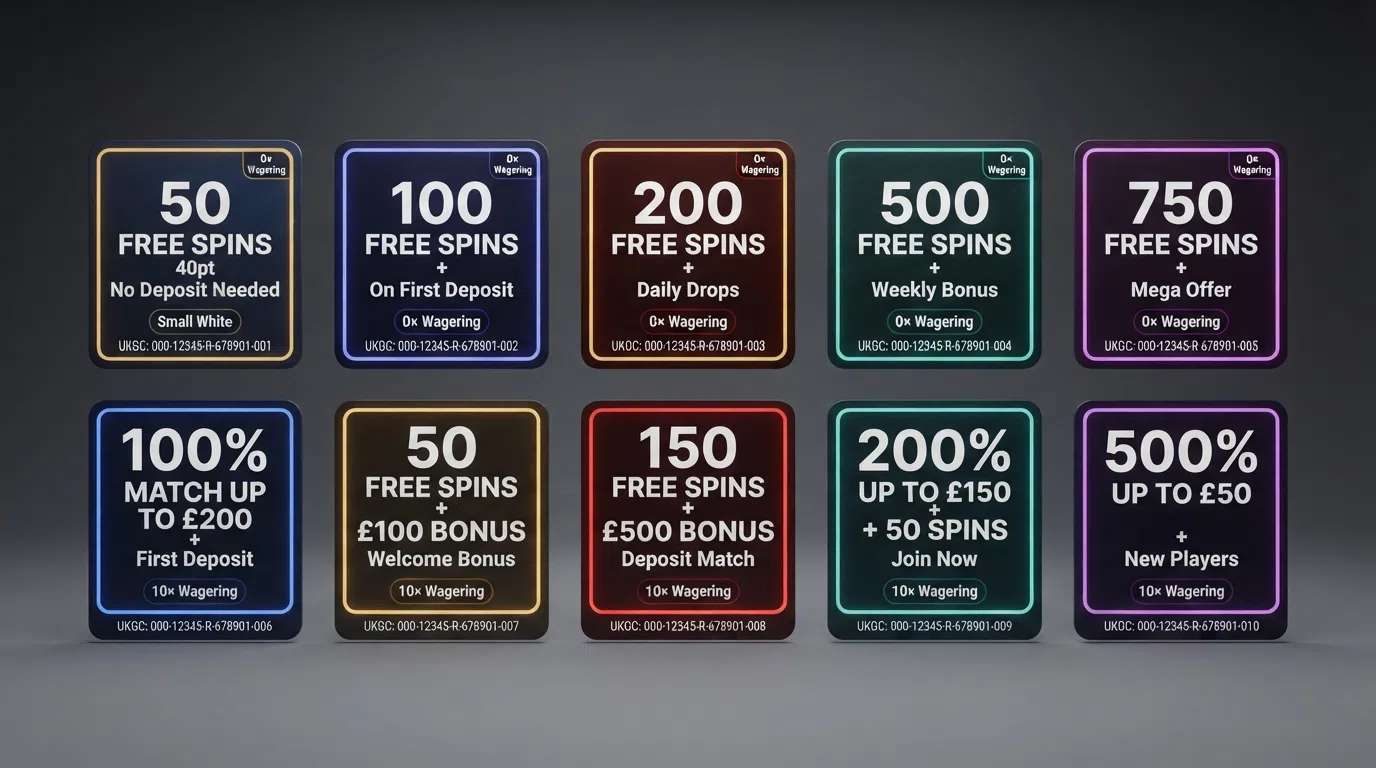
The table below ranks the ten featured UKGC-licensed operators by their current low-deposit welcome offers. Wagering is stated on the free-spins winnings, not on the deposit itself — the UKGC cap of 10× (in force from 19 December 2025) applies to the bonus amount, not to a deposit the player can withdraw at any time. Full licence details sit on the UKGC public register, which is the definitive verification source for any claim a brand makes about its licensing.
| Casino | UKGC Licence | Welcome Offer (2026) | Wagering on Winnings | Stand-out Feature |
|---|---|---|---|---|
| bet365 | 55149 | Up to 500 free spins on Book of Horus, Curse of the Bayou, Magic Forge, Wrath of the Deep | 0× | Largest spin package in the set; 0× wagering on a 500-spin ceiling |
| Sky Vegas | 65519 | 50 no-deposit spins + up to 200 on £10 stake | 0× | Genuine no-deposit entry; 0× wagering on the full 250 spins |
| Paddy Power | Flutter group (PPB) | 60 no-deposit + 200 on £10 wager | 0× | Most no-deposit spins in the set (60); 0× on all 260 |
| Betfair | Betfair Limited | 50 no-deposit wager-free + 100 on £10 play | 0× (no-deposit) / 10× (deposit half) | Split structure; tight 72-hour expiry on both halves |
| William Hill | 39225 | 200 free spins on Big Bass Splash on £10 stake | 10× | Big headline number with a £30 cashout cap |
| PricedUp | 1776 | 90 spins on Big Bass Bonanza on £30 wager | 10× | £1 general minimum deposit; most recent casino licence in the set |
| Midnite | 42647 | 150 no-wager spins on £20 wager | 0× | Clean no-wagering promise on a £5 deposit floor |
| MrQ | 60629 | Up to 300 spins (75/day on 4 × £10 deposits) | 0× | Site-wide 0× wagering policy; PayPal withdrawals under 4 hours |
| Ladbrokes | LC International (Entain) | 200 free spins | 0× | High-street name; Entain group backing |
| Coral | LC International (Entain) | 200 free spins | 0× | Ladbrokes sister brand; identical offer structure |
Each operator’s write-up below covers the offer mechanics, the wagering position, and what the package is actually worth to a small-stake player. The featured set spans the full range of entry points: from a genuine no-deposit route at Sky Vegas, Paddy Power, and Betfair, to the £1 general minimum at PricedUp, to the £10 standard at the high-street names.
bet365 — Up to 500 Free Spins, No Wagering, £10 Lifetime Deposit Required
bet365’s welcome package is the largest in the featured set by spin count — up to 500 free spins, credited across four eligible in-house titles (Book of Horus, Curse of the Bayou, Magic Forge, and Wrath of the Deep), each at 10p per spin. The headline feature is the 0× wagering: winnings carry no playthrough requirement, which bet365’s own terms describe by saying there is “no wagering requirement attached to the winnings, which are added straight to your withdrawable balance.” That is the cleanest possible structure for a free-spins offer in the UK market, and it is what makes the 500-spin ceiling worth talking about despite the deposit trigger.
The entry condition is a £10 lifetime deposit — not a £10 deposit on a single transaction, but a cumulative £10 across any payment method, at any time after registration. A player who has never deposited and then funds the account with £10 unlocks the offer. The spins are released on a daily schedule, with seven days to use each day’s batch and 30 days from registration to claim the full package. bet365 operates under UKGC licence 55149 (Hillside (UK Gaming) ENC), active on the public register as of 29 July 2026.
The trade-off is the lack of a no-deposit route. A player who wants to sample bet365 without committing any money cannot do so through the welcome offer; the £10 deposit is the gate. For a player who is happy to deposit that amount, the package is generous by any measure in the UK market: 500 spins at 0× wagering is the upper bound of what any featured operator offers, and the lack of a cashout cap means anything won is withdrawable cash. The slot RTPs for the four eligible titles are not publicly disclosed; players should consult the in-game information panel for the most accurate game specifications.
Sky Vegas — 50 No-Deposit Spins, 0× Wagering, Genuine £0 Entry Point
Sky Vegas is one of only three featured operators offering a true no-deposit entry. The 50 free spins on registration are credited without a deposit and carry 0× wagering, meaning winnings go straight to the withdrawable balance. The offer then extends to up to 200 additional spins on a £10 stake, also at 0× wagering, for a total ceiling of 250 spins — all wager-free.
The expiry is the structural constraint: 7 days to use the no-deposit spins and 30 days to deposit and stake £10 for the additional batch. Sky Vegas operates under UKGC licence 65519, active on the public register. The 50 no-deposit spins are the most accessible entry point in the featured set for a player who wants to test the product without committing funds. The downside is the small headline count relative to bet365’s 500; the upside is that nothing has to leave the player’s account to claim them.
The qualifying condition for the deposit half is a £10 stake rather than a £10 deposit, which is a meaningful distinction. A player who deposits £10 and bets it (rather than leaving it sitting in the balance) unlocks the additional 200 spins. The total ceiling of 250 wager-free spins is competitive with the larger packages on the market, and the 7-day expiry on the no-deposit half is standard rather than unusually tight. The specific slot titles for the spins may vary.
Paddy Power — 60 No-Deposit Spins, 0× Wagering, 260 Total Available
Paddy Power matches Sky Vegas on the 0× wagering front and exceeds it on the no-deposit spin count. The 60 no-deposit free spins are split: 50 on a selection of eligible slots and 10 on Paddy’s Mansion Heist specifically, credited on registration with no deposit required. An additional 200 spins unlock on a £10 wager, all at 0× wagering, for a 260-spin total ceiling.
The 7-day expiry applies to all spins from the claiming date, and Paddy Power operates under Flutter Entertainment’s PPB group licences (PPB Countermeasures Limited and PPB Entertainment Limited), active on the UKGC register. The two-pool structure — 50 spins on a multi-game selection plus 10 spins on a single named title — is unusual in the featured set and reflects a welcome offer designed to push a player toward a specific game while still offering breadth.
For a player prioritising the no-deposit route, Paddy Power is the highest-count option in the set: 60 spins before any money changes hands, with 0× wagering on all of them. The deposit-triggered top-up of 200 spins requires a £10 wager, not just a deposit, so the qualifying action is the stake rather than the funding. The specific eligible games should be checked on the operator’s terms page.
Betfair — 50 No-Deposit Spins Wager-Free, 100 More on £10 Play
Betfair’s offer splits cleanly in two. The 50 no-deposit spins are wager-free — winnings go to the cash balance with no playthrough. The 100 deposit-triggered spins, unlocked on a £10 play, carry 10× wagering on the winnings. That split is the offer’s defining feature, and it is worth understanding before claiming both halves: the no-deposit half is a clean win-cash offer, the deposit half requires clearing the bonus before withdrawal.
The expiry is tight on both halves: 72 hours from credit. That is meaningfully shorter than the 7-day window at Sky Vegas, Paddy Power, and most of the rest of the set, and it is the main constraint on the offer’s value. A player who does not log in and use the spins within three days loses them entirely, including the no-deposit half. Betfair operates under Betfair Limited (company 5140986), active on the UKGC register. Specific slot titles and RTPs for the eligible games should be verified on the operator’s site.
The split structure is the right model for Betfair to offer: 50 clean no-deposit spins on the front end, 100 bonus spins with standard wagering on the back. The trade-off for a player is the 72-hour clock on both halves — short enough that the offer demands attention rather than sitting in the account waiting to be used. These wager-free spins at Betfair represent an accessible entry point that matches the quality of the rest of the no-deposit tier.
William Hill — 200 Spins on £10 Stake, £30 Cap, 72-Hour Window
William Hill’s 200 free spins on Big Bass Splash, at 10p each, present the biggest headline number in the set after bet365. The structure is deposit-triggered: a £10 stake unlocks the 200 spins, which then carry 10× wagering on the winnings. The expiry is 72 hours, the same as Betfair’s. The cap is £30 maximum cashout from the offer.
The £30 cap is the constraint that defines the offer’s real value. A 200-spin run at 10p each represents a maximum possible return of £20 in spin credit; the £30 cap allows the player to walk away with up to £30 in winnings, which is plausible but not generous given the 10× playthrough. To put it in concrete terms: if the free spins return £5 in cash, the 10× wagering requires £50 of additional play before withdrawal, and the cap means anything beyond £30 is forfeit. A player who runs the offer hot and wins more than £30 sees the excess removed. William Hill operates under UKGC licence 39225 (WHG (International) Limited), active on the register.
The RTP for this variant should be checked on the operator’s site. William Hill’s 200-spin headline is attractive for volume players, but the combination of a £30 cap and 10× wagering requirements creates a realistic ceiling on your winnings. We rate this offer as a high-volume package rather than a high-value one.
PricedUp — 90 Spins on Big Bass Bonanza, £1 General Minimum Deposit
PricedUp is the operator with the lowest general deposit floor in the featured set — £1 for standard play, accepted under UKGC licence 1776 (Off Course Bookmakers Limited), with the casino licence obtained in April 2024. That date makes PricedUp the most recently licensed casino operator among the ten featured, and the £1 minimum is a genuine low-floor differentiator for a player whose budget is measured in single pounds rather than tens.
The welcome offer, however, demands more than the £1 minimum to unlock. 90 free spins on Big Bass Bonanza require a £30 wager on Pragmatic Play slots within 24 hours of registration. The spins are at 10p each (£9 total face value), with 10× wagering on the winnings. Big Bass Bonanza is the fully-researched title in the set: 96.71% RTP, high volatility, 2,100× maximum win — the specs are on the manufacturer’s page and confirmed in third-party testing.
The gap between the £1 general minimum and the £30 welcome-offer trigger is the structural feature of PricedUp’s proposition. A player can fund the account with a single pound and play for real money at the lowest stake tiers, but unlocking the welcome package requires committing £30 of slot play within a day. For a player whose budget is genuinely small, the £1 minimum matters more than the welcome offer; for a player who was going to deposit £30 anyway, the 90 spins on a known-RTP slot are a reasonable top-up. PricedUp is also the only operator in the set where the welcome-offer slot has a fully-confirmed RTP, which gives it an edge in transparency.
Midnite — 150 No-Wager Spins on £20 Wager, £5 Minimum Deposit
Midnite is a newer entrant on the UKGC register, operating under licence 42647. The welcome offer is 150 free spins at 10p each (£15 total face value), credited on a £20 wager, with 0× wagering on the winnings. The deposit floor for general play sits at £5, which is the most common low-deposit threshold in the featured set. The 7-day validity window is standard rather than tight.
The clean no-wagering structure is the offer’s main selling point. £15 of spin credit on a 0× wagering basis is competitive with the larger packages at Ladbrokes and Coral once the cashout ceiling is considered. The £20 wager trigger is higher than the £10 triggers at Sky Vegas, Paddy Power, and William Hill, but the 0× wagering distinguishes the offer from those competitors. The Big Bass Splash slot that appears in the Midnite offer is the same title William Hill uses, and its RTP was not confirmed in this run for the Splash variant specifically.
For a player who is comfortable with a £20 qualifying wager and values the 0× wagering structure, Midnite is one of the cleaner offers in the set. The £5 general minimum is a secondary advantage for a player who wants to test the platform with a small deposit before committing to the welcome-offer trigger. The 150-spin count sits in the middle of the range, and the £15 maximum value (assuming all spins convert at face value) is the implicit ceiling on the offer.
MrQ — Up to 300 Spins, Zero-Wagering Policy, Same-Day PayPal
MrQ has built its brand identity on the 0× wagering promise as a site-wide policy rather than a one-off welcome offer, and the welcome package reflects that. Up to 300 free spins on Fishin’ Bigger Pots of Gold, released 75 per day across four £10 deposits, all at 0× wagering. The qualifying window is tight: 12 hours per deposit to earn the spins, 48 hours to use each batch.
The release structure is the offer’s defining feature. Rather than a single 300-spin drop, the spins are dripped across four qualifying deposits of £10, each day’s batch useable within 48 hours. That structure rewards consistent play over four days rather than a single session, and it makes the offer less attractive to a player who was planning one deposit and one session. MrQ operates under UKGC licence 60629, active on the register, and the standout operational feature is the withdrawal speed: same-day withdrawals, with PayPal specifically processed in under four hours.
The 0× wagering means winnings are cash from the moment they credit, which combined with the under-four-hour PayPal turnaround makes MrQ the strongest operator in the set for a player who values fast access to winnings. As with many welcome-offer titles, the specific RTP for this slot is available via the operator’s in-game information panel. MrQ’s tiered 300-spin structure is our pick for consistent players who value a wager-free experience over the largest single-batch headlines.
Ladbrokes — 200 Spins No Wagering, Entain-Backed, Deposit Required
Ladbrokes’ welcome offer is a straightforward 200 free spins at 0× wagering, with a deposit required to unlock. The package sits under LC International Limited, the Entain group entity that also operates Coral — meaning Ladbrokes and Coral share a parent licence and an offer structure. Full offer details should be confirmed on the operator’s site.
For a player choosing between Ladbrokes and Coral, the offers are essentially identical. The choice comes down to brand preference, existing account history, and which site the player finds easier to navigate. Both sit under the same Entain umbrella, both offer 200 no-wagering spins, and both require a deposit rather than offering a no-deposit route. The absence of a no-deposit entry point is the main difference between the Entain pair and the Flutter/Stars pair at the top of the no-deposit tier.
The Entain group licence is one of the largest in the UK market, and LC International’s status on the public register is current. Ladbrokes provides the reliable, high-street experience that many players prefer, and its 200-spin no-wagering offer provides a solid balance between volume and simplicity.
Coral — 200 Spins No Wagering, Entain-Backed, Deposit Required
Coral’s offer is structurally identical to Ladbrokes’: 200 free spins, 0× wagering, deposit required, operated under the same LC International Limited (Entain) licence. The two are sister brands in every practical sense, and the decision between them is a matter of which site the player prefers to use rather than which offer is better.
For a player with no existing relationship to either brand, the offers are interchangeable. Full offer details should be confirmed on the operator’s site. The Entain backing provides regulatory confidence and a large group resource, but it does not change the mechanics of the welcome offer. The main practical advantage of choosing Coral over Ladbrokes — or vice versa — is often the existing account relationship: a player who already has a Coral sports account may find the casino offer more accessible than opening a new Ladbrokes account.
The 200 no-wagering spins are a clean structure, and the deposit requirement is the only barrier. For a player whose primary concern is the wagering position, both Entain brands deliver; for a player who needs a no-deposit entry point, neither qualifies, and the search moves to Sky Vegas, Paddy Power, or Betfair.
Why Your Bonus Is Smaller Than It Looks — Wagering, Caps, and the Real Cost
The gap between “500 free spins” and “£500 of withdrawable cash” is the wagering requirement. A free spin is not a cash credit; it is a chance to win cash, subject to whatever conditions the operator attaches. In the UK, those conditions are now bounded by the UKGC’s 10× wagering cap, which came into force on 19 December 2025 under LCCP Social Responsibility Code 5.1.1. A bonus can no longer carry a 30× or 40× playthrough; the ceiling is 10× the bonus amount. That is a real protection, but it does not make every bonus valuable. A 10× wagering requirement on a £5 free-spins haul is a £50 turnover obligation before the winnings can be withdrawn, and that is a meaningful amount of play to clear on a small starting balance.
The difference between 0× and 10× wagering in pounds and time is the difference the rest of this section is about. A 0× offer — the structure at bet365, Sky Vegas, Paddy Power, MrQ, Ladbrokes, Coral, and Midnite — credits winnings as cash. A player can withdraw immediately, with no playthrough. A 10× offer — the structure at William Hill, PricedUp, and the deposit half of Betfair — requires the player to wager the bonus winnings ten times before withdrawal. On a £5 win, that is £50 of additional slot play. On a £20 win, that is £200. The cap on William Hill’s offer (£30 maximum cashout) means that anything beyond £30 is forfeited regardless of how much is won, which combined with the 10× wagering makes the offer materially less generous than the headline 200-spin number suggests.
The UKGC’s mixed-product ban — also under SR Code 5.1.1 — closes off the cross-sell structure that used to be common: “bet £10 on football, get 50 free spins.” That structure is now prohibited. An offer may condition a bonus on playing a different product type only in limited circumstances, and the standard low-deposit free-spins package is single-product by design. For a low-stakes player, the practical effect is that free spins come with slot play, not sportsbook exposure, which is the right product for the audience.
No-Deposit Free Spins — Who Offers Them and What They Are Worth
Three operators in the featured set offer a genuine no-deposit route: Sky Vegas (50 spins), Paddy Power (60 spins), and Betfair (50 spins). All three carry 0× wagering on the no-deposit half, meaning winnings go to the cash balance. The structural difference is in the expiry: Sky Vegas and Paddy Power give 7 days, while Betfair gives 72 hours. That is a meaningful constraint — a 72-hour clock on 50 wager-free spins is tight enough that a player who registers on a Friday afternoon and does not return until Monday loses the offer.
The value of the no-deposit spins is a function of the slot they are played on, and that data was not confirmed for most eligible titles in this run. As a rough guide, a 10p spin on a 96.71% RTP slot returns 9.67p on average over the long run, which means 50 spins have an expected return of about £4.84 before any wagering. A 60-spin package at the same parameters returns about £5.80. Neither figure is life-changing, but both are withdrawable cash at 0× wagering — which is the structural advantage a no-deposit offer has over a 10× deposit-triggered one. The player is not risking any of their own funds, and the winnings are not subject to playthrough.
The third of the set that does not offer a no-deposit route (bet365, William Hill, PricedUp, Midnite, MrQ, Ladbrokes, Coral) all require some form of deposit or wager to unlock their welcome package. The minimum thresholds range from £1 (PricedUp’s general minimum, though the welcome offer requires £30) to £30 (PricedUp’s welcome trigger). These seven operators require a deposit to get started, while only Sky Vegas, Paddy Power, and Betfair offer a path that begins with zero money down.
Welcome and Deposit-Triggered Bonuses at Low Stakes
The deposit-triggered offers across the featured set cluster around a £10 threshold, with one operator at £20 and one at £30. bet365 requires a £10 lifetime deposit (not a single transaction). William Hill requires a £10 stake. PricedUp requires a £30 wager on Pragmatic Play slots within 24 hours. Midnite requires a £20 wager. MrQ requires four £10 deposits across four days. Ladbrokes and Coral require a deposit (threshold not fully confirmed in this run). The threshold pattern reflects what the operators have calculated as the minimum commitment that justifies the spin allocation.
Free-spins-only welcome packages dominate the low-deposit space. Deposit-match bonuses — the traditional “100% up to £100” structure — are largely absent from the featured set, and that is a deliberate market choice. A deposit match at a £10 minimum would produce at most £10 in bonus funds, which is not a compelling headline. Free spins, by contrast, can be advertised as a large count (200, 300, 500) at a low per-spin value (10p), creating a headline that reads as generous even though the face value is modest. The 10× wagering cap means the operator can offer that headline without the player having to clear an impossible playthrough, and the 0× offers in the set remove the wagering entirely.
The practical effect for a small-stake player is that the welcome-offer market has consolidated around free spins rather than cash matches, and the relevant question is no longer “how big is the bonus” but “what does the spin package actually convert to at the slot’s RTP, and what are the wagering and cap conditions on the winnings.” That is the question the operator write-ups above answer in each case.
The 10× Wagering Cap and What It Means for Your Winnings
The UKGC’s 10× cap, in force from 19 December 2025, limits how hard a bonus works against the player. Before the cap, wagering requirements of 30×, 40×, even 65× were standard in the UK market. A £10 bonus at 65× wagering required £650 of play before withdrawal — a clearing obligation that swallowed most casual players’ deposits. The 10× cap reduces the worst case to £100 of play on a £10 bonus, which is still meaningful but no longer punishing.
The cap limits the wagering multiplier but does not limit other constraints. A 10× offer can still carry a maximum cashout cap, an expiry window, game restrictions, and a qualifying-deposit threshold. The William Hill 200-spin offer is a case in point: 10× wagering is the lowest it can be under the cap, but the £30 maximum cashout and the 72-hour expiry are additional constraints that determine what the offer is actually worth. The 10× cap is necessary, not sufficient — it stops the worst offers without making every offer good.
Why 0× wagering offers exist is a question of operator economics. bet365, MrQ, Ladbrokes, Coral, and Midnite all offer 0× on at least part of their welcome package, and MrQ extends 0× as a site-wide policy. The operators sustain this by accepting a higher bonus cost per player in exchange for the marketing advantage of a clean wagering position, and by structuring the offers as free spins (where the per-spin cost is bounded at 10p) rather than cashable bonus credit. A 0× offer on 200 free spins at 10p each costs the operator a maximum of £20 in spin credit per player, plus the expected loss on those spins at the slot’s RTP — a manageable acquisition cost. A 0× offer on a £100 cash bonus would be a different proposition entirely.
Ongoing Promotions and Loyalty — What Low-Stakes Players Actually Get
The loyalty and ongoing-promotion landscape at low-deposit levels is thin. Most VIP and cashback programmes are gated behind deposit volume, wagering volume, or both — thresholds that a £1-to-£10 player will not reach. The featured operators in this set run recurring free-spin or low-stake promotions to varying degrees, but the data on specific ongoing offers was not surfaced in this run beyond the welcome packages.
The UKGC rules on direct marketing opt-in (SR Code 5.1.12, in force from 1 May 2025) mean that a player who has not explicitly opted in to promotional contact for a specific product and channel will not receive marketing for that product. A player who registered for a casino account but did not opt in to casino promotional emails will not hear about the operator’s recurring free-spin offers. This is a structural friction in the UK market: the offers exist, but the player has to actively request them rather than having them pushed.
For a small-stake player, the practical approach is to opt in to promotional contact at the operators where they hold accounts, check the promotions page after logging in, and treat any recurring offer as a bonus rather than a baseline expectation. The welcome package is the main event; everything after it is incremental.
Deposit Methods That Do Not Eat Your First Tenner — Payments at UK Low-Stakes Casinos
The three payment methods that work at small deposit sizes in the UK are debit cards, PayPal, and pay-by-mobile billing. The credit-card ban — in force for all remote gambling since 14 April 2020, including credit-card-funded payments routed through e-wallets — removes a fourth option that was once common. The ban applies to the funding source, not the payment processor: a credit card top-up to a PayPal balance, followed by a PayPal deposit to a casino, is treated as a credit-card gambling transaction and is not permitted.
The table below summarises the main options. The “UKGC Status” column refers to whether the method is permitted under UKGC rules; the “Withdrawal Speed” column refers to typical settlement times once the operator has approved the withdrawal, not the operator’s internal processing time.
| Payment Method | UKGC Status | Typical Min Deposit | Withdrawal Speed | Notes for Low-Stake Players |
|---|---|---|---|---|
| Debit card (Visa, Mastercard) | Permitted | £1–£10 | 1–3 business days | Universal fallback; no per-transaction fees from the operator |
| PayPal | Permitted | £5–£10 | Same day to 24 hours | Faster withdrawals at select operators; MrQ processes PayPal in under 4 hours |
| Pay-by-mobile / pay-by-phone | Permitted | £1–£10 | Not available for withdrawal | Micro-deposit channel; deposit charged to phone bill; must withdraw via another method |
| Credit card | Banned | N/A | N/A | Banned for all remote gambling since 14 April 2020, including via e-wallets |
Debit Card, PayPal, and Pay-by-Mobile at UK Low-Deposit Casinos
Debit cards are the universal fallback. Every UKGC-licensed operator accepts Visa and Mastercard debit, the minimum deposit is typically £5 or £10 (with PricedUp at £1), and there are no per-transaction fees from the operator. The deposit is instant; the withdrawal takes 1–3 business days once the operator has approved it. For a player who is not specifically optimising for speed, the debit card is the lowest-friction option and the one that works at every featured operator.
PayPal is the faster-withdrawal option. The deposit is instant, the withdrawal is typically same-day to 24 hours once approved, and MrQ’s benchmark of under 4 hours for PayPal is the fastest in the featured set. The minimum PayPal deposit is typically £5 or £10, slightly higher than the debit-card minimum at some operators, and not every operator accepts PayPal — verification of PayPal availability is necessary before assuming it is an option. For a player who values fast access to winnings, PayPal is the method of choice at operators that support it.
Pay-by-mobile and pay-by-phone billing are the micro-deposit channels. A deposit is charged to the player’s phone bill (or deducted from pay-as-you-go credit), the minimum is typically £1 or £5, and the method is designed for small, frequent deposits. The structural limitation is that pay-by-mobile does not support withdrawals — a player who deposits by phone must add a withdrawal method (usually a debit card or bank account) before cashing out. The method is also subject to daily deposit caps set by the pay-by-mobile provider, typically £30 or £40 per day, which makes it unsuitable for a player who wants to fund a larger session from a single transaction.
The credit-card ban closes off the option that was once common. A player who tries to deposit using a credit card, or who funds an e-wallet with a credit card and then deposits from the e-wallet, will be blocked at the operator’s payment-processing stage. The ban has been in force since 14 April 2020 and is enforced by every UKGC-licensed operator as a condition of their licence.
Withdrawals — No-Minimum-Cashout Policies and Payout Speed
“No minimum withdrawal” is a phrase that appears on several UK operator sites, and it generally means what it says: a player can withdraw any balance, however small, without a minimum threshold. The practical constraint is not the operator’s minimum but the payment method’s economics — a £2 withdrawal to a debit card will arrive as a £2 deposit in the player’s bank account, and some banks treat small inbound transfers as suspicious. The operator-side minimum is the more relevant figure, and at most UKGC-licensed sites it is either £0 or £5.
Same-day and instant withdrawal claims require unpicking. “Same-day” typically means the operator processes the withdrawal request on the same day it is submitted, not that the money arrives in the player’s account on the same day. “Instant” usually means the operator approves the request immediately, with the payment-method settlement time still applying. MrQ’s claim of PayPal withdrawals in under 4 hours is closer to a true end-to-end figure: from request to funds available, in under four hours, at an operator that processes PayPal as its fastest pathway.
For a low-stakes player, the withdrawal speed matters more in proportion than for a high-stakes player. A £10 withdrawal that takes three business days to clear is a smaller share of a £1,000 bankroll than it is of a £10 bankroll, and the relative cost of a day’s delay is higher. The operators in the featured set that process withdrawals fastest — MrQ at under 4 hours via PayPal, and the Entain group (Ladbrokes, Coral) at same-day for verified accounts — are the right fit for a player for whom speed is the priority.
Crypto at UK Low-Stakes Casinos — the Regulatory Reality
The crypto cluster is almost entirely absent from the UK-focused search results for “no minimum deposit casino.” Bitcoin and other cryptocurrency casinos do not appear in the UKGC-licensed market because the regulatory framework does not permit them. The Commission requires that identity be verified before the first deposit or any gambling, and that verification requires the player to provide documents that effectively anchor the account to a real-world identity. Anonymous play is not possible at a licensed GB site, and a crypto-only deposit flow is inconsistent with that requirement.
A player who searches for a crypto low-deposit casino in the UK is, in practice, searching for an offshore operator — a site licensed in a jurisdiction that permits anonymous crypto play. What the player gives up by going offshore is the full suite of UKGC protections: no GamStop, no Commission complaints route, no approved ADR, no British consumer redress, no statutory stake caps, no 10× wagering ceiling, no credit-card ban, no mandatory deposit-limit prompt. The operator’s own house rules apply, and those rules are not enforceable by any UK body if something goes wrong. The UKGC works through disruption (cease-and-desist notices, search-engine delisting, domain suspension, payment-provider referrals) rather than ISP blocking, so the site may remain accessible even after regulatory action.
The handful of hybrid operators — sites that accept both crypto and fiat, and that claim some form of UK-facing licence — should be checked on the UKGC public register before depositing. A claim of “UK-licensed” on the site itself is not sufficient; the register is the definitive source. If the operator does not appear on the register, it is not licensed for the GB market, and the protections that come with a licence do not apply.
Mobile Low-Stakes Play — Apps, Browsers, and What Changes on a Small Screen
Playing on a phone does not change what a small deposit can do at a UKGC-licensed casino, because the games, the stake caps, and the wagering requirements are the same regardless of the device. What changes is the interface, the payment flow, and (at some operators) the available game library. A mobile browser session at a casino like Sky Vegas or Paddy Power will offer substantially the full game catalogue, with the deposit and withdrawal flows adapted to a touch interface. A native app, where one exists, may offer a slightly different game selection and a more streamlined payment flow, but the underlying terms of any welcome offer are unchanged.
The iOS and Android availability picture varies by operator. The major high-street brands (bet365, William Hill, Ladbrokes, Coral, Paddy Power) all offer native apps on both platforms, typically downloadable from the App Store and Google Play. Newer entrants (Midnite, PricedUp) may offer mobile-optimised browser experiences rather than native apps, which is functionally equivalent for most players but lacks the push-notification and biometric-login conveniences of a native client. The game library on a mobile browser is usually 90%+ of the desktop library, with the remaining titles excluded because they are not HTML5-compatible.
Mobile Browser vs Dedicated Casino Apps at Low Stakes
The trade-off between a mobile browser and a native app is largely a matter of convenience. A browser session requires no download, works on any device with a modern browser, and updates automatically when the operator updates the site. A native app requires a download, occupies storage, and must be updated manually (or auto-updated, depending on the device settings), but offers faster loading, push notifications for promotional offers, and biometric login for faster access.
For a low-stakes player, the practical decision is whether the convenience of an app is worth the storage cost. A player who uses the casino occasionally is better served by a mobile browser; a player who uses it frequently, or who wants push notifications for limited-time promotions, is better served by a native app. Neither option changes the deposit, the wagering, or the withdrawal flow at the small amounts that define the low-stakes space.
The game library differences between mobile browser and app are typically minor. Most modern slot titles are built in HTML5 and run identically on both platforms. The exceptions are older titles that were built in Flash, and a handful of live-dealer games that require more bandwidth than a mobile connection can reliably provide. Neither category is likely to feature in a low-deposit welcome offer, so the practical impact on the welcome-package experience is negligible.
Mobile-Specific Offers and How They Compare to Desktop
None of the featured operators currently advertises a mobile-specific low-deposit promotion distinct from their standard welcome offer. Mobile-exclusive bonuses exist in the UK market — app-only free spins, mobile-only deposit matches — but the operators in the featured set do not appear to run them in 2026 as of the research date. The standard welcome offer is available regardless of the device used to register and claim.
A player who is choosing between operators on the basis of a mobile-exclusive offer will not find one in the featured set. The relevant comparison is the standard welcome package, which is the same on mobile and desktop. For a player who is optimising for mobile experience specifically, the relevant questions are app availability, game library on mobile, and the smoothness of the payment flow on a small screen — all of which are covered in the operator profiles above to the extent the data was available.
Your £1 Spin Deserves a Real Game — Slots and Casino Games at Low Stakes
The slot titles that appear in the featured operators’ welcome offers are a mix of in-house originals (bet365’s Book of Horus, Curse of the Bayou, Magic Forge, Wrath of the Deep) and Pragmatic Play titles (Big Bass Bonanza at PricedUp, Big Bass Splash at William Hill and Midnite, Fishin’ Bigger Pots of Gold at MrQ, Paddy’s Mansion Heist at Paddy Power). The RTPs for these titles are not equally well-documented, and the table below reflects the data confirmed in this run.
| Slot Title | Provider | RTP | Volatility | Max Win |
|---|---|---|---|---|
| Big Bass Bonanza | Pragmatic Play | 96.71% | High | 2,100× |
| Big Bass Splash | Pragmatic Play | — | — | — |
| Book of Horus | bet365 Originals | — | — | — |
| Curse of the Bayou | bet365 Originals | — | — | — |
| Fishin’ Bigger Pots of Gold | — | — | — | — |
| Magic Forge | bet365 Originals | — | — | — |
| Paddy’s Mansion Heist | — | — | — | — |
| Wrath of the Deep | bet365 Originals | — | — | — |
Big Bass Bonanza is the only title in the set with a fully confirmed RTP, volatility classification, and max win — 96.71% average return, high volatility, 2,100× maximum win. That combination means a long-run return close to the slot’s theoretical maximum (within the standard house edge) but a session-to-session experience that can swing dramatically. High-volatility slots produce long dry spells punctuated by infrequent but larger wins; a player on a £10 deposit at 10p per spin should expect the deposit to be exhausted before a significant win lands, on average.
Online Slots at No-Minimum-Deposit Casinos — What the Welcome-Offer Titles Tell Us
The slots the operators put in front of new low-deposit players are not, in most cases, the highest-RTP titles in the operator’s library. They are titles the operator has commercial reasons to promote: in-house originals (where the operator keeps the full margin), high-profile Pragmatic Play releases (where the brand recognition drives engagement), and games with bonus-round mechanics that make for compelling free-spin play. The RTP is secondary to the marketing value.
Big Bass Bonanza is the clearest example. At 96.71% RTP, it sits in the middle of the Pragmatic Play range — neither the highest nor the lowest in the developer’s portfolio. Its presence at PricedUp is a function of brand recognition: Big Bass Bonanza is one of the most-played online slots in the UK, and using it in a welcome offer signals familiarity to a player who already knows the game. The high volatility and 2,100× max win make it a good fit for free-spin play, where the operator wants the possibility of a large payout (even at low probability) to generate marketing screenshots and player excitement.
The bet365 in-house titles (Book of Horus, Curse of the Bayou, Magic Forge, Wrath of the Deep) were not itemised with RTPs in this run. In-house originals are typically the operator’s highest-margin games, which means lower RTPs than the market average, though the specific figures are not publicly disclosed in the same way as third-party titles. You can find the exact RTP for these games in the in-game information panel, as required by UKGC licensing rules.
Table Games and Live Casino at Minimum Stakes
Table games and live casino are playable on a £1–£10 deposit, but the session length is short. A digital blackjack table with a 50p minimum stake will exhaust a £10 deposit in 20 hands if the player bets the minimum every time, and a live roulette table with a £2 minimum will exhaust it in 2 minutes. The minimum stakes on table games and live casino are typically higher than the minimum stakes on slots, which is why slots dominate the low-deposit space.
The statutory stake caps (£5 for 25+, £2 for 18–24) apply to online slots only — there is no statutory stake cap for non-slot products. A table-game player can bet above the slot cap at their own discretion, which is a relevant distinction for a player who prefers table games. The practical constraint at low deposit levels is the minimum stake per round, not a regulatory ceiling.
The featured operators all offer live casino sections, though the per-operator table minimums were not itemised in this run. As a general principle, live casino minimums at UKGC-licensed sites start at £0.50 or £1 for roulette and £1 or £5 for blackjack, with higher minimums at the busier tables. A £10 deposit at a £1 roulette minimum lasts 10 spins, which is enough to get a feel for the game but not enough for an extended session. For a player whose budget is genuinely £10, the slot welcome offer is almost always the better use of the deposit.
Brand-New Low-Deposit Casinos — What 2026‘s Launches Mean for Small-Stake Players
The most recent casino licence in the featured set is PricedUp’s, obtained in April 2024 under UKGC account 1776 (Off Course Bookmakers Limited). That makes PricedUp the newest entrant in the set by approximately 18 months — the next most recent licence is Midnite’s, with the rest of the operators holding long-established licences. The pattern is instructive: new entrants in the UK low-deposit space are typically bookmakers adding casino verticals to existing licences, rather than casino-first operators launching from scratch.
The trade-off between a fresh welcome offer and an unproven track record is the central question for a player considering a brand-new operator. PricedUp’s £1 general minimum and 90-spin welcome offer are competitive on the surface, but the operator has been running a casino vertical for under two years. Player reviews, payout-track-record data, and the operator’s responsiveness to complaints are all shorter than the equivalent dataset for bet365 or William Hill. The UKGC public register confirms that the licence is active; it does not confirm that the operator has a clean operational history.
Genuinely new 2026 launches among UKGC low-deposit casinos were not identified in this run. The pattern of new entrants in the UK market in recent years has been bookmakers expanding into casino verticals rather than casino-only startups, and the featured set reflects that trend. PricedUp is our recommended choice for those seeking the most recent platform, while established names remain the standard for proven, long-term track records.
Recent UK Low-Deposit Casino Launches and What They Brought to the Market
PricedUp’s arrival illustrates the pattern. Off Course Bookmakers, a Hove-based bookmaker operating since 1986, obtained a casino licence in April 2024 and added a casino vertical to its existing sportsbook. The £1 minimum deposit is a genuine low-floor differentiator; the welcome offer’s £30 wager trigger is higher than the £10 triggers at the larger operators but comes with 90 free spins on a fully-documented slot. The pattern — a bookmaker adding casino with a low general minimum and a free-spins welcome offer — is the standard template for new UKGC entrants in the low-deposit space.
The broader pattern is the absence of deposit-match bonuses. None of the featured operators, new or established, offers a traditional “100% up to £X” deposit match as the headline welcome offer. Free spins have emerged as the dominant format because they allow for large headline numbers without excessive wagering liabilities. For today’s low-stakes players, evaluating the specific wagering and cashout terms is more important than simply counting the spins.
How to Evaluate a Brand-New Operator Before You Deposit
The checklist for a brand-new operator is short and decisive. The UKGC public register is the first stop — the operator’s licence number, the licence type, and the licence status are all visible there. If the operator does not appear on the register, do not deposit. The register is the definitive source, and a claim of “UK-licensed” on the operator’s own website is not a substitute.
The second check is the approved ADR provider. UKGC-licensed operators must offer access to an approved alternative dispute resolution service — IBAS is the most common in the gambling sector, though others operate. An operator without a named ADR is a red flag, and a player who encounters one should not deposit.
The third check is GamStop integration. Every UKGC-licensed online operator must connect to GamStop, and the integration should be visible at registration. An operator that does not offer GamStop self-exclusion at the registration stage is not compliant with the Commission’s rules, and that is grounds for walking away regardless of the welcome offer.
The fourth check is the deposit-limit prompt. From 31 October 2025, operators must prompt customers to set a financial deposit limit before their first deposit, and any request to decrease a limit must be actioned immediately. An operator that does not present this prompt at the first-deposit stage is not compliant, and a player who values the safer-gambling infrastructure should treat the absence as a deal-breaker.
The absence of player-review history is a risk factor, but it is not a disqualifier. A new operator has no reviews because it is new; the relevant question is whether the operator has the regulatory infrastructure in place to handle the issues that will eventually generate reviews. The UKGC public register, the ADR, GamStop, and the deposit-limit prompt together answer that question. A flashy welcome offer does not substitute for any of these checks.
The Safety Net You Pay For — UK Licensing, GamStop, and What You Give Up Offshore
A UKGC operating licence is not a footer decoration. It is the legal framework that makes the UK online casino market one of the most heavily regulated in the world, and it delivers concrete protections to a player making a £5 deposit. The Gambling Act 2005, extended to remote operators by the Gambling (Licensing and Advertising) Act 2014, makes a GB licence compulsory at the point of consumption for any operator serving GB customers. The Commission’s three licensing objectives — preventing crime, ensuring fair and open gambling, and protecting children and vulnerable persons — translate into specific player-facing protections that a licensed operator must implement.

The statutory protections include the age-banded slot stake caps (£5 for 25+, £2 for 18–24, in force from April and May 2025 respectively under SI 2025/215), the 10× wagering cap on bonuses (in force from 19 December 2025 under LCCP SR Code 5.1.1), and the game-design rules (in force from 31 October 2021) that ban auto-play, cap spin speed at 2.5 seconds, prohibit losses disguised as wins, permanently ban reverse withdrawals, and require session-time and losses/wins display. The mandatory ADR route and the Commission’s own complaints process give a player a path to resolution that does not exist outside the licensed market. GamStop, mandatory for every online operating licence since 31 March 2020, provides the national self-exclusion infrastructure. The deposit-limit prompt, mandatory from 31 October 2025, ensures that every player is offered a safer-gambling tool before they fund their account.
What a player gives up by going offshore is all of this. No GamStop, no Commission complaints route, no approved ADR, no British consumer redress. The UKGC works through disruption — cease-and-desist notices, search-engine delisting, domain suspension, payment-provider referrals — and does not currently hold statutory ISP/DNS blocking powers. The site may remain accessible. The legal status of the player on an unlicensed site carries no established penalty; what the player loses is protection, not liberty. But the absence of protection is itself the cost, and it is a cost that only becomes visible when something goes wrong.
UKGC Licensing — What It Actually Protects When You Deposit a Fiver
The concrete protections a UKGC licence delivers, mapped to the deposit-and-play experience, are these. The identity verification requirement means the operator knows who is playing, which supports the anti-money-laundering framework and creates a traceable record if a dispute arises. The age-banded stake caps mean a 20-year-old cannot bet £5 per spin; the cap for that age band is £2. The 10× wagering cap means a bonus cannot carry a playthrough that would require hundreds of pounds of additional play to clear. The game-design rules mean the slot cannot auto-play, cannot spin faster than 2.5 seconds, and cannot disguise a loss as a win through celebratory graphics on a losing spin. The reverse-withdrawal ban means the operator cannot tempt a player to cancel a pending withdrawal and keep playing.
The mandatory ADR route and the Commission’s complaints process mean that if the operator withholds funds or applies terms unfairly, the player can escalate beyond the operator’s own customer service. IBAS (the Independent Betting Adjudication Service) is the ADR provider for several major operators, and its decisions are binding on the operator. If IBAS rules against the operator, the operator must pay; if the player escalates to the Commission, the Commission can take regulatory action including licence suspension. That escalation path does not exist outside the licensed market.
The deposit-limit prompt, mandatory from 31 October 2025, is a specific safer-gambling intervention. Before a player’s first deposit, the operator must present a prompt to set a financial deposit limit. The player can accept or decline, but the prompt must appear and must be recorded. A decrease in the limit must be actioned immediately; an increase may be subject to a cooling-off period. This is the regulatory infrastructure that ensures every licensed player is at least offered the tools, even if they choose not to use them.
GamStop Self-Exclusion — How It Works and Why It Is Mandatory
GamStop is the national multi-operator online self-exclusion scheme for Great Britain. Every GB-licensed online operating licence has been required to participate since 31 March 2020. The exclusion periods offered are six months, one year, five years, or five years with auto-renewal. A registration cannot be cancelled early — once activated, the exclusion runs to the end of the selected period, and the player cannot remove themselves from the scheme during that time.
The interaction between GamStop and operator-level tools is layered. GamStop blocks the player from all UKGC-licensed online operators simultaneously; the player cannot open new accounts, deposit at existing accounts, or receive marketing from participating operators during the exclusion period. Operator-level tools (reality checks, time-outs, deposit limits) operate alongside GamStop and can be set independently for each account the player holds. A player who has self-excluded via GamStop and then tries to open a new account at a licensed operator will be blocked at the registration stage, because the operator checks the GamStop database as part of the sign-up process.
The mandatory deposit-limit prompt at first deposit is a separate but related intervention. It is not a self-exclusion tool — it is a budgeting tool that allows the player to set a maximum deposit amount over a specified period. The operator must offer it; the player can decline. For a player who wants to self-exclude entirely, GamStop is the tool; for a player who wants to set a spending ceiling, the deposit limit is the tool. Both are available at every UKGC-licensed operator, and the absence of either is a sign that the operator is not compliant.
Casinos Outside GamStop — the Protections You Lose
A site operating without a GB licence is outside the GamStop system. The UKGC works through disruption — cease-and-desist notices, search-engine delisting, domain suspension, payment-provider referrals — rather than statutory ISP blocking. The site may remain accessible from a UK IP address, and the player who reaches it will not face any penalty for doing so. What the player gives up is the full suite of UKGC protections: no GamStop, no Commission complaints route, no approved ADR, no British consumer redress, no statutory stake caps, no 10× wagering ceiling, no game-design rules, no mandatory deposit-limit prompt, no credit-card ban, no identity verification requirement enforced by a UK regulator.
The practical consequence is that any dispute with an offshore operator is resolved (if at all) under the operator’s own terms, in the operator’s own jurisdiction, with the operator’s own ADR (if any). If the operator withholds winnings, applies bonus terms unfairly, or simply disappears, the player has no UK-based escalation path. The payment-provider referrals the Commission makes can disrupt the operator’s ability to process deposits and withdrawals, but they do not guarantee that a player who has already been defrauded will recover their funds.
A player considering an offshore low-deposit casino should ask what they are gaining that the licensed market does not offer. If the answer is “anonymity” or “no verification,” the licensed market cannot offer that, and the player should understand that the absence of verification is the absence of recourse. If the answer is “higher bonuses” or “fewer restrictions,” the licensed market’s restrictions are the protections, and removing them removes the protection.
Safer Gambling Tools and Where to Get Help
The concrete resources a UK player can use today are these:
- National Gambling Helpline: 0808 8020 133, freephone, 24/7, operated by GamCare.
- GambleAware: funds and coordinates the National Gambling Support Network; provides self-assessment tools and signposting to local services.
- NHS gambling harm clinics: operate in England, Scotland, and Wales; 4,355 referrals in 2024/25, up from 2,284 in 2023/24.
- GamCare: provides tailored, user-led support across key regions.
- GamStop: the national multi-operator self-exclusion scheme; periods from 6 months to 5 years, with a 5-year auto-renewal option; mandatory for all UKGC-licensed online operators.
- Operator-level tools: reality checks (periodic pop-ups showing time played and net position), time-outs (24-hour to 6-week cooling-off periods), deposit limits (daily, weekly, or monthly ceilings), and session tracking (mandatory display of total time, total stakes, and total wins/losses during a slots session).
The prevalence data is worth knowing. 13.1% of adults who gamble (approximately 6.8 million GB adults) were classified as experiencing any level of gambling problems (PGSI 1+) per GambleAware’s Annual Treatment and Support Survey 2024. The National Gambling Support Network treated 11,960 clients in 2024/25, an 11% year-on-year increase from 10,754 in 2023/24. NHS gambling referrals totalled 4,355 in 2024/25, up from 2,284 in 2023/24. These figures are not a warning shot; they are the background against which the low-deposit casino market operates, and they are the reason the regulatory framework exists.
How We Evaluated and Ranked These Casinos
The ranking is built on three sources. The UK Gambling Commission’s public register of licence holders, last updated 29 July 2026, is the definitive verification source for every licence claim made in the operator profiles above. The operator set was drawn from current UKGC-licensed brands with active low-deposit or no-deposit welcome offers, identified through the market landscape and the comparison content that dominates the low-deposit search results. The evaluation criteria were licence status (verified on the register), offer structure (free-spin count, wagering terms, caps, expiry), minimum deposit (for general play and for the welcome-offer trigger), and payout speed (where confirmed in the operator’s terms).
The ranking is qualitative rather than scored. No operator has been assigned a numerical weight for each criterion, and no composite score has been produced. The table above is a snapshot of the current offer landscape, and the operator write-ups provide the detail that the table cannot — the expiry windows, the cap structures, the no-deposit eligibility, and the qualifying conditions. The featured set is not the entire UK low-deposit market; it is the set of ten UKGC-licensed operators that the research identified as the most relevant to the keyword.
The research date and the inherent limitation that terms change should be flagged. Welcome offers are promotional and are revised periodically; the wagering terms, spin counts, and cap structures stated above are accurate as of the research date but may have changed by the time a reader visits the operator’s site. The UKGC register is updated regularly and is the most current source for licence status; the operator’s own promotions page is the most current source for offer terms. A player who encounters a discrepancy should defer to the operator’s current terms, verified against the register.
What You Should Actually Do with a Small Deposit in 2026
The central finding is that the no-minimum-deposit promise is a marketing phrase, not a product. No UKGC casino accepts a £0 deposit, and the genuine no-deposit route runs through free-spins offers at three featured operators (Sky Vegas, Paddy Power, and Betfair). For a player whose budget is genuinely zero, those three are the only options in the featured set. For a player who can fund a £1 or £5 deposit, PricedUp and Midnite extend the entry point. For a player who can fund a £10 deposit, the full featured set becomes available.
Chasing a welcome bonus with a minimum deposit often yields less withdrawable cash than playing without one. The session-loss maths from the calculation at the centre of this page makes the point: a £10 deposit at 10p per spin on Big Bass Bonanza, at the slot’s 96.71% RTP, produces an expected loss of about £0.33 over 100 spins — about 3.3% of the deposit. That is a long-run average; any individual session can swing wildly, especially on a high-volatility title. The welcome offer, if it carries 10× wagering and a cashout cap, will on average return less than the face value of the spins, and in many cases will return nothing if the player does not clear the wagering in time.
The one action every player should take before depositing is verifying the licence on the UKGC public register. The register is the definitive source; the operator’s own footer is a claim, not a verification. If the operator does not appear on the register, the protections discussed in the previous section do not apply, and the deposit should not be made. If the operator does appear, the safer-gambling tools (deposit limit, reality check, time-out, GamStop) should be set before the first spin rather than after. The deposit-limit prompt is mandatory from 31 October 2025; setting a limit at the prompt is a five-second action that creates a ceiling the player cannot accidentally exceed.
The low-deposit casino model, evaluated honestly, serves both sides. A player who treats a £10 deposit as a paid entertainment session — the same way they would treat a £10 cinema ticket — gets a regulated product with consumer protections, a defined session length, and a clear cost ceiling. A player who treats a £10 deposit as the entry to a system that will return more than it costs is, on the arithmetic, almost always wrong. The expected loss is the house edge, the bonus is bounded by the 10× cap, and the spin outcomes are governed by the slot’s RTP. None of these numbers are negotiable, and none of them change because the deposit was small.
Frequently Asked Questions
Are there any UK casinos that accept a £0 deposit and let me play for real money?
No, every UKGC-licensed online casino requires a deposit to play for real money. The regulatory regime (identity verification and anti-money laundering checks) makes a true £0 entry impossible. The “no minimum deposit” search typically refers to the lowest deposit amount available, which is £1 at select operators.
How do I get free spins without making a deposit at a UK casino?
You can claim no-deposit free spins by registering at a UKGC-licensed operator that offers them, such as Sky Vegas, Paddy Power, or Betfair. You must complete identity verification before you can withdraw any winnings. These spins are credited upon registration, allowing you to sample the game without funding an account.
Does the 10× UKGC wagering cap make winnings from free spins worthless?
The 10× cap limits the wagering obligation, preventing excessive turnover requirements. It ensures that winnings are not locked behind impossible playthroughs. While a 10× requirement still requires you to play through your winnings, it is a significant improvement over the higher requirements used in the past, making the winnings more accessible.
How fast can I withdraw winnings from a no minimum deposit casino — same day or instant?
Withdrawal times vary. While operators often process requests on the same day, settlement depends on your payment method. PayPal is frequently the fastest option, with operators like MrQ capable of processing transactions in under four hours. Debit cards typically take 1–3 business days to clear after the operator approves your request.
Is it safe to play at a UK casino with a very small deposit, and what protections do I have?
It is safe if you play at a UKGC-licensed casino, which provides statutory protections like GamStop, deposit-limit prompts, and access to ADR services for disputes. If an operator is not on the UKGC public register, you lose these protections, including the 10× wagering cap and the right to formal escalation. Always verify the licence first.
Limits – nodeposit-casinobonuses-uk
Content created by the «nodeposit-casinobonuses-uk» team