
How Cluster Pays Slots Work and Where UK Players Should Spin Them
 Available in GB
Cluster pays is the default new release now. The mechanic — adjacent matching symbols pay, cascades refill the grid, and a single spin keeps paying until the board settles — accounts for over 60% of slots published this year, a figure that has reshaped what a slot looks like across British lobbies. The shift away from fixed paylines has not happened quietly: cluster pays games now drive the highest-engagement sessions on UK-licensed sites, and the cascade chain sits behind the slots sessions that run longest. Knowing how the mechanic works is no longer optional for anyone who plays online.

This page covers the mechanic, the six titles worth your bankroll, the ten UK-licensed casinos running them, and the British rules that govern every spin. The aim is to leave you knowing which cluster pays slot suits your budget, which operator pays free-spin winnings as cash rather than bonus funds, and where the UK regulatory perimeter actually sits.
Data current as of September 8, 2026; licence claims verified against the Gambling Commission public register (gamblingcommission.gov.uk/public-register).
What Cluster Pays Slots Are — And the Reason They Dominate UK Reels in 2026
Cluster Pays Slots Defined: No Paylines, Just Connected Symbols
A cluster pays slot drops the payline entirely. There is no left-to-right pattern to land, no fixed number of lines, no “ways to win” count advertised at the top of the game. Instead, the game sits on a grid — 5×5 at the small end, 8×8 at the large — and pays whenever five or more matching symbols touch each other horizontally or vertically. Adjacency is the only rule. Diagonals do not count. A symbol’s neighbours are the four positions directly above, below, left and right, and the grid is scanned from corner to corner after every spin to find every cluster that exists. That scan is the engine of the whole format.
What this changes structurally is the surface area a win can occupy. A traditional 5×3 slot with 20 paylines lays down twenty fixed paths across a small grid; a cluster pays slot running 7×7 lays down forty-nine positions whose every neighbour is a potential link in a cluster. The result feels less like a line lottery and more like a small physics puzzle: the symbols fall, settle, and either connect or do not. Reactoonz, the Play’n GO title that has done more than any other to popularise the format, runs exactly that 7×7 layout.
Cluster Pays vs Traditional Paylines: Why the Grid Beats the Line
Traditional paylines are fixed paths drawn across the reels. They pay left to right (or both directions, in some games) on lines numbered 1 through 50, and the player bets on a chosen subset of them. Cluster pays replaces the entire concept with adjacency: a win forms wherever five or more matching symbols touch, anywhere on the grid, in any shape the grid allows.
Two practical consequences follow. First, the hit feel changes. Payline slots deliver an outcome the player can predict by the line count and the symbol positions; cluster pays slots produce outcomes that depend on how densely symbols have landed in the first place. Second, the session lengthens. Because the grid is larger and the scan is exhaustive, more spins contain at least one cluster — and the cascade mechanic that kicks in after a cluster means a single paid spin can resolve into several wins before the grid settles. In the first quarter of 2026, 4.4% of all online slots sessions in Great Britain lasted more than one hour. The cascade mechanic is the structural reason a chunk of those sessions ran that long.
How the Cascade Mechanic Turns One Spin Into Multiple Wins
The cascade is what separates cluster pays from grid slots that lack it. The sequence runs like this: a paid spin resolves, the grid scans for clusters, paying clusters are evaluated, those symbols are removed from the board, and the symbols above fall down to fill the gaps. New symbols drop in from the top. The grid is then re-scanned. If new clusters have formed, they pay and the cycle repeats. One paid spin can resolve into three, five, or eight consecutive cascades before the grid finally settles.
The multiplier design layered on top of cascades differs by game, and the difference matters. Cascade multipliers reward streaks: the longer the chain, the higher the multiplier on the next drop, and the payoff comes from holding the chain together. Random multipliers, by contrast, spike individual wins — Fruit Party hands out multipliers reaching 256× at random during cascades, so a single win inside a chain can dwarf everything around it. Walking wild multipliers move between positions and accumulate as they go, the way Jammin’ Jars’s jam jars wander across the 8×8 grid after each cascade. Each design produces a different session rhythm, and the cluster pays format hosts all three.
Key Features That Set Cluster Pays Slots Apart
The grid sizes cluster pays slots use map to a clear hierarchy of volatility feel. Aloha! Cluster Pays runs a 6×5 grid that plays tight and predictable. Reactoonz sits at 7×7, the format’s middle ground. Sugar Rush and Fruit Party both use 7×7 layouts with denser cluster requirements and heavier multiplier systems. Jammin’ Jars runs the largest standard grid in the format at 8×8, where cascades have more room to chain before the grid settles. The grid size is not just visual; it sets the per-spin cluster frequency and the typical chain length.
The multiplier systems define the second tier of difference. Cascade multipliers step up with each consecutive drop. Random multipliers land unpredictably, with Fruit Party’s 256× ceiling as the standout. Walking wild multipliers (Jammin’ Jars) move across the grid between cascades and stack. Sticky multiplier spots (Sugar Rush) persist across cascades in their position, accumulating value until a spin ends. Each mechanic produces a different kind of session, and the right one depends on what the player wants from a session: streaks, spikes, accumulators, or compounds.
Two British rules apply to every cluster pays slot the same as any other online slot. Auto-play is banned, and the minimum spin speed is 2.5 seconds per game cycle. The cascade mechanic is not exempt from either: a multi-cascade spin still resolves within the same game cycle, and the player clicks for each spin rather than letting the game auto-run.
Bonus Rounds and Free Spins Inside Cluster Pays Games
Cluster pays titles trigger free-spin rounds in one of two ways. Some use scatter symbols counted anywhere on the grid after a cascade resolves; others use an internal feature meter that charges through consecutive cascade wins. Reactoonz’s Quantumeter fills across four charging cascades and then releases the Gargatoon feature; Sugar Rush’s free spins are triggered by scatter symbols appearing anywhere on the grid during normal play. Inside the free-spin round, the same multiplier system usually intensifies — Sugar Rush’s sticky multiplier spots accumulate value across cascades, and Sweet Bonanza’s multiplier bomb symbols add their value to the round’s total.
The bonus-buy option exists in the UK market but is constrained by the stake cap. Buying a bonus typically costs between 50× and 100× the base stake, and the purchase itself counts toward the per-cycle cap. A player buying into a bonus round would breach the £5 (25+) or £2 (18–24) cap if the purchase price exceeds the limit. The mechanic is legal; the cap is the ceiling.
How to Play Cluster Pays Slots — And What to Check Before You Spin
Read the paytable first. Every cluster pays title pays differently by cluster size — five-of-a-kind is the floor, and the largest clusters pay disproportionately more than mid-sized ones. Some titles add value tiers at 9+, 12+, or 15+ connected symbols. Reactoonz’s paytable shows the full payout ladder from the minimum cluster upward; Sugar Rush’s shows where the multiplier spots land and how they accumulate. Five minutes with the paytable before any stake avoids the surprise of hitting a small cluster that pays less than expected.
The RTP and volatility ratings are the second thing to check. Reactoonz runs 96.51% RTP at high volatility; Aloha! Cluster Pays runs 96.42% at low volatility; Sugar Rush and Fruit Party both sit at very high volatility. The RTP percentage is the long-run return to player across millions of spins — it is not a session guarantee. The volatility rating tells you how the returns are distributed: low volatility means many small wins; very high volatility means few wins with occasional large payouts. A £100 bankroll at a low-volatility title behaves completely differently from the same bankroll at a very-high-volatility title.
The third check is the stake. UK regulation sets a £5 maximum per game cycle for players aged 25 and over, and £2 for players aged 18 to 24. The cap applies to the total staked across the full cascade chain, not to the click that initiates the spin. Stake the lowest amount you can sustain for the session you want, not the ceiling. The cascade mechanic’s structure means one spin can run through several rounds before the grid settles — the stake is committed to the entire cycle.
The Best Cluster Pays Slots Worth Your Spins in 2026 — And Which Fall Short
| Slot Title | Provider | RTP | Volatility | Max Win | Grid Size |
|---|---|---|---|---|---|
| Jammin’ Jars | Push Gaming | 96.83% | High | 20,000× | 8×8 |
| Reactoonz | Play’n GO | 96.51% | High | 4,570× | 7×7 |
| Sweet Bonanza | Pragmatic Play | 96.48–96.51% | High | 21,175× | 6×5 |
| Sugar Rush | Pragmatic Play | 96.50% | Very High (5/5) | 5,000× | 7×7 |
| Fruit Party | Pragmatic Play | 96.47–96.50% | Very High | 5,000× | 7×7 |
| Aloha! Cluster Pays | NetEnt | 96.42% | Low | 2,000× | 6×5 |
The top of the RTP table is also the top of the volatility table in two cases. Jammin’ Jars carries the highest RTP in the set at 96.83%, well above the others, and runs at high volatility with an 8×8 grid that produces the longest cascade chains in the format. Sweet Bonanza’s 21,175× max win is the largest headline figure on the page — but that figure is a theoretical ceiling, not a realistic session outcome, and the £2 or £5 stake cap means a UK player can never stake enough in one spin to make 21,175× a meaningful return. Sugar Rush and Fruit Party both run at very high volatility (5/5 on the Pragmatic Play scale), which means long stretches of empty grids punctuated by occasional large payouts. Aloha! Cluster Pays, at the bottom of the RTP list, runs at low volatility — the gentle end of the format and the right starting point for a first session.
One of the six carries an alternate RTP setting that matters. Jammin’ Jars ships with two RTP configurations: 96.83% at default and 94.25% at the lower setting. The 2.58-percentage-point gap is not academic. At 96.83%, a £100 turnover returns £96.83; at 94.25%, the same turnover returns £94.25. The difference compounds across a session. UK operators are not required to publish which RTP version they run, but the in-game help screen typically shows it. Check before you stake.
Top-Rated Cluster Pays Titles Every Slot Fan Should Try in 2026
Reactoonz is the reference point. The 7×7 grid hosts alien symbols, the Quantumeter charges across four consecutive cascade wins, and the Gargatoon feature releases when the meter is full. High volatility, 96.51% RTP, 4,570× max win — the format at its most balanced. Sweet Bonanza runs a 6×5 grid and pays anywhere on it without adjacency restrictions, making it technically a pay-anywhere tumble slot rather than a strict cluster pays game, but the cascade mechanic and the multiplier bombs (reaching 100× during the free-spin round) place it firmly in this family. The 21,175× max win is the headline; the format’s most spectacular bonus round is the substance.
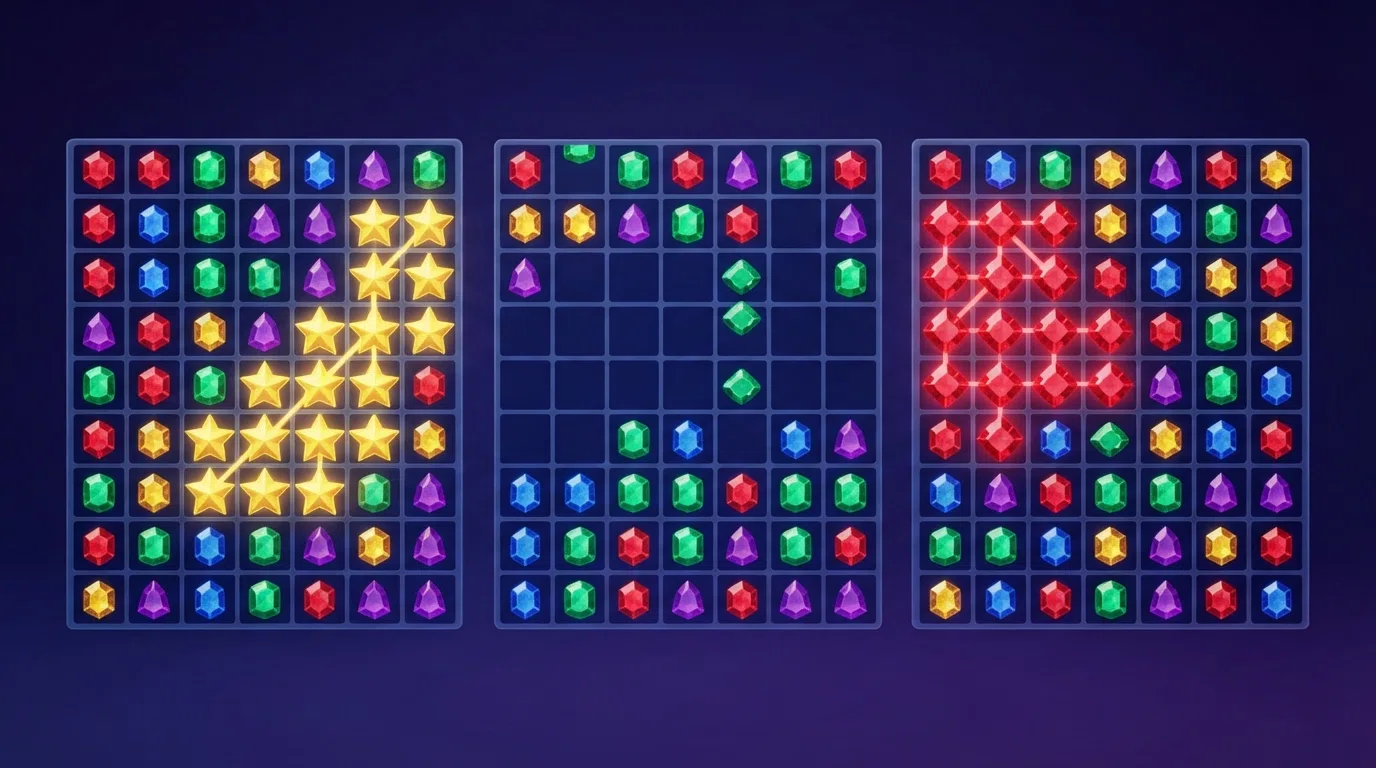
Jammin’ Jars is the highest-RTP title in the format and the one with the alternate setting to watch for. The 8×8 grid holds jam jar wilds that move one position in a random direction after every cascade, and their multipliers stack with each cascade they survive. A jar that survives five cascades at multipliers of 1×, 2×, 3×, 4×, and 5× is paying its cluster at 15× by the end. Sugar Rush runs a 7×7 grid with sticky multiplier spots that accumulate across cascades — the longer a chain, the larger the spots grow, and the spots persist into the free-spin round where they keep adding up. Fruit Party uses a 7×7 grid and the random multiplier system: any cluster can be augmented by a random multiplier, and clusters can carry multiple multipliers that combine, with the ceiling at 256× per cluster.
Aloha! Cluster Pays is the low-volatility entry point. NetEnt’s 6×5 grid, tiki symbols, and sticky-win re-spins make it the most accessible cluster pays title in the set. The 2,000× max win is the lowest of the six, and the low volatility means small clusters pay frequently enough to sustain longer sessions without bankroll pressure.
What Makes a Cluster Pays Slot Stand Out
Grid size sets the rhythm. A 5×5 grid pays tight and frequent; an 8×8 grid produces longer cascade chains because there are more positions for new symbols to fall into and more opportunities for clusters to form. Jammin’ Jars’s 8×8 grid produces more multi-cascade chains than any other title in the set.
Multiplier design shapes session outcomes in three distinct ways. Cascade multipliers reward streaks — the longer the chain, the higher the multiplier, so the value comes from holding the chain together rather than from any single win. Random multipliers spike individual wins unpredictably, with Fruit Party’s 256× ceiling as the standout. Walking wild multipliers move between cascades and stack, so a single wild that survives several cascades can carry a heavy multiplier by the end. Sticky multiplier spots persist in place and accumulate, the way Sugar Rush’s spots grow with each cascade that passes through them.
The alternate-RTP issue is worth a closer look. Jammin’ Jars ships with two configurations, and the gap between 96.83% and 94.25% is one of the widest among mainstream cluster pays titles. Operators choose which configuration to run, and the choice is not always public. The in-game help or information panel typically carries the figure; check it before staking. A 2.58-point RTP gap over a £200 session is a £5.16 difference in expected return — small in absolute terms, large relative to the edge itself.
Max-win figures are theoretical ceilings, not realistic outcomes. The 21,175× headline on Sweet Bonanza is the maximum any single spin can produce under the game’s design; it is not a session expectation, and the £5 (or £2) UK stake cap means the absolute maximum a UK player can win from a single paid spin is £106,275 (or £42,510 for under-25s). Hit frequency — how often the bonus round or a major payout lands — is not consistently published for cluster pays titles, which leaves the player relying on the volatility rating and demo sessions to estimate how often the bigger payouts arrive.
Why You Should Always Try a Cluster Pays Slot for Free Before You Deposit
Free-Play Cluster Pays Slots: No Deposit, No Registration Needed
Demo mode at UK-licensed casinos runs the same game client as the real-money version, but with a play-money balance. The random number generator is identical to the live game — the UK Gambling Commission requires it — so what happens on a demo spin is statistically equivalent to what happens on a paid spin. No deposit is required. Most UK operators do not require account registration to load a demo, though some do. Aggregator sites like online-casinos.co.uk and Slotcatalog.com list demo-friendly versions of the major cluster pays titles.
The provider matters for demo availability. NetEnt’s Aloha! Cluster Pays is widely available across UK casino demo lobbies. Play’n GO’s Reactoonz is equally accessible — the 7×7 grid and the Quantumeter charge-up mechanic are easier to read in demo than from a paytable description. Pragmatic Play’s Sugar Rush and Fruit Party are usually available in demo at major UK operators. Push Gaming’s Jammin’ Jars is the slightly harder find: not every UK casino stocks it, but the demo is available where the live game is.
Demo Mode vs Real-Money Play: What Free Spins Can (and Cannot) Teach You
Demo mode accurately teaches the mechanic. Cascade frequency, bonus-round triggers, volatility rhythm — all of these are visible over many demo spins, and the cascade chains behave the same way they do at real stakes. The cluster pays mechanic has no hidden mode-switching between demo and real play; the maths is the maths.
What demo cannot teach is the psychology. The emotional response to a losing streak with real money is not reproducible in demo. The discipline of stopping at a pre-set loss limit is much harder to maintain when real money is on the grid. The NHS Adult Psychiatric Morbidity Survey 2023–24 found that 4.6% of online gamblers scored at least moderate risk on the Problem Gambling Severity Index (PGSI 3+), against 1.6% of all adults. The gap between demo and real play is where that risk concentrates.
The transition from demo to real money should start at the low end of the permitted stake range, not at the ceiling. A player aged 25 and over with a £5 cap might stake £0.20 per spin for their first real session; a player aged 18 to 24 with a £2 cap should start at £0.10. The cascade mechanic makes session length unpredictable, and a small stake buys more cascades per bankroll than the maximum does.
Top UK-Licensed Casinos for Cluster Pays Slots in 2026
Every operator on this page holds an active GB operating licence, confirmed against the Gambling Commission public register (gamblingcommission.gov.uk/public-register) in August 2026. The split is not between licensed and unlicensed — all ten are licensed — but between two offer structures. Six operators pay free-spin winnings as cash with zero wagering. Four apply a 10× wagering requirement to either bonus funds or spin winnings. The 10× cap itself became statutory on 19 December 2025 under LCCP Social Responsibility Code 5.1.1, which also banned mixed-product promotional offers (an offer may no longer condition a bonus on playing a different product type).

| Operator | UKGC Licence | Welcome Offer | Free Spins | Wagering | Game Providers — Cluster Pays |
|---|---|---|---|---|---|
| Sky Vegas | GB-licensed (Flutter Entertainment) | Deposit & stake £5 → up to 200 FS | 200 FS | 0× (cash winnings) | NetEnt, Play’n GO, Pragmatic Play, Push Gaming, ELK Studios, Blueprint |
| bet365 Games | GB-licensed (bet365 Group) | Up to 500 FS (10 daily reveals × up to 50 FS) | 500 FS | 0× | Play’n GO, NetEnt, Pragmatic Play, Push Gaming, Microgaming |
| Betfair Casino | GB-licensed (Flutter Entertainment) | 50 no-deposit FS + 100 FS on £10 deposit | 150 FS total | 0× (cash winnings) | Play’n GO, NetEnt, Pragmatic Play, Blueprint, IGT |
| Paddy Power Games | GB-licensed (Flutter Entertainment) | 60 no-deposit FS + 100 FS on £10 deposit | 160 FS total | 0× (cash winnings) | Play’n GO, NetEnt, Pragmatic Play, Blueprint |
| Ladbrokes Casino | GB-licensed (Entain) | Bet £10 → 100 FS + £30 casino bonus | 100 FS | 10× on bonus funds; 0× on FS winnings | Play’n GO, NetEnt, Pragmatic Play, Blueprint, IGT |
| Coral Casino | GB-licensed (Entain) | Deposit £5, wager £5 → £10 bonus + 100 FS | 100 FS | 10× | Play’n GO, NetEnt, Pragmatic Play, Blueprint |
| William Hill Vegas | GB-licensed (evoke plc) | Deposit & wager £10 → 200 FS | 200 FS | 10× on FS winnings | Play’n GO, NetEnt, Pragmatic Play, Blueprint, IGT |
| Gala Bingo | GB-licensed (Entain) | Deposit & spend £10 → 100 FS | 100 FS | 0× on FS winnings | Play’n GO, NetEnt, Pragmatic Play, Blueprint |
| 888casino | GB-licensed (evoke plc) | 100% up to £100 bonus | N/A | 10× on selected slots | NetEnt, Play’n GO, Pragmatic Play, Red Tiger, Blueprint |
| Paddy Power Casino | GB-licensed (Flutter Entertainment) | Up to 260 FS (60 no-dep + 200 on deposit £10) | 260 FS total | 0× (cash winnings) | Play’n GO, NetEnt, Pragmatic Play, Push Gaming |
Sky Vegas: 200 Free Spins with Zero Wagering on Cluster Pays Titles
Sky Vegas pays free-spin winnings as cash. There is no wagering requirement on what those spins win and no maximum cashout cap. The offer runs as a stake of £5 to unlock up to 200 free spins at £0.10 per spin, claimable within 30 days and expiring 7 days after claim. The provider line-up covers every major cluster pays studio: NetEnt, Play’n GO, Pragmatic Play, Push Gaming, plus ELK Studios and Blueprint for the wider catalogue. For a player who wants to drop straight into Reactoonz or Jammin’ Jars without the wagering drag, Sky Vegas is the cleanest entry point among the featured set.
bet365 Games: 500 Free Spins Across 10 Daily Reveals
bet365 Games runs the largest free-spin count on this page, but the structure is more involved than a flat allocation. Up to 500 free spins are revealed in 10 daily batches, with up to 50 spins released each day. The 0× wagering applies, but the 20-day completion window means a player needs to log in across 20 consecutive days to claim the full allocation. Missing a day forfeits that day’s batch. The cluster pays library is the deepest in the featured set — Play’n GO, NetEnt, Pragmatic Play, Push Gaming, and Microgaming are all on the provider list. For a player who can commit to the daily reveal, 500 spins with no wagering is the page’s largest pure-spin offer.
Betfair Casino: 50 No-Deposit Free Spins on Cluster Pays Slots
Betfair Casino is one of two operators on this page offering free spins with no deposit at all. The structure is 50 no-deposit spins plus 100 more on a £10 deposit, totalling 150 free spins at 0× wagering. The no-deposit spins are pre-selected to Crabbin’ For Cash Extra Big Catch Jackpot King at £0.10 per spin — a fishing-themed title, not a cluster pays game, so the cluster pays access opens with the deposit-triggered 100 spins. The 7-day spin expiry is the standard Flutter window across no-deposit offers. Worth knowing: the no-deposit spins serve as a taster of the casino’s interface; the cluster pays library proper unlocks once a deposit is in.
Paddy Power Games: 60 No-Deposit Spins Plus 100 More on Deposit
Paddy Power Games runs the highest no-deposit free-spin count on this page. Sixty no-deposit spins break down as 50 on slots (the cluster pays access point) plus 10 on Paddy’s Mansion Heist, with another 100 spins on a £10 deposit. Total 160 spins at 0× wagering, 7-day expiry. The no-deposit 50-slot allocation is where a player can test the cluster pays mechanic on Flutter’s library — Play’n GO, NetEnt, Pragmatic Play, and Blueprint are all present — without committing a penny. For budget-conscious players, the no-deposit tier is the page’s strongest free entry point.
Ladbrokes Casino: £30 Bonus Plus 100 Free Spins — With 10× Wagering on the Bonus
Ladbrokes Casino runs a hybrid offer: 100 free spins at 0× wagering on the spin winnings, plus a £30 casino bonus with 10× wagering on the bonus funds. The two parts carry two different term sets — the free spins pay cash, the bonus must be wagered 10× before withdrawal. The pre-selected free-spin titles include Big Bass Splash and Eye of Horus, neither of which is a cluster pays slot, so the cluster pays access is through the bonus fund route rather than the spin allocation. The provider line-up — Play’n GO, NetEnt, Pragmatic Play, Blueprint, IGT — is the Entain standard, identical to Coral and Gala Bingo. This is the primary choice for players who prefer a balanced mix of bonus funds and free spins.
Coral Casino: £10 Bonus and 100 Free Spins with a £5 Entry Point
Coral Casino runs the lowest deposit threshold on this page. A £5 deposit and a £5 wager unlocks a £10 bonus plus 100 free spins, both carrying 10× wagering. The £5 entry point is the most accessible barrier among the featured set, and for a player who wants to test cluster pays slots without committing £10 across the board, Coral is the cheapest route. The library is the Entain standard — Play’n GO, NetEnt, Pragmatic Play, Blueprint — and the same as Ladbrokes and Gala Bingo, since Coral, Ladbrokes, and Gala Bingo all sit under the Entain licence.
William Hill Vegas: 200 Free Spins — But Watch the £30 Cashout Cap
William Hill Vegas offers 200 free spins on a £10 deposit and wager, but the terms carry the tightest cashout ceiling on this page. Free-spin winnings carry 10× wagering and a £30 maximum cashout — a player who hits a large cascade on their free spins keeps at most £30. The 72-hour spin expiry is also the shortest on the page, which compresses session planning into a single weekend. Big Bass Splash is the pre-selected free-spin title at £0.10 per spin. The verdict: this offer suits a player who wants to try the mechanic rather than chase a payout, not one hunting a return.
Gala Bingo: 100 Free Spins with Cash Winnings and No Wagering
Gala Bingo carries a full cluster pays slot library despite the bingo branding — Play’n GO, NetEnt, Pragmatic Play, and Blueprint are all on the provider list, the same Entain library as Ladbrokes and Coral. The offer runs as a £10 deposit and spend unlocking 100 free spins at 0× wagering, claimable within 7 days and expiring 7 days after claim. While the branding focuses on bingo, the slot library itself matches the quality and depth of the Entain group’s other casinos.
888casino: 100% Match Up to £100 — Bonus-First, Not Free-Spins-First
888casino is the only operator on this page without a free-spins-led offer. The structure is a 100% deposit match up to £100, with 10× wagering on selected slots and a 90-day bonus validity window — the longest on this page. The longer window suits a player who plays infrequently or wants to spread the wagering requirement across many sessions rather than concentrate it. The provider line-up adds Red Tiger to the standard cluster pays set — useful for the wider catalogue even if Red Tiger’s cluster pays titles are thinner than the others.
Paddy Power Casino: Up to 260 Free Spins with Zero Wagering
Paddy Power Casino runs the highest total free-spin count on this page: 60 no-deposit plus 200 on a £10 deposit, totalling 260 spins at 0× wagering. The 7-day spin expiry applies to both tiers. The provider line-up includes Push Gaming alongside the Flutter standard, so Jammin’ Jars is available alongside Reactoonz, Sweet Bonanza, and Sugar Rush. The Paddy Power Casino vs Paddy Power Games comparison is mostly a spin-count question — Casino gives 260 total, Games gives 160; the offer shape is otherwise identical. For a player set on Flutter, the Casino route gives more spins for the same deposit.
Are Cluster Pays Slots Legal and Fair? What British Regulation Actually Covers
Cluster pays slots are fully legal in Great Britain under the Gambling Act 2005, extended to remote operators by the Gambling (Licensing and Advertising) Act 2014. The point-of-consumption reform introduced by the 2014 Act made a GB licence compulsory for any operator serving GB players, wherever the operator is based. The Gambling Commission is the single statutory regulator, an executive non-departmental public body sponsored by the Department for Culture, Media and Sport.
The licensing objectives, set out in section 1 of the 2005 Act, are three: preventing gambling from being a source of crime or disorder, ensuring gambling is conducted in a fair and open way, and protecting children and other vulnerable persons from harm or exploitation. Cluster pays slots fall under remote casino operating licences, and the rules that govern any online slot apply to them the same way.
The most distinctive feature of the current British model is the age-banded stake cap. Players aged 25 and over face a £5 maximum per game cycle; players aged 18 to 24 face £2 per game cycle. The cap applies to the total staked within the cycle — the period from spin initiation to when all winnings are delivered — not to the click that initiates the spin. A cascade chain still resolves within one game cycle, and the entire cycle counts against the cap. The stake limit does not apply to roulette, blackjack, or live casino; it is specific to online slots.
UKGC Licensing and What It Means for Cluster Pays Players
A GB licence is not optional. Any operator serving British players without one commits a criminal offence under section 33 of the Gambling Act 2005, regardless of what other licences it holds elsewhere. A Curaçao licence or an MGA licence means nothing for a GB player — the operator is illegal at the point of consumption regardless of its offshore credentials. The Commission’s enforcement is disruption-based: cease-and-desist notices to operators, referrals to search engines for unlicensed URLs, and domain suspension. Between April 2024 and June 2025, the Commission issued 3,140 disruption notices, referred 447,778 URLs to search engines, and saw 287,961 URLs removed. There are no statutory ISP or DNS blocking powers currently; blocking legislation has been proposed but not enacted.
A player on an unlicensed site loses every protection the licensing regime offers. No GAMSTOP coverage. No Commission complaints route. No alternative dispute resolution provider. No deposit-protection rules. No age or identity verification guarantee. The operator is not subject to LCCP conditions or Remote Technical Standards, and the games may or may not carry the same RNG certification a GB-licensed operator requires.
The Commission’s public register (gamblingcommission.gov.uk/public-register/businesses) is the verification tool. It is a live, searchable database listing licensed businesses, trading names, domains, licence types, and any regulatory actions. Every operator on this page was checked against it. A player should check it too before depositing anywhere — licences can be surrendered, suspended, or revoked, and the register is updated.
Fairness and RNG Auditing of Cluster Pays Mechanics
The cascade mechanic must pass the same RNG certification as any slot. Every symbol drop, every cascade outcome, every multiplier trigger is determined by a random number generator that has been independently tested and certified. The UKGC requires this certification as a condition of operating, and the testing laboratories, such as Gaming Laboratories International and eCOGRA, audit the RNG, the game maths, and the published RTP. The 96.5% RTP printed on Reactoonz’s paytable is the long-run return to player across the certified RNG’s output — not a guarantee, not a session promise, but the audited mathematical expectation.
The UK game-design rules directly shape the cluster pays experience. Auto-play is banned. Spin speed may not be faster than 2.5 seconds per game cycle. Features that speed up play are banned. Losses disguised as wins — the sound and imagery that celebrate a return smaller than the stake — are banned. Reverse withdrawals (cancelling a withdrawal request to keep playing) are banned. The mandatory session display shows total losses, total wins, and time played during a slots session, and the player cannot dismiss it permanently.
The cascade mechanic’s structure interacts with these rules. A multi-cascade spin still resolves within the 2.5-second minimum, and the same spin can run through several rounds of cluster evaluation and payout before the grid settles. The longer sessions this produces are exactly what the Commission’s session-length monitoring tracks: 8.9 million slots sessions exceeded one hour in the first quarter of 2026, around 4.4% of the 202 million total sessions. The cascade mechanic is part of why that figure remains meaningful.
GAMSTOP, Deposit Limits, and the UK Player-Protection System
GAMSTOP is the national multi-operator self-exclusion register, mandatory for every GB-licensed online operating licence since 31 March 2020. Registration is free, takes minutes, and covers every GB-licensed operator automatically. Exclusion periods are 6 months, 1 year, 5 years, or 5 years with auto-renewal. The exclusion cannot be cancelled early. GAMSTOP only reaches licensed sites — which is why the licence check matters in the first place.
Deposit limits have moved from a customer-set option to a mandatory offer. From 31 October 2025, operators must prompt customers to set a financial limit before their first deposit. From 30 June 2026 (extended to 30 September 2026), operators must offer a gross deposit limit — based solely on money paid into the account, not net of withdrawals — and only that form may legally be called a “deposit limit.” A net deposit limit (money in minus money out) is no longer compliant with the rule.
Financial vulnerability checks have run since 28 February 2025 at a £150 net deposit threshold in a 30-day rolling period, using publicly available data (CCJs, IVAs, bankruptcy orders) rather than income verification. Financial risk assessments — the more intrusive affordability checks that would assess a player’s income against their deposits — were announced by the UKGC Board on 7 July 2026 but have not yet commenced. Stage 1 thresholds would be £5,000 net deposits in 24 hours for players aged 25 and over, and £2,500 for under-25s; final thresholds are lower. Until the commencement date is confirmed, these are policy intent, not operative rules.
Staying in Control: Responsible Gambling for Cluster Pays Players
The cluster pays mechanic’s cascade chain produces longer sessions than standard payline slots, and the longer a session runs, the more relevant the harm-reduction tools become. The NHS Adult Psychiatric Morbidity Survey 2023–24 found that 1.6% of British adults experienced at least moderate-risk gambling (PGSI 3+) and 0.4% experienced problem gambling (PGSI 8+); among those who gambled online, the at-least-moderate-risk figure rose to 4.6%. The prevalence data is the reason the UK regulatory framework exists in its current shape, and it is the reason every operator on this page is required to offer the tools below.
In 2026, GamCare reported that 82% of National Gambling Helpline contacts cited online gambling specifically as the form they struggled with — the highest rate since 2021. Between April 2024 and March 2025, 11,960 clients were treated by National Gambling Support Network providers; online was the most common gambling location for 72% of them. The cluster pays format sits inside that distribution, and the help infrastructure below is built for the population the data describes.
Deposit Limits, Reality Checks, and Session Tools That Work
A deposit limit is the first line of defence. From 30 June 2026, only a gross deposit limit (money paid in only) may be offered under that name — and it must be set before the first deposit. Setting a weekly or monthly gross deposit limit is the single most effective harm-reduction step a player can take, because it caps the total funds that can enter the account regardless of how many withdrawals come back out. The UKGC’s research consistently shows that players who set deposit limits gamble less and report lower harm scores than those who do not.
Reality checks are the second. Every GB-licensed operator must offer periodic pop-ups during slots sessions showing time played and net position. The mandatory session display — total losses, total wins, and time played — runs throughout the session and cannot be permanently dismissed. Read it. It is the only view inside the casino that shows what the session has actually cost, and on a cascade-heavy cluster pays session the numbers can move faster than expected.
Time-outs and self-exclusion sit above reality checks. A time-out is a short cooling-off period — 24 hours to 6 weeks — that the player sets themselves. Self-exclusion is longer — 6 months, 1 year, or 5 years — and is what GAMSTOP registration covers across every GB-licensed operator at once. The two are not interchangeable: a time-out is a pause, GAMSTOP is a commitment.
Self-Exclusion Tools and Where to Get Help
The National Gambling Helpline (0808 8020 133) is freephone, available 24 hours a day, and operated by GamCare. It is the first call for anyone whose gambling has stopped feeling like entertainment. GamCare also runs free counselling by phone, live chat, WhatsApp, and group chat — the route for ongoing support after the initial call. The NHS runs gambling harm clinics: the National Problem Gambling Clinic for England, NHS Problem Gambling Scotland, and the Wales gambling services. Gamblers Anonymous runs UK-wide peer-support meetings for those who prefer a group setting. GambleAware hosts a self-assessment tool that returns a PGSI-style score and points toward the appropriate next step.
GAMSTOP registration is at gamstop.co.uk. It is free, takes a few minutes, covers every GB-licensed operator, and cannot be reversed early once the exclusion period begins. It is the strongest single commitment available to a UK player, and the appropriate response when the tools above have not been enough.
The statutory levy, in force from 6 April 2025, funds the treatment, prevention, and research infrastructure above. It is set at 1.1% of gross gambling yield for remote casino licences, split 50% to treatment, 30% to prevention, and 20% to research. Total online GGY in the first quarter of 2026 was £1.55 billion — the levy scales with that figure, and the help network is funded by it.
The Age-Banded Stake Limit: Why Your Age Decides Your Maximum Bet
Two adults at the same casino face different maximum bets on the same cluster pays slot. The £5 cap applies to players aged 25 and over and came into force on 9 April 2025. The £2 cap applies to players aged 18 to 24 and came into force on 21 May 2025. Both are imposed by SI 2025/215 and both apply to online slots specifically — roulette, blackjack, and live casino are not covered.
The age band is enforced at the verification stage. Since 7 May 2019, every GB-licensed operator must verify name, address, and date of birth before any deposit or gambling, including free bets and bonuses. There is no grace period. By the time a player places their first spin, the operator knows their age and applies the appropriate cap.
The rationale is the prevalence data. Younger adults show higher rates of gambling harm than the over-25 population, and the £2 cap is a targeted prevention measure for the 18–24 cohort. It is not a moral judgement on the cohort — it is a regulatory response to the data the NHS APMS 2023–24 produced. The cap will be reviewed as the data evolves; it is in force now.
For cluster pays slots specifically, a “game cycle” includes the full cascade chain. The period from spin initiation to when all winnings are delivered is one cycle, and the cap applies to the total staked within it. The cascade mechanic does not reset the cap — it runs inside the same cycle, and a multi-cascade spin is one cycle rather than several smaller ones. The £2 cap on a 7×7 high-volatility cluster pays slot changes the arithmetic of every bonus offer on this page, and it is the reason demo-mode exploration is proportionally more valuable for under-25 players.
How We Picked and Ranked the Operators on This Page
Every operator was checked against the Gambling Commission public register in August 2026. The register is live — licences change, are surrendered, or are revoked — and a player should re-check at gamblingcommission.gov.uk/public-register before depositing. The ten operators on this page are the ones whose licence status was active at the time of checking, and the offer details were taken from each operator’s website at the same time.
The ranking criteria were four: GB licence status as a binary gate (unlicensed operators were excluded entirely); wagering requirements (0× offers ranked above 10× offers on the principle that cash winnings beat bonus funds); free-spin counts (a higher count at 0× ranking above a lower count); and the cluster pays library depth as measured by provider coverage. The Entain brands (Ladbrokes, Coral, Gala Bingo) share a licence holder and a library; the Flutter brands (Sky Vegas, Betfair, Paddy Power) likewise. evoke plc holds both William Hill and 888casino. The shared licences explain the structural similarities within each group.
The ranking does not reflect commercial arrangements. No operator paid for placement on this page, and no affiliate revenue share or advertising spend influenced the order. The ranking reflects offer terms and library depth, and nothing else. Limitations: offer terms change without notice, operator libraries add and remove titles, and the UKGC register is live. Check it yourself before depositing anywhere — including the operators listed here.
Which Cluster Pays Slot Is Right for You? Putting It All Together
If this is your first cluster pays session, start with Aloha! Cluster Pays in demo mode. The 6×5 grid is the smallest in the format, the low volatility means small clusters pay often enough to keep a bankroll alive, and the sticky-win re-spins make the cascade mechanic visible without the multiplier complexity of the heavier titles. Twenty demo spins are enough to see the mechanic in action; two hundred are enough to feel the volatility. Spend a session in demo before any real stake.
If you are choosing between operators, the wagering requirement matters more than the spin count. Six of the ten operators on this page pay free-spin winnings as cash with zero wagering; four apply a 10× requirement to either bonus funds or spin winnings. A 200-spin offer at 10× with a £30 cashout cap (William Hill Vegas) is worth less than a 100-spin offer at 0× with no cap (Gala Bingo) once the wagering drag is priced in. The spin count is the headline; the wagering is the substance.
If you are aged 18 to 24, the £2 per-cycle cap changes the arithmetic of every offer on this page. A 200-spin allocation at 0× wagering becomes a 200 × £0.10 = £20 total bet rather than a 200 × £0.10 × 10 = £200 turnover with a £5 stake. The cap keeps the session size down by design, which makes demo-mode exploration proportionally more valuable. The high-volatility titles at the top of the slot ranking (Sugar Rush, Fruit Party) are the wrong starting point for a first session; the £2 cap magnifies their downside.
The number to remember is 96.5%. At a 96.51% RTP on Reactoonz, a 100-spin session at £2 stake costs an expected £7 in turnover-adjusted loss — not £200. The calculation is straightforward: £2 × 100 spins = £200 turnover, multiplied by the house edge of 3.49% (100% minus 96.51%), equals £6.98. The figure is an average across many sessions and many players; no single session follows it. A session that hits one cascade chain can swing well above or well below the average. The cascade mechanic’s structure — multiple wins per paid spin — can move either direction, and the volatility rating on each title is the honest guide to which direction a given session is likely to move.
For a player who has spent time on demo and is ready to stake, the 0× wagering operators are the right first step. Sky Vegas, bet365 Games, Betfair, Paddy Power Games, Gala Bingo, and Paddy Power Casino all pay free-spin winnings as cash. The cluster pays library is deep at every one. The choice between them comes down to the spin count, the entry stake, and the operator’s catalogue — not the wagering, because the wagering is identical at zero.
Frequently Asked Questions
What is the minimum cluster size needed to win on a cluster pays slot?
The minimum cluster size is five matching symbols connected horizontally or vertically — adjacency is the rule, diagonals do not count. Some titles pay additional tiers at 9+, 12+, or 15+ connected symbols; check the in-game paytable for the specific ladder. The scan after each spin checks every symbol’s horizontal and vertical neighbours only.
How do cascading reels work in cluster pays slots?
When a winning cluster pays out, the symbols involved are removed from the grid and new symbols drop in from above to fill the gaps. The grid is then re-scanned for new clusters, and the cycle repeats until no new cluster forms. One paid spin can resolve into three, five, or more consecutive wins before the grid settles. Multiplier designs vary: cascade multipliers step up with each drop, random multipliers spike individual wins, and sticky multiplier spots accumulate value across cascades.
Can I play cluster pays slots for free in demo mode at UK casinos?
Yes. Demo mode is available at UK-licensed casinos without a deposit, and most operators do not require account registration to load a demo. The demo runs the same RNG as the real-money version — UK Gambling Commission rules require it — so what happens in demo is statistically equivalent to what happens at real stakes. Demo mode teaches the mechanic accurately but cannot replicate the psychology of real-money play.
Are cluster pays slots fair and regulated by the UKGC?
Yes. Cluster pays slots are licensed under remote casino operating licences in Great Britain and fall under the Gambling Act 2005 as extended by the Gambling (Licensing and Advertising) Act 2014. Every spin outcome is determined by a certified random number generator, and the published RTP percentages are audited by independent testing laboratories. The UKGC’s game-design rules — 2.5-second minimum spin speed, no autoplay, no losses disguised as wins — apply to cluster pays slots the same as any other online slot.
Do cluster pays slots have different stake limits under UK law?
Cluster pays slots carry the same stake cap as any other online slot: £5 per game cycle for players aged 25 and over, £2 for players aged 18 to 24. The cap applies to the total staked within the full cascade chain — from spin initiation to when all winnings are delivered. It does not apply to roulette, blackjack, or live casino. Both caps were imposed by SI 2025/215 and came into force in April and May 2025.
What is the RTP of popular cluster pays slots like Reactoonz and Sweet Bonanza?
Reactoonz runs at 96.51% RTP at high volatility with a 4,570× max win. Sweet Bonanza runs at 96.48–96.51% RTP at high volatility with a 21,175× max win. Jammin’ Jars runs at 96.83% (alternate setting 94.25%) at high volatility with a 20,000× max win. Sugar Rush runs at 96.50% at very high volatility with a 5,000× max win. The RTP figures are the long-run return to player across millions of spins, not a session guarantee.
Slots – nodeposit-casinobonuses-uk
Content created by the «nodeposit-casinobonuses-uk» team