Where to play with SOL — and what you give up to do it
 Available in GB
Solana casinos exist, they are accessible from a UK IP, and not one of them holds a UKGC licence. That gap — a deposit rail that settles in roughly one second versus a regulator that has not signed off on a single crypto-accepting operator — sits at the centre of this page. What follows is what those casinos actually offer, what the bonus numbers cost in expected losses, and what a UK player trades away by playing at them.
Current as of September 8, 2026; licence claims verified against the Curaçao eGaming validator and the Anjouan Gaming Board public register.
What a SOL Casino Actually Means — and Why It Can Never Carry a UKGC Badge
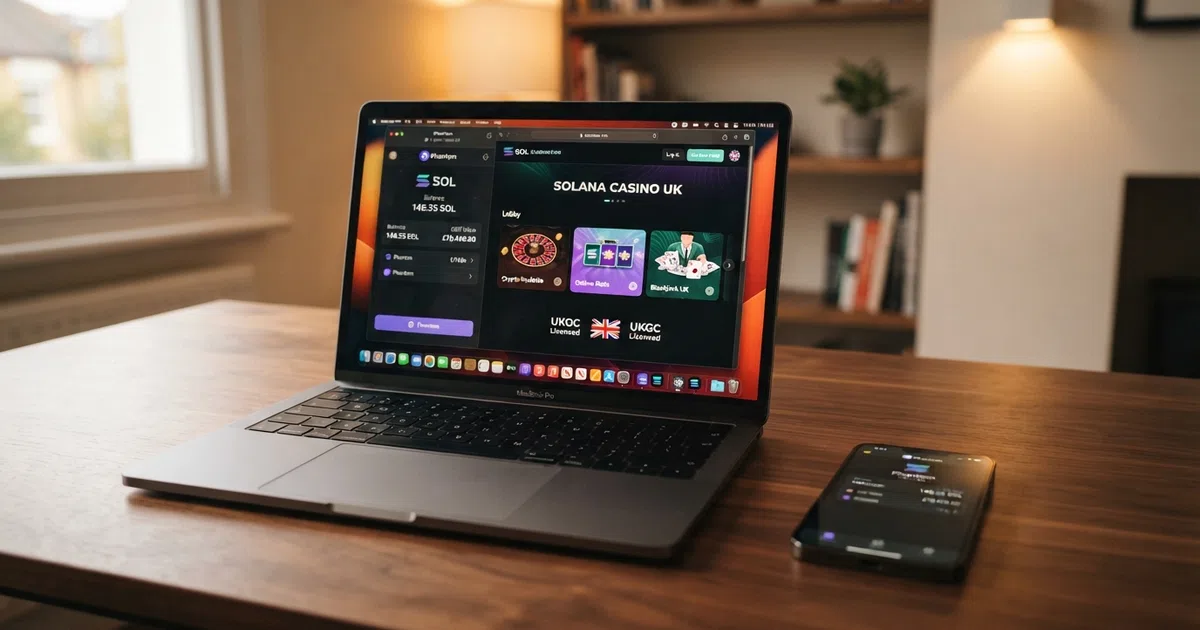
A Solana casino is, at its core, an online gambling site that accepts SOL as a deposit and pays winnings in SOL or a stablecoin pegged to it. The casino runs the same kind of games — slots, blackjack, roulette, live dealer — as any UKGC-licensed site, but the funding rail is the Solana blockchain rather than a card or a bank transfer. The player sends SOL from a self-custody wallet, typically Phantom or Solflare, and the casino credits the balance after on-chain confirmation. That confirmation happens in roughly one second, at a network fee of about 0.000005 SOL — a fraction of a penny.
The reason none of these operators can carry a UKGC badge is straightforward, even if it has not been written into a formal ban. The Gambling Commission treats crypto-funded gambling as high-risk under its anti-money-laundering framework, because source-of-funds verification — a regulator’s basic ask — becomes effectively impossible when the deposit rail is a self-custody wallet. As of 2026, no UKGC-licensed casino or betting operator accepts any cryptocurrency as a deposit or withdrawal method. The Commission’s CEO, Andrew Rhodes, told the IAGR 2025 conference that governments “can’t ignore” the rise of crypto gambling demographics; the Commission has also hinted at a “sensible pathway” for cryptoassets to be used as a consumer payment option at licensed operators, conditional on strengthened AML infrastructure, but no timeline has been confirmed. The hint is not a route.
The practical consequence is that every Solana casino serving a UK player sits outside the British regulatory system. Most carry a Curaçao eGaming licence or, in two of the cases below, an Anjouan Gaming Board licence. Both regimes require a company to register and a basic AML policy on file; neither provides anything close to the consumer protection a UKGC licence mandates. There is no GAMSTOP coverage, no UKGC complaints route, no alternative dispute resolution provider in the British sense, and no statutory deposit-limit tool. Section 33 of the Gambling Act 2005 makes the unlicensed supply of gambling to GB customers a criminal offence carrying up to 51 weeks’ imprisonment or an unlimited fine. That falls on the operator, not the player — but it tells a UK reader exactly where the legal weight sits.
How a Solana Casino Transaction Works
A typical Solana casino transaction has three legs: fiat to SOL, SOL to the casino, and the casino crediting the balance. The first leg happens off the casino entirely — at an exchange where a UK player buys SOL with GBP, paying the exchange’s spread (0.5–1.5% is typical) and withdrawing to a self-custody wallet such as Phantom or Solflare. The second leg is the on-chain transfer: the player copies the casino’s deposit address or scans a QR code, sends SOL, and waits for confirmation — about one second on Solana, against ten minutes to an hour on Bitcoin. The third leg is the casino’s own ledger, which credits the balance once a sufficient number of confirmations has registered.
A small number of operators skip the second and third leg distinction. Luck.io is a non-custodial casino: there is no account, no deposit address to copy, no in-house balance to credit. The player connects a Phantom or Solflare wallet, and the casino settles wagers directly on chain. The trade is that no account also means no welcome bonus, no VIP programme, and no support history — none of the structures a player is used to from a UKGC site exist there. Roughly $80 million was wagered on the platform in its first six weeks, which says what it says about demand.
The Real-Money Experience at an Offshore Solana Casino
The gameplay is familiar. The lobby carries Pragmatic Play slots, Evolution live tables, the same NetEnt and Hacksaw titles that populate any large online casino, and a few in-house originals at the Solana-native operators. Stakes are placed in SOL or a USDT/SOL pair. The difference is everything around the games: no UKGC-mandated reality check pops up after an hour of play, no session display shows running losses and time played, no mandatory two-and-a-half-second spin minimum slows slots down, no auto-play ban stops a player from setting a hundred spins in motion, and no gross deposit limit is offered before the first deposit.
Account creation is where the divide opens up most visibly. At a GB-licensed site, identity must be verified before the first deposit or any gambling activity — name, address, date of birth. At an offshore Solana casino the deposit can land with nothing more than an email address or, at a non-custodial operator like Luck.io, with no account at all. That is the pitch. The catch comes at withdrawal, where the same operator that took the deposit in seconds will routinely ask for documents before paying out. AML obligations exist even under Curaçao and Anjouan regimes, and the casino enforces them where its own exposure is largest — at the cashout.
Solana Deposits Confirm in One Second — Your Withdrawal Will Not
The headline feature of a Solana casino is the deposit. The headline drawback is the withdrawal. Both are true at the same time, and the gap between them is where most player disappointment sits.
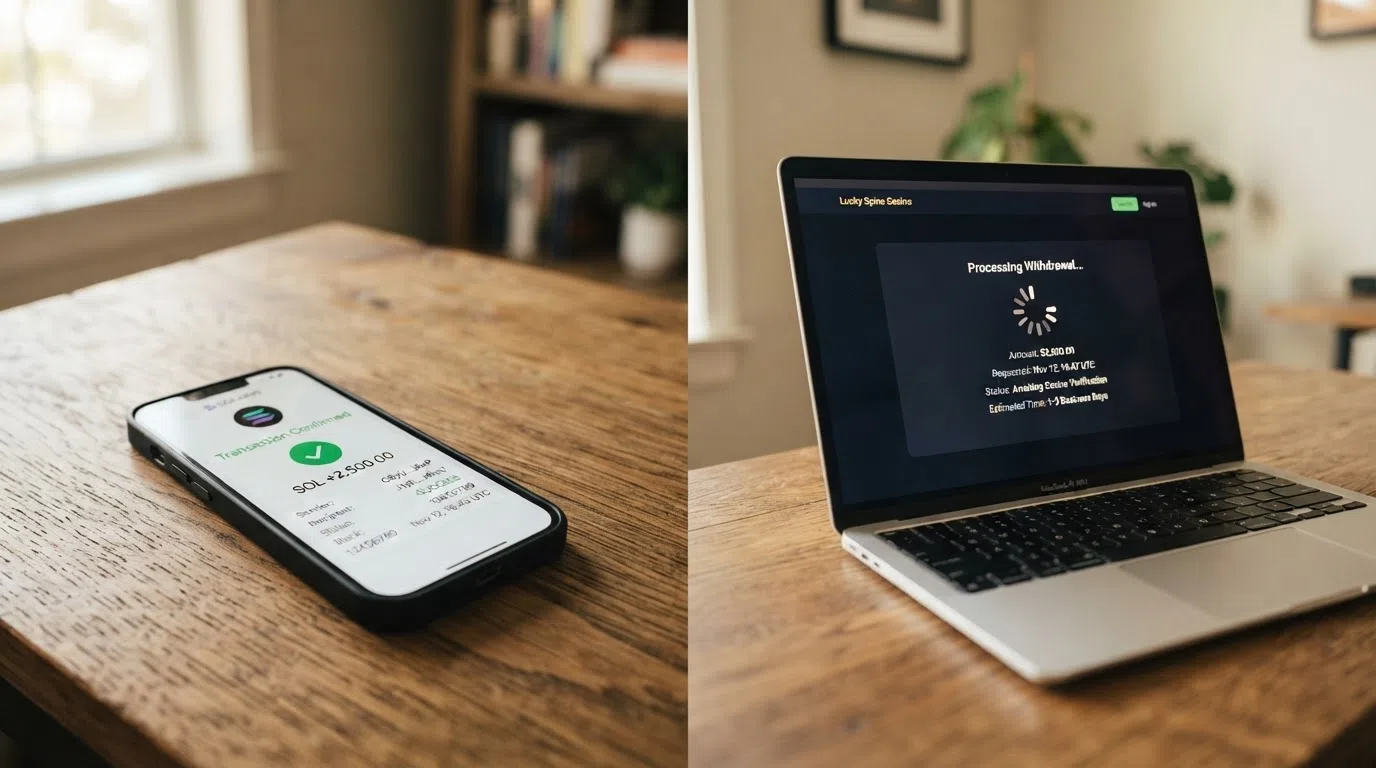
On the deposit side, the Solana network settles a transaction in roughly one second at a fee of about 0.000005 SOL. That is faster than any card payment, any bank transfer, and most e-wallet deposits at a UKGC-licensed casino. The cost is the exchange spread on the fiat-to-SOL conversion — 0.5–1.5% depending on the venue, payment method and size. Beyond that, the network charges nothing meaningful and the casino typically charges nothing on top.
The withdrawal is where the picture flips. The blockchain has already settled the moment the casino broadcasts the SOL transfer; the player’s wallet will show the incoming transaction almost immediately. What they will not see for several minutes — sometimes several hours — is the corresponding balance update inside the casino’s own ledger, because the casino holds the withdrawal in pending status while it runs its own checks. Wild.io completes most withdrawals in under ten minutes; BC.Game’s payout window sits at five to ten minutes; TG.Casino and Thrill both advertise instant withdrawals. These figures describe the operator’s processing, not the network’s, and the difference is what a UK player needs to internalise.
How to Deposit with Solana at an Online Casino
The path is the same at every featured operator. Open a Phantom or Solflare wallet, fund it with SOL from an exchange that accepts GBP deposits (debit card or bank transfer depending on the venue), navigate to the casino cashier, select SOL as the deposit currency, and either scan the QR code or copy the deposit address. Send the SOL. The casino’s balance updates once the on-chain confirmation registers — within a second or two in practice.
The minimum deposits vary enough to matter. BC.Game accepts a SOL-equivalent of $1; TG.Casino’s floor is 0.01 SOL; CoinCasino’s is $10; Lucky Block asks for £20. Each is the operator’s policy, not the network’s — there is no Solana-side minimum that would prevent a 0.001 SOL transfer. The deposit ceiling is set by the operator’s payment screen, not by any AML limit, and offshore operators do not apply the £150 rolling-30-day financial-vulnerability check that LCCP 3.4.4 mandates at UKGC licensees from 28 February 2025. The credit-card ban that has applied to all GB remote gambling since 14 April 2020 (LCCP 6.1.2) does not reach offshore sites either; the deposit rail is the wallet, not a card.
Why Your Withdrawal Is Slower Than the Blockchain Promises
A withdrawal at a Solana casino goes through three stages: the player requests a cashout, the operator’s internal review authorises it, and the SOL transfer is broadcast to the player’s wallet. The first stage is usually instant. The second is where minutes and hours accumulate, because the operator runs AML and source-of-funds checks even under a Curaçao licence — particularly above certain thresholds. The third stage is sub-second on the blockchain.
The published figures cluster tightly. Wild.io states most withdrawals under ten minutes; BC.Game’s stated payout window is five to ten minutes; TG.Casino and Thrill both market instant withdrawals. There is no public benchmark for what “instant” means in either case — a few seconds or a few minutes — and no external regulator auditing the figure. The audit is a community-reported one: player forums, complaint sites, the slow accumulation of reputation that no operator can buy outright. That is the source of trust at an offshore casino, and it is the reason a small test withdrawal before committing a serious bankroll is a habit rather than a chore.
What Deposit Minimums the Featured Solana Casinos Set
The floors span two orders of magnitude. TG.Casino accepts 0.01 SOL — a few pence at recent prices and the lowest entry point of the reviewed set. BC.Game’s $1 SOL-equivalent sits in the same low-cost band. CoinCasino requires $10, Lucky Block £20, with most of the rest of the featured operators falling somewhere between.
The practical reading is that the floor tells you nothing about the operator and everything about who the operator is courting. A 0.01 SOL minimum is a wallet-testing price — the operator wants the player to try the cashier and see the speed. A £20 minimum is the start of a serious deposit, where the player has already decided they may stay. Neither says anything about the games, the bonus, or the licence behind the cashier.
Debit Cards, Bank Transfers and Solana Go: The Wider Payment Picture
A UK player funding a Solana casino account almost always starts at an exchange that accepts GBP — a debit card or a bank transfer, both of which work at the major venues. The credit-card ban that has applied to all GB remote gambling since 14 April 2020 (LCCP 6.1.2) does not bind an offshore casino, but it does bind the player’s own card-issuer: a UK bank will block a credit-card payment coded to a gambling merchant under the same rules, and the player will not get the funds to the exchange in the first place. Debit cards are unaffected.
Solana Go is a separate payment rail that several operators integrate for smaller devices, intended to make the SOL transfer a one-tap flow inside a mobile wallet. The detail research carries does not extend to a deeper breakdown — the practical reading is that the wallet’s UX is doing the work, not the casino’s cashier. For a UK player, the question is less which rail is cheapest than which wallet is easiest on the phone they actually use.
Solana vs Bitcoin vs Ethereum: Which Network Costs You Least
The short answer: Solana, by a wide margin. The Solana network charges roughly 0.000005 SOL per transaction — a fraction of a cent at any recent SOL price. Bitcoin transaction fees vary with congestion but routinely run from a few dollars up to $50, with confirmation times of ten minutes to an hour. Ethereum post-Merge sits in a similar fee band ($2–$50) with much faster confirmation (around fifteen seconds on the base layer, though the practical cost varies with L2 usage).
The trade is reach. Solana is newer to the casino market than either Bitcoin or Ethereum; BC.Game accepts 40+ cryptocurrencies, Stake 20 and Wild.io 12+, but at smaller operators SOL support is added late or not at all. A UK player who wants the cheapest rail is betting that the casino they pick accepts it. Most of the reviewed operators do. The ones who pick a Bitcoin-only operator by habit are paying a few dollars every time they move money, in fees they would not pay on Solana.
The 10 Solana Casinos UK Players Can Access in 2026
Selection was straightforward. The ten operators below were confirmed to accept Solana deposits, were reachable from a UK IP at review time, and each carried an identifiable offshore licence. The order reflects fit to the page topic — Solana acceptance, bonus value, game library breadth, withdrawal speed — rather than market share, which research does not measure for this niche. Every operator is offshore-licensed; no UKGC-licensed casino accepts cryptocurrency as of 2026, and the table below is the practical answer to what that leaves.
| Operator | Licence | Welcome Bonus | Free Spins | Wagering | Game Providers |
|---|---|---|---|---|---|
| BC.Game | Curaçao eGaming | Four-match up to $1,600 + 400 FS | 400 | 40× bonus | Pragmatic Play, Evolution, others |
| BitStarz | Curaçao eGaming | Up to $500 / 5 BTC + 180 FS | 180 | 40× bonus | Pragmatic Play, Evolution, NetEnt, 4,500+ games |
| Lucky Block | Curaçao eGaming | 200% up to £25,000 + 50 FS | 50 | Bonus only (deposit excluded) | Pragmatic Play, Evolution, Hacksaw, others |
| Stake | Curaçao eGaming | No welcome bonus | N/A | N/A | Pragmatic Play, Evolution, Hacksaw, 6,000+ games |
| TG.Casino | Curaçao eGaming | 200% up to 10 ETH + 50 FS | 50 | 40× bonus | Pragmatic Play, Evolution, others |
| BetPanda | Curaçao eGaming | 100% up to 1 BTC (SOL equiv.) | — | 80× bonus | Pragmatic Play, Evolution, others |
| Wild.io | Curaçao eGaming | 400% up to $10,000 + 300 FS | 300 | 40× bonus | Pragmatic Play, Evolution, others |
| Goated | Anjouan (ALSI-202411063-FI2) | — | — | — | In-house + third-party studios, 1,200+ games |
| Thrill | Anjouan Gaming Board | — | — | — | 3,100+ games |
| CoinCasino | Curaçao eGaming | 200% up to $30,000 + 50 Super Spins | 50 Super Spins | 40× (10% increments per 6×) | Pragmatic Play, Evolution, others |
The table above compares only what research carries. Where a column reads “—” the figure was not confirmed at the time of review, and the operator’s own promotions page is the source that would close the gap. Welcome bonuses are stated at their headline caps; the cost in expected losses, which is the figure that actually matters, is worked through in the section on bonuses.
BC.Game
BC.Game’s welcome package is a four-deposit match ladder worth up to $1,600 plus 400 free spins across the four deposits. The minimum deposit is the lowest in the reviewed set — $1 SOL-equivalent — and the wagering requirement is 40× the bonus. BC.Game also runs a separate rakeback offer: a 300% match up to $20,000 at 45× wagering, available on top of the welcome. The licence is Curaçao eGaming; payouts are stated at five to ten minutes; the operator accepts more than 40 cryptocurrencies, including SOL.
At 40× wagering and a four-deposit structure that requires four trips through the cashier, the headline $1,600 figure is paid for in expected losses before it clears.
BitStarz
BitStarz has been running since 2014 and lists more than 4,500 games. The welcome bonus goes up to $500 or 5 BTC plus 180 free spins, with a 40× wagering requirement on the bonus amount, a $5 maximum bet during wagering, and a 14-day bonus validity window. The licence is Curaçao eGaming; sub-ten-minute BTC payouts are reported; SOL was added via an API rollout rather than as a launch coin.
A working option for a player who wants a deep catalogue and a long-running operator.
Lucky Block
Lucky Block offers a 200% match up to £25,000 plus 50 free spins. The wagering applies to the bonus portion only — the deposit is excluded from turnover — and the free spin winnings carry a £100 cap. Minimum deposit is £20; maximum bet during wagering is £5. The licence is Curaçao eGaming.
The £25,000 cap is the largest headline in the reviewed set by currency, and the bonus-only wagering is more generous than the deposit-and-bonus wagering most of the rest apply. But the £100 free-spin cap is the explicit ceiling on the slice of the offer that would otherwise look larger.
Stake
Stake does not offer a traditional welcome bonus. The operator’s model is 3.5% rakeback on the theoretical house edge, a daily $100,000 wager race and a weekly $75,000 raffle. Stake has operated since 2017, supports 20 cryptocurrencies including SOL, and lists more than 6,000 games. The licence is Curaçao eGaming.
For a player who would rather be paid on every spin than chase a headline figure, Stake is the model the rest of the set is measured against. Where Wild.io is the fast-payout play and BitStarz is the deep-catalog play, Stake is the daily-volume play.
TG.Casino
TG.Casino runs inside Telegram, with a 200% match up to 10 ETH plus 50 free spins. The wagering requirement is 40× the bonus. The minimum SOL deposit is 0.01 SOL — the lowest entry point in the reviewed set — and the operator advertises instant withdrawals. The licence is Curaçao eGaming.
That 0.01 SOL floor makes TG.Casino the most accessible operator in this set for testing the cashier with minimal funds.
BetPanda
BetPanda runs a 100% match up to 1 BTC (or its SOL equivalent) at 80× wagering — the highest wagering multiple in the reviewed set. The operator’s 10% weekly cashback is the closest the featured set comes to a no-wagering offer: cashback is paid without any turnover requirement. The licence is Curaçao eGaming.
At 80× wagering, several multiples higher than the rest of the reviewed set, the welcome bonus is paid for in expected losses that dwarf the headline figure. The model is workable only for players who will play regularly enough to draw on the cashback each week; chasing the headline and walking away after one session is a losing proposition.
Wild.io
Wild.io carries a 400% match up to $10,000 plus 300 free spins at 40× wagering, with most withdrawals completing in under ten minutes. The operator accepts 12+ cryptocurrencies including SOL and runs live blackjack, roulette and baccarat tables 24/7. The licence is Curaçao eGaming.
For the player who has decided to play and wants the speed and the match size at the same time, Wild.io is the obvious pick in the reviewed set.
Goated
Goated launched in June 2024 and is operated by Mirai Kaze Ltd under Anjouan Licence No. ALSI-202411063-FI2. The casino is Solana-native rather than Solana-added: the in-house originals and third-party slots sit on a 1,200+ game catalogue, with a native $GOATED token that supports staking and a weekly lottery. Over $1 billion has been wagered on the platform since launch. The welcome-bonus terms were not confirmed at the time of review.
The Solana-native architecture is the choice the rest of the reviewed set does not match — BitStarz and the other Curaçao operators added SOL via an API rather than building around it. But Anjouan is not a stronger regime than Curaçao, and the $1B wagered figure is the platform’s, not the player’s.
Thrill
Thrill launched in 2025 under an Anjouan Gaming Board licence. The casino carries more than 3,100 games and advertises instant withdrawals. CryptoSlate rates the platform at 9.3/10. Welcome bonus terms were not confirmed at the time of review.
The headline figures are scale and speed. Where Goated is the Solana-native architectural play in the Anjouan-licensed set, Thrill is the scale-and-speed play.
CoinCasino
CoinCasino runs a 200% match up to $30,000 plus 50 Super Spins. The 40× wagering requirement releases the bonus in 10% increments per 6× of turnover — a structure that pays out the bonus in tranches rather than as a single credited balance. Minimum deposit is $10. The licence is Curaçao eGaming.
For a high-deposit player who can grind through the 40× ladder in tranches, CoinCasino’s $30,000 cap is the largest headline figure in the reviewed set. The 10%-per-6× release structure is the reason it can be that large.
Why Your Solana Casino Bonus Costs More Than It Pays
The headline number on a casino bonus is the smallest of the figures the reader needs. What matters is the cost of clearing it, and the cost is worked in expected losses on the required turnover — the volume of wagering the bonus terms force the player to put through the games.
Take BitStarz’s headline: up to $500 in bonus funds at 40× wagering on the bonus. The required turnover is $500 × 40 = $20,000. At a slot with a 96.50% RTP — Gates of Olympus is the worked example at this figure — the house edge is 3.50%, and the expected loss on $20,000 of wagering is $20,000 × 0.035 = $700. The headline bonus is $500; the cost of clearing it is $700 in expected losses. The bonus is paying the player $500 to lose $700. Net: the player is roughly $200 down before any cashout. The same arithmetic, applied to a slot at 96.09% RTP, would shift the expected loss marginally higher because the RTP is lower; at 96.71% it would shift marginally lower. The order of magnitude is unchanged.
This is an average over many spins under the stated assumptions, not a guaranteed outcome for any individual player. It is also a lower bound: it assumes only the bonus amount is wagered, not the deposit, and it ignores game-weighting rules that many bonus terms apply (table games typically contribute 10% or less of stake to wagering, which means the player would need to run several multiples of the headline turnover through slots to clear the same requirement). The arithmetic is the cleanest case the offer can present.
Welcome Bonuses at Solana Casinos: The Headline vs the Fine Print
The advertised figures cluster between 100% and 400% match, with caps ranging from $500 (BitStarz) to $30,000 (CoinCasino) and £25,000 (Lucky Block). A 100% match means a $100 deposit returns $100 in bonus funds; a 400% match returns $400 on the same deposit. The cap is the ceiling on what that match percentage actually pays out. Wild.io’s 400% up to $10,000 means a $2,500 deposit maxes the offer; anything above that is bonus-capped, not bonus-matched.
The wagering requirement is the real filter. At 40× bonus (BC.Game, BitStarz, TG.Casino, Wild.io, CoinCasino) the player needs to run 40 times the bonus through the games. At 80× bonus (BetPanda) the player needs to run 80 times. Lucky Block’s bonus-only wagering is the more generous structure — turnover applies to the bonus portion, not to deposit + bonus combined — but the £25,000 cap still sets the ceiling. A smaller match at lower wagering is often worth more than a larger match at higher wagering, because the cost of clearing is lower; the headline does not tell the reader that.
Free Spins That Come with Strings
Free spin allocations across the reviewed set run from 50 (Lucky Block, TG.Casino, CoinCasino’s Super Spins) to 400 (BC.Game), with BitStarz at 180 and Wild.io at 300. The figure is large; the realised value is smaller. Wagering applied to free spin winnings typically sits at the same 40× as the cash bonus, and several operators add an explicit cap on free spin winnings — Lucky Block’s £100 cap is the clearest example in the set.
The arithmetic of a free spin is straightforward: spin stake × RTP × number of spins. At 50 spins of $0.10 against a 96.50% RTP slot, the expected return is $4.83 in spin value, against which the operator has paid the spin cost. At 400 spins of $0.10, the expected return is $38.60. Those figures assume the winnings are withdrawable, which is rarely the case — the wagering requirement and the cashout cap do the work of converting the spin value into something the player can actually take out.
No-Deposit Bonuses and the Solana Casino Reality
A “no-deposit bonus” is a credit the casino applies to a new account without requiring a deposit first — the offer a player can test before committing any SOL. None of the ten featured operators carries a confirmed no-deposit bonus at the time of review. The closest equivalent is Luck.io’s non-custodial model, where there is no account to credit and no deposit to skip, but there is also no bonus to take.
The reason is structural rather than oversight. Crypto casinos fund the welcome offer out of expected player losses, and a deposit match is the cleanest way to convert a deposit into turnover. A no-deposit offer gives away turnover to a player who may never deposit; the casino would be paying for a player who does not commit. For a UK player searching specifically for a no-deposit Solana bonus, the honest answer at the time of review is that none of the checked operators currently offers one.
No-Wagering Bonuses and Why the UK Market Moved Away from High Multiples
A no-wagering bonus pays out winnings as cash, with no turnover requirement attached. They are rare, and the closest the featured set comes is BetPanda’s 10% weekly cashback with no wagering on cashback amounts. The cashback is a refund on losses rather than a bonus on deposits, but the absence of a turnover requirement makes it functionally similar.
The reason a no-wagering offer is uncommon is that the wagering requirement is where the operator recoups the bonus cost. A bonus paid as cash, withdrawable immediately, costs the operator whatever the bonus figure is. A bonus that must be turned over 40× pays for itself out of the expected loss on that turnover — which, as the worked example earlier in this section shows, is more than the bonus itself at 40× and a 96.50% RTP slot. The UKGC’s 10× wagering cap, in force from 19 December 2025 under LCCP 5.1.1, is the regulatory floor the offshore market does not bind itself to. Offshore operators set their own multiples at 40× to 80×, and the wagering is the cost the player pays for the headline.
Bonus Codes and Promo Offers: What You Actually Need
Most Solana casinos auto-apply welcome offers on deposit, without the player entering a code. Where a code does exist, it is displayed on the operator’s own promotions page — the cashier prompts for it where relevant. Codes that circulate through affiliate sites and email lists do exist, but their value tends to be operator-specific, time-limited, and subject to terms that vary by jurisdiction.
The useful instruction is not to chase codes but to read the offer’s shape — the match percentage, the cap, the wagering multiple, the max bet, the game weighting, the validity window. Those numbers are the ones that determine whether the offer is worth taking, and they are the same whether the offer is entered with a code or applied automatically on deposit.
The Games You Can Play with SOL — and the RTP Figures Behind Them
Slots dominate the Solana casino catalogue, as they dominate every online casino catalogue. Pragmatic Play is the most consistently named supplier across the reviewed set; Evolution supplies the live tables; NetEnt, Hacksaw and a handful of in-house studios fill out the rest. The games are the same titles a player will find at a UKGC-licensed site — the catalogue is not the differentiator.
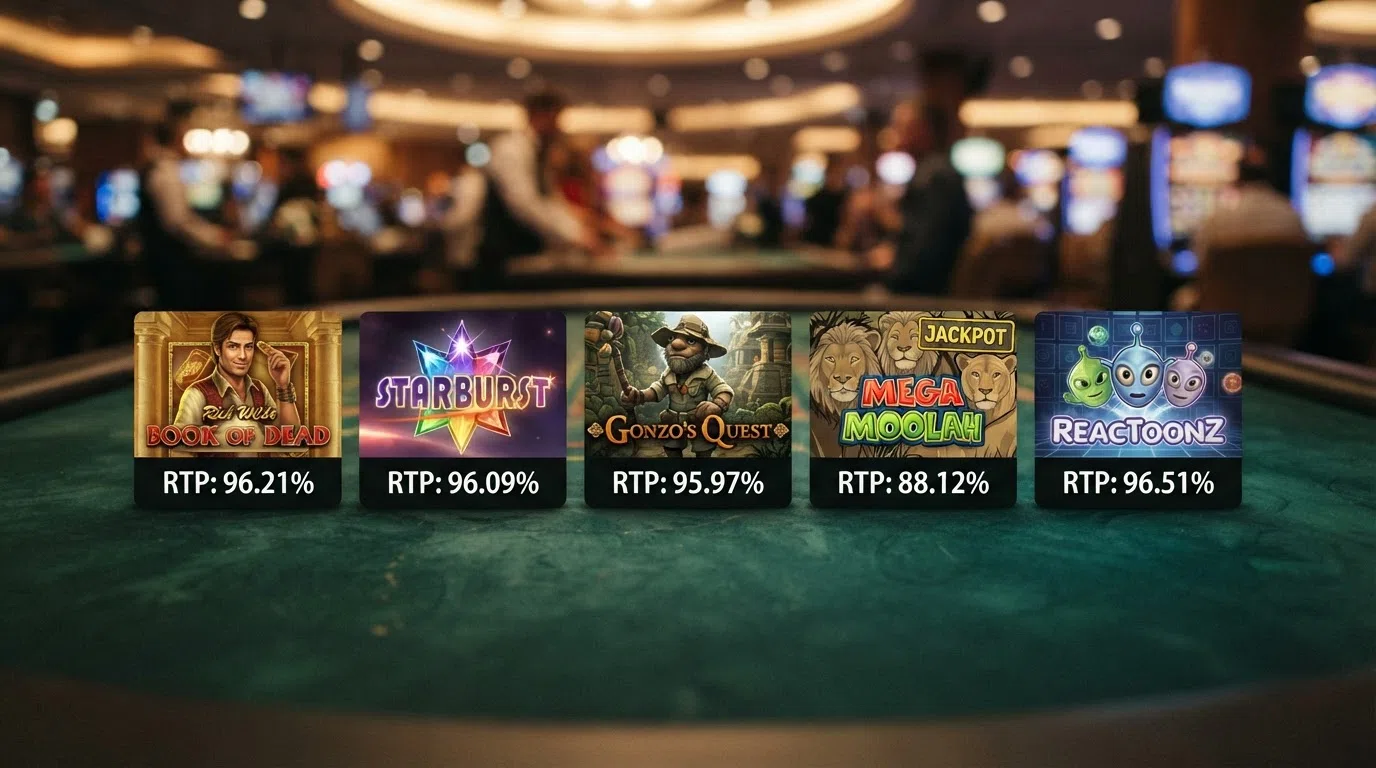
The differentiator is what the player is paying to play them, and that comes down to return-to-player. RTP is the percentage of stake a slot returns to players over a long run of spins; the house edge is 1 minus RTP. At 96.50% RTP, the slot keeps 3.50% of every pound staked across enough spins to converge on the figure. That convergence takes millions of spins at most modern slots, which is why an RTP figure describes the long-run expectation rather than any individual session.
Solana Slots: The Titles with Published RTP Figures
Five titles carry verified RTP figures in the research at the time of review. The table below states each title, its RTP, its provider, its volatility class and its maximum win where research carries one. Volatility describes the spread of payouts — high volatility slots pay less often but in larger amounts; low volatility slots pay more often but smaller amounts.
| Slot Title | RTP | Provider | Volatility | Max Win |
|---|---|---|---|---|
| Starburst | 96.09% | NetEnt | Low-mid | — |
| Gates of Olympus | 96.50% | Pragmatic Play | High | 5,000× |
| Sweet Bonanza | 96.48% | Pragmatic Play | Medium | 21,175× |
| Big Bass Bonanza | 96.71% | Pragmatic Play | High | 2,100× |
| The Dog House Megaways | 96.55% | Pragmatic Play | High | 12,305× |
A volatility entry of “—” means the figure was not carried at the time of review and is left blank rather than guessed. The table is the research’s verified set; other slots the player encounters in the lobby do not carry the same audit and are not added to the list.
Blackjack, Roulette and Table Games with SOL
Every reviewed operator carries a table-game lobby alongside the slots. RNG blackjack and roulette come from a mix of providers; live tables come from Evolution and, at some operators, Pragmatic Play Live. The RTP on blackjack with basic strategy is around 99.5%, which is materially better than the slots in the table above; roulette sits closer to 97–98% depending on the variant.
The catch is game weighting under bonus wagering. Most bonus terms treat table games as 10% or less of stake — a £10 blackjack hand may contribute £1 or less to the required turnover, while a £1 slot spin contributes the full £1. For a player clearing a bonus, this means table games do most of the earning on a per-pound basis but contribute a fraction of the per-pound turnover required. Some bonus terms exclude table games entirely; others restrict them to a small contribution. The terms are what determine whether the higher-RTP table games are useful for clearing or only for unbonus play.
Live Dealer Games at Solana Casinos
Live dealer tables run on the same Evolution and Pragmatic Play Live feeds that supply UKGC-licensed casinos. The product is the same — blackjack, roulette, baccarat, game-show formats — and the experience is identical to fiat play except for the funding method. Wild.io runs 24/7 live blackjack, roulette and baccarat, which is the most explicit operating-hours commitment in the reviewed set; other operators carry the same providers but do not state the same always-on coverage.
The funding is the only layer where SOL changes anything. The player stakes in SOL or a stablecoin peg, the table settles in the same units, and the casino credits winnings to the same balance. The dealers do not know what rail the player is on, and the rail does not affect the cards.
Bingo and Other Games
Bingo is not a headline category at any of the ten featured operators. Some carry bingo-style games within the broader catalogue — Slingo-style hybrids, keno, scratch cards — but a UK player searching specifically for a Solana bingo room will not find one in this set. The category is dominated by slots and live dealer; bingo sits in the smaller-game tab at most.
For a player who wants bingo specifically, the honest route is a UKGC-licensed bingo site rather than an offshore crypto casino — the safer-gambling tooling (deposit limits, reality checks, GAMSTOP) applies, the credit-card ban does not bite because the deposit is in GBP, and the catalogue is purpose-built for the game. The Solana casino set is not the place for it.
Mobile Solana Casinos: No App, No Problem
Solana casinos are mobile by default. Every operator in the reviewed set runs an HTML5 browser site rather than a downloadable app — there is no native iOS or Android casino app at any of the ten featured operators. The reason is partly platform policy (the Apple App Store and Google Play Store restrict real-money gambling apps in most jurisdictions) and partly economic (a single browser codebase covers desktop, tablet and phone). The result is that the mobile experience is the desktop experience shrunk to a phone screen.
The wallet connection is the only layer where mobile behaves differently. Phantom and Solflare both offer mobile browser extensions or in-wallet dApp browsers that handle the connection from a phone; the player opens the wallet, approves the connection, and the casino session runs in the same browser tab. Luck.io’s non-custodial model fits this flow more naturally than a custodial one — there is no separate cashier, just a wallet prompt for each wager.
Mobile Slots with Solana
Slots render in HTML5 by default at every major provider, including Pragmatic Play, which means a Pragmatic slot at a Solana casino on a phone is functionally identical to the same slot at a UKGC site on a phone. Touch controls substitute for click; the spin button is thumb-sized; the autoplay settings work the same way. The only mobile-specific layer is the wallet prompt, which sits behind the spin button rather than in front of it.
Performance is a function of the phone and the network connection rather than the casino. A recent mid-range Android or iPhone running a 5GHz Wi-Fi connection will not notice whether the slot is funded by SOL or by GBP. The casino’s own pages are heavier than the games themselves — promotional graphics, animations, the lobby catalogue — and those are the parts most likely to feel slow on an older device.
The Anonymity Trade-Off: What ‘No KYC’ at a Solana Casino Actually Means
“No KYC” is the headline promise of the crypto casino market. The reality is more conditional. Deposit-side anonymity is real at most offshore operators — a player can send SOL from a self-custody wallet and have it credited to a casino balance without naming themselves. Withdrawal-side anonymity is not, because the operator has its own AML obligations even under Curaçao and Anjouan regimes and will require documents before paying out above a threshold that varies by operator.
The contrast with a UKGC-licensed site is total. Identity — name, address, date of birth — must be verified before the first deposit or any gambling activity at a GB-licensed operator. There is no equivalent verification at a Solana casino until the player asks for their money back. That gap is the pitch. The cost is everything that comes with operating outside the British regulatory framework: no GAMSTOP coverage, no UKGC complaints route, no alternative dispute resolution, no statutory deposit-limit tool, no Financial Ombudsman if the operator refuses to pay.
Crypto-Focused Casinos: Solana Alongside Bitcoin and Ethereum
The featured operators are multi-crypto, with Bitcoin and Ethereum typically the first to be supported and Solana a later addition. BC.Game carries 40+ cryptocurrencies; Stake 20 including SOL; Wild.io 12+. The pattern reflects the casino industry’s adoption curve — BTC and ETH were first because the wallet infrastructure was first; SOL arrived as Phantom and Solflare reached scale.
For a UK player, multi-asset support means the player can hold a balance in several coins, switch between them for withdrawals, and pick the cheapest rail for each transaction. The exchange-spread cost (0.5–1.5% on fiat-to-SOL conversion) applies whichever crypto is used; the difference is the network fee on the on-chain leg. SOL is the cheapest rail in the set; ETH and BTC sit materially higher.
No-Registration and No-Account Solana Casinos
The non-custodial model is the extreme case. Luck.io requires no registration, no email, no account at all — the player connects a Phantom or Solflare wallet and plays directly on chain. Roughly $80 million was wagered on the platform in its first six weeks. The trade is the absence of the structures a UK player is used to: no welcome bonus, no VIP programme, no support history, no responsible-gambling tooling. The model appeals to players who value the wallet-to-wallet settlement and the absence of account data sitting on a third party’s server.
The non-custodial model does not suit players seeking welcome bonuses, VIP programmes or a support history. However, for those who simply want to test a Solana casino with minimal capital and no paperwork, it remains an efficient entry point.
No-Verification Play and Where It Hits a Wall
The typical pattern at a custodial offshore casino is: deposit without KYC, play without KYC, hit a withdrawal threshold that triggers ID checks. The threshold varies by operator and is rarely published in advance; it sits at a level where the operator’s own AML exposure becomes material, typically in the low thousands of pounds. Documents requested are the standard set — government ID, proof of address, sometimes proof of source of funds for larger withdrawals.
The way to find the threshold is to read the operator’s payments page before depositing. Some operators publish a tiered system (no KYC up to a withdrawal amount, light KYC above, full source-of-funds above another tier); others leave the threshold implicit. The player who plans to withdraw in chunks under the threshold is paying for the anonymity with a per-withdrawal ceiling; the player who plans a larger cashout should expect to be asked.
New Solana Casinos: What Has Launched and What Changed
The newest entrants to the Solana casino market look different from the established Curaçao names. They tend to be Solana-native rather than Solana-added — built around the chain rather than supporting it — and they tend to carry Anjouan licences rather than Curaçao eGaming. The shift reflects two things: Anjouan’s lower-cost licensing process has attracted new operators who would have defaulted to Curaçao in earlier years, and the Solana-native architecture is easier to build from a clean slate than to graft onto a multi-currency platform.
Goated launched in June 2024 and is the clearest example. The casino is operated by Mirai Kaze Ltd under Anjouan Licence No. ALSI-202411063-FI2, lists 1,200+ games including in-house originals, runs a native $GOATED token with staking and a weekly lottery, and has accumulated over $1 billion in wagers since launch. Thrill launched in 2025 under an Anjouan Gaming Board licence, carries 3,100+ games, advertises instant withdrawals, and is rated 9.3/10 on CryptoSlate.
The Latest Solana Casino Launches in 2026
The launch timeline over the last 18 months runs Goated (mid-2024), Thrill (2025), with Solcasino.io outside the UK-accessible set since it geo-blocks British IPs entirely under its Tobique Gaming Commission enhanced-due-diligence requirements. The newer launches are smaller in absolute terms than the established Curaçao names — Goated’s 1,200+ games is well under BitStarz’s 4,500+ — but they are typically more focused on the Solana experience specifically.
The phrase “new” in this market carries a different weight than it would in a UKGC-regulated one. A UKGC casino needs a licence to operate; the licence takes months to obtain and the operator is identifiable. An offshore casino can launch in weeks with an Anjouan licence, an incorporated company, and a wallet-connection flow; the operator behind the brand is often harder to identify from the casino’s own pages. Newer is not safer in this market. It is just newer.
Best of the New Crop: What to Look For
The evaluation lens for a recently launched casino is sharper than for an established one, because there is less community feedback to lean on. The first check is the licence — both Goated’s ALSI-202411063-FI2 and Thrill’s Anjouan Gaming Board entry should be visible on the regulator’s public register. The second is ownership: Goated’s operator, Mirai Kaze Ltd, is named on its own pages. Thrill’s ownership is less clearly stated. The third is the game-provider mix: Pragmatic Play, Evolution, NetEnt, Hacksaw are named studios with audited RNGs; an unbranded “in-house” catalogue without a third-party audit certificate is a higher-risk surface.
The fourth is community feedback. Newer operators have less of it, which is why the threshold for a small test withdrawal matters more than for a long-running name. The recommendation is the same as for any offshore casino: start with the minimum deposit, run a small withdrawal to confirm the pipe works, then scale up if the operator earns it.
How to Choose a Solana Casino When the UKGC Is Not Watching
Choosing an offshore casino without a regulator’s safety net is a different exercise than choosing a UKGC-licensed one. The criteria a UK player is used to applying — licence status, GamStop coverage, ADR route, complaint-to-Commission option — do not apply. The criteria that do apply are sharper, less standardised, and depend on the player’s own diligence.
The starting point is the licence register. Curaçao eGaming operates a public validator where the licence number an operator publishes can be checked against the issuing authority’s records. Anjouan’s Gaming Board carries a similar register. A licence number that does not resolve on the register is not a licence. The second point is the game providers: Pragmatic Play, Evolution, NetEnt, Hacksaw are named studios with audited RNGs and a public reputation for not licensing to outright scams. An unbranded catalogue without a third-party audit is higher-risk. The third is the bonus terms — wagering multiples, max bet, game weighting, validity windows — read in full before the first deposit, because the headline is the smallest of the figures that matters.
A Step-by-Step Guide to Evaluating a Solana Casino
- Check the licence register (Curaçao eGaming validator, Anjouan Gaming Board register) for the licence number the operator publishes. If it does not resolve, walk away.
- Verify the game providers are named and audited. Pragmatic Play, Evolution, NetEnt and Hacksaw are audited studios with public reputations. An unbranded catalogue without a third-party audit certificate is higher-risk.
- Read the bonus terms in full. Note the wagering multiple (40× is the typical Solana casino figure, 80× the outlier), the max bet during wagering ($5 or £5 across most operators), the game weighting (table games typically contribute 10% or less), and the validity window (14 days at BitStarz, often longer elsewhere).
- Search player forums and complaint sites for withdrawal complaints. A pattern of complaints about a specific operator is the strongest single signal of a payout problem.
- Start with the minimum deposit. Run a small withdrawal to test the pipe before committing serious funds. A withdrawal that lands within the operator’s stated window is the single best evidence the operator is paying out.
The Pros and Cons of Solana Casinos for a UK Player
The pros are real. Solana deposits confirm in roughly one second at a network fee that is a fraction of a cent, against several minutes to several hours for card and bank deposits at UKGC sites. The exchange spread (0.5–1.5%) is the only meaningful cost on the deposit leg. Bonus offers dwarf what GB-licensed casinos can offer — CoinCasino’s £30,000 cap is the most extreme example in the set, against the GB market’s effective 10× wagering cap that limits the value of any headline number. No UKGC stake cap applies offshore: a Solana casino does not impose the £5/£2 per-game-cycle slot limit (statutory from April–May 2025 under SI 2025/215), and there is no statutory spin-speed minimum.
The cons are also real. No UKGC protection means no GAMSTOP coverage, no Commission complaints route, no alternative dispute resolution provider, and no statutory deposit-limit tool. The wagering at 40× to 80× is several multiples of the GB cap of 10× in force from 19 December 2025. The offshore licence does not provide the consumer protection a UKGC licence does, and the player’s only recourse for a non-paying operator is the operator’s own dispute process. The Remote Gaming Duty at 40% from 1 April 2026 is a GB operator’s cost, not a player-facing one, but it illustrates the gap in regulatory weight between the two regimes.
The Legal Reality: Offshore, Unregulated and Beyond GamStop
The UK regulatory framework sits on one side. Every Solana casino accessible to a UK player sits on the other. The gap between them is not a regulatory grey zone; it is a sharp line, drawn by section 33 of the Gambling Act 2005, which makes the unlicensed supply of gambling to GB customers a criminal offence. The line falls on the operator — up to 51 weeks’ imprisonment, an unlimited fine, or both. The player is not prosecuted for gambling at an unlicensed site. What the player loses is the protection that a UKGC licence guarantees.
That is the legal reality. The rest of this section describes what the protection is, why Solana casinos do not carry it, and what the gap costs in practical terms.
UKGC Licensing and Why Solana Is Excluded
The Gambling Commission is the single statutory regulator for gambling in Great Britain, sponsored by DCMS. The primary statute is the Gambling Act 2005, extended to remote operators by the Gambling (Licensing and Advertising) Act 2014, which brought all online gambling serving GB customers into the point-of-consumption licensing regime. Three licensing objectives anchor the framework: preventing gambling from being a source of crime, ensuring gambling is fair and open, and protecting children and other vulnerable persons. Day-to-day obligations sit in the Licence Conditions and Codes of Practice (LCCP) and the Remote Technical Standards (RTS).
Crypto sits outside this framework because the Commission’s anti-money-laundering requirements assume the operator can identify the source of funds flowing into a customer’s account. With a self-custody wallet, the operator receives SOL from an address whose provenance is not externally verifiable. The Commission’s position is that crypto-funded gambling is high-risk under that framework. No formal ban has been issued — and indeed cannot easily be, because the Commission regulates operators, not payment methods — but the practical effect is a closed door: as of 2026, no UKGC-licensed casino or betting operator accepts any cryptocurrency as a deposit or withdrawal method.
The Commission’s CEO, Andrew Rhodes, told the IAGR 2025 conference that governments “can’t ignore” the rise of crypto gambling demographics. The Commission has also hinted at a “sensible pathway” for cryptoassets to be used as a consumer payment option at licensed operators, conditional on strengthened AML infrastructure. No timeline has been confirmed. The hint is not a route. What would need to change for a UKGC-licensed Solana casino to exist is a workable source-of-funds verification regime for crypto deposits that satisfies the Commission’s AML framework — a problem the industry has not solved and the Commission has not committed to solving on a published timeline.
GamStop Self-Exclusion: Why It Stops at the UK Border
GAMSTOP is the national multi-operator online self-exclusion scheme, mandatory at GB-licensed operators since 31 March 2020. Exclusion periods run six months, one year, five years, or five years with auto-renewal. Exclusion cannot be cancelled early and continues for up to seven further years if the person does not contact GAMSTOP after expiry. The scheme is online-only and licence-bound — it cannot reach operators outside the GB licensing system.
The consequence for a self-excluded player is concrete. A player who has registered with GAMSTOP cannot place a bet or open an account at any UKGC-licensed online casino for the duration of their exclusion. Every Solana casino on the featured list sits outside the scheme. The self-excluded player who chooses to play at one of these operators does so without any of the protections GAMSTOP was designed to provide, and without the operator having any obligation to refuse the registration. The barrier is the player’s own.
If you are self-excluded via GAMSTOP and are considering an offshore casino, the honest reading is that the exclusion’s purpose was to remove the option. The offshore route is not a workaround that preserves the spirit of the exclusion; it is a route around it. The support organisations listed in the section on staying safer are the route back to the infrastructure the exclusion was set up to provide.
The Curaçao and Anjouan Licences: What They Actually Enforce
Eight of the ten featured operators carry a Curaçao eGaming licence; two (Goated and Thrill) carry an Anjouan Gaming Board licence. Neither is equivalent to a UKGC licence, and the difference matters more than the headline similarity.
Curaçao eGaming is the legacy licence for the offshore online casino market. The framework requires a company to register with the Curaçao Gaming Control Board, hold an anti-money-laundering policy on file, and maintain segregated player funds. It does not require UK-equivalent consumer protection: no mandated deposit limits, no reality checks, no session displays, no GAMSTOP-equivalent self-exclusion, no ADR obligation in the British sense. The licence is a registration and a regulatory floor, not a consumer-protection regime.
Anjouan’s Gaming Board is a newer entrant, lower-cost, and stricter at the registration stage than Curaçao’s eGaming licence, but still well below UKGC equivalent on player-facing protections. Goated’s licence (ALSI-202411063-FI2) and Thrill’s Anjouan licence are visible on the issuing authority’s public register; both represent the same gap from a UK player’s perspective. A UK player should not treat either licence as equivalent to a UKGC licence, because neither is.
The bottom line for a UK player: the licence register tells the player whether the operator has registered with anyone. It does not tell the player whether the operator will pay out. That information comes from elsewhere.
UKGC Enforcement: Cease-and-Desist, Not ISP Blocks
The Commission’s enforcement toolkit is disruption, not blocking. The Commission can issue cease-and-desist notices, refer URLs to search engines for delisting, suspend domains, and refer payment-provider relationships. It does not currently hold statutory ISP or DNS blocking powers — the relevant legislation has been proposed but not enacted.
The figures for the April 2024 to June 2025 period give the scale: 3,140 disruption notices issued; 447,778 URLs referred to search engines; 287,961 URLs removed; an average 32% drop in engagement across 160 disrupted sites. The sites remain reachable from a UK IP; they are simply harder to find through British search. None of the ten featured operators in this page’s ranking is among the disrupted URLs at the time of review, but the Commission’s posture towards the offshore market is clear.
For a UK player, the practical reading is that the site is accessible but the regulatory environment is hostile to it. The Commission does not endorse the operator; the Commission is actively trying to make the operator less findable. The player is operating in a regulatory grey area in the sense that the regulator cannot stop them, not in the sense that the regulator approves.
Safety Signals and Red Flags at a Solana Casino
The trust signals that distinguish a working offshore casino from a problematic one are concrete and checkable. A published licence number that resolves on the regulator’s register. Named game providers with audit certification. A named operating company with a registered address that can be cross-checked. Community presence on player forums and complaint sites, with a track record that holds up under search. Transparent bonus terms that do not change between the deposit page and the wagering screen. These are the features of an operator who expects to be paid out and intends to honour withdrawals.
The red flags are equally concrete. No licence number, or a licence number that does not resolve on the register. Anonymous ownership — no named company, no registered address, only a contact form. No named game providers — only “in-house” content without a third-party audit certificate. Withdrawal complaints that form a pattern across player forums. Bonus terms that change after the first deposit. A customer support channel that goes silent on a withdrawal request.
A UK player who runs this checklist before depositing will not catch every problematic operator, but will catch most of the obvious ones. The ones that pass the checklist are the operators worth considering with real money.
Scams, Offshore Risks and What the UK Player Stands to Lose
A scam at a Solana casino looks like one of three patterns. A clone site that imitates a legitimate operator’s branding and wallet addresses — the SOL goes to the scammer, not the casino. A fake licence number — the operator publishes a Curaçao or Anjouan number that does not resolve on the regulator’s register. A blocked withdrawal — the player wins, requests a cashout, and is told the bonus terms were violated, the KYC check failed, or the wagering was not completed, in a way that never quite resolves. Each pattern is common enough in the offshore market that the player’s exposure is real.
The UK player has no British consumer redress for any of them. There is no Financial Ombudsman route. There is no UKGC complaints process. There is no alternative dispute resolution provider in the British sense. The only recourse is the operator’s own dispute process and, in the most serious cases, civil action in the operator’s home jurisdiction — Curaçao or Anjouan, where enforcement against an offshore operator from a UK address is impractical. The Costigan King statement that “consumers who wish to gamble using cryptocurrency are already able to do so — predominantly via offshore or unlicensed operators. Those environments sit outside the UK anti-money laundering framework, outside domestic safer gambling controls and beyond the reach of UK enforcement” describes the gap.
The funds lost to an unregulated operator are almost certainly unrecoverable. That is the cost of the offshore route, and it is the figure every other benefit on this page should be weighed against.
Staying Safer at a Solana Casino: The Tools That Still Work
The UKGC’s safer-gambling tooling does not reach an offshore casino. Reality checks, time-outs, deposit limits, auto-play bans, the 2.5-second spin minimum, session P&L displays — none of these are mandated at Curaçao or Anjouan licensees. The tools a UK player is used to having do not exist at the casino level. They exist elsewhere: at the player’s own wallet, on the player’s own phone, at the support organisations listed below.
The responsible-gambling infrastructure that applies to a UK player at any casino, offshore or licensed, is the UK’s own. GamCare operates the National Gambling Helpline. GAMSTOP covers GB-licensed sites. BeGambleAware provides information and signposting. The NHS runs gambling harm clinics. Gamblers Anonymous runs peer support groups. The infrastructure is free, confidential, and available regardless of where the gambling took place.
The UK Support Organisations Every Player Should Know
The National Gambling Helpline, run by GamCare, is the single entry point: 0808 8020 133, available 24/7, 365 days a year, with live chat on the GamCare website. The helpline received more than 52,000 calls in 2024–25 and saw nine in ten people who completed treatment through the National Gambling Support Network reporting improvement. GamCare’s site also provides information for family members and affected others, who make up a substantial share of the helpline’s caseload.
BeGambleAware (beGambleAware.org) provides information and signposting rather than direct treatment. The site covers what each treatment option does, what to expect from a first conversation, and how to access local services. GAMSTOP (gamstop.co.uk) is the self-exclusion scheme for GB-licensed sites, with exclusion periods of six months, one year, five years, or five years with auto-renewal. Self-exclusion cannot be cancelled early. The NHS runs gambling harm clinics in England, Scotland and Wales; referral can be via the helpline or via a GP. Gamblers Anonymous (ga.org.uk) runs peer support groups across the UK.
Gambling Harm in the UK: What the Numbers Say
The prevalence data puts the offshore route in context. The NHS Adult Psychiatric Morbidity Survey 2023–24 found 0.4% of adults in England experienced problem gambling (PGSI 8+) and 1.6% experienced at least moderate-risk gambling (PGSI 3+); prevalence was highest among 25–34 year olds, at 3.5%. GambleAware’s 2024 Annual Treatment and Support Survey reported 13.1% of adults who gamble — approximately 6.8 million GB adults — were classified as experiencing any level of gambling problems (PGSI 1+). Almost 1.6 million adults in England who gamble may benefit from treatment or support for harmful gambling. The share of adults experiencing gambling problems who now want treatment rose from 17% in 2020 to 30% in 2024.
These are the population figures that justify the safer-gambling infrastructure. The offshore crypto casino sits outside the infrastructure built to address those numbers. The player using an offshore casino has to bring the infrastructure themselves — a budget, a time limit, a session log, a willingness to use the helpline if the budget stops being met.
Setting Your Own Limits When the Casino Does Not
The casino will not set a deposit limit. The wallet can. Decide a monthly SOL budget before the first deposit and do not exceed it. Convert that budget to GBP at the current SOL price so the figure is comparable to other spending; the volatility of SOL against GBP adds a second layer of risk that a GBP-denominated player at a UKGC site does not carry.
Time-box the sessions with a phone alarm. The UKGC-mandated reality check does not exist at an offshore casino; the player’s own alarm is the substitute. Keep a session log — stakes placed, wins, losses, time played, the wallet balance at the start and end — because the casino does not display this and a player without a record has no way to know whether the month’s budget is being respected.
Take breaks. The auto-play ban at UKGC sites is designed to slow play; at an offshore casino the player has to do this manually. And use GAMSTOP as a backstop even if playing offshore — registering for self-exclusion from GB-licensed sites removes the option of switching back to a regulated alternative during a difficult session, which is itself a form of friction that helps.
How We Evaluated These Solana Casinos
The ten operators in this page’s ranking were selected on four criteria. First, confirmed Solana deposit acceptance — each operator was checked to accept SOL at the cashier, either natively or via a third-party on-ramp. Second, UK IP accessibility — each operator was reachable from a UK IP at the time of review without a VPN, with the caveat that several carry their own jurisdiction warnings in the terms. Third, identifiable licence — each operator publishes a Curaçao or Anjouan licence number that can be checked against the issuing regulator’s public register. Fourth, identifiable game providers and bonus terms — each operator’s site carries named studios (Pragmatic Play, Evolution, NetEnt, Hacksaw and others) and published welcome offers.
Licence claims were verified against the Curaçao eGaming validator and the Anjouan Gaming Board public register at the time of review. The UKGC’s public register of licence holders was consulted to confirm that no GB-licensed operator accepts cryptocurrency — a finding the research treats as definitive for the duration of the page. Bonus terms were taken from each operator’s own promotions page at review time and are subject to change; the operator’s site is the source that should be checked before depositing, since terms in this market are updated more frequently than at UKGC licensees.
Game-provider lists were taken from each operator’s site. Withdrawal-track-record assessments were informed by community feedback on player forums and complaint sites, weighted towards recent reports rather than historical ones. No operator paid for inclusion in this ranking and no ranking position was negotiated; the order reflects fit to the page topic — Solana acceptance, bonus value, game library, withdrawal speed — and is editorial.
What a UK Player Should Actually Do About Solana Casinos
The page’s conclusion is not that Solana casinos are dishonest — most of the operators reviewed are long-running businesses with named licences and named game providers. The conclusion is that they sit outside the British regulatory system and that a UK player who chooses to play at one is giving up every consumer protection that system has built since the Gambling Act 2005.
The arithmetic from earlier in this page is the clearest framing. A $500 bonus at 40× wagering — BitStarz’s headline figure, applied to a 96.50% RTP slot — costs roughly $700 in expected losses before it clears. The player is paying $700 to receive $500. The bonus is, in expected-value terms, a $200 loss on top of whatever the player’s underlying gambling session costs. That is the price of the bonus, and the price is paid in expected losses that the wagering requirement forces the player to run through the games.
The legal picture is the other framing. No UKGC-licensed casino accepts cryptocurrency. Every Solana casino accessible from a UK IP is offshore. GAMSTOP does not reach any of the ten operators in this ranking. The Commission’s enforcement is disruption, not blocking; the sites remain reachable, but the regulator is actively trying to make them less findable. A player who is self-excluded via GAMSTOP and chooses to play at an offshore casino has removed the barrier the exclusion was set up to provide.
The verdict, then, is for the player to weigh. A UK player who chooses to play at a Solana casino is stepping outside every consumer protection the British regulatory system has built over the last twenty years. They should treat any deposit as money they may never recover — not because the casinos are necessarily dishonest, but because the legal and practical safeguards that make a UKGC casino a recoverable proposition do not exist at an offshore operator. The expected-loss arithmetic from this page’s bonus section, applied to any of the ten featured offers, is the size of the bet the player is taking against the operator’s house edge, on top of the bet they are taking against the absence of a regulator. The player who accepts both is the player who should be playing.
Frequently Asked Questions
Can I play Solana slots on my mobile phone?
Yes — every Solana casino reviewed on this page runs an HTML5 browser site rather than a native app, and the Pragmatic Play, NetEnt and Evolution slots render on mobile by default. The wallet connection is handled by Phantom or Solflare’s mobile browser or in-wallet dApp browser, which approves the connection on the phone rather than a desktop extension. The experience is functionally identical to playing at a UKGC-licensed casino on the same phone, except for the funding rail and the absence of UKGC-mandated reality checks and spin-speed minimums.
Do Solana casinos require KYC verification?
Most offshore Solana casinos do not require identity verification on deposit — a player can fund an account with an email and a SOL transfer. KYC is typically triggered at withdrawal, where the operator’s own AML obligations require documents above a threshold that varies by operator and is rarely published. The non-custodial operator Luck.io requires no KYC at all because there is no account to verify, but also offers no welcome bonus, no VIP programme and no support history. UKGC-licensed casinos require identity before the first deposit — the two systems are at opposite ends of the verification spectrum.
Are Solana casino bonuses better than regular casino bonuses?
Headlines are larger — CoinCasino’s £30,000 cap, Wild.io’s 400% match — but the wagering requirements are several multiples of the UKGC’s 10× cap (in force from 19 December 2025). A $500 bonus at 40× wagering, played on a 96.50% RTP slot, costs roughly $700 in expected losses to clear. The expected-value gap is narrower than the headline gap suggests, and can be negative against the player.
Are on-chain Solana casinos provably fair?
Provably fair systems — where the player can verify each spin’s outcome against a published hash — exist at some on-chain and crypto-native casinos, including Luck.io. They are not universal; a player should look for a provably fair badge on the games they intend to play and the verification steps the operator publishes. Third-party audited studios (Pragmatic Play, Evolution, NetEnt) are audited by independent testing houses rather than by the player, which is a different but well-established form of fairness verification.
How fast are Solana transactions compared to Bitcoin and Ethereum?
Solana transactions confirm in roughly one second at a fee of about 0.000005 SOL — a fraction of a cent. Bitcoin transactions take ten minutes to an hour at fees that range from a few dollars up to $50. Ethereum transactions confirm in around fifteen seconds at fees between $2 and $50 depending on network congestion. Solana is materially the fastest and cheapest of the three; the trade is that fewer casinos accept SOL than BTC.
What is the safest Solana casino for UK players?
No Solana casino is regulated by the UKGC, so “safest” here means different things than at a licensed site. Operators with long track records, named licences verifiable on the Curaçao eGaming or Anjouan Gaming Board registers, named game providers and responsive community feedback carry less risk than anonymous operators with no audit trail. The safer practice, regardless of operator, is to start with the minimum deposit, run a small test withdrawal before committing, set a wallet-level spending cap, and use the UK support organisations listed in this page if the budget stops being respected.
Are Solana Casinos Still Available to UK Players in 2026?
Yes, they are accessible, and that is the operative word. None of the ten operators reviewed on this page geo-blocks UK IPs by default, though several carry warnings in their terms about players from restricted jurisdictions being responsible for checking local law. Two Solana-native operators do block UK players outright: Solcasino.io geo-blocks the UK entirely under its Tobique Gaming Commission enhanced-due-diligence requirements, and BetHog, founded by FanDuel co-founders Nigel Eccles and Rob Jones, is not available to UK or US players. The accessible market for a UK reader is therefore the offshore end of the Solana casino landscape — Curaçao and Anjouan licensees, with the occasional Malta- or Costa Rica-licensed outlier.
The picture has not changed meaningfully since the UKGC’s stance hardened. There has been no UK regulator-driven mass blocking of crypto casino domains, because the Commission does not currently hold statutory ISP-blocking powers — the legislation has been proposed but not enacted. What enforcement looks like is disruption: cease-and-desist notices, search-engine delisting, domain suspension, payment-provider referrals. From April 2024 to June 2025 the Commission issued 3,140 disruption notices and referred 447,778 URLs to search engines, of which 287,961 were removed, with an average 32% drop in engagement across 160 disrupted sites. The sites remain reachable; they are simply harder to find through British search.
Do Solana Casinos Charge Fees on Deposits and Withdrawals?
The network charges almost nothing: roughly 0.000005 SOL per transaction, a fraction of a cent. The exchange charges 0.5–1.5% on the fiat-to-SOL leg of the round trip, paid at the point of purchase and recovered in the SOL-to-fiat leg on cashout. The casino’s own fee schedule is what matters in the middle, and research at the time of review did not carry a per-operator fee table. The honest instruction is to check each operator’s payments page before depositing: most are explicit about whether they charge on deposits, withdrawals, or both, and most disclose any minimum withdrawal threshold that would force a player to consolidate funds.
The “no fee” promise that some Solana casino marketing leads with refers to the network leg. It is true at that level and misleading at any other, because the exchange spread is real and the casino’s own fee, where it exists, is real.
Are There Solana Casino Apps for iOS and Android?
No featured Solana casino offers a downloadable app for iOS or Android. The combination of platform restrictions on real-money gambling apps and the operator’s own preference for a single browser codebase leaves the mobile experience browser-based. A UK player who wants app-like access can add the casino site to their phone’s home screen — most modern browsers offer “add to home screen,” which places an icon on the home screen that opens the site full-screen without the browser chrome. The result is app-like in feel without being an app in any technical sense.
For a player who specifically wants a native app, the route is a UKGC-licensed casino rather than a Solana casino. The major UK brands run native apps on both stores, and the experience is more polished than a browser tab. The trade is the deposit rail — GBP and cards rather than SOL and a wallet — and the bonus offers that come with that rail, which the section on bonuses covers.
Payments – nodeposit-casinobonuses-uk
Content created by the «nodeposit-casinobonuses-uk» team