
Casino Sites That Accept Jeton in the UK — What Actually Works in 2026
 Available in GB
Jeton is a perfectly serviceable e-wallet — FCA-authorised, a million users strong, and free to open. None of that helps a UK casino player in 2026, because Jeton is not on the cashier page of any major UKGC-licensed casino. Not bet365, not William Hill, not Sky Vegas, not Ladbrokes, not 888, not Betfair, not Betfred, not Coral, not Betway, not Paddy Power. The wallet works in the UK; the casino half of the equation doesn’t. That single fact reshapes this entire page: a reader searching for Jeton-accepting UK casinos is, today, searching for something the licensed market does not offer.
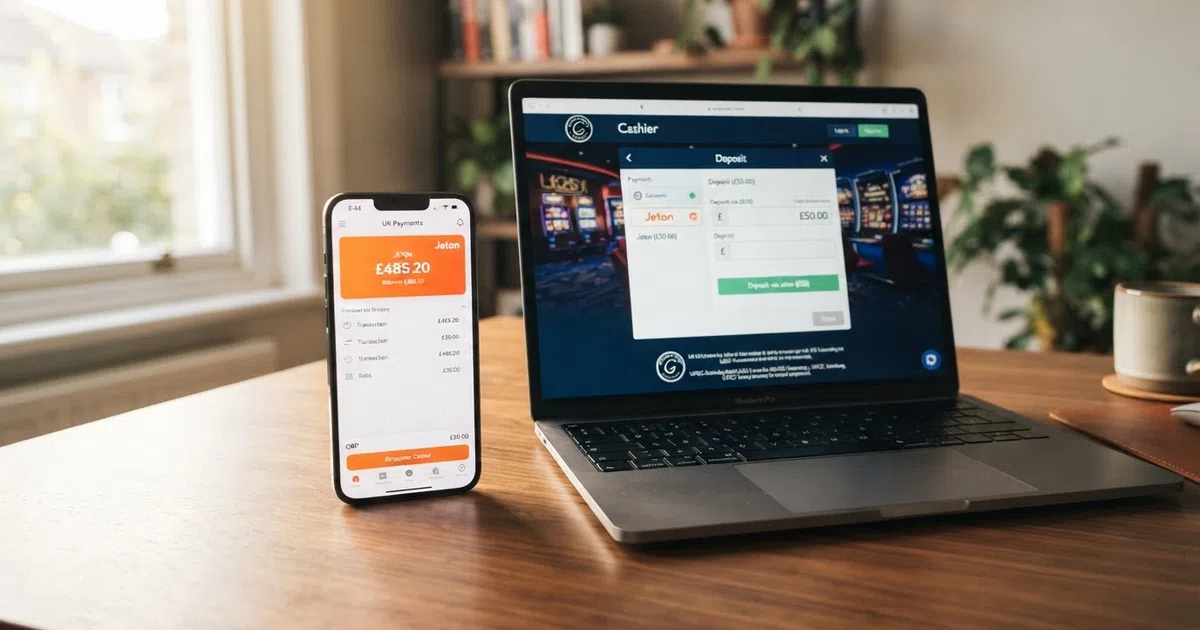
The honest response is to lay out what does work, name the offshore corners where Jeton does sit on the cashier, and cost the trade-off. Players who already use Jeton can still reach the offshore sites. Players who want UKGC protections — GamStop, ADR, deposit-limit prompts, the £5 slots stake cap, the 10× wagering ceiling — need a different wallet. The two routes are not equivalent, and the page below names the difference in numbers, not in adjectives.
Verified against the UK Gambling Commission’s public register of gambling businesses, current as of September 8, 2026.
What Is Jeton? How the FCA-Authorised E-Wallet Works for UK Casino Players
Jeton at a Glance: An FCA-Regulated Digital Wallet With Global Reach
Jeton is an e-money wallet run by LA Orange Limited, authorised and supervised by the Financial Conduct Authority under firm reference number 902088. The company was established in 2017 and now serves more than a million users across 25 or more countries, offering 50-plus payment methods inside the same account. That is a credible footprint: the FCA authorisation means client funds are safeguarded under the Electronic Money Regulations 2011, the firm is subject to capital requirements, and its register entry is publicly searchable.
The product line is wider than a single wallet. Jeton runs a prepaid voucher called Jeton Cash, a wallet-to-wallet transfer service, and the Jeton Card — a physical and virtual Mastercard that draws on the wallet balance. The virtual card is issued instantly; the physical card arrives by post. The card is available to residents of the European Economic Area, the UK included. It opens at retailers, online, and at ATMs, with a per-transaction ATM limit of £700.
The corporate identity is what separates Jeton from a hundred similar fintechs. An FCA registration is not decorative — it is the legal basis on which Jeton holds customer balances, segregates them from its own operating funds, and submits to regulatory oversight. For a UK player, the wallet itself is safe in the same way a UK current account at a regulated bank is safe: the operator can fail, and the safeguarded funds can be returned through the regulatory process. The casino you spend those funds at is a separate question.
Why UK Casino Players Search for Jeton Deposit Options
Three reader profiles drive this search, and they are not the same profile.
The first is the existing Jeton user. They opened the wallet for another purpose — remittances, a Skrill replacement, a way to manage deposits in a currency they use — and naturally looked for UK casinos that take it. The friction point is that Jeton works as a wallet in the UK but not as a casino payment rail, so the search sends them in circles.
The second is the fee-conscious depositor. Credit card deposits attract surcharges at some operators; PayPal has been quietly removed from one of the bigger UK brands. A new wallet that promises transparent fees, free account maintenance, and no foreign-exchange padding is worth investigating. The fee schedule reads well: cash withdrawals in pounds cost 0.5%, card top-ups cost 5%, account opening and maintenance are free. That is competitive with the alternatives.
The third is the speed-seeker. E-wallets in other markets are valued for instant deposits and same-day withdrawals, and Jeton’s marketing leans on that. The UK deposit route, however, is bank transfer only — which is not the speed proposition the wallet sells elsewhere. As CasinoFreak notes of the UK setup: “In the UK, the only available payment method for deposits is Bank Transfer. There, it typically takes 1-3 days, which in my opinion is a bit on the higher side, and the deposit limit is set at £10-5000.” In other words, the headline benefit does not travel to the UK.
Mobile-first users round out the picture. Jeton’s Android app and mobile site handle transfers from a phone, and most UK casino cashier flows are mobile-optimised regardless of the payment method. The bottleneck is still the bank transfer leg, not the device.
The Honest Picture: Jeton’s Limited UK Casino Footprint in 2026
The search “casino sites that accept jeton uk” returns pages about Jeton, but the casinos those pages recommend are not UKGC-licensed. Affiliate sites, global and Australian lists, Irish reviews — all carry the same offshore roster: Woo Casino, National Casino, BitStarz, PlayAmo, SpinBetter, Basswin, Cloudbet, MelBet. Some carry a Malta-licensed Casumo entry, but the UKGC-licensed version of the same brand does not list Jeton at the cashier. The pattern is consistent: every UKGC operator in the ranked set below was checked individually for a Jeton option, and none was found.
The UK market differs from the markets where Jeton is integrated because UKGC-licensed operators run on a small, stable set of payment rails — debit cards, PayPal, Apple Pay, Google Pay, Paysafecard, bank transfer, and the newer Pay by Bank and Revolut Pay. Sky Vegas has actively pruned its list, dropping PayPal and Google Pay and adding the open-banking-based Pay by Bank. Newer payment methods reach UK players through regulated acquirers, not through direct wallet-to-casino integrations of the kind Jeton relies on in other territories. The regulatory stack — identity verification before first deposit, no credit card funding, mandatory deposit-limit prompts — pushes operators toward a small set of fully compliant providers, and Jeton’s UK deposit leg (slow bank transfer) does not earn it a seat at that table.
What this means for the reader is that the search has two honest answers. The first is to use Jeton at an offshore site and give up UK protections. The second is to use a wallet the UK licensed market actually accepts — PayPal, Apple Pay, Revolut Pay, Paysafecard, debit card, bank transfer — and keep the protections. The rest of this page lays out both.
Is Jeton Safe? Security, Trust and Player Protections
Jeton is safe as a wallet. FCA authorisation is the substantive answer here: the firm is supervised, client funds are safeguarded, the registration is searchable on the FCA register (firm reference 902088), and the company has been operating since 2017 with more than a million users across 25-plus countries. The published fee schedule is a transparency signal in its own right — 0.5% on UK cash withdrawals, 5% on card top-ups, free account maintenance — and is publicly posted rather than buried. Standard security layers apply: encryption in transit, two-factor authentication on the account, and segregated funds.
What Jeton’s authorisation does NOT do is make a casino safe. The wallet protects the money in transit; the casino protects the money once it lands. A player depositing at an unlicensed offshore site via Jeton has a perfectly well-protected wallet, and an unprotected casino — no GamStop coverage, no UKGC complaints route, no alternative dispute resolution, no guarantee that the games are fair, no obligation to honour responsible-gambling requests. The UK Gambling Commission is explicit on the gap: “When consumers access illegal gambling sites, they expose themselves to risks and are not afforded the protections required in the regulated sector. We are particularly focused on identifying and disrupting those illegal websites which are targeting young and vulnerable gamblers.”
A safe Jeton deposit is one that ends at a UKGC-licensed cashier. As of 2026, that cashier does not list Jeton.
The Top 10 UK-Licensed Online Casinos — and the E-Wallets They Actually Accept in 2026
| Casino | UKGC Licence | Jeton Accepted | Welcome Bonus | E-Wallets Accepted | Min Deposit |
|---|---|---|---|---|---|
| bet365 | Active | No | Bet £10 Get £30 (1× wagering) | PayPal, Apple Pay, Google Pay, Paysafecard, bank transfer | £5 |
| Sky Vegas | Active (Flutter) | No | 50 no-deposit + 200 deposit free spins (no wagering) | Apple Pay, Pay by Bank, Revolut Pay | £5 |
| Ladbrokes | Active (Entain) | No | 100 free spins (no wagering) on £10 play | Apple Pay, Google Pay, Paysafecard, bank transfer | £5 |
| Betfair | Active (Flutter) | No | 50 no-deposit + 100 deposit free spins (no wagering) | PayPal, Apple Pay, Paysafecard, bank transfer | — |
| 888 Casino | Active (evoke plc) | No | 100% deposit match up to £100 (10× wagering) | PayPal, Apple Pay, bank transfer | £10 |
| William Hill | Active (evoke/888 Holdings) | No | 200 free spins on Big Bass Splash, 10p each | Apple Pay, PayPal, Paysafecard, cash vouchers, online banking | £5 |
| Paddy Power | Active (Flutter) | No | 60 no-deposit + 200 deposit free spins (no wagering) | PayPal, Apple Pay, Paysafecard, bank transfer | £10 |
| Betfred | Active (Betfred Group) | No | — | PayPal, Apple Pay, Paysafecard, bank transfer | — |
| Coral | Active (Entain) | No | — | PayPal, Apple Pay, Paysafecard, bank transfer | — |
| Betway | Active (Super Group) | No | — | PayPal, Apple Pay, bank transfer | — |
The “no” in the Jeton column is the same answer for every row. The interesting column is the e-wallets column, because that is where a Jeton user can redirect. PayPal and Apple Pay together cover every operator in the table except Sky Vegas (which has removed PayPal). The minimum deposit column shows the same £5 entry point at six of the ten brands, with 888 and Paddy Power the only £10 floors in the set. The bonus column shows the structural shift in the UK bonus market: six of the ten offers are no-wagering free-spin bundles, one is a low-wagering cash credit (bet365’s Bet £10 Get £30 at 1×), and 888 carries the market’s signature cash match under the new 10× ceiling.
The ranking order reflects market presence and licence verification, with each brand cross-checked against the UKGC’s public register of gambling businesses — 2,663 active licence records, last updated 29 July 2026. Every operator in the table holds an active operating licence for Great Britain. The gaps in bonus, free spin, wagering, and minimum deposit cells for Betfred, Coral, and Betway reflect data not confirmed in the current research cycle, not a negative finding. Those brands remain safely on the UKGC register and the e-wallet and Jeton columns are populated from current cashier pages.
bet365 Casino: The Market Leader With PayPal, Apple Pay and Google Pay
bet365 is the largest UK-facing online operator, and its cashier reads like a survey of mainstream UK payment rails: Visa/Mastercard debit, PayPal, Apple Pay, Google Pay, Paysafecard, and bank transfer. Jeton is not among them. The welcome offer is a low-friction one — Bet £10 Get £30 in Bet Credits at 1× wagering, claimable within 30 days of registration. Most methods accept a £5 minimum deposit, with bank transfer the exception at £100. A player who arrived with a Jeton wallet can swap to PayPal or Apple Pay and keep the same instant-deposit experience; the bonus terms do not exclude e-wallets the way Sky Vegas’s do. The brand is the safe harbour of the ranking: every payment method on its cashier page is mainstream UK, every offer is wagered at the lowest rate in the table, and the £5 minimum makes it the most accessible entry point in the set.
Sky Vegas: No-Wagering Free Spins and a Streamlined Payment Line-Up
Sky Vegas runs 50 no-deposit free spins on registration plus 200 more after a £10 spend, all with zero wagering — the headline bundle in the no-wagering column. The 7-day validity window is the only friction. The payment story is more interesting than the bonus: Sky Vegas removed PayPal and Google Pay, and now accepts debit card, Apple Pay, Pay by Bank, and Revolut Pay. The Jeton-not-accepted finding is the same, but the brand’s pivot tells a reader something useful about the UK market’s direction. Pay by Bank is an open-banking transfer, Revolut Pay is app-based and fast, and the move away from PayPal signals that even large UK operators are reconsidering which e-wallets are worth the integration cost. For a Jeton user, Sky Vegas works with Apple Pay, Revolut Pay, or bank transfer — but promotions require a debit card or Apple Pay deposit to qualify, so verify these terms before funding your account.
Ladbrokes Casino: 100 No-Wagering Free Spins With a £10 Entry
Ladbrokes is an Entain brand and an old name on the UK high street. The welcome offer is 100 free spins with no wagering on selected games, valued at £0.10 per spin, after a £10 qualifying play. The 48-hour acceptance window is tight, and spins expire 7 days from acceptance. Payment methods cover the UK mainstream: Visa/Mastercard debit, Apple Pay, Google Pay, bank transfer, and Paysafecard. The £5 minimum deposit matches the cluster of low-entry brands. Jeton is not accepted; for an e-wallet user, Apple Pay or Paysafecard is the closest substitute. The brand suits a player who wants a clean no-wagering spin bundle and is happy to use a mainstream UK rail.
Betfair Casino: 150 No-Wagering Free Spins Across Two Deposit Tiers
Betfair is Flutter-owned, like Sky Vegas and Paddy Power, and the bonus structure mirrors those brands: 50 no-deposit free spins on registration, then 100 more on a £10 deposit and play, with zero wagering throughout. The 150 total is generous by the table’s standard. Payment methods cover the standard UK operator rails. The minimum deposit was not confirmed in the current research run, so the cell reads as a dash. PayPal coverage at Betfair is the practical point for a Jeton user — Flutter has not removed PayPal from this brand the way it did at Sky Vegas, so PayPal is the cleanest e-wallet substitute here.
888 Casino: A 100% Deposit Match With the New 10× Wagering Cap
888 is one of the few UK operators still running a deposit-match bonus, and the 10× wagering cap that came into force on 19 January 2026 is what makes it usable. The offer is 100% up to £100, wagered 10× on selected slots within 90 days, with winnings capped at £100. The £10 minimum deposit is the higher of the cluster. Payment methods are debit card, PayPal, Apple Pay, and bank transfer. The 10× cap is the regulatory story of the bonus market: before the change, deposit matches commonly carried 30× to 60× wagering, which made a £100 bonus into £3,000 to £6,000 of required turnover. At 10×, the same bonus is £1,000 of turnover — clearing a bonus in a session rather than across weeks of play. The £100 winnings cap is the trade-off: 888 pays real cash, but the upside is limited. Jeton users will find PayPal and Apple Pay fully supported here, and no exclusionary clauses limit these methods in the bonus terms.
William Hill Casino: 200 Free Spins and the Widest High-Street Payment Reach
William Hill carries 200 free spins on Big Bass Splash at 10p each after a £10 deposit and wager, with a £30 maximum cashout from free spin winnings. The 72-hour issue window is the shortest in the set, so the offer suits a player who signs up and plays the same day. Payment methods are the widest in the ranking: Visa/Mastercard debit, Apple Pay, PayPal, online banking, Paysafecard, and cash vouchers — the last one is the high-street angle, and it gives the brand a unique position among operators that have moved online-only. The £5 minimum is the cluster floor. Jeton is not accepted; the substitutes for a Jeton user are PayPal, Apple Pay, or a Paysafecard voucher bought at a shop.
Paddy Power Games: 260 No-Wagering Free Spins and a No-Deposit Starter
Paddy Power’s 260 free spins are the largest no-wagering bundle in the table: 60 on registration, then 200 on a £10 deposit and play. The split mirrors Sky Vegas and Betfair but with a higher headline number. Payment methods follow the standard UK rail set. The £10 minimum is the higher of the cluster. The Flutter-owned operator runs no-wagering throughout, so the player keeps whatever the spins return. A Jeton user can route through PayPal or Apple Pay and claim the bundle in full; there is no e-wallet exclusion on this offer. The bonus value is real because the cap is on the wagering, not the winnings.
Betfred Casino: A UK High-Street Stalwart With a Growing Online Presence
Betfred holds a 4.85% share of the UK online casino market — a meaningful position built on the high-street bookmaker’s brand. The current welcome bonus, free spin count, and minimum deposit were not confirmed in this research run, so the cells read as dashes rather than guesses. What is confirmed: the UKGC licence is active, the Jeton-accepted answer is no, and the payment methods include the standard UK operator rails. For a Jeton user, PayPal and Apple Pay are the substitutes. The brand sits below the headline set on bonus visibility, but the market share puts it ahead of several better-known rivals for player trust.
Coral Casino: An Entain Powerhouse With 6.29% Market Share
Coral is Entain’s second brand in the ranking and the bigger of the two by market share at 6.29%. Like Betfred, the welcome bonus, free spin allocation, and minimum deposit were not confirmed this run, so the cells are dashes. Confirmed: UKGC active, Jeton not accepted, payment methods include the standard UK rail set. The Coral high-street estate gives it a cash-voucher entry route in some regions; the online casino’s payment page currently lists the standard UK rail. Jeton users should default to PayPal or Apple Pay, benefiting from the brand’s regulated safety and long-standing high-street presence.
Betway Casino: A Global Brand With a Solid UKGC Footprint
Betway holds a UKGC licence through Super Group, with a 2.04% market share that places it in the top tier of UK-licensed online casinos. The welcome bonus, free spins, and minimum deposit were not confirmed this run. Payment methods are debit card, PayPal, Apple Pay, and bank transfer — slightly narrower than Coral’s, with Paysafecard absent. Jeton is not accepted. The brand is a global casino operator with a solid UK regulated presence, and a Jeton user can substitute PayPal or Apple Pay without changing anything else about the deposit flow. The thinner payment line-up is a small reason to prefer Coral or William Hill for e-wallet breadth, but the licence status and market presence make Betway a safe choice.
New UK Casino Brands That Could Add Jeton Support Down the Line
Newer UKGC-licensed entrants are likelier than the incumbents to add alternative payment rails. A fresh brand trying to differentiate in a market dominated by ten big names has an incentive to advertise the wallets and apps the bigger operators ignore. The 10× wagering cap applies equally to new entrants from 19 January 2026, so the bonus terms will be comparable, but the payment page is where the difference shows. Before signing up, check three things: the UKGC public register (2,663 active licence records, last updated 29 July 2026), the cashier page for the specific payment method you want to use, and the bonus terms for any e-wallet exclusion clause. A new brand’s marketing is a hypothesis; the cashier page and the licence register are the evidence. The risk in a new brand is the opposite of an offshore site: the licence is real, but the operator’s reputation, withdrawal history, and dispute record are shorter. The trade-off is a fresh product versus a longer track record, and the reader makes that call.
How to Deposit and Withdraw Using Jeton at Online Casinos
Setting Up and Funding Your Jeton Wallet From the UK
Opening a Jeton account is the same flow as any FCA-regulated e-money product: name, address, date of birth, email, password, then identity verification through a government-issued document. The FCA requires this for anti-money-laundering reasons, and Jeton applies it before the wallet can receive a bank transfer or card top-up above the no-kyc threshold. Once verified, funding options open up.
The free route is a bank transfer. UK bank transfers into Jeton are free, the funds are usually credited on the same business day, and there is no fee on the Jeton side. A card top-up is faster — typically instant — but costs 5% of the top-up value, charged by Jeton at the moment of deposit. The 0.5% fee on cash withdrawals in pounds only applies when money leaves the wallet, not when it goes in. There is no monthly account fee, no inactivity fee, and no fee for keeping the wallet open.
The credit-card interaction matters for casino players. Credit cards have been banned for all remote gambling in Great Britain since 14 April 2020, and the ban extends to e-wallet funding — funding a Jeton wallet with a credit card and then depositing at a casino is blocked. Debit cards work, and a debit-funded wallet is fully usable for casino deposits where Jeton is accepted. The 5% card top-up fee still applies, and the credit card route is closed regardless of fee. Plan to fund from a UK bank account, either by transfer (free) or debit card (5%), and the wallet works as intended.
Making a Casino Deposit With Jeton: The UK Step-by-Step
Where a casino does list Jeton, the deposit flow is the standard e-wallet pattern: select Jeton at the cashier, enter the deposit amount, authenticate in the Jeton window, confirm, and the casino credits the account once Jeton settles. In markets where Jeton is integrated with instant rails, that confirmation is seconds. In the UK, it is not. As CasinoFreak describes the UK setup: “In the UK, the only available payment method for deposits is Bank Transfer. There, it typically takes 1-3 days, which in my opinion is a bit on the higher side, and the deposit limit is set at £10-5000.”
The 1–3 day window is the friction point. A player who chooses Jeton at a UKGC-listed casino is choosing a slower deposit than PayPal, Apple Pay, or Paysafecard would deliver. The £10 minimum and £5,000 maximum are reasonable casino-side limits, and Jeton’s own account accepts deposits up to £10,000 by bank transfer, so the limit chain works for normal play. The delay is the cost of the UK route, and it is the reason none of the major UK operators have integrated Jeton — the speed proposition is the wallet’s selling point, and the UK version does not sell it.
Withdrawing Casino Winnings to Your Jeton Wallet
Cashout direction is where Jeton recovers some of its appeal. Casino-side processing to a Jeton wallet is typically under 24 hours where the operator supports it, against 1–3 business days for a UK bank transfer. From Jeton, the wallet-to-bank leg is £10–£10,000 per transfer, completes in 0–30 minutes for a local bank, and is instant for an international transfer. The 0.5% fee on UK cash withdrawals applies on the Jeton side. A £500 cashout, for example, costs £2.50 in Jeton fees, and arrives in the UK bank within half an hour in most cases.
The constraint is upstream: no major UKGC-licensed casino currently supports Jeton withdrawals, because the wallet is not in their cashier to begin with. At offshore sites that do accept Jeton for both deposits and withdrawals, the chain works as described, with the player’s UK bank receiving the funds faster than a standard bank transfer would deliver them. The 24-hour casino-side processing figure is typical rather than guaranteed; always check the operator’s stated withdrawal window before depositing.
Jeton Fees, Limits and What They Cost Your Casino Bankroll
The fee line items, in order, are: account opening and maintenance free, bank-transfer top-up free, debit card top-up 5%, cash withdrawal in pounds 0.5%, ATM withdrawal at the Jeton Card £700 per transaction. Casino-side limits on Jeton deposits, where the operator supports it, run £10–£5,000 per transaction in the UK. The Jeton-to-bank leg costs 0.5% on the way out.
A worked £100 deposit-and-cashout cycle at an offshore Jeton casino shows the real cost. Funding the wallet is free if done by bank transfer, or £5 by debit card. Depositing £100 to the casino is free on the Jeton side. Playing and cashing out the £100 back to Jeton is free on the casino side, with whatever game-edge loss already absorbed. Withdrawing £100 from Jeton to a UK bank costs 0.5%, or 50p. Total Jeton fees for the round trip: 50p on the cheapest funding route, £5.50 if funded by debit card. The wallet is not the costly line — the offshore casino’s house edge is, and the lost UK protections are the bigger cost.
Using Jeton on Mobile: Android Apps and Mobile-Optimised Casino Sites
Jeton’s Android app handles transfers, balance checks, and Jeton Card management from a phone, and it is the cleaner of the two operating contexts for everyday wallet work. The mobile flow at a casino cashier is the same as desktop: select Jeton, enter the amount, authenticate in the Jeton window, confirm. Mobile-optimised UK casino sites do not treat Jeton differently from desktop because the payment integration is server-side, not browser-side. The 1–3 day UK bank-transfer delay is the same on every device. Ultimately, the wallet’s speed is dictated by the UK banking infrastructure, rendering the mobile device’s technical specifications largely irrelevant to deposit times.
Casino Bonuses and Free Spins for UK E-Wallet Depositors in 2026
Welcome Bonuses: What UK Casino Deposit Matches and Free Spins Are Worth
The UK bonus market in 2026 is split into three offer types. The first is the no-wagering free spin bundle, which dominates the Flutter and Entain brands: Sky Vegas, Ladbrokes, Betfair, and Paddy Power all run 100 to 260 no-wagering spins. The second is the no-wagering free spin bundle at William Hill, with a £30 maximum cashout as the trade-off. The third is the deposit match, which 888 carries alone in the ranked set at 100% up to £100 with 10× wagering.
The bet365 offer sits in a category of its own — Bet £10 Get £30 in Bet Credits at 1× wagering is closer to a sportsbook structure than a casino bonus, and the qualifying bet settlement at 1× is the lowest wagering cost in the table. The Bet Credits are withdrawable as cash once the qualifying bet settles, so the offer has the same clarity as a no-wagering spin bundle but a different shape.
The 10× wagering cap is the structural change. From 19 January 2026, LCCP Social Responsibility Code 5.1.1 capped wagering requirements at 10× the bonus amount, with a simultaneous ban on mixed-product bonuses that combined casino, betting, bingo and lottery in one offer. The pre-cap norm was 30× to 60×, and a £100 deposit match at 30× meant £3,000 of required turnover. At 10×, the same bonus is £1,000 of turnover, which a serious slots player can clear in one or two sessions rather than weeks of play. The shift makes the remaining deposit matches more realistic, and it explains why most operators moved to no-wagering free spins instead — the spin bundle does not need the wagering cap to be fair.
No-Wagering Free Spins: Keep What You Win, No Strings Attached
No-wagering means the free spin winnings are credited as real cash, withdrawable immediately, with no playthrough requirement. Six of the ten operators in the ranked set run no-wagering free spin offers on at least some of their free spin bundles: Sky Vegas, Ladbrokes, Betfair, Paddy Power, and William Hill (with a £30 cap as the trade-off). 888 is the contrast — its offer is a cash match, not spins, and the 10× wagering applies. bet365’s Bet £10 Get £30 sits in a third category, where the Bet Credits convert to withdrawable cash once the qualifying bet settles at 1×.
The no-wagering value is real and quantifiable. A 100-spin bundle at £0.10 per spin returns an expected value based on the slot’s RTP. A 96% RTP slot over 100 spins at £0.10 gives an expected return of £9.60. A 94% RTP slot gives £9.40. The numbers are modest but the wagering saving is the point — a 30× wagering requirement on the same £10 expected return would require £300 of playthrough, which at a £2 stake per spin for the under-25 age band is 150 spins. No-wagering collapses the gap between earning the bonus and having it in cash.
Bonus Codes, Promo Deals and the Payment-Method Fine Print
Bonus codes in the UK are less common than in other markets because the welcome offer is auto-credited on a qualifying deposit at most UKGC-licensed casinos. Where a code is required, it is entered at the cashier or the registration page, and the T&Cs make the requirement visible. The bigger fine-print issue for a Jeton user is the payment-method exclusion clause — the small print that excludes certain deposit methods from bonus eligibility.
Sky Vegas is the clearest example. Promotions require a deposit by debit card or Apple Pay, and other accepted methods (Revolut Pay, Pay by Bank) do not qualify. The clause is not hidden, but a player who has not read the T&Cs would find the 200-spin follow-up missing from their account. The same pattern exists in offshore bonus terms with greater frequency and less disclosure — a “deposit by Skrill or Neteller excludes you from the welcome bonus” clause is the standard offshore boilerplate, and a Jeton deposit at the same site would be treated similarly.
The reading order is: read the T&Cs, check the payment-method clause, fund the account with a method that qualifies. A Jeton user at an offshore site can usually claim a bonus with a Jeton deposit, but the offer value is reduced by the offshore site’s own structural weaknesses, and the wagering requirements are often higher than the UK 10× cap because the cap does not apply outside the UKGC. The honest comparison is between a UKGC no-wagering spin bundle (claimable with PayPal or Apple Pay) and an offshore deposit match (claimable with Jeton, but with worse terms and no UK protections). The UK offer wins on every dimension except the payment method.
The 10× Wagering Cap: Why Your 2026 Bonus Is Smaller But Fairer
A worked example makes the 10× cap visible. Take 888’s 100% deposit match up to £100. At the old 30× norm, a player claiming the full £100 bonus would need to wager £100 × 30 = £3,000 before the bonus converts to withdrawable cash. At the 10× cap, the same £100 bonus requires £100 × 10 = £1,000 of turnover. The clearing time at the £5 slots stake cap (players 25 and over) is £1,000 / £5 = 200 spins, and at the 2.5-second minimum spin speed that is 500 seconds, or about 17 minutes and 20 seconds of pure spinning. In practice, with a realistic hit rate and session breaks, the bonus clears in an evening.
The arithmetic assumes the bonus amount is the only thing being wagered (deposit + bonus wagering, or bonus-only wagering, depending on the operator’s structure), and the input figure is the headline bonus at full claim. The output is a time figure — how long the bonus takes to clear — not a payout value. The expected loss on £1,000 of slots turnover at a 96% RTP is £40, which is the house edge doing what it always does, and the player walks away with the bonus cleared or partially cleared depending on variance.
The 10× cap is the clearest regulatory improvement to the UK bonus market in years. The mixed-product ban is the second half of the same reform — operators can no longer bundle a casino bonus with a free bet, a bingo ticket, and a lottery entry into a single promotion. The two changes together have made the UK bonus market smaller in headline value but more realistic to clear, and that is a better trade for the player who actually plays the bonus through.
Slots, Table Games, Live Dealer and Bingo at UK E-Wallet Casinos
Real-Money Slots at UK Casinos: What the Stake Caps Mean for Your Session
The UKGC’s online slots stake cap, in force from April and May 2025 under SI 2025/215, splits by age: £5 per game cycle for players 25 and over, £2 per game cycle for players 18 to 24. A “game cycle” means a single spin, including any feature spins or bonus rounds that resolve from that stake. The cap is per stake event, not per session or per hour, and it is a hard limit at the game software level — a player cannot raise the stake above £5 (or £2) even by selecting a higher coin value or bet level.
The stake cap is one of three rule sets that reshape UK slots. The second is the game-design rules in force since 31 October 2021: auto-play is banned, the minimum spin speed is 2.5 seconds, features that accelerate play are banned, and “losses disguised as wins” — slot animations that celebrate a payout smaller than the stake — are banned. The third is the session display: every UKGC-licensed slots game must show the player their total wins, total losses, and time played during the session. The reverse-withdrawals ban, in place since 2021, prevents casinos from encouraging players to cancel a withdrawal and return funds to play.
The practical session is different from the pre-cap experience. A £5 stake cap means a 200-spin session at £1,000 turnover is a long evening, not a quick one — the 2.5-second minimum spin extends 200 spins to 500 seconds of spinning, plus feature rounds and natural pauses. The session display is a quiet prompt to stop; for a player who is aware of the figures, the running loss counter is the responsible-gambling tool working as designed. For a Jeton user, none of this changes the payment method question: the stake cap and game-design rules apply at the casino, regardless of how the funds arrived.
Blackjack, Roulette and Table Games for E-Wallet Players
Table games sit outside the slots stake cap. Blackjack, roulette, baccarat, and casino poker variants have no statutory stake limit at the UKGC level, and the table limits are set by the operator within their licence conditions. A £5-a-hand blackjack game is standard; £500-a-hand is available in the high-roller rooms at most major UK brands; live dealer VIP tables go higher. The RTP profile is also different: blackjack at near-optimal play returns 99.5% or better, European roulette returns 97.3%, and these are tighter house edges than the typical 94% to 96% slot.
The game-design rules (auto-play ban, 2.5-second spin speed, losses-disguised-as-wins ban) apply to slots specifically, not to table games. Live dealer blackjack and roulette run at the pace of the dealer and the other players, with no enforced minimum cycle time. A Jeton user at an offshore table-game lobby will find the same game library as a UKGC player, with the RTP set by the software provider rather than the regulator, and the same caveat about offshore play: no UKGC protection on game fairness, no ADR route on a dispute.
Live Dealer Games: The Closest Thing to a Casino Floor With an E-Wallet Deposit
Live dealer studios are operated by specialist providers — Evolution and Pragmatic Play Live dominate the UK market — and stream blackjack, roulette, baccarat, and game-show formats from physical studios to the player’s device. The deposit side is the same as the rest of the casino: a Jeton deposit at an offshore site, a PayPal or Apple Pay deposit at a UKGC site, funds land in the cash balance, and the player joins a live table from the lobby. The minimum stakes at live tables are higher than RNG games — 50p to £1 at the low end, scaling to £10,000+ at VIP tables — and the pace of play is set by the dealer.
The social and immersive quality of live dealer is the draw. The 38% of UK adults who gamble online (Gambling Survey for Great Britain, Wave 4, September 2025 to January 2026) are spending more time in live lobbies as the format matures, and the game-show titles (Crazy Time, Monopoly Live, Lightning Roulette) are the bridge between RNG slots and table games for a player who wants a more theatrical session. Live dealer lobbies support Jeton where available, but players strictly seeking UK-regulated environments will need to look beyond the offshore operators that currently carry these integrations.
Bingo Sites That Accept E-Wallet Deposits
UK bingo is a smaller market than online casino, but the e-wallet acceptance pattern is similar: debit cards, PayPal, Apple Pay, and Paysafecard, with Jeton absent from the mainstream brands. The bingo-specific sites (Gala Bingo, Foxy Bingo, Mecca Bingo, Tombola) and the casino-bingo hybrids at Entain, Flutter, and 888 all use the same UK payment rails as their casino siblings.
The tax structure changed on 1 April 2026. Remote Gaming Duty rose from 21% to 40% for online casino operators, and Bingo Duty was abolished on the same date. The headline effect on bonuses is that bingo operators, no longer paying the duty, have more room to fund player promotions, and the post-abolition bingo welcome offers are typically more generous than their pre-abolition equivalents. The 10× wagering cap and mixed-product ban from 19 January 2026 apply to bingo bonuses on the same terms as casino bonuses, so the offer structure looks similar across verticals. For a Jeton user, the bingo angle is more of a tax-side curiosity than a payment-side one — the e-wallet question stays the same.
If Not Jeton, Then What? The E-Wallet Alternatives UK Casinos Actually Accept
| Payment Method | UK Casino Acceptance | Deposit Speed | Withdrawal Speed | Player Fees | Bonus Eligibility |
|---|---|---|---|---|---|
| PayPal | bet365, Betfair, 888, William Hill, Paddy Power, Betfred, Coral, Betway | Instant | Within 24 hours | None at the casino | Generally eligible |
| Apple Pay | All ten ranked operators | Instant | Not supported for withdrawals | None | Varies by operator (Sky Vegas requires for promos) |
| Google Pay | bet365, Ladbrokes | Instant | Not supported for withdrawals | None | Generally eligible |
| Paysafecard | bet365, Ladbrokes, Betfair, William Hill, Paddy Power, Betfred, Coral | Instant | Not supported for withdrawals | None | Generally eligible |
| Pay by Bank | Sky Vegas | Same day | Within 24 hours | None | Excluded from Sky Vegas promotions |
| Revolut Pay | Sky Vegas | Instant | Within 24 hours | None | Excluded from Sky Vegas promotions |
| Skrill / Neteller | Limited UKGC presence (removed from many since 2020) | Instant | Within 24 hours | Possible currency conversion fee | Often excluded from welcome bonuses |
| Debit card | All ten ranked operators | Instant | 1–3 business days | None | Generally eligible |
| Bank transfer | All ten ranked operators | 1–3 business days | 1–3 business days | None | Generally eligible |
The headline is PayPal and Apple Pay. Between them, they cover every UKGC-licensed operator in the ranked set: PayPal at eight of ten (Sky Vegas and Ladbrokes being the gaps), Apple Pay at all ten. The deposit speed is instant for both, the withdrawal speed is the casino’s standard processing window (typically under 24 hours for e-wallets), and the player pays no fee on either side. The bonus eligibility is the variable: PayPal is almost universally accepted as a qualifying deposit method, while Apple Pay’s eligibility depends on the operator’s promotion T&Cs (Sky Vegas requires Apple Pay or debit card, while others accept it without flagging).

Pay by Bank and Revolut Pay are the newer UK rails. Pay by Bank is an open-banking direct transfer from the player’s bank account, and it sits behind the same bank login a UK player would use for any direct debit or standing order. Revolut Pay is an app-based payment linked to a Revolut account. Both are gaining ground at the operators that have leaned into the open-banking trend, with Sky Vegas being the clearest example. The trade-off against PayPal and Apple Pay is bonus eligibility: Sky Vegas excludes both Pay by Bank and Revolut Pay from promotions, so the welcome offer is claimable only with a debit card or Apple Pay deposit.
The 2020 credit card ban changed the UK payment landscape for gambling, and the 2020 Skrill/Neteller pullback changed it again. Several UKGC operators quietly removed Skrill and Neteller from their cashier pages in the years after 2020, partly because of bonus abuse and partly because of acquirer pressure. Today, Skrill and Neteller are accepted at a small number of UKGC sites, and the welcome bonus at most operators excludes both wallets. Jeton users should prioritize PayPal and Apple Pay as their primary UK-facing e-wallet alternatives.
Why You Might Need a Jeton Alternative — and What Makes a Good One
Three reasons push a UK player toward an alternative wallet. The first is the basic one: Jeton is not on the cashier at UKGC-licensed casinos, so a player who wants to play at a regulated site needs a different method. The second is the speed reason: even at offshore sites that take Jeton, the UK deposit leg is a 1–3 day bank transfer, which is slower than PayPal or Apple Pay. The third is the bonus reason: at operators that run payment-method eligibility clauses (Sky Vegas is the clearest example), a player needs to know which wallet unlocks the welcome offer.
A good Jeton alternative scores on five dimensions: acceptance breadth (how many of the UKGC-licensed casinos take it), deposit speed (instant, ideally), withdrawal speed (under 24 hours), player fees (none, ideally), and bonus eligibility (qualifies for the welcome offer). PayPal scores on all five. Apple Pay scores on acceptance breadth, deposit speed, and player fees, but loses on withdrawal support — Apple Pay is a deposit rail at most UK operators, and a withdrawal routes to bank transfer. Skrill and Neteller score on speed but lose on acceptance and bonus eligibility. Paysafecard scores on acceptance and player anonymity but does not support withdrawals.
PayPal, Skrill, Neteller and Apple Pay: How the Big Four E-Wallets Compare
PayPal is the dominant UK casino e-wallet by every measure. Eight of the ten ranked operators take it, the deposit is instant, the withdrawal completes within 24 hours, and the player pays no fee. The brand is familiar, the buyer protection extends to disputes in some scenarios, and the welcome bonus eligibility is the default at UKGC operators. The Sky Vegas absence is the one notable gap, and it is a Flutter policy rather than a PayPal market decision. For a Jeton user, PayPal is the closest substitute in every respect except the wallet brand.
Apple Pay is the deposit rail. Every UKGC operator in the ranked set accepts it, the deposit is instant, and the player pays no fee. The withdrawal side is the weakness: Apple Pay is a payment-authentication method, not a money-receiving account, so a withdrawal routes to the player’s linked bank or card. Some operators are now offering Apple Pay withdrawals, but the support is not universal. The bonus eligibility question is operator-specific: Sky Vegas requires Apple Pay or debit card for promotions, while others accept it without flagging.
Skrill and Neteller have retreated from the UKGC market. Several operators removed them from cashier pages after 2020, partly because Skrill/Neteller-funded players were over-represented in bonus-abuse cases and partly because the e-wallets’ own fee structure (currency conversion, inactivity fees) made them less attractive to casual players. Today, Skrill and Neteller are accepted at a small number of UKGC-licensed sites, and the welcome bonus at most operators excludes both. For a Jeton user, Skrill and Neteller are the wrong substitutes in the UK.
Pay by Bank, Revolut Pay and the New UK Deposit Rails
Pay by Bank is an open-banking transfer initiated from the casino cashier. The player authenticates the deposit through their own bank app, the transfer settles on the same day, and no card data touches the casino. The model is closer to a direct bank transfer than to a card-based e-wallet, and the security story is the strongest of the payment methods on this page — there is no card number to steal, no wallet to fund, no intermediary in the transaction chain. The trade-off is bonus eligibility: Sky Vegas, the most prominent Pay by Bank adopter, excludes it from promotions.
Revolut Pay is Revolut’s payment product, available to the 4 million-plus UK adults who hold a Revolut account. The deposit is instant, the player authenticates through the Revolut app, and the funds settle from the Revolut balance. As with Pay by Bank, the trade-off is bonus eligibility at operators that restrict the qualifying methods. Both rails are growing, and the trend is toward open-banking-style direct transfers at the expense of card-based e-wallets.
The bigger picture is that the UK payment market is consolidating around a small set of rails — debit cards, PayPal, Apple Pay, Pay by Bank, and the voucher products. Jeton is not in the consolidation, and a UK player looking for an e-wallet substitute finds the strongest answer in PayPal, the broadest deposit coverage in Apple Pay, and the most modern rails in Pay by Bank and Revolut Pay.
UK Gambling Laws, Licensing and What Offshore Jeton Casinos Mean for Your Safety
The UK Gambling Commission Licence: What It Guarantees You as a Player
The UK Gambling Commission is the single statutory regulator for commercial gambling in Great Britain, an executive non-departmental public body sponsored by the Department for Culture, Media and Sport. The Commission licenses operators, personnel, and software, and publishes a public register of every licence holder — 2,663 active records, last updated 29 July 2026. The register is searchable by business name, trading name, domain name, or account number, and a player can verify any UK-facing operator in seconds.

The statutory basis is the Gambling Act 2005, extended to remote operators by the Gambling (Licensing and Advertising) Act 2014. The 2014 reform introduced point-of-consumption licensing, making a GB licence compulsory for any operator serving GB customers regardless of where the operator is incorporated. A Curaçao or Malta licence is not a substitute.
Section 1 of the 2005 Act sets three licensing objectives that drive everything else: preventing gambling from being a source of crime or disorder, ensuring fair and open gambling, and protecting children and other vulnerable persons from harm. The Licence Conditions and Codes of Practice (LCCP) and the Remote Technical Standards (RTS) are the working instruments that translate those objectives into operator obligations.
The concrete protections a UKGC licence delivers to a player start with identity. Since 7 May 2019, every UKGC-licensed online operator must verify the player’s name, address, and date of birth before the first deposit and before any gambling. There is no anonymous play at a licensed GB site. Second, fund segregation: customer balances are held separately from operator funds, so an operator insolvency does not automatically wipe player balances. Third, dispute resolution: every UKGC operator must offer access to an independent alternative dispute resolution (ADR) provider, and the Commission’s complaints process sits above the operator’s own. Fourth, the responsible-gambling infrastructure: deposit-limit prompts, reality checks, GamStop, and the financial-vulnerability checks described below. Fifth, the age-18 minimum across all commercial gambling.
GamStop Self-Exclusion: How It Works and Which Casinos Must Honour It
GamStop is the national multi-operator online self-exclusion scheme for Great Britain. It has been mandatory for every GB-licensed online operating licence since 31 March 2020. A player registers with GamStop, chooses an exclusion period (six months, one year, five years, or five years with auto-renewal), and is then unable to open a new account or deposit at any UKGC-licensed online casino, bingo site, or betting platform for the duration.
The exclusion cannot be cancelled early. The minimum period is six months, and the longest is five years plus auto-renewal, which a player has to actively opt out of at the end of the period. The model is the strictest version of self-exclusion — the player commits and the operator enforces — and it is the reason GamStop works as a population-level harm-reduction tool.
The critical fact for a Jeton user is that GamStop does not cover offshore sites. The scheme is mandatory for GB-licensed operators, and the UKGC has no authority to require an unlicensed operator to honour a GamStop registration. A player who has self-excluded via GamStop can still open an account and deposit at an offshore Jeton casino, and the offshore operator is under no obligation to check. The same holds for the operator’s own responsible-gambling tools — deposit limits, reality checks, time-outs, financial vulnerability checks — which are required at UKGC sites and not required at offshore ones.
Offshore Jeton Casinos: The Real Cost of Playing Without a UKGC Licence
The casinos that accept Jeton at the cashier are predominantly offshore. Woo Casino, National Casino, BitStarz, PlayAmo, Casumo (non-UK entity), SpinBetter, Basswin, Cloudbet, and MelBet all sit in this category, licensed in Curaçao, Anjouan, or Malta rather than by the UKGC. The license is real in the sense that the operator has paid for it, but it does not deliver the protections a UKGC licence does.
What a UK player loses at an offshore Jeton casino is the full set. There is no GamStop coverage, so a self-excluded player can still play. There is no UKGC complaints route — the regulator has no jurisdiction over an unlicensed operator serving GB customers. There is no ADR requirement, so a dispute is between the player and the operator with no independent escalation. There are no mandatory financial vulnerability checks, no mandatory deposit-limit prompts, and no mandatory reality checks. The 10× wagering cap does not apply, and the £5 slots stake cap does not apply. The game-design rules (auto-play ban, 2.5-second spin speed, losses-disguised-as-wins ban) do not apply. Anonymous play is possible at some offshore sites, because identity verification is not enforced at the cashier.
The UKGC’s enforcement against offshore sites is disruption, not blocking. From April 2024 to June 2025, the Commission issued 3,140 cease-and-desist notices, referred 447,778 URLs to search engines for delisting, and saw 287,961 URLs removed. The Commission does not have statutory ISP or DNS blocking powers; the legislation has been proposed but not enacted. The UKGC is explicit on the player-side risk: “When consumers access illegal gambling sites, they expose themselves to risks and are not afforded the protections required in the regulated sector. We are particularly focused on identifying and disrupting those illegal websites which are targeting young and vulnerable gamblers.”
The player penalty is not established. Every traced UKGC sanction targets the operator, the advertiser, or the intermediary — not the player. What the player loses by using an offshore Jeton casino is protection, not freedom. The choice is a real one, and the trade-off is: Jeton works, and the UK safety net does not.
Crypto, Jeton and Anonymity: Where Offshore Casinos Overlap
A small set of offshore casinos accept both Jeton and cryptocurrency. Cloudbet and BitStarz are the names that recur in this overlap, with bitcoin, ethereum, and a handful of altcoins running alongside Jeton at the cashier. The pitch to the player is anonymity: a crypto-funded account can be opened with minimal personal data, the deposit does not touch a UK bank, and the Jeton rail offers a fiat on-ramp for players who want one. The reality is more constrained than the pitch.
UKGC-licensed casinos require full identity verification before first deposit — name, address, date of birth, and document proof — and the verification is not optional. There is no anonymous play at a licensed GB site, and there is no crypto deposit rail at a UKGC-licensed casino that delivers the no-KYC experience the offshore sites advertise. Cryptocurrency is not an established payment method at UKGC sites: the regulator has not approved a specific rule for or against it, and the major operators do not list it at the cashier.
The risk profile of a crypto-and-Jeton offshore casino is the offshore profile plus the volatility profile. Crypto-funded balances move with the market, the operator is unlicensed for GB, and the responsible-gambling infrastructure is whatever the operator chooses to implement. For a UK player who values the anonymity pitch, the trade is between privacy and protection, and the page is named honestly: the privacy is real, and the protection is not.
What Happens If You Play at a Casino Without GamStop Protection
The practical scenario is a player who has self-excluded via GamStop, or who is concerned about a developing gambling habit, opening an account at an offshore Jeton casino. The GamStop registration does not block the offshore site. The operator is under no obligation to check the GamStop database, and most do not. The player deposits via Jeton or crypto, plays, and the absence of the UKGC responsible-gambling stack becomes visible at the first sign of a problem.
There is no UKGC complaints process. The operator’s own customer support is the first and last line, and the regulator has no leverage to compel a response. There are no mandatory deposit limits, no reality checks, no time-outs, no financial vulnerability checks. The £500 daily deposit ceiling a player might have set at a UKGC site does not exist at the offshore one. The 4.3 million UK adults affected by a family member’s or friend’s gambling are the population the UKGC framework is designed to protect, and an offshore Jeton casino sits outside that framework.
The help services are still available regardless of where the player chooses to play. GamCare runs the National Gambling Helpline and accepts contacts from players at offshore sites. The National Gambling Support Network treats clients regardless of operator. NHS gambling harm clinics are open to any UK resident. The support does not require the player to be at a UKGC site, and the choice to play offshore does not close the door to help — but the prevention infrastructure is the part that goes missing, and that is the part that matters when the player is still in control of the decision.
Responsible Gambling: Tools, Limits and Where to Get Help in the UK
Deposit Limits, Reality Checks and the Tools Every UK-Licensed Casino Must Offer
Every UKGC-licensed online casino must offer a set of responsible-gambling tools, and the specific obligations tightened significantly in 2025 and 2026. From 31 October 2025, operators must prompt every customer to set a financial limit before the first deposit. The prompt is not a checkbox; it is a deliberate step in the registration flow, and the player is asked to choose a limit before the cashier opens.
The limit itself is governed by RTS 12. The operator must offer a “gross deposit limit” — a cap on the total amount a player can deposit in a defined period, regardless of withdrawals — with at least equal prominence to any other limit type. Only the gross deposit limit may be called a “deposit limit”; other forms (net deposit limits, loss limits) can be offered but cannot be marketed as the deposit limit. The intent is to keep the cap on money in, not on money out, so a player who withdraws winnings does not reset the limit upward.
Reality checks and session displays run in the background. Every UKGC-licensed slots game must show the player their total wins, total losses, and time played during the session, and the display is permanent for the duration of play. Time-out features and cool-off periods (24 hours, 7 days, 30 days) are available on request. The mandatory deposit-limit prompt from 31 October 2025, the original compliance date for RTS 12, was extended to 30 September 2026.
Financial vulnerability checks are the deeper layer. From 28 February 2025, a net deposit threshold of £150 in a rolling 30-day period triggers a light-touch check using publicly available data — bankruptcy, county court judgments, individual voluntary arrangements, debt relief orders. The check runs without interrupting play, and the result determines whether a more detailed financial risk assessment is needed. The financial risk assessment framework itself was piloted through 2025 and confirmed for staged rollout on 7 July 2026, with stage-1 thresholds of £5,000 in 24 hours for players 25 and over (£2,500 for under-25) and final thresholds of £1,000/£3,000 and £750/£2,000 respectively. The start date for the staged rollout was not confirmed at the time of the research.
Self-Exclusion: GamStop, Operator-Level Blocks and What Each Covers
GamStop is the national layer. A single registration excludes a player from every UKGC-licensed online operator for the chosen period (six months, one year, five years, or five years with auto-renewal), and the exclusion cannot be cancelled early. GamStop is the most powerful self-exclusion tool available to a UK player at a licensed site.
Operator-level self-exclusion is the per-site layer. A player who wants a shorter break from a single brand can request a time-out (24 hours to 30 days) or a self-exclusion (six months to five years) at that operator, without registering with GamStop. The operator-level tool is useful for a player who wants to step back from one brand specifically, or who wants a short break without committing to the six-month GamStop minimum. The brand enforces the exclusion, the player cannot reopen the account during the period, and the brand’s responsible-gambling team monitors for breach attempts.
The gap is offshore. Neither GamStop nor operator-level exclusion covers an unlicensed site, and a Jeton user at an offshore casino has access to none of these tools automatically. Some offshore operators offer their own self-exclusion schemes, but the quality and enforcement are inconsistent, and the player who self-excludes at one offshore site can still open an account at the next one.
Where to Get Help: GamCare, the National Gambling Helpline and NHS Services
GamCare runs the National Gambling Helpline, the main UK point of contact for anyone concerned about their own or someone else’s gambling. The helpline took more than 52,000 calls in 2024/25, and 996 treatment referrals in January 2026 alone — a 48% year-on-year increase. 81.5% of helpline contacts in 2026 cited online gambling as a concern, the highest proportion in five years.
The National Gambling Support Network, funded by the statutory levy and delivered through regional providers, treated 11,960 clients in 2024/25, an 11% year-on-year increase. The NGSN offers structured treatment, from brief interventions to cognitive behavioural therapy, and accepts self-referrals as well as helpline referrals. The 11% growth in a single year is a signal that the demand for treatment is rising alongside the regulatory tightening — the supply of help is expanding because the demand is there.
NHS gambling harm clinics operate in England, Scotland, and Wales, providing specialist psychological treatment for gambling disorder. The clinics accept referrals from GPs, from GamCare, and self-referrals, and the treatment is free at the point of use. The Scottish and Welsh services are run by their respective health boards, and the English network is coordinated through the NHS Northern Gambling Service and the NHS Southern Gambling Service.
Gamblers Anonymous runs peer support meetings across the UK, modelled on the Alcoholics Anonymous structure. The meetings are free, anonymous, and open to anyone with a gambling problem. The peer support model is the oldest layer of the UK help landscape, and it remains an active option.
GambleAware funds the National Gambling Support Network, the helpline, and a research portfolio, and from 6 April 2025 the voluntary contribution model was replaced by a statutory levy on operators — 1.1% of gross gambling yield for remote casino licences, split 50% to treatment, 30% to prevention, and 20% to research. The levy model is the structural change that ties the cost of harm reduction to the industry that generates it.
For a player at an offshore Jeton casino who is worried about their play, the help services do not require a UKGC account. GamCare, the NHS clinics, and Gamblers Anonymous accept anyone in the UK, and the first step is the helpline or the GamCare website.
How We Chose and Ranked the Casinos on This Page
The ranking above is built on four sources. The first is the UK Gambling Commission’s public register, which was checked for every operator in the table. The register is the definitive source for licence status, and a brand does not appear in the ranking without a current GB operating licence. The register is searchable by business name, trading name, domain name, or account number, and the 2,663 active records were last updated 29 July 2026.
The second is market presence. The ranked brands are the operators with the largest UK-facing online casino footprints, drawn from operator market-share data and from the UK casino review portals that rank the major brands. bet365, William Hill, Ladbrokes, Coral, Sky Vegas, Paddy Power, Betfair, 888, Betfred, and Betway are the names that recur across multiple independent rankings, and they are the names a UK player encounters first when searching for an online casino.
The third is operator payment pages. Each brand’s cashier page was checked for accepted payment methods, with the Jeton-accepted answer recorded individually for every operator. The answer is the same — no — and the page reports it as the same. The payment-method column in the table is built from each operator’s published banking page or customer support documentation, current as of the research date.
The fourth is bonus terms. The welcome offer, free-spin allocation, wagering requirement, and validity window are sourced from each operator’s promotions page and from the UK affiliate databases that track bonus terms. Where a brand’s bonus was not confirmed in the research cycle, the cell reads as a dash rather than a guess, and the operator remains on the basis of licence status and market presence.
The ranking is not a recommendation to play at any specific brand. The page describes what each operator offers, what it accepts, and what protections the UKGC licence delivers, and the reader makes the choice with the information in front of them.
What UK Players Should Actually Do About Jeton and Casino Deposits in 2026
The practical verdict is short. Jeton is not a viable UK casino deposit method in 2026 at any UKGC-licensed operator, and the UK deposit route at offshore sites is a slow bank transfer that negates the wallet’s main selling point. A player who arrived at this page looking for a UKGC casino that takes Jeton will not find one.
The e-wallet substitutes deliver what Jeton promises. PayPal and Apple Pay together cover every operator in the ranked set, the deposits are instant, the withdrawals are under 24 hours for e-wallets, the player pays no fee, and the welcome bonus is claimable. The 10× wagering cap and the no-wagering free spin bundles make the bonus market more realistic to clear than the pre-2026 norm. The £5 minimum deposit at most operators makes the entry barrier the lowest in years.
The case for staying inside the UKGC-licensed market is the full protection suite. GamStop coverage for self-excluded players. ADR access for disputes. Mandatory deposit-limit prompts. Reality checks. Financial vulnerability checks. The £5 slots stake cap for adults. The 10× wagering cap on bonuses. The credit card ban. The 18+ minimum. The 40% Remote Gaming Duty funding the public-interest side of the regulatory framework. None of this applies at an offshore Jeton casino.
The case for the offshore option is honest too. Jeton works at the cashier. Crypto and anonymity are available at some sites. Bonuses can be larger and wagering requirements can be lower (or higher, depending on the operator). The player decides with full information: the protections on one side, the payment method and the privacy on the other.
The single clear action for a UK player searching this keyword is to use PayPal or Apple Pay at a UKGC-licensed casino from the ranked set, claim the welcome offer, and keep the protections. Jeton stays in the wallet for the purposes it does serve in the UK, and the casino deposit routes through the rail that the UK market actually accepts.
Frequently Asked Questions
Can I set up a Jeton wallet from the UK and link it directly to a casino account?
Yes, a Jeton wallet can be opened from the UK with standard identity verification (name, address, date of birth). Linking it to a casino account is the part that does not work at any major UKGC-licensed operator, because Jeton is not on the cashier page. At offshore sites that accept Jeton, the wallet links and deposits work, but the UK deposit leg is bank transfer only, taking 1 to 3 days. For UKGC play, the wallet needs to be PayPal or Apple Pay instead.
What are the actual deposit and withdrawal limits when using Jeton at online casinos?
Where Jeton is accepted, the typical casino-side deposit range is £10 to £5,000 per transaction, with the casino processing the deposit once the Jeton transfer clears. For UKGC-licensed sites that do not accept Jeton, the equivalent limits are set by the operator’s own cashier and the chosen payment method. Jeton’s own wallet-to-bank withdrawal is £10 to £10,000 per transfer, completing in 0 to 30 minutes locally or instantly internationally. The 0.5% UK cash withdrawal fee applies on the Jeton side.
Does Jeton charge me anything to deposit into or cash out from a casino?
The Jeton account itself is free to open and maintain. Funding the wallet by UK bank transfer is free; funding by debit card costs 5% of the top-up. Withdrawing cash in pounds from the Jeton wallet costs 0.5% of the transaction value. Casino-side, Jeton deposits and withdrawals are free on the Jeton side, though the offshore casino may charge its own fees. At UKGC-licensed operators, deposits and withdrawals through PayPal, Apple Pay, and debit card are free on the player side.
Can I withdraw my casino winnings back to my Jeton wallet, and how fast does it arrive?
At offshore sites that accept Jeton, casino-side processing to a Jeton wallet is typically under 24 hours, with the funds appearing in the Jeton balance once the casino releases them. From Jeton, a withdrawal to a UK bank completes in 0 to 30 minutes locally or instantly for an international transfer, and costs 0.5%. The full cashout chain is usually under 24 hours end to end where the operator supports it. At UKGC-licensed sites, Jeton withdrawals are not available because Jeton is not in the cashier.
Is using Jeton at an online casino safe and legal from the UK, or is it a grey area?
Using Jeton is legal in the UK. The wallet is FCA-authorised (firm reference 902088), and funding it is not restricted. Playing at a UKGC-licensed casino is the safest option, and the player gets GamStop, ADR, deposit-limit prompts, and the other UK protections. Playing at an offshore casino is not a criminal offence for the player, but the UKGC has no jurisdiction over the operator, and the responsible-gambling and dispute-resolution protections do not apply. The “grey area” is the loss of those protections, not the legality of using the wallet.
If I play at a non-GamStop casino with Jeton, what UK player protections am I giving up?
The full UKGC stack. No GamStop coverage, so a self-exclusion does not block the account. No UKGC complaints route. No ADR. No mandatory deposit-limit prompts. No reality checks. No financial vulnerability checks. No 10× wagering cap. No £5 slots stake cap. No credit card ban (the operator’s own rules apply). No 18+ age enforcement at the UKGC standard. The offshore operator is not bound by any UKGC licence condition, and the player has no UK regulator to escalate to. The help services (GamCare, NGSN, NHS clinics) are still available regardless of where the player plays, but the prevention infrastructure is missing.
The Jeton Card vs Jeton Wallet: Which One Works for Casino Play?
The Jeton Card is a physical and virtual Mastercard linked to the Jeton wallet balance, available to residents of the European Economic Area including the UK. The virtual card is issued instantly; the physical card arrives by post. The card opens the wallet balance anywhere Mastercard is taken, including at any UKGC-licensed casino that accepts Mastercard debit.
For casino play, the card and the wallet do different things. A casino deposit made with the Jeton Card at the cashier looks, to the casino, like a Mastercard debit transaction. The casino does not know there is a Jeton wallet behind it, and the deposit hits instantly — unlike the UK bank-transfer Jeton deposit, which is 1–3 days. The 5% card top-up fee applies to the wallet-to-card funding step, so the round trip is wallet → card → casino. The withdrawal side does not work through the card: winnings go back to the wallet, and then to the bank.
The trade-off is speed at the deposit against an extra fee on the funding step. For a player who already has a Jeton Card, this is the fastest UK-funded Jeton route to a casino. For a player who does not, the Jeton Card is worth setting up only if the casino accepts Mastercard debit, which most UKGC operators do anyway. The card adds little the wallet does not already give you at a UKGC-licensed site, and it is the offshore-and-crypto context where the card most changes the practical experience.
No-Deposit Bonuses and Free Spins: Can You Claim Them With an E-Wallet?
Three operators in the ranked set run no-deposit free spin offers: Sky Vegas (50 spins on registration), Betfair (50 spins on registration), and Paddy Power (60 spins on registration). The qualification is account opening and identity verification, not payment method — so the no-deposit offer is claimable without funding a wallet at all. The “claim with an e-wallet” question is about the deposit-required follow-up, where the deposit method may or may not unlock the second half of the bundle.
Sky Vegas is the case to watch. The 50 no-deposit spins are unconditional. The 200 deposit-required spins, however, require the qualifying deposit to be made by debit card or Apple Pay — Revolut Pay and Pay by Bank are listed as accepted payment methods but excluded from the promotion. The clause matters because a player who has just funded Jeton or Revolut Pay, neither of which is a Jeton-accepting casino rail at Sky Vegas anyway, would not qualify. The 50 no-deposit spins remain claimable, and the 200-spin follow-up does not. The other operators in the cluster are less restrictive: Betfair and Paddy Power run the same Flutter promotions structure without the same payment-method gate, so a PayPal or Apple Pay deposit unlocks the second half.
The structural lesson is that a no-deposit offer is worth claiming at any UKGC-licensed casino, but the deposit-required offers need a check on the T&Cs. A Jeton user at an offshore site claiming the same kind of offer needs the same check, and the offshore operator is less likely to publish the e-wallet exclusion clause in a clear place.
Payments – nodeposit-casinobonuses-uk
Content created by the «nodeposit-casinobonuses-uk» team