
Where to Find Progressive Slots That Actually Pay — and the UK Sites Worth Your Spin
 Available in GB
The promise of a progressive slot is clean. Spin, watch the meter climb past seven figures, and one random trigger hands it to a stranger somewhere on the network. That is the whole appeal. The maths behind it is less romantic — a slice of every stake feeds the pool, the base game pays out less than a regular slot to fund that slice, and the overwhelming majority of players will never see the wheel stop on the Mega tier. UK players in 2026 have a regulator that has tightened every loose end of this transaction: a £5 ceiling per spin for the over-25s, a £2 ceiling for the 18-to-24s, bonus wagering capped at ten times the bonus, mandatory identity checks before a first deposit, and a national self-exclusion register that reaches every UKGC-licensed operator. Inside that fence, a progressive slot is a lottery ticket with a real-money receipt; outside it, the protections stop at the border.

This page ranks the ten UKGC-licensed operators the research covered, breaks down what their welcome offers actually cost, explains why the RTP on a progressive slot is lower than the RTP on a regular slot and walks through the regulation that shapes every spin. The numbers, licence statuses and offer terms come from the Gambling Commission public register, from operator terms pages and from game-provider product documentation current as of September 8, 2026, checked against the Commission’s own register.
What Progressive Slots Are — and Why the Jackpot Keeps Growing
What “Progressive” Actually Means
A progressive slot is a casino game in which a portion of every bet feeds a growing jackpot. The base game pays out the way any other slot does — combinations, free-spin rounds, multipliers — and a small slice of each stake diverts into a shared pool instead. That pool sits on screen as a meter, climbs with every spin from every player on the network and pays out at a single trigger. “Progressive slots are casino games where a portion of every bet feeds into a growing jackpot. The prize keeps increasing until a player hits the winning combination.” That definition is enough to make the appeal obvious; it is also enough to reveal the trade. The base game carries a lower return to compensate for the slice diverted into the pool.
The pool does not start empty. After a payout, it resets to a seed value — the floor the operator or game provider guarantees as the next jackpot’s starting point. Mega Moolah, the most recognised progressive slot network in the UK, seeds its Mega tier at £1,000,000. From there, every spin across the network pushes the meter upward until a player triggers the wheel. The seed matters: it sets the minimum a winner will receive, and it sets the floor of the proposition a player is buying into.
Standalone, Networked and Wide-Area: Three Ways a Jackpot Grows
The size of the meter is a function of how many machines feed it. A standalone progressive sits on a single slot at a single site; the pool grows slowly, the payouts are small and the hit frequency is high. A networked or local-area progressive shares a pool across one operator’s machines — every spin on the same game across the same brand contributes to one meter. A wide-area progressive links the same game across multiple operators and often multiple game providers; the pool grows fastest and pays the largest sums. Mega Moolah is wide-area: its Mega tier has paid out eight-figure sums, and its seed is a million pounds, because every Games Global casino on the network contributes to one meter.
The trigger mechanism on a wide-area progressive is random, with the payout point determined by the mystery mechanic defined later in this article. There is no countdown, no threshold, no near-miss. The meter is a display, not a signal. A player chasing a wide-area progressive is buying a lottery ticket that pays out somewhere on a uniform distribution rather than at a fixed point.
How Online Progressive Slots Work at UK-Licensed Sites
In practice, a UK player spins a progressive slot inside a UKGC-licensed casino’s game lobby. The lobby separates progressive titles from regular slots by a badge, a category filter or a dedicated tab; the on-screen meter updates in real time and the spin speed is governed by the Commission — no faster than 2.5 seconds per spin since October 2021. Each progressive slot at a UK-licensed site has its return-to-player percentage certified by an independent testing house, and the same regulator audits the operator’s published payout figures.
The scale of UK online slots play is large enough that the meters on the major networks move quickly. In the most recent quarter the Commission reports — Q4 (January to March) 2026 — slots generated £773 million in gross gambling yield, a 12% increase year-on-year, with 25.1 billion spins placed by an average of 4.8 million monthly active accounts. That volume is what makes wide-area progressives possible; it is also what determines how fast a meter climbs between payouts.
The Progressive Slots Directory: Titles and Networks UK Players Can Access
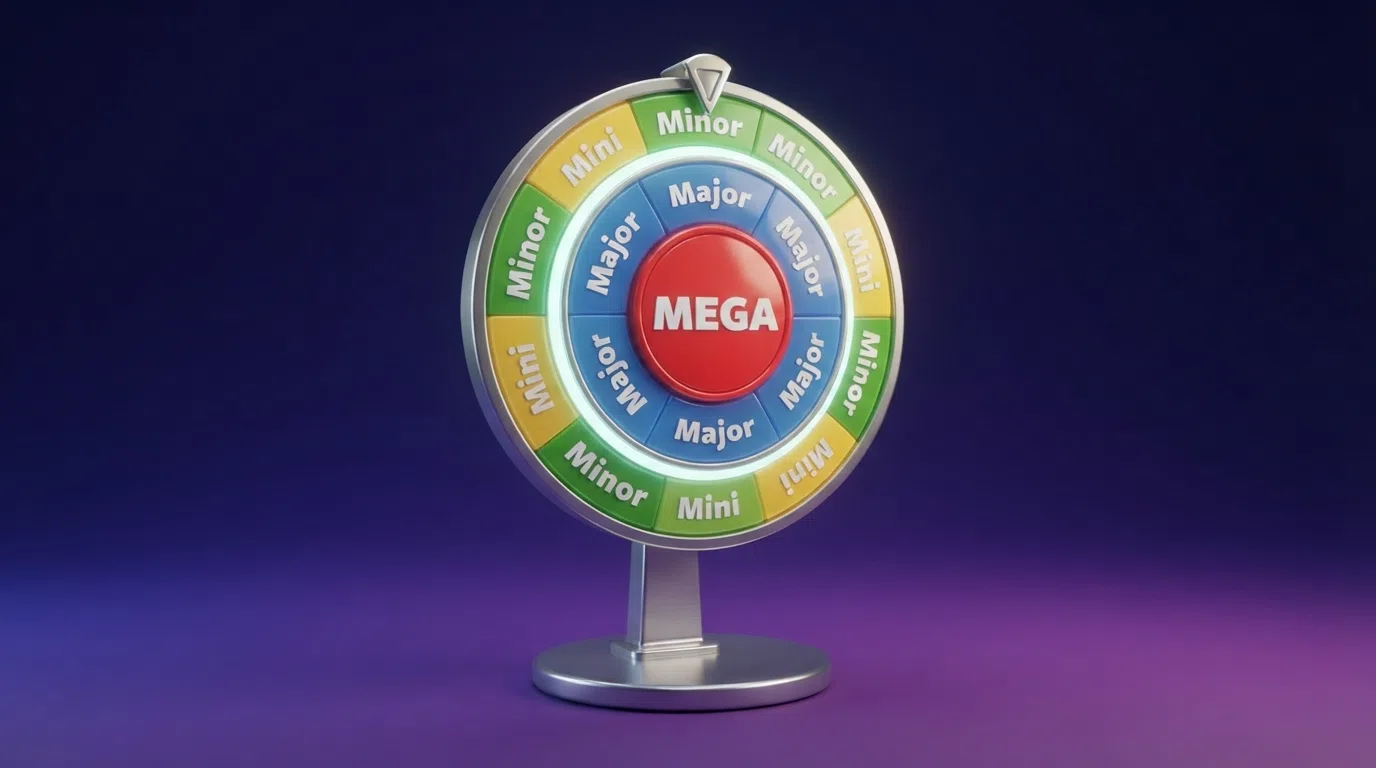
Five progressive networks dominate the UK market. Mega Moolah (Games Global) carries the flagship four-tier wheel — Mini, Minor, Major and Mega — and seeds the Mega at £1,000,000. WowPot and Dream Drop are Games Global’s sister networks, each with its own tiered wheel. Jackpot King is Blueprint Gaming’s network and runs across more than thirty titles on most UKGC sites. Age of the Gods is Playtech’s mythology-themed pool, with a top jackpot that has paid out seven-figure sums. Beyond those networks, individual titles like NetEnt’s Divine Fortune and Hall of Gods and Playtech’s Jackpot Giant stand on their own meters.
The headline RTPs from the four researched titles cover a wide range. Mega Moolah sits at 88.12% — low for any slot, lower than most non-progressive games. Jackpot Giant is at 94.22%. Hall of Gods is at 95.70%. Divine Fortune leads the researched set at 96.59% — a progressive that returns more to the base game than Mega Moolah does by more than eight percentage points. That gap is the trade-off the player is choosing between: the bigger the jackpot, the bigger the slice of every stake the network diverts into the pool, and the smaller the slice returned through the base game.
Mobile Progressive Slots: Apps and Browser Play in the UK
Every UKGC-licensed operator in the research offers a mobile experience — either a native app on iOS and Android, a mobile-responsive website or both. The progressive slot experience on a smaller screen is functionally identical to the desktop version: the same meter, the same spin speed, the same bonus-round structure. The jackpot meter updates in real time on mobile and on desktop. Game availability is broadly the same; older progressive titles from before 2020 occasionally have a desktop-only build, but the major networks — Mega Moolah, Jackpot King, Dream Drop, WowPot, Age of the Gods — are mobile-optimised across every featured UK site.
Browser play requires no download at any UKGC-licensed operator. The slot loads in HTML5, runs in a mobile browser and behaves identically to the desktop client. Native apps offer push notifications for promotional offers and slightly faster load times for the lobby, but the spin itself runs the same RNG on both. A player who wants to chase a progressive jackpot on a phone in 2026 has the full library available.
The Best Progressive Jackpot Slots for UK Players in 2026
The table below ranks the ten featured operators on the metrics that matter to a progressive slot player — licence status, the welcome offer’s real cost, the progressive networks and titles each site carries and the depth of the wider slot library. All ten hold an active GB operating licence on the Gambling Commission public register as of the research check.
| Operator | GB Licence | Welcome Offer | Wagering | Progressive Titles | Slot Count | Demo Mode |
|---|---|---|---|---|---|---|
| Bet365 | Active | Up to 500 free spins (50/day × 10 days) on £10 deposit | 0x | Mega Moolah, Jackpot King, Age of the Gods, Mega Fortune | 1,000+ | Yes |
| William Hill | Active | 200 free spins | 0x | Mega Moolah, Jackpot King, King Millions, Rapid Fire Jackpots | 1,000+ | Yes |
| Betfair | Active | 50 free spins on selected slots | 0x | Jackpot King (30+ titles), Mega Moolah | 500+ | Yes |
| Sky Vegas | Active | 100 free spins (no deposit required) | 0x | Jackpot King, Dream Drop, Mega Moolah | 600+ | Yes |
| Betway | Active | £50 bonus + 100 free spins | 10x | Mega Moolah, WowPot, King Millions | 500+ | Yes |
| PlayOJO | Active | 50 free spins on Big Bass Bonanza (£0.10 each) | 0x | Divine Fortune, Cleopatra, Rainbow Riches, 290+ jackpot slots, 80+ Must Drop Jackpots | 3,000+ | Yes |
| 888casino | Active | 100% match up to £200 | 30x (progressive slots excluded) | Jackpot King, Mega Fortune, Age of the Gods | 500+ | Yes |
| Virgin Games | Active | 30 free spins on Double Bubble | 0x | Mega Moolah, Jackpot King, King Millions | 400+ | Yes |
| LeoVegas | Active | Up to £100 + 50 free spins | 10x | Mega Moolah, King Millions, Dream Drop | 2,000+ | Yes |
| Videoslots | Active | 100% match up to £200 + 11 free spins | 10x | Mega Moolah, Treasure Nile, Jackpot King, 200+ progressive slots | 8,500+ | Yes |
Seven of the ten featured operators run no-wagering free-spin offers. That is not generosity; that is the UKGC bonus cap taking the wagering out of the picture. With wagering requirements capped at 10x from 19 December 2025, and most sites choosing to remove the wagering entirely on welcome free spins, the comparison shifts from “how much do I have to clear” to “how many spins, on which games, with what expiry”. Three operators in the set — Betway (500+) carries Mega Moolah, WowPot, and King Millions; 888casino (500+) carries Jackpot King, Mega Fortune, and Age of the Gods; LeoVegas (2,000+) carries Mega Moolah, King Millions, and Dream Drop; Videoslots (8,500+) carries Mega Moolah, Treasure Nile, and Jackpot King.
Sky Vegas: No-Deposit Free Spins with Zero Wagering
Sky Vegas is the only featured operator whose welcome offer does not require a deposit. One hundred free spins credit on registration, the winnings carry zero wagering and the bonus sits in the account for seven days. The progressive selection spans Jackpot King, Dream Drop and Mega Moolah — three of the four major networks — across a library of more than six hundred slots. Demo mode is available without a deposit. For a player who wants to test the progressive slot experience without funding an account first, Sky Vegas is the only option in the set.
The bet for a new player is simple. The no-deposit offer lets you feel the spin speed, the meter behaviour and the bonus-round rhythm on a real progressive slot — not a demo-mode virtual credit — and the absence of wagering means any win is withdrawable cash from the moment it lands. The downside is the spin count. One hundred spins is a session, not a campaign. To extend it, a first deposit is required, and the welcome offer’s £0.10 per spin value at the deposit tier is unremarkable compared to the rest of the set.
Bet365: The Largest Free-Spin Volume Across Ten Days
Bet365 splits the headline figure across ten days. Up to fifty free spins a day for ten days after a £10 first deposit — up to five hundred spins total, with the daily allocation randomised across selected games. Wagering sits at 0x; every win is paid as cash. The progressive network coverage is the widest in the table: Mega Moolah, Jackpot King, Age of the Gods and Mega Fortune all run from the Bet365 lobby across a library of more than one thousand slots.
The volume is the point. Five hundred spins over ten days is the densest welcome campaign in the featured set, and the randomised daily allocation forces the player into different games rather than letting them concentrate spins on a single title. Demo mode at Bet365 requires registration but no deposit, which puts a player one step ahead on progressive slot research before committing the £10 that unlocks the bonus. The 0x wagering means the only consideration is the ten-day clock — use them or lose them.
William Hill: 200 Free Spins with Same-Day Cash Winnings
William Hill offers two hundred free spins on welcome, with zero wagering and a seventy-two-hour validity window. That three-day clock is the tightest in the featured set and the one that most players will fail to clear. The progressive selection — Mega Moolah, Jackpot King, King Millions and Rapid Fire Jackpots — covers the flagship networks across a library of more than one thousand slots. Demo mode is available.
A player with a tight first session has the best fit here. Two hundred spins in three days is a sharp, focused campaign that fits a single weekend. A player who wants to spread the spins across a month has the wrong offer. The same-day cash winnings model means there is no wagering barrier to clear before withdrawal — the only pressure is the seventy-two-hour clock.
Betfair: 50 Free Spins and Access to the 30-Title Jackpot King Pool
Betfair’s welcome is fifty free spins with zero wagering and a seven-day validity, the most modest spin count in the no-wagering cluster. What it gains the player is progressive network depth: the Jackpot King pool runs more than thirty titles at Betfair, the largest single-network count in the featured set, alongside Mega Moolah and a library of five hundred slots. Demo mode is available.
The fifty spins are a taster. The progressive coverage is the proposition. Investors in network breadth over welcome spin volume have their best fit here, where the seven-day clock is a comfort rather than a deadline.
PlayOJO: No-Expiry Winnings and 290-Plus Jackpot Slots
PlayOJO’s welcome — fifty free spins on Big Bass Bonanza at £0.10 each after a £10 deposit, zero wagering, no expiry on winnings — sits at the bottom of the spin-count column. It sits at the top of the progressive-depth column: two hundred and ninety jackpot slots, including eighty-plus Must Drop Jackpots, across Divine Fortune, Cleopatra and Rainbow Riches, with a total library of more than three thousand. Demo mode is available.
The no-expiry mechanic is the offer’s distinguishing feature. A win from a free spin at PlayOJO sits in the player’s balance until they choose to withdraw it. Every other operator in the set imposes a validity window — seventy-two hours, seven days, ten days, thirty days, ninety days — and forfeits unplayed spins or unwithdrawn winnings at the end of it. PlayOJO does not. A player with a casual approach to slot sessions — deposit, play, leave, return weeks later — gets the only welcome in the set that does not punish them for it.
Virgin Games: 30 Free Spins on Double Bubble with No Wagering
Virgin Games offers the smallest welcome in the featured set — thirty free spins on Double Bubble after a £10 deposit, zero wagering, thirty-day validity — paired with the narrowest progressive selection: Mega Moolah, Jackpot King and King Millions across four hundred slots. Demo mode is available.
The fit is the opposite of PlayOJO. Where PlayOJO rewards a casual player with no-expiry winnings, Virgin Games rewards a focused player who wants a curated experience and a single branded title. Thirty spins is a short session; thirty days is more than enough time to clear it. The progressive coverage is light by the table’s standard — three networks, no Dream Drop, no WowPot — but the brand-name slot, the clean welcome and the extended validity make the offer simple to evaluate.
Betway: A £50 Match Bonus and 100 Free Spins with the 10x Cap
Betway’s welcome — £50 cash bonus plus one hundred free spins, 10x wagering, thirty-day validity. The progressive network carries Mega Moolah, WowPot and King Millions across five hundred slots. Demo mode is available.
The £50 bonus is a small bankroll top-up rather than a campaign. The hundred free spins double the volume; the 10x wagering requirement applies to the bonus amount only and not to the free-spin winnings. A player who wants to extend their session on a progressive slot — rather than concentrate spins on the welcome — has the right offer here. A player who wants to spin and walk away has the wrong one.
888casino: 100% Match to £200 with the Longest Validity Window
888casino offers the largest cash match in the featured set — one hundred per cent up to £200 — with a ninety-day validity window and a thirty-times wagering requirement. The wagering applies to the bonus amount only. Progressive jackpot slots are excluded from wagering contribution entirely, which means the bonus must be cleared on non-progressive games. The progressive network carries Jackpot King, Mega Fortune and Age of the Gods across five hundred slots. Demo mode is available.
The ninety-day window is the longest in the featured set and three times the typical free-spin expiry. The 30x wagering requirement is punitive — and the progressive exclusion means a player who wants to clear the bonus on the games they actually want to play cannot. The offer suits a player with patience and a willingness to grind a non-progressive slot library for ninety days.
LeoVegas: Up to £100 Plus 50 Free Spins and an £11.2 Million Jackpot Pedigree
LeoVegas’s welcome — up to £100 bonus plus fifty free spins, 10x wagering, thirty-day validity — carries the cleanest progressive pedigree in the featured set: the site has paid out an £11.2 million Mega Moolah jackpot, the largest win referenced anywhere in the research. The progressive network runs Mega Moolah, King Millions and Dream Drop across two thousand slots. Demo mode is available.
The proposition is the jackpot record. A player who weighs an operator by what has already been paid out, rather than what its welcome offer costs, has the strongest single-site case in the table. The £100 match plus fifty spins at 10x wagering is competitive but not distinguished; the £11.2 million payout is.
Videoslots: 8,500-Plus Games and 200-Plus Progressive Titles
Videoslots’s welcome — one hundred per cent match up to £200 plus eleven free spins, 10x wagering, thirty-day validity — is the smallest spin add-on in the featured set. The library is not. Eight thousand five hundred slots and two hundred progressive titles dwarfs every other operator on the table. The progressive network spans Mega Moolah, Treasure Nile, Jackpot King and every other major provider. Demo mode is available.
A player who wants the widest possible choice of progressive slot has the right site here. The eleven welcome spins are a footnote against an 8,500-game library; the £200 match at 10x wagering is competitive. The argument for Videoslots is the catalogue, not the welcome.
Not All Progressives Are Created Equal: Mystery, Must-Hit-By and More
Mystery Progressive Slots: The Jackpot with No Visible Threshold
A mystery progressive pays out at a randomly chosen point on a uniform distribution between its seed value and a maximum. The player sees a meter climbing but not a countdown. There is no “must hit by £X” badge, no target threshold displayed. The appeal is the surprise: the meter can stop on the next spin regardless of its current value. The trade is the absence of a closing window — a player cannot time their session around an imminent payout because the imminent payout is not announced.
Mystery progressives are the dominant network type in the UK. Mega Moolah’s wheel is mystery. WowPot’s wheel is mystery. Dream Drop’s wheel is mystery. Three of the five major networks discussed above are mystery progressives, and the research’s quoted mechanic — “The jackpot starts at a defined minimum amount. A point at which the jackpot will hit is randomly chosen on a uniform distribution between the starting value and maximum possible jackpot” — describes the type.
Must-Hit-By Progressives: The Jackpot That Must Drop Before a Ceiling
A must-hit-by progressive pays out before it reaches a published ceiling. The on-screen display shows a range — typically “must drop by £X” — and the closer the meter climbs to that ceiling, the more players pile in. PlayOJO’s eighty-plus Must Drop Jackpots are must-hit-by titles, displayed as such in the lobby, and the mechanic creates a visible countdown that does not exist on a mystery progressive.
The closing window changes the player behaviour. On a mystery progressive, the meter is informational. On a must-hit-by progressive, the meter is strategic — a player reading the lobby a thousand pounds below the ceiling is reading a different proposition than a player reading the lobby at the seed. This type is rarer than mystery at UKGC-licensed sites, and PlayOJO’s eighty-plus title count is the densest must-hit-by offering in the featured set.
Video Progressive Slots: Modern Five-Reel Jackpot Titles
The dominant progressive slot format in the UK is the five-reel video slot with a bonus round, free spins and a multi-tier jackpot. Mega Moolah is a five-reel progressive with a wheel-spin bonus that pays one of four tiers. Divine Fortune runs a five-reel layout with a free-spin bonus round and a jackpot game that awards one of three tiers. Hall of Gods carries a five-reel structure with a pick-three shield bonus that triggers one of three jackpots. Age of the Gods is a five-reel progressive with a bonus that spins the player into a paytable pick.
The video progressive format improves the base-game experience at the cost of jackpot hit frequency. A three-reel classic progressive pays more often but pays less; a five-reel video progressive pays less often but layers free-spin rounds and pick bonuses around the jackpot trigger. The four researched titles — Mega Moolah at 88.12% RTP, Divine Fortune at 96.59%, Hall of Gods at 95.70%, Jackpot Giant at 94.22% — all carry medium volatility with different max non-jackpot payouts: Mega Moolah caps at 1,125x stake, Divine Fortune at 1,000x, Hall of Gods at 4,300x.
Penny Progressive Slots: Low-Stakes Jackpot Play
The £5 stake cap for over-25s and £2 cap for 18-to-24s, in force under SI 2025/215 since April and May 2025, defines the floor and the ceiling of UK progressive slot stakes. A player can spin a progressive slot at the minimum stake the game allows — often £0.10 or £0.20 — and still qualify for the full jackpot. The contribution to the pool scales with the stake; lower stakes feed it more slowly, but every qualifying spin is eligible.
The stake limit is a ceiling, not a floor. A player with a small bankroll has more low-stake progressive options in 2026 than they did before the cap came in. The £2 ceiling for younger players is more restrictive than the £5 ceiling for the over-25s, but both permit the same minimum-stake play. The featured operators all carry low-stake progressive titles; the choice of game matters more than the choice of stake level.
Free Play or Real Money: Two Ways to Spin Progressive Slots
Free Progressive Slots: Demo Play Without Registration
Every operator in the featured set offers demo mode on progressive slots. The demo runs the full game — same RTP, same bonus rounds, same meter behaviour — with virtual credits. The jackpot ticker climbs in demo mode the same way it climbs in real-money mode. The bonus round triggers in demo mode the same way it triggers in real-money mode. The only difference is the payout: a demo-mode jackpot win credits virtual credits to a virtual balance. No real money changes hands.
Demo mode at Bet365 requires registration but no deposit. Every other featured operator offers demo mode without registration on most progressive titles. Demo play provides the safest route to understanding the mechanics of a bonus round or meter without the pressure of a real-money balance. It remains the most effective tool for research before funding an account.
No-Download Free Progressive Play: Browser-Based Instant Access
No UKGC-licensed operator requires a software download for progressive slot play. The HTML5 build runs in any modern browser, on desktop and on mobile, without a casino client. Native apps exist at most UKGC sites but they are an alternative, not a requirement. The browser experience delivers the same RNG, the same RTP, the same spin speed as the desktop client. For progressive slots specifically, there is no feature parity issue between browser and app.
Free Progressive Jackpot Slots: Risk-Free Jackpot Chasing
Demo mode lets a player watch the meter climb and trigger the bonus round without spending real money. The rhythm of a progressive slot — the base-game frequency, the bonus-round trigger rate, the time between spins — is identical in demo and real-money mode. What demo cannot replicate is the bankroll pressure. A player watching a virtual meter climb to £2 million is not making a deposit decision; a player watching a real meter climb to £2 million at £5 a spin is watching £625 disappear every twenty-five spins.
Free play is the right tool for comparing progressive titles side by side. Five minutes on Mega Moolah in demo mode, five minutes on Divine Fortune in demo mode, five minutes on Hall of Gods in demo mode and the player has a direct comparison of bonus-round structure, base-game pacing and visual feel before committing to a real-money session.
Real-Money Progressive Slots: Playing for Cash Jackpots
Real-money progressive slot play at a UKGC-licensed site requires identity verification before the first deposit — a rule in force since 7 May 2019 — and acceptance of the stake limits. The £5 ceiling for over-25s and £2 ceiling for 18-to-24s apply to every real-money spin. The seed value applies to the jackpot floor: a real-money spin on Mega Moolah starts the player at the bottom of a pool that will not fall below £1,000,000 before the next trigger.
The maths of a real-money progressive spin is straightforward. A £5 spin on Mega Moolah returns 88.12% on the base game and contributes the remainder to the jackpot pool. A £5 spin on Divine Fortune returns 96.59% on the base game and contributes less to a smaller jackpot pool. The difference — eight percentage points of return per spin — is what the player trades for a shot at the larger prize.
Free-Play vs Real-Money: When to Switch
The three signals that demo mode has taught a player enough. First, the player has triggered the bonus round at least once and understands the mechanic. Second, the player has played enough spins to feel the base-game pacing and the volatility — five hundred demo spins is a reasonable minimum. Third, the player has chosen a deposit limit they can afford and selected an operator whose welcome offer suits the session. Once those three signals are clear, demo has done its job and the player can fund an account.
The deposit step is the same at every UKGC site. Set a deposit limit. Make a first deposit. Claim the welcome offer if the terms suit the planned session. Navigate to the progressive slots section. Pick a title. Check the jackpot rules and the stake requirements. Spin.
Progressive vs Regular Slots: Which One Deserves Your Stake
Progressive vs Regular Slots: Key Differences in RTP, Volatility and Payout Structure
- RTP. A progressive slot diverts a slice of every stake into the jackpot pool, lowering the base-game return. A non-progressive slot returns the full stake through the base game. The gap is the trade-off: Mega Moolah’s 88.12% versus a regular slot’s 95-97% is the slice the network takes to fund the meter.
- Volatility. Progressive slots are among the highest-variance games in any casino lobby. The base game pays small amounts frequently; the jackpot pays an enormous amount rarely. A regular slot pays medium amounts at medium variance. A progressive slot can drain a £100 bankroll in a hundred spins and return £2.40 — the most common outcome at 88.12% RTP.
- Payout structure. A regular slot distributes returns across thousands of small and medium wins. A progressive slot concentrates value into one enormous payout — the jackpot — that most players will never see. The expected value is similar in the long run; the experience is not.
Are Progressive Slots Worth Playing? The Pros and Cons
The case for progressive slots is the upside. A life-changing sum on a single spin, the entertainment value of a meter that climbs past seven figures and the bonus-round trigger that rewards a long session — these are real. For a player who has set a strict session limit, who treats the jackpot as a bonus outcome rather than the goal and who chooses a progressive with the highest base-game RTP, the trade is defensible.
The case against progressive slots is the base-game return. At 88.12%, Mega Moolah costs a player more per spin than almost any non-progressive title. The variance drains a bankroll faster than a regular slot at the same stake. The probability of triggering the top jackpot is comparable to winning a national lottery. The vast majority of players will see their bankroll shrink long before they see a seven-figure return.
The middle ground is the RTP-conscious progressive. Divine Fortune at 96.59% RTP returns more on the base game than Mega Moolah does and still pays a progressive jackpot — a smaller jackpot, but a real one. Hall of Gods at 95.70% sits closer to the regular-slot range and pays a top jackpot that has run into seven figures. Jackpot Giant at 94.22% sits between the two. A player who treats the jackpot as a bonus and the base game as the session has the right titles here.
Where to Find Progressive Jackpot Slots at UK Sites
A UKGC-licensed lobby separates progressive slots from regular slots by a badge, a filter or a dedicated tab. The badge is the fastest route — a small icon next to the game name that signals a progressive jackpot is attached. The filter lets a player sort the library by jackpot size or network. The tab groups all progressive titles into one category. PlayOJO’s lobby groups two hundred and ninety jackpot slots across multiple categories; Videoslots’ lobby groups two hundred progressive slots across every major network; Betfair’s Jackpot King tab groups more than thirty titles into a single sub-lobby.
A check on the jackpot’s current state is part of the navigation. The meter is live and updates in real time. The jackpot’s last payout is sometimes displayed alongside the current meter; if not, a quick search of the game’s name returns the payout record. A progressive slot whose meter is sitting at the seed is a different proposition from one whose meter is sitting at ten million — the probability of a trigger is the same on a uniform distribution, but the expected value is higher when the pool is closer to its maximum.
Which UK Operators Carry the Best Progressive Selection
Three operators lead on progressive slot depth. Videoslots carries two hundred progressive slots across every major provider — the widest catalogue in the featured set, an order of magnitude ahead of any competitor. PlayOJO carries two hundred and ninety jackpot slots with eighty-plus Must Drop Jackpots — the densest single-site progressive count. Betfair carries thirty-plus Jackpot King titles — the largest single-network count.
Three operators lead on progressive pedigree. LeoVegas carries an £11.2 million Mega Moolah payout record — the largest win referenced in the research. Bet365 carries Mega Moolah, Jackpot King, Age of the Gods and Mega Fortune — four major networks on one site. William Hill carries Mega Moolah, Jackpot King, King Millions and Rapid Fire Jackpots — the broadest network spread on a UKGC-licensed operator with a 1,000+ slot library.
The rest of the set — Sky Vegas, Betway, 888casino, Virgin Games — covers the major networks at narrower depth. A player prioritising catalogue breadth has Videoslots or PlayOJO. A player prioritising welcome-offer fairness has Bet365, William Hill or PlayOJO. A player prioritising jackpot pedigree has LeoVegas.
Why Your 2026 Progressive Slot RTP Is Smaller Than It Looks
Progressive Slots RTP: What the Numbers Actually Mean
The headline RTP on a progressive slot includes the slice of every stake that goes to the jackpot pool. The base-game RTP is what a player actually plays against — and on a wide-area progressive with a large seed, the base-game RTP is several percentage points lower than the headline figure suggests.
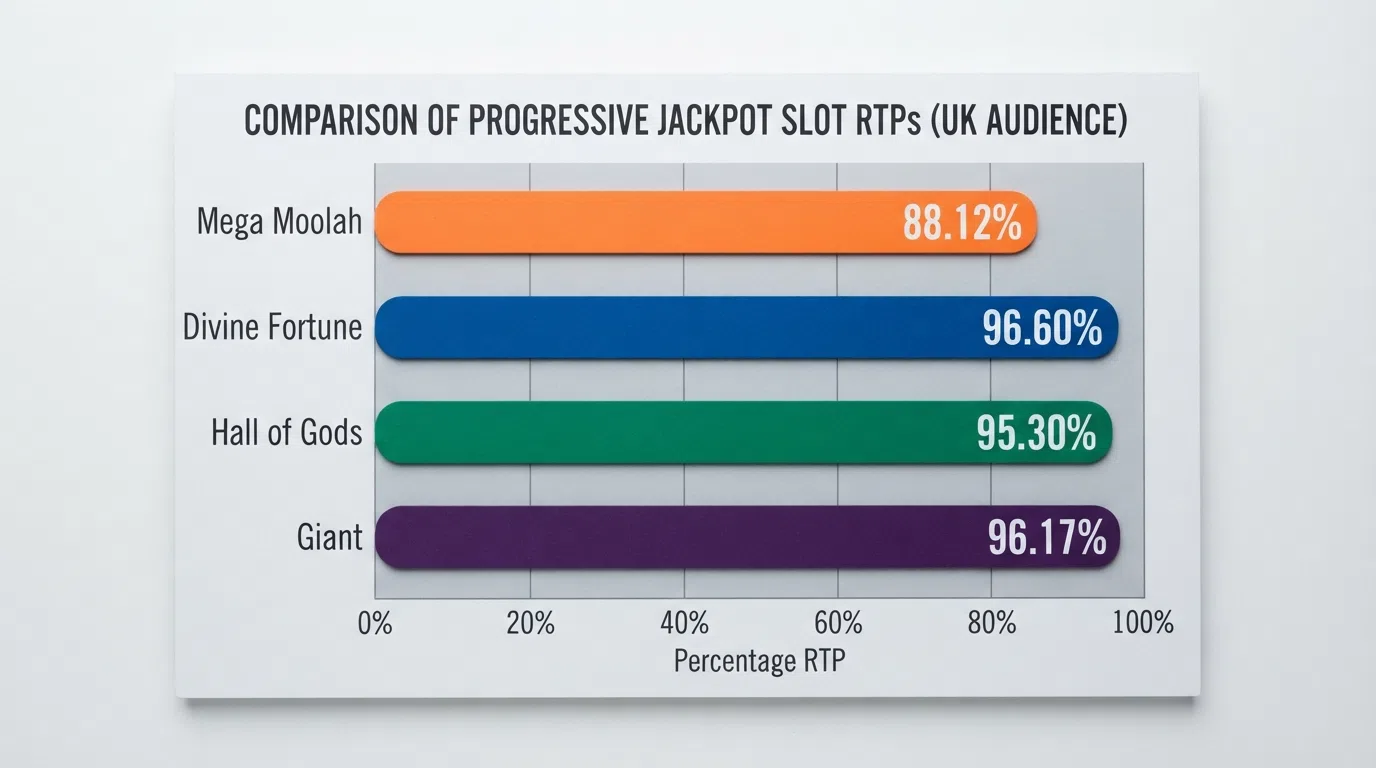
| Slot Title | Provider | RTP | Volatility |
|---|---|---|---|
| Mega Moolah | Games Global | 88.12% | Medium |
| Jackpot Giant | Playtech | 94.22% | Medium-to-low |
| Hall of Gods | NetEnt | 95.70% | Medium |
| Divine Fortune | NetEnt | 96.59% | Medium |
The eight-point gap between Mega Moolah at 88.12% and Divine Fortune at 96.59% is the trade the player is choosing. At £5 a spin, the expected loss per spin on Mega Moolah is £0.59; on Divine Fortune it is £0.17. Over five hundred spins — a typical session at £5 stake — that gap accumulates to £210 between the two titles. A player who chooses Mega Moolah over Divine Fortune is paying £210 for a shot at a larger jackpot, on top of the stake itself.
Progressive Jackpot Odds: The Probability of Hitting the Big One
The exact probability of hitting the Mega tier on Mega Moolah is not published. The scale is. The trigger is randomly chosen on a uniform distribution between the seed and the maximum — a mechanic that produces a payout somewhere in the range, with no fixed schedule. In the most recent quarter, UK players placed 25.1 billion spins across online slots. The Mega Moolah wheel triggers on a fraction of those spins; the Mega tier triggers on a fraction of those wheel stops. The odds are comparable to winning a national lottery.
The odds shift across jackpot types but stay low. A standalone progressive on a single machine at a single site hits more often than a wide-area progressive — but pays less when it does. A networked progressive sits between the two. The relationship between jackpot size and hit probability is inverse: the larger the pool, the longer the average wait between payouts. The mystery mechanic governs these odds, creating an unpredictable gap between wins.
Progressive Slots Strategy: Tips and Best Practices
- Play at the maximum qualifying stake if the jackpot requires it. Some progressive titles reduce the jackpot contribution below a threshold stake; check the game rules before spinning.
- Set a session loss limit before you start. A progressive slot’s variance drains a bankroll faster than a regular slot at the same stake. A pre-set limit stops the session before the variance does.
- Choose progressive slots with the highest base-game RTP. Divine Fortune at 96.59% returns more on the base game than Mega Moolah at 88.12% and still pays a progressive jackpot.
- Treat the jackpot as a bonus, not a goal. The probability of triggering the top tier is lottery-scale. The session should be affordable on the base game alone.
How to Win at Progressive Slots: Practical Advice
No strategy changes the RNG outcome. Every spin is independent and the jackpot trigger is random — no pattern to exploit, no sequence to predict, no strategy that improves the odds. What a player can control is which progressive title they play, their stake size, their session length and when they walk away. The bankroll management approach that lets a player spin for longer on the same deposit is straightforward: set a session limit, divide the bankroll by the limit to get a spin count, choose a stake that lets the player hit the spin count, and stop at the limit regardless of the meter.
How Often Progressive Slots Hit: Frequency and What to Expect
Mega Moolah has paid out multiple seven-figure and eight-figure jackpots — the frequency varies and no fixed schedule exists. A growing jackpot pool is statistically closer to a trigger but never guarantees one; the trigger follows the mystery mechanic already described, picking a random payout point within the distribution range, and a meter that has climbed past ten million is no closer to the trigger than one that has climbed past two million. The base-game hit frequency governs how often a player sees any return; the jackpot hit frequency governs how often the top tier pays. The two are independent.
How to Play Progressive Slots: A Step-by-Step Guide
Step one: pick a UKGC-licensed operator from the table above and complete registration with identity verification — the Commission’s mandatory pre-deposit check, in force since 7 May 2019. Step two: set a deposit limit before funding the account — the prompt has been mandatory since 31 October 2025. Make a first deposit and claim the welcome offer if the terms suit the planned session. Step three: navigate to the progressive slots section, pick a title and check the jackpot rules and the stake requirements before spinning. The £5 ceiling for over-25s and £2 ceiling for 18-to-24s apply to every spin.
The Cost of a £50 Bonus: What the Wagering Costs in Real Terms
A £50 bonus at the UKGC’s maximum 10x wagering means £500 of qualifying turnover before the bonus converts to withdrawable cash. At a base-game RTP of 88.12% — Mega Moolah, the largest progressive pool in the research — the expected loss across £500 of turnover is £59.40. That is the bonus’s real cost in expectation: the player risks £59.40 of their own funds to clear £50 of bonus money, with a probability-weighted outcome that lands in the negative on average. A player spinning through a £50 Betway bonus at £5 a stake on Mega Moolah is therefore looking at one hundred spins, an expected return of £440.60 and an expected loss of £59.40 — the wagering does not recover the bonus; it just gates the withdrawal.
This is a statistical estimate over many spins, not a forecast for any individual session. A player can land ahead in a single session; the average over a hundred spins is what the maths describes.
Crypto and Progressive Slots: A UK Player’s Reality Check
Bitcoin Progressive Jackpot Slots: What UK Players Need to Know
Bitcoin progressive slots exist. They are not at UKGC-licensed sites. The Commission does not currently licence crypto-only casinos and does not permit GB-licensed operators to accept direct cryptocurrency deposits. The Bitcoin progressive slot sites accessible to UK players are offshore operators, typically Curaçao-licensed, with no UK player protections. The risks follow directly: no mandatory identity verification, no GAMSTOP self-exclusion, no deposit limits, no statutory £5 or £2 stake cap, no recourse to the Gambling Commission and no approved ADR provider.
Some UK players still choose crypto progressive slots. The reasons are concrete: anonymity, faster withdrawals and bonus structures the UK regulation prohibits — including higher match percentages, lower wagering and crypto-specific deposit bonuses. The cost is the absence of every protection the UK framework offers. Section 33 of the Gambling Act 2005 makes unlicensed provision a criminal offence; the Commission pursues it through cease-and-desist notices, search-engine delisting and domain suspension, not ISP blocking.
Crypto-Friendly Progressive Slot Sites: The Offshore Landscape
The typical licensing regime of a crypto progressive slot site accessible to a UK player is Curaçao eGaming — a jurisdiction the Commission does not recognise as equivalent to its own. The progressive networks are often the same: Games Global and NetEnt titles are licensed internationally and appear at offshore operators. What is absent is the UK regulatory layer: no £5 or £2 stake cap, no spin-speed minimum, no game-design rules and no GAMSTOP. A licence footer on an offshore casino reads “Curaçao eGaming” or “Antillephone”; the absence of a UK Gambling Commission account number is the immediate signal.
Crypto vs Fiat: The Pros and Cons for Progressive Slot Play
Fiat play at a UKGC-licensed operator carries every protection the UK framework offers. Statutory stake limits cap the loss per spin. GAMSTOP blocks every UKGC site at once during an exclusion. Mandatory identity verification prevents underage play. The credit card ban blocks credit-card-funded e-wallets. The Commission’s complaints route and an approved ADR provider offer recourse. Crypto play at an offshore operator carries none of these — but offers faster withdrawals, larger bonuses and no UK-mandated stake cap.
The decision framework is straightforward. The protections lost by playing offshore outweigh the speed and bonus advantages for almost every UK player. A player with a session limit they can enforce themselves, no self-exclusion requirement and a willingness to forgo the Commission’s complaints route can weigh the trade differently. Most players cannot.
UK Regulation: What the Law Means for Your Progressive Slot Play
UKGC Licensing: What It Requires from Progressive Slot Operators
The Gambling Commission is the single statutory regulator of gambling in Great Britain. The Gambling Act 2005, extended to remote operators by the Gambling (Licensing and Advertising) Act 2014, sets three licensing objectives: preventing crime, ensuring fair and open gambling and protecting children and vulnerable persons. Every operator offering progressive slots to GB players must hold an active GB operating licence. The licence is compulsory at the point of consumption; providing gambling without one is a criminal offence under section 33 of the 2005 Act.
The conditions attached to a GB operating licence shape every progressive slot session. Pre-deposit identity verification has been mandatory since 7 May 2019. Player funds must be segregated in line with the Commission’s rules. Game fairness is certified by independent testing houses. Game design is constrained: auto-play banned, spin speed no faster than 2.5 seconds, features that speed up play banned, losses disguised as wins banned, reverse withdrawals banned, session time and net position displayed at intervals the player chooses. Bonus wagering is capped at 10x since 19 December 2025. All ten featured operators hold active GB licences on the public register as of the research check.
Player Protections: Stake Caps, Game-Design Rules and the Deposit-Limit Requirement
The stake cap is the most concrete protection. £5 per game cycle for players aged 25 and over, £2 for players aged 18 to 24 — in force under SI 2025/215 since 9 April 2025 (£5) and 21 May 2025 (£2). The cap applies to the total stake within a single game cycle, not to a per-spin figure inside a free-spin round. A “game cycle” is the period from game initiation to completion, and the cap is enforced at the operator level — no spin button accepts a stake above the cap.
The game-design rules — in force since 31 October 2021 — remove every mechanic that previously shortened or smoothed a slot session. Auto-play is banned. Spin speed is no faster than 2.5 seconds. Features that speed up play are banned. Losses disguised as wins are banned — a spin that returns less than the stake but celebrates with a fanfare is no longer permitted. Reverse withdrawals are banned — once a withdrawal request is made, it cannot be cancelled. Session time and net position must be displayed at intervals the player chooses.
The deposit-limit requirement — in force since 31 October 2025 — compels every operator to prompt a customer to set a financial limit before the first deposit. The state does not set the limit; the prompt makes sure the player does. Once set, the limit can be lowered immediately and raised only after a confirmation period.
Offshore vs UK-Licensed Progressive Operators: The Protection Gap
Playing progressive slots at an offshore operator means losing every UK protection. No GAMSTOP coverage — an exclusion at a UKGC site does not block an offshore site. No statutory stake cap — an offshore site can offer a £50 spin. No identity verification requirement — an offshore site can accept play without checking age. No Gambling Commission complaints route — disputes go to the offshore regulator or to nowhere. No approved ADR provider.
The signs of an unlicensed site are concrete. The licence footer does not show a UK Gambling Commission account number. The accepted payment methods include cryptocurrency the UKGC does not permit. The bonus terms exceed the UKGC’s 10x wagering cap. The operator offers products outside the Commission’s game-design rules — auto-play, fast spin, reverse withdrawal. The Commission’s public register is the definitive check; a site not on it is not licensed for GB play.
Chasing Jackpots Safely: Responsible Gaming for Progressive Slots
Setting Deposit and Session Limits When Chasing Progressive Jackpots
The deposit-limit tool is the first line of defence. Every UKGC-licensed operator offers it; the Commission has compelled operators to prompt the customer to set one before the first deposit since 31 October 2025. A daily, weekly or monthly cap is set in advance and enforced at the cashier — once the limit is hit, the account cannot deposit further until the period resets.
The reality-check feature is the second line of defence. A pop-up displays session time and net position at intervals the player chooses — typically every fifteen, thirty or sixty minutes. A player who set a one-hour reality check and finds themselves at a £200 loss after fifty-five minutes is being given the chance to stop before the session does. The session-time and net-position display are mandatory under the Commission’s game-design rules; the interval is the player’s choice.
Session limits and time-outs are the third line of defence. A session limit caps the time spent on the site. A time-out blocks access for a chosen cooling-off period — twenty-four hours, seven days, thirty days. Both are operator-set, enforced automatically and reversible only at the end of the chosen period.
Recognising Problem Play Tied to Jackpot-Chasing
The progressive slot format creates a specific behavioural pull. The meter climbs visibly. The bonus round rewards a long session. A player who has lost their session budget is sitting in front of a meter that is closer to a trigger than it was when they started — and the temptation to deposit again to keep spinning is the jackpot-chasing cycle the research describes.
The behavioural red flags are familiar. Exceeding the deposit limit set in advance. Hiding play from family or partners. Chasing losses with new deposits. Feeling anxious when not playing. The GamCare self-assessment tool is a free online questionnaire that measures gambling’s impact on life and signposts support if the answers suggest harm. The National Gambling Helpline — 0808 8020 133 — is free, confidential and available twenty-four hours a day, every day.
The NHS operates specialist gambling treatment clinics in England, Scotland and Wales. Self-referral is accepted; a player does not need a GP appointment to access them. GambleAware maintains information, tools and support services. Gambling blocking software blocks access to gambling sites at the device level, independently of any operator tool.
Responsible-Gaming Tools at UK Progressive Slot Sites
GAMSTOP is the backstop. A national multi-operator self-exclusion scheme, mandatory for every UKGC-licensed online operator since 31 March 2020. A player registers once and chooses an exclusion period: six months, one year, five years, or five years with auto-renewal. The exclusion cannot be cancelled early. Once registered, the player is blocked at every UKGC-licensed online gambling site for the period chosen. GAMSTOP is online-only and licence-bound; it does not cover offshore or unlicensed sites.
The additional tools at the operator level — time-outs, deposit limits, session limits, reality checks, account closure — sit between the session and the GAMSTOP exclusion. A player who finds themselves exceeding a session limit can set a time-out. A player who finds themselves exceeding a deposit limit can extend the time-out. A player who finds themselves extending the time-out repeatedly can self-exclude through GAMSTOP. The escalation is deliberate.
The statutory levy — in force from 6 April 2025 — charges 1.1% of gross gambling yield on remote casino operators. The funds split 50% to treatment, 30% to prevention and 20% to research. On the most recent quarterly GGY figure — £773 million in Q4 2026 — the levy funds approximately £8.5 million per quarter for the support infrastructure that the responsible-gaming tools rely on. The Remote Gaming Duty on operators rose from 21% to 40% from 1 April 2026; the statutory levy sits alongside it, funded separately.
The prevalence data frames the scale. Approximately 13.1% of GB adults who gamble experience some level of problem gambling (PGSI 1+), equivalent to roughly 6.8 million adults. Thirty per cent of adults experiencing problems want treatment, support or advice — up from 17% in 2020. Approximately 2 million children live in households with adults experiencing problem gambling.
How We Ranked the Best Progressive Slot Sites
Every operator in the featured set was checked against the Gambling Commission’s public register to confirm an active GB operating licence at the time of writing. The research carried out the check on 29 July 2026 and confirmed the licence status on each account.
The evaluation criteria were progressive slot selection size and network coverage, welcome-offer terms including wagering multiple and validity window, total slot library breadth and provider mix, and the availability of demo mode. The welcome-offer ranking was weighted toward zero-wagering offers — the seven operators that offer them sit at the top of the no-cost-to-the-player column — and the three with cash match bonuses are ranked by the size of the match and the breadth of the progressive library.
The sources used were the Gambling Commission’s market data and public register, the operator terms pages for welcome-offer details, the game-provider product documentation for RTP and volatility, and the Commission’s guidance on stake limits and player protections. Where the research lacked a figure, the page states the point qualitatively rather than inventing one.
The Smart Way to Play Progressive Slots in the UK
The progressive slot proposition is a lottery ticket with a base-game cost. A wide-area progressive at 88.12% RTP buys a shot at a million-pound floor with every spin; a high-RTP progressive at 96.59% buys a smaller shot at a smaller jackpot with more of every stake returned through the base game. The maths is honest about which side of that trade most players land on — the base game pays less than a regular slot, the jackpot pays more than any other casino game, and the probability of the jackpot is low enough that the player should plan for the base game to be the session.
The UK regulatory framework removes the worst risks. The £5 stake cap for over-25s and £2 cap for 18-to-24s set a ceiling on what a single spin can cost. The 10x wagering cap stops bonus terms from being punitive. Mandatory identity verification blocks underage play. GAMSTOP blocks every UKGC-licensed site at once during an exclusion. The Commission’s complaints route and an approved ADR provider offer recourse. Inside that fence, progressive slot play is entertainment with a real-money receipt and a real-money ceiling.
The practical takeaway. Pick a high-RTP progressive — Divine Fortune at 96.59% is the strongest researched title, Hall of Gods at 95.70% sits behind it. Pick a UKGC-licensed operator whose welcome offer matches the session — Bet365 for volume, William Hill for focus, PlayOJO for casual sessions with no expiry. Set a deposit limit before funding the account. Treat the jackpot as a bonus outcome, not the goal. Walk away at the session limit regardless of the meter.
Frequently Asked Questions
Which progressive slots have the highest RTP for UK players?
Of the researched titles, Divine Fortune by NetEnt leads at 96.59%, with Hall of Gods by NetEnt at 95.70% and Jackpot Giant by Playtech at 94.22% behind it. Mega Moolah by Games Global sits at 88.12% — the lowest of the set, reflecting the larger jackpot contribution. A higher RTP means a smaller house edge on the base game, not a higher probability of triggering the jackpot.
Is it legal to play progressive jackpot slots online in Great Britain?
Yes, at a UKGC-licensed operator. The Gambling Commission regulates online gambling in Great Britain under the Gambling Act 2005, extended to remote operators in 2014. Every operator offering progressive slots to GB players must hold an active GB operating licence. Providing gambling without a GB licence is a criminal offence under section 33 of the 2005 Act.
What is the maximum I can stake on a progressive slot in the UK?
£5 per game cycle for players aged 25 and over, and £2 for players aged 18 to 24. The caps are in force under SI 2025/215, with the £5 limit live since 9 April 2025 and the £2 limit live since 21 May 2025. A game cycle is the period from game initiation to completion, and the cap applies to total staked within it.
How often do progressive jackpots like Mega Moolah pay out?
The trigger is randomly chosen on a uniform distribution between the seed and the maximum — there is no fixed schedule. Mega Moolah has paid out multiple seven-figure and eight-figure jackpots over its history, with the Mega tier seeding at £1,000,000 after each payout. The exact hit frequency is not published; the trigger mechanism produces payouts somewhere in the range without a predictable cadence.
Do I pay tax on progressive jackpot winnings in the UK?
No. UK players pay no tax on gambling winnings. The player-side betting duty was abolished in 2001. Operators pay Remote Gaming Duty on their gross gambling yield — which rose from 21% to 40% from 1 April 2026 — but winnings paid to players are paid gross.
Are progressive slots available at all UKGC-licensed casinos?
Most UKGC-licensed online casinos carry at least one progressive network — typically Mega Moolah or Jackpot King — but the depth varies widely. The featured set ranges from Virgin Games at three networks and four hundred slots to PlayOJO at two hundred and ninety-plus jackpot slots and Videoslots at two hundred progressive slots across eight thousand five hundred games. A player prioritising progressive depth has the catalogue comparison in the table above.
Slots – nodeposit-casinobonuses-uk
Content created by the «nodeposit-casinobonuses-uk» team