
Where UK cashback actually returns your money — and where the fine print eats the rebate
 Available in GB
Current as of September 8, 2026 · Verified against the UK Gambling Commission’s public register of licence holders
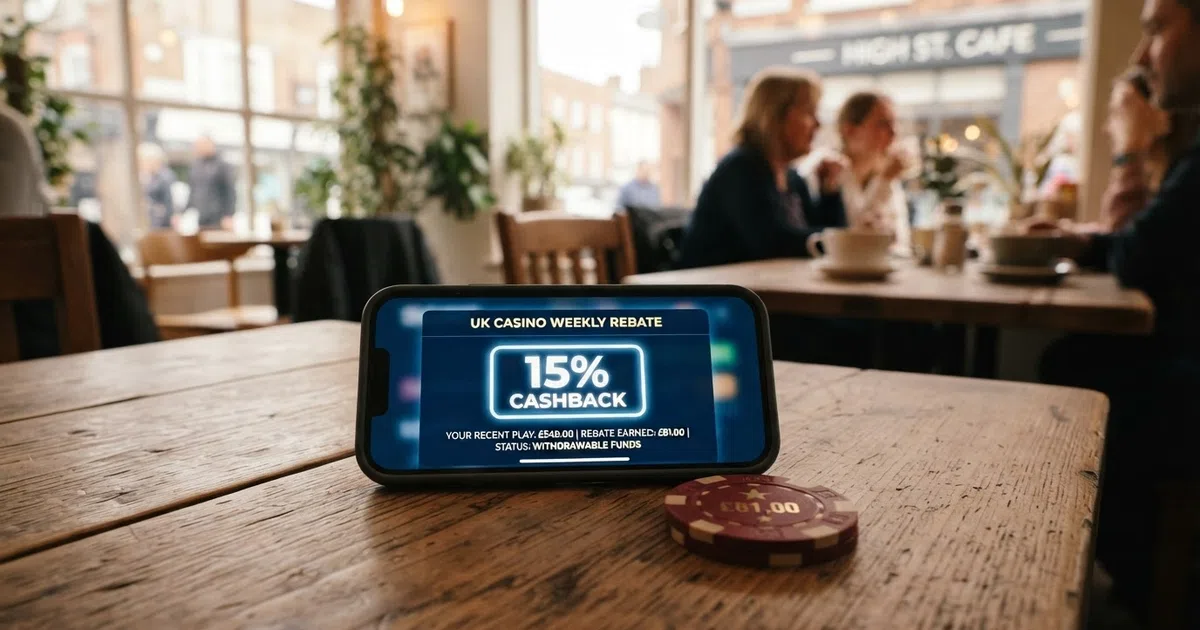
Cashback is the one promotion that returns something after a losing session rather than dangling something in front of one. That is the entire pitch, and the reason UK players now look for it before they look at deposit matches or free spin drops. The catch is that the word “cashback” covers a wide spread of mechanics, and the difference between a 10% real-cash rebate and a 10% bonus-credit rebate with ten-times wagering is the difference between a tool and a marketing line. This page ranks the ten UK-licensed casinos whose cashback terms justify a reader’s attention in 2026, names the calculation method each one uses, and sets out the rules that govern every offer on the market.
Why Casino Cashback Is the Bonus That Actually Returns Your Money
Cashback at UK-licensed casinos typically ranges from 5% to 25% of net losses, with 10% on a weekly cadence the most common structure in the market. That figure alone understates what has changed. Two regulatory moves in the last eighteen months reshaped the offers a player now sees: the UK Gambling Commission’s hard 10× wagering ceiling on bonus funds, in force since 19 January 2026, and the doubling of Remote Gaming Duty to 40% from 1 April 2026, which tightened operator margins. The combined effect is a market where the leading offers have moved away from bonus-credit-with-wagering and towards real cash with zero further play. The percentage a casino advertises is now less informative than the payout type underneath it.
What Casino Cashback Actually Is — and What It Isn’t
Cashback is a rebate. The house takes a defined slice of what you lost (or, with some operators, of what you staked) and credits a percentage back to your account. It is structurally the opposite of a deposit match, which adds to your bankroll before you play, and distinct from a free spin drop, which hands you a fixed number of rounds on a named slot. Where cashback and a deposit match converge is in their shared vocabulary — both are called “bonuses” — but a match is paid in advance on money you have not yet lost, and cashback is paid afterwards on money you have. One is a sweetener at the door; the other is a partial refund on the way out.
The rebate principle is what makes cashback feel different to players even when the numbers are similar. A £100 deposit match and a £10 weekly cashback on a £100 loss are both worth a tenner in headline terms, but only one of them involves a further wagering commitment to reach withdrawal. That structural difference, not the percentage, is what decides whether the offer is worth taking.
Net Losses, Net Spend, or Turnover — How Your Cashback Is Actually Calculated
Three calculation bases appear across the UK market, and the one your operator uses changes the cashback number more than the percentage does.
The net losses model is the most common. Bets minus wins over a defined period — typically a week — produces the figure, and a percentage of that net is credited back. All British Casino runs this calculation daily, paying 10% of the previous day’s net losses in real cash. Quinn and Fitzdares run a weekly version of the same model, also at 10%.
The net spend model is what Duelz uses. It widens the net by subtracting rewards, so the calculation reads bets minus wins minus rewards. The “rewards” element captures free spin winnings, bonus credits, and any other promotional value credited to the account, so the cashback number is smaller than under a pure net-losses model. Duelz is transparent about this, which is part of why the offer sits well in the ranking.
The turnover model takes total stake regardless of outcome and rebates a percentage of that. Mr Vegas’s Rainbow Fridays is the clearest UK example: cashback is calculated on total turnover, not on losses, so a player who broke even or even came out slightly ahead on the week still earns cashback. The trade-off is that the percentage has to be smaller to be sustainable, and the headline rate is usually lower than equivalent net-losses offers.
The same percentage under two different models can pay half as much. A 10% net-losses cashback on a £200 weekly net is £20. A 10% turnover-based cashback on £2,000 of weekly wagering is also £20 — but the £2,000 in stakes had to be played through to earn it. The two cashback numbers are equal; the volume of play behind them is not.
Real Cash or Bonus Funds — Why the Payout Type Changes Everything
The most important sentence on any UK cashback promotion is the one that names the payout type. Real-cash cashback lands in your account as withdrawable money with no further wagering. Bonus-fund cashback lands as credit you must play through before it can be withdrawn, and the 10× ceiling on that further play only softens what was previously a 30× to 60× commitment.
Among the operators in this ranking, All British Casino, Duelz, PlayOJO, Mr Vegas, Quinn, Fitzdares and 10bet all pay cashback as real cash with no wagering. SpinYoo pays 10% weekly on real-money losses up to £50 as bonus funds with a 10× wagering requirement within 72 hours, and a £5 maximum bet while that wagering is in progress. Grosvenor’s 10% weekly net-losses cashback for Blackcard members was not confirmed in this review at the payout-type level, which is a gap a player should close with the operator’s own terms before signing up.
The gap between the two payout types is the gap between £10 in your hand and £10 you must play to convert. A 10% cashback paid in bonus funds with 10× wagering is worth substantially less than a 7% cashback paid in real cash, and a player comparing percentages alone will choose the wrong offer.
Daily, Weekly, or on Every Spin — How Often Cashback Lands in Your Account
Frequency shapes the real value of a cashback offer as much as the percentage or the payout type. A rebate credited on a continuous basis softens the sting of a losing session as it happens, while a weekly or monthly credit lets losses accumulate first and the rebate arrives on a delay.
Daily cashback is the rarest and the most valuable in cash-flow terms. All British Casino is the only operator in the featured set running daily real-cash cashback, with the rebate credited each day on the previous day’s net losses.
Weekly cashback is the industry standard. Duelz calculates Friday to Thursday and credits at noon every Friday. Mr Vegas credits Rainbow Fridays on a Friday schedule. Quinn, Fitzdares, SpinYoo, Grosvenor and most of the rest of the market run weekly cycles. The fixed weekday matters: a cashback that lands on a Monday is a different proposition from one that lands on a Friday, because the timing affects how much bankroll the player has to draw on by the time the rebate arrives.
Continuous per-spin cashback is PlayOJO’s OJOplus model. Every real-money spin on a participating game returns a small amount, paid as real cash with no wagering. The unit value is small, but the cashback starts accruing from the first spin rather than the end of a week, which keeps the bankroll more level across a session than any end-of-period credit.
The Best Cashback Casinos in the UK for 2026
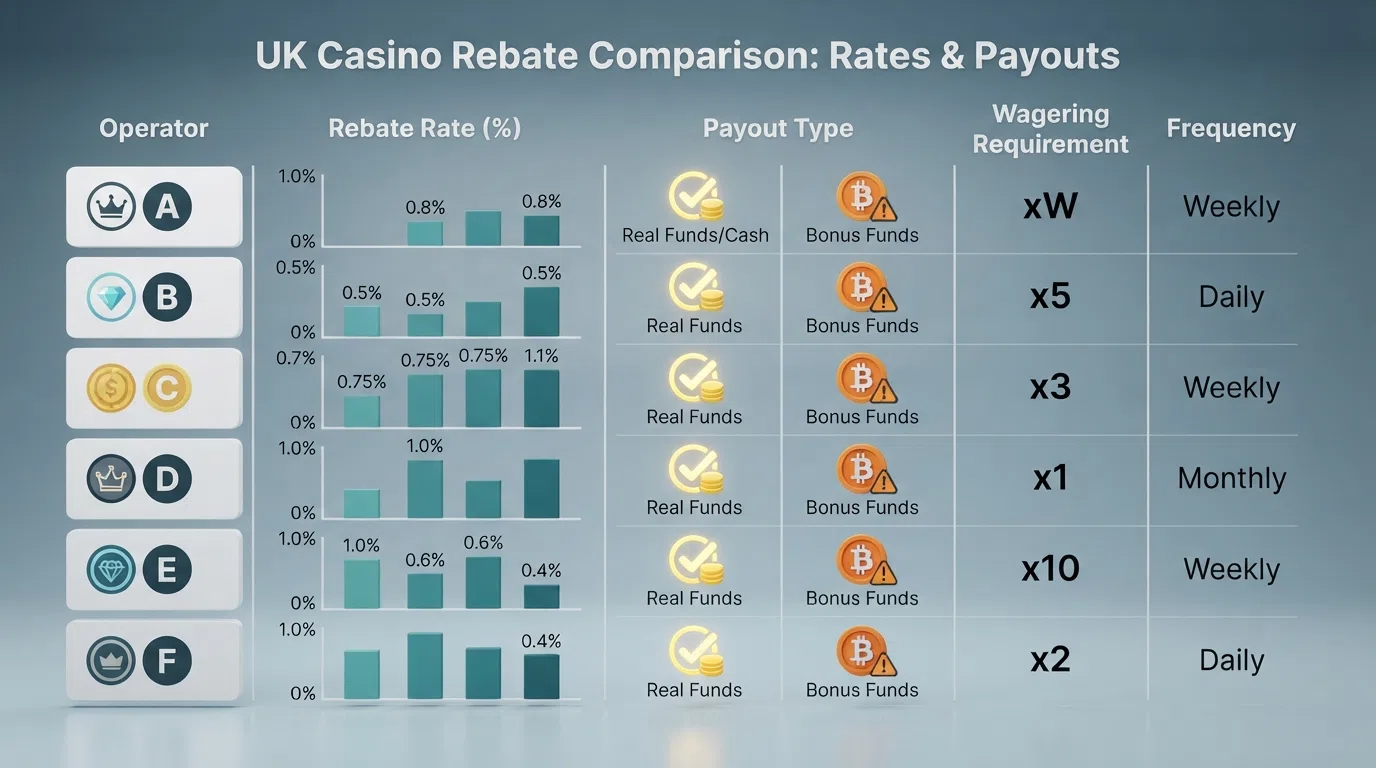
The table below ranks ten UK-licensed casinos by cashback quality. Real-cash payouts with zero wagering sit at the top; bonus-fund payouts and offers with no direct cashback programme sit lower. Welcome offers are noted but are not the primary ranking factor — the cashback is.
| Operator | UKGC Licence | Cashback Rate | Payout Type | Wagering on Cashback | Frequency |
|---|---|---|---|---|---|
| All British Casino | L&L Europe (38758) | 10% | Real cash | 0× | Daily |
| Duelz | Skill On Net (54077) | 10% | Real cash | 0× | Weekly (Friday) |
| PlayOJO | Skill On Net | Varies per game | Real cash | 0× | Every spin |
| Mr Vegas | Videoslots | Varies by turnover | Real cash | 0× | Weekly (Friday) |
| Quinn Casino | QuinnBet | 10% | Real cash | 0× | Weekly |
| Fitzdares | Fitzdares (57410) | 10% | Real cash | 0× | Weekly |
| Grosvenor Casino | Rank Group | 10% (Blackcard) | — | — | Weekly (Thursday) |
| SpinYoo | White Hat Gaming | 10% (up to £50) | Bonus funds | 10× within 72h | Weekly |
| bet365 Casino | Hillside (New Media) | No cashback programme | Loyalty coins | — | Ongoing |
| 10bet Casino | Ocean Star | Up to 50% (selected games) | Real cash | 0× | Varies |
Grosvenor’s wagering and payout type are unverified in this review; the operator should be checked directly before relying on the offer. The split that drives the ranking is not the percentage — 10% is the market norm — but the payout type. Seven of the ten operators return cashback in real cash with no wagering at all. One (SpinYoo) returns it in bonus credit with a 10× turnover requirement, which puts it in a different value class. One (bet365) does not run a cashback programme in the traditional sense and uses a loyalty-coin model instead. One (10bet) offers a much higher headline rate that is awarded randomly on specific games rather than guaranteed on net losses, which places it in a separate category again.
The cluster at the top of the table — All British, Duelz, PlayOJO — share three things. They pay in real cash. They apply zero wagering. And they credit the rebate either daily, on a fixed weekday, or continuously. Each one is examined below.
All British Casino — 10% Daily Cashback, No Wagering, No Cap
All British Casino offers 10% cashback on net losses, credited daily as real cash with no wagering and no maximum ceiling. It is the only daily real-cash cashback with no upper limit in the featured set, and the only one where the offer is the headline product rather than a sidebar to a deposit match. Activation is conditional: the cashback lights up when the account balance falls below £10, and only after 24 hours have passed since the first deposit. Deposits funded through Skrill or Neteller are excluded from the offer.
The mechanics matter here. A daily cycle means the rebate is never more than 24 hours away, which keeps the bankroll more level than a weekly credit would. A real-cash payout means the money is yours to withdraw the moment it lands. The no-cap element means a high-variance session that produces a large weekly net loss still returns the full 10% — there is no weekly ceiling eating the upper end of the result.
The verdict: for a player who plays most days and wants the cashback to arrive daily rather than on a Friday, this is the strongest single offer in the UK-licensed market. The activation condition (balance below £10, 24 hours post-deposit) is the price of that generosity, and a player who keeps a buffer balance above £10 will never trigger it.
Duelz Casino — 10% Weekly Cashback on Net Spend, Paid as Real Cash
Duelz offers 10% weekly cashback on net spend, calculated as bets minus wins minus rewards, and credited every Friday at noon as real cash with no wagering. The minimum cashback is £0.10; the maximum is £500 per week. The welcome offer is up to 140 free spins on a £25 or more deposit, with 20 spins credited per day over 7 days and 10× wagering on the free-spin winnings within the same 7-day window.
The net-spend calculation is the part a player should read carefully. Subtracting rewards from the equation means any free spin winnings, bonus credits, or other promotional value credited during the week reduce the net — and therefore the cashback — that follows on Friday. A player who clears the welcome offer’s free spins with a strong return will see a smaller cashback number than a player who took the same deposit and lost it all. The transparency of the formula is the point; the number is not inflated by ignoring it.
The verdict: the £500 weekly ceiling is the only meaningful cap, and it is well above the level most recreational players reach. The 10× wagering on the welcome free spins is the post-reform ceiling and the lowest it can lawfully be at a UK-licensed site. For a player who wants a clearly stated formula, a fixed Friday payout, and no further play on the cashback, Duelz is the cleanest weekly offer in the ranking.
PlayOJO — Continuous Per-Spin Cashback With Zero Wagering on Everything
PlayOJO’s OJOplus pays cashback on every real-money spin, returned as real cash with no wagering requirement. The unit value per spin is small — OJOplus is not designed to compete with a 10% weekly rebate on large net losses — but the model is structurally different: cashback starts accruing from spin one rather than at the end of a period. The welcome offer is 50 to 80 free spins on Big Bass Bonanza at £0.10 per spin, with a minimum £10 deposit, and no wagering on free-spin winnings. The no-wagering model applies to every reward PlayOJO pays, including free spin returns, which removes the usual 10× commitment entirely.
The continuous model is best understood against the weekly model. A player on a £200 weekly loss at a 10%-of-net-losses competitor would receive £20 on Friday. The same player on PlayOJO would have received a small rebate on each spin throughout the week, with the cumulative number landing at the end. The cashback number at the end of the week is broadly comparable; the difference is that the bankroll did not have to absorb the full £200 before the rebate arrived.
The verdict: for a player who values cashback as a bankroll-smoothing tool over a lump-sum refund, OJOplus is the model. For a player who wants a single large Friday credit rather than a stream of small returns, a weekly 10% competitor is the better fit. PlayOJO is the only operator in the featured set that pays cashback on every spin rather than on a defined period.
Mr Vegas — Wager-Free Rainbow Fridays Cashback on Total Turnover
Mr Vegas’s Rainbow Fridays pays cashback on total turnover every Friday, in real cash with no wagering. The turnover-based calculation is the differentiator: a player who broke even on the week still earns a rebate, because the calculation is on stake rather than on net losses. The welcome bonus is a 100% deposit match up to £50, paid in 10% increments as the player wagers 10× the initial deposit within 60 days, with a £10 minimum deposit.
The 10× on the welcome match is the post-reform UKGC ceiling, and the 60-day window is generous by industry standards. The cashback side, meanwhile, is on turnover rather than losses — which means the offer is best for a player whose total weekly stake is high relative to their weekly net result, or who simply wants the rebate to be independent of whether they won or lost.
The verdict: for a player who plays high volume and wants the cashback to be uncoupled from their win/loss outcome, Rainbow Fridays is the strongest turnover-based offer in the ranking. The welcome offer is slower to land than a single 100% credit because of the 10% incremental release, but every increment is already in real cash with no further play attached.
Quinn Casino — 10% Weekly Cashback on Losses, Paid as Withdrawable Cash
Quinn Casino offers 10% weekly cashback on losses, paid as withdrawable real cash with zero wagering. The welcome offer is 50 free spins on Big Bass Splash at £0.10 per spin, requiring a £10 or more stake within 7 days, with the spins themselves valid for 7 days.
The cashback terms are the same as the rest of the real-cash 10% cluster, and the welcome offer sits in the middle of the range — fewer spins than Duelz’s 140, more than bet365’s variable prize-reveal structure. The 7-day window on both the qualifying stake and the spin validity is the constraint to plan around.
The verdict: a straightforward 10% real-cash weekly cashback with a modest free-spin welcome. The right fit for a player who wants the market-standard percentage without the net-spend deduction Duelz applies or the daily activation condition All British Casino imposes.
Fitzdares Casino — 10% Weekly Cashback on Losses, Paid as Withdrawable Cash
Fitzdares offers 10% weekly cashback on losses, paid as real cash with zero wagering. The welcome offer is free spins on Big Bass Splash, triggered by a £10 or more stake on non-jackpot slots within 7 days. Fitzdares positions itself as a premium British bookmaker, and the cashback offer extends that positioning to its casino product.
The net-losses calculation is the standard 10% weekly model, and the welcome offer’s restriction to non-jackpot slots is the structural difference from Quinn — the slot eligible for the welcome is constrained, but the cashback is not.
The verdict: a clean 10% weekly real-cash rebate for a player who already has a Fitzdares account, or for a player drawn to a brand positioned as a premium British operator rather than a casino-first brand. The cashback terms match the rest of the top tier; the differentiator is the brand positioning.
Grosvenor Casino — 10% Weekly Cashback Exclusive to Blackcard Members
Grosvenor offers 10% weekly cashback on net losses for Blackcard members only. A minimum £50 stake is required between Thursday 01:00 and Wednesday 00:59, and the cashback is credited every Thursday. Welcome bonus details and the cashback wagering and payout type were not confirmed in this review.
The Blackcard restriction is the structural point. Cashback is not available to all Grosvenor customers — it is a loyalty-tier benefit. The £50 weekly stake threshold is the qualification, and the Thursday credit is the timing. A player who is not yet a Blackcard member needs to check the qualification criteria with the operator directly, and the cashback wagering and payout type need to be verified against Grosvenor’s own terms before relying on the offer.
Grosvenor’s 10% offer is a loyalty-tier benefit rather than a universal programme, restricted to Blackcard members with a £50 weekly qualifying stake. Since the bonus details and payout type are unconfirmed in this review, players should consult Grosvenor’s own terms to verify suitability before attempting to qualify for the Blackcard tier.
SpinYoo Casino — 10% Weekly Cashback as Bonus Funds With 10× Wagering
SpinYoo offers 10% of real-money losses back each week, up to £50, paid as bonus funds with a 10× wagering requirement that must be completed within 72 hours. The maximum bet while wagering is in progress is £5.
SpinYoo is the only operator in the featured set paying cashback in bonus credit. The 10× figure is the post-reform UKGC ceiling, which is the lowest a UK-licensed casino can lawfully set — but the 10× commitment is on top of the play that produced the loss in the first place, and the 72-hour window is the shortest in the ranking. A player who receives £20 in SpinYoo cashback has to wager £200 of that credit within three days at a £5-per-spin ceiling to convert it to withdrawable cash, which is a very different proposition from receiving £20 in real cash on a Friday at Duelz.
The verdict: the right operator for a player who specifically wants bonus-credit cashback and is willing to take the 10× commitment. The wrong operator for a player who sees “10% cashback” and assumes it pays in the same form as the rest of the ranking.
10bet Casino — Up to 50% Random Cashback on Selected Games
10bet offers up to 50% cashback on selected games, awarded randomly when staking requirements on those games are met, paid as real cash with no wagering. Welcome bonus details were not confirmed in this review.
The “up to 50%” is the highest headline rate in the featured set by a wide margin, but the offer is structurally different from every other entry. The cashback is not on net losses over a period; it is awarded randomly on specific games, and a player who does not stake on those particular games does not qualify. A 10% guaranteed real-cash rebate on net losses is more valuable in cash terms than a 50% chance of a random cashback on a game a player may not be playing.
Because 10bet’s 50% cashback is awarded randomly on specific games, it lacks the predictable, session-long coverage of the other featured operators. It serves best as a targeted bonus for players already active on those games, rather than a primary cashback programme for general casino play.
bet365 Casino — No Dedicated Cashback Programme; Loyalty Club With bet365 Coins
bet365 does not run a traditional cashback programme. The operator uses a Loyalty Club built around bet365 Coins and an invitation-only VIP scheme. The welcome offer is up to 500 free spins via a prize-reveal system at £0.10 per spin with no wagering on winnings, requiring a minimum £10 lifetime deposit, with spins valid on Book of Horus, Curse of the Bayou, Magic Forge, and Wrath of the Deep.
bet365 is the largest UK-licensed operator, and the absence of a cashback programme is a deliberate design choice rather than an oversight. The loyalty-coin model converts play into redeemable points rather than into a percentage rebate on losses, and the VIP scheme is by invitation. A player searching specifically for cashback will not find it here; a player who values prize-reveal free spins with no wagering on winnings will.
The verdict: a strong welcome offer and a large operator with a recognisable brand, but a misfit for a reader whose search is specifically for cashback. The bet365 Coins loyalty programme is a different product, and the reader’s call is whether the prize-reveal free spins and the loyalty-coin accrual substitute for a 10% weekly rebate.
No-Deposit Cashback — Can You Really Get Money Back Without Paying In?
No-deposit cashback — a rebate paid to a player who has not first deposited and played — is effectively absent from the UK-licensed market. Every cashback offer in the featured set is gated behind a real-money deposit, and most also require real-money play to produce the net loss or turnover the cashback is calculated on. The structural reason is straightforward: cashback is funded by the house edge on play, and a rebate on play that has not happened is a free credit dressed up as a refund.
The distinction worth keeping is between no-deposit cashback and no-deposit free spins. The free spin welcome offers at Quinn, Fitzdares, PlayOJO, and bet365 are not cashback — they are a fixed number of rounds on a named slot, paid in advance, and the difference matters for how the offer is treated under the wagering cap. No-deposit free spins remain common; no-deposit cashback does not, and the reader looking for the latter is looking for something the UK-licensed market does not currently provide.
Low-Wagering Cashback Offers — What the 10× Cap Means in Practice
The 10× wagering ceiling on bonus funds, in force since 19 January 2026, did two things to the cashback market. It capped the further-play commitment on bonus-credit cashback at a level well below the 30× to 60× that was common before the reform. It also removed the room for high-wagering cashback to be a competitive differentiator, which forced operators to compete on payout type instead. If you cannot load the wagering, you compete on whether the cashback lands as real cash or as bonus credit.
The practical effect is visible in the ranking. Seven of the ten operators pay cashback in real cash with no wagering. One (SpinYoo) pays in bonus credit with 10× wagering — the new ceiling, and the lowest a UK-licensed operator can lawfully set. The pre-reform world would have seen 30×, 40× or 60× commitments on the same offer. The post-reform 10× is the legal floor for bonus-fund cashback, and most of the market has decided the floor is not worth competing on at all.
How No-Deposit Cashback Compares to Standard Deposit-Tied Cashback
A deposit-tied cashback programme is not a worse deal than a hypothetical no-deposit alternative — it is the standard deal, and the economic logic behind it explains why. Cashback is funded by the house edge on real-money play. The operator’s cost of paying a 10% weekly cashback is built into the margin between what players stake and what they win back. A cashback paid without any prior play would be a free credit, and free credits at scale are losses the operator has not earned the right to absorb. The 10% weekly rebate exists because the player has already given the house the play from which the rebate is drawn.
A 10% real-cash weekly cashback on a £200 net loss, with the rebate landing as withdrawable money on a Friday, is the standard offer at the top of this ranking. It is funded by the play that produced the £200 loss in the first place, and the rebate is the house returning a slice of what it took.
Which Games Pay the Best Cashback — and Which Do Not
Not every game contributes equally to cashback at a UK-licensed casino. Slots dominate the cashback-eligible product set, table games are restricted at most operators, and live-dealer cashback is the hardest to find. The mixed-product bonus ban under LCCP Social Responsibility Code 5.1.1, in force since 19 January 2026, means a cashback offer that is restricted to slots cannot be conditioned on play in a different product — which simplifies what a player sees, but also limits the game breadth of any single offer.
Slot Cashback — The Default and Most Widely Available Game Type
Every cashback programme in the featured set covers slot play, and most are built primarily around it. Slots carry the highest house edge of any major online product, the highest volume of play, and the broadest contribution weighting to cashback calculations. The two structural rules that shape slot cashback are the statutory stake cap — £5 per game cycle for players aged 25 and over (in force 9 April 2025) and £2 for players aged 18 to 24 (in force 21 May 2025) — and the 2.5-second minimum spin speed. The stake cap puts a ceiling on how much one spin can lose, and the spin-speed floor extends the time over which a cashback calculation accrues. The combined effect is that a high-variance slot session at the maximum stake is now both legally bounded and time-bounded, and the cashback is calculated on a smaller, slower play base than it was before April 2025.
Blackjack Cashback — Available but Scarcer and Often on Specific Titles
Blackjack cashback exists at a handful of UK operators but is almost always tied to a specific variant. Virgin Games offers £10 cashback for wagering £50 on Signature Blackjack within 30 days for new players, paid as real cash with no wagering. The wider pattern is that blackjack’s lower house edge means lower or zero cashback contribution at most sites, and operators who offer blackjack cashback typically restrict it to a single named title. A player who wants blackjack cashback should expect to find it as a targeted, single-title offer rather than as a general programme.
Live Casino Cashback — The Hardest to Find at UK-Licensed Sites
Live-dealer cashback is the rarest of the three categories. Higher running costs for live studios compress the margin on which cashback would be funded, and the mixed-product bonus ban means a live-dealer cashback must be a standalone offer rather than an add-on to a slots programme. Where live cashback does exist, it typically carries lower percentages than the slots equivalent. The honest position is that the UK-licensed market does not yet offer broad live-dealer cashback coverage, and a player whose primary interest is live casino should expect to find a slots-dominant programme with live-dealer play either excluded or at reduced weighting.
Crypto Cashback Casinos — Higher Rewards, Fewer Protections
Crypto casinos advertise headline cashback rates that UK-licensed operators cannot lawfully match. The terms a UK-licensed site is bound by — the 10× wagering cap, the £5 and £2 stake limits, the credit card ban, the GAMSTOP integration, the ADR complaints route, the Gambling Commission’s enforcement reach — do not apply at an offshore operator, and the cashback percentages on offer reflect the absence of those constraints. The trade-off is the loss of every UK player protection that sits behind them.
Bitcoin Cashback Casinos — The Offshore Alternative
Bitcoin cashback offers at offshore casinos typically carry higher percentages than UK-licensed equivalents, with no 10× wagering ceiling, no per-spin stake limit, and no GAMSTOP coverage. The Gambling Commission’s enforcement is disruption-based — disruption notices and search-engine URL referrals — but the Commission does not currently hold statutory ISP or DNS blocking powers. The result is that an unlicensed offshore site may be visible to a UK player and may even advertise in UK-facing channels, but a GB licence is a point-of-consumption obligation, and the absence of one means the operator is operating outside the regulatory perimeter.
What a UK player actually risks by depositing at an unlicensed bitcoin casino is the loss of the protective layer that comes with a UKGC licence: no GAMSTOP coverage if self-exclusion is needed, no Gambling Commission complaints route if funds are withheld, no ADR provider for dispute resolution, and no British consumer redress mechanism. The higher cashback percentage is the visible cost of giving those up.
Crypto vs Fiat Cashback — What the Numbers Actually Show
A 25% cashback at an unlicensed crypto casino and a 10% cashback at a UK-licensed operator are not comparable on the percentage alone. The 25% sits on top of a withdrawal process the player has no UK statutory route to challenge, a self-exclusion system the player cannot rely on, and a regulator the player cannot complain to. The 10% sits on top of GAMSTOP integration, an ADR route, a Gambling Commission complaints process, statutory affordability checks, and a stake cap that limits how much the player can lose per spin in the first place.
The protection gap dwarfs the percentage gap. A 10% real-cash weekly rebate at a UK-licensed operator is worth more in expected value than a 25% offshore offer once the absence of a regulatory safety net is priced in — not because the offshore operator is dishonest by default, but because the player has no UK statutory recourse if something goes wrong.
The Rules That Shape Every Cashback Offer You See in the UK
Every cashback term a UK player reads — the percentage, the wagering, the game eligibility, the payment methods — is shaped by rules the Gambling Commission wrote under the Gambling Act 2005 and the Gambling (Licensing and Advertising) Act 2014. The table below sets out the structural rules and what they mean for cashback.

| Restriction | What It Caps or Prohibits | In Force Since | What It Means for Cashback Players |
|---|---|---|---|
| 10× wagering cap (LCCP SR 5.1.1) | Further play required on bonus funds | 19 January 2026 | Capped ceiling on bonus-credit cashback; most market has moved to real cash |
| Mixed-product bonus ban (LCCP SR 5.1.1(3b)) | Cross-product bonus conditioning | 19 January 2026 | A cashback offer cannot require play in a different product to unlock |
| Slots stake cap £5 (25+) / £2 (18–24) | Maximum stake per game cycle | 9 April 2025 / 21 May 2025 | Caps the per-spin loss feeding into cashback calculations |
| Credit card ban (LCCP 6.1.2) | Gambling payments by credit card | 14 April 2020 | Cashback must be funded by debit or non-credit-funded e-wallets |
| Financial vulnerability checks | Mandatory at £150 net deposit in 30 days | 28 February 2025 | Operator must check publicly available data above threshold |
| GAMSTOP self-exclusion | Multi-operator online self-exclusion | 31 March 2020 | Cashback stops on self-exclusion; cannot be re-enabled early |
| Age verification before deposit | Identity check before first deposit | 7 May 2019 | Anonymous cashback play is not possible at GB-licensed sites |
| Remote Gaming Duty 40% | Tax on operator’s online casino profit | 1 April 2026 | Tightens operator margin, constraining cashback generosity |
| Statutory levy 1.1% GGY | Operator contribution to treatment, prevention, research | 6 April 2025 | Funded by operators, not players |
The single most consequential row is the 10× wagering cap. Before the reform, bonus-fund cashback at 30× to 60× wagering was a marketing line that converted to a small real-cash return only after extensive further play. After the reform, the 10× ceiling is the legal floor, and the cashback market has largely decided the floor is not worth competing on — most of the leading offers now pay in real cash with zero wagering.
UKGC Licensing — What a British Casino Licence Actually Requires
A UKGC licence is a point-of-consumption obligation. Since the Gambling (Licensing and Advertising) Act 2014, any operator taking GB players must hold a GB licence, regardless of where the operator is based. The licence is granted under the Gambling Act 2005 and is overseen by the Gambling Commission, an executive non-departmental public body sponsored by the Department for Culture, Media and Sport. The Commission’s three licensing objectives, set out in section 1 of the 2005 Act, are preventing gambling from being a source of crime, ensuring gambling is conducted fairly and openly, and protecting children and vulnerable persons. The public register of licence holders contained 2,663 business records at the last update on 29 July 2026, and every operator in this ranking was checked against that register.
Age verification has been a pre-deposit obligation since 7 May 2019, and the identity check sits before any account is funded. Anonymous play is not possible at a GB-licensed site, and the verification chain is what makes the rest of the regulatory framework — deposit limits, GAMSTOP integration, financial vulnerability checks — operationally possible.
The 10× Wagering Cap — How One Rule Rewrote Cashback Design
Before 19 January 2026, bonus-fund wagering requirements of 30× to 60× were common at UK-licensed casinos. A £20 bonus credited as bonus funds at 40× wagering required £800 of further play to convert. The 10× ceiling dropped that £800 to £200, which is still a substantial commitment on top of the play that produced the loss, and it removed the room for high-wagering cashback to be a meaningful differentiator. Operators could no longer compete by loading the wagering, and the competitive ground shifted to payout type. If the wagering is capped, the only way to make a bonus-fund offer more attractive than a rival’s is to make the underlying offer better in real-cash terms — and the easier path was to drop the bonus credit entirely.
The Pradeep Rajania quote on the mixed-product bonus ban is the framing the Commission used for the wider reform: “The new LCCP SR Code provision 5.1.1(3b) is to ban the mixing of products within an individual incentive or promotional offer, including where terms are linked and shared.” The 10× cap and the mixed-product ban are part of a single reform, and the cashback market’s shift to real-cash no-wagering is the predictable response to both.
Stake Limits, the Credit Card Ban, and What They Mean for Cashback Players
The slots stake cap age-bands the maximum bet per game cycle: £5 for players aged 25 and over, £2 for players aged 18 to 24, both imposed under SI 2025/215 and in force from April and May 2025 respectively. The cap is a ceiling on the per-spin loss that feeds into a cashback calculation, and the age banding means two adults at the same casino can face different maximum bets on the same slot. The 2.5-second minimum spin speed and the auto-play ban sit alongside the stake cap as game-design rules that shape how a cashback session accrues.
The credit card ban, in force since 14 April 2020 under LCCP licence condition 6.1.2, covers all remote gambling and extends to credit-card-funded e-wallet payments including Skrill, Neteller, and PayPal. A cashback offer cannot be funded by credit, and the player must use a debit card, a non-credit-funded e-wallet, or a bank transfer to qualify. The Remote Gaming Duty increase to 40% from 1 April 2026 is the operator-side economic pressure that constrains how generous cashback can be — every pound returned to a player is a pound against an operator’s post-duty margin, and the doubling of duty is a structural brake on the headline rates the market might otherwise offer.
Customer-set deposit limits are mandatory from 31 October 2025, and the operator must prompt the customer to set a financial limit before the first deposit. The offer must include a gross deposit limit, and only the gross form may be labelled as a “deposit limit” under Remote Technical Standard 12 from 30 September 2026.
GAMSTOP and Cashback — What Happens When You Self-Exclude
GAMSTOP is the national multi-operator online self-exclusion scheme for Great Britain, and participation has been mandatory for every GB-licensed online operating licence since 31 March 2020. Exclusion periods are six months, one year, five years, or five years with auto-renewal, and none of them can be cancelled early. Once an exclusion is in force, the player cannot deposit or play at any GB-licensed online operator, and the cashback programme stops with the play.
What happens to cashback already accrued but not yet credited at the moment of self-exclusion depends on the operator’s own terms. The general position is that cashback is treated as part of the player’s account balance at exclusion, and the player’s ability to withdraw the balance during the exclusion period is restricted. A player considering GAMSTOP should treat accrued cashback the same way as a deposited balance: it is part of the account at the point of exclusion, and the operator’s terms govern its handling. GAMSTOP is online-only and licence-bound — it does not cover land-based venues and does not reach operators outside the GB licensing system, which is a separate point the offshore-cashback section above already covers.
When Cashback Encourages You to Play One More Round
Cashback is structurally a loss-mitigation tool, and that is also its responsible-gambling dimension. A rebate on a net loss softens the sting of the loss itself, and the softening is precisely the mechanism that can extend a session past the point the player originally intended to stop. The 0.4% of adults in England with a PGSI score of 8 or more (problem gambling) and the 1.6% with a PGSI score of 3 or more (at least moderate risk) — figures from the 2023/24 Adult Psychiatric Morbidity Survey — are the population the cashback rebate is least suited to, because the rebate is the encouragement, not the safeguard. The Health Survey for England 2024 puts 5% of adults at PGSI 1 or more (at risk or problem gambling), stable since 2012, with men at 7% and women at 3%. NHS gambling treatment referrals in 2024/25 totalled 4,355, up 91% from 2,284 in 2023/24, and GamCare made 996 referrals to treatment and peer-based support services in January 2026 alone — up 48% from January 2025. The National Gambling Helpline receives over 52,000 calls per year, and 82% of contacts in 2026 cited online gambling specifically.
The Psychology of the Rebate — Why Cashback Feels Different From Other Bonuses
The framing of cashback is “getting something back” rather than “getting something extra,” and the framing matters cognitively. A deposit match is a gift at the door; cashback is presented as a return on what was already yours. The reframing converts a loss into a partial-recovery narrative, and a player who has taken a substantial hit in a session may feel the rebate justifies one more round of play. That is the responsible-gambling question cashback raises that no other promotion does: the offer’s purpose is to keep the player at the table, and the player has to decide in advance how much of the bankroll is committed to a session before the rebate is taken into account.
The distinction worth holding is between using cashback as a planned bankroll tool and chasing losses through it. A player who sets a session budget, plays to it, and treats the cashback as a credit toward next week’s session is using the offer as designed. A player who extends a session to chase the cashback threshold is using the offer against themselves.
Practical Limits — Setting Deposit Caps Alongside Cashback
A UK player who wants to use cashback without letting cashback use them has a clear set of tools available. The operator’s mandatory deposit-limit prompt is the first line: a gross deposit limit must be offered before the first deposit from 31 October 2025, and the customer-set level is the cap that governs how much of the bankroll can reach the cashback calculation in the first place. Reality checks during a session, time-outs for short breaks, and self-exclusion through GAMSTOP for longer breaks are the second and third lines.
The support infrastructure sits behind those tools. The National Gambling Helpline, operated by GamCare, is free, confidential, and available 24 hours a day. GamCare provides online self-assessment tools and free counselling by telephone, live chat, and face-to-face. GambleAware funds the National Gambling Support Network. The NHS runs gambling harm clinics in several regions, and Gamblers Anonymous runs peer-support meetings across the country. The statutory levy, in force from 6 April 2025 at 1.1% of gross gambling yield for remote casino licences, is the funding mechanism for much of the treatment and prevention infrastructure, with proceeds split 50% to treatment, 30% to prevention, and 20% to research.
How We Ranked the Best Cashback Casinos
This ranking is built on three sources of evidence. The first is the cluster of UK-facing affiliate and review pages that rank cashback casinos — OLBG, talkSPORT Betting, Bojoko, Squawka, Betzoid, CasinoAppsOnline, The Sun, CardMates, CasinoBuddies, SpinHunter, GambleGuru, Racing Post, BritishGambler, GotTheOdds, Bookies, SpinVerdict, and CasinoHawks — and the second is the per-operator T&Cs each of those pages quotes. The third is the Gambling Commission’s public register of licence holders, last updated 29 July 2026 and containing 2,663 business records, against which every operator in this ranking was checked.
The ranking criteria, in order of weight, are cashback percentage, payout type (real cash preferred over bonus funds), wagering requirement on the cashback (zero preferred over any positive figure), frequency of crediting, maximum cashback cap, and eligibility restrictions. The welcome offer at each operator is noted but is not the primary ranking factor — the cashback is. The order is set by the cashback offer on its own terms, and the welcome offer is a secondary signal of how the operator positions the brand.
Grosvenor’s wagering and payout type were not confirmed in this review, which is the reason its row in the table carries an em dash in the relevant cells. A reader considering Grosvenor should verify those two terms against the operator’s own conditions before relying on the offer, and the ranking places Grosvenor below the verified no-wagering real-cash cluster on the strength of that verification gap as well as the Blackcard membership restriction.
Is Casino Cashback Worth It? What We Would Actually Do
Cashback is worth taking when three conditions hold: the payout is real cash, the wagering on the cashback is zero, and the player has already planned the session budget without counting the rebate. Under those conditions, a 10% weekly real-cash rebate on net losses is a genuine reduction in the cost of play — the house edge is still there, but a slice of it is returned at the end of the period rather than absorbed by the operator.
Cashback is not worth chasing when the payout is bonus credit, when the wagering is positive, or when the cashback is the reason the player is playing. A 10% bonus-credit rebate with 10× wagering is a marketing line on top of a marketing line: the loss has already happened, and the rebate asks for further play before it can be converted. A player who extends a session to reach a cashback threshold has made the rebate the point of the play, and the rebate is not designed to be the point.
The arithmetic the page has carried lets the reader do the calculation themselves. A £200 weekly net loss at 10% real-cash cashback returns £20 at the end of the week. A £200 weekly net loss at 10% bonus-credit cashback with 10× wagering returns £20 of credit that requires £200 of further play at a £5 max bet to convert. The first £20 is yours on Friday; the second £20 is yours only after the 72-hour window and the wagering commitment. The percentage is the same. The value is not.
The decision framework, then, is payout type first, wagering second, frequency third, percentage last. The percentage is the headline; the payout type is the substance; and the substance is what the player takes home.
Frequently Asked Questions
How does a casino cashback bonus work and what percentage of losses can I get back at UK casinos?
A casino cashback bonus returns a percentage of your net losses (or, with some operators, your net spend or total turnover) over a defined period — daily, weekly, or continuous. UK-licensed offers typically range from 5% to 25% of net losses, with 10% on a weekly cycle the most common structure. The cashback is calculated at the end of the period and credited to your account as either real cash or bonus funds.
What is the difference between cashback paid as real cash and cashback paid as bonus funds?
Real-cash cashback is withdrawable the moment it lands in your account, with no further play required. Bonus-fund cashback must be wagered before it can be withdrawn — at a UK-licensed casino, the wagering requirement is capped at 10× the bonus amount. A 10% real-cash rebate and a 10% bonus-fund rebate with 10× wagering carry the same headline percentage and a very different real value.
Are casino cashback bonuses subject to wagering requirements at UK-licensed casinos?
It depends on the operator. Several leading UK-licensed casinos — All British, Duelz, PlayOJO, Mr Vegas, Quinn, Fitzdares, and 10bet — pay cashback as real cash with zero wagering. SpinYoo pays 10% weekly cashback as bonus funds with a 10× wagering requirement that must be completed within 72 hours. The UKGC’s 10× ceiling, in force since 19 January 2026, is the legal maximum on bonus-fund wagering at any UK-licensed site.
Is casino cashback available for new players or only for existing customers and VIPs?
Cashback at the operators in this ranking is available to all qualifying players, not only to existing customers or VIPs. Grosvenor is the partial exception: its 10% weekly net-losses cashback is restricted to Blackcard members, who must meet a minimum £50 weekly stake to qualify. The other operators in the ranking open cashback to any account holder who meets the activation conditions.
What happens to my cashback if I self-exclude through GAMSTOP?
GAMSTOP excludes you from every GB-licensed online operator for the period you select, and the cashback programme stops with the play. Cashback already accrued at the point of exclusion is treated as part of your account balance, and the operator’s terms govern its handling during the exclusion. Exclusion periods are six months, one year, five years, or five years with auto-renewal, and none can be cancelled early. GAMSTOP does not cover land-based venues or unlicensed offshore sites.
Promotions – nodeposit-casinobonuses-uk
Content created by the «nodeposit-casinobonuses-uk» team