
Bank Cheque Deposits at UK Online Casinos: Who Still Takes Them
 Available in GB
A bank cheque was once the default way to fund a UK gambling account. You wrote it, posted it, and waited. That era is over for almost every UK-licensed online casino. In 2026, only three major brands still take a physical bank cheque: William Hill, Ladbrokes and Betfair, with processing windows running from three days to three weeks. The rest of the market has moved to instant bank-to-bank payments, debit cards and e-wallets, and the cheque survives as a niche method for a small minority of players.
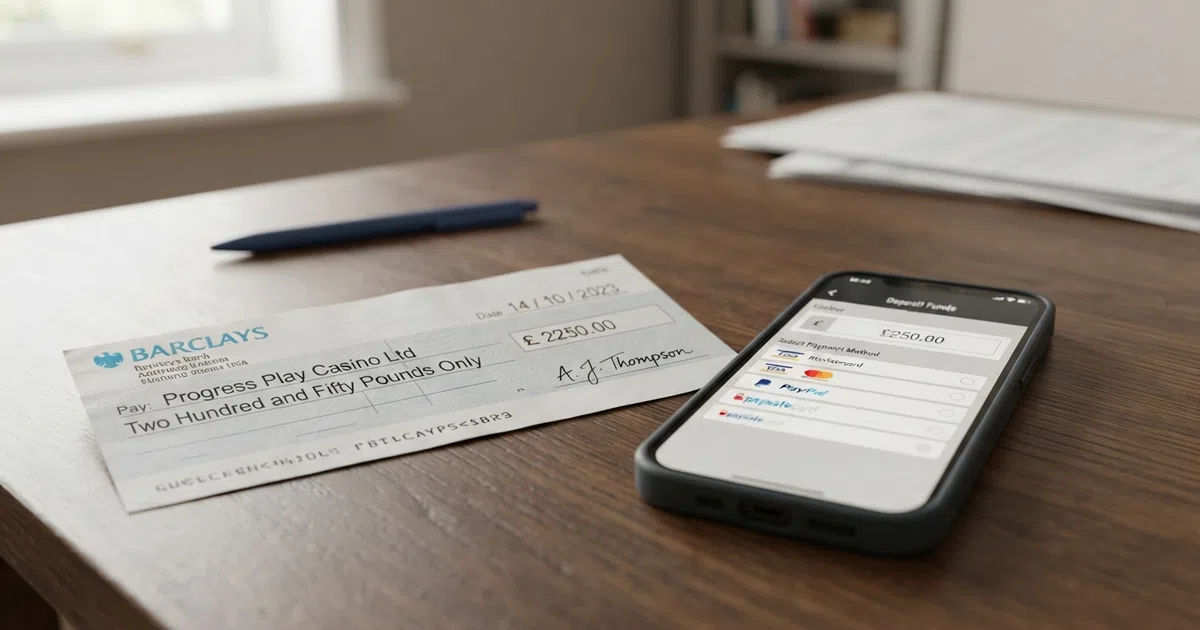
This page sets out what the cheque option actually involves at the operators that still offer it, why almost every other UKGC-licensed brand has dropped the method, what the regulator requires from any operator that does accept one, and which of the featured operators offers the closest modern alternative. The featured set below is ranked by relevance to bank-payment methods, not by market share. Every operator listed holds an active UKGC remote casino licence as confirmed on the public register, and the bonus figures are taken from each brand’s published terms at the time of writing.
Current as of September 8, 2026 and verified against the UK Gambling Commission’s public register of licence holders.
Cheque Deposits at Online Casinos Are Nearly Gone — Here Is What Is Left
A physical bank cheque is paper. It is drawn on a UK bank account, made payable to the operator, signed by the account holder, and posted to an address the operator specifies. The operator’s cashier then presents it to its own bank for clearance, and the funds land in the player’s casino account once the cheque has cleared. It is the slowest way to fund an online casino account in the UK, and it is also the method most likely to be quietly dropped from a brand’s deposit page.
Before the spread of instant banking, the cheque was a standard payment instrument for remote gambling. Cheeky Punter’s own coverage describes it as “not a very common deposit method as it takes so long to process but nevertheless it’s still available and used by a minority of punters”. That minority is the audience for what is left of the method in 2026.
What a Bank Cheque Deposit Actually Involves
The mechanics are unchanged from a decade ago. The player writes a cheque payable to the operator, writes the player’s casino account number on the reverse, signs it, and posts it to the operator’s payments address. The cashier team reconciles incoming cheques against its customer database, deposits the cheque into its own business account, waits for the cheque to clear, and credits the player’s balance once the funds have settled. Processing windows range from three to twenty-one days depending on the operator, with William Hill at around ten days, Ladbrokes at one to twenty-one days, and Betfair at three days for deposits. William Hill does not charge for the service; the other two have not published fee schedules in the data available.
A personal cheque and a bank draft behave differently in this context. A personal cheque is drawn on the player’s own current account and can bounce. A bank draft is guaranteed funds because the issuing bank has already collected the money, but few UK-licensed online casinos actively request one. Operators that do accept cheques generally accept personal cheques, which is why the clearance window is set as wide as it is.
Who Still Uses Bank Cheques for Casino Deposits — and Why
The remaining users tend to fall into a small number of profiles. Some are older players who pre-date digital banking and find the cheque a familiar instrument. Some are players without access to instant banking, whether by personal preference or by circumstance. Some cite the privacy and control arguments: a cheque is paper, the chequebook is theirs, and the act of writing one feels more deliberate than a card swipe.
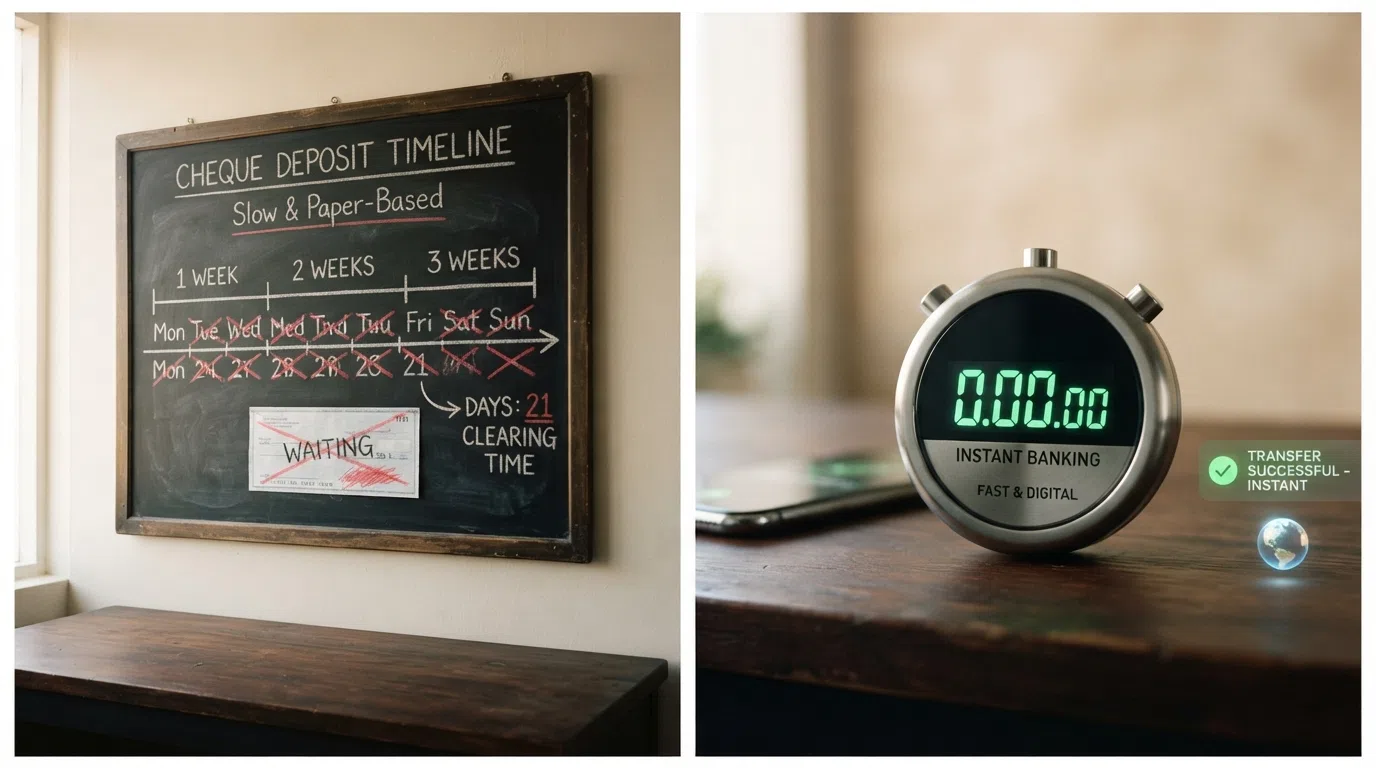
The practical downside is what dominates. A three-week wait for funds to clear is incompatible with most players’ idea of playing today. Modern debit card deposits clear instantly, open banking clears in seconds, and a standard bank transfer arrives within one to three working days. Even a short play session on a bonus with a seven-day validity window can be over before a cheque lands. The cheque survives because a small group of players keeps it alive, not because it competes on its merits.
The Difference Between a Bank Cheque Deposit and a Bank Transfer
The two are not the same thing, and most search results treat them as if they were. A bank cheque is paper, posted by the player, and physically deposited by the operator. A bank transfer is digital, initiated by the player through their own banking app, and cleared through BACS, Faster Payments or the Single Euro Payments Area. Bank transfer deposits at UK casinos typically take one to three business days, with withdrawals taking three to seven business days and minimums in the £10 to £20 range. A physical cheque deposit takes three to twenty-one days, and a withdrawal by cheque can take up to thirty days at Betfair.
The reason the distinction matters is that bundling them hides the practical story. Most UK-licensed casinos that no longer accept physical cheques still accept bank transfers. Pages that present “cheque and bank transfer” as one option tell the reader there is a method that does not, in fact, exist. The player who arrives expecting to post a cheque to a brand that only takes Faster Payments is the player who is told the wrong story.
Where Bank Cheques Stand Today — Acceptance, Speed, Limits and the Shift to Digital
The full picture in 2026 is narrow. Three UKGC-licensed operators accept physical bank cheque deposits at the time of writing, each with its own terms, processing window and minimum. Every other major UK online casino has moved to bank transfer, open banking, debit card and e-wallet channels, and the shift is accelerating as open banking rails become standard.
| Payment Method | Typical Deposit Time | Typical Withdrawal Time | Minimum Deposit |
|---|---|---|---|
| Bank cheque (William Hill, Ladbrokes, Betfair) | 3–21 days | 1–30 days | £5–£10 |
| Bank transfer (BACS / Faster Payments) | 1–3 business days | 3–7 business days | £10–£20 |
| Open banking (Pay by Bank, Trustly) | Instant | Instant to a few hours | Varies by operator |
| Debit card | Instant | A few hours to a few days | £5–£10 |
The table shows what the choice is really about. The cheque is the slowest option in every column. A bank transfer is faster on deposit and faster again on withdrawal. Open banking matches the debit card for deposit speed. None of the modern methods is meaningfully slower than any other on the deposit side, and only open banking matches the cheque on fee exposure (because there typically is no fee for either).
Which UK-Licensed Casinos Still Accept a Bank Cheque Deposit
Three operators confirm physical cheque deposits on the data available: William Hill, Ladbrokes and Betfair. All three are Entain- or Flutter-owned legacy brands with long retail histories, and all three run their cheque channel alongside a full set of modern payment options. The acceptance is real, not marketing.
William Hill takes cheque deposits at a £10 minimum, with approximately ten-day processing and no published fee. Ladbrokes takes cheques at the same £10 minimum, with a one-to-twenty-one-day deposit window and a one-to-three-day withdrawal window. Betfair takes cheques at the lowest minimum of the three, £5, with a three-day deposit and a withdrawal that can take up to thirty days. There is also a smaller operator, Planet Sport Bet, that accepts bank cheques alongside Mastercard, Visa, Maestro and bank transfer, without e-wallet or crypto options, but it is not one of the three mainstream brands named by the source data.
Operators that do not confirm cheque deposits in the available data include bet365, Paddy Power, Sky Vegas, Coral, Betfred, Grosvenor Casinos and Gala Bingo. Some of them accept bank transfer or open banking, which is a different method. Readers who arrive expecting to post a cheque to any of those brands will not find the option on the cashier page.
How to Deposit by Bank Cheque — Step by Step
The workflow is paper-heavy and old-fashioned. The player logs into the casino account, opens the cashier or help section, and locates the operator’s postal address for cheque payments. The player then writes a cheque payable to the operator’s company name, writes the casino account number or customer reference on the reverse, signs the cheque, and posts it by Royal Mail or a tracked service to the address provided. Some operators request a covering letter or a photocopy of the cheque and a form of identification; the operator’s AML policy, set under LCCP Condition 5.1.1, requires them to verify the source of funds.
Once received, the cashier team reconciles the cheque to the player’s account, deposits it into its own business account, and waits for the cheque to clear. Funds are credited to the player’s casino balance once the operator’s bank confirms clearance. The window from post to playable balance runs from three days at Betfair to three weeks at Ladbrokes in the worst case, with William Hill at around ten days in between.
The points at which the process can stall are practical. A cheque can be returned unpaid if the player’s account does not have the funds, and the player is liable for any returned-item fee the operator passes on. A stale-dated cheque (typically older than six months) is not honoured. A cheque made out to the wrong payee, or without a signature, is not processed. The player who follows the cashier instructions exactly will avoid most of these, but the longer the post takes, the larger the chance that something else changes in the meantime.
Cheque Processing Times, Deposit Limits and What to Expect
The three operators publish different numbers. William Hill sets a £10 minimum and processes in approximately ten days with no fees. Ladbrokes sets a £10 minimum and runs a one-to-twenty-one-day window for deposits, with a one-to-three-day window for withdrawals. Betfair sets a £5 minimum and processes deposits in around three days, but withdrawals can take up to thirty days. None of the three publishes a maximum cheque deposit in the available data.
A three-week wait is not theoretical. It is the worst-case window at Ladbrokes, and it has direct consequences for a player who wants to use a welcome bonus. Most welcome offers in the featured set run on a seven-day or ten-day validity window: 72 hours from credit at William Hill, 48 hours to accept and seven days to use at Ladbrokes, 48 hours to credit and seven days to use at Betfred, Coral, Betfred and Gala Bingo. A cheque that takes fourteen working days to clear arrives after the bonus has already expired, and the player who funds the account that way is funding it without the welcome offer attached.
The bank transfer baseline for comparison is one to three days on deposits and three to seven days on withdrawals. That is still slower than open banking or a debit card, but it is a different order of magnitude from a three-week cheque, and it is what most operators who no longer take cheques offer instead.
Bank Cheque vs Debit Card, Bank Transfer and Open Banking
The cheque loses on every practical measure except one. On speed, a cheque takes three to twenty-one days against instant for debit cards and open banking, and one to three days for bank transfers. On security, the cheque has no chargeback mechanism; a debit card does. On the operator’s anti-fraud side, cheques are covered by LCCP 5.1.1 as cash equivalents, which means operators accepting them need additional AML policies. On the player’s side, a cheque gives the player no opportunity to recover funds once the cheque has cleared, while a debit card chargeback can be filed within a defined window.
The one measure on which the cheque arguably wins is that it does not require the player to register a card or an e-wallet with the operator. For a player who has decided not to store payment details online, the cheque is a way to fund a casino account without sharing card or banking credentials. It is also, in a real sense, the only deposit method in the table that does not leave a payment trail on the player’s own banking app. That is a privacy feature for a small number of players, and a red flag for everyone else.
The shift to open banking is the practical story behind all of this. Trustly, Pay by Bank and Faster Payments are now standard at major UKGC-licensed operators, and instant bank-to-bank deposits are available at several of them. The cheque has not been banned. It has simply been out-engineered, and the brands that still accept it are the brands that have chosen not to drop the channel for legacy customers.
Only a Handful of UK Casinos Still Take Bank Cheques — Here Are the Best Alternatives
The featured set covers ten operators. Three of them — William Hill, Ladbrokes and Betfair — accept physical bank cheque deposits. The other seven accept bank transfer, open banking or debit card instead, and the table below sets out what each one offers, with the licence, the bank-payment method, the welcome offer, the wagering and the validity in one place.
| Operator | UKGC Licence Since | Bank Payment Method | Welcome Offer | Wagering | Offer Validity |
|---|---|---|---|---|---|
| William Hill | 1 Nov 2014 | Cheque (£10 min, ~10 days) | 200 free spins on Big Bass Splash | 0× | 72 hours from credit; offer ends 31/12/2026 |
| Ladbrokes | 1 Nov 2014 | Cheque (£10 min, 1–21 days) | 100 free spins on slots | 0× | 48 hours to accept, 7 days to use |
| Betfair | Active (Flutter) | Cheque (£5 min, 3 days) | Varies by promotion | Up to 10× | Varies by promotion |
| bet365 | 17 Oct 2019 | Bank transfer | Up to 500 free spins | 0× | 30 days to claim, 72 hours per credit |
| Paddy Power | Active (Flutter) | Bank transfer, debit card | 60 no-deposit + 100 spins after £10 stake | 0× | 7 days from credit |
| Sky Vegas | Active (Bonne Terre) | Open banking, debit card, PayPal | 50 no-deposit + 200 spins after £10 stake | 0× | 7-day expiry on spins |
| Coral | Active (Entain) | Bank transfer, debit card | 100 free spins on slots | 0× | 48 hours to accept, 7 days to use |
| Betfred | Active (Petfre Gibraltar) | Debit card required | Up to 200 free spins | 0× | 48 hours to credit, 7 days to use |
| Grosvenor Casinos | Active (Rank Group) | Online cheque not confirmed | 100% match: deposit £20, play with £40 | 10× (deposit + bonus) | 7 days |
| Gala Bingo | Active (Entain) | Bank transfer, debit card, PayPal | 100 free spins after £10 deposit and spend | 0× | Claim and use within 7 days |
The split is honest. Most featured operators no longer accept physical cheques. Where the cashier still does, the welcome offer attached to the cheque-funded deposit is the same offer that any other funding method would unlock, because no operator in the featured set restricts the welcome bonus to a particular payment channel. The cheque choice, in other words, is about the deposit mechanism, not about the bonus.
William Hill — Bank Cheque Deposits with Wager-Free Spins
William Hill is the longest-standing cheque acceptor in the UK online market. The brand holds UKGC account 2752, with a Casino Remote licence active since 1 November 2014 and a General Betting Standard Remote licence active since 9 November 2010. Cheque deposits are accepted at a £10 minimum, with approximately ten-day processing and no published fee. The welcome offer is 200 free spins on Big Bass Splash at 10p each, with zero wagering on any winnings and a 72-hour window from credit. The offer is scheduled to end on 31 December 2026.
The game-provider depth is the broadest in the featured set: Playtech, Microgaming, NetEnt, Evolution, IGT, Pragmatic Play and Blueprint. That mix covers live casino, jackpot slots, table games and the major studio releases, and it is part of why the brand is still the first name most UK players think of when they think of a cheque-accepting casino.
A cheque-funded first deposit at William Hill clears in around ten working days, which is the median of the three cheque-accepting operators. It is faster than Ladbrokes at the long end and slower than Betfair. The wagering-free spin winnings are the operator’s standard offer, not a cheque-specific concession, and the 72-hour validity on the spins is the tightest window of the three cheque acceptors. A player funding by cheque and planning to use the welcome offer needs to allow for the post-to-credit gap before claiming; otherwise the spins credit into an account that has not yet been funded.
For a player who has decided to fund by cheque and wants the widest game selection, William Hill is the most natural first stop.
Ladbrokes — The Broadest Cheque Processing Window in the Market
Ladbrokes takes cheques at a £10 minimum with a one-to-twenty-one-day deposit window and a one-to-three-day withdrawal window. The brand holds UKGC account 1611 under the Entain group, with a Casino Remote licence active since 1 November 2014. The welcome offer is 100 free spins at 10p each when the player bets £10 on slots, with zero wagering and a 48-hour acceptance window followed by a 7-day validity. The provider set is NetEnt, Pragmatic Play, Evolution, Blueprint, Playtech and Red Tiger.
The one-to-twenty-one-day window is the widest range of the three cheque acceptors, which is also the brand’s defining feature for a player funding by cheque. In the best case, the deposit lands in a working day. In the worst case, it lands three weeks later. A player who has set up a Ladbrokes account to use the welcome offer needs to be aware that the offer’s 48-hour acceptance window starts from registration, not from the cheque clearing, and the spins’ 7-day validity is from credit, not from the first deposit.
The brand sits in the same Entain group as Coral and Gala Bingo, and the welcome-offer mechanics on the wager-free spins are identical across the three. A player who is set on Entain-group wager-free spins and who plans to fund by cheque gets a slightly more predictable timeline at Coral and Gala Bingo, because both of those run on a bank-transfer rail rather than a cheque rail.
For a player who wants the longest-running cheque channel in the UK retail-and-online market, Ladbrokes is the option. The window is wide, the operator is experienced, and the offer is the same one any other payment method would unlock.
Betfair — The Lowest Cheque-Deposit Minimum Among Featured Operators
Betfair’s cheque minimum is £5, the lowest of the three cheque acceptors and the lowest in the featured set. The deposit clears in around three working days, and the withdrawal can take up to thirty days, which is the longest in the set. The brand operates under the Flutter group, which holds active remote casino licences. The welcome offer varies by promotion period, with wagering capped at the UKGC’s 10× ceiling on bonus funds.
The £5 minimum makes Betfair a natural choice for a player testing the waters with the smallest possible cheque deposit. The three-day deposit window is the fastest of the three cheque acceptors, and the 30-day withdrawal ceiling is the trade-off. A player who wins on a Betfair cheque-funded deposit and wants to withdraw by cheque is committing to a long wait.
The provider line-up is Playtech, NetEnt, Evolution, Red Tiger, Blueprint and IGT. The variable welcome offer means the page cannot quote a specific free-spin count or wagering term for the cheque path, and the operator’s published terms at the time of deposit are the ones that govern the bonus. The 10× wagering cap, where it applies, is the maximum the UKGC permits, not a Betfair-specific ceiling.
For a player who wants the lowest cheque minimum and the fastest cheque deposit, Betfair is the right name. For a player who wants a defined welcome offer on day one, the variable terms mean a closer look at the cashier at the time of deposit.
bet365 — No Confirmed Cheque Acceptance, but Bank Transfer and a Large Free-Spin Offer
bet365 does not confirm physical cheque deposits in the available data. The brand does confirm bank transfer as a payment method, and it is the alternative for a player who is open to digital banking but not to a debit card. The UKGC accounts are 38721 and 39563, held by Hillside UK Sports and Hillside UK Gaming, with a Casino Remote licence active since 17 October 2019.
The welcome offer is up to 500 free spins, credited as five to fifty spins per day over ten days after a £10 stake. The wagering is zero. The claim window is 30 days from registration, and each daily credit expires 72 hours after it lands. The provider set is Playtech, NetEnt, Microgaming, Evolution, Pragmatic Play, Red Tiger and Blueprint.
For a player who is set on bank transfer rather than cheque, bet365 is the largest-scale alternative. The brand is also the only featured operator that publishes a daily spin allocation, which means the player who wants 500 spins gets them across ten days rather than as a single credit. The 72-hour expiry on each daily credit is a tighter window than the headline 30 days suggests, and the player who does not log in for three days loses that day’s batch.
Paddy Power — No-Deposit Free Spins Plus a Bank-Transfer Fallback
Paddy Power does not confirm physical cheque deposits. The brand accepts bank transfer and debit card, and the welcome offer is 60 no-deposit free spins plus 100 more after a £10 stake, at 10p each, with zero wagering and a 7-day validity. The operator is PPB Entertainment Limited under the Flutter group.
The no-deposit component is the brand’s distinctive feature. A player who registers a Paddy Power account gets 60 spins credited without funding the account at all, which means the player can try the cashier with no payment-method commitment. The remaining 100 spins are unlocked by a £10 stake on slots, and the bank-transfer rail is what funds the stake if the player is set on the cheque alternative.
For a player who is open to bank transfer but wants to keep some spins out of the funding path, Paddy Power is the most flexible structure in the featured set.
Sky Vegas — Open Banking Instead of Cheques, with 250 Free Spins
Sky Vegas has moved fully to open banking, debit card and PayPal, with no cheque option in the available data. The UKGC licence is held by Bonne Terre Gaming Limited under the Flutter group, with licence number 065519 active. The welcome offer is 50 no-deposit free spins plus 200 more after a £10 stake, with zero wagering and a 7-day expiry on the spins and a 30-day window for the deposit-and-stake step.
For a player who is set on instant bank-to-bank payments, Sky Vegas is the cleanest open-banking offer in the featured set. The Pay by Bank rail is the closest modern equivalent to a cheque, because it allows a direct account-to-account payment without sharing card details. The 7-day spin expiry is the same window most featured operators run, and the no-deposit component mirrors Paddy Power’s structure.
Coral — An Entain Stablemate with No Cheque but 100 Wager-Free Spins
Coral does not confirm physical cheque deposits in the available data. The brand accepts bank transfer and debit card, and the welcome offer is 100 free spins at £0.10 each when the player bets £10 on slots, with zero wagering, a 48-hour acceptance window and a 7-day validity. The UKGC account is 54743 under LC International Limited in the Entain group, sharing the licence with Gala Bingo.
For a player who is set on the Entain wager-free spins offer but is open to a bank-transfer rail rather than a cheque, Coral is the same product as Ladbrokes on the bonus side and a different payment method. The provider line-up is the same, the wagering is the same, the validity is the same. The choice between Coral and Ladbrokes for a cheque-averse player is the choice between bank transfer and a faster bank transfer.
Betfred — Up to 200 Free Spins but Debit Card Required for the Welcome Offer
Betfred’s welcome offer is up to 200 free spins with zero wagering, credited within 48 hours of a £10 stake on slots. The offer requires a debit card deposit: the published terms tie the welcome offer to a debit card transaction, which is a payment-channel restriction none of the other featured operators impose. The UKGC remote casino licence is held by Petfre Gibraltar Limited.
The debit-card requirement is the practical constraint. A player who is set on bank transfer or cheque cannot unlock Betfred’s welcome offer through those rails. The provider set is Playtech, IGT, Microgaming, NetEnt, Pragmatic Play and Blueprint, and the 7-day expiry on the credited spins is the standard window.
For a player who is open to a debit card and wants the highest single-brand spin count among the operators with a debit-card restriction, Betfred is the option. For a player who has decided against the debit-card channel, the brand is not in the running for the welcome offer at all.
Grosvenor Casinos — The Only Match Bonus in the Set, with the Highest Wagering
Grosvenor Casinos is the only featured operator offering a percentage match bonus rather than free spins. The offer is a 100% match: deposit £20 and play with £40. The wagering is 10× on the bonus funds, which is the maximum the UKGC’s social responsibility code permits. The 7-day validity is the practical binding constraint. The UKGC account is 39372 under Rank Group Plc, and the online cashier does not confirm cheque deposits in the available data; the physical Grosvenor casino network may accept cheques at venue, which is a different channel from the online account.
The 10× wagering on deposit plus bonus is the headline number. A player who deposits £20 plays with £40 and must wager £400 within seven days before any winnings become withdrawable. At the £5 maximum stake per game cycle for players aged 25 and over, that is eighty game cycles of wagering, or roughly £400 of stake volume, run inside a week. The 7-day validity is the practical binding constraint, and the 10× ceiling is the statutory one.
For a player who wants a matched bankroll rather than free spins, and who is comfortable with the wagering cost, Grosvenor is the only match-bonus option in the set. For a player who wants wager-free spins, the other nine operators are closer to the mark.
The cost of clearing the Grosvenor bonus, run as a worked example at the £5 per-game-cycle stake for players aged 25 and over, plays out as follows. The bonus adds £20 of bonus funds. At £5 per game cycle, that is forty game cycles to wager the bonus funds alone, which at the standard 2.5-second spin minimum runs to roughly 100 seconds of active play. The expected loss over those cycles at a typical slot RTP of around 96% is the bonus’s real cost, not the £20 face value. This is a statistical estimate across many spins, not a guaranteed outcome for any single player.
Gala Bingo — Bingo-First but Bank Transfer and 100 Wager-Free Spins for Slot Players
Gala Bingo is bingo-led but slot-friendly. The brand accepts bank transfer, debit card and PayPal, with no physical cheque confirmation in the available data. The welcome offer is 100 free spins at 10p each, with zero wagering, a 7-day claim window and a 7-day validity, unlocked by a £10 deposit and a £10 spend on slots. The UKGC account is 54743 under LC International Limited in the Entain group, sharing the licence with Coral.
The provider mix leans bingo: Pragmatic Play, Blueprint, Red Tiger, Eyecon, Slingo and NetEnt. The slot coverage is real, but the brand’s identity is the bingo lobby, and a player looking for the full live-casino suite will find more of it elsewhere in the featured set.
For a player who is open to bank transfer and wants a wager-free spin offer backed by a bingo-led brand, Gala Bingo is the right name. For a player who is set on the live-casino side, a NetEnt-and-Evolution-led operator is a closer fit.
What the UK Gambling Commission Requires When You Pay by Cheque
Every UK online casino that accepts a cheque does so under a defined regulatory framework. The Gambling Act 2005 is the foundation statute, the Gambling Commission is the single regulator, and the Licence Conditions and Codes of Practice set out what an operator must do when it takes a cheque from a customer. Three specific LCCP provisions govern the cheque channel directly, and the broader safety architecture covers what happens before, during and after a deposit.

The Gambling Act 2005 and the UKGC — Who Makes the Rules
The Gambling Act 2005 is the foundation statute for gambling regulation in Great Britain, covering England, Scotland and Wales. Northern Ireland operates under separate, older legislation and sits outside the Commission’s remit. The Gambling Commission, an executive non-departmental public body sponsored by the Department for Culture, Media and Sport, is the single regulator for the GB market. The Commission’s public register, last updated 29 July 2026, listed 2,661 active business licence results at the time of writing.
The Act sets out three licensing objectives: preventing gambling from being a source of crime or disorder, ensuring gambling is conducted in a fair and open way, and protecting children and other vulnerable persons. Every LCCP condition and every RTS requirement is anchored in those three objectives. The Gambling (Licensing and Advertising) Act 2014 extended the regulatory perimeter to remote operators serving GB customers from anywhere in the world, which is why every brand in the featured set holds a UKGC remote licence rather than a jurisdiction-specific one.
The Act gives the Commission the power to issue, attach conditions to, suspend and revoke operating licences, and to take enforcement action against unlicensed operators. The point-of-consumption rule means a GB licence is compulsory for any operator taking GB customers, regardless of where the operator is based. The Commission’s published register is the authoritative list of which operators are licensed today, and the entries carry the licence type, the licence account number and the date the licence became active.
LCCP Conditions That Apply to Cheque Payments
Three LCCP provisions apply directly to the cheque channel. LCCP Condition 5.1.1 requires licensees to “implement appropriate policies and procedures concerning the usage of cash and cash equivalents (for example, bankers drafts, cheques and debit cards and digital currencies) by customers, designed to minimise the risk of crimes such as money laundering”. A cheque is named in the condition as a cash equivalent, and an operator accepting cheques must have AML policies that cover the cheque channel in the same way they cover debit cards and bank transfers.
LCCP Condition 5.1.2 requires payments to be processed through providers defined under the Payment Services Regulations 2017, which means the operator’s cheque-handling bank and the player’s issuing bank both sit inside the regulated payments perimeter. LCCP Condition 6.1.2 prohibits all GB-licensed remote operators from accepting credit card payments for gambling, in force since 14 April 2020, and extends to credit-card-funded e-wallet payments. A bank cheque drawn on the player’s own current account is not a credit card payment and is not caught by the ban, which is why the cheque channel survives for the three operators that still offer it.
For the player, the practical effect of these three conditions is that a cheque deposit at any UKGC-licensed casino is processed under the same AML scrutiny as a debit card transaction, and the player may be asked to provide source-of-funds documentation in line with the operator’s customer due diligence policy. The conditions are also why a cheque that does not match the registered name on the casino account is not processed: the operator’s AML controls require the cheque to match the verified player identity.
What the Regulator Does Not Do — Player Risk on Unlicensed Sites
A UKGC licence is the difference between a regulated channel and an unregulated one. Operating gambling for GB customers without a Commission licence is a criminal offence under section 33 of the Gambling Act 2005, carrying up to 51 weeks’ imprisonment, an unlimited fine, or both. The Commission uses disruption rather than ISP-level blocking: cease-and-desist notices, search-engine delisting, domain suspension and payment-provider referrals. Published figures for the period from April 2024 to June 2025 record 3,140 disruption notices issued, 447,778 URLs referred to search engines, and 287,961 URLs removed. There is no statutory ISP or DNS blocking regime in force in Great Britain, although legislation to introduce one has been proposed.
There is no statutory penalty for a player who gambles on an unlicensed site. The cost is protection: no GAMSTOP, no access to the Commission’s Alternative Dispute Resolution route, and no Commission complaints pathway. A player who has a payment dispute on an unlicensed site has no UK-regulated backstop to take it to, which is the practical reason a UKGC licence matters even for a player who only cares about getting their money back.
For a player who is set on the cheque channel, this distinction matters more than for a player using a debit card. The cheque user is already a small minority in the market, and the operators that still accept cheques are the long-established licensed brands. There is no incentive to chase an unlicensed cheque-accepting site, and the regulatory answer is the same as for any other payment channel: stay inside the licensed perimeter.
GAMSTOP, ADR and What Happens When Something Goes Wrong
The safety architecture for every UKGC-licensed online operator has four parts: GAMSTOP, the operator’s own responsible-gambling tools, the Alternative Dispute Resolution route, and the Commission’s complaints pathway. GAMSTOP has been mandatory for every GB-licensed online operator since 31 March 2020, and a player can self-exclude for six months, one year, five years, or five years with auto-renewal. The exclusion cannot be cancelled early, and the operator is required to refuse the player’s attempts to open new accounts during the exclusion period.
Financial vulnerability checks are triggered at a £150 net deposit over a rolling 30-day window, in force from 28 February 2025. The check is an interaction prompt, not an automatic block: the operator asks the player a defined set of questions about their financial situation, and the response informs the operator’s risk assessment. The £150 threshold is the trigger, not a deposit cap, and a player who passes the check is not blocked from depositing further.
Where a payment dispute cannot be resolved with the operator directly, the player can escalate to an ADR provider, and from there to the Commission if the ADR outcome is unsatisfactory. ADR is a free route for the player and is the path a cheque clearance dispute would take if the operator’s published timeline were missed without explanation. The Commission’s complaints route is a backstop, not a first port of call, and the published expectation is that operators and ADR providers resolve the matter first.
The Safety Net — Responsible Gambling Tools Every UK Player Should Use
The UKGC’s responsible-gambling framework is not a footnote on a payments page. It is a set of operator-mandated tools, a defined prevalence picture, and a public pathway to help. The framework applies equally to a player funding by cheque, by bank transfer, by open banking or by debit card, and the operator’s tools are the same in every case.
Deposit Limits, Reality Checks and the Tools the Regulator Mandates
- Customer-set deposit limits are prompted before the first deposit, in force from 31 October 2025. A decrease applies immediately; an increase can be delayed by the operator.
- A gross deposit limit, based solely on money paid in rather than net position, must be offered with at least equal prominence under RTS 12, extended to 30 September 2026.
- Reality checks and time-outs are standard tools every UK-licensed online operator must offer. Reality checks interrupt play at defined intervals; time-outs suspend the account for a chosen cooling-off period.
- Session loss, session win and time-played displays are mandatory since 31 October 2021, and the player can see the running totals at any time during a session.
- Auto-play is banned on slots, and the spin speed must be at least 2.5 seconds per game cycle. Features that disguise losses as wins, or that speed up play, are also banned.
- Online slots carry a statutory maximum stake of £5 per game cycle for players aged 25 and over and £2 for players aged 18 to 24, imposed by SI 2025/215.
How Many UK Players Are Affected — The Prevalence Data
The policy framework sits on a measured prevalence picture. In 2024, 2.7% of adults aged 18 and over in Great Britain scored 8 or higher on the Problem Gambling Severity Index, statistically stable compared to 2023. The number is small in percentage terms and large in absolute terms, because the adult population of Great Britain runs into the tens of millions.
Helpline demand is moving. GamCare’s National Gambling Helpline made 996 referrals to treatment and peer-based support services in January 2026, up from 674 in January 2025 — a 48% year-on-year increase. GambleAware’s National Gambling Support Network recorded over 52,000 calls to the Helpline over the year. The trend is not a one-off spike; the year-on-year move is the kind of step-change that prompts a service-capacity response rather than a passing reference.
The funding side of the picture is the statutory gambling levy, which raised just under £120 million in its first year from April 2025, with 1.1% of GGY levied on remote casino licences. The proceeds are ringfenced for research, prevention and treatment of gambling-related harm, and the levy is the mechanism that funds the helpline and the NHS clinic network that takes the referrals.
Where to Get Help — GamCare, the National Gambling Helpline and NHS Clinics
The first port of call is GamCare’s National Gambling Helpline on 0808 80 20 133, open 24 hours a day, 365 days a year. The Helpline routes callers to treatment and peer-support services, and GamCare is the commissioning body for the National Gambling Support Network. GambleAware funds the Helpline and the wider treatment pathway.
NHS gambling-harm clinics operate in England, Scotland and Wales, providing specialist treatment under the National Health Service. Gamblers Anonymous runs peer-support meetings across Great Britain, and a player who prefers a peer-led setting can find a local meeting through the GA directory. GAMSTOP is the self-exclusion route for the online channel, with the four defined exclusion periods set out earlier in this page, and is mandatory for every GB-licensed online operator.
The four routes are not alternatives. They are layers: a player who picks up the Helpline and is referred into treatment is in the NHS pathway; a player who self-excludes through GAMSTOP and wants peer support can attend GA; a player who wants both can use both. The architecture is built so that no single step is a closed door.
How We Selected and Ranked These Casinos
The featured set was selected on bank-payment relevance, not on market share, and every operator was checked against the UK Gambling Commission’s public register of licence holders to confirm an active remote casino licence. The public register, last updated 29 July 2026, listed 2,661 active business licence results at the time of writing, and each operator’s licence account number, licence type and active-since date is taken from that register.
Cheque-acceptance data was sourced from each operator’s cashier page where available and cross-checked against independent affiliate research, including Cheeky Punter’s method-specific directory of cheque-friendly betting sites. Where an operator’s cashier does not explicitly confirm physical cheque deposits, the data records that absence rather than treating silence as acceptance. The same rule applies to bank-transfer and open-banking alternatives: the operator’s published cashier terms are the source, and any channel not confirmed there is recorded as not confirmed.
Ranking was ordered by relevance to bank-payment methods. Operators with confirmed cheque acceptance lead the table, followed by operators that confirm bank transfer or open banking. The evaluation criteria were: UKGC licensing status, confirmed bank-payment method, processing speed and minimum deposit data, welcome-offer terms and wagering, and game-provider breadth. All five were assessed qualitatively from published terms and the public register, and no quantitative scoring was used. Where two operators offered the same bonus on the same rails, the higher game-provider count was used to break the tie.
The list is not a market-wide ranking. It is a bank-payment-focused ranking of the operators for whom the published terms and the available data supported a comparison. Operators outside the featured set, including some with active UKGC licences, are not assessed here.
What This Means for Your Next Deposit — Cheque or Otherwise
The honest answer is that bank cheque deposits are still available at three UKGC-licensed operators in 2026, and the cost of using them is time. William Hill clears in around ten days, Ladbrokes in one to twenty-one days and Betfair in around three days, with withdrawals running up to thirty days at Betfair. None of the three charges a fee for the service. None of the three restricts its welcome offer to a cheque-funded deposit.
For most players, the practical alternative is faster. A bank transfer clears in one to three working days. Open banking, where it is supported, is instant. A debit card deposit is instant. The trade-off is that a cheque does not require the player to share card or banking-app credentials with the operator, which is the privacy feature that keeps a small group of players on the channel. For a player who has decided not to register a card or an e-wallet, the cheque remains a real option, and the three operators named here are the ones that confirm it.
The welcome offers in the featured set are wager-free at nine of the ten brands, and the only exception is Grosvenor’s 100% match at the UKGC’s 10× ceiling on bonus funds. A cheque-funded first deposit at William Hill, Ladbrokes or Betfair can clear in time for a wager-free spin offer, but the player needs to allow for the post-to-credit gap: a Ladbrokes cheque that takes the full 21 days will arrive after the 48-hour acceptance window on the welcome spins has closed, which is the practical cost a cheque user pays.
The decision rests on whether a three-week wait is acceptable for the convenience of paying by post. For most readers in 2026, the answer is no. For a small minority, the answer is yes, and the three operators named above are the ones that make the choice possible.
Frequently Asked Questions
Do any UK online casinos still accept bank cheque deposits in 2026?
Yes, three UKGC-licensed operators confirm physical bank cheque deposits: William Hill (£10 minimum, approximately ten-day processing), Ladbrokes (£10 minimum, one to twenty-one days for deposits, one to three days for withdrawals) and Betfair (£5 minimum, three-day deposit, up to thirty days for withdrawals). Planet Sport Bet also accepts cheques alongside card and bank transfer, but it is not one of the three major brands named in the source data, and most other featured operators have moved to bank transfer, open banking or debit card only.
Is it safer to use a bank cheque or a debit card at online casinos?
A debit card carries a chargeback right within a defined window, which a cheque does not. Both channels are covered by the UKGC’s AML and payment-services rules (LCCP 5.1.1, 5.1.2 and 6.1.2), so the regulatory protection is the same on the operator’s side. The player-side difference is the chargeback mechanism and the dispute route through ADR if a clearance timeline is missed. For most players, a debit card is the safer channel by virtue of the chargeback alone.
Why have most UK casinos stopped accepting physical cheques?
The cheque has been out-engineered. Open banking rails (Pay by Bank, Trustly) and Faster Payments now allow instant bank-to-bank deposits at several major UKGC-licensed operators, and a bank transfer clears in one to three working days. A cheque takes three to twenty-one days. The cheque survives at three legacy brands because those brands have chosen not to drop the channel for their existing customers, not because the channel competes on speed or cost.
What is the best alternative to cheque deposits at UK online casinos?
It depends on the player’s priority. For instant funding, open banking (Pay by Bank, Trustly) is the closest modern equivalent. For a predictable one-to-three-day window, a bank transfer is the standard alternative. For maximum acceptance, a debit card is the most widely supported method. The welcome offers at most UKGC-licensed operators are not restricted by payment method, so the funding choice is about the deposit mechanism, not the bonus.
Are bank cheque withdrawals still available at UKGC-licensed casinos?
Yes, but the timelines are long. Betfair’s cheque withdrawal can take up to thirty days, and Ladbrokes publishes a one-to-three-day withdrawal window. William Hill’s withdrawal data is less clearly stated. The same operators that accept cheque deposits generally allow cheque withdrawals, though not every brand confirms both directions in the published terms. Where a faster withdrawal is needed, a bank transfer or e-wallet is the standard alternative, and the operator’s cashier publishes the specific timelines per method.
Can I use open banking instead of a cheque to deposit at UK casinos?
Yes, and for most players the answer is to do exactly that. Sky Vegas runs an open-banking rail through its Pay by Bank option, and several other featured operators support Trustly or similar instant bank-to-bank rails. Open banking deposits clear in seconds rather than days, and the operator’s AML checks run in the background. The trade-off is that open banking requires the player to authenticate the deposit through their own banking app, which the cheque does not.
Payments – nodeposit-casinobonuses-uk
Content created by the «nodeposit-casinobonuses-uk» team