
The Top 10 Highest-Paying UK Online Casinos, Ranked for Real Return
 Available in GB
“Highest paying” sounds like a slot with a 99% return-to-player sticker on the loading screen. In practice, it is a three-part test that the UK market makes unusually testable: a deep enough inventory of genuinely high-RTP games, bonus terms that survive a regulator-imposed 10× wagering ceiling, and withdrawals that land in hours rather than the working week. This ranking sorts ten UKGC-licensed casinos against that test using independently verified RTP data, current operator terms, and published payout records.

Data current as of September 8, 2026 and checked against the UK Gambling Commission’s public register of licence holders.
Why “highest paying” means more than a headline RTP number
The phrase “highest paying casino” sits in a crowded market where every operator can quote a percentage, and most quote a generous one. The number on a casino’s homepage is rarely wrong, and rarely the whole story either. A site that averages 97% across its library might run a 94% version of the only slot its welcome offer pays on; a casino that advertises 99% may bury a five-day pending period inside its withdrawal terms; a third may hand out a “100% match” bonus wrapped in 40× wagering that the regulator no longer permits — but the page still says “bonus available” in the banner. Sorting one from the other takes three checks, and the first is the most often skipped.
A casino’s headline number is, almost without exception, a *library average* — the mean RTP across every game it hosts. The slot a player actually sits down to play, by contrast, is a single title with a single RTP, and the casino chooses which version of that title to run. The same game from the same provider can ship with 94%, 96% or 98% variants, and the operator picks one. The difference is £4 of theoretical return for every £100 wagered — invisible on the homepage, decisive over a session.
The UK market is the only one in which this matters in the same way it does. Three regulator-imposed rules, in force by the end of 2026, make the term “highest paying” something a player can verify rather than a slogan a casino can claim: an age-banded per-spin stake cap on online slots, a hard ceiling on bonus wagering, and a deposit-limit regime that prevents the kind of stake escalation a high-RTP headline is often used to mask. Apply all three to a single operator and a great deal of the marketing cloud evaporates.
RTP versus house edge: the two numbers that define your return
RTP — return to player — is the long-run theoretical percentage of wagers a game returns to the player pool. A 96% slot returns £96 for every £100 wagered, on average, across millions of spins. House edge is the same number viewed from the other side of the table: 100% minus RTP. They are the same fact in two voices. The figure is a *theoretical* one — a single session of a few hundred spins will routinely sit anywhere from 40% return to 160% return, with the swings getting wilder the higher the variance of the title.
Table games compress that gap. Blackjack with basic strategy runs at roughly 99.5% RTP — a house edge of about 0.5%, the tightest margin a mainstream casino game offers. Baccarat’s banker bet comes in around 98.94% after the standard commission. European roulette sits at 97.30%, and French roulette with the La Partage rule climbs to roughly 98.65% because the even-money insurance halves the house’s cut on half the spins. The numbers are not in the same league as blackjack, but they are stable in a way slot RTP is not: a roulette wheel’s rules *are* the RTP, where a slot’s configurable chip is.
What “highest paying” actually means under UK regulation in 2026
UK regulation makes the claim testable in three specific ways. The first is the online slots stake cap, in force since April and May 2025: a maximum of £5 per game cycle for players aged 25 and over, and £2 per game cycle for players aged 18 to 24. That cap is not a marketing rule; it is statute, and it sits on every spin, every bonus-feature entry, every autoplay-style stake escalation. Any UK welcome offer whose headline value assumes a £10 or £20 per-spin baseline is, by the regulator’s own design, reading from a sheet that no longer applies.
The second is the wagering ceiling. From 19 December 2025, the UKGC’s LCCP social responsibility code 5.1.1 caps bonus wagering at 10×, with the requirement stated in terms that leave no daylight: operators must “apply wagering requirements, which requires a customer to play through bonus funds, over a maximum of 10 times.” Mixed-product promotions — bonus bets that bleed between casino, sports and bingo — were banned in the same change. Any UK offer with 10× wagering is now at the regulatory maximum. The wager-free offers that anchor this ranking sit at zero.
The third is the deposit-limit regime, fully effective from 30 September 2026 under the updated RTS. Operators must offer a gross-deposit-based limit, prompt before the first deposit, action any decrease immediately, and remind the customer to review the limit at least every six months. The “stake limit” terminology now replaces the older “spend limit” wording on the operator side. The mechanic that lets a player lose the difference between a casino’s “average” and a single session’s actual return — chasing — is the one the regulator has spent the last five years quietly dismantling.
Beyond RTP: payout speed, bonus fairness and the real value equation
A 99% RTP casino that takes two weeks to pay out is not the highest-paying casino for the player whose session ended well. A 96% RTP casino that pays the same day is, for that player, the higher-payer of the two. The arithmetic is unromantic: a withdrawal pending for ten business days is money the player cannot redeploy, cannot compound, cannot withdraw to a different operator offering a stronger game the next morning. Speed is a payout-quality number, not a customer-service number.
Bonus terms, in turn, preserve or destroy the headline value the rest of the offer is built around. Under the UKGC’s 10× cap, a £10 welcome bonus can carry a maximum of £100 of wagering before withdrawal. A wager-free welcome offer carries none. The difference between the two is not a marketing nuance — it is the entire bonus value, recycled back into the player’s balance rather than burned through a multiplier.
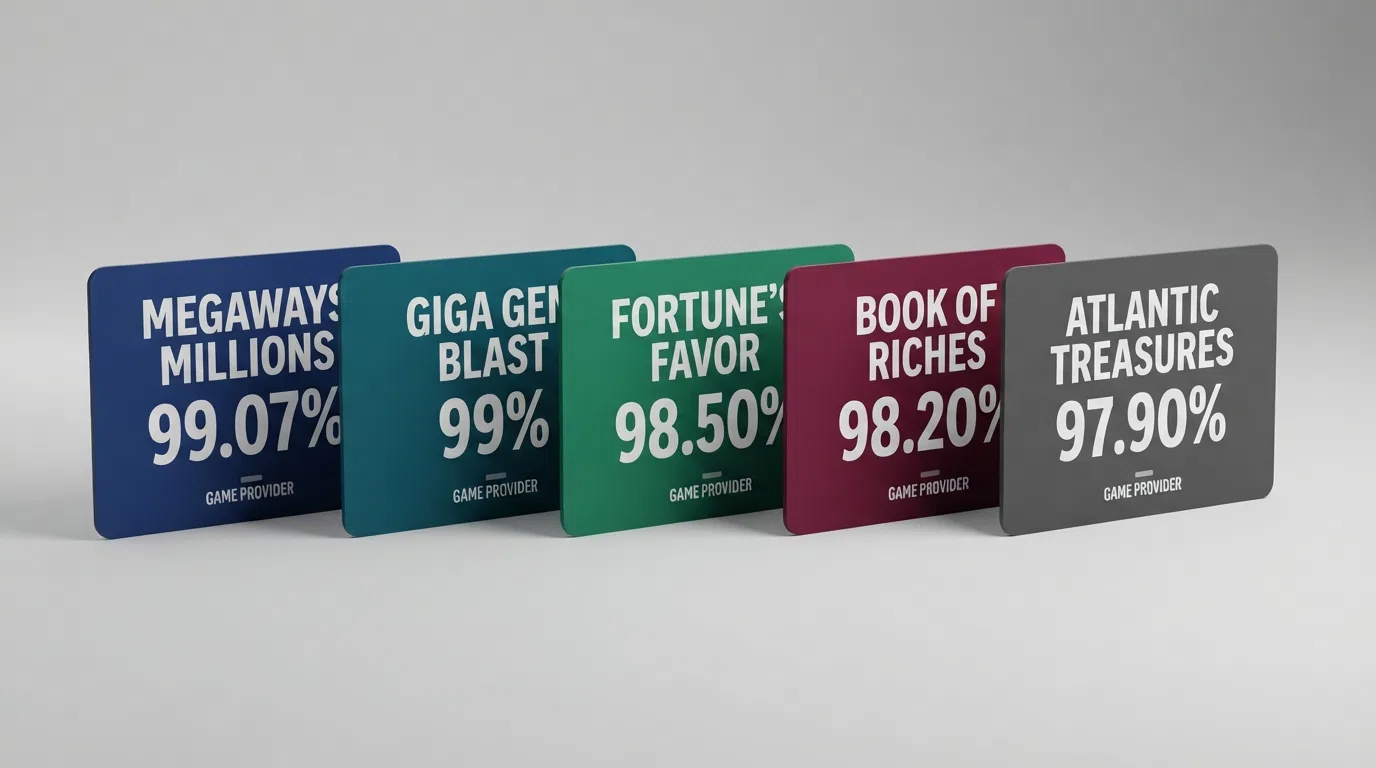
Game depth is the third leg. A casino needs enough high-RTP titles to make its headline claim meaningful across the games a player actually wants to play. Four verified high-RTP slots — Ugga Bugga at 99.07%, Book of 99 at 99%, Mega Joker at 99%, and 1429 Uncharted Seas at 98.50% — establish the inventory-depth benchmark. A casino that hosts one of them is offering a marketing line. A casino that hosts all four, alongside blackjack, baccarat and French roulette at their proper RTPs, is offering a return profile.
Top 10 highest-paying UK online casinos for 2026
The ten operators below are all UKGC-licensed and have been cross-referenced against the Gambling Commission’s public register. They are ranked on three combined criteria: the depth of their high-RTP game inventory, the wagering terms on the current welcome offer, and the documented speed of withdrawals. Where the data runs out — and for four operators in this set, it runs out cleanly on the welcome-offer side — the ranking rests on the data that did come through, and the gaps are noted plainly.
The market context for this ranking comes from the Gambling Commission’s Q1 2026 figures: total online GGY at £1.55bn, up 7% year on year, with slots GGY at £773m, up 12% year on year. The UK online market is growing faster than the wider industry, and within it, slot play is growing faster still. The list below is the segment of that growth that actually pays out.
| Casino | UKGC licence | Welcome offer | Free spins | Wagering | Game library |
|---|---|---|---|---|---|
| bet365 Games | Yes | Up to 500 free spins on proprietary titles | 500 | 0× | Proprietary + major suppliers |
| Sky Vegas | Yes | 50 no-deposit FS + 200 FS after £10 stake | 250 | 0× | 1,000+ |
| Betway | Yes | Stake £10, get 150 free spins | 150 | 0× | Broad slot + live casino |
| Pub Casino | Yes | 50 no-wagering free spins | 50 | 0× | 2,200+ |
| Unibet | Yes | Stake £10, get 200 FS on Big Bass Bonanza | 200 | 10× | 4,000+ |
| BetMGM UK | Yes | 200 free spins on Big Bass Splash | 200 | — | Large |
| MrQ | Yes | Up to 300 cash spins or 200 free spins | 300 / 200 | — | Slot-led |
| Casumo | Yes | — | — | — | Large + 60+ live blackjack |
| The Vic | Yes | — | — | — | Live-led (London-studio exclusives) |
| 10Bet | Yes | — | — | — | Live-casino emphasis, RTP transparency |
How we verified RTP and payout claims for every casino on this list
Three layers of evidence went into the ranking. The first is the UKGC public register: every operator below appears there, and the licence status was checked against the register rather than inferred from the operator’s own marketing. The register is the only authoritative answer to whether a UK player is playing under UKGC protection, and the bonus terms on the page matter very little without it.
The second layer is independent RTP data. The slot numbers in the next section — Ugga Bugga at 99.07%, Book of 99 at 99%, Mega Joker at 99%, 1429 Uncharted Seas at 98.50% — come from the publicly available slot-testing work cited in this article’s research. Volatility ratings, where used, come from the same pool: Blood Suckers at 98% RTP with low volatility, 1429 Uncharted Seas at roughly 98.5% with low/medium volatility, Mega Joker at 99% with high volatility. These are not the casino’s claims; they are cross-references against the casino’s claims.
The third layer is operator-specific terms. The bonus structure of each featured offer was read against the published terms on the operator’s own site. The withdrawal-time claims for Pub Casino (under two hours), Casumo (under two hours), The Vic (under three hours) and BetMGM UK (typically within 24 hours for e-wallets) come from independent UK-facing review sources. Operators whose bonus or RTP specifics could not be traced to a verifiable source are noted as such, and ranked on the data that did come through.
What to look for beyond the headline RTP: withdrawal speed, bonus terms, game depth
The featured set splits cleanly on withdrawals. Pub Casino and Casumo are documented at sub-two-hour payout benchmarks in independent UK reviews, the fastest pair in the set. BetMGM UK follows at typically within 24 hours for PayPal and other e-wallets, again per independent reporting. The Vic sits at sub-three hours. The rest fall back to standard multi-day processing, the default for UKGC-licensed operators that have not invested in instant-banking rails.
Bonus terms under the UKGC 10× cap divide the set into three groups. The wager-free cluster — bet365 Games, Sky Vegas, Betway, Pub Casino — offers zero wagering on free-spin winnings. The 10× ceiling cluster — Unibet, with 200 free spins on Big Bass Bonanza at 96.71% RTP — sits at the regulatory maximum, the highest wagering any UK-licensed casino is permitted to apply. The data-gap cluster — MrQ, Casumo, The Vic, 10Bet — has welcome-offer specifics that could not be confirmed at reliable granularity this run; their place in the ranking is on payout speed and game depth, with the offer section to be filled in by the player against current terms.
Game-library depth is the multiplier. Unibet’s 4,000+ casino games make it the broadest library in the set; Pub Casino’s 2,200+ and Sky Vegas’s 1,000+ follow. bet365 Games’ proprietary library is smaller in count but curated around titles that meet the operator’s own house standard. Casumo, The Vic and 10Bet each push live-dealer depth — 60+ live blackjack tables at Casumo is a real outlier — which moves the comparison away from slot RTP and toward table-game RTP. The headline a player is comparing has to be a *matching* headline.
bet365 Games: 500 wager-free spins across a proprietary slot library
The headline is the spin count: up to 500 free spins, no wagering, no deposit match to dilute the offer. The mechanics are more precise than the count suggests. bet365 credits the spins in tranches — 5, 10, 20, then 50 — across ten daily picks, each pick unlocking on a successive day after registration. The spin value is £0.10, the standard across UK wager-free offers, and the eligible titles come from bet365’s own proprietary catalogue: Book of Horus, Curse of the Bayou, Magic Forge, Wrath of the Deep and others.
Two windows sit on top of the offer. The first is the claim window: 30 days from registration to trigger the offer, with a minimum of £10 in lifetime deposits required. The second is the expiry on unused spins and winnings, set at 7 days from credit. Wagering is 0×: any win from a free spin withdraws as cash immediately, the cleanest bonus mechanic the UK market permits.
When evaluating an offer by withdrawable value rather than headline total, bet365 requires the least amount of arithmetic. The proprietary slot library’s RTP lacks the granular public verification of the Ugga Bugga / Book of 99 group, but the trade-off is clear. The wager-free structure handles that uncertainty more cleanly than a 10× wagering offer: a slot returning 95% instead of 99% still pays out 100% of the free-spin winnings as cash. Sampling the casino through this bonus requires no complex calculation, making this an efficient entry point.
Sky Vegas: 50 no-deposit spins plus 200 more, all wager-free
The Sky Vegas welcome is the only no-deposit free-spin offer at 0× wagering in the featured set, and that is the only sentence that matters about it. 50 spins land on registration, no deposit required, no wagering on winnings, 7-day expiry from credit. A further 200 free spins are unlocked after a £10 stake, with the same 0× wagering, £0.10 per spin, 7-day expiry and 30-day deposit-and-stake window.
The game library is 1,000+ titles, including Sky exclusives and Jackpot King content. That is mid-pack by featured-set standards — Unibet and Pub Casino carry more — but the no-deposit entry point changes the comparison entirely. A player can register, take the 50 free spins, and either withdraw any winnings or move on, with no deposit at risk. The 200-spin second tranche, post-stake, is a separate offer rather than an extension of the first.
For a player who wants to test a UKGC-licensed casino before committing a deposit — and the 50 no-deposit free spins are exactly that test, with cash-out terms attached — Sky Vegas is the right operator. The 0× wagering applies to both tranches, which is rarer than the marketing might suggest. The library depth is the cost: a player who has already decided on a specific high-RTP slot will not necessarily find it on Sky’s first page.
Betway: stake £10 and get 150 free spins with zero wagering
Betway’s welcome is the cleanest stake-triggered wager-free offer in the set. Stake £10, take 150 free spins, no wagering on the winnings. The 150 spins credit 50 per day across three days after the qualifying stake, at £0.10 per spin, on five designated slot games listed in the operator’s terms.
The validity window is 7 days from registration to claim the qualifying stake, the tightest in the wager-free cluster — bet365 gives 30 days for the lifetime deposit threshold, Sky Vegas gives 30 days for the deposit and stake. A player who registers and does not stake within a week forfeits the spins. The slot games are designated rather than player-chosen, which constrains the offer’s RTP profile but also means the operator has done the curation. The five slots in the eligible set are picked for the offer, not for a player who is browsing.
The broader Betway portfolio carries a wider slot and live casino range than the welcome offer suggests. For a player who already has a Betway account, or who is comfortable with a designated-slot offer, this is the wager-free mechanic at its most efficient: one stake, 150 spins, no wagering. The 7-day window is the friction, and the friction is the only reason to take a different wager-free offer instead.
Pub Casino: 50 no-wagering free spins with no win cap
Pub Casino’s offer is the structurally simplest in the wager-free cluster. 50 free spins, 0× wagering, no win cap — a slot win is paid out at full value, whatever the multiplier. The 2,200+ game library is the second-largest in the featured set, spanning Megaways titles and crash games alongside the standard slot catalogue.
On withdrawals, independent UK-facing review sources document a sub-two-hour cashout benchmark. That is the fastest documented payout in the featured set, matched only by Casumo, and it is the most practical answer to the question “highest paying” in the sense the player actually cares about. A 50-spin offer is small by headline, but a 50-spin offer whose winnings arrive in the same day is a different offer from the same offer on a slower site.
The simplicity of the welcome is the trade-off. There is no no-deposit path, no staggered tranche, no second offer to unlock. A player registers, deposits, takes 50 spins, and either wins or does not. The game library is the reason to stay past the welcome: 2,200 titles is enough depth for a player to find the high-RTP slots they have already decided they want to play.
Unibet: 200 free spins on Big Bass Bonanza at the UKGC wagering limit
The Unibet offer is the highest-wagering welcome in the featured set, and it sits at exactly the regulatory ceiling. Stake £10 on slots, take 200 free spins on Big Bass Bonanza, with 10× wagering on the winnings — the maximum any UKGC-licensed operator can lawfully apply. Spin value is £0.10, validity is 48 hours from credit, and the bonus slot is fixed: Big Bass Bonanza at 96.71% RTP.
The library is the standout. 4,000+ casino games is the broadest in the featured set, and it includes Megaways, jackpot slots, live dealer, and a deep sportsbook. For a player who is not staking on the offer alone, Unibet is the operator with the most places to go afterwards. The offer itself is a single-bonus-slot mechanic on a high-but-not-top RTP title, and the wagering cap of 10× on £20 of winnings (200 spins at £0.10) means the player must clear £200 of slot play to withdraw the maximum bonus value.
The 48-hour validity is the tightest in the featured set. A player who takes the offer and does not use the spins within two days forfeits them. The trade-off is straightforward: more games afterwards, less offer margin now. For a player whose “highest paying” is measured in long-term library value rather than welcome-offer EV, Unibet is the right pick.
BetMGM UK: 200 free spins on Big Bass Splash with exclusive high-RTP inventory
The BetMGM UK offer is the major-brand version of the Big Bass series: 200 free spins on Big Bass Splash after qualifying, with the broader library making room for exclusive high-RTP slot versions. Independent reviews cite Jackpot 6000 at 98.9% RTP as a BetMGM UK exclusive variant, the kind of inventory differentiator the headline figures miss.
On withdrawals, Racing Post documents PayPal and other e-wallet cashouts as typically completing within 24 hours. That sits behind the sub-two-hour Pub Casino and Casumo benchmarks but well ahead of multi-day processing. The brand recognition — MGM is a household name in US gaming — is a different sort of trust signal from a UKGC licence, and it sits alongside one rather than in place of it.
Wagering on the free spins, bonus validity and exact spin value are not documented at the same granularity as the wager-free cluster. The 200 free spins on Big Bass Splash is the headline, and the headline is the only figure the player’s arithmetic can rest on. The combination of exclusive high-RTP versions and 24-hour e-wallet cashouts is the strongest part of the profile, and the part a comparison is built on.
MrQ: up to 300 cash spins or 200 free spins, no-wagering positioning
MrQ’s offer is the largest headline spin count in the featured set, on two offer paths: up to 300 cash spins, or 200 free spins. “Cash spins” is a UK-specific term for free spins paid out as withdrawable cash — the same mechanic as a 0× wagering bonus, without the word “wagering” appearing in the terms. MrQ’s brand positioning is built around no-wagering offers as the default, and the welcome is the cleanest expression of that.
The data gap on this operator is the widest in the set. Wagering on the cash spins, validity windows, spin value and whether either tranche requires a deposit are not confirmed at the granularity of the wager-free cluster. The “up to 300” figure is also a maximum, contingent on the offer path, deposit level and any opt-in steps that are not in the published terms at the granularity the comparison needs. For a player, the practical question is which path the current offer terms route them down, and that is the question to answer against the operator’s own site.
For a player drawn to the cash-spin mechanic and the 300-spin headline, MrQ is the right offer, and the rest of the profile is what it is. Slot-led portfolio, UKGC-licensed, no-wagering brand. The comparison against the wager-free cluster will be cleaner once the per-tranche specifics surface.
Casumo: a large live-dealer library and sub-two-hour cashout record
Casumo’s place in the ranking rests on two pillars. The first is documented withdrawal speed: independent UK reviews time the cashout at under two hours, matched only by Pub Casino in the featured set. The second is the live-dealer library: 60+ live blackjack tables is a real outlier, and the live dealer proposition overall sits among the deepest in the UK market.
The welcome offer is the open question. Specifics on the current welcome were not confirmed at reliable granularity this run, and the ranking reflects the data that was confirmed: payout speed and game depth. A player who has already chosen Casumo as their live-dealer operator will find the offer terms on the operator’s site, and the comparison against the wager-free cluster should be made on whatever the current welcome is. The sub-two-hour payout benchmark and the live-dealer depth do not depend on the welcome offer being any particular value.
For a player who weighs “highest paying” by table-game RTP and live-dealer breadth, Casumo is the right operator in the set. The combination of fast cashouts and 60+ live blackjack tables puts the operator in a category of one alongside the slot-heavy brands above, and the ranking reflects that.
The Vic: London-streamed live exclusives and a live-led proposition
The Vic is the only live-dealer-first operator in the featured set, and the difference is structural rather than cosmetic. London-streamed live blackjack exclusives — games hosted from a UK studio and unavailable at other operators — anchor the proposition. Independent UK review sources document the Vic’s position in the live-dealer cluster.
The welcome-offer specifics were not confirmed at reliable granularity this run. The ranking rests on what was confirmed: live-led proposition, UK-studio exclusives, documented payout speed. The Vic is the right operator for a player who treats live-dealer quality as the primary differentiator, and the offer terms on the operator’s site will fill in the rest. The London-studio streaming is a real differentiator, and a player who has not played UK-studio live dealer before will notice the difference from a generic Pragmatic Live lobby.
For a player who wants the live-dealer-first experience with a UK-studio twist, The Vic is the right pick in the set. The sub-three-hour payout benchmark is not the fastest among the live-led operators, and the ranking reflects that.
10Bet: live-casino emphasis with RTP transparency
10Bet rounds out the set on a different basis from the rest: RTP transparency. The operator publishes RTP figures on individual live-casino and slot game pages, which is a real trust signal in a market where the casino’s homepage RTP is a library average and the game-level RTP is the player’s actual return. The Independent’s UK operator roundup lists 10Bet with an average RTP in the 97% range, in line with the wider UK market.
The welcome-offer specifics were not confirmed at reliable granularity this run. The ranking rests on what was confirmed: live-casino emphasis, RTP transparency, the broader category of “publishes the figure on the game page.” A player who treats RTP transparency as a deal-breaker will find 10Bet is the operator in the set that does it most visibly, and that is the comparison the ranking is built on.
For a player who values being able to see the RTP of the specific game they are about to play, before they play it, 10Bet is the right pick. The welcome offer terms on the operator’s site are the missing piece, and the player’s own comparison is the part that fills it in.
The UK’s highest-RTP slots: titles where the return actually favours the player
A player chooses individual titles, not site-wide averages. A casino with a 97% library average might host a 99% Ugga Bugga and a 94% branded slot; the player sits at the slot, not at the average. The list below is the cluster of UK-available titles whose RTP maths genuinely favours the player — independently verified, with the volatility rating where the data carries it. The list is short by design: an honest top of the high-RTP market runs to a handful of titles, not a long tail.
| Slot title | Provider | RTP | Volatility |
|---|---|---|---|
| Ugga Bugga | Playtech | 99.07% | — |
| Book of 99 | Relax Gaming | 99% | — |
| Mega Joker | NetEnt | 99% | High |
| 1429 Uncharted Seas | Thunderkick | 98.50% | Low/medium |
| Blood Suckers | NetEnt | 98% | Low |
The gap between a slot’s published RTP and the casino-specific version is where the comparison quietly breaks. Operators can and do run lower-RTP variants of the same title — a Ugga Bugga at 99.07% is not the same game as a Ugga Bugga at 94%, even though the loading screen is identical. The only reliable check is the in-game help menu, which every UKGC-licensed game must display, and the comparison against the provider’s published range.
Top 10 highest-RTP slots available at UK-licensed casinos in 2026
The list above is the verified top of the market. Beyond it, the independently verified RTPs thin out fast, and the long tail of slots running between 94% and 96% RTP is where most UK casino libraries spend their bulk. The titles in the table are the ones a player who has decided that high-RTP is the criterion can actually play.
The format of those titles is consistent. Ugga Bugga, Book of 99, Mega Joker, 1429 Uncharted Seas, Blood Suckers — all five are fixed-payline or classic-reel slots, none are Megaways, none are progressive jackpots. The format choice is not an accident: the highest-RTP slot designs are the ones where the maths is not split between base game and a feature pool, and where the per-spin cost is the player-controlled variable. The next section makes that trade-off explicit.
Megaways, progressive jackpots and classic reels: how RTP varies by slot type
Megaways slots typically run in the 95.5% to 96.5% RTP band — below the top fixed-payline titles by 2 to 3 percentage points, and that gap is the price of the dynamic reel system. Progressive jackpots carry a split: a base-game RTP, plus a contribution to the jackpot pool, and the headline figure on the loading screen is rarely the base-game return. A progressive’s 96% headline might be 92% base and a 4% jackpot contribution — the player’s session return is 92%, and the 4% is a lottery ticket the player did not ask for.
The 98%+ RTPs sit in the format where the maths is cleanest. Classic three-reel and fixed-payline slots — Ugga Bugga, Book of 99, Mega Joker, Blood Suckers, 1429 Uncharted Seas — are the designs where the provider’s RTP target is met without splitting the return between a base game and a feature. The player pays a fixed stake, the maths returns a fixed percentage, and the format makes the trade-off legible. Megaways and progressives are not worse games; they are different products, with the RTP cost of the feature paid by the player’s theoretical return.
Low-volatility high-RTP slots: the steady-return playbook
A 99% RTP high-volatility slot can drain a bankroll faster than a 97% low-volatility title. The volatility is the variance around the RTP mean — a high-volatility slot pays less often and in larger amounts, a low-volatility slot pays more often and in smaller amounts. The 99% RTP is the long-run average; the short-run session depends on the volatility. Under the UK £5 per-spin stake cap, the difference between a high-volatility and a low-volatility title of the same RTP is the difference between a session that ends in the first 200 spins and a session that lasts 800.
The best examples in the UK market are Blood Suckers at 98% RTP with low volatility and 1429 Uncharted Seas at roughly 98.5% RTP with low/medium volatility. Both are fixed-payline, both return close to 99% over the long run, and both pay out often enough that a £5-per-spin session lasts longer than a high-volatility title with the same theoretical return. The 99% Mega Joker is the contrast: same RTP, high volatility, and a bankroll profile that swings harder. Anyone managing a fixed bankroll under the stake cap should prioritize the volatility rating as the second-most-critical metric in the help menu, directly following the RTP itself.
Max win potential versus payout percentage: which number matters more
Max win is a marketing number. A 50,000× multiplier sounds dramatic, and at a £5 per-spin stake it is £250,000 — but the probability of hitting it is, for almost every slot, a fraction of one percent, and the slot that advertises it is generally running a lower base-game RTP to fund the headline. A 99% RTP slot with a 5,000× max win is, over a session, better value than a 95% RTP slot with a 50,000× max win. The base-game return is the number on every spin; the max win is the number on the loading screen.
The UK stake cap changes the arithmetic on both sides. At £5 per spin, the 50,000× max win is £250,000 — and the 5,000× max win on the 99% slot is £25,000. The first number is bigger; the second is the one that pays out across thousands of sessions. The 99% RTP is the rate at which the player is paid in the long run, the max win is the rate at which the player is paid once in a million spins. Both are real numbers; only one of them is the player’s return.
Table games and live dealer: the UK’s highest-odds casino games
The slot RTP is a configurable chip. The table-game RTP is a rule, and the rule is the return. Blackjack, baccarat and roulette together form the highest-odds tier of any UK casino, and the gap between them and the slot catalogue is structural: a slot’s RTP is a design choice, a table game’s RTP is a property of the game. That is the entire reason a 99.5% blackjack sits at the top of the odds list while the slot RTP table is a long conversation about format and volatility.
| Game | Variant | RTP | House edge |
|---|---|---|---|
| Blackjack | Basic strategy | ~99.5% | ~0.5% |
| Baccarat | Banker bet | ~98.94% | ~1.06% |
| Roulette | French, La Partage | ~98.65% | ~1.35% |
| Roulette | European | 97.30% | 2.70% |
| Roulette | American | 94.74% | 5.26% |
The hierarchy reads off the table. Blackjack at 99.5% is the highest-odds mainstream casino game on the UK market, by a margin of roughly half a percentage point over baccarat’s banker bet. French roulette with La Partage comes third, at 98.65%, with the even-money insurance rule doing the work of closing the gap. European roulette at 97.30% is a full percentage point and a half behind French, and American roulette at 94.74% is the one UK-licensed casinos almost never run, the double-zero making the house edge an unromantic 5.26%.
Blackjack, baccarat and roulette: which table game gives you the best mathematical chance
Blackjack with basic strategy, at roughly 99.5% RTP and a house edge of about 0.5%, is the best-odds mainstream casino game available in the UK. The “basic strategy” condition is doing the work — a player who deviates from the optimal hit/stand/double/split decisions gives back a fraction of that 0.5% to the house, and the cost of even small deviations compounds over a session. The basic strategy chart is a one-page lookup the player can carry into the session, and the cost of not using it is the only real tax the game imposes on the disciplined player.
Baccarat’s banker bet, at around 98.94% RTP after the standard 5% commission, is the simplest near-even-money option on the UK market. The player makes one decision — banker or player — and the house edge is set by the rules. The commission is the cost of the bet: the banker wins more often than the player, and the commission is the house’s cut. The player bet at roughly 98.76% RTP is close, but the banker bet is the better odds pick by a small margin.
Roulette’s two UK-licensed variants are the simplest comparison. European roulette, with a single zero, runs at 97.30% RTP. French roulette, with the La Partage rule, runs at roughly 98.65% — because La Partage returns half the even-money stake when the ball lands on zero, halving the house’s cut on the bets the rule covers. American roulette, with the double zero, runs at 94.74% and is the variant the UK-licensed market has largely dropped. A player who finds a European or French wheel at a UKGC-licensed casino is finding the right game; a player who finds an American wheel is finding a game that costs an extra 2.56 percentage points of return for no reason.
How to check a game’s exact RTP before you play
A five-step process. Each step takes longer to read than to do.
- Open the game and locate the help, info, or paytable icon — usually a question mark or “i” in the top or bottom corner of the game window.
- Scroll to the RTP or “theoretical return to player” section. Every UKGC-licensed game is required to display this, and the figure is the RTP the casino is running on the version of the title in front of you.
- Note the exact percentage. The provider’s published range for a popular title can include 94%, 96% and 98% variants, and the casino chooses which one to host. The percentage on the help menu is the one the player is playing.
- Check whether the RTP is conditional. Some titles (one well-known example is Monopoly On The Money) advertise a higher RTP that only applies in a specific feature mode or at a particular stake level. The conditional RTP is the one the player is playing if the mode and stake match; the headline is not.
- Cross-reference the figure against independent slot-testing sources where available. The high-RTP slots in the table above are independently verified at the figures shown; the verification is the player’s defence against a casino running a different variant.
UK gambling regulation: the rules that make “highest paying” real
The three regulatory mechanics that shape every offer on this page are the stake cap, the 10× wagering ceiling, and the GAMSTOP net. The mechanics are not optional: they are statute, regulation and licence condition, and the casino the player deposits with either operates under all three or operates outside UK player protection entirely. The test for whether “highest paying” is a meaningful claim is whether the casino passes that test.
UKGC licensing: what a British licence requires for fair payouts
The UK Gambling Commission is the regulator, and the public register of licence holders is the only authoritative answer to whether a casino is licensed for UK customers. The licensing objectives set by the Gambling Act 2005 are three: prevent gambling from being a source of crime or disorder, ensure gambling is fair and open, and protect children and other vulnerable persons. The framework extends to remote operators via the Gambling (Licensing and Advertising) Act 2014, which brought offshore operators into the point-of-consumption regime.
The technical standards underneath the licensing objectives are the practical levers. Games must display their theoretical RTP. Random number generators must be certified. Operators must use certified testing houses — eCOGRA, Gaming Laboratories International, iTech Labs are the names the player will see in the game-help menu — to verify that the certified RTP matches the certified RNG. A UKGC-licensed game has a paper trail; a non-UKGC-licensed game has a marketing claim.
The register itself is the tool any player can use before depositing. A casino’s licence status, the licence type, and the operating companies behind the licence are all public. A player who cannot find a casino on the register should not deposit at it, and “highest paying” stops being a question the moment that test is failed. The ten operators in this ranking are all UKGC-licensed; the verification is the player’s first check before they take any further figure at face value.
Stake caps, deposit limits and the 10× wagering rule: how UK regulation shapes every offer on this page
Three mechanics, one operator, every offer. The stake cap is a per-game-cycle maximum on online slots: £5 for players aged 25 and over, £2 for players aged 18 to 24. The cap is in force since April and May 2025, and it is statute. Any UK welcome offer whose headline value assumes a higher spin baseline is reading from a sheet that no longer exists.
The wagering ceiling is the bonus multiplier cap: 10× maximum on bonus funds, in force from 19 December 2025. The UKGC’s own language leaves no daylight: operators must “apply wagering requirements, which requires a customer to play through bonus funds, over a maximum of 10 times.” Mixed-product promotions were banned in the same change. Any UK offer with 10× wagering is at the regulatory maximum; the wager-free offers that anchor this ranking sit at zero, the only lower number the rule permits.
The deposit-limit regime, fully effective from 30 September 2026, is the third leg. Operators must offer a gross-deposit-based limit, prompt the customer to set a financial limit before the first deposit, action any decrease immediately, and remind the customer to review the limit at least every six months. The “stake limit” terminology now replaces the older “spend limit” wording on the operator side. The mechanic that lets a player lose the difference between a casino’s “average” and a single session’s actual return — chasing — is the one the regulator has spent five years quietly dismantling.
A worked example ties the three together. A player takes a 10× wagering offer, stakes £10 to claim £20 in bonus, and clears the wagering on a 96% RTP slot. The required turnover is £200 (10× £20). At a £2 per-spin stake (the 18–24 cap) on a 96% RTP slot, that is 100 spins of bonus play. The expected loss on the bonus, on a 96% RTP game, is £200 × 4% = £8. The bonus pays £20 in gross, the expected cost is £8, and the expected value to the player is £12 before any other terms apply. At a £5 per-spin stake (the 25+ cap), the same turnover is 40 spins. The expected loss is the same £8; the play time halves.
That is the cost the 10× cap sets as the ceiling. The wager-free offers that anchor the top of this ranking carry zero turnover, zero expected loss on the wagering component, and a different calculation entirely — the free spins are paid out at the slot’s face RTP, the winnings are withdrawable as cash. The cap and the wager-free offer sit at opposite ends of the same rule, and the gap between them is the space the marketing lives in.
GAMSTOP and the safety net every UK-licensed casino must provide
GAMSTOP is the national online self-exclusion scheme, and every UKGC-licensed online operator has been required to participate since 31 March 2020. A player who registers with GAMSTOP is excluded from every UKGC-licensed gambling site at once, for 6 months, 1 year, 5 years, or 5 years with auto-renewal. The exclusion is irreversible within the chosen period — it cannot be cancelled early.
The scope is what it says on the scheme. All UKGC-licensed online operators at once. Land-based venues are not covered. Unlicensed sites are not covered. A player who has self-excluded and then opens an account at an offshore casino without a UKGC licence is opening an account at an operator the UK regulator does not reach; the GAMSTOP block does not apply. The interaction with bonus offers is also explicit: operators must not market to self-excluded players, and any bonus claimed before the exclusion remains subject to its terms — including the wagering and validity windows that applied at the time of claim.
GAMSTOP is the safety net, not the only one. The UKGC’s deposit-limit regime, the time-out facility inside every UK casino account, and the National Gambling Helpline at 0808 8020 133 are the rest. The tools sit at different levels — operator-level, account-level, national-scheme-level — and a player who is using one is using only one of the three. The sections that follow cover the rest.
Staying in control: the responsible-gambling tools every UK player should use
A 99% RTP slot and a £5 per-spin stake cap do not change the structure of the game. The house has the edge, and the player’s session return depends on volatility as much as RTP, on stake size as much as game choice, and on the length of time the player sits at the machine. The theoretical return plays out over millions of spins; a single session can and will deviate sharply. The UK-licensed casino’s responsible-gambling tools are the infrastructure that makes the deviation survivable, and they are present in every licensed account by regulation.
Deposit limits, session caps and reality checks: tools inside every UK casino account
A short list, explained clearly.
- Deposit limits. Set a gross-deposit-based limit before the first deposit; decreases take effect immediately, increases do not. The operator must prompt the limit before the first deposit and remind the player to review it at least every six months. The deposit limit is the single most effective control available, and it is the one the regulator has spent five years making harder to avoid.
- Reality checks. Pop-ups at intervals showing time played and net win/loss position. Required on every UKGC-licensed product. The interval is operator-set, but the display is mandatory, and the player who treats the pop-up as a session-end prompt is using the tool as it was designed.
- Time-outs. 24-hour, 48-hour, one-week, or longer account-level breaks from a single operator. Distinct from GAMSTOP, which covers all UKGC-licensed sites at once. A player who wants to step back from a specific operator without the wider scheme uses the operator’s time-out.
- Session display. Slots and table games show total wins, losses, and time played during the session. Required on every UKGC-licensed game. The information is on the screen, and a player who reads it is using the tool.
- Self-exclusion. The account-level version, distinct from GAMSTOP, and covering a single operator for a chosen period. A player who has decided to stop with one operator and continue with others uses this; a player who has decided to stop with all UKGC-licensed operators uses GAMSTOP.
- 2.5-second minimum spin speed, no auto-play. The structural brakes on slot play. The 2.5-second minimum is the slowest pace the regulator permits, and the auto-play ban means a player cannot set 500 spins and walk away. Both are mandatory, both are on every UKGC-licensed slot.
The tools are inside the account, and the player who has not found them has not looked. A responsible-gambling menu sits inside every UK casino account, usually under “Safer Gambling” or “My Account,” and the deposit limit sits at the top of it because that is where the regulator requires it to be.
Self-exclusion through GAMSTOP: how it works and when to use it
GAMSTOP registration is online, free, and covers every UKGC-licensed operator at once. The player chooses an exclusion period — 6 months, 1 year, 5 years, or 5 years with auto-renewal — and the registration is irreversible within that period. The minimum period is six months; the maximum is five years, with the option of auto-renewal for a player who wants the exclusion to continue without a re-registration step.
What happens to existing accounts and pending withdrawals is operator-specific, but the basics are uniform. An account at a UKGC-licensed operator cannot be reopened during the exclusion period, and the operator is required to take reasonable steps to prevent the player from gambling. Pending withdrawals are processed in line with the operator’s standard terms; the exclusion does not void a withdrawal that was already in progress, and any bonus claimed before the exclusion remains subject to its terms.
The limitations are real. GAMSTOP does not cover land-based venues — bookmakers, casinos, bingo halls. GAMSTOP does not cover unlicensed sites. A player who has self-excluded and then opens an account at an offshore operator without a UKGC licence is opening an account the UK regulator does not reach, and the self-exclusion is a UKGC-licensed tool that applies only to UKGC-licensed operators. The next section covers what those tools do not cover.
Where to get help: the National Gambling Helpline and free support services
The National Gambling Helpline, run by GamCare, is the front-line service. The number is 0808 8020 133 for England and Scotland, 0808 2819 265 for Wales. The line is free, available 24 hours a day, 7 days a week, and the call is confidential. GamCare also runs the same number for general gambling-harm support, and the two numbers route to the same service.
NHS UK guidance sets the threshold for seeking help. A score of 8 or higher on the PGSI-style screening questions means gambling-related harms are likely, and the NHS directs people in that range to the National Gambling Helpline. The NHS’s own language is unambiguous: “if your total score is 8 or higher, you or those closest to you, are likely to be experiencing gambling-related harms.” A player who scores in that range is not a player who is “managing” — the score is a clinical signal that the help line exists to respond to.
GambleAware and the NHS gambling-harm clinics are the next layer. GambleAware funds research, treatment, and the wider support infrastructure, and the clinics — based in NHS trusts across England — provide face-to-face treatment for gambling-harm cases. Both are free, and both take self-referrals. The message from the regulator and the NHS alike is the same: using these services is a strength, not a failure. A 99% RTP slot does not change the structure of the game, and the tools exist for the moments when the structure becomes personal.
How we selected and ranked the top 10 highest-paying UK casinos
The selection criteria are three, and they are applied in order. The first is the UKGC public-register licence: every operator on this list appears there, and the licence status was checked against the register rather than inferred from the operator’s own marketing. An operator without a UKGC licence is not on the list, regardless of its RTP claims or its bonus terms.
The second is the depth of the high-RTP game inventory. The four independently verified slots at 98.5% RTP and above — Ugga Bugga, Book of 99, Mega Joker, 1429 Uncharted Seas — are the benchmark. An operator that hosts them, or the closest available alternatives, ranks higher than one that does not. Library size is the second-order criterion: Unibet’s 4,000+ games, Pub Casino’s 2,200+, Sky Vegas’s 1,000+ are the order of magnitude.
The third is the bonus terms under the UKGC 10× cap and the documented withdrawal speed. The wager-free cluster — bet365 Games, Sky Vegas, Betway, Pub Casino — ranks highest on bonus terms. The 10× cluster — Unibet — ranks below. The data-gap cluster — MrQ, Casumo, The Vic, 10Bet — is ranked on the data that did come through, with the offer gap noted plainly. Withdrawal speed is the tiebreaker where the bonus terms are close: Pub Casino and Casumo’s sub-two-hour benchmarks are the fastest in the set, BetMGM UK’s sub-24-hour e-wallet cashouts are next, The Vic’s sub-three-hour live-dealer cashouts after that.
The operators checked are the ten featured in the ranking. The data sources are the UKGC public register, the independent slot-testing work cited in the slot list, the operator’s own published terms, and the independent UK-facing review sources cited in the operator profiles. This ranking is not a test of every UKGC-licensed casino. It is a test of the ten operators below, against the data available at the time of research, and operators whose bonus or RTP specifics were not confirmed are ranked on the data that was confirmed. A different run of research might surface those specifics; the ranking would then shift, and the audit trail would be the published terms on the operator’s site at the date of the player’s visit.
What it all means: choosing a high-paying UK casino with your eyes open
The UK’s best-paying casinos are not defined by a single RTP number. They are the operators that combine a deep high-RTP game inventory, wager-free or low-wagering bonus terms, and fast, verifiable withdrawals under UKGC regulation. The ranking on this page sorts the ten operators on those three legs, and the table at the top of the operator section is the comparison the page is built around.
Three checks to apply before the first deposit. Verify the UKGC licence on the public register, not on the operator’s homepage. Open the help menu of the slot or table game the player intends to play, and read the RTP off the screen — not off the casino’s marketing. Compare the bonus wagering against the 10× regulatory ceiling, and prefer 0× where it is offered, because 0× is the only number below the cap. The casino that passes all three is the casino the comparison is built around, and the rest of the offer is the rest of the offer.
The honest caveat sits at the end. Theoretical RTP plays out over millions of spins. A single session of a few hundred spins can and will deviate sharply from the theoretical number, and the deviation can run in either direction. A 99% RTP slot can pay out 200% in a lucky hour, and the same slot can pay out 60% in an unlucky one. The house’s long-run edge is the house’s, and no “highest paying” label changes it. What the label does change is the rate at which the edge is collected, and the rate at which a player’s session return matches the theoretical one. The operator that lets the player play at the highest verified RTP, with the least bonus friction, and pays out the fastest, is the operator that comes closest to the label — and the player who does the three checks above is the player who can see how close.
The market context is the closing note. The UK’s online gambling market grew 7% year on year in Q1 2026 to £1.55bn, with slots alone up 12% to £773m. The market is growing, slot play is growing faster, and the regulatory ceiling is doing the work of keeping the growth honest. The ten operators in this ranking are the part of the market that pays out under the ceiling, and the player who chooses from the ranking is choosing from the part of the market that has been measured. The rest of the market is the rest of the market.
Frequently asked questions about the highest-paying UK online casinos
Are “wager-free” welcome spins better value than matched bonuses under UK rules?
Yes, on the metric the comparison is built around. A wager-free offer pays out free-spin winnings as cash at 0× turnover, while a matched bonus carries up to 10× wagering under the UKGC ceiling — the maximum the regulator permits. The wager-free offer is the only UK offer that returns the full slot win without the player clearing additional turnover, and on a 96% RTP slot that difference is the entire bonus value. Matched bonuses still exist in the UK market, but the value they deliver is the value left after the wagering requirement, and that value is lower than the headline.
Do UK-licensed casinos publish a single site-wide payout percentage — and should you rely on it?
Most do, on the homepage or in a “Fairness” or “About” page. The figure is a library average, weighted across every game the casino hosts, and it is a real number verified by the testing houses. It is not, however, the RTP of the slot a player is about to sit down to. The site-wide figure says the average return across the catalogue; the in-game help menu says the return on the specific game and version the player is running. The two are independent, and the second is the one the player’s return is set by.
What is the safest way to compare “best payout” casinos in the UK without relying on affiliate tables?
Three steps. First, verify the UKGC licence on the public register before comparing anything else. Second, check the in-game RTP of the specific titles the player intends to play, by opening the help menu and reading the figure off the screen. Third, read the published bonus terms for the wagering multiplier, the bonus validity window, and any game restrictions, and compare those against the UKGC’s 10× ceiling. A comparison that passes all three is built on the data that matters; a comparison that fails any of the three is built on the data the operator wants the player to see.
How fast can withdrawals really be at UK casinos using PayPal, Trustly, or debit cards?
The fastest documented benchmarks in the featured set are sub-two hours at Pub Casino and Casumo via instant-banking rails, with BetMGM UK at typically within 24 hours for PayPal and other e-wallets, and The Vic at sub-three hours. Outside the featured set, UKGC-licensed operators typically process e-wallet withdrawals within 24 hours and debit-card withdrawals within 1 to 3 working days, after the operator’s internal pending period. The reverse-withdrawal ban is in force across the UK market, so a player who requests a withdrawal cannot undo it during the pending window to keep playing with the same funds.
What is GAMSTOP, and how does it interact with high-RTP casinos and bonus offers?
GAMSTOP is the national online self-exclusion scheme, mandatory for every UKGC-licensed operator since 31 March 2020. A player who registers with GAMSTOP is excluded from every UKGC-licensed gambling site at once, for 6 months, 1 year, 5 years, or 5 years with auto-renewal. The exclusion is irreversible within the chosen period. Operators must not market to self-excluded players, and any bonus claimed before the exclusion remains subject to its terms. GAMSTOP does not cover land-based venues or unlicensed sites, and a player who has self-excluded but opens an account at an offshore operator without a UKGC licence is operating outside the scheme.
Does blackjack’s “99.5% RTP” mean you will lose only 0.5% in real play?
In the long run, across a large number of correctly played hands, yes — that is the definition of the theoretical return. In any single session, no. Variance runs the other way, and a 100-hand session at 99.5% RTP can produce outcomes well above or well below the theoretical figure. The 0.5% house edge is the cost the player pays per hand on average, not the cost of any particular hand, and the player’s actual session return depends on the hands they are dealt, the decisions they make, and how long they sit at the table. “Basic strategy” is the condition that makes the 99.5% figure real; a player who deviates from basic strategy gives back a fraction of the 0.5% to the house, and the cost compounds across the session.
Live dealer versus RNG: does the RTP actually change?
No. A European roulette RNG game and a live European roulette table run on the same rules and return the same 97.30% theoretical RTP. The RTP is a property of the game, and the delivery format is a property of the casino. The two are independent.
What does change is the pace, and pace is the part of the comparison that actually costs the player. Live dealer game speed is slower — a hand of blackjack runs at the dealer’s pace, a roulette spin at the wheel’s pace — which means fewer decisions per hour and lower theoretical loss per hour at the same stake. RNG table games run faster: the player clicks “deal” and the next hand is dealt, the player clicks “spin” and the next spin resolves. The rule is the same; the bankroll burns faster.
The UK’s game-design rules add a separate brake on the slot side that does not apply to table games. Slots must run at a minimum 2.5 seconds per game cycle, with auto-play banned, and a session display of wins, losses and time played required. RNG table games carry no such brake, and a player on a session-length budget at an RNG table game will spend that budget faster than at a live table. The RTP is identical; the cost per hour is not.
Limits – nodeposit-casinobonuses-uk
Content created by the «nodeposit-casinobonuses-uk» team