
USDC Casinos for UK Players: The Full Operator Breakdown
 Available in GB
The search for a USDC casino that takes UK players runs into a wall almost immediately. The wall has a name: the UK Gambling Commission. Every operator on this page accepts USDC, and not one of them holds a British licence. That is not a gap in the market waiting to be filled. It is the market, full stop.
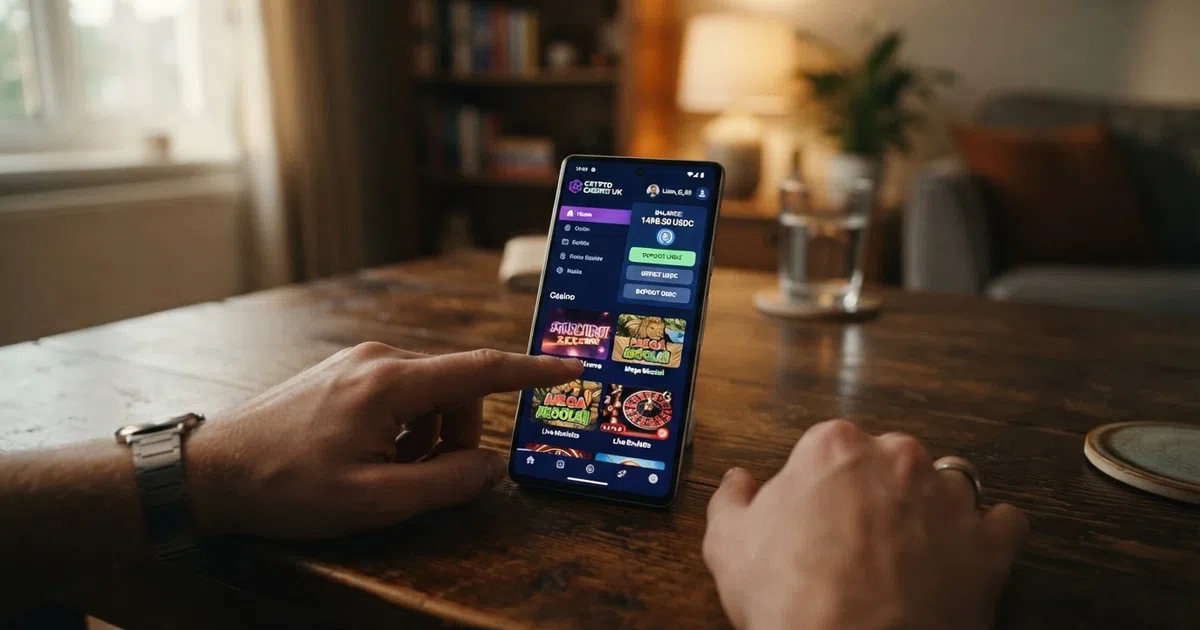
USDC, or USD Coin, is a stablecoin issued by Circle, pegged one-to-one to the US dollar, and transferable across fifteen-plus blockchain networks including Ethereum, Solana, Polygon, Arbitrum, Base, and Tron. On Solana, a USDC transaction settles in five to twenty seconds for under a cent. That speed is exactly why crypto casinos have adopted it: the deposit lands before a credit-card deposit would even leave the cashier page.
And yet the UKGC’s public register contained 2,663 records as of late July, and none of them is a crypto-accepting casino. The Commission’s position is blunt: it will not consider operating licence applications with a crypto funding element unless the operator provides a full source-of-funds history at the application stage. No operator has met that bar. Several of the biggest names in crypto gambling — Stake, BC.Game, BitStarz, Cloudbet, Wild.io, Shuffle, Roobet — now explicitly block UK IP addresses in their terms. The ones that don’t block are licensed in Curaçao and operate outside UK jurisdiction entirely.
This page ranks the ten operators that research confirmed, describes what each one offers a UK player, and spells out exactly what protections the reader gives up by playing offshore. The numbers are current as of September 8, 2026 and were verified against the UK Gambling Commission’s public register and each operator’s published terms and conditions.
Understanding USDC Casino Deposits — and the UK Regulatory Reality
USDC works in online casinos the same way it works everywhere else in crypto: the player sends tokens from a self-custody wallet to a deposit address the casino provides, the blockchain confirms the transaction, and the balance appears in the casino account. The difference from Bitcoin or Ethereum is that USDC does not swing in price while it sits in the casino’s balance. A £500 USDC deposit today is still £500 worth of USDC tomorrow, and that stability is why it has become the default stablecoin for crypto gambling.
The casino side is straightforward. The harder question is the jurisdiction. Great Britain requires every operator serving British customers to hold a UKGC operating licence under the Gambling Act 2005, extended to remote operators by the 2014 Act. A Curaçao licence is not a substitute, and no Curaçao-licensed casino is authorised to offer gambling to GB customers. Yet the Curaçao operators are exactly the ones accepting USDC. The market exists in the gap between what the UKGC permits and what the UKGC can prevent. The UKGC has no statutory ISP or DNS blocking power, so offshore sites remain reachable. The Commission instead works through disruption: 3,140 disruption notices, 447,778 URLs referred to search engines, and 287,961 URLs removed between April 2024 and June 2025.
The practical effect for a UK player: every USDC casino on this page is Curaçao-licensed, operates outside UK jurisdiction, and offers none of the protections a UKGC licence provides — no GAMSTOP coverage, no Commission complaints route, no approved alternative dispute resolution (ADR), and no credit-card chargeback, because crypto transactions are irreversible. The trade is speed and privacy for the entire UK player-protection framework. That trade is the subject of the rest of this page.
How a USDC Casino Deposit Actually Works
A USDC deposit starts with a self-custody wallet — software like MetaMask or Trust Wallet that holds the player’s private keys rather than holding funds on a third-party exchange. Once the wallet is funded with USDC, the player goes to the casino’s cashier page, selects USDC as the deposit method, and chooses a blockchain network. The casino generates a deposit address specific to that network. The player copies the address (or scans a QR code), enters the amount, and confirms the transaction in the wallet.
Confirmation speed depends on the network. On Ethereum, a USDC transfer takes three to five minutes and costs a few dollars in gas, which fluctuates with network congestion. On Solana, it settles in five to twenty seconds for under a cent. On Polygon, it lands in roughly thirty seconds for fractions of a cent. Shuffle, for example, reports ETH deposits taking three to five minutes and SOL deposits around thirty seconds. The casino credits the balance after a set number of on-chain confirmations, typically one to three depending on the network.
The stablecoin peg matters here. When a player deposits £500 in USDC, the casino credits the account in USDC (or its dollar equivalent) and that balance stays at £500. Deposit £500 in Bitcoin and the same balance could be worth £380 or £620 by the following morning, independent of whether the player won or lost a single hand. USDC removes that second layer of volatility — the gambling is just the gambling.
Multi-network USDC means the player chooses the trade-off. Ethereum is the default and the most widely supported by casinos, but it is the slowest and the most expensive. Solana is the fastest and cheapest and is gaining casino support, though not every operator offers it yet. Polygon sits in the middle on both axes. For a UK player making regular small deposits, Solana is the practical winner. For a player making one large deposit and not in a rush, Ethereum’s wider acceptance still matters.
The Source-of-Funds Hurdle That Keeps Crypto Out of GB Casinos
The reason no UKGC-licensed casino accepts USDC is not a law that says “no crypto.” It is a set of overlapping regulatory requirements that make crypto funding incompatible with a GB operating licence in practice.
The UKGC’s blockchain guidance is direct: the Commission will not consider operating licence applications with a crypto funding element unless the operator provides a full and complete history of source-of-funds evidence at the application stage. The anti-money-laundering and Licence Conditions and Codes of Practice (LCCP) requirements that govern GB operators were designed for fiat payment chains, where the player’s bank already maintains KYC records and transaction histories. Crypto breaks that chain. A wallet address does not come with a name attached to it, and tracing its history requires forensic blockchain analysis that the UKGC’s existing supervisory model does not accommodate.
Then there is the tax. Remote Gaming Duty on operator gaming profits rose from 21% to 40% on 1 April 2026, applying to accounting periods beginning on or after that date. A 40% take from gross gaming yield is a heavy load for any operator to bear, and it leaves little margin for the compliance infrastructure that crypto funding would demand. The incentive structure pushes licensed operators toward fiat and pushes crypto operators offshore.
The result is a de facto ban without a named prohibition. The UKGC has not passed a rule reading “cryptocurrency deposits are forbidden.” It has set source-of-funds and AML requirements that no crypto-funded operator can meet, and it has stated it will not process applications that do. Every USDC casino a UK player can reach is therefore offshore, Curaçao-licensed, and not authorised to serve GB customers under the Gambling Act 2005. Several major operators have responded to UKGC enforcement pressure by adding the UK to their restricted-countries list — Stake since March 2025 is one prominent example. The market is contracting at the licensed end and persisting at the offshore end.
USDC vs Bitcoin and Other Casino Cryptocurrencies
USDC is a stablecoin. Bitcoin is not. That single difference reshapes the gambling experience. A Bitcoin deposit of 0.01 BTC at £50,000 per coin is worth £500 today; if Bitcoin drops to £45,000 by the following week, the same balance is worth £450, and the player has lost money on the exchange rate before playing a hand. USDC sidesteps that entirely — the peg holds within fractions of a cent under normal conditions, and the player’s balance stays put.
USDC’s main competitor is Tether (USDT), the other dominant stablecoin. Both are dollar-pegged, both work across multiple chains, both are accepted at most crypto casinos. The differences are structural. USDC is issued by Circle, a US-regulated company that publishes regular attestation reports from major accounting firms. USDT is issued by Tether Limited, which has faced regulatory scrutiny over the years and publishes attestations with less granularity. For most players the practical difference is negligible — the dollar peg holds in both cases — but for larger balances and for players who care about issuer transparency, USDC has the cleaner reputation.
The casino side also varies. Some operators accept USDC but not USDT. Others accept USDT and Bitcoin and Ethereum but not USDC. Among the featured set, Shuffle accepts fifteen crypto assets including USDC on both Ethereum and Solana, with a $20 minimum deposit and withdrawal. The point is that “crypto casino” is not one thing — the specific token and the specific network determine the speed, the fee, and the regulatory profile of the deposit.
For the UK player, the calculus is simple. If the goal is to move money in and out of a casino quickly and without the exchange-rate gamble, USDC is the practical choice. Bitcoin is for players who want to speculate on price while they play. USDT is a near-substitute that works at most of the same casinos. Everything else — Litecoin, Dogecoin, the long tail of altcoins — is available at some operators but adds friction without adding much value.
The Real Pros and Cons of Playing at USDC Casinos
- Deposits land in seconds on Solana, roughly thirty seconds on Polygon, and three to five minutes on Ethereum — all faster than any card payment or bank transfer.
- Transaction fees are negligible on Solana (under $0.01) and Polygon, and a few dollars on Ethereum depending on gas.
- The stablecoin peg means the gambling balance does not move with crypto markets; players are not making two bets at once.
- No credit card is involved, so there is no bank statement trail and no card-issuer block on gambling transactions.
- Privacy: only a wallet address is shared with the casino, not personal banking details.
- No GAMSTOP coverage — the national self-exclusion scheme applies only to GB-licensed operators and does not cover offshore casinos.
- No UKGC complaints route and no approved ADR — a dispute with an offshore operator has no British consumer redress.
- Crypto transactions are irreversible — once USDC leaves the wallet, it cannot be recalled.
- The UKGC’s 10× wagering cap does not apply; offshore terms typically run 30×–50× on deposit plus bonus.
- Responsible gambling tools (mandatory deposit-limit prompts, reality checks, time-outs) are offered at some offshore operators but are not required and enforcement is at the operator’s discretion.
The Operators We Checked — and Which Ones Welcome UK Players
Ten operators were verified for this ranking. Seven accept UK players or do not explicitly block them. Three — Stake, BC.Game, and BitStarz — appear in the table because they dominate the USDC casino market and a UK player will encounter them while searching, but each one blocks UK access in its terms. Every operator listed holds a Curaçao licence. None holds a GB operating licence.
| # | Operator | UK Access | Licence & Regulator | Welcome Offer | Wagering Requirement | Standout Feature |
|---|---|---|---|---|---|---|
| 1 | FortuneJack | Serves UK players | Curaçao GCA (live since 2014) | 200% up to $2,000 | 40× on deposit + bonus, 7-day window | 2,748 slots from 30+ providers, Evolution + Pragmatic Play Live |
| 2 | FairSpin | Serves UK players | Curaçao GCA OGL/2024/222/0540 (granted 14 April 2025) | 150% up to $2,000 | 45× on deposit + bonus, 30-day window, $10 max bet | Newest Curaçao licence in the set, 10 USDC minimum deposit |
| 3 | Rainbet | Serves UK players | Curaçao | 250% up to $1,750 across 3 deposits + 60 free spins | 40× on deposit + bonus, 7-day window, $30 min per tier | Highest headline match for UK-accessible operators; >97.4% RTP slots excluded from bonus |
| 4 | Flush | Serves UK players | Curaçao | Up to $1,500 tiered (100% for $10–$200, 150% above) | 30× (Tier 1) or 35× (Tier 2) | No-KYC, crypto withdrawals processed in ~41 minutes (tested) |
| 5 | MyStake | Serves UK players | Curaçao | 170% up to £1,500 + 30 free spins | 30× casino wagering | Casino, live dealer, and sportsbook on one balance; Evolution, Pragmatic Play, Hacksaw, BGaming, Nolimit City |
| 6 | Freshbet | Serves UK players | Curaçao | 250% up to £1,500 | Not stated in published terms | Sportsbook on the same platform |
| 7 | Tenobet | Serves UK players | Curaçao | 400% up to £5,000 | Not stated in published terms | Strong Evolution-led live dealer floor |
| 8 | Stake.com | BLOCKED UK since March 2025 | Curaçao | 200% up to $2,000 | 40× on deposit + bonus | 4,200+ games including exclusive Stake Originals (provably fair) |
| 9 | BC.Game | BLOCKED UK | Curaçao | 380% up to $4,000 + 400 free spins across 4 deposits | 45× on bonus only, 30-day window, $15 max bet | 6,500+ games, the largest library in the set |
| 10 | BitStarz | UK EXPLICITLY RESTRICTED in terms | Curaçao GCA OGL/2024/165/0185 | 100% up to $2,000 | 50× on deposit + bonus, 30-day window, $5 max bet | Multi-award-winning, verifiable Curaçao licence |
The spread tells the page’s main story. The UK-accessible operators cluster around 30×–45× wagering on deposit plus bonus, with bonus windows ranging from a tight seven days (FortuneJack, Rainbet) to a generous thirty days (FairSpin). The three blocked operators are the ones with the biggest game libraries and the most aggressive bonus packages — Stake’s 4,200+ games, BC.Game’s 6,500+, BitStarz’s award-winning reputation. The reader has to choose between access and scale. There is no operator in the market that combines both.
FortuneJack — 2,748 Slots, 30+ Providers and a Decade Online
FortuneJack has been live since 2014, making it the longest-running operator in the featured set. The game library carries 2,748 slots from 30-plus providers, with live dealer through Evolution and Pragmatic Play Live — the two studios whose tables appear at nearly every serious online casino. The welcome offer is a 200% match up to $2,000, with 40× wagering on the deposit plus the bonus and a seven-day validity window. A 16-tier loyalty programme runs alongside the welcome package.
The seven-day window is the tightest in the set. A $1,000 deposit on the 200% match produces a $2,000 bonus, and 40× on the combined $3,000 means $120,000 in wagering before the bonus converts to withdrawable cash. At even a brisk pace on slots, that is a heavy lift inside one week. The casino is best suited to a player who intends to play large volume immediately after depositing, not someone who plans to spread the bonus over a relaxed week.
For a UK player looking for the deepest slot library among the accessible operators, FortuneJack is the top pick. The game count and provider range dwarf the competition. The wagering is standard for the set. The bonus window is the trade-off.
FairSpin — 150% Match, 30-Day Validity and the Newest Curaçao Licence
FairSpin holds Curaçao GCA licence OGL/2024/222/0540, granted on 14 April 2025 — the freshest licence among the featured operators. The welcome offer is 150% up to $2,000, with 45× wagering on deposit plus bonus, a 30-day validity window, and a $10 maximum bet while the bonus is active. The minimum deposit is 10 USDC.
The 30-day window is the standout. Where FortuneJack and Rainbet give seven days, FairSpin gives more than four times that. A player who prefers to take the bonus at a measured pace — evenings and weekends, not concentrated sessions — has room to do so. The 45× wagering is on the higher end of the set, and the $10 max bet is a constraint on the high-roller play style, but for a recreational player depositing $200–$500, the terms are workable.
The licence is the selling point for cautious players. FairSpin’s Curaçao licence was issued under the reformed 2024 framework, which moved from master-licence arrangements to direct B2C licensing. The licence number is verifiable against the Curaçao Gaming Control Board register. For a UK player who wants the most recent regulatory paper trail, FairSpin offers it.
Rainbet — 250% Across Three Deposits, with a 40× Sprint
Rainbet’s welcome package is the highest headline match percentage among UK-accessible operators: 250% up to $1,750 across three deposits, plus 60 free spins (20 per stage, on Pragmatic Play’s Sweet Bonanza). The wagering is 40× on deposit plus bonus, with a seven-day validity window. The minimum deposit is $30 per tier, the highest minimum in the set. Games above 97.4% RTP are excluded from bonus clearance.
The high minimum is the first filter. A player depositing $30 per tier across three deposits commits at least $90, and the bonus activates only on each deposit. The 7.4-percentage-point gap between the highest eligible RTP and 97.4% sounds technical but matters in practice: it cuts out a significant slice of high-RTP slots from the wagering contribution. Sweet Bonanza, the featured free-spins game, sits at 96.49% RTP with high volatility — within the eligible range, but the kind of game where bonus money can vanish quickly during a cold streak.
Rainbet suits a player with a $90-plus bankroll who wants the largest possible bonus and is willing to play it through fast. The seven-day window rules out casual play. The free spins on Sweet Bonanza are a draw for fans of the game specifically, less so for players who prefer other slots.
Flush — No-KYC Withdrawals in Under an Hour
Flush is the only no-KYC operator in the featured set. The welcome bonus is tiered: 100% on deposits from $10 to $200, 150% above $200, up to a total of $1,500. Wagering is 30× on Tier 1 or 35× on Tier 2. The minimum deposit is $10. Crypto withdrawals were tested at approximately 41 minutes — the fastest documented withdrawal in the set.
“No-KYC” at Flush means the casino does not require identity verification at registration or deposit. It does not mean the casino can never ask for documents. Operators offering no-KYC play typically trigger verification at withdrawal, especially for larger amounts, under their own AML obligations. The no-KYC label is best read as “deferred, not eliminated” — the player who withdraws $5,000 will likely be asked for ID even if the player who withdraws $50 will not.
Flush is the right pick for a player who values speed and privacy over maximum bonus size. The $1,500 ceiling is lower than FortuneJack’s $2,000, FairSpin’s $2,000, Rainbet’s $1,750, or Tenobet’s £5,000, but the sub-hour withdrawal makes it the most practical option for a player who expects to cash out frequently. A player who plans to deposit once and play through a long bonus is better served elsewhere; a player who wants fast, clean cycles wins at Flush.
MyStake — 170% Match, Live Dealer and Sportsbook on One Balance
MyStake offers 170% up to £1,500 plus 30 free spins, with 30× wagering on the casino bonus. The wagering multiple is the lowest in the featured set, tied with Flush’s Tier 1 rate. The game roster is broad: Pragmatic Play, Evolution (live dealer), Hacksaw, BGaming, and Nolimit City, with crash, dice, and plinko mini-games alongside the standard slot and table lineup. A sportsbook runs on the same balance.
The all-in-one structure is the draw. A player who wants to play slots, drop into a live blackjack table, and place a football accumulator without juggling separate accounts and separate balances finds it at MyStake. The £1,500 maximum is lower than several competitors but the 30× wagering means the same dollar value of bonus is less expensive to clear. A £500 deposit with the 170% match produces an £850 bonus, and the 30× wagering requirement on that bonus is substantially less expensive to clear than the equivalent at a 40× or 45× competitor.
The lack of a published bonus validity window is a gap. Players who sign up should confirm the current terms before depositing, since a 30× bonus with an unspecified window could be tighter or looser than competitors. For a player who plans to play frequently across casino and sportsbook, the combined-balance model and the low wagering multiple make MyStake the most cost-effective option in the set.
Freshbet — A 250% Match with Sportsbook on the Side
Freshbet offers 250% up to £1,500, with a sportsbook on the same platform. The wagering requirement and bonus validity window were not surfaced in published terms during research — a gap the player should fill before depositing by reading the current terms page directly.
The 250% headline is competitive. If the wagering lands in the 30×–40× range typical of the set, the effective cost is in line with FortuneJack or MyStake. If it lands higher — 45× or 50×, as at FairSpin or BitStarz — the cost climbs sharply. Without the published number, the reader can only rank Freshbet by headline, and headline is the worst metric for ranking casino bonuses. The sportsbook inclusion is a positive for players who want both products, but the terms gap means Freshbet sits lower in the ranking than the headline suggests.
Tenobet — 400% Up to £5,000 with Evolution Live Dealer
Tenobet’s welcome package is the largest by maximum amount in the featured set: 400% up to £5,000. The game roster includes Evolution (live dealer), Pragmatic Play, Hacksaw, and Play’n GO, with a strong live-dealer floor. The wagering requirement and bonus validity window were not surfaced during research.
A 400% match is an aggressive offer. At a £1,000 deposit the bonus is £4,000, and 40× on deposit plus bonus would require £200,000 in wagering. At 50× — BitStarz’s rate — the figure rises to £250,000. Without a published wagering multiple, the reader cannot evaluate whether the headline is generous or punitive. The live-dealer floor is the most reliable positive: Evolution is the industry gold standard, and its presence means a solid table-game experience. As with Freshbet, the reader should verify the current terms before committing.
Stake.com — 4,200+ Games, Zero UK Access Since March 2025
Stake.com carries 4,200+ games, including its exclusive Stake Originals — provably fair in-house titles where the player can verify each round’s outcome against the blockchain. The welcome offer is 200% up to $2,000 with 40× wagering on deposit plus bonus. The bonus terms are competitive. The access terms are not. Stake has hard-blocked UK players since March 2025, likely in response to UKGC enforcement pressure.
For a UK player, Stake is present on the page because it is the first name anyone will encounter while researching crypto casinos, and because the game library and Originals are genuinely best-in-class. The block is real: UK IP addresses receive a restricted-access page rather than the full casino. A UK player who finds a way around the block — a VPN, for instance — would still be playing on a platform that has stated it does not accept UK customers, which means the protections (such as they are at a Curaçao casino) are not extended to UK-resident accounts.
The inclusion here is for market completeness. A UK player who sees Stake ranked highly elsewhere should know the UK-access status before clicking through.
BC.Game — 380% Bonus and 6,500+ Games (Blocked for UK)
BC.Game’s welcome package is the most aggressive in the set: 380% up to $4,000 on the first deposit, plus 100 free spins per deposit across four deposits — up to $20,000 and 400 free spins in total. Wagering is 45× on the bonus only (not deposit plus bonus), with a 14-day validity window on the bonus funds and a 24-hour expiry on the free spins. The maximum bet is $15 while the bonus is active. The game library is 6,500+ titles. The UK-access status is blocked.
The bonus-on-only wagering is the standout. At a $1,000 deposit the bonus is $3,800, and 45× on the bonus alone is $171,000 in wagering — a large number, but smaller than 40× on a $4,000 combined total at a competitor. The 24-hour free-spins expiry is aggressive: a player who deposits on a Monday morning has until Tuesday morning to use 100 spins or lose them. BC.Game is built for high-volume play, and the bonus structure rewards players who can move fast.
Like Stake, BC.Game is included for market completeness. The UK player who sees BC.Game at the top of other rankings should know the UK block is firm.
BitStarz — Award-Winning Casino, Explicit UK Restriction
BitStarz holds Curaçao GCA licence OGL/2024/165/0185 (issued to Gareton B.V.) and has won multiple industry awards. The welcome offer is 100% up to $2,000 with 50× wagering on deposit plus bonus, a 30-day validity window, and a $5 maximum bet. The terms explicitly restrict United Kingdom players.
The 50× wagering is the highest in the featured set, and the 100% match percentage is the lowest. A $1,000 deposit produces a $1,000 bonus, and 50× on $2,000 is $100,000 in required wagering. The $5 max bet constrains play style, and the 30-day window is reasonable but the high multiplier makes the bonus expensive to clear. The licence is verifiable, the awards are real, and the terms explicitly state the UK is restricted — which is the clearest possible signal that a UK player should not attempt to register.
The honest verdict on BitStarz for a UK reader: it is one of the better Curaçao casinos in the global market, and it is not available to UK players. The page includes it because the player will encounter it while researching, and because its terms provide the clearest example of the UK-restriction language other operators use less explicitly.
How to Spot a Safe USDC Casino — and Avoid the Scams
The Curaçao licensing framework reformed in 2023–2024, moving from a master-licence model (where a master licence holder sub-licensed to operators) to direct B2C licensing under the Curaçao Gaming Control Board. The new licence numbers follow the format OGL/2024/XXX/XXXX. FairSpin (OGL/2024/222/0540) and BitStarz (OGL/2024/165/0185) are two examples from the featured set with verifiable numbers. A player evaluating any USDC casino beyond this list should check the licence number against the CGCB register.
Beyond the licence, the practical checks are: a withdrawal track record visible in community forums (Reddit’s r/cryptocasinogambling, AskGamblers complaint histories, independent review sites with dated payout reports); provably fair game options on the in-house titles (a hash-based system where the player can verify each round); published terms for bonuses, withdrawals, and country restrictions; and a clear corporate entity behind the brand. Operators that hide the licence number, omit the corporate entity, or carry unverifiable claims about their licence should be treated as red flags.
The UKGC’s enforcement data — 3,140 disruption notices, 447,778 URLs referred to search engines — is the backdrop. The Commission is actively disrupting offshore operators, and the disruption can affect access. A casino that is reachable today may be disrupted tomorrow. Players who choose to play offshore should understand that the site’s availability is not guaranteed.
Why Your USDC Deposit Lands in Seconds but Your Withdrawal Doesn’t
The deposit is fast because the blockchain is fast. A USDC transfer on Solana settles in five to twenty seconds. On Ethereum it takes three to five minutes. On Polygon, around thirty seconds. The deposit side is a solved engineering problem.
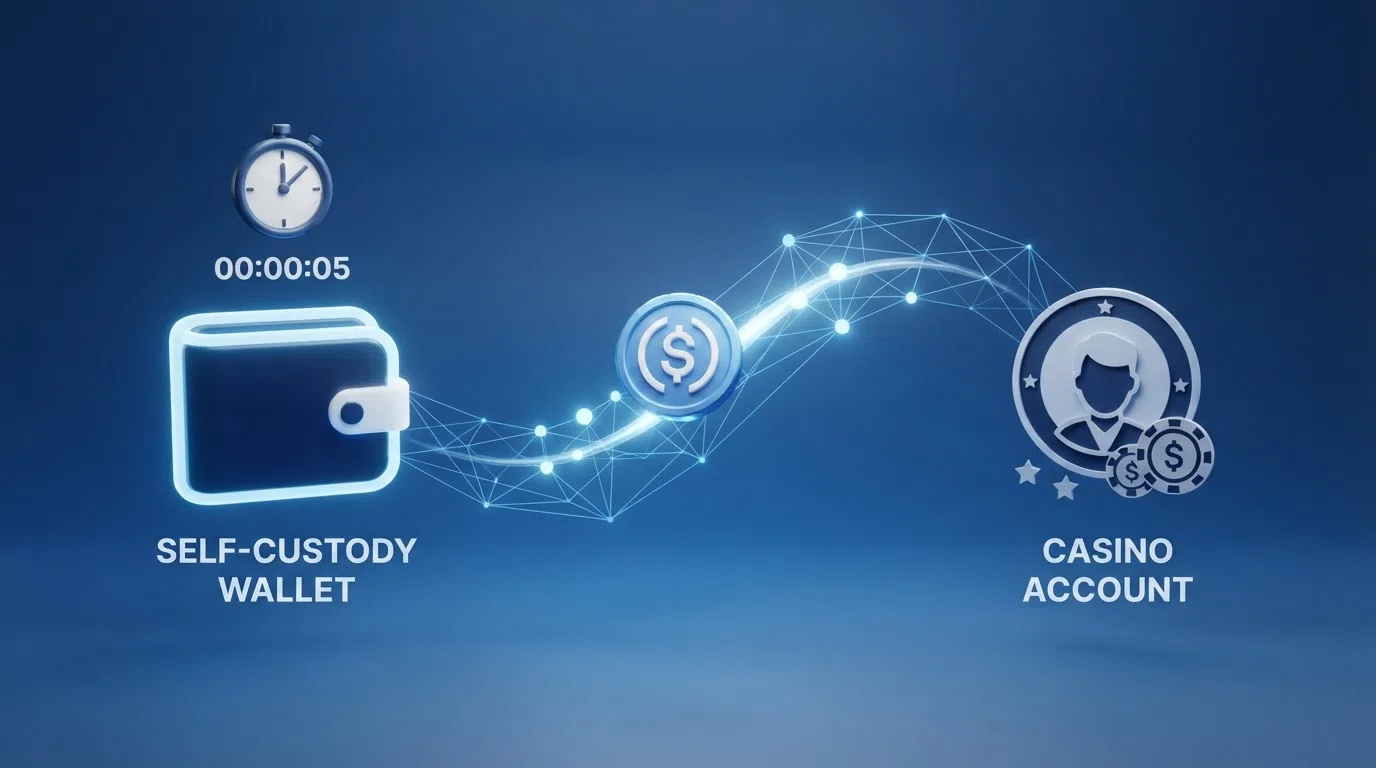
The withdrawal side is a different story. The blockchain can move USDC from the casino’s hot wallet to the player’s wallet in seconds, but the casino has to authorise the withdrawal first. That authorisation involves an operator-side queue, an anti-fraud check, and sometimes a manual review. The fastest documented withdrawal in the featured set is Flush at approximately 41 minutes, tested in May 2026. Most other operators process withdrawals within hours to a few business days. The bottleneck is the operator, not the chain.
Fees follow the same pattern. A USDC deposit on Solana costs the player under a cent. A USDC withdrawal on Solana costs the player under a cent for the network fee, plus whatever the operator charges for processing. Most offshore operators do not charge a withdrawal fee, but some do, and the fee structure should be in the terms page. The hidden cost is the exchange rate if the player withdraws in a currency other than USDC — the casino’s conversion rate will typically include a spread.
Minimum deposit and withdrawal thresholds vary. Shuffle sets $20 as the floor for both. Flush sets $10 for deposits. Rainbet requires $30 per deposit tier. The minimums are low enough to be practical for most players, and the player should confirm them before initiating a transfer, since sending USDC below the minimum either sits in the casino’s balance without activating a bonus or bounces back to the wallet (depending on the operator).
Step by Step: Making Your First USDC Casino Deposit
The first deposit takes longer than any subsequent one, because the wallet setup and the token purchase happen first. The sequence runs: buy USDC on a major exchange or through a fiat on-ramp service; transfer the USDC to a self-custody wallet (MetaMask for Ethereum and EVM chains, Phantom for Solana, or a multi-chain wallet that supports both); create an account at the chosen casino; navigate to the cashier and select USDC as the deposit method; choose the blockchain network (match the network to the wallet’s USDC holding); copy the deposit address or scan the QR code; enter the amount in the wallet and confirm the transaction; wait for on-chain confirmation (one to three blocks depending on the network); and the balance appears in the casino account.
The network selection is the most error-prone step. Sending USDC on the Solana network to an Ethereum deposit address (or vice versa) will either fail or, in the worst case, send the tokens to an inaccessible address. The casino’s deposit page shows the correct network for the address it provides — match the network in the wallet before confirming. For a player who is not confident about network selection, starting with a small test deposit ($10–$20) before committing a larger amount is the safe play.
The purchase step at the start is where most first-timers spend the most time. UK players have several on-ramp options, from major exchanges to peer-to-peer marketplaces. The exchange route is faster and cleaner for KYC purposes, and the USDC can be sent to a self-custody wallet immediately after purchase. The casino never sees the exchange account or the bank account behind it.
Ethereum, Solana or Polygon? Picking Your Blockchain Network
Ethereum (ERC-20) is the default for USDC at most casinos, the most widely supported, and the slowest. A typical Ethereum USDC transfer takes three to five minutes and costs a few dollars in gas, which fluctuates with network congestion. During peak periods, gas has historically spiked above $20 per transaction. For a player depositing $500 or more, the gas fee is a small percentage of the total. For a player depositing $20, the gas fee is a significant slice.
Solana is the fastest and cheapest for USDC. Transactions settle in five to twenty seconds, fees are under $0.01, and the network has not experienced sustained congestion in recent periods. Casino adoption is growing but not universal — Shuffle is one operator that supports both ETH and SOL USDC. For a UK player making regular small-to-medium deposits, Solana is the practical choice on speed and cost. The trade-off is that Solana’s ecosystem is newer and fewer wallets support it natively, though Phantom and Trust Wallet both work.
Polygon sits in the middle: roughly thirty seconds for settlement, fractions of a cent in fees, and decent but not universal casino support. Polygon USDC is an ERC-20 token on the Polygon network, and it requires a wallet configured for Polygon (MetaMask supports it with a custom network addition). For a player who wants Ethereum compatibility without Ethereum gas fees, Polygon is the compromise.
The practical recommendation for a UK player: use Solana if the casino supports it, Ethereum if it does not, and Polygon when speed matters and Ethereum gas is elevated. Match the network in the wallet to the network the casino specifies, every time, without exception.
Withdrawal Speed, Fees and Hidden Costs
Flush’s ~41-minute withdrawal is the benchmark in the featured set. Other operators are slower — some process within a few hours, others take one to three business days, and a few quote longer windows for larger amounts. The variation is operator-side, not chain-side. A casino that runs withdrawals through manual review will be slower than one that uses automated processing, regardless of which blockchain the player picks.
Network fees for withdrawals are the same as for deposits — under a cent on Solana, fractions of a cent on Polygon, a few dollars on Ethereum. The player pays these, not the casino. Some operators absorb a portion of the fee, particularly on larger withdrawals, but most pass the network cost through.
Hidden costs are rarer in crypto than in fiat payment processing, but they exist. The most common is the exchange rate spread when a player withdraws in a currency other than USDC. If the casino holds the balance in USDC and the player requests a withdrawal in GBP, the conversion happens at the casino’s rate, which will include a margin. Withdrawing in USDC and converting elsewhere is usually cheaper.
Withdrawal limits are the other variable. Some operators cap daily, weekly, or monthly withdrawals; others do not. The featured set’s published limits vary, and a player who plans to cash out a large balance should confirm the withdrawal ceiling before depositing. A common offshore pattern is a per-transaction cap with a per-day or per-week limit stacked on top, designed to slow the rate at which the casino pays out.
No-KYC Casinos: Can You Play Without Verification?
Flush is the no-KYC operator in the featured set, and the model deserves a clear explanation. “No-KYC” at an offshore crypto casino means the casino does not require identity verification — passport, proof of address, source-of-funds documents — at registration or deposit. The player creates an account with an email address and a password, deposits USDC, and plays.
The catch is that KYC is not eliminated. It is deferred. At some point in the withdrawal process, typically when the player requests a withdrawal above a threshold, the casino asks for documents. The threshold varies — some operators request verification at the first withdrawal, others only above $1,000 or $2,000. The legal basis is the casino’s own anti-money-laundering obligations, which still apply even where the regulator does not enforce them. A casino that never asked for documents and paid out unlimited amounts would attract the attention of its payment providers and its licensing authority.
The practical effect for a UK player: no-KYC play means faster onboarding and more privacy at the deposit stage, with the understanding that a large withdrawal will eventually trigger verification. A player who plans to play with small balances and cash out frequently will likely never see a KYC request. A player who plans to play with a large balance and withdraw it all at once will see the request, and should be prepared to provide documents.
True anonymous play — deposit, play, withdraw, no questions asked, at any amount — does not exist at any licensed casino in the featured set. The closest the market gets is the Flush model, and even Flush has limits on how far no-KYC extends.
The Real Cost of a USDC Casino Bonus: Wagering Requirements UK Players Face
The numbers on a bonus page are designed to look generous. A 200% match up to $2,000 reads as “the casino will give me up to $2,000 free.” The fine print says otherwise, and the fine print is the wagering requirement.
Wagering (also called rollover or play-through) is the total amount the player must bet before the bonus converts to withdrawable cash. At FortuneJack, a $1,000 deposit triggers the 200% match — a $2,000 bonus — and the wagering is 40× on the deposit plus the bonus, meaning $3,000 × 40 = $120,000 in total bets before the bonus clears. At Rainbet, a 250% match across three deposits at the $30 minimum costs the player $90 in deposits for up to $225 in bonus, and 40× on the combined deposit and bonus is the clearing requirement. At FairSpin, 45× on deposit plus bonus makes the clearing requirement heavier than at the 40× competitors, but the 30-day window gives the player more time to meet it.
The contrast with the GB-licensed market is stark. Since 19 December 2025, wagering requirements at UKGC-licensed operators are capped at 10× the bonus amount, and mixed-product bonuses (bet on football, get free spins) are banned. Offshore operators are not bound by these rules. The 30×–50× range common in the featured set is three to five times the GB cap. A player who has played at a UK-licensed casino and is now evaluating a Curaçao offer should adjust expectations accordingly.
Take the FortuneJack welcome offer as a worked example. The player deposits $1,000 and claims the 200% match, creating a $2,000 bonus. The total balance is $3,000. The wagering requirement is 40× on deposit plus bonus, so the player must place $120,000 in total bets before the bonus funds convert to cash. At a slot with a 96.49% RTP — Sweet Bonanza’s default, the benchmark figure used in the research — the expected loss across $120,000 in wagering is $120,000 × (1 − 0.9649) = $4,212. That is the statistical cost of clearing the bonus, before counting the original $1,000 deposit or any winnings. In plain terms: the player puts up $1,000, plays through $120,000 in bets, and on average loses about $4,200 in the process. The $2,000 bonus does not offset that cost — the expected loss is larger than the bonus itself.
That arithmetic is the page’s clearest answer to the question of whether offshore bonuses are a good deal. They are not, in expected-value terms, and the higher the wagering multiple and the lower the game RTP, the worse the deal becomes. The bonus is a tool to extend play time, not a way to build a bankroll.
Welcome and Deposit-Match Bonuses Compared
| Operator | Welcome Offer | Wagering | Validity | Max Bet During Bonus | UK Access |
|---|---|---|---|---|---|
| FortuneJack | 200% up to $2,000 | 40× D+B | 7 days | $15 | Yes |
| FairSpin | 150% up to $2,000 | 45× D+B | 30 days | $10 | Yes |
| Rainbet | 250% up to $1,750 + 60 FS | 40× D+B | 7 days | Not specified | Yes |
| Flush | Up to $1,500 tiered | 30× (Tier 1) / 35× (Tier 2) | Not stated | Not specified | Yes |
| MyStake | 170% up to £1,500 + 30 FS | 30× (casino) | Not stated | Not specified | Yes |
| Freshbet | 250% up to £1,500 | Not stated | Not stated | Not specified | Yes |
| Tenobet | 400% up to £5,000 | Not stated | Not stated | Not specified | Yes |
| Stake.com | 200% up to $2,000 | 40× D+B | Not stated | Not specified | No (blocked since March 2025) |
| BC.Game | 380% up to $4,000 + 400 FS | 45× bonus only | 30 days (24h on FS) | $15 | No (blocked) |
| BitStarz | 100% up to $2,000 | 50× D+B | 30 days | $5 | No (explicitly restricted) |
Two patterns jump out. First, the wagering multiples among UK-accessible operators cluster at 30×–45×, and the bonus windows cluster at 7–30 days, with several windows left unspecified. The unspecified terms are a real gap — a player who values transparency should weight the operators with full published terms more heavily. Second, the highest headline match percentages (Rainbet 250%, Freshbet 250%, Tenobet 400%) come with either the shortest windows, the highest minimums, or missing wagering data, and the 400% match at Tenobet in particular cannot be evaluated without its wagering multiple.
The GB benchmark row that the table does not include: at a UKGC-licensed casino, the equivalent offer would carry a 10× wagering cap and no mixed-product bonus, and the slot stake would be limited to £5 (or £2 for 18–24-year-olds). The player is choosing between the GB-licensed model (low wagering, hard stake caps, GAMSTOP coverage, no crypto) and the offshore model (high wagering, no stake caps, no GAMSTOP, crypto accepted). The trade-off runs in both directions.
No-Deposit Bonuses for USDC Players: What the Market Actually Offers
A no-deposit bonus is a promotional credit or free-spins batch the casino awards without requiring the player to deposit first. The term comes up frequently in searches. The reality at the featured operators: none of the ten offers a no-deposit USDC bonus. Every welcome package in the set requires a deposit to activate.
The reason is structural. No-deposit bonuses carry high fraud risk — a player can claim the bonus, play through a small portion of the wagering, and walk away with whatever cash remains, repeating the process across multiple accounts. Crypto makes the fraud easier because each wallet address can serve as a new identity. The operators that offered aggressive no-deposit packages in the early 2020s have largely retreated from the model, and the remaining offers tend to carry strict maximum-cashout caps (often $50–$100) and high wagering that makes the effective value small.
A UK player who sees a “no-deposit USDC bonus” advertised should treat it as a red flag rather than an opportunity. The legitimate version is a small free-spins batch or a $5–$20 free chip, with 50×–100× wagering and a max-cashout cap. The illegitimate version is an unverifiable claim with no published terms. Either way, the no-deposit USDC bonus is not a meaningful part of the current market, and the player who is optimising for value is better served by a deposit-match offer with full published terms.
Free Spins on USDC Deposits
Free spins do exist, but they are almost always attached to a deposit package rather than offered standalone. Among the featured operators, Rainbet includes 60 free spins on Sweet Bonanza (20 per deposit stage) as part of the 250% welcome offer. BC.Game includes 100 free spins per deposit across four deposits, with a tight 24-hour expiry on each batch. MyStake includes 30 free spins with the 170% welcome offer. FortuneJack advertises a 500% freespins variant offer alongside the main 200% deposit match.
The key terms to check on any free-spins offer: the game the spins are valid on (operator-chosen, not player-chosen), the value per spin (typically $0.10–$0.20), the wagering on spin winnings (often 30×–45× at offshore operators, sometimes zero on the spin value itself), and the expiry (anywhere from 24 hours to 30 days). The game choice matters because the spin’s expected value depends on the game’s RTP and volatility — a $0.20 spin on a 96% RTP slot returns about $0.19 on average, before any wagering on the winnings.
A UK player who values free spins specifically should look at Rainbet (60 spins on a high-quality slot with reasonable terms) and BC.Game (400 spins but on a blocked platform). For UK-accessible operators, Rainbet is the clear winner on free-spins value within the welcome offer.
No-Wagering and Low-Wagering Offers: The Search Comes Up Short
A no-wagering bonus is the gold standard of casino promotions: the player keeps what they win, no rollover required. Among the featured operators, none offers a no-wagering USDC welcome bonus. The closest the market gets is Cloudbet’s zero-wagering rakeback and cash drops package — up to $2,500 over 30 days, with 10% rakeback on every bet and daily cash drops — but Cloudbet blocks UK players and serves only as a benchmark for what the model looks like.
The absence of no-wagering offers at UK-accessible USDC casinos is not an oversight. Offshore operators face no statutory wagering cap (the GB 10× cap does not apply to them), and the higher the wagering multiple, the more total play the bonus generates and the more theoretical house edge the casino collects. A no-wagering bonus gives that margin back to the player. Operators that can charge 40×–50× wagering have no commercial reason to offer zero-wagering alternatives.
The practical effect: a UK player who wants the closest equivalent to a no-wagering offer should look for the lowest-wagering deposit match in the set. MyStake (30×) and Flush Tier 1 (30×) sit at the floor. At 30× on a $1,000 deposit with a 100% match, the clearing requirement is $60,000 in total bets — still high in absolute terms, but one-quarter lower than the 40× competitors and a third lower than the 50× ceiling at BitStarz. A player who is bonus-conscious should weight the 30× operators heavily.
Games You Can Play with USDC: Slots, Live Dealer and Table Games
USDC casinos carry the same game categories as fiat casinos. Slots dominate the lobby at every operator. Live dealer and table games round out the offering. The differences are in the providers, the game counts, and the regulatory overlay.
FortuneJack leads the UK-accessible set with 2,748 slots from 30-plus providers, including Evolution and Pragmatic Play Live for the live-dealer floor. BC.Game’s 6,500+ games are the largest in the broader market but the operator blocks UK. Stake.com’s 4,200+ games and exclusive Stake Originals (provably fair in-house titles) are similarly blocked. Among the UK-accessible operators, FortuneJack’s library is the deepest, MyStake and Tenobet offer strong Evolution-led live-dealer floors, and Rainbet features Pragmatic Play’s Sweet Bonanza prominently in its free-spins offer.
The GB regulatory overlay does not apply offshore. At a UKGC-licensed casino, slots carry a statutory maximum stake of £5 per game cycle for players aged 25 and over and £2 for players aged 18–24, with a 2.5-second spin minimum, auto-play banned, and losses-disguised-as-wins banned. None of those rules apply at an offshore USDC casino. A player who wants to place £50 bets on a single spin, spin at maximum speed, or use auto-play can do so at a Curaçao operator. The trade-off is the absence of the UKGC’s other consumer protections.
USDC Slots: Top Titles and What RTP to Expect
The slot library at the UK-accessible USDC casinos is broad and provider-deep. Pragmatic Play, Hacksaw, Play’n GO, BGaming, and Nolimit City are the slot providers that appear most frequently across the featured set, with Evolution and Pragmatic Play Live handling the live-dealer table games. Sweet Bonanza, the game featured in Rainbet’s free spins, runs at 96.49% RTP with high volatility — a research-verified figure. Most slots in the modern market cluster in the 94%–96.5% RTP range, with high-volatility titles sitting at the lower end of that band and low-volatility titles at the higher end.
RTP transparency is the slot question that matters most for value. At a UKGC-licensed casino, operators must publish RTP for every game. At an offshore USDC casino, the same legal requirement does not apply, though most reputable providers build RTP into the game client and the better operators surface it. Rainbet’s exclusion of games above 97.4% RTP from bonus clearance is unusual — it shows the operator reading the RTP figures closely enough to exclude the player-favourable titles. The implication for a player evaluating bonus value: the games that contribute to wagering at an offshore casino are typically the standard 94%–96.5% RTP slots, not the high-RTP variants that some providers offer.
The 2.5-second spin minimum, the auto-play ban, and the £5/£2 stake cap do not apply offshore. A UK player who has become accustomed to spinning at 0.5-second intervals at an offshore casino and then tries a UKGC-licensed slot will find the experience materially slower and more constrained. The two regulatory models produce materially different gameplay.
Blackjack, Roulette and Table Games with USDC
RNG (random number generator) blackjack and roulette are available at every featured operator. The provider quality varies. Evolution and Pragmatic Play Live are the live-dealer gold standard. BGaming, Hacksaw, and Nolimit City focus more on slots than tables. Provably fair table-game alternatives exist at some operators — Stake’s Originals include dice, crash, plinko, and mines, where each round’s outcome can be verified against a server seed and a client seed. Provably fair is not the same as live-dealer quality, but it is a meaningful transparency feature for players who care about verifiability.
For the UK-accessible operators, MyStake and Tenobet carry the strongest live-dealer floors (both include Evolution). FortuneJack’s live dealer runs through Evolution and Pragmatic Play Live, the two studios that cover most of the live-dealer market. Flush and Rainbet do not surface their live-dealer providers in research, and the player should check the live-casino lobby directly. Freshbet’s live-dealer situation was not surfaced either.
Rule variants on RNG tables also matter. European roulette (single zero) has a 2.7% house edge; American roulette (double zero) has 5.26%. Blackjack rule variations — dealer hits or stands on soft 17, doubling after split, surrender — shift the house edge by fractions of a percent. A serious table-game player at an offshore casino should read the rules page for each variant before committing significant volume.
Live Dealer Casinos That Accept USDC
Live dealer is the bridge between crypto convenience and the casino-floor experience. A live-dealer game streams a real dealer from a studio, accepts crypto-funded bets, and settles in the player’s USDC balance. The providers worth looking for are Evolution and Pragmatic Play Live, in that order — Evolution’s studios, game-show formats, and table limits are the industry benchmark, and Pragmatic Play Live is a credible alternative with a smaller game library.
Among the UK-accessible operators, FortuneJack, MyStake, and Tenobet surface live dealer through Evolution. FortuneJack also carries Pragmatic Play Live. MyStake’s live-dealer offering sits alongside its casino and sportsbook on a single balance, which is unusual among the featured set. The player who values live-dealer quality most should weight these three operators.
The UKGC-regulated live-dealer experience is broadly similar to the offshore version, with one key difference: the GB stake caps do not apply offshore, so a player who wants to bet £500 per hand on a live blackjack table can do so at a Curaçao operator. The trade is the absence of ADR and the UKGC complaints route if a dispute arises. For most players the practical experience is the same; for the high-stakes player the absence of limits is the draw.
Mobile USDC Casinos: Apps Are Rare, but Browser Play Works Everywhere
No featured operator has a dedicated USDC casino app on the Google Play Store or the Apple App Store. The crypto-gambling niche sits outside the mainstream app-store policies, and operators that tried to list apps have historically been removed. The result is a mobile ecosystem built entirely on mobile browsers.
The browser experience at a modern offshore casino is solid. The HTML5 game clients run on iOS Safari, Android Chrome, and the smaller mobile browsers without dedicated apps. Live dealer streams in mobile browser at acceptable quality on a decent connection. Deposits and withdrawals happen through the mobile browser, with the wallet app (MetaMask, Trust Wallet, Phantom) handling the USDC transaction. The flow is: open the casino in the mobile browser, open the wallet app, copy the deposit address, confirm the transaction, return to the browser to see the balance.
The practical recommendation for a UK player who wants to play on mobile: use the mobile browser rather than seeking a native app, and keep the wallet app open in a separate tab or on a second device for the deposit flow. Native apps would be marginally more convenient; their absence is a feature of the regulatory environment rather than a technical limitation.
New USDC Casinos in 2026: Fresh Faces, Same Offshore Reality
New USDC casinos launch frequently, and the rate has not slowed in 2026. FairSpin’s Curaçao licence was granted on 14 April 2025 — the newest licence among the featured operators. Several other USDC-accepting brands have appeared in 2025 and 2026 with Curaçao or Anjouan licensing, USDC deposits, and welcome offers pitched at the 150%–300% match range. The pattern is consistent: offshore licence, crypto-first cashier, generous headline bonus, short validity window.
The UKGC enforcement data provides the backdrop. The Commission referred 447,778 URLs to search engines between April 2024 and June 2025, and 287,961 were removed. New offshore casinos emerge to fill the gap. The market is dynamic but the regulatory reality does not change: every new entrant is offshore, every one is outside UK jurisdiction, and every one is one UKGC disruption notice away from reduced search visibility.
A UK player evaluating a new USDC casino should check: the licence number against the CGCB register, the corporate entity behind the brand, the restricted-countries list for an explicit UK check, the withdrawal terms and any maximum-cashout caps, and the community reputation (Reddit threads, AskGamblers, independent review sites with dated payout reports). A brand with no community footprint, no verifiable licence, and no published withdrawal terms is a red flag regardless of the headline bonus.
Is It Legal? UK Regulation, Offshore Licences and the Protections You Lose
Online casino gambling is licensable in Great Britain. The Gambling Act 2005, extended to remote operators by the Gambling (Licensing and Advertising) Act 2014, requires every operator serving British customers to hold a UKGC operating licence. A Curaçao or Anjouan licence is not a substitute. The Commission’s public register, with 2,663 records as of late July, is the single source of truth: a brand is either on it or it is not. No crypto-accepting casino is on it.
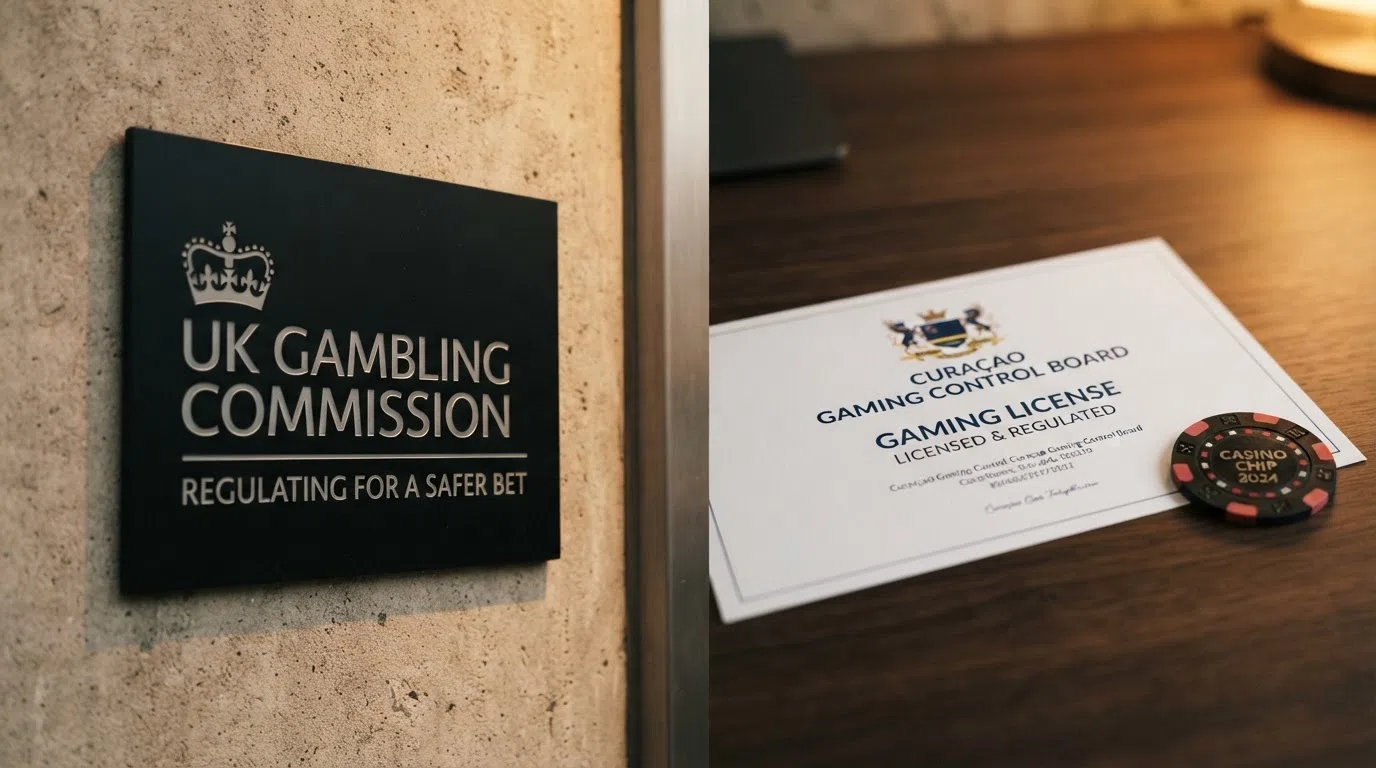
The protections a UKGC licence provides are not abstract. GAMSTOP, mandatory for every GB online operating licence since 31 March 2020, blocks registered users from every GB-licensed site for six months, one year, five years, or five years with auto-renewal. Financial vulnerability checks trigger at a £150 net deposit threshold over a rolling 30-day period. From 30 September 2026, gross deposit limits become mandatory. The ASA-enforced advertising rules prohibit content with strong appeal to under-18s and require the “strong appeal” test for all gambling ads. A UKGC-licensed operator that fails to meet these standards faces enforcement action, financial penalties, and licence revocation.
None of this applies to a Curaçao-licensed USDC casino. The offshore operator may offer some responsible-gambling tools voluntarily, but it is not required to, and enforcement is at the operator’s discretion. A UK player who has self-excluded via GAMSTOP can deposit USDC at an offshore casino within minutes, because the offshore operator has no integration with GAMSTOP. That fact is the central tension of this page, and it is the reason a USDC casino for UK players is always an offshore casino for UK players, with everything that phrase implies.
The UK Gambling Commission’s Position on Cryptocurrency
The UKGC has not passed a rule reading “cryptocurrency deposits are prohibited.” It has published blockchain technology and crypto-assets guidance that makes crypto licensing practically impossible. The guidance states that the Commission will not consider operating licence applications with a crypto funding element unless the operator provides a full and complete history of source-of-funds evidence at the application stage. The requirement is the bar, and no operator has cleared it.
The three licensing objectives of the Gambling Act 2005 frame the Commission’s position. Preventing gambling from being a source of crime or disorder, ensuring it is conducted fairly and openly, and protecting children and other vulnerable persons — each of these objectives runs into difficulty with crypto funding. Source-of-funds tracing is the immediate hurdle. The opacity of blockchain transactions conflicts with the Commission’s AML expectations, and the LCCP requirements for identity verification before first deposit cannot be met through a wallet address.
Andrew Rhodes, the Commission’s CEO, has acknowledged the growth of crypto gambling in public comments: “The reality is, and this growth in those demographics means, I don’t think governments can ignore that pattern.” The Commission’s posture is regulatory caution, not prohibition. The practical effect is the same as prohibition, because no operator has met the bar and the register contains zero crypto-accepting casinos.
The Gambling (Licensing and Advertising) Act 2014 made a GB licence compulsory at the point of consumption. A Curaçao licence does not satisfy the requirement. The operator providing facilities for gambling without a GB licence commits a criminal offence under section 33 of the Gambling Act 2005 — up to 51 weeks’ imprisonment, unlimited fine, or both. The sanction targets operators and intermediaries, not players. The player who gambles at an unlicensed site faces no confirmed criminal penalty. The protection the player loses is consumer protection, not liberty.
Offshore Licensing: What a Curaçao Licence Actually Means
A Curaçao licence is real and verifiable. The Curaçao Gaming Control Board oversees the framework, and the reformed 2023–2024 structure moved from master-licence arrangements to direct B2C licensing. The new licence numbers follow the OGL/2024/XXX/XXXX format. Two featured operators carry verifiable numbers: FairSpin (OGL/2024/222/0540, granted 14 April 2025 to Techcore Holding B.V.) and BitStarz (OGL/2024/165/0185, issued to Gareton B.V.). A player can check these against the CGCB register.
What a Curaçao licence requires of an operator is less than what a UKGC licence requires. The CGCB oversees anti-money-laundering compliance, responsible gambling policies, and game fairness, but the enforcement regime is lighter, the consumer-redress mechanisms are less developed, and the player-protection standards are not equivalent. There is no equivalent of GAMSTOP, no equivalent of the ASA advertising code, and no equivalent of the UKGC’s enforcement disruption programme.
The comparison is not “Curaçao bad, UKGC good.” Both are regulatory frameworks, and the Curaçao framework provides real oversight. The comparison is about what the player gives up: the UKGC’s consumer-protection machinery, the complaints and ADR routes, the mandatory responsible-gambling tools, and the statutory stake caps. A player who values speed and crypto convenience weighs the trade differently from a player who values the full UK consumer-protection framework. The page presents both sides; the decision is the reader’s.
GamStop Won’t Cover You Here — and Other Protections You Lose
GAMSTOP is the national self-exclusion scheme for online gambling in Great Britain. Registration with GAMSTOP blocks the user from every GB-licensed online gambling operator for the chosen period — six months, one year, five years, or five years with auto-renewal. Exclusion cannot be cancelled early. If the user does not contact GAMSTOP after expiry, exclusion continues for up to seven further years. The scheme is mandatory for every GB online operating licence since 31 March 2020.
GAMSTOP does not cover offshore sites. A player registered with GAMSTOP can still deposit USDC at any Curaçao-licensed casino that accepts UK players. The scheme is a GB-licence condition, enforced through the GB-licensed operators’ integration with the GAMSTOP database. The offshore operator has no such integration and no obligation to participate. This is the clearest possible example of the protection a UK player gives up by playing offshore.
Beyond GAMSTOP, the GB protections that do not apply offshore include: financial vulnerability checks (the £150 net deposit threshold over rolling 30 days, in force since 28 February 2025), affordability assessments (announced for staged rollout by the UKGC Board on 7 July 2026, with Stage 1 thresholds of £5,000 net deposits in 24 hours for 25+ and £2,500 for under 25), the mandatory deposit-limit prompt before first deposit (in force 31 October 2025), reality checks during play, time-out functionality, the £5/£2 slot stake cap (age-banded), the auto-play ban, the 2.5-second spin minimum, the ban on losses disguised as wins, and the credit-card ban (extended to credit-card-funded e-wallets, in force since 14 April 2020).
The UKGC complaints route and approved ADR also do not apply. A player with a dispute against a Curaçao-licensed operator has no British consumer-redress option. The dispute resolution is between the player and the operator, with the CGCB as the ultimate regulator — and the CGCB’s enforcement priorities differ from the UKGC’s. Crypto transactions are irreversible, and credit-card chargeback is not an option. A player whose withdrawal is delayed or refused has limited recourse.
The penalty framework for operators is robust. Providing facilities for gambling without a GB licence is a criminal offence under section 33 of the Gambling Act 2005. The UKGC’s enforcement record — 3,140 disruption notices, 447,778 URLs referred to search engines, 287,961 URLs removed between April 2024 and June 2025 — is the practical deterrent. The Commission works through cease-and-desist notices, search-engine referrals, domain registrar pressure, and payment-provider referrals. No statutory ISP or DNS blocking power exists currently; legislation has been proposed but not enacted. The disruption is real, and the offshore operators’ UK access is contingent on staying below the Commission’s enforcement threshold.
Responsible Gambling Tools at USDC Casinos — and Where They Fall Short
The responsible-gambling infrastructure at a UKGC-licensed casino is statutory: deposit-limit prompts before first deposit, reality checks during play, time-outs, GAMSTOP integration, mandatory self-exclusion, the 2.5-second spin minimum, the auto-play ban, financial vulnerability checks, and affordability assessments. Each of these is a licence condition, and failure to comply is an enforcement matter.
At an offshore USDC casino, the picture varies. Some operators offer session timers, deposit limits, and self-exclusion within their own platform. Most do not. The better ones link to responsible-gambling organisations in their terms. The worst offer nothing. There is no integration with GAMSTOP, no obligation to offer deposit limits before first deposit, and no statutory reality-check requirement.
The prevalence context is worth stating. In 2024, 2.7% of adults aged 18+ in Great Britain scored 8+ on the Problem Gambling Severity Index (PGSI 8+), statistically stable compared to 2023. PGSI 1+ — any level of problems — rose to 15.6% from 13.1% in 2023. Forty-seven per cent of adults had gambled in the past four weeks, per the Gambling Survey for Great Britain. These figures describe the licensed market, where the responsible-gambling infrastructure is mandatory. The offshore market, which sits outside the same infrastructure, draws a disproportionate share of players who have self-excluded from GB-licensed sites or who are seeking the unregulated experience the UKGC’s protections were designed to constrain. That is a structural feature of the offshore market, not an accident.
Where to Get Help: UK Support Resources
- GamCare runs the National Gambling Helpline on freephone 0808 8020 133. GamCare reported 996 referrals to treatment and peer-based support in January 2026, a 48% year-on-year increase.
- The National Gambling Support Network, funded by GambleAware, treated 11,960 clients between April 2024 and March 2025, an 11% increase on the previous year.
- NHS gambling harm clinics operate in England, Scotland, and Wales, providing specialist treatment.
- Gamblers Anonymous runs peer-support meetings across the UK.
- GAMSTOP provides self-exclusion from all GB-licensed online gambling sites — it does not cover offshore casinos, and the honest framing is that registering with GAMSTOP is a necessary but not sufficient step for a player who also uses offshore sites.
- GambleAware funds research, prevention, and treatment, including the National Gambling Support Network.
Frequently Asked Questions about USDC Casinos
Are there any UKGC-licensed casinos that accept USDC deposits?
No. The UK Gambling Commission does not license crypto-funded casinos. Its licensing conditions, including anti-money laundering and source-of-funds requirements, are practically incompatible with crypto deposits. As of July 2026, the Commission’s public register confirms that no UKGC-licensed operator accepts USDC or any other cryptocurrency.
Is it legal for UK players to gamble at offshore USDC casinos?
The Gambling Act 2005 requires operators to hold a UKGC licence to serve British customers. Offshore casinos lack this licence, meaning they operate outside UK jurisdiction. While UK players can access these sites, they lose all UKGC consumer protections, including ADR routes and the ability to claim gambling-related losses.
How long does a USDC deposit take to appear in my casino account?
It depends on the blockchain network used. Solana transactions typically settle in five to twenty seconds, making them the fastest option. Ethereum transfers take three to five minutes, while Polygon transactions settle in roughly thirty seconds. Once the network confirms the transaction, the casino usually credits the balance immediately.
Which blockchain network should I use to deposit USDC — Ethereum, Solana or Polygon?
Solana is generally the best choice for speed and cost, with settlements under twenty seconds and fees below $0.01. Polygon is a reliable, low-cost middle ground. Ethereum is the most widely supported network but is slower and more expensive. Match your wallet’s network to the casino’s deposit address.
Can I withdraw USDC winnings back to my own wallet, and how fast is it?
Yes, you can withdraw to your self-custody wallet. Speed varies by operator rather than blockchain. While the transfer itself takes seconds, operators perform internal reviews and anti-fraud checks first. Withdrawals can take anywhere from forty-one minutes to several business days depending on the casino’s internal processing policy and queue.
What happens if an offshore USDC casino refuses to pay my withdrawal?
Because offshore casinos are not licensed in Great Britain, you lack access to the UKGC’s complaints route or approved ADR services. Your only recourse is to dispute the issue with the operator or the Curaçao Gaming Control Board directly. Since crypto transactions are irreversible, recovering disputed funds can be extremely difficult.
Are USDC casino winnings taxable in the UK?
In the UK, gambling winnings are generally not considered income and are not subject to income tax or capital gains tax. This rule applies regardless of whether you win at a UK-licensed casino or an offshore site. However, winnings are not protected by British law if the operator withholds them.
Do USDC casinos offer the same responsible gambling protections as UK-licensed sites?
No. Offshore operators are not required to follow the UKGC’s responsible gambling mandates, such as GAMSTOP integration, financial vulnerability checks, or the £5/£2 slot stake cap. Some offshore sites offer voluntary tools, but these are discretionary. You lose the entire UK consumer-protection framework when playing at an offshore USDC casino.
How We Selected and Ranked These USDC Casinos
The operator set was built from crypto-casino affiliate databases, community forums, and each operator’s published terms page. The verification method was to cross-check Curaçao GCA/CGCB licence numbers against official registers where surfaced (FairSpin OGL/2024/222/0540, BitStarz OGL/2024/165/0185), and to check the UKGC public register to confirm no operator in the set holds a GB operating licence.
The UK-access test reviewed each operator’s restricted-countries list. Operators that explicitly restrict the United Kingdom in their terms — Stake since March 2025, BC.Game, BitStarz, and the four non-featured operators (Cloudbet, Wild.io, Shuffle, Roobet) — are marked accordingly. The seven UK-accessible operators are those that do not explicitly block UK access in their published terms. Access status can change, and a player should confirm the current position before depositing.
The ranking criteria, in order of weight: confirmed USDC acceptance, published bonus terms (where available), game-provider quality, UK-player accessibility, community reputation, and withdrawal track record. The limitations are real: operators’ terms change, bonus offers change, and UK-access status can change. The page reflects research conducted in 2026 and verified against the UKGC’s public register and each operator’s current terms page.
What UK Players Should Know Before Depositing USDC at an Online Casino
Every USDC casino a UK player can reach is offshore, Curaçao-licensed, and outside UK jurisdiction. That is the structural fact the entire page returns to. The player trades the entire UK consumer-protection framework — GAMSTOP, the UKGC complaints route, ADR, the £5/£2 slot stake cap, the 10× wagering cap, the deposit-limit mandate, financial vulnerability checks — for crypto convenience, sub-minute deposits, and wallet-only play. The trade is real, and it is the reader’s to make or not make.
The practical checklist before depositing: verify the Curaçao licence number against the CGCB register; read the bonus terms (wagering multiple, validity window, max bet, eligible games); check the restricted-countries list for the current UK status; test a small deposit and a small withdrawal before committing a larger balance; and confirm the operator still serves UK players on the day of sign-up, because access status changes. The honest framing: the reader is choosing between the protections of a UKGC licence (no crypto, low wagering, full consumer redress) and the speed and privacy of USDC (no UKGC protection, high wagering, no consumer redress). The page cannot give the reader both.
The UK-regulated alternative is the bet365, Sky Bet, Paddy Power, Betfair, Ladbrokes, Coral, William Hill, Grosvenor, Betfred, and Allwyn brands — long-established domestic groups that hold UKGC operating licences, integrate with GAMSTOP, cap slot stakes at £5 (£2 for 18–24), cap wagering at 10×, and provide ADR and UKGC complaints routes. None of them accepts USDC. That is the trade in one sentence.
Payments – nodeposit-casinobonuses-uk
Content created by the «nodeposit-casinobonuses-uk» team