
Casinos that accept Litecoin in the UK: the licensed-versus-offshore split for 2026
 Available in GB
Litecoin has a particular appeal for casino deposits. Its 2.5-minute block time and modest network fees mean a player can fund an account and have it playable in minutes rather than hours, and a withdrawal can return to a private wallet without the chargeback risk that a card payment carries. That is the pitch. The reality for a UK player is more interesting, because the same regulator that protects players at home is the one that quietly steers almost every UK-facing casino away from taking Litecoin directly. This page is about that gap, what each side of it costs a player, and how the bonuses on the licensed side compare with the offers an offshore Litecoin casino will hand you on the way in.

Current as of September 8, 2026 · UK Gambling Commission public register (29 July 2026) and the operator bonus terms published at that point.
What Litecoin casinos are — and whether UK players can still use them in 2026
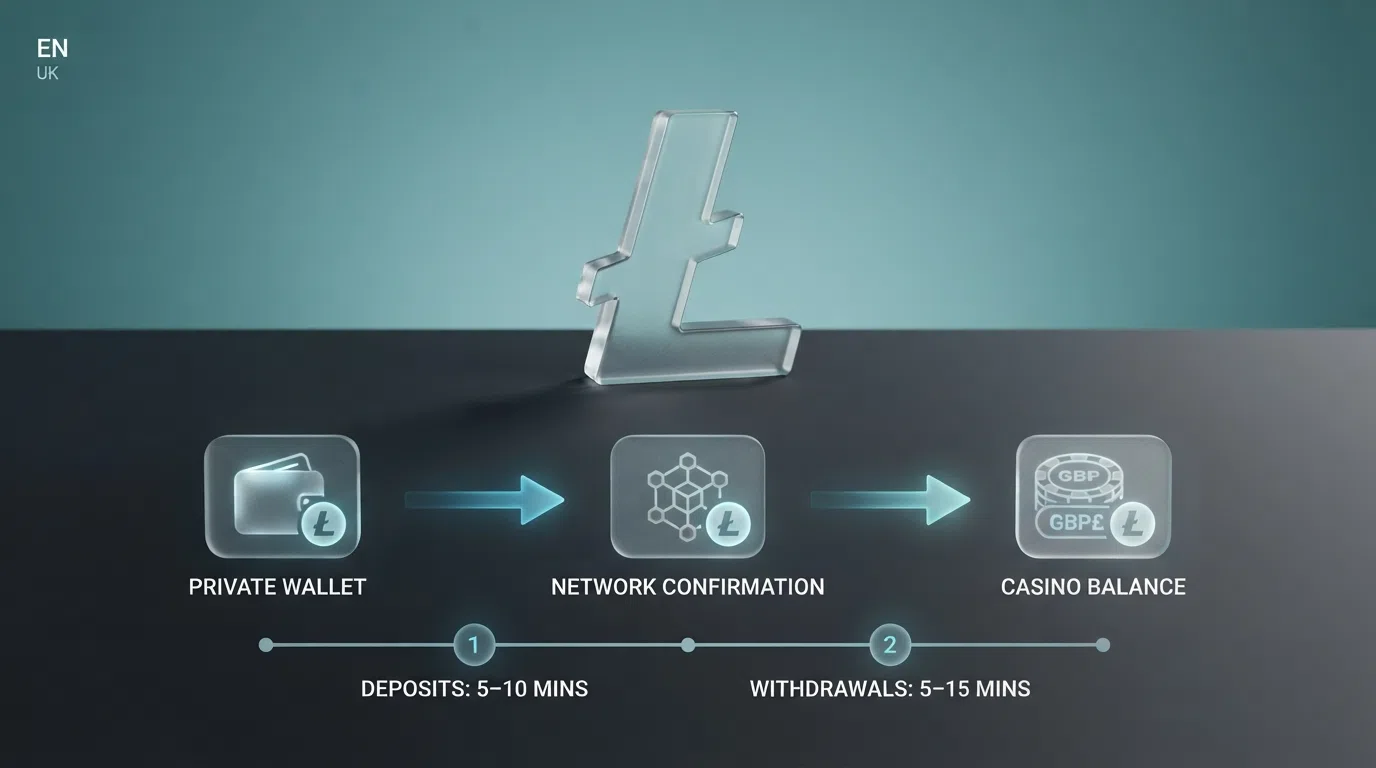
A Litecoin casino is, in plain terms, an online casino that lets a player deposit and withdraw in LTC rather than only in pounds. The wallet-to-game flow looks the same as a crypto transfer anywhere: the player sends a set amount of Litecoin from a private wallet to a deposit address the casino generates, the network confirms the transaction in a few minutes, and the casino credits the account at the LTC-to-GBP rate it applies at the time. The reverse trip — winnings back to the wallet — works the same way, which is part of why LTC is popular at offshore sites. There is no bank in the middle to decline the payment, no statement entry on a UK current account showing a casino’s name, and no chargeback that a player can later regret. The trade-off is that there is also no chargeback a player can rely on if a casino decides not to pay.
UK players still search for Litecoin casinos in 2026 for three reasons. The first is the speed, which is real: a tested Duelbits LTC deposit cleared in 5–10 minutes and a tested £150 withdrawal from Rolletto arrived in 52 minutes. The second is privacy, by which most players mean a debit-card statement that does not name a gambling site. The third is bonus value, because offshore crypto casinos routinely advertise welcome packages several times larger than anything a UK-licensed operator can offer under the post-19 December 2025 wagering cap.
What the UKGC thinks of all this is the load-bearing fact on this page. The Commission has said it will not consider operating-licence applications that include a crypto funding element unless the applicant hands over a full and complete source-of-funds history, and that crypto-assets present additional risks versus fiat — fiat-value fluctuation, the difficulty of customer identification, AML triggers, scalability problems, fees, and fund security. The result of that stance, in practice, is that no major UKGC-licensed casino currently accepts LTC at the cashier. The UK-facing Litecoin casino a player is looking for in 2026 is almost always an offshore brand — licensed in Curaçao or somewhere equivalent, outside GamStop, and operating on its own house rules.
That does not make using one illegal. UK players do not face an established penalty for gambling on an unlicensed site. What they lose, and the word matters, is protection. The dispute routes, the segregated customer funds, the reality checks, the self-exclusion tooling that the UKGC requires at home are not in the package at an offshore LTC casino. A player who values those protections is being told, by the regulator’s own funding policy, to choose a different rail.
How a Litecoin casino actually works
A Litecoin deposit starts with the player opening the casino’s cashier and requesting a deposit. The site generates a one-time LTC address — a string of letters and numbers, sometimes shown as a QR code — and the player sends Litecoin to that address from their own wallet. The casino waits for confirmations on the Litecoin network before crediting the account; the exact number of confirmations varies by operator, and the gap between “sent” and “playable” is the part most players underestimate. A tested Duelbits deposit took 5–10 minutes end to end, and a tested withdrawal arrived in 5–15 minutes once approved — that is the fast end of the range, at an offshore brand with no source-of-funds paperwork standing between the player and the cashier. At a UKGC-licensed site, the equivalent timeline can be longer because the operator is required to run affordability and identity checks before crediting.
The on-chain model and the payment-processor model behave differently. Some offshore casinos take LTC directly to a wallet they control; others route the deposit through a payment processor that converts the LTC to fiat or stablecoin in the background, with the player playing in pounds. The first model is the one that lets a player win and withdraw in LTC. The second is the one most players actually use without realising it, because the cashier looks the same and the playable balance is in pounds either way. Where the difference matters is at withdrawal: a casino that holds your LTC can return LTC, and one that converted on the way in has to either buy LTC to pay you back or pay you in pounds to a different method. A player who specifically wants to bank Litecoin winnings should check which model the casino runs before they deposit.
Why use Litecoin for online gambling — and the downsides
Litecoin’s edge over Bitcoin at the cashier is concrete. The block time is 2.5 minutes against Bitcoin’s 10, network fees are a small fraction of what BTC costs at the same congestion, and the confirmation window for a casino deposit is short enough that a player is not waiting an hour to find out whether their money arrived. Competitor pages on this topic agree on that framing, and it is broadly true: for the casino use case, LTC is faster and cheaper than BTC at the same destination.
The downsides matter as much. There is no chargeback protection. A player who sends LTC to the wrong address — their own typo, a copied-and-pasted old address, a clipboard-hijacking malware swap — has no recourse at all, because the Litecoin network does not arbitrate transactions. There is also no FSCS-style protection on funds held by the casino, no UKGC complaints route, and no ADR body to write to if a withdrawal stalls. The price of LTC moves during a session too, which means a £50 deposit in Litecoin is not a £50 balance if the price moves 4% between the deposit and the withdrawal. The UKGC has flagged this volatility as a specific risk. And then there is the bank-statement point: a deposit from a UK debit card names the casino on the statement, and a Litecoin deposit does not. That is the upside some readers came for and a small flag for anyone whose bank has a gambling-block policy they would otherwise have to navigate.
Getting started: accounts, wallets and your first LTC deposit
A UK player who wants to use Litecoin at an online casino starts by acquiring LTC through a UK-registered exchange, then moving it to a private wallet they control. The exchange is where the GBP-to-LTC trade happens, the wallet is what holds the LTC between casinos, and the casino is the destination. The first two are the parts that do not change: the third is the part that decides whether the player is on a UKGC-licensed site or not, and what that means in practice.
The casino account itself is straightforward. Offshore LTC casinos ask for an email address, a username and a password, and most let a player deposit before any identity check. UKGC-licensed casinos do not: identity must be verified before the first deposit or first bet, and the check covers name, address and date of birth. The split matters for two reasons. First, a player who values the speed and the no-statement-entry feature of LTC is choosing the offshore path on purpose, and the lack of an identity check is part of what they are buying. Second, a player who later needs to withdraw a large amount is going to face a KYC review either way, and the offshore sites are not faster on that step — they are just doing it at withdrawal time rather than at deposit time. A player who has not kept records of where their LTC came from is, at that point, in the position the UKGC’s source-of-funds rules are designed to prevent: trying to prove an origin they cannot evidence.
The deposit itself is a wallet-to-wallet transfer. The casino shows a one-time address, the player sends the LTC, the network confirms, and the balance updates. From the player’s side it is one screen, a paste, a send, and a wait. From the casino’s side it is a confirmation counter, a conversion step, and a credit to the playing account. Where the wait is, depends on which casino, which is the topic the section on deposits and withdrawals picks up in detail.
The best Litecoin casinos for UK players: 2026 compared
The comparison below covers every UK-licensed operator whose welcome package was surfaced for this review, plus two offshore Litecoin casinos the page references for tested withdrawal timing. The UKGC-licensed set is the one a UK player can actually play at under UK protections; the offshore rows are there to show the speed and offer profile that a player would be choosing instead of — or in addition to — the licensed set. The table is ranked by the licensed set’s own bonus value, with the offshore rows grouped below for the cashout and confirmation numbers they are useful for. A blank cell means the figure was not confirmed in the research for this run; an em dash means a feature does not apply.
| Operator | UKGC Licence Status | Welcome Bonus | Wagering on Bonus | Free Spins Included |
|---|---|---|---|---|
| bet365 | UK-licensed (account 55149) | Up to 500 free spins | 0x on winnings | Yes — up to 500 |
| LeoVegas | UK-licensed (account 39198) | 50 free spins on Big Bass Splash | 0x on winnings | Yes — 50 |
| Paddy Power | UK-licensed (account 39426) | 60 no-deposit spins + 100 more after £10 deposit | 0x on winnings | Yes — up to 160 |
| BetVictor | UK-licensed (account 39576) | £30 bonus + 50 free spins on Fishin’ Frenzy | 10x on bonus funds | Yes — 50 |
| BetUK | UK-licensed (number not confirmed) | 50 free spins on Big Bass Splash | 0x on winnings | Yes — 50 |
| William Hill | UK-licensed (account 2752) | Big Bass free-spin offer with £30 win cap | — | Yes (size not confirmed) |
| Sky Bet | UK-licensed (number not confirmed) | — | — | — |
| Betfair | UK-licensed (account 39435) | 70 no-deposit spins + 200 more after £10 deposit | 0x on winnings | Yes — 270 |
| Midnite | UK-licensed (number not confirmed) | 100 free spins after £20 wager | — | Yes — 100 |
| Duelbits (offshore) | Not UKGC-licensed | — | — | — |
| Rolletto (offshore) | Not UKGC-licensed | — | — | — |
The column the table cannot draw is the one the player actually pays for. The licensed set’s bonuses are small and clean — a fixed number of £0.10 spins, a 0x or 10x wagering multiplier, a 3-to-30-day validity, and a clear maximum cashout where one exists. The offshore set routinely offers headline match bonuses several times that size, with wagering multipliers that push the turnover required into four-figure territory, and terms that change between sign-up and withdrawal. The reason the licensed set’s bonuses are smaller is the bonus cap the UKGC brought in from 19 December 2025, which limits wagering requirements to 10x across the board and bans mixed-product promotional offers. The reason the offshore set’s bonuses are larger is precisely because the UKGC’s bonus cap does not apply to them. A player who ranks operators by headline offer size will end up on the offshore side; a player who ranks by what they actually keep will end up on the licensed one.
Three of the licensed operators in the table — Paddy Power, Betfair and, in part, BetUK — have no-deposit components. They are the only reviewed entries where a player can play with bonus spins without first putting money in, and they sit at the top of the no-deposit discussion further down the page.
bet365
bet365 is the largest UKGC-licensed operator in the reviewed set, on a UKGC account (55149) that has been active for years and a game-catalogue breadth that runs Pragmatic Play, Playtech, Blueprint, Big Time Gaming and Evolution. The reviewed welcome offer on the Games vertical is up to 500 free spins at £0.10 each, with 0x wagering on winnings. The spins are issued over 10 days in daily batches, and each daily batch expires in 24 hours if unused. To qualify, a player needs £10 in lifetime deposits at the brand — modest, and the kind of qualifying condition a player hits within a single first session.
What that offer really delivers, in cash terms, is a maximum of £50 in spin value across the 10 days, with no wagering hurdle and no cashout cap on winnings. Compared with the 0x wagering peers, bet365’s package wins on volume (500 vs the 50 to 270 elsewhere in the set) but loses on the headline spin value per unit — every reviewed competitor runs the same £0.10 per spin, so bet365 is offering more of the same rather than a richer spin. The other lever is the daily 24-hour expiry on each batch, which is shorter than Paddy Power’s 7-day window and means a player who skips a day loses those spins. For a player who is going to log in daily to use them, this is the strongest 0x offer in the table; for a player who plays once a week, it is a worse deal than it looks.
Bet365’s conclusion for a UK player is straightforward. If you are already in the bet365 ecosystem for sports, this is the cleanest free-spin package in the UK licensed set, and the 0x wagering means every win is cash you can withdraw. The £10 lifetime deposit qualifier is not a meaningful hurdle, but the daily 24-hour expiry on each batch is a real one if you do not play every day.
LeoVegas
LeoVegas is the UK-licensed mobile-first casino in the set, with a UKGC Casino Remote licence that has been active since 1 November 2014. The reviewed welcome offer is 50 wager-free spins on Big Bass Splash at £0.10 per spin, triggered by a £10 minimum deposit and a 1x playthrough of that deposit. Spins are valid for 3 days after crediting. The provider list is Pragmatic Play, Play’n GO, NetEnt, Evolution and Red Tiger, and the mobile experience is the strongest in the reviewed set, with a 4.8/5 iOS App Store score and a 4.2/5 on Google Play from a tester running the apps in the field.
The 1x deposit playthrough is unusual. Most UKGC-licensed spins in the set are credited after a simple £10 deposit, and LeoVegas is the one that asks the player to wager the £10 once before the spins land. That is a light condition — £10 wagered at a slot at minimum bet is a few minutes of play — but it is a condition, and it is the kind of detail that separates a £5 free-spins package from a real one. The 3-day validity is on the short side, sitting at the lower end of the licensed set’s range. The win cap was not surfaced in the reviewed terms, and the absence of a stated cap in research is not the same as a confirmed no-cap; a player should treat it as unknown until they check the live offer page.
LeoVegas’ take for a UK player is that the offer is small but clean, the wagering multiplier is 0x on winnings, and the mobile app is the best-tested one in the set. The 1x deposit playthrough is the catch to know about, and the 3-day spin validity is short enough that a player who does not log in within the window loses the offer. For a player who plays from a phone and is happy with Big Bass Splash, this is a fair 50-spin welcome with no wagering to clear.
Paddy Power
Paddy Power runs under PPB Entertainment Limited, on UKGC account 39426, and the reviewed welcome package is the only one in the set with a genuine no-deposit component. A player gets 60 free spins worth £0.10 each on registration, no deposit required, then 100 more spins after a £10 deposit and wager, with 0x wagering on the winnings and a 7-day expiry on the whole package. To trigger the deposit stage, the player must use a debit card or Apple Pay — that requirement, which is unusual, is one of the conditions to know about.
The no-deposit offer is what makes Paddy Power stand out. Paddy Power Games — the games-vertical entry in research that shares UKGC account 39426 — describes the same package in slightly different shape: 50 no-deposit spins plus 10 no-deposit spins on Paddy’s Mansion Heist, then 100 more spins after a £10 deposit and wager. Whichever side of the vertical a player is on, the headline number is the same and the terms — 0x wagering, 7-day expiry, debit card or Apple Pay for the deposit stage — apply across the reviewed offers. The 7-day window is more generous than bet365’s 24-hour daily expiry, but the 160-spin total is a third of bet365’s 500. The trade is consistency-versus-volume.
Paddy Power’s position for a UK player is that this is the no-deposit offer to pick if you want to play at a UKGC-licensed casino without committing a deposit first. The 0x wagering and the 7-day validity make the 60 no-deposit spins genuinely worth claiming, and the deposit stage of the offer is a fair add-on if you were going to play there anyway. The debit-card or Apple Pay requirement on the deposit stage is the limitation, because a player who planned to fund with a bank transfer or an e-wallet will have to switch methods.
BetVictor
BetVictor runs on UKGC account 39576, and the reviewed welcome is the one in the set that mixes bonus funds with free spins. A player who opts in, deposits and wagers £10+ on selected games within 7 days of registration gets £30 in casino bonus funds plus 50 free spins on Fishin’ Frenzy. The bonus funds carry 10x wagering, and there is a maximum cashout cap of £300 on bonus winnings. The bonus expires 30 days after issue if unused.
The 10x wagering is the post-19 December 2025 UKGC maximum, and the £300 cashout cap is the clearest example of a hard ceiling in the reviewed set. The expected-loss calculation on this offer, using the prescribed formula on Big Bass Bonanza’s 96.71% RTP, gives an estimated expected loss of £9.87 against the £30 bonus once the 10x wagering is run through. That is the cost of clearing the bonus before any cashout cap is applied. The £300 cap then limits what a player can walk away with from bonus winnings, regardless of the headline bonus size.
The arithmetic makes the offer easier to read. A player who clears the £30 bonus at 10x wagering and wins during the wagering period can walk away with up to £300 from the bonus leg. Anything above that is forfeited at withdrawal. The free spins on Fishin’ Frenzy are a separate leg, at the 96.12% commonly-reported RTP, and the 0x wagering on the spins (if it applies here) is the part of the package that does not eat into a player’s bankroll. The qualifying window of 7 days from registration is tight for a player who does not sign up with the intent of playing that week.
BetVictor’s verdict for a UK player is that this is the only reviewed offer where the wagering multiplier is above 0x, and that the £300 cashout cap is a hard ceiling on what the bonus can pay out. The expected loss of about £9.87 to clear the bonus is the cost the maths assigns to the £30 headline, and the Fishin’ Frenzy spins are a worthwhile add-on for a player who is going to play that game anyway. For a player who wants a clean 0x package, Paddy Power, Betfair and LeoVegas all clear the wagering more cheaply.
BetUK
BetUK is the lean entry in the licensed set: 50 free spins on Big Bass Splash at £0.10 each, 0x wagering on winnings, a 3-day validity, and a £10 deposit plus 1x wagering as the trigger. The UKGC licence number for BetUK was not surfaced in this run, which is a gap on this page; the operator appears on the UK-facing market, but the specific account number was not confirmed against the public register at the time of writing.
The offer is structurally close to LeoVegas — same spin count, same slot, same spin value, same 0x wagering, same 3-day window. The 1x wagering on the deposit is the same condition. Where the two differ is in mobile presence and brand maturity, and on both BetUK is the smaller name. For a player who is choosing between LeoVegas and BetUK on the bonus alone, the offers are equivalent and the choice comes down to which site the player prefers to use.
BetUK’s conclusion for a UK player is that this is a small 0x offer on a high-RTP slot with a short window, and the licence number was not confirmed in this run. A player who wants to play there should verify the account number on the UKGC public register before depositing — that is a check this page would not skip.
William Hill
William Hill is the longest-standing name in the reviewed licensed set, on UKGC account 2752 with remote betting active since 9 November 2010. The provider list runs Evolution, IGT, Blueprint Gaming, Pragmatic Play and Playtech, and the catalogue breadth is among the largest in the set. The current LTC-relevant free-spin offer was not surfaced in full: research confirms a Big Bass Splash free-spin offer with a £30 win cap, and the rest of the terms — spin count, wagering multiplier, validity — were not pinned down for this run.
The £30 win cap is the figure that travels. It applies to the Big Bass free-spin offer that was reviewed, and it is the lowest hard cap in the licensed set where one is stated. The spin count behind that cap was not confirmed, which means a player reading this page cannot tell from research alone what the offer’s effective per-spin value is. A player who wants to know should check the live offer page; the cap is the one number the research does carry, and it is the one number that will determine whether a player keeps the full value of a lucky spin.
William Hill’s assessment for a UK player is that this is a high-street brand with a UKGC licence that has been active for over fifteen years and a game catalogue that is hard to match. The current free-spin offer, on the evidence available, has a £30 win cap and the other terms were not confirmed. For a player who values the brand more than the bonus, that is a fair trade; for a player who is bonus-shopping, the cap is the lowest in the set and the rest of the offer needs to be checked on the live page.
Sky Bet
Sky Bet is the major UK brand in the set for which the current welcome bonus, free-spin count and wagering terms were not surfaced in this review. The operator is UKGC-licensed, the provider list is Evolution, Pragmatic Play, Blueprint Gaming, Red Tiger and IGT, and the slot and live-dealer catalogue is in line with the rest of the licensed set. The bonus terms for the current offer are the gap.
For a player who already has a Sky Bet account, this matters less; the existing-account path is unaffected by the welcome offer. For a player considering Sky Bet on the strength of its brand, the welcome bonus is the part of the page that does not have an answer yet. The recommendation this page can make is the one that applies to every operator with a gap: check the live offer page before depositing, because the research for this run did not surface the current number.
Sky Bet’s verdict for a UK player is that the licence is UKGC, the providers are confirmed, and the welcome bonus is not stated in this review. The operator is on the list because the brand carries weight in the UK market, and the specific terms of its current LTC-relevant offer are a check the player should run themselves before committing a deposit.
Betfair
Betfair runs on UKGC account 39435 and the reviewed welcome offer is the largest in the licensed set. A player gets 70 free spins as a no-deposit element, then 200 more spins after depositing and wagering £10, for a total of 270 free spins with 0x wagering on winnings and a 7-day validity. The eligible games are a choice of 12 in the reviewed offer, the spin value is £0.10, and there is no win cap stated in the reviewed terms.
The headline number of 270 spins is what jumps off the table. It is roughly 70% larger than Paddy Power’s 160 and more than half again as many as bet365’s 500-spin offer is worth in cash value. The 0x wagering is consistent with the rest of the 0x-spin set, the 7-day validity is generous compared with bet365’s daily 24-hour expiry, and the 12 eligible games give a player room to choose a slot they actually want to play rather than the one the operator has picked. The trade is in the brand: Betfair is better known for its exchange, and the casino vertical is where the welcome offer lives.
Betfair’s verdict for a UK player is that this is the largest 0x free-spin package in the reviewed licensed set, with the longest validity window tied with Paddy Power. A player who wants a 0x offer with a high spin count and a choice of games will find the most generous package here. The catch is that the offer is reviewed against Oddschecker’s reporting of the current promo, and the live offer page is the place to confirm the eligible-game list before opting in.
Midnite
Midnite is the newer UK-licensed entry in the set, with a provider list that runs Evolution, Pragmatic Play, Blueprint Gaming, Red Tiger and NetEnt. The reviewed welcome offer is 100 free spins after a £20 wager, with no no-deposit element. The wagering multiplier on the spins, the spin value, and the validity window were not surfaced in this run.
The £20 qualifying wager is unusual — most offers in the set qualify on a £10 deposit, and LeoVegas and BetUK qualify on a £10 deposit plus 1x wager. Midnite’s structure is closer to a “wager £20 and the spins land” mechanic, which is a different kind of condition: the player is committing real money on the first spin, and the spins are a reward for doing so rather than a free first step. The 100-spin count is competitive with the 50-to-160 range that the rest of the licensed set sits in, but without a confirmed wagering multiple or validity, the comparison cannot be pushed further on this page.
Midnite’s verdict for a UK player is that this is a UKGC-licensed operator with a 100-spin welcome triggered by a £20 wager. The wagering multiplier, spin value and validity were not confirmed in this run, and a player should check the live offer page before depositing. The brand is newer than the rest of the set, and the catalogue is the one the provider list points to — a slot and live-dealer mix comparable to LeoVegas and BetUK.
How fast your Litecoin actually moves: deposits, withdrawals and hidden costs
The mechanics of moving LTC at a casino are not the same as the marketing claim of “instant.” The marketing claim is right that the network is fast — a 2.5-minute block time, a tested deposit of 5–10 minutes at Duelbits, a tested withdrawal of 5–15 minutes at the same brand — but the casino sits between the network and the player’s balance, and the casino is the part most players underestimate. At an offshore brand with no source-of-funds paperwork in the loop, that gap is small. At a UKGC-licensed site — which is, again, the same set of brands that do not accept LTC directly — the gap is wider. The numbers below are from tested offshore sites, and the transfer to a licensed-brand experience is what the rest of this section works through.
Depositing with Litecoin: step by step
A Litecoin deposit is a transfer from a private wallet to a casino-controlled address, followed by a confirmation count, followed by a credit to the player’s balance. The confirmation count is the part the player sees as a wait: the casino is waiting for a set number of network blocks to pass before it credits the funds, and that number is set per casino. Two confirmations is a common minimum, which on Litecoin is about five minutes; some operators require three or more for larger deposits. The 5–10 minute deposit time at Duelbits in real-world testing lines up with that range. The shorter the casino’s confirmation requirement, the faster the deposit lands; the longer, the more time a player is sitting on a “pending” balance that is technically on the network but not yet playable.
The two models the section on mechanics introduced behave differently at this step. An on-chain deposit goes wallet-to-casino, and the casino credits LTC at the rate it applies. A processor-mediated deposit goes wallet-to-processor-to-casino, and the player is credited in pounds at a conversion rate the processor applies. The first model is the one where the player sees the LTC confirmations directly; the second is the one where the player sees a pound balance the moment the processor accepts the deposit, because the conversion has already happened. Neither is faster or slower in absolute terms, but the failure modes differ. An on-chain deposit that fails to confirm simply does not credit; a processor deposit that fails to convert can stall in the middle.
The hidden cost at the deposit step is the exchange-rate spread. The casino or processor quotes a rate, the network moves at a market rate, and the difference is the operator’s margin. A 1% spread on a £100 deposit is £1, and it is the part of the cost the player pays without seeing a fee line on the screen. The UKGC has flagged this category of risk — fees, scalability, fund security — in its guidance on crypto, and the spread is the part the player actually pays.
Withdrawal speed: when your Litecoin actually arrives
A tested Duelbits withdrawal arrived in 5–15 minutes once approved, and a tested £150 withdrawal from Rolletto arrived in 52 minutes. Both are from offshore sites, both are from brands that do not run a UKGC source-of-funds review on every withdrawal, and both are faster than the 24-to-48 hours that regulated casinos are often quoted at. The gap is the source-of-funds step, the KYC step, and the operator’s own withdrawal-approval queue. At an offshore LTC casino, all three of those steps are lighter than at a UKGC-licensed site, which is part of the reason the cashout times look the way they do.
The two numbers above are not guarantees. They are tested times, from a single withdrawal each, on a given day, at a given network congestion. The Duelbits range is the operator’s real-world performance for the tests that were run; the Rolletto number is a single £150 transaction that took 52 minutes end to end. A player who withdraws at a different time of day, on a busier network, at a larger amount, will not get the same number. The 24-to-48 hour figure that is often quoted for regulated casinos is itself an estimate across many transactions, and the operator’s own queue is the variable that swings it the most.
For a UK player, the practical question is whether the offshore speed is worth the trade. The answer depends on what the player is doing with the funds. A player who is cashing out a small win to a private wallet will see the difference between a 15-minute and a 48-hour withdrawal and feel it. A player who is withdrawing a large amount is going to hit a KYC check at the offshore site anyway, and the speed advantage shrinks significantly when source-of-funds documentation is required. In short, offshore casinos are faster for small, routine cashouts but rarely faster once compliance checks are triggered.
Minimum deposits, maximum limits and what they mean for LTC players
LTC-accepting casinos run on a low minimum deposit floor — £10 equivalent in LTC is a common threshold in the reviewed licensed set, and offshore sites routinely set the floor lower. The £10 figure is also the most common welcome-offer qualifier in the UK-licensed set, so the deposit a player makes to claim a bonus is the deposit they would have made anyway. The interesting wrinkle is on the LTC side: £10 in Litecoin is not a fixed amount of LTC, it is whatever £10 buys at the moment of deposit, and a player who deposits when the price is down gets more LTC for the same pounds. That is a feature for a player who is timing the market and a hazard for a player who is not, because the playable balance swings with the price.
There is no nationwide UK deposit ceiling. The UK model caps stake per spin, requires the offer of a customer-set deposit limit, and requires the operator to prompt for that limit before the first deposit. What that means in practice is that a player at a UKGC-licensed casino sets their own limit, the operator must honour decreases immediately, and the operator cannot advertise a “no limit” experience. At an offshore LTC casino, the same structure does not apply, and the player is relying on the operator’s own controls. The point of the UKGC framework is the assumption that a player who has not chosen a limit is one whose limit the operator should help them pick, and the offshore set does not run that assumption.
The stake cap regime is the other half of the limit picture. UK online slots carry a statutory per-game-cycle stake cap of £5 for players 25 and over, and £2 for players 18 to 24. The caps are on stake, not deposit, and they apply to the licensed market. An offshore LTC casino is not subject to the same caps, which means a player can place a £20 spin at one, and the licensed-market discipline that keeps the spend in check is gone. That is part of the trade a UK player makes when they cross to the offshore side.
Fees: where the real cost of using Litecoin hides
LTC network fees are a small fraction of BTC network fees at the same congestion, and they are low enough that a £50 deposit is not eaten by the cost of moving it. The casino’s own fee policy is the second variable: most LTC-accepting casinos do not charge a deposit fee, and the majority do not charge a withdrawal fee, but the absence of a fee line on the cashier is not the same as a confirmed zero-fee policy. The third variable is the exchange-rate spread, which is the cost the player pays for the convenience of not buying LTC themselves. A 1% spread is typical at the larger payment processors, and the spread is the line item the player does not see.
The hidden cost the page flags is the round trip. A player who deposits £100 in LTC, plays, and withdraws the same £100 in LTC pays the spread twice — once on the way in, once on the way out. On a round trip at 1% spread, the cost is £2, and that is before any house edge. The UKGC has called out fees and fund security as specific risks of crypto, and the round-trip spread is exactly the kind of cost the warning covers. A player who is bonus-shopping across multiple offshore sites will accumulate that cost on every cycle, and it is the part of using LTC that the marketing does not usually print.
The other hidden cost is the volatility. A £100 LTC deposit that becomes a £96 playable balance because the price moved 4% in the deposit window is, in real terms, a 4% loss before the player has spun a slot. The reverse also runs — a deposit that becomes a £104 playable balance is, in real terms, a 4% gain before the player has spun — and the point is that the volatility is not symmetric around the player’s expectation. The UKGC has named fiat-value fluctuation as a specific crypto risk, and the deposit-step exposure is the concrete form that risk takes for a casino player.
Debit cards, banking and payment options alongside Litecoin
A casino that takes LTC does not always let a player fund every leg of the welcome offer in crypto. Paddy Power’s deposit-stage offer is the clearest example: the no-deposit spins are credited on registration, but the additional 100 spins after a £10 deposit require a debit card or Apple Pay. The reason is partly operational — the no-deposit stage is the casino’s own marketing money, and the deposit stage is real-money play the operator wants to route through a method it can charge back against — and partly regulatory, in the sense that the UKGC’s affordability and source-of-funds reviews work more easily on a card payment than on a crypto transfer. A player who plans to use LTC end-to-end should check whether the deposit stage of the offer they are claiming accepts LTC, because the answer is sometimes no.
The credit-card ban under LCCP 6.1.2 — in force since 14 April 2020, including for credit-card-funded e-wallet payments — is the other piece of the payments picture. The ban applies to UKGC-licensed operators, and it is the reason a player cannot fund a UKGC-licensed casino with a credit card, directly or through an e-wallet like PayPal or Skrill that has been topped up by credit card. At an offshore LTC casino, the same ban does not apply, and a player can in principle fund with a credit card at the cashier. That is a feature for some readers and a flag for others; it is the same trade the rest of the offshore set runs on.
Bank transfers, e-wallets and prepaid vouchers are the alternatives to LTC at most casinos. Bank transfers are slower — 1 to 3 business days is typical — and e-wallets are faster but carry their own fees at the e-wallet level. LTC sits between the two: faster than a bank transfer, cheaper than a credit card, and not subject to the same chargeback risk. The choice between them is the choice between speed, cost and the protections each method carries.
No-registration and instant-play Litecoin casinos
The no-registration model is the pitch that sits at the far end of the offshore LTC market. A player opens the casino, deposits LTC, plays, and withdraws — no account creation beyond an email address, no identity check, no source-of-funds review. The model is built around the fact that crypto transfers do not require the player to identify themselves to a payment processor, and the casino is happy to skip the KYC step on the way in. The trade is at the withdrawal step: when a player asks for a large cashout, the operator is going to ask for the same documents a UKGC site would have asked for at deposit, and the player is going to be in a weaker position to argue because they did not establish the relationship at sign-up.
The model is uniformly offshore. UKGC-licensed casinos cannot run a no-registration model because identity must be verified before first deposit or gambling, and the rule has been in force since 7 May 2019. The same casinos are also not on GamStop, which is a self-exclusion register that only covers GB-licensed operators. A player who has self-excluded through GamStop and is looking for a way back into gambling is, in the structural sense, the target market for the no-registration model, and the structural sense is exactly why the model exists outside the UKGC framework.
For a UK player who is not self-excluded and who values the speed and the no-statement feature, the no-registration model is a real option. The page’s standing position is that the option trades the UKGC’s protections for the convenience, and the player should make that trade with their eyes open. The next sections cover what that trade looks like in concrete terms.
Why your Litecoin casino bonus is smaller than it looks
A casino bonus is a number, and the number is the part the marketing leads with. The number is also the part the bonus terms shrink, sometimes to the point where the headline value is not the value a player keeps. The two levers that do the shrinking are wagering requirements and cashout caps, with validity windows as a third lever that disposes of unused bonus money before the player has used it. The licensed set’s offers are smaller in headline terms, and the licensed set’s terms are also cleaner — the UKGC’s 19 December 2025 cap on wagering at 10x means a UK-licensed bonus can never ask for the kind of turnover an offshore bonus can, and the absence of a mixed-product offer ban at offshore sites means offshore bonuses can roll slots, live dealer and table games into a single promotional package. A player who compares headline numbers is comparing a regulated offer to an unregulated one, and the comparison is the first place the maths can mislead.
The expected-loss calculation on the BetVictor welcome is the worked example. The £30 bonus carries 10x wagering — the UKGC maximum — which means the player must turn over £300 before the bonus converts to withdrawable cash. At Big Bass Bonanza’s 96.71% RTP, the expected loss on £300 of wagering is £300 × (1 − 0.9671) = £9.87. That is the cost of clearing the bonus. The £300 maximum cashout on bonus winnings is the cap that limits what the player can walk away with after that cost. The 30-day validity is the window in which the £300 of turnover has to happen, and the window is the part of the offer that disposes of the bonus if the player does not clear it in time.
Welcome bonuses: deposit matches, free spins and what UK operators really offer
The UK licensed set’s welcome offers split into two shapes. The first is a free-spins package, which is the dominant form across the reviewed operators: bet365 (up to 500 spins), LeoVegas (50), Paddy Power (60 no-deposit + 100 deposit), BetUK (50), Betfair (70 no-deposit + 200 deposit), Midnite (100 after a £20 wager) and William Hill (size not confirmed, £30 win cap). The second is a hybrid package with bonus funds and free spins, which is the shape BetVictor runs (£30 in bonus funds + 50 free spins on Fishin’ Frenzy). BetVictor is the only reviewed operator with a deposit-match component in the headline; the rest of the set is free-spins-only.
The hybrid shape is the one that pulls in a wagering multiplier. BetVictor’s 10x on the bonus-fund leg is the UKGC maximum under the 19 December 2025 cap, and it is the reason the £30 bonus carries a £9.87 expected loss against a 96.71% RTP slot. The free-spins legs of the same offers are mostly 0x — the UKGC’s cap does not bite on free spins because the operator is offering the spins at a fixed value rather than as a percentage match. The player who wants a clean 0x offer can find one in the licensed set; the player who wants a larger headline can find it at BetVictor, with the wagering cost the calculation has just run.
The offshore comparison is a different shape entirely. Match bonuses of 100% to 200% of the first deposit, with 30x to 50x wagering, are common, and the headline numbers are several times the size of anything in the UK licensed set. The terms are the part the comparison has to keep up with: a 200% match at 40x wagering on a £100 deposit is a £200 bonus that needs £8,000 of turnover to clear, with an expected loss at a 96.71% RTP slot of about £263. That is the cost of clearing a headline that looks like free money. The 10x cap is what makes the UK licensed set’s bonuses look small in absolute terms, and it is also what makes the cost of clearing them small in relative terms.
No-deposit bonuses: free spins without spending a penny
Paddy Power’s 60 no-deposit spins and Betfair’s 70 no-deposit spins are the two offers in the reviewed set where a player can play with bonus spins without first putting money in. Both are 0x wagering, both are at £0.10 per spin, both are valid for 7 days, and both are at UKGC-licensed operators. The fact that there are only two in the reviewed set is itself a finding: most UK-licensed welcome offers in the current market do not have a no-deposit leg, and a player who wants one is choosing between Paddy Power and Betfair.
The “no deposit” label is also worth reading carefully. Paddy Power’s no-deposit spins are credited on registration without a deposit, but the deposit-stage leg of the same offer (the additional 100 spins after a £10 deposit and wager) requires a debit card or Apple Pay. A player who plans to claim only the no-deposit leg can do so without funding the account, and the no-deposit winnings are withdrawable subject to the 0x wagering and 7-day expiry. A player who plans to claim both legs is making a £10 deposit, and the debit-card-or-Apple-Pay requirement is the condition to know about. The same pattern runs at Betfair.
The cost of a no-deposit offer is hidden in the 0x wagering label. A 60-spin no-deposit offer at £0.10 with 0x wagering is a maximum of £6 in playable value, and the winnings from those spins are withdrawable as cash. That is a real £6 of upside for zero deposit. The reason the offer is small is exactly that it is free — operators do not give away large no-deposit packages because the math is unfavourable — and a player who treats the £6 as a free bet rather than a free bankroll is reading the offer correctly.
Free spins with and without deposit: the fine print that changes everything
A free-spin offer’s real worth is set by three levers: the spin value, the eligible games, and the expiry. The £0.10 spin value is standard across the reviewed set, and a player comparing offers on spin count alone is comparing the same unit price everywhere. The eligible-game list is where the offers diverge: Betfair’s 12 eligible games give the player a choice, Paddy Power’s mix includes Paddy’s Mansion Heist as a no-deposit element, LeoVegas and BetUK are pinned to Big Bass Splash, and bet365’s daily reveal is a different game each day. The player who has a preferred slot should look at the eligible list, because the headline spin count is the same unit price on every offer.
The expiry is the lever that disposes of the offer if a player does not use it. bet365’s daily 24-hour expiry on each batch is the most aggressive in the set: a player who skips a day loses those spins, and the 10-day issuance window is the limit on how many batches the player can collect. Paddy Power and Betfair’s 7-day validity is the generous end of the set, and LeoVegas and BetUK’s 3-day validity is the tight end. A player who is choosing between offers with the same spin count and the same 0x wagering should pick the offer with the longer validity, because the longer window is the one that survives a missed day.
The wagering on free-spin winnings is the lever that decides whether the winnings are cash or bonus. 0x on free-spin winnings means the winnings are withdrawable as cash the moment the spin is played, which is the case across most of the reviewed set. A non-zero wagering multiplier on free-spin winnings would mean the winnings are bonus funds that have to be turned over before they withdraw, and the 10x cap on bonus-fund wagering does not apply to free-spin wagering under the same rules. The reviewed licensed set is mostly 0x on free spins, and the absence of a non-zero example is the cleanest summary of where the UK licensed market sits on this lever.
Wagering requirements: the multiplier that decides whether you keep anything
Wagering requirements are the multiplier that converts a bonus into a cost. A 10x wagering multiplier on a £30 bonus means the player must turn over £300 before the £30 becomes withdrawable cash, and the cost of turning over £300 depends on the RTP of the game the player is wagering on. The calculation the section above ran is the simple form: turnover × (1 − RTP) = expected loss. At a 96.71% RTP slot, £300 of turnover costs £9.87 in expected loss, and that is the cost the bonus carries before any cashout cap or validity window is applied.
The UKGC’s 19 December 2025 cap at 10x is the regulatory ceiling on this number. A UK-licensed bonus can never ask for more than 10x wagering, and a player who is choosing between UK-licensed offers on wagering terms is choosing between 0x (the dominant form in the set) and 10x (BetVictor). The 0x offers do not carry a wagering cost, and the 10x offer carries the £9.87 expected loss the calculation just ran. The fact that BetVictor is the only reviewed operator with a 10x offer is a finding: the licensed market has consolidated around 0x free spins as the dominant welcome shape, and the deposit-match offer with a wagering multiplier is now a minority form.
The offshore comparison is the part the player should hold against the licensed ceiling. A 100% match at 40x wagering is a common offshore shape, and the expected loss on a £200 bonus (a £100 deposit matched at 100%) at 40x wagering is £200 × 40 × (1 − 0.9671) = £263.20 at a 96.71% RTP slot. That is more than the bonus itself, and it is the cost of clearing a headline that looks like free money. The 10x cap is what makes the licensed set’s bonus costs small in absolute terms, and the absence of the cap offshore is what makes the offshore set’s bonus costs large in absolute terms.
Bonus codes, promo tokens and why this page does not print them
A bonus code is the string a player types into the cashier to claim a particular offer, and the code is the part of the offer that expires fastest. Codes rotate between affiliate publishers, are time-limited, and are not the kind of fact a review can carry reliably. The bonus terms — wagering, validity, game eligibility, cashout cap — are the part of the offer that outlasts any code, and they are the part a player actually needs to evaluate the offer.
This page describes the offers by their terms rather than printing codes, for two reasons. The first is that a code that is live when research runs is not necessarily live when a player reads the page, and printing a dead code is worse than printing nothing. The second is that the page’s purpose is to help a player compare offers, and the comparison is built from the terms. A code is a key to a specific offer, not a basis for a comparison, and the comparison is what this page does.
A player who wants a code should check the operator’s own promotions page, the affiliate publishers that currently run the offer, and the welcome email or SMS the operator sends on registration. The terms on this page are the framework for evaluating whatever code the player finds.
Slots, live dealers and table games: what you can play with Litecoin
The game catalogue at an LTC-accepting casino is the same catalogue any other player at the same brand sees, because the payment method does not change the games. A player who deposits LTC at an offshore casino gets the same slots, live dealer tables and table games as a player who deposits a credit card at the same brand. The difference is at the cashier and the protection framework, not in the lobby. The reviewed licensed set runs a consistent provider mix — Pragmatic Play, Playtech, Blueprint Gaming, Evolution, NetEnt, IGT, Red Tiger, Big Time Gaming, Play’n GO — and the slot-first reality of the catalogue is the same in both the licensed and offshore markets.

Litecoin slots: real-money play, free play and the best slot sites
The slot table below covers the titles that appear in the reviewed welcome offers and the ones research has surfaced with a confirmed RTP, provider, volatility and maximum win. The licensed set is dominated by Pragmatic Play’s fishing-themed slots: Big Bass Bonanza and Big Bass Splash appear across multiple welcome offers, and Big Bass Bonanza’s 96.71% RTP, high volatility and 2,100x maximum win are the figures a player should hold against the wagering maths the section above worked through. The table is not the full list of slots at any of these casinos; it is the list of titles where research has surfaced a number a player can use.
| Slot Title | RTP | Provider | Volatility | Maximum Win |
|---|---|---|---|---|
| Big Bass Bonanza | 96.71% | Pragmatic Play | High | 2,100x stake |
| Big Bass Splash | 96.71% | Pragmatic Play | — | — |
| Fishin’ Frenzy | 96.12% | Blueprint Gaming | — | — |
| Paddy’s Mansion Heist | — | — | — | — |
Big Bass Bonanza is the slot the welcome-offer maths is built around, and the 96.71% RTP, 5×3 layout, 10 paylines and £0.10 minimum bet are the figures the calculation above used. The 2,100x maximum win is the upper end of what a single spin can return, and high volatility is the rating that says most spins will return less than the stake, with the occasional spin returning a multiple. Fishin’ Frenzy’s 96.12% RTP is the figure BetVictor’s welcome spins are played on, and the slightly lower RTP is the reason the expected loss on those spins is marginally higher than on Big Bass Bonanza at the same wagering.
The UKGC’s slot-design rules are the framework the licensed set runs under. Turbo and slam-stop features are banned, autoplay is banned, spin speeds faster than 5 seconds are banned, and audio or visual celebrations of returns less than or equal to stake are banned. The rules are about the design of the slot, not the payment method, and they apply to every slot at a UKGC-licensed casino regardless of how the player funded the account. The offshore set is not subject to the same rules, and a player at an offshore LTC casino will see autoplay, turbo modes and faster spin speeds that the licensed set does not run.
Free-play modes are the part of the slot experience that does not require a real-money balance. Most slot providers include a demo mode in the slot itself, and the casino’s lobby usually surfaces it. The demo mode runs on the same math as the real-money version, and it is the way a player can test a slot’s volatility and bonus frequency without funding the account. The free-play mode does not pay real money, and the wins a player lands in demo do not withdraw.
Live dealer games with Litecoin deposits
Evolution is the dominant live-dealer provider across the reviewed licensed set — listed for bet365, LeoVegas, Paddy Power, BetVictor, BetUK, William Hill, Sky Bet, Betfair and Midnite — and a player depositing LTC at an offshore brand running Evolution will see the same live blackjack, roulette and baccarat tables a UKGC-licensed player sees. The live-dealer lobby is the part of the catalogue that has converged across the licensed and offshore sets, because Evolution is the supplier to both.
Live games count toward wagering requirements differently from slots at most casinos, and the contribution is usually lower — 10% to 20% is a common range, with slots contributing 100%. A player who is clearing a bonus and trying to use live games as the wagering vehicle will find the bonus clears more slowly than the slot-only path, and the expected loss per unit of wagering is higher because the RTP on live tables is different from the RTP on slots. The UKGC’s ban on mixed-product promotional offers from 19 December 2025 is the rule that stops an operator from running a single bonus that rolls slots, live dealer and table games into one promotional package. The ban is on the offer shape, not on the contribution rates inside an offer, and the contribution rates at most operators are still set so that live games count at less than 100%.
Live-dealer betting limits are wider than slot limits, and a player who wants to place a £500 bet on a hand of blackjack will find a table that takes it. The licensed set’s £5-per-spin stake cap does not apply to live dealer games in the same way it applies to slots, and the offshore set does not run the cap at all. Anyone moving between slot and live-dealer play at the same casino should know that the stake cap regulating slot spend does not extend to live-dealer sessions in the same way.
Table games: blackjack, roulette and bingo with Litecoin
RNG blackjack and roulette are the table-game options at the reviewed set, and the providers running them are Playtech (bet365, William Hill, Betfair), IGT (Paddy Power, BetVictor, William Hill, Sky Bet) and Blueprint Gaming (bet365, Paddy Power, BetVictor, BetUK, William Hill, Sky Bet, Betfair, Midnite). The table games run at a higher RTP than most slots — blackjack at standard rules sits around 99.5%, and European roulette at 97.3% — and the lower house edge is the part a player is paying for with the slower gameplay.
Table-game contributions to wagering requirements are the part a player should check on the bonus terms. Most casinos slot table games at 10% to 20% contribution, which means a £10 slot wager counts as £10 toward wagering and a £10 blackjack wager counts as £1 to £2. A player who is trying to clear a bonus on table games will find the bonus takes five to ten times as long to clear, and the effective expected loss per unit of cleared bonus is higher because the slower contribution means more rounds of the table game. The 0x offers in the licensed set sidestep this problem because there is no wagering to clear; the 10x BetVictor offer does not, and a player who plans to clear it on table games is in for a slow ride.
Bingo is the niche option in the table-games set. The licensed set runs bingo rooms at Paddy Power, bet365, William Hill and Sky Bet, and the bingo vertical is its own product with its own bonuses and its own wagering terms. The 19 December 2025 mixed-product promotional offer ban has reshaped the bingo bonus landscape, and a player who is looking for a bingo-specific bonus at a licensed casino will find the offer shape is now narrower than it was a year ago.
Litecoin casinos on mobile: apps vs browser — which wins
The mobile experience at a UK-facing casino is the default, not a differentiator. The reviewed licensed set runs responsive sites that adapt to a phone screen, and most of them run a dedicated app as well. The app scores that research has surfaced are limited — LeoVegas at 4.8/5 on iOS and 4.2/5 on Google Play is the operator with a tested mobile-app score in the research — and the other operators’ app scores were not surfaced. The fact that the apps exist is itself the finding: a player who wants to play from a phone will find a way at any of the reviewed licensed brands, and the choice between app and browser is a choice about which interface the player prefers.
Mobile-optimised Litecoin casino sites
A mobile-optimised site is the baseline expectation for any UK-facing casino in 2026, and the reviewed licensed set runs responsive sites that handle the deposit, withdrawal and game-launch flows on a phone screen. The offshore LTC casinos that the page references for cashout speeds also run responsive sites, and the difference between a mobile-optimised site and a mobile app is mostly about the home-screen icon and the push notifications, not about the underlying catalogue.
The performance difference between Wi-Fi and mobile data is the variable that swings the experience on a phone. A live-dealer blackjack table is heavier than an RNG slot, and a player on a slow mobile connection will see the live-dealer stream buffer in a way that an RNG slot will not. The licensed set’s slot-design rules — no autoplay, no turbo, no spin speeds faster than 5 seconds — are an advantage on a slow connection, because the slower spin speed is the one the operator would have run anyway. The offshore set’s faster spin speeds and autoplay features are the part of the experience that does not run well on a slow mobile connection, because the player is trying to skip the spin before the connection can keep up.
Dedicated casino apps that accept Litecoin deposits
LeoVegas is the dedicated-app benchmark in the reviewed set, with tested iOS App Store and Google Play scores of 4.8/5 and 4.2/5 respectively, and both apps running smoothly in research’s testing. The other reviewed licensed operators — BetVictor, William Hill, Paddy Power, bet365, Sky Bet and Betfair — all have UK app-presence, but specific app scores were not surfaced in the research for this run. A player who is choosing between operators on the strength of the app experience will find LeoVegas is the only one with a confirmed app score, and the rest of the field has the apps but not the published numbers.
The app experience is a real differentiator for a player who plays daily. Push notifications, biometric login, and a one-tap deposit flow are the parts of the experience that a browser tab does not replicate, and the operators that run them well are the ones that retain mobile-first players. The trade is at the storage level: an app takes up space on a phone, a browser tab does not, and a player who plays at three casinos is in a different position with three apps versus three bookmarks. The browser path is the lighter one, and the app path is the more committed one.
Litecoin vs Bitcoin vs the rest: where LTC fits in UK crypto gambling
Litecoin’s place in the UK crypto-gambling market is the faster-and-cheaper alternative to Bitcoin, with a smaller community and a thinner set of casino-specific integrations. The 2.5-minute block time and lower network fees are the practical edges, and the rest of the comparison runs on those two numbers. The multi-crypto casino model — BTC, ETH, LTC, DOGE and USDT all sitting in the same cashier — is the standard shape at offshore brands, and LTC is one of the coins that model runs on. The anonymity pitch is the other half of the offshore crypto-gambling market, and it is the part that does not survive a UKGC review.
Bitcoin vs Litecoin casinos: which crypto wins for UK players
Bitcoin is the original crypto at the casino cashier, and Litecoin is the faster-and-cheaper alternative. The 10-minute block time against Litecoin’s 2.5 is the headline number, and the difference shows up in the deposit confirmation time: a player waiting for two Bitcoin confirmations is waiting 20 minutes on average, against five minutes for two Litecoin confirmations. Network fees are the other axis: Bitcoin fees spike with congestion and can run several pounds per transaction at peak, against Litecoin fees that stay in fractions of a pence at the same conditions. For the casino use case, where a player is funding an account for a session, Litecoin wins on both speed and cost.
The countervailing factor is liquidity and adoption. Bitcoin is the cryptocurrency every cashier knows, every exchange lists, and every player has heard of; Litecoin is the one the player has to specifically buy and specifically send. A casino that takes BTC takes the coin most players already have; a casino that takes LTC takes a coin a player has to acquire, which is a friction the cashier does not always surface. The friction is smaller than it was three years ago, and most major crypto exchanges list LTC alongside BTC, but the friction is still there for a player who is not already in the LTC market.
For a UK player choosing between BTC and LTC at an offshore casino, the practical answer is to use whichever coin the player already holds and to accept the speed and cost difference as a secondary consideration. For a player who is choosing which coin to buy for casino use, LTC is the right answer on speed and cost, and the right answer on adoption only at the casinos that run a multi-coin cashier.
Crypto-only casinos and the multi-coin model
The crypto-only casino model is the offshore brand that runs entirely on cryptocurrency, with no fiat banking rail at the cashier. The model is uniformly offshore, uniformly outside GamStop, and uniformly outside the UKGC’s framework. The advantage is the absence of bank-side friction: a player can deposit, play and withdraw in crypto without ever touching a card or a bank. The disadvantage is the absence of UKGC-side protection: no ADR route, no segregated funds guarantee, no UKGC complaints process, and no GamStop coverage. The model exists because the market supports it, and the market supports it because the UKGC’s crypto-funding stance has effectively pushed crypto-native operators offshore.
The multi-coin model is the standard shape at these casinos, with BTC, ETH, LTC, DOGE and USDT all sitting in the same cashier. The variety gives a player flexibility, and the flexibility is the part the marketing leads with. The trade is the part the marketing does not: every coin a player holds at the casino is a coin the casino holds on the player’s behalf, and the custody arrangement at an offshore crypto-only casino is the casino’s own house rules. A player who values the multi-coin flexibility is choosing the offshore model on purpose, and the trade is the one the rest of this page has been working through.
The bonus structure at crypto-only casinos is the other half of the model. Match bonuses of 100% to 200% with 30x to 50x wagering are common, and the headline numbers are several times the size of anything in the UK licensed set. The cost of clearing those bonuses is the part the calculation on the BetVictor welcome made concrete: at 40x wagering on a £200 bonus, the expected loss at a 96.71% RTP slot is about £263, and that is the cost of clearing a headline that looks like free money. The 10x UKGC cap is what makes the licensed set’s bonus costs small, and the absence of the cap is what makes the offshore set’s bonus costs large.
Anonymity, no-KYC and no-account Litecoin play
The anonymity pitch is the promise that a player can deposit, play and withdraw LTC without identifying themselves to the casino. The promise is true at the deposit step at most offshore LTC casinos, and it is partly true at the withdrawal step: a small withdrawal can clear without a KYC review, and a large withdrawal will trigger one. The point at which the anonymity ends is the point at which the casino decides the withdrawal is large enough to warrant a check, and the casino’s threshold is the part the player does not know until they hit it.
The pitch is incompatible with UKGC licensing. Anonymous play is not possible at a GB-licensed site, and identity must be verified before first deposit or gambling under rules that have been in force since 7 May 2019. A player who values the anonymity is choosing the offshore model on purpose, and the offshore model is the one the rest of this page has been describing. The protection the player trades is the protection a UKGC-licensed site provides: ADR access, fund segregation, the UKGC complaints route, GamStop coverage, and the affordability and vulnerability checks that the regulator requires.
The risk of playing at a casino that does not verify identity is the part the page should not skip. A no-KYC casino that decides not to pay a withdrawal has the upper hand: the player has not established a documented relationship, the casino is not subject to a UKGC complaints process, and the player’s recourse is whatever the casino’s own terms provide. The offshore casino market is not a uniform risk profile — there are reputable operators with long track records — but the absence of identity verification at the point of deposit is the part the player is paying for, and the price is the protection the verification would have provided.
New Litecoin casinos: fresh launches worth a look in 2026
The new-casino market in 2026 is the offshore market’s churn layer, with brands launching and rebranding on a cycle the licensed set does not run. A new LTC-accepting casino in 2026 is almost always an offshore brand, and the player evaluating one is doing the work the UKGC’s licensing process does at the licensed end. The page does not name specific new launches this run — research did not surface them with the licence-and-bonus detail the table format requires — and the framework below is the one a player should run any new LTC casino through before depositing.
What to check at a new Litecoin casino before you deposit
A new LTC casino is a higher-risk proposition than an established one, and the checks below are the ones that move it from “unverified” to “evaluated.” None of them is a guarantee, and the cumulative picture is the part that matters.
- Verify the licence on the regulator’s public register. A Curaçao licence number should resolve to a real licensee on the Curaçao Gaming Authority’s site; a UKGC licence number should resolve on the UKGC public register. A licence that does not resolve is the single largest red flag in the new-casino market.
- Read the withdrawal terms before depositing. The pending period, the maximum cashout, the KYC triggers, and the bonus-wagering contribution rates are the four numbers that decide what a player can actually withdraw. A casino that hides these behind a “contact support” link is a casino that does not want the player to read them.
- Check player complaints about delayed or denied withdrawals. The player forums and the complaint aggregators are the place where a casino’s withdrawal behaviour shows up in the language actual players use. A pattern of complaints about the same issue is a finding; a single complaint is not.
- Test the support channel with a pre-deposit question. The response time and the answer quality at the support stage are the closest a player can get to a dry run of the withdrawal process. A support team that does not respond before the deposit is not going to respond faster after.
- Check the responsible-gambling tooling. A new casino with no deposit-limit prompt, no self-exclusion option, and no reality-check feature is a casino that is not running the operator’s standard player-protection layer. The UKGC requires these tools at every licensed brand; offshore brands vary, and the variation is the part the player should check.
The legal reality: UKGC licensing, offshore risk and what GamStop actually covers
The legal picture for a UK player using Litecoin casinos in 2026 is two-tier. The UK-licensed tier is the one the UKGC regulates, the one GamStop covers, and the one the LCCP and RTS govern. The offshore tier is the one Curaçao or another overseas regulator licenses, the one GamStop does not cover, and the one the UKGC’s enforcement team disrupts through search-engine removals and disruption notices rather than blocking. A UK player who is choosing between the two is choosing between the protections the UKGC framework provides and the speed and offer profile the offshore market provides. The framework is the same one the rest of the page has been working through, and the legal mechanics are the part this section makes explicit.
UKGC licensing and Litecoin: why the two rarely meet
The UKGC’s stance on crypto funding is the load-bearing fact on the licensed side. The Commission has said it will not consider operating-licence applications with a crypto funding element unless the applicant provides full and complete source-of-funds history, and the guidance frames crypto-assets as carrying additional risks versus fiat: fiat-value fluctuations, customer-identification challenges, AML triggers, scalability issues, fees, and fund-security concerns. The result of that stance, in practice, is that no major UKGC-licensed casino currently takes LTC directly at the cashier. A UK player who wants to play at a UKGC-licensed casino is funding in pounds, and a UK player who wants to fund in LTC is at an offshore brand.
The fiat-on-ramp workaround is the bridge the licensed set does not run. A player who wants to play at a UKGC-licensed casino funds in pounds by debit card or bank transfer, plays under UKGC rules, and withdraws to the same method. A player who wants to use LTC funds an offshore casino, plays under the offshore operator’s house rules, and withdraws to a private wallet. The two paths are separate, and the player who is using both is keeping the licensed and offshore experiences in different browser tabs. The legal risk in that pattern is the player’s risk: the licensed side carries the UKGC’s protections, the offshore side does not, and the player is the one who chose the split.
The practical effect of the UKGC’s stance is that the UK-facing Litecoin casino market is, in structural terms, an offshore market. A UK player searching for “casinos that accept Litecoin UK” is searching for an offshore brand, and the search results will reflect that. The licensed casinos in the table above accept pounds, not LTC, and the comparison the page runs is between the licensed pound experience and the offshore LTC experience, not between two LTC-accepting brands.
GamStop, self-exclusion and the offshore protection gap
GamStop is the national multi-operator online self-exclusion scheme, and participation has been mandatory for every GB-licensed online operator since 31 March 2020. The exclusion periods are six months, one year, five years, or five years with auto-renewal; the exclusion cannot be cancelled early; and if the person does not contact GamStop after expiry, the exclusion continues for up to seven further years. GamStop is online-only and licence-bound, and it does not cover unlicensed or offshore sites. A player who has self-excluded through GamStop and is looking for a way back into gambling is, in structural terms, the target market for an offshore LTC casino that is not on GamStop, and that is exactly why offshore LTC casinos exist outside the GamStop framework.
The protection gap is the practical consequence. A UKGC-licensed casino must check a player against GamStop before allowing them to deposit or play; an offshore LTC casino does not. The check is the part of the protection framework that the offshore set does not run, and a self-excluded player using an offshore LTC casino is, in regulatory terms, in the same position as a self-excluded player using an unlicensed bookmaker: outside the framework, on the operator’s own terms. The personal and financial risks of that position are the ones the responsible-gambling section at the foot of this page is designed to address.
The seven-year post-expiry extension rule is the part of the GamStop framework that does not always surface. A player whose five-year exclusion expires and who does not contact GamStop continues to be excluded for up to seven further years, which means the effective ceiling on a single GamStop registration is twelve years (five-year exclusion + seven-year post-expiry extension). The rule exists because the regulator does not want a self-excluded player to lapse back into gambling by default, and the rule is the kind of detail a player who is registering is told but a player who is asking the question later may not remember.
Offshore Litecoin casinos: the safety trade-off, honestly explained
The trade a UK player makes by playing at an offshore LTC casino involves surrendering protections like ADR access, segregated funds, the UKGC complaints route, GamStop coverage, and the affordability checks required at home. The player gains speed of withdrawal, the no-statement-entry feature, and the bonus offers the 10x wagering cap does not apply to. The trade is real, and the trade is the player’s to make.
The UKGC’s enforcement picture is the supply-side answer. The Commission reports 3,140 disruption notices, 447,778 URLs referred to search engines, and 287,961 URLs removed in the year to June 2025. The enforcement is aimed at the supply side, not at individual players, and there is no statutory ISP or DNS blocking power currently in force. Blocking legislation has been proposed, but the law as it stands is disruption, not blocking, and the player who reaches an offshore LTC casino through a search engine is reaching it because the search engine has not yet been required to remove it.
The personal penalty for a UK player gambling on an unlicensed site is not established. Section 33 of the Gambling Act 2005 targets the operator that runs an unlicensed site from Britain, with up to 51 weeks’ imprisonment, an unlimited fine, or both. The player is not the target of that provision, and the absence of a personal penalty is the part the regulator is explicit about. The cost to the player is the cost of giving up the UKGC’s protections, not the cost of breaking a law.
The offshore licensing regimes themselves vary. Curaçao’s regime is the most common, and it requires less of the operator than the UKGC’s regime does; the customer-funds segregation, the ADR body, the responsible-gambling tooling, and the source-of-funds review are all lighter under Curaçao than under the UKGC. Other offshore regulators run tighter regimes, and a player who is choosing between offshore brands should look at the regulator and what it requires before looking at the bonus.
Safety, security and how to spot a Litecoin casino you should avoid
The list below is the red-flag set the page is willing to print. None of these is a guarantee that a casino is unsafe, and a casino that triggers one is not automatically a casino to avoid. A casino that triggers two or more is one the player should walk past.
- No visible licence, or a licence that does not resolve on the regulator’s public register. The single largest red flag in the offshore market.
- A pattern of withdrawal complaints on player forums or complaint aggregators. One complaint is noise; a pattern is a finding.
- Bonuses with terms that are not published in full before deposit, or terms that change between sign-up and withdrawal. A casino that hides the wagering multiple, the cashout cap, or the eligible-game list is a casino that does not want the player to read them.
- Missing or fake responsible-gambling tooling. A casino with no deposit-limit option, no self-exclusion feature, and no reality check is a casino that is not running the operator’s standard player-protection layer.
- No UK-facing complaints body and no ADR route. A casino with no independent complaints process is a casino that resolves disputes on its own terms.
- Support that does not respond before the deposit, or support that responds only to deposit-related questions and not to withdrawal-related ones. The shape of the support response is the closest a player can get to a dry run of the withdrawal process.
The regulatory trajectory: what is changing for UK casino players in 2026
The licensed market is in the middle of a regulatory cycle, and the changes below are the ones that affect anyone playing at a UK-facing online casino in 2026. The stake caps on online slots are the most concrete: £5 per game cycle for players 25 and over, in force since 9 April 2025, and £2 for players 18 to 24, in force since 21 May 2025. The caps are on stake, not deposit, and they apply to the licensed market only. An offshore LTC casino is not subject to the caps, and a player who moves to the offshore side can place a £20 spin without the licensed-side discipline.
Remote Gaming Duty is rising from 21% to 40% from 1 April 2026, applying to accounting periods beginning on or after that date. The duty is on the operator, not the player, and a higher duty is a higher cost of doing business for the licensed set. The effect on the player is at the offer level: a higher operator duty is a thinner margin on bonus offers, and the licensed set’s welcome packages may shrink in headline value as the duty bites. The offshore set does not pay UK Remote Gaming Duty, and the duty is part of the cost asymmetry the offshore set runs on.
The RTS terminology change is the rule that swaps “spend limits” for “stake limits” and amends the loss-limit definitions, in force from 30 September 2026. The change is a clarification rather than a substantive shift, and a player who is already familiar with the licensed set’s deposit- and loss-limit framework will not see a new rule. The 31 October 2025 deposit-limit prompt regime is the substantive change on the same front: operators must prompt a customer to set a financial limit before first deposit, decreases must be actioned immediately, and a gross deposit limit must be offered with at least equal prominence. A player at a UKGC-licensed casino will see the prompt at sign-up; a player at an offshore casino will not.
The financial vulnerability check regime is the part of the framework that has rolled out in stages. The light-touch check at a £500 rolling 30-day net deposit threshold ran from 30 August 2024; the threshold dropped to £150 from 28 February 2025. The check uses publicly available data only, and a player whose deposits cross the threshold is in the population the operator reviews. The financial risk assessments that sit beyond the light-touch check are not yet mandatory; the Commission Board confirmed a careful, staged rollout on 7 July 2026, but the start date is not established and the assessments are not in force. The trajectory is toward tighter affordability scrutiny, and a player who is planning to play at a UKGC-licensed casino in 2026 is in the period where the scrutiny is being built.
Responsible gambling: tools that work and where to get help
The help infrastructure for UK players is the part of the page that does not change with the payment method. A player who is using Litecoin at an offshore casino has the same access to GamCare, the same access to the National Gambling Helpline, and the same access to NHS England’s problem-gambling support as a player funding in pounds at a UKGC-licensed casino. The offshore operator’s responsible-gambling tooling is a separate question, and the offshore set varies, but the help infrastructure is the same and the contacts below are the ones that work regardless of which casino a player is using.
The National Gambling Helpline is run by GamCare on 0808 8020 133, available 24 hours a day, every day of the year, with live chat and WhatsApp also available. GamCare’s self-assessment tool is the place a player can run a private check on their own gambling. NHS England estimates there could be as many as 593,000 problem gamblers in Great Britain, and the figure is the prevalence number behind the help-line, the self-assessment tool and the GamStop framework.
GamStop is the national multi-operator online self-exclusion scheme, and registration is at the GamStop site. The exclusion periods are six months, one year, five years, or five years with auto-renewal; the exclusion cannot be cancelled early; and the post-expiry extension runs up to seven further years. A player who has self-excluded through GamStop and is using an offshore LTC casino is outside the framework the exclusion was designed to cover, and that is the part of the page the help-line is for.
Deposit limits, reality checks and session controls
The UKGC’s framework for player controls is mandatory at every GB-licensed casino, and the controls are the part the offshore set does not always replicate. The deposit-limit prompt must run before a player’s first deposit, the player must be offered a gross deposit limit with at least equal prominence, and a decrease in the limit must be actioned immediately. A player at a UKGC-licensed casino cannot reach the lobby without seeing the prompt, and the prompt is the operator’s first interaction with the player’s deposit behaviour.
Reality checks and time-out options are the session-level controls. A reality check is a pop-up that surfaces a player’s session length and net position at a set interval; a time-out is a self-imposed break of 24 hours to several weeks that the operator honours without question. Both are required at UKGC-licensed casinos, and both are the kind of tool a player who is using a volatile asset like LTC is specifically advised to set. The offshore set’s tooling varies, and a player who is choosing between offshore brands should look for the deposit-limit option, the reality check, and the time-out feature in the responsible-gambling page before depositing.
The session-display rule is the part of the framework that runs in the background. UKGC-licensed casinos must display total losses, total wins and time played during a slots session, and the display is the part of the experience that gives a player a real-time read on their spend. The display is mandatory at the licensed set, varies at the offshore set, and is the kind of detail a player should look for if they are choosing between offshore brands.
Financial vulnerability checks and what they mean for players
The financial vulnerability check regime is the light-touch review that runs at a rolling 30-day net deposit threshold. The threshold is £150 from 28 February 2025, and the check uses publicly available data only. A player who crosses the threshold is in the population the operator reviews, and the review is the operator’s first formal step beyond the deposit-limit prompt. The check is not a credit check and does not use credit-reference-agency data; it is the operator’s own review of the publicly available information on the player.
The financial risk assessments that sit beyond the light-touch check are the next stage of the framework, and they are not yet mandatory. The Commission Board confirmed a careful, staged rollout on 7 July 2026, and the rollout is the part of the trajectory the regulatory section above covered. The start date is not established, and a player who is reading this page in 2026 is in the period where the assessments are being built. A player who is planning to play at a UKGC-licensed casino over the next year is in the period where the operator’s affordability scrutiny is going to tighten, and the deposit-limit prompt and the £150 light-touch check are the current expression of that scrutiny.
How we selected and ranked these Litecoin casinos
The selection and ranking on this page is built from three sources. The first is the search-engine landscape for the head term, which surfaced the offshore-dominated “best Litecoin casinos” roundup pages and the UK-branded casino pages that do not focus on LTC. The landscape analysis told us the dominant result type, the depth norm, and the gaps — most pages are offshore-centric and light on the UKGC structure, and few cleanly separate the licensed and offshore experiences. The second source is the UKGC public register, with a snapshot dated 29 July 2026 that confirmed the licence status of every UK-licensed operator in the featured set. The third source is the operator’s own published bonus terms, which supplied the wagering multipliers, the validity windows, the eligible-game lists, and the cashout caps the table and the operator write-ups carry.
The ranking criteria are: licence status (UK-licensed operators are reviewed first, with the offshore set referenced for tested cashout timing); bonus terms (wagering multiplier, validity, cashout cap, spin value, eligible games); game-catalogue breadth and provider quality; and the consistency of the offer with the UKGC’s 19 December 2025 bonus rules. The featured set covers nine UK-licensed operators whose welcome packages were surfaced with the detail the table format requires, plus two offshore brands (Duelbits and Rolletto) whose tested cashout timing is the reason they are in the running text. The featured set is not a ranking of the entire UK-facing casino market, and the page does not claim it is.
What this review does not cover is the rest of the UK-facing casino market. The operators named in the table are the ones whose bonus terms research surfaced in this run, and a UK player considering a brand not on the list is not being told the brand is bad — the brand is being told the page did not surface the terms. The offshore market is larger than the two brands the page references, and the absence of a brand from the running text is not a finding about the brand. The page’s job is to cover the operators whose bonus terms and licence status research has confirmed, and the limit of that coverage is the limit of the research.
What UK players should actually do about Litecoin casinos right now
The verdict this page reaches is not a brand pick. It is a framework, and the framework is built from the three findings the rest of the page has been working through.
The first finding is that UKGC-licensed casinos and direct Litecoin deposits are separate paths. A UK player who wants to play at a UKGC-licensed casino is funding in pounds; a UK player who wants to fund in Litecoin is at an offshore brand. The two paths do not cross at the cashier, and the player who is using both is keeping the licensed and offshore experiences in separate places. The legal penalty for that split is not established, and the cost is the loss of the UKGC’s protections on the offshore side.
The second finding is the bonus maths. The licensed set’s 0x wagering offers cost the player nothing to clear beyond the RTP of the slot, and the headline spin count is the headline value. BetVictor’s £30 bonus at 10x wagering is the only reviewed offer with a non-zero wagering cost, and the expected loss on that offer against Big Bass Bonanza’s 96.71% RTP is £9.87 — a number the calculation the section on bonuses worked through made concrete. The offshore set’s match bonuses look several times larger in headline value, and the cost of clearing them at 30x to 50x wagering is several times larger in expected loss. A player who ranks by headline is choosing the offshore side; a player who ranks by what they keep is choosing the licensed side.
The third finding is the safety arithmetic. A UK player who deposits LTC at an offshore casino trades ADR access, fund segregation, the UKGC complaints route, GamStop coverage, the affordability and vulnerability checks, and the slot-design rules that ban turbo, autoplay and spin speeds under 5 seconds. The trade is the speed of withdrawal, the no-statement-entry feature, and the offer profile the 10x wagering cap does not apply to. The UKGC’s enforcement is on the supply side, and the player is not the target of the regulator’s action.
The framework that follows is the one the page has been building. A UK player who values the UKGC’s protections is funding in pounds at a licensed casino, and the comparison within the licensed set is the one the table runs. A UK player who values the speed and the no-statement feature of Litecoin is at an offshore brand, and the comparison within the offshore set is the one the page has flagged as a higher-risk choice. A UK player who wants both is splitting the bankroll, and the split is the part the framework asks the player to make with their eyes open. The page does not pick an operator. It picks the framework, and the framework is the page’s conclusion.
Frequently asked questions
Can I use Litecoin at UKGC-licensed casinos, or are LTC casinos mainly offshore?
LTC casinos are mainly offshore. The UKGC will not consider operating-licence applications with a crypto funding element unless applicants provide full source-of-funds history, and no major UKGC-licensed casino currently accepts LTC at the cashier. A UK player who wants to use Litecoin is, in practice, playing at an offshore brand, and the protections the UKGC framework provides do not extend to the offshore side.
What is the typical minimum deposit for Litecoin casinos in the UK?
Offshore LTC casinos typically set a low minimum deposit floor in the £10-to-£20 equivalent range, with the exact figure varying by brand. The £10 figure is also the most common welcome-offer qualifier in the UK-licensed set, although the licensed set accepts pounds, not LTC, and the minimum in pounds is the one the offer terms state.
Do Litecoin casino bonuses have wagering requirements, and what are realistic max cashout caps?
Yes, and they vary. UKGC-licensed bonuses are capped at 10x wagering from 19 December 2025, and most free-spin offers in the reviewed set carry 0x wagering with no cashout cap stated. Offshore bonuses routinely run at 30x to 50x wagering with maximum cashout caps that can be tight. The realistic UK-licensed cashout cap in the reviewed set is £300 at BetVictor; the offshore caps vary by brand and by offer.
Is it safe to play at offshore Litecoin casinos if they are not on GamStop?
The safety profile is materially different. A UKGC-licensed casino provides ADR access, fund segregation, the UKGC complaints route, GamStop coverage, and the slot-design rules the regulator requires; an offshore LTC casino does not. The personal penalty for a UK player using an offshore site is not established, but the cost is the loss of the UKGC’s protections, and that is the trade the player is making. Players who have self-excluded through GamStop are specifically outside the framework the offshore set runs, and the help-line contacts in the responsible-gambling section are the place to start.
Which slot games are commonly used with Litecoin welcome offers, and what are their RTPs?
Big Bass Bonanza and Big Bass Splash are the most common bonus-slot titles in the reviewed offers, both from Pragmatic Play at 96.71% RTP. Fishin’ Frenzy appears in BetVictor’s welcome at 96.12% RTP, and Paddy’s Mansion Heist appears in part of Paddy Power’s no-deposit offer with no confirmed RTP in this run. The 96.71% figure on Big Bass Bonanza is the slot the expected-loss calculation on the BetVictor bonus is built around.
Can UK players still use Litecoin casinos in 2026?
Yes, in the sense that offshore Litecoin casinos are accessible to UK players and there is no established penalty for using them. No, in the sense that no major UKGC-licensed operator currently takes LTC directly. The two facts sit side by side because the UKGC has chosen to treat crypto funding as a high-risk activity that requires enhanced source-of-funds scrutiny, and the operators it licences have followed that lead by not offering LTC as a deposit method. The result is a market that has been split cleanly in two: a UK-licensed set where a player deposits in pounds and plays under UKGC rules, and an offshore set where a player deposits in LTC and plays under whatever the operator’s licence requires.
A UK player seeking a UKGC-licensed casino experience is generally looking for a pound-denominated experience, not a Litecoin one. The two paths do not cross at the cashier. A UK player who wants to use Litecoin is, in practice, an offshore-casino player, and accepts the trade that comes with it. The regulator’s job is the licensed set; the offshore set is regulated by whoever licensed the brand the player is using, and that is usually not a UK body. What UK players do not face is a personal penalty for that choice. Section 33 of the Gambling Act 2005 targets the operator that runs an unlicensed site from Britain, not the customer who deposits on one. The 3,140 disruption notices and 287,961 URLs the UKGC reports having removed in the year to June 2025 are aimed at the supply side, not at individual players.
The interesting part of that arrangement is what it means in practice. A player can use an offshore Litecoin casino today, lose, and never hear from anyone. They can also win, withdraw, and never hear from anyone, which is the case that has kept the offshore LTC market growing despite the protection gap. The page that follows works through which operators sit where, what each one is actually offering, and what the comparison is worth.
Payments – nodeposit-casinobonuses-uk
Content created by the «nodeposit-casinobonuses-uk» team