
The Highest-Payout Online Slots and the UK Casinos That Actually Run Them
 Available in GB
Data current as of September 8, 2026 · verified against the UK Gambling Commission’s public licence register and operator-level RTP data
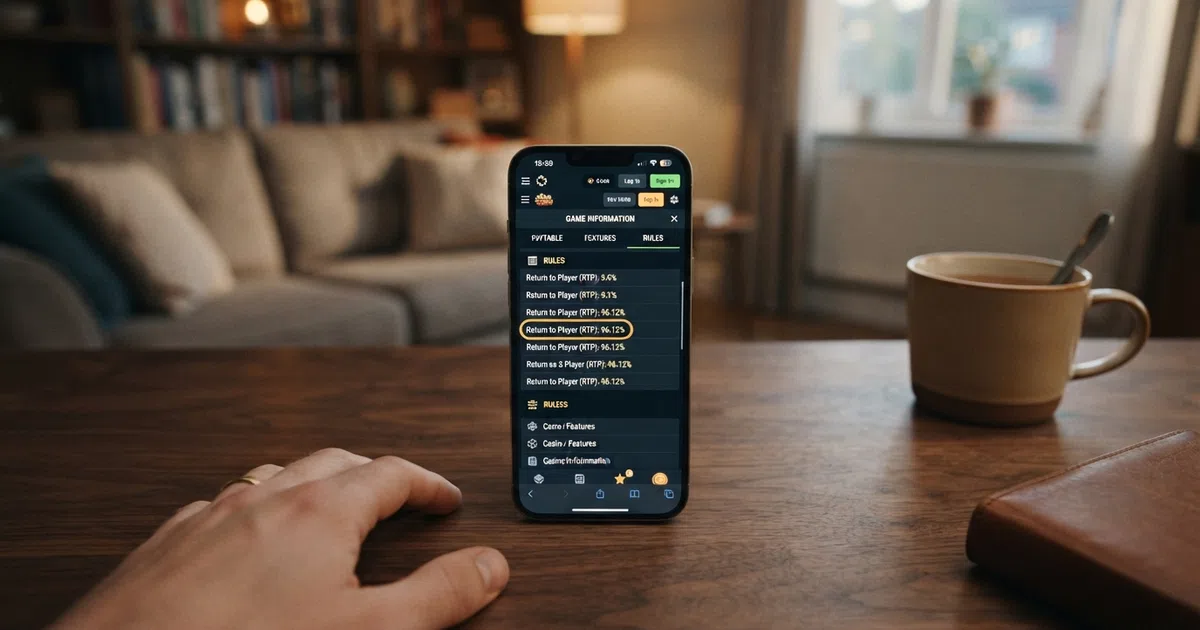
Return-to-player percentage is the single most quoted number in online slots marketing, and one of the most misunderstood. A 99% RTP does not mean a 99p return on every pound staked. It does not predict the next session, the next hundred spins, or the next bonus round. It is a long-run statistical average that the Gambling Commission requires operators to disclose, and that the Commission monitors against actual play in real time. This guide explains what the figure really represents, ranks the highest-RTP slots available to UK players right now, and walks through the ten GB-licensed operators where those slots sit alongside competitive welcome terms, all under the framework the Commission has built since the 2025 stake-cap reforms.
What Slot Payout Percentage Actually Means for Your Money
Return to player, or RTP, is the share of total money staked on a slot that the game returns to players across a very large number of game cycles. The Gambling Commission’s own framing is unambiguous: “The %RTP is an average achieved over a significant number of game plays and not each time the gaming machine is played.” The Commission adds that an 85% RTP slot should not be expected to return 85p for every £1 during a playing session. Both statements come from the Commission’s Return to Player guidance page, and together they draw a line most affiliate pages skip. RTP is not a per-session promise. It is a designed mathematical edge that takes hundreds of thousands, often millions, of spins to express.
What RTP Actually Means — Beyond the Percentage
Every regulated online slot ships with a designed, or theoretical, RTP set by the studio and disclosed in the game’s rules. That figure is what the game will return to players on average, given its maths model played out indefinitely. The actual RTP, by contrast, is what real players collectively experience in a given period. Under the Commission’s RTS 3C, the actual RTP is calculated as total wins divided by total turnover, multiplied by 100. The Commission monitors that figure across every licensed operator’s game library. A meaningful divergence between designed and actual triggers scrutiny, because the two should converge over a large enough sample.
The reason the distinction matters is that a player walking into a casino will not experience the designed RTP in a single session. They will experience variance, and variance can run in any direction for hundreds of spins before the long-run average begins to assert itself. A 99% slot can return nothing over 200 spins. A 94% slot can pay out a 500x win on the third spin. Neither outcome tells the player what the slot is “worth.” The designed figure, multiplied by the time horizon of a real session, is what tells them what the slot is worth.
How to Find Any Slot’s Payout Percentage
Finding a slot’s RTP at a GB-licensed casino is a five-second job once you know where to look. Open the game, tap the information or help icon, scroll to the game rules section, and the designed RTP sits there in plain text. RTS 3C requires the figure to appear in player-facing game rules, and every regulated operator complies because the Commission audits it.
The figure a player sees is set by the studio, but it reaches them through a chain of verification. The Commission does not test games itself. It requires operators to engage an approved third-party test house, of which the four dominant ones are eCOGRA, iTech Labs, Gaming Laboratories International, and BMM Testlabs. Those laboratories run millions of simulated spins against the game’s maths model, confirm the designed RTP matches the implementation, and submit a report to the Commission before the slot can be released to UK players. The player’s second cross-check sits at the operator level: independent audit data published by RTPTrack, which records the average RTP across each operator’s full slot library. For April 2026, Bet365 runs an average RTP of 96.30% across more than 1,500 slots, which sets a practical floor for what a serious UK-facing library looks like.
House Edge, Hold Percentage, and Hit Frequency Explained
RTP is one of three companion metrics that together describe a slot’s economics. House edge is its mirror: 100% minus RTP. A 96% RTP slot carries a 4% house edge, meaning the operator keeps £4 on every £100 staked on average across the long run. That figure is the casino’s theoretical gross margin, and it is what makes the business a business. Hold percentage is what the casino actually retains in a given period, and it is rarely identical to the house edge, because short-term results bounce around the designed number before settling.
Hit frequency is the third metric, and the one players most often confuse with RTP. Hit frequency is the share of spins that produce any win at all, of any size. A slot with a 30% hit frequency pays something on roughly one spin in three. A slot with an 8% hit frequency pays something on roughly one spin in twelve. A high hit-frequency slot feels generous in play, but the wins it produces are small. Hit frequency says nothing about the size of the returns, only their frequency. A high-hit-frequency, low-payout slot can have a low RTP, just as a low-hit-frequency, high-payout slot can have a high RTP. The two metrics measure different things.
RTP vs Volatility: Why Both Numbers Matter
RTP and volatility together determine what a slot actually feels like to play. Volatility is the spread and size of wins. A low-volatility slot produces frequent, small wins. A high-volatility slot produces rare, large wins. Two slots can share a 99% RTP and play nothing like each other, and that is the trap.
Playtech’s Ugga Bugga sits at 99.07% RTP with low volatility and a 1,000x maximum win per line. Relax Gaming’s Book of 99 sits at 99% RTP with high volatility and a 5,000x maximum win. On paper, Ugga Bugga is the better slot. In practice, Book of 99 pays out less often but pays more when it does, and a session of 200 spins on Book of 99 can produce a different shape of result entirely. A player who picks the 99% slot without checking the volatility profile can blow through a bonus in 50 spins chasing a feature that lands once in 400.
The UKGC’s structural backstop matters here too. Remote slot game design rules, in force since October 2021, require a minimum 2.5-second spin speed and ban auto-play. Those rules do not change a slot’s RTP. They do slow the rate at which a player can cycle through variance, which is itself a form of protection. A slot that resolves once every 2.5 seconds gives the player time to recognise what is happening, which a turbo-spin slot never does.
Average Payout Rates for UK Online Slots
Most UK-facing online slots cluster between 94% and 97% RTP, with the highest-RTP titles as outliers above 97%. RTPTrack’s April 2026 data places a Tier 1 threshold at 96.30% average RTP across an operator’s library, a useful benchmark for what a serious high-payout casino looks like. Bet365, LeoVegas, and PlayOJO all clear that bar.
The macro picture comes from the Commission’s own market data. In the fourth quarter of FY 2025/26, the period from January to March 2026, UK online slots generated £773m in gross gambling yield, a 12% year-on-year increase, on 25.1 billion spins across an average of 4.8 million monthly active accounts. Both the spin count and the active-account count are new peaks for the dataset. Players are playing more, and the operator margin remains a small but reliable percentage of every pound staked.
The UKGC’s Own RTP Formula and Live Monitoring
The Commission does not set a minimum RTP floor. It does something arguably more useful: it requires every slot’s designed RTP to be disclosed, requires the maths to be verified by an approved test house, and monitors actual RTP across every operator in real time. The formula is public, and it is simple: actual RTP equals total wins divided by total turnover, multiplied by 100.
A meaningful divergence between that figure and the designed RTP is the trigger for regulatory action. Operators are required to report, and the Commission has the power to investigate, require remedial action, or revoke a game from the market. The framework treats RTP as a contractual promise between the operator and the player, backed by independent verification and continuous audit. It is not a guarantee, and the Commission does not pretend it is. It is a disclosure regime that lets an informed player compare games on the only metric that long-run math actually rewards.
The Highest-RTP Online Slots Worth Playing in 2026
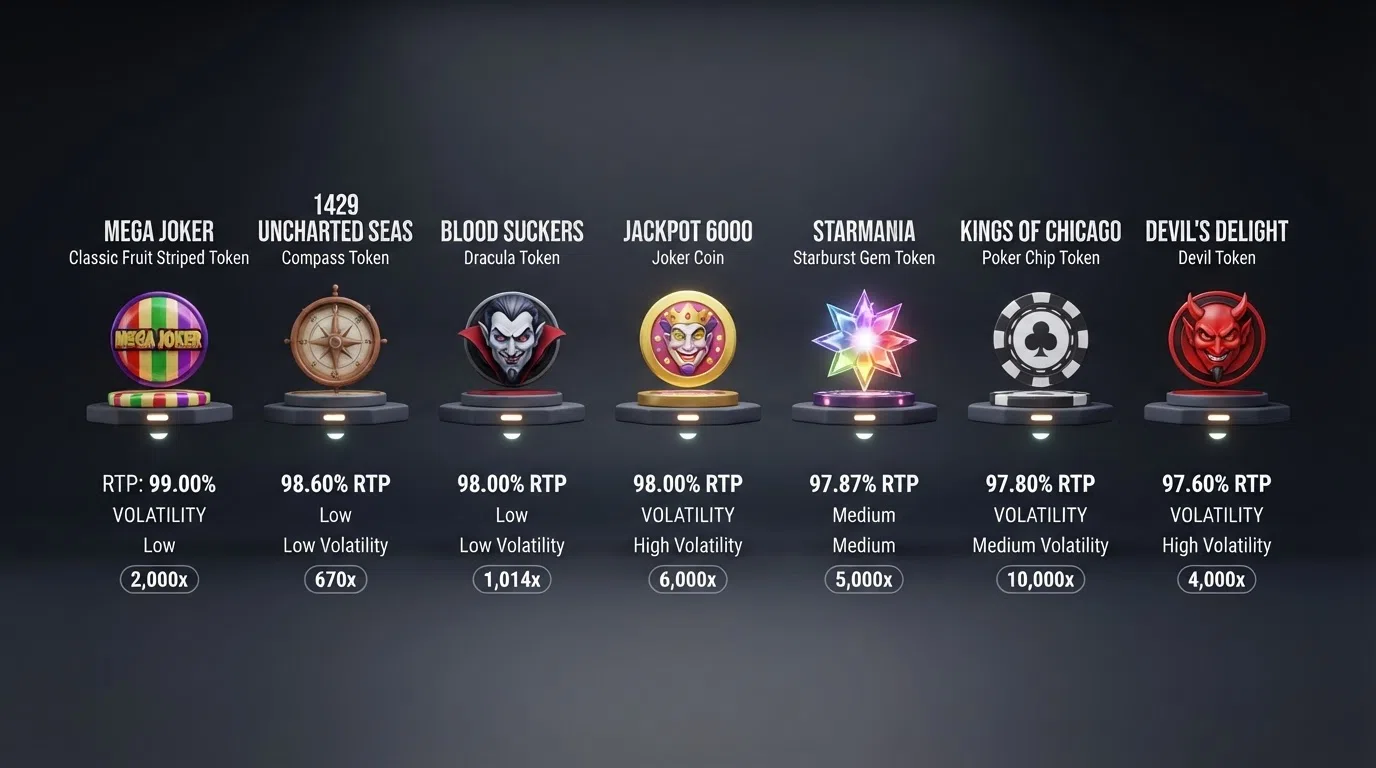
The top tier of UK-available slots is small, distinct, and well-documented. Seven titles sit at or above 96.7% RTP, and the gap between the top of the list and the next-best-known high-RTP slot is meaningful enough to be the difference between a 99% and a 97% game.
The Top Seven Highest-RTP Slots Available to UK Players
| Slot Title | RTP | Provider | Volatility | Max Win |
|---|---|---|---|---|
| Ugga Bugga | 99.07% | Playtech | Low | 1,000x per line |
| Book of 99 | 99.00% | Relax Gaming | High | 5,000x |
| Mega Joker | up to 99% | NetEnt | — | — |
| 1429 Uncharted Seas | 98.60% | Thunderkick | Low | 670x |
| Blood Suckers | 97.99% | NetEnt | Low | — |
| Blood Suckers Megaways | 97.66% | Red Tiger | — | — |
| Big Bass Splash | 96.71% | Pragmatic Play | High | — |
The volatility column tells most of the story. Three of the seven are explicitly low volatility, which means frequent small wins and a flatter session shape. Two are high volatility, which means longer dry spells and a fatter top end. The remaining two carry no volatility rating in the public sources but sit in the same RTP tier. A player who wants the highest possible return on a modest bankroll will gravitate to the low-volatility end. A player chasing a 5,000x ceiling will sacrifice hit frequency to get it.
Why Playtech’s Ugga Bugga Leads at 99.07% — and What That Actually Buys You
Ugga Bugga is not a modern video slot. It is a 3×1 classic with ten paylines, jungle-themed symbols, and a 1,000x maximum win per line. What it has is the highest published RTP of any slot available to UK players, at 99.07%, set by Playtech and verified through the standard third-party test house route. The game is low volatility, which means the 99.07% return arrives as frequent small wins rather than occasional jackpots. A session on Ugga Bugga feels steady. The bankroll lasts. The numbers move slowly, in small increments, and the player can see what is happening to their balance in real time.
The ceiling is what limits the upside. A 1,000x per-line max win is generous for a low-volatility classic but modest compared to the 5,000x ceiling on Book of 99. Ugga Bugga is the right slot for a player who wants the highest possible return over a long, calm session, and the wrong slot for anyone chasing a life-changing single spin.
High Volatility, High RTP: Book of 99 and Mega Joker
Book of 99 and Mega Joker both claim 99% RTP, and the similarity ends there. Book of 99 is a modern Relax Gaming video slot with high volatility and a 5,000x maximum win. It plays the way a 2020s slot plays: cascading reels, expanding symbols, a free-spins feature. The 99% RTP is the headline, the high volatility is the lived experience, and the 5,000x ceiling is what a player is actually buying when they sit down.
Mega Joker is a NetEnt classic whose 99% RTP is conditional. The headline figure applies only at maximum coin setting with wins transferred through the Supermeter feature, the upper-tier bonus mode that requires the player to actively move winnings up the stake ladder. A casual player spinning at low stakes in the base game experiences a substantially lower RTP, and the gap between the marketed figure and the base-game figure is large enough that Mega Joker functions as a different product depending on how it is played. It is the highest-RTP slot on paper for the player who plays it correctly, and a mid-pack slot for the player who treats it as a casual spin.
Blood Suckers and the NetEnt High-RTP Legacy
NetEnt holds two of the seven slots in the high-RTP tier. The original Blood Suckers sits at 97.99% with low volatility, a vampire-themed slot that has been a fixture of bonus-clearing play for over a decade. Its Megaways remake, produced by Red Tiger rather than NetEnt itself, runs at 97.66%. Both are low volatility, which makes them unusually well suited to wagering requirements: the player cycles through a large number of spins at a steady pace, the variance does not spike, and the bankroll lasts long enough to complete the playthrough.
The trade-off versus the 99% tier is straightforward. A session on Blood Suckers costs the player roughly 2% more in expected house edge than a session on Ugga Bugga, but the difference per spin is small enough to be invisible in any single session. Over hundreds of thousands of spins, the gap compounds. For a casual player, the difference between 97.99% and 99.07% is academic. For a high-volume bonus clearer, it is not.
Where the Highest-RTP Slots Actually Live: UK Casino Payout Rates Compared
The highest-RTP slot in the world is worth nothing if the operator carrying it runs a 60x wagering requirement, withholds withdrawals, or runs an offshore operation outside the Commission’s reach. The operator layer is where RTP either survives contact with reality or gets buried under bonus terms and friction.

Operator Payout Rates at a Glance
| Operator | GB Licence | Welcome Free Spins | Wagering | Spin Value |
|---|---|---|---|---|
| Bet365 | Yes | Up to 500 | 0× | — |
| Sky Vegas | Yes | 70 no-deposit + 200 deposit | 0× | 1p × 10 lines |
| William Hill | Yes | 200 on Big Bass Splash | 10× | 10p |
| Ladbrokes | Yes | 100 | 10× | 10p |
| Paddy Power | Yes | 50 no-deposit + 200 deposit | 0× | — |
| Coral | Yes | 100 | 10× | £0.10 |
| Betfred | Yes | Up to 200 | 0× | — |
| Betfair | Yes | 50 no-deposit + 100 deposit | 0× | — |
| 32Red | Yes | 320 on Big Bass Splash | 0× | £0.10 |
| Virgin Games | Yes | 100 on Game of Thrones | 0× | 1p × 10 lines |
Every operator on the list holds a current GB licence, and the table is sorted by structural quality: wager-free offers first, the 10x-cap offers next. The 10x cap is itself a major change. Before 19 December 2025, UK casino bonuses routinely carried 30x, 40x, or even 60x wagering requirements. The Commission’s new ceiling, under LCCP Social Responsibility Code 5.1.1, has compressed the market toward wager-free or near-wager-free terms.
What a Casino’s Aggregate Payout Rate Actually Tells You
A casino’s published overall payout rate is a weighted average across slots, table games, live dealer, and instant-win products, and it tells a player almost nothing about the RTP of the individual slot they plan to play. A casino that runs 96% across its full library may carry every high-RTP slot on the market and several low-RTP ones, or it may carry only a handful of mid-RTP titles. The figure is a directional signal, not a decision tool.
The more useful number is the operator-level RTP audit, which slices the data by game type. RTPTrack’s April 2026 figures show Bet365 at 96.30% across 1,500+ slots, and PlayOJO and LeoVegas at the same threshold across 2,000+ and 3,500+ slots respectively. Those numbers mean those operators have configured their slot libraries at or near the designed RTP across the full range, not that every individual slot on the site runs at 96.30%. The same slot title can also carry different RTP configurations at different operators, though in practice most studios ship a single global RTP and operators carry it as published. The point is that the per-operator average is a check on whether the operator has degraded any titles below designed, and a player who cares about RTP should look at it.
Beyond the Headline Payout Figure: What Else to Check
RTP is one number. The decision to play at a given operator is shaped by at least four others. The first is GB-licence status, which is non-negotiable: an unlicensed operator is operating illegally under section 33 of the Gambling Act 2005, and the player loses Commission complaints routes, ADR access, and GAMSTOP protection. Every operator in the table above holds a current licence.
The second is the wagering structure. A wager-free offer preserves the RTP advantage a high-payout slot gives the player, because the winnings land in the withdrawable balance directly. A 10x wagering offer erodes that advantage by a calculable amount. The third is the slot library’s breadth and provider mix, which proxies for RTP choice. An operator carrying Playtech, NetEnt, Pragmatic Play, and Relax Gaming gives the player access to nearly every high-RTP title in the market. The fourth is the deposit and withdrawal infrastructure, which determines whether a winning session is actually paid out without friction. None of these replaces RTP, but together they decide whether the RTP is accessible.
Bet365
Bet365 is the largest UK-facing operator and the only one in the featured set with independently audited, published RTP at the operator level: 96.30% across more than 1,500 slots, per RTPTrack’s April 2026 figures. The welcome offer is a 10 Days of Spins promotion running to up to 500 free spins, with each day’s prize drawn from a selection of 5, 10, 20, or 50 spins. Wagering is 0x, winnings land as cash, and the offer is claimable within 30 days of registration. The game library spans Playtech, NetEnt, Pragmatic Play, Microgaming, Red Tiger, Big Time Gaming, Relax Gaming, Thunderkick, and Yggdrasil, which means essentially every high-RTP title in the UK market is on the floor. For a player who wants the broadest RTP choice in the market on a wager-free welcome, Bet365 remains the most complete and accessible option available.
Sky Vegas
Sky Vegas is the no-deposit entry point in the featured set: 70 free spins before the player deposits a penny, with a further 200 spins released after a £10 deposit and stake, all at 0x wagering. Winnings are withdrawable cash with no cap specified. The 7-day spin expiry is short, so the spins need to be used promptly. The library runs Pragmatic Play, Playtech, NetEnt, Red Tiger, Big Time Gaming, Blueprint Gaming, IGT, and Evolution, which covers the major studios without quite matching Bet365’s depth. Sky Vegas suits a player who wants to try a real-money slot before committing a deposit, on terms that do not punish them for doing so.
William Hill
William Hill runs a slot-specific welcome: 200 free spins on Big Bass Splash after a £10 deposit and stake, at 10p per spin. The wagering is 10x on winnings, at the new Commission cap, with a £30 maximum cashout and a 72-hour spin expiry. Big Bass Splash itself is the highest-RTP entry in Pragmatic Play’s Big Bass series, at 96.71% with high volatility, so the bonus is paired with a slot whose long-run return is genuinely competitive. The £30 cashout cap is the trade-off. A player who hits a meaningful win on Big Bass Splash’s free-spins feature is leaving money on the table beyond that ceiling. This package is ideal for players who want to leverage a highly competitive RTP title like Big Bass Splash within a focused, time-bound bonus period.
Ladbrokes
Ladbrokes runs a Bet £10 Get 100 free spins offer on Big Bass Bonanza, Sweet Bonanza, or Starburst, at 10p per spin, with 10x wagering on winnings at the Commission cap. The 30-day validity window and £5 maximum bet during wagering are standard. The estimated bonus EV, per the SlotMachines UK formula, is around £6.00, which is a function of the 10x cap, the 10p spin value, and the 100-spin count. The Entain group structure means the same provider mix and the same bonus framework show up across Ladbrokes and Coral, with variations in the games and the timing.
Paddy Power
Paddy Power carries the largest total free-spins count in the featured set: 50 no-deposit free spins plus 200 deposit spins, 260 in total, all at 0x wagering. The 7-day spin expiry applies after credit. The library runs Pragmatic Play, NetEnt, Playtech, Red Tiger, Blueprint Gaming, Big Time Gaming, and Evolution, which is a Flutter-group standard spread. Paddy Power is a standout choice for those prioritising raw spin volume and a low-barrier no-deposit entry, though keep in mind the deposit-related spins do require a real-money stake to trigger.
Coral
Coral is structurally a sister offer to Ladbrokes under the Entain group: Bet £10 Get 100 free spins at £0.10 each, 10x wagering on winnings, with a 48-hour acceptance window and 7-day validity. The estimated bonus EV is around £6.00, the same as Ladbrokes. The provider mix is the same Flutter/Entain standard. The 48-hour acceptance window is the meaningful difference: a player who does not opt in within two days loses the offer entirely. The offer is essentially a mirror of the Ladbrokes promotion, making it a reliable alternative for players who already hold a Coral account or prefer the brand’s interface.
Betfred
Betfred runs up to 200 free spins after a £10 stake on casino slots, with 0x wagering and winnings paid directly to the withdrawable balance. The 7-day spin validity is standard. The meaningful restriction is on the payment method: debit card deposit is required for qualification, and e-wallet or prepaid card deposits may be excluded. The library runs Playtech, Pragmatic Play, NetEnt, Red Tiger, Blueprint Gaming, Microgaming, and Evolution, which is a solid mid-tier spread. It is a robust choice for users who prefer standard debit card transactions and want to avoid the complexity of wagering requirements or tiered bonus structures.
Betfair
Betfair offers 50 no-deposit free spins plus 100 additional spins after a £10 deposit, all at 0x wagering. The Flutter group structure means the provider mix (Playtech, NetEnt, Pragmatic Play, Red Tiger, Blueprint Gaming, Evolution) matches the rest of the Flutter set. The spin count is lower than Paddy Power’s, and the no-deposit component is identical, so the offer is a step down for a player choosing between Flutter brands. The trade-off is that Betfair’s sportsbook and exchange integration may suit a player who wants casino and sports on one account.
32Red
32Red runs the highest single-deposit free-spins count in the featured set: 320 spins on Big Bass Splash at £0.10 per spin, after a £30 deposit and stake. Wagering is 0x on winnings. The qualifying deposit is higher than the £10 standard across the rest of the set, and the payment restriction is debit card or instant bank transfer only. The 7-day claim window with 48-hour spin expiry is short. The bonus pairs with Big Bass Splash’s 96.71% RTP, the highest in the Big Bass series, and the spin count is large enough to give the high-volatility game room to land its top end. This represents a premium value proposition for serious players who don’t mind a higher entry threshold in return for a substantial volume of spins on a proven, high-payout machine.
Virgin Games
Virgin Games runs a themed welcome: 100 free spins on Game of Thrones after a £10 deposit and wager, at 0x wagering, with winnings paid as cash subject to a £10 minimum withdrawal. The 30-day qualifying window plus 30 days to use spins is the most generous timing in the set. The library is built around Gamesys in-house slots, supplemented by NetEnt, Pragmatic Play, Evolution, Red Tiger, and IGT, which gives the player access to major studios but with a Gamesys-flavoured mix. Game of Thrones is not a high-RTP title in the 99% tier, so the offer trades headline payout percentage for thematic appeal and a clean wager-free structure.
How UK Regulation Keeps Slot Payouts Honest
The Gambling Commission does not set a minimum RTP, and it does not test games. What it does is build a framework that requires disclosure, requires independent verification, requires live monitoring, and recently, has reshaped the economics of every spin through stake caps. The framework is the single most important reason a UK player can trust a published RTP figure at all.
UKGC RTP Disclosure Rules: What Operators Must Show You
RTS 3C is the technical standard that requires every remote slot to display its designed RTP in player-facing game rules. The rule is unambiguous: a player who opens a game’s help or information panel must be able to find the RTP figure without searching further. The Commission audits compliance, and operators that fail to disclose are subject to regulatory action.
Beyond the disclosure requirement, the Commission publishes its own monitoring methodology. Actual RTP is total wins divided by total turnover, multiplied by 100. The Commission runs that calculation across every operator’s game library in real time, and a meaningful divergence between designed and actual triggers scrutiny. The framework does not eliminate variance, but it ensures that the long-run figure operators promise is the figure they deliver, and that the Commission has the data to know when they do not.
How Third-Party Testing Keeps RTP Figures Honest
The Commission does not test games itself. It licenses four approved test houses to do it: eCOGRA, iTech Labs, Gaming Laboratories International, and BMM Testlabs. Each test house runs millions of simulated spins against a slot’s maths model and verifies that the designed RTP matches the implementation. The test report is submitted to the Commission before the slot is released to UK players.
The structure means a slot cannot reach a UK player without a third-party verified RTP figure, and the operator cannot release a game without the report on file. The Commission retains the power to investigate, audit, and require remedial action, but the day-to-day verification is done by the approved laboratories. The player’s confidence in a published RTP is downstream of that chain: studio, test house, Commission, operator, game rules.
The New Stake Caps and What They Mean for RTP Gameplay
The £5/£2 age-banded stake caps, imposed by SI 2025/215, are the most significant UK slot regulation in a generation. For players aged 25 and over, the maximum stake per game cycle is £5, in force from 9 April 2025. For players aged 18 to 24, the maximum is £2, in force from 21 May 2025. A game cycle is the period from game initiation to when all staked money is lost or all winnings delivered, which means the cap is on total staked within a single cycle, not per spin in isolation.
The early data shows the caps are working as designed. Slots GGY per session fell from £4.01 to £3.82 year-on-year, spins per session dropped from 136 to 124, and the share of sessions lasting longer than one hour fell from 5.9% to 4.4%, with 8.9 million such sessions recorded in the dataset. The cap does not change RTP. It changes the rate at which a player cycles through variance, which is the protection the structural rule was designed to provide.
Why Your Slot’s RTP Will Not Save Your Session
The mathematics of RTP is a long-run average, and a session is by definition not the long run. A 99% slot can return zero over 200 spins. A 94% slot can produce a session-winning 500x feature on the third spin. The published figure is what the game is worth across millions of cycles, not what it will do tonight.
RTP Is a Long-Term Average, Not a Session Promise
The Commission’s own guidance is the clearest statement of what RTP does and does not mean: “The %RTP is an average achieved over a significant number of game plays and not each time the gaming machine is played.” The second statement is more concrete: “If a gaming machine displays an 85% RTP, you should not expect to win an average of 85 pence for every £1 you stake during a playing session.” Both come from the Commission’s Return to Player guidance page, and both are the authoritative framing of what an RTP figure actually represents.
The implication is that a player who picks a 99% slot over a 94% slot has made a sound long-run decision and a decision that may not show up in the next 200 spins. Variance dominates in short windows, and the longer the window, the more the RTP figure asserts itself. A player who treats the figure as a per-session guarantee is misreading it. A player who treats it as the input to an expected-cost calculation is reading it correctly.
Using Payout Knowledge to Set Realistic Limits
The expected-loss formula, expected loss equals spins multiplied by stake multiplied by one minus RTP, lets a player calculate the cost of a session before they sit down. At 100 spins on a 96% RTP slot at £2 per spin, the expected loss is £8. At 100 spins at £5 per spin, the expected loss is £20. Neither figure is what the player will actually lose. Variance guarantees the outcome will differ. The figure is the average over many such sessions, and it is the right input to a deposit-limit decision.
The Commission’s structural rules support the calculation. Operators must offer a deposit limit with at least equal prominence to other financial limits, and from 30 September 2026 only a gross deposit limit may be called a deposit limit. Reality checks display total losses, total wins, and time played during a session. The 2.5-second spin speed slows the rate at which a player can cycle through variance. None of these change RTP. They slow the rate of loss enough that the player can recognise what is happening before the session has gone too far.
The calculation also shows why the age-banded stake cap matters. A player aged 18 to 24 is capped at £2 per cycle, and the expected loss at 100 spins is half what it is for a player at the £5 cap. The 96% slot is the same slot. The session cost is not.
Where to Get Help When Gambling Stops Being Fun
The UK operates one of the most comprehensive problem-gambling support networks in the world, and the prevalence data explains why it exists. The Gambling Survey for Great Britain Year 3 found that 47% of adults in Great Britain had gambled in the past four weeks, and 38% had gambled online. GamCare reported 996 referrals to treatment and peer-based support services in January 2026, a 48% increase year-on-year, with 81.5% of those disclosing a form of gambling citing online forms, a five-year high.
The National Gambling Helpline, operated by GamCare, is free and available 24/7 on 0808 8020 133. GAMSTOP provides multi-operator online self-exclusion with 6-month, 1-year, or 5-year exclusion periods, with no early cancellation. NHS gambling harm clinics operate in England, Scotland, and Wales. The GambleAware self-assessment quiz has been completed over 160,000 times, with over half of those taking meaningful action as a result. The infrastructure exists, it is accessible, and it is the right call when gambling stops being entertainment.
How We Selected and Ranked the Best Payout Slots and Casinos
The slots in this ranking are drawn from sources that publish the designed RTP: the Commission’s own guidance on game rules disclosure, the studios’ published specifications, and independent slot databases. The ranking is by published RTP, with volatility and maximum win as secondary dimensions because they determine whether a high-RTP title is actually playable on a given bankroll.
The operators in this ranking are drawn from GB-licensed brands, with no offshore or unlicensed operators included. The ranking criteria are: GB-licence status, verified RTP data from the operator’s library, welcome-offer terms assessed against the 10x wagering cap and the wager-free standard, and provider-mix breadth as a proxy for RTP choice. The data sources are the UK Gambling Commission’s public register, the operators’ own published terms, and RTPTrack’s April 2026 operator-level audit.
What the Numbers Say: Your RTP Playbook for Smarter Slot Play
A high-RTP slot cuts the expected cost of play, and a wager-free bonus at a GB-licensed operator preserves that advantage. Pick from the ranked list: Ugga Bugga at 99.07% for long, low-volatility sessions, Book of 99 at 99% for a high-volatility ceiling, Blood Suckers at 97.99% for bonus clearing. Pick a wager-free welcome from Bet365, Sky Vegas, Paddy Power, Betfair, Betfred, 32Red, or Virgin Games, and the slot’s RTP reaches the withdrawable balance without erosion. Avoid the 10x-cap offers unless the bonus game itself is a high-RTP title like Big Bass Splash, where the wagering erodes less because the underlying return is higher.
The £5/£2 stake cap sets a hard ceiling on per-spin loss. The expected-loss formula, spins times stake times one minus RTP, lets a player budget a session before they sit down. The Commission’s mandatory deposit-limit offer, with equal prominence to other financial limits, is the structural tool to enforce that budget. Reality checks during play show total losses, total wins, and time played. The 2.5-second spin speed slows the rate of loss.
RTP is not a guarantee. The mathematics of a 99% slot says nothing about the next 200 spins, and a player who treats the figure as a session promise is misreading it. The help infrastructure exists for the moments when gambling stops being fun, and the right move is to use it.
Frequently Asked Questions
What does RTP (return to player) mean on online slots?
RTP is the share of money staked that a slot returns to players across a very large number of game cycles, expressed as a percentage. A 96% RTP slot returns £96 on every £100 staked on average, but the average is over millions of spins, not a single session. The Gambling Commission’s own guidance is clear that RTP does not predict what any individual session will return.
Do UK online casinos all offer the same RTP on the same slot game?
In practice, yes, because most studios ship a single global RTP configuration and GB-licensed operators carry the game as published. The same slot at Bet365 and Sky Vegas will run at the same designed RTP. Independent audit data from RTPTrack confirms that operators like Bet365, LeoVegas, and PlayOJO all run at 96.30% average across their slot libraries, which suggests no operator is degrading titles below designed.
What is the average payout percentage for online slots in the UK?
Most UK-facing online slots cluster between 94% and 97% RTP, with the highest-RTP titles as outliers above 97%. The top of the market, led by Ugga Bugga at 99.07% and Book of 99 at 99%, sits well above the average. At the operator level, RTPTrack’s April 2026 data places Tier 1 at 96.30% average across the full slot library, which is the practical benchmark for a high-payout casino.
Is a high RTP slot guaranteed to pay out more during my session?
No. Return to Player percentages function as statistical averages calculated over millions of spins. They do not act as guarantees for short-term sessions. A slot’s RTP reflects its long-term mathematical edge, whereas individual gaming sessions are governed by short-term variance, which can lead to results that fluctuate wildly before long-run trends emerge.
Can a UK casino change a slot’s RTP setting without telling players?
No. Under RTS 3C, the designed RTP must be displayed in the game’s player-facing rules, and any change to that figure would be a material change requiring re-verification by an approved test house and notification to the Gambling Commission. Operators cannot silently reconfigure a slot’s RTP without those steps, and the Commission’s live monitoring would catch a divergence between designed and actual RTP regardless.
What does house edge mean and how does it relate to RTP?
House edge is the mirror of RTP: 100% minus RTP. A 96% RTP slot carries a 4% house edge, which is the operator’s theoretical gross margin on every £100 staked. House edge is the casino’s cut. RTP is the player’s cut. They are two ways of describing the same long-run mathematical relationship between stakes and returns.
Limits – nodeposit-casinobonuses-uk
Content created by the «nodeposit-casinobonuses-uk» team