
The Best Online Casino Game Shows for UK Players
 Available in GB
Last updated: 17 August 2026 · Verified against the UK Gambling Commission Public Register
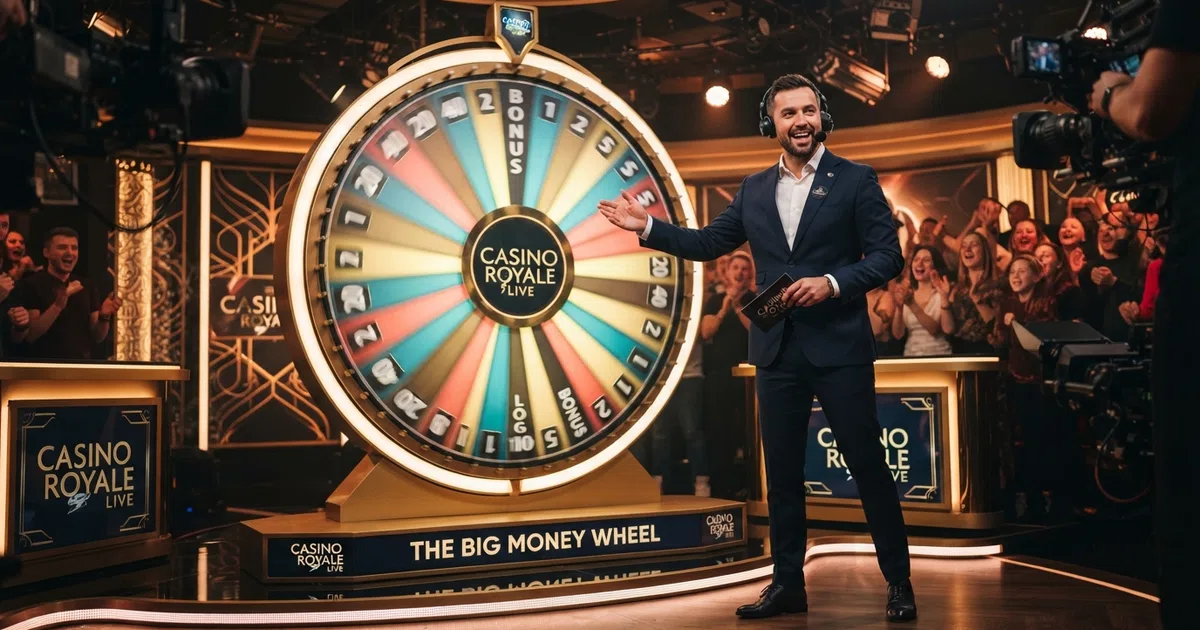
A live casino game show is a real-money game streamed from a physical studio, hosted by a presenter, and resolved by mechanical means: a wheel spin, a ball draw, a dice drop. That is the whole format, and it is the reason a game show sits in its own category on a UK-licensed casino, distinct from the RNG slots in the lobby next door and from the blackjack and roulette tables that share the live floor. The presenter calls the round. The wheel stops. The result was determined the moment the segment settled, not by an algorithm, and that distinction is the one that lets regulators audit a live game with different tools from the ones they use to certify a slot.
For UK players, the practical consequence is a product with a known house edge (typically between 2.70% and 4.60% across the major titles), a headlining max-win figure that often misrepresents the realistic return, and a welcome-bonus trap that has historically drained player value: game-show contribution rates to wagering requirements have often sat at 10% within the live-casino classification, sometimes at 0%, meaning a £100 bonus played at a game show can take ten times the turnover to clear as the same bonus on a slot. The regulator has stepped in. From 19 January 2026, UKGC Social Responsibility Code 5.1.1 caps bonus wagering at 10× across all products and bans mixed-product offers, which materially changes the math of claiming a casino bonus as a game-show player.
This page ranks the major game-show titles by what actually matters: return to player, house edge, volatility and the realistic shape of a session. It then ranks ten UKGC-licensed operators by game-show catalogue breadth and bonus terms that work for game-show play, verified against the UK Gambling Commission’s public licence register. Every operator named below holds a current GB remote casino licence.
What Are Live Casino Game Shows? How the Studio Meets the Screen
A live casino game show is a presenter-led game streamed from a purpose-built studio, with bets placed through the on-screen interface and results determined by physical equipment on camera. The format borrows the structure of a television game show — host, studio, audience energy, a moment of resolution — and bolts a betting grid onto it. The result is a casino product that looks nothing like a slot and behaves differently from a standard live-dealer table. RNG games are algorithm-driven, invisible and fast. Live game shows are physical, visible and paced at roughly 30 to 60 seconds per round.
How a Live Game Show Actually Works: Presenters, Wheels and Real-Time Results
The studio is a controlled set with multiple camera angles, lighting designed for broadcast and one or more physical game pieces: a money wheel, a ball-draw machine, a puck launcher, a pachinko board. The presenter stands beside the equipment and runs each round, calling bets open, building the moment of resolution and announcing the result. The betting window opens when the round loads and closes — visibly — before the spin or draw; once the wheel is in motion, late bets are rejected. The result is captured on camera, transmitted to the betting client in real time and settled into the player’s balance within seconds.
What this means in practice is that every game show on a UK-licensed site is independently verifiable in a way an RNG slot is not. The wheel, the ball, the dice: they are on camera, in a regulated studio, in front of an independent testing house. That is the appeal of the format, and it is also what makes the house edge honest: no strategy changes the outcome of a wheel spin or ball draw, no staking system overrides the probability distribution built into the game’s pay table, and every title in this category carries a published RTP that has been certified under the UK Gambling Commission’s Remote Technical Standards.
Live Dealer Game Shows vs RNG Versions: What the Difference Means for Your Money
The same product names sometimes exist in both formats. A player can find an RNG Dream Catcher, an RNG Mega Wheel and several other titles that imitate the live format without the studio. The distinction matters for three reasons. First, fairness: a live game show’s outcome is determined by physical equipment on camera, while an RNG version’s outcome is determined by an algorithm. The Remote Technical Standards cover both, but the audit model is different. Second, pace: live rounds run on the studio’s clock (typically 30–60 seconds), while RNG versions can be played as fast as the player can click. Third, the session feel: the live format carries a presenter, a social chat layer, a visible studio audience, and a pacing that builds tension. An RNG version plays like a slot. The UK market has moved heavily toward the live format in this category, and every UKGC-licensed operator on this page carries the live versions as the primary offering.
What UK Players Actually See: Navigating a Game-Show Lobby on a Licensed Casino Site
On a UKGC-licensed casino, game shows are typically filed under a dedicated category within the live-casino section: “Game Shows”, “Live Shows”, or labelled with the provider (Evolution, Pragmatic Play Live, Playtech). The category is usually at or near the top of the live-casino navigation. Evolution Gaming produces the dominant UK catalogue — Crazy Time, Monopoly Live, Funky Time, Dream Catcher, Mega Ball, Lightning Storm, Deal or No Deal Live, Monopoly Big Baller, Adventures Beyond Wonderland, Cash or Crash, Gonzo’s Treasure Hunt and Crazy Coin Flip all sit in this provider’s library — and every major UK-licensed operator carries the full Evolution game-show range. Pragmatic Play Live’s Mega Wheel and Sweet Bonanza CandyLand appear at most sites as a secondary catalogue; Playtech’s Adventures Beyond Wonderland rounds out the offering. Most lobbies allow demo-mode spectating for logged-in users, which is the cheapest way to learn a new title’s betting layout before committing a stake.
Why the Best Live Game Show Isn’t the One With the Biggest Multiplier
A 25,000× max win looks like value. It is not. The headline multiplier on Crazy Time or Lightning Storm is what a player could win on a single bet under a specific, low-probability bonus outcome, and chasing it costs money at the rate the house edge takes from every other bet. Across the six major Evolution titles, RTP sits in a published 95.97–96.58% band, which means a player loses between 3.42% and 4.03% of turnover on average. That 0.6-percentage-point spread is the real differentiator between titles, and it compounds quickly across a session. Dream Catcher, the simplest money wheel in the category, has the lowest house edge at approximately 2.70% — and it has no bonus rounds at all. Crazy Time, the bonus-round factory that dominates every UK ranking, runs an average RTP of 95.41% across all bet types. The player who wants to keep more of their stake should be looking at house edge, not max win.
Crazy Time: The Bonus-Round Factory With a 25,000× Ceiling
Crazy Time is the title that put the game-show category on the map, and it is the one almost every UK guide names first. It is a four-segment bonus-round design built around a Top Slot reel and a 54-segment money wheel. Players bet on numbers 1, 2, 5 or 10, or on one of the four bonus rounds: Cash Hunt, Pachinko, Coin Flip and the headline Crazy Time bonus. The RTP splits sharply across bet types: 96.08% on the number 1 bet, 94.41% on the Crazy Time bonus bet, and an overall average of 95.41% across all bets. The maximum win of 25,000× the stake is the figure that does the marketing heavy lifting, and it is the figure that most misleads.
The four bonus rounds are where the volatility lives. Cash Hunt is a shooting-gallery multiplier reveal. Pachinko drops a puck down a pegged board. Coin Flip flips a physical two-sided puck to determine a multiplier. The Crazy Time bonus opens a virtual 64-segment wheel held by a giant flapper in a 3D world, with multipliers that can compound into the 25,000× range. None of these rounds change the house edge: the pay table sets the long-run return, the wheel determines the outcome, and the presenter’s job is to make the wait feel like it matters. It does not, to the math. To the session experience, it absolutely does, which is why Crazy Time has earned its place at the top of the category despite the spread in per-bet RTP.
Monopoly Live: When a Board Game Meets a Money Wheel
Monopoly Live is the title that took the money-wheel format and added a 3D Monopoly board bonus round to it. Players bet on numbers 1, 2, 5 or 10, or on Chance, 2 Rolls or 4 Rolls — the latter two launch Mr Monopoly into a virtual board where he walks around collecting property multipliers and houses. The certified RTP including the 3D board round is 96.23%, higher than Crazy Time’s overall average, and the maximum win exceeds 10,000× the stake. The volatility sits in the medium-to-high band, driven almost entirely by the bonus round, because base-game segment wins are small. A player who wants the board-game payoff needs the bonus to land. A player who wants a steady session should stick to the number bets and accept the 2 Rolls and 4 Rolls segments as a periodic ride rather than a target.
Funky Time: Evolution’s Disco-Themed DigiWheel Experiment
Funky Time is Evolution’s attempt to push past the money-wheel format, and it does so with a 24-letter-segment DigiWheel that runs faster and louder than its predecessors. The default segment pays 25:1, and the wheel feeds four bonus rounds: Bar Bonus (95.99% RTP), Stayin’ Alive, VIP Disco (95.38% RTP) and Funkytime. The overall optimal RTP is 95.99% and the max win reaches 7,500×. What Funky Time trades for the lower ceiling is pacing — the DigiWheel resolves more rounds per minute than a traditional money wheel, which compounds the house edge’s effect on a session bankroll. A player who enjoys the rhythm will find this title more engaging than Dream Catcher and not far behind it on return. A player who treats game shows as one decision per round will find the energy forced.
Dream Catcher: The Simplest Title and the One With the Lowest House Edge
Dream Catcher is the game that started the money-wheel format at Evolution, and it remains the most efficient title in the category. A 54-segment wheel, six segment values, no bonus rounds, a certified 96.58% RTP on the ×1 segment and a 40× maximum single-segment payout. That 96.58% figure delivers a house edge of approximately 2.70% — the lowest in the money-wheel category by a clear margin. What Dream Catcher gives up is theatrical: there are no 3D board walks, no multiplier reveals, no shooting galleries. The presenter spins, the wheel stops, the player gets paid. It is a no-nonsense experience that rewards simple bet choices.
Lightning Storm: Evolution’s Newest Flagship and Its Five Bonus Games
Lightning Storm is Evolution’s 2025 flagship, featuring a 39-segment DigiWheel and five bonus games. The RTP split is the widest in the category: 97.44% on the Leaf (instant-win) bet, dropping to approximately 95.12–95.13% on numbered and bonus-chasing bets. The maximum multiplier is 20,000× the stake, capped at £500,000 per round, which is a real ceiling for a single payout rather than a theoretical one. The Leaf bet is the standout: at 97.44% it carries a house edge of about 2.56%, marginally better than Dream Catcher’s 96.58% and a number that no other live title in the category matches. A player who likes the Lightning Storm format and is willing to commit to the Leaf bet will see a lower house edge than any other published figure in the live game-show space. Players chasing the headline 20,000× will pay for it on the RTP spread.
Mega Ball: The Lottery-Style Game Show With a 1,000,000× Theoretical Ceiling
Mega Ball is the odd one out. It is not a wheel; it is a 20-ball draw played on bingo-style cards, with a multiplier system applied to matching lines. Players can purchase up to 200 cards per round at €0.10 to €100 per card, and the theoretical maximum win reaches 1,000,000× the stake. The certified RTP sits at approximately 95.40–96% including the multiplier expected value. The strategic lever, such as it is, is card count: more cards means more lines, more chances to match and a higher base bet per round, which means the house edge compounds faster on the bankroll. The 1,000,000× ceiling is a lottery number — it is a multiplier applied to a single line at maximum stake, and the probability of hitting it is small enough that it functions as marketing rather than realistic return. A player who buys one or two cards is closer to the published RTP; a player chasing the ceiling by buying 200 cards is paying a much higher effective house edge.
Side by Side: RTP, Max Win and Volatility Across Every Major Title
The table below ranks the six major titles by RTP from highest to lowest and makes the inverse relationship between headline max-win figures and average return immediately visible.
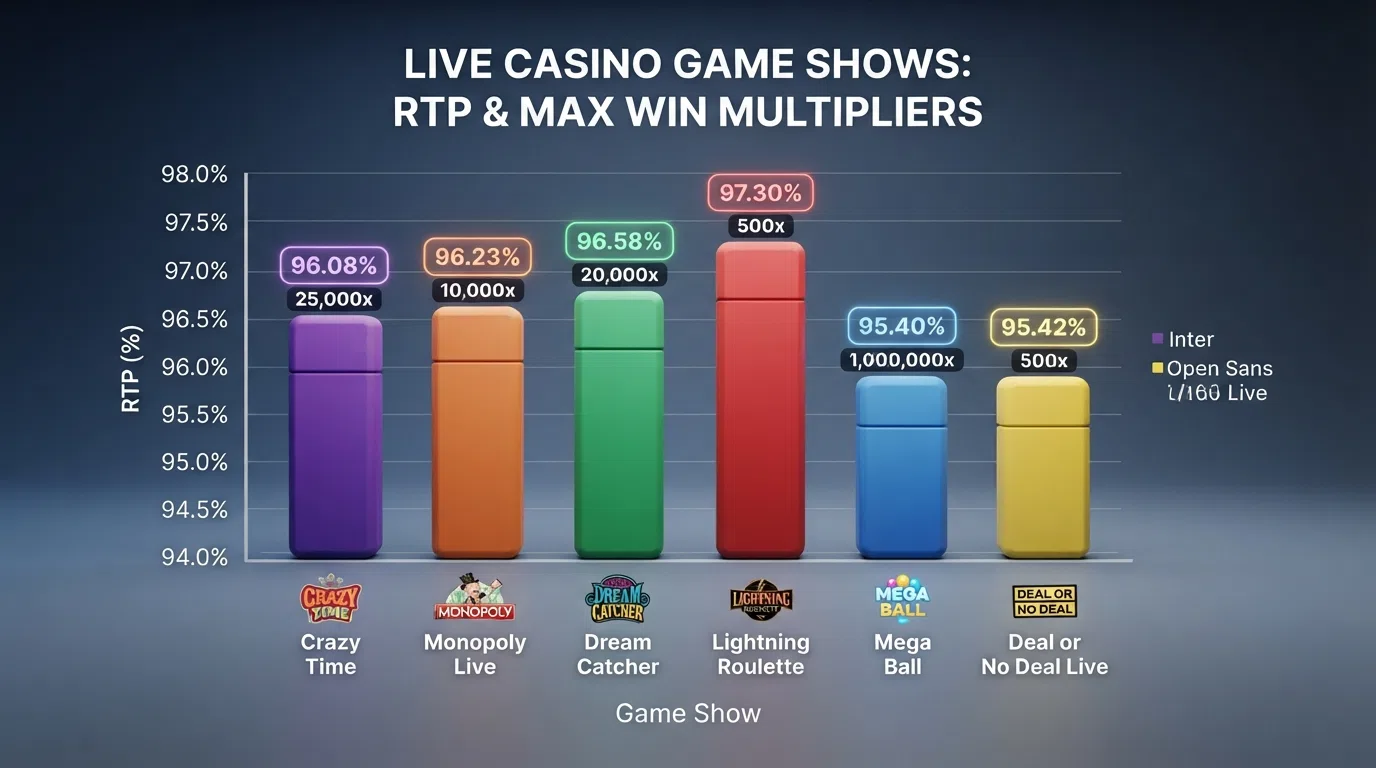
| Game Show Title | Provider | RTP (Optimal Bet) | Max Win | Volatility |
|---|---|---|---|---|
| Lightning Storm (Leaf bet) | Evolution | 97.44% | 20,000× (capped £500,000/round) | — |
| Dream Catcher | Evolution | 96.58% | 40× | Steady, single-wheel, no bonuses |
| Monopoly Live | Evolution | 96.23% | 10,000×+ | Medium to high |
| Funky Time | Evolution | 95.99% | 7,500× | — |
| Crazy Time (average) | Evolution | 95.41% | 25,000× | — |
| Mega Ball | Evolution | ~95.40–96% | 1,000,000× (theoretical) | — |
Three things stand out once the figures sit beside each other. First, the title with the highest per-bet RTP (Lightning Storm on the Leaf bet) is not the title that appears at the top of any UK ranking. Second, the title with the highest headline max win (Mega Ball’s 1,000,000× theoretical) carries an RTP in the same band as titles with a 40× ceiling. Third, the spread between the best and worst published RTP figures in this category is 2.04 percentage points, which over a session of 1,000 £1 rounds is the difference between losing £27 and losing £46. The house edge compounds quietly, and the title choice compounds with it.
Where to Play: UK Casinos With the Strongest Game Show Lobbies in 2026
The table below compares the ten UKGC-licensed operators ranked on this page. The columns are the four things that actually matter for a game-show player: the licence account (verified against the UK Gambling Commission’s public register), the welcome offer, the wagering requirement on free spins (because game-show contribution is typically only 10% of the wagering total), and the providers whose game-show catalogue is available.
| Operator | UKGC Licence Account | Welcome Offer | Wagering on Free Spins | Game-Show Providers |
|---|---|---|---|---|
| Bet365 | 55149 | Up to 500 free spins over 10 days | 0× | Evolution, Playtech |
| Sky Vegas | 38706 | 70 no-deposit + 200 on £10 spend (270 total) | 0× | Evolution, Pragmatic Play Live |
| LeoVegas | 39198 | 50 wager-free spins on £10 deposit | 0× | Evolution, Pragmatic Play Live, Playtech |
| PlayOJO | 39326 | 50 free spins on £10 deposit | 0× | Evolution, Pragmatic Play Live, Playtech |
| Paddy Power Games | 39439 | Up to 320 free spins (60 no-deposit + 260 on £10) | 0× | Evolution, Pragmatic Play Live |
| Ladbrokes Casino | 1611 | 100 free spins on £10 deposit | 10× | Evolution, Pragmatic Play Live, Playtech |
| Coral Casino | 1611 | 100 free spins on £10 deposit | 10× | Evolution, Pragmatic Play Live, Playtech |
| BetVictor | 39576 | £30 casino bonus + 50 free spins on £10 deposit | 10× | Evolution, Pragmatic Play Live |
| 32Red | 39430 | 100 free spins (£0.20 each) on £10 deposit | 10× | Evolution, Microgaming |
| Betfair | 39439 | 50 free spins on £10 deposit | Varies by offer | Evolution, Playtech |
The split between the top five (0× wagering) and the bottom five (10× wagering or variable) is the single most important decision in this table. A 10× wagering requirement on free-spin winnings means a player must bet those winnings ten times before withdrawing; if the wagering contribution for live casino is 10% (a common setting), the effective multiplier becomes 100×. The January 2026 10× cap has helped, but the contribution-rate trap is still the most common way a casino bonus is silently worth less than its marketing suggests. A player who plans to claim a welcome offer and play game shows with it should treat the zero-wagering row as the default and the 10× row as a second choice with eyes open.
Bet365: The Full Evolution Suite Plus Playtech Exclusives and 500 Zero-Wagering Spins
Bet365 sits at the top of the ranking for a single reason: depth. The live-casino floor runs 50+ tables and the full Evolution game-show suite — Crazy Time, Dream Catcher, Monopoly Live, Mega Ball, Lightning Dice, Deal or No Deal Live — alongside Playtech exclusives that do not appear on most competitor sites. The welcome offer is up to 500 free spins distributed over 10 days (5, 10, 20 or 50 per day depending on the promotion), each worth £0.10, paid as cash with no wagering. The minimum to qualify is £10 in lifetime deposits, and the claim window is 30 days. The UKGC licence is account 55149 under Hillside (UK Gaming) Limited, active on the public register. Bet365 delivers a gold standard in library size, making it the primary choice for deep-dive game-show fans.
Sky Vegas: 70 No-Deposit Free Spins and the Full Evolution Line-Up
Sky Vegas is the only operator in the ranking offering a no-deposit free-spins package as part of the welcome. New players receive 70 free spins on registration with no deposit required, plus 200 more on depositing and spending £10, all with zero wagering and a 7-day expiry. The Evolution game-show suite is complete, including Crazy Time, Monopoly Live and Funky Time. The UKGC licence sits at account 38706 under Bonne Terre Limited, part of the Flutter Entertainment group. This structure provides a low-risk entry point for those wanting to explore the live environment without an immediate spend.
LeoVegas: Monopoly Big Baller Access and 50 Wager-Free Spins
LeoVegas has held a UKGC remote casino licence since 1 November 2014 (account 39198, LeoVegas Gaming PLC), making it one of the longer-tenured operators on the page. The welcome offer is 50 wager-free spins on Big Bass Splash for a £10 deposit, with a 1× deposit wagering requirement and 7-day windows for both the deposit wagering and the spin use. The per-spin value is £0.10, for a maximum bonus of £5. The game-show catalogue is the full Evolution suite plus Pragmatic Play Mega Wheel and Monopoly Big Baller. LeoVegas is a mobile-first operator, and the live-casino experience is built for portrait orientation. For a mobile-first player who wants a long-tenured UKGC licence and Evolution’s full range, LeoVegas is the fit.
PlayOJO: Zero-Wagering Model Means Game-Show Play Faces No Contribution-Rate Penalty
PlayOJO’s proposition is structural rather than promotional: the operator pays all winnings as cash, with no wagering requirements on any offer. The welcome package is 50 free spins on Big Bass Bonanza for a £10 deposit, each worth £0.10, with a maximum bonus value of £5. The game-show lobby is the full Evolution range. What the zero-wagering model delivers for a game-show player is the elimination of the contribution-rate trap entirely: when a bonus is paid in cash from the start, there is no contribution rate to discount, and game-show play during a welcome period is exactly as effective at clearing bonus value as slot play. The UKGC licence sits at account 39326 under SkillOnNet, active on the register. By removing the bonus math entirely, PlayOJO bypasses the contribution-rate barriers common at competitor sites.
Paddy Power Games: Up to 320 Free Spins, Lightning Storm Included
Paddy Power Games offers the most free spins in the ranked set: up to 320 total, split between 60 no-deposit spins and 260 on a £10 qualifying deposit, all with 0× wagering and a 7-day validity. The Evolution suite is complete and includes Lightning Storm. The UKGC licence is account 39439 under PPB Entertainment, part of Flutter. It is the logical destination for players prioritising volume alongside the very latest studio releases.
Ladbrokes Casino: 100 Free Spins, Full Evolution Suite and Playtech Game Shows
Ladbrokes sits in the 10×-wagering band of the ranking, but it earns its place with the widest provider mix in the set: Evolution, Pragmatic Play Live and Playtech game shows all under one roof. The welcome offer is 100 free spins on a £10 qualifying deposit with 10× wagering on winnings, valid for 7 days. The UKGC licence is account 1611 under LC International, the Entain entity that also covers Coral. This operator suits players who value provider diversity enough to handle the moderate wagering requirements.
Coral Casino: Shared Entain Infrastructure, 100 Free Spins and Sub-One-Hour Payouts
The UKGC licence is account 1611 under LC International / Entain, and it is a mirror to the Ladbrokes offering. The sub-one-hour payout speed acts as a differentiator for withdrawal-focused players.
BetVictor: £30 Casino Bonus, 50 Free Spins and a Dedicated Game-Show Category
BetVictor is one of only two operators in the ranking offering a cash bonus alongside free spins. The welcome package is a £30 casino bonus plus 50 free spins on Fishin’ Frenzy for a £10 deposit, with 10× wagering on both the bonus and the spin winnings and a maximum withdrawal of £300 from bonus-derived funds. The bonus validity is 30 days; the qualifying deposit window is 7 days. The live-casino lobby has a dedicated game-show category, which is a small but useful navigation detail for a player browsing the catalogue. The UKGC licence is account 39576 under BV Gaming Limited. Its dedicated navigation makes this a reliable site for those who prefer an organised live-lobby experience.
32Red: 100 Free Spins at £0.20 Each and the Kindred Evolution Line-Up
32Red offers the highest per-spin value in the ranking: 100 free spins at £0.20 each on Sweet Bonanza, for a maximum bonus value of £20 on a £10 deposit and stake, with 10× wagering on winnings. The claim window is 7 days and the spin expiry is 48 hours after credit. The Evolution game-show suite is complete, including Crazy Time and Monopoly Live. The UKGC licence is account 39430 under 32Red, part of the Kindred Group. For a player who values per-spin value over spin count, 32Red is the clear pick.
Betfair: Evolution Suite With Betfair-Branded Live Tables and Variable Bonus Terms
Betfair closes the ranking as the Flutter exchange brand, sharing a UKGC licence (account 39439) with Paddy Power. The Evolution suite is complete, and the site offers Betfair-branded live tables — a small but distinct UX feature for a player who already uses the exchange product. The welcome offer varies by promotion period; the current offering is 50 free spins on selected slots for a £10 deposit with variable wagering and 7-day validity. For a player who is already on the Betfair exchange and wants a single account across products, Betfair is the fit; for a pure game-show player chasing bonus value, the higher-ranked Flutter brand is the better play.
Is It Safe? UK Licensing, Game-Show Fairness and What the Rules Actually Protect
Every operator on this page holds a current UK Gambling Commission remote casino licence. That is the single fact that makes the rest of the page meaningful: the dispute-resolution route, the self-exclusion scheme, the financial vulnerability checks, the deposit-limit prompt and the bonus-wagering cap all exist because a regulator has the power to enforce them. Lose the licence, and every one of those protections disappears.

The UK Gambling Commission Licence: What It Requires From Every Operator on This Page
The Gambling Commission is the sole regulator for commercial gambling in Great Britain, operating as an executive non-departmental public body under the Department for Culture, Media and Sport. The framework is set by the Gambling Act 2005 and extended to remote operators by the Gambling (Licensing and Advertising) Act 2014, which introduced the point-of-consumption requirement: any operator serving GB players must hold a UKGC licence, regardless of where the operator is incorporated. Section 1 of the 2005 Act sets the three licensing objectives that every operator must pursue: preventing gambling from being a source of crime or disorder, ensuring gambling is conducted in a fair and open way, and protecting children and other vulnerable persons from being harmed or exploited. A Curaçao, Maltese or Gibraltar licence alone is not a substitute; serving GB players without a UKGC licence is a criminal offence under section 33 of the 2005 Act, carrying up to 51 weeks’ imprisonment and an unlimited fine. The penalty for a player on an unlicensed site is not criminal; it is the loss of every UKGC protection described on this page.
How Live Game Shows Are Tested for Fairness: RNG Auditing and the Remote Technical Standards
The fairness framework sits on the Licence Conditions and Codes of Practice and the Remote Technical Standards. The RTS sets the technical requirements for all remote gaming products, and the game-design rules in force since 31 October 2021 — auto-play banned, spin speed not faster than 2.5 seconds per game cycle, losses disguised as wins banned, reverse withdrawals banned — apply to online slots. Live game shows sit under the general RTS fairness and certification requirements rather than the slots-specific design rules, which is why the product-level interventions (auto-play ban, spin-speed limit) read as a slots package to anyone tracking them.
What the RTS does require for live game shows is independent testing of the equipment: the wheel, the ball-draw machine, the dice, the pachinko board. The certification process verifies that the mechanical outcome is statistically fair over the long run, and the published RTP figures for every title on this page (95.40% to 97.44% depending on title and bet type) are the result of that certification. The live format makes the audit easier to evidence than a slot algorithm: the wheel is on camera, the result is captured at the moment of resolution and the test house can review footage. The pay table still sets the house edge, and no staking system overrides it; the difference is that a player can watch the result being produced rather than trusting an algorithm they cannot see.
What UK Regulation Does Not Cap for Game Shows — And Why That Matters
The headline product intervention of the last 18 months is the statutory stake cap, imposed by SI 2025/215: £5 per game cycle for players aged 25 and over (in force from 9 April 2025) and £2 per game cycle for players aged 18 to 24 (in force from 21 May 2025). This cap applies only to online slots. There is no equivalent statutory stake cap for live casino game shows, which is a significant gap to understand before budgeting a session. A £5-per-spin cap on a slot is a hard ceiling; a £500-per-round bet on Crazy Time is not. The 2.5-second spin-speed minimum and the auto-play ban are also slots-specific. The product-level interventions that most readers will have heard about are slots interventions; live game shows operate under the general fairness regime rather than the slots product rules.
The bonus side, however, has been reined in. From 19 January 2026, Social Responsibility Code 5.1.1 caps wagering requirements at 10× and bans mixed-product promotional offers such as “bet on football, get casino free spins”. For a game-show player, the cap matters because the historical problem has been the contribution rate: a bonus with a 35× wagering requirement and a 10% live-casino contribution effectively required 350× wagering on game shows to clear. The 10× cap removes the worst of that gap.
Disputes, ADR and What Happens When Something Goes Wrong
Every UKGC-licensed operator must belong to an approved Alternative Dispute Resolution provider, which is the route a player takes when an in-house complaint cannot be resolved. The escalation path runs: operator complaint → ADR provider → UKGC. The Commission does not adjudicate individual disputes directly; ADR does. If the ADR outcome is unsatisfactory, the Commission can take regulatory action against the operator, and it has the power to suspend or revoke a licence, but the player-side resolution sits with the ADR body.
The Commission also operates an enforcement programme against unlicensed operators. Between April 2024 and June 2025, the UKGC issued 3,140 disruption notices, referred 447,778 URLs to search engines, secured the removal of 287,961 of those URLs, and recorded an average 32% fall in engagement across 160 disrupted sites. The Commission’s tools are cease-and-desist notices, search-engine referral, domain suspension and payment-provider referrals. ISP and DNS blocking powers have been proposed but not enacted. For a player, the practical point is this: if a site lacks a UKGC licence, the Commission cannot help with a dispute, GAMSTOP does not block the site, and the financial-vulnerability check described in the next section does not apply. The protections are real, and they are conditional on the operator being licensed.
Playing Safely: The Tools Every Game Show Player Should Set Up Before Betting
The safer-gambling framework that applies to a game-show session is the framework that applies to every product on a UKGC-licensed site. The regulator has built a layered system: a mandatory deposit-limit prompt before the first deposit, GAMSTOP for multi-operator self-exclusion, reality checks and time-outs inside the product, and a financial vulnerability check at a defined net-deposit threshold. Each tool exists because the three licensing objectives require it, and each is more effective when a player sets it up before the first stake.
Deposit Limits: The Mandatory Prompt and Why You Should Set One Before You Play
Since 31 October 2025, every UKGC-licensed operator must prompt a customer to set a financial deposit limit before accepting a first deposit. The prompt is not a suggestion: it is a precondition to funding the account. By 30 September 2026, the offer must take the form of a standardised “gross deposit limit” presented with at least equal prominence to the deposit input itself. Decreases to a deposit limit must be actioned immediately; increases may not be, which means a player who tightens a limit cannot loosen it impulsively. For a game-show session, a deposit limit interacts directly with the bankroll available for a given period, and the difference between setting a limit and ignoring the prompt is the difference between a planned session cost and an open-ended one.
GAMSTOP: The National Self-Exclusion Scheme That Covers Every GB-Licensed Operator
GAMSTOP has been mandatory for all GB-licensed online operators since 31 March 2020. A single registration blocks the player from every UKGC-licensed casino, bingo site and betting site that operates online in Great Britain. The exclusion periods are six months, one year, five years, or five years with auto-renewal. None can be cancelled early. GAMSTOP does not cover unlicensed sites, which is the operational reason the UKGC licence requirement is non-negotiable for a player who wants the protection to work across the market. A registration with GAMSTOP is irreversible for the chosen period and it extends automatically if the auto-renewal option is selected. For a player who recognises that their play has become a problem, GAMSTOP is the single most effective step available in the UK market.
Reality Checks, Time-Outs and Tracking What a Session Actually Costs
Every UKGC-licensed operator must offer reality checks — on-screen pop-ups that display time elapsed and net position during a session. Time-out periods are short cooling-off blocks that range from 24 hours to several weeks, available without closing the account. Game shows are not subject to the slots-specific requirement to display total losses and wins during every session, but the general safer-gambling product requirements apply, and most operators extend the same tracking display to live-casino products. The point of these tools is interruption: a reality check forces a pause, a time-out forces a longer one, and the cumulative effect is a session that ends on the player’s terms rather than on the studio’s clock. A player who is not using reality checks is paying a hidden cost in the form of unmeasured session length.
Financial Vulnerability Checks and Where to Get Help in the UK
From 28 February 2025, every UKGC-licensed operator must run a light-touch financial vulnerability check on customers reaching a net deposit threshold of £150 in a rolling 30-day period (the threshold was £500 from 30 August 2024 and was lowered to £150 in February 2025). The check uses publicly available data only and is not income-based. The purpose is to flag customers whose deposit pattern suggests financial strain and to offer intervention or signposting. Financial risk assessments at higher thresholds have been announced but have not yet commenced.
The independent support services are the route a player takes if the operator-side tools are not enough. GamCare runs the National Gambling Helpline (0808 8020 133, with live chat available). The NHS operates gambling harm clinics in England, Scotland and Wales. Gamblers Anonymous runs peer support groups. GambleAware provides public information. The prevalence figure behind all of this is from the Gambling Survey for Great Britain 2024: 2.7% of adults in Great Britain scored 8 or higher on the Problem Gambling Severity Index, a score that indicates possible gambling disorder. That figure is statistically stable year-on-year, and it is the denominator that the safer-gambling framework is built around.
How We Selected and Ranked Every Operator on This Page
The ranking was built from four inputs. First, the UK Gambling Commission public register, used to verify that every operator holds an active remote casino licence as of the current date. Second, each operator’s own site, used to confirm game-show catalogue breadth, provider list and welcome-bonus terms. Third, competitor guides from Bojoko, SlottyHouse, OLBG, CasinoAppsOnline, CasinoPie, BonusLoots, LiveCasino24 and LiveCasinoComparer, used to cross-check catalogue claims and bonus structures. Fourth, the licensed market’s published data on game-show contribution rates and wagering terms.
Four criteria ordered the list. Game-show catalogue breadth: operators with the full Evolution suite, plus a Pragmatic Play Live and/or Playtech secondary catalogue, ranked above those with a partial suite. Streaming quality and mobile UX: live studios vary in production standard, and a player on a phone is the modal UK game-show player. UKGC licence validity, verified against the public register: an active licence is a precondition for ranking. Bonus terms applicable to live game-show play: operators with 0× wagering on free spins ranked above those with 10× wagering, because the contribution-rate trap is the single most expensive way a welcome offer can be mis-sold to a game-show player. Bet365, Sky Vegas, LeoVegas, PlayOJO and Paddy Power took the 0×-wagering spots; the remaining five took the 10×-wagering spots, ordered by per-spin value, provider breadth and withdrawal speed within that band.
Your Move: Pick the Wheel Whose Pace and Variance Match How You Bet
The best live game show is not the one with the biggest multiplier. It is the one whose RTP, house edge and session rhythm match how the player actually bets. For a player who values session length per pound staked, Dream Catcher is the rational pick in the category: 96.58% RTP, approximately 2.70% house edge, no bonus rounds, no theatrical pacing. For a player who values the bonus-round experience and accepts the lower average RTP, Crazy Time is the title that has earned its place at the top of every UK ranking. For a player who wants the lowest house edge in the category and is willing to commit to a specific bet, Lightning Storm’s Leaf bet at 97.44% is the standout figure, a number that establishes a new benchmark for return to player in the live game-show space. For a player who likes the board-game format, Monopoly Live at 96.23% is the right shape.
On the operator side, the choice is between the 0×-wagering row and the 10×-wagering row. A player who plans to play game shows with bonus funds should default to Bet365, Sky Vegas, LeoVegas, PlayOJO or Paddy Power, where free-spin winnings are paid as cash. A player who values provider breadth over bonus terms can take Ladbrokes, Coral or 32Red and accept the 10× wagering. A player who wants a cash bonus component should look at BetVictor. And every player, regardless of which operator sits at the top of their shortlist, should confirm the UKGC licence status on the public register before depositing — because the deposit-limit prompt, the GAMSTOP coverage, the financial vulnerability check, the ADR dispute route and the 10× wagering cap are all conditions of that licence, and every one of them disappears the moment a player steps onto an unlicensed site.
Frequently Asked Questions
Does Crazy Time really earn its spot at the top of every ranking?
Crazy Time earns the top spot by session experience rather than by math. Its overall average RTP of 95.41% is lower than Dream Catcher’s 96.58% and Monopoly Live’s 96.23%, and the 25,000× max win is a low-probability bonus-round outcome rather than a realistic return. What the title delivers is four distinct bonus rounds, a 54-segment wheel and a pacing that keeps a session engaging. The player who enjoys the format pays for it in house edge; the player who values session length should look at Dream Catcher.
Which live title gives UK players the lowest house edge?
Two titles compete for the lowest published house edge. Dream Catcher runs at approximately 2.70% on the ×1 segment (96.58% RTP), the lowest figure in the money-wheel category. Lightning Storm’s Leaf bet runs at approximately 2.56% (97.44% RTP), which is marginally lower but applies only to that specific bet type, not to the title overall. For a player who wants a single-wheel, no-bonus-round session with the lowest published house edge, Dream Catcher is the right pick. For a player willing to commit to the Leaf bet on Lightning Storm, the figure is slightly better.
What is the difference between Crazy Time and Funky Time?
Both are Evolution titles with a Top Slot reel and a money wheel, but the formats differ in two ways. Crazy Time uses a traditional 54-segment money wheel with four bonus rounds (Cash Hunt, Pachinko, Coin Flip, Crazy Time) and a max win of 25,000×. Funky Time uses a 24-letter-segment DigiWheel with four different bonus rounds (Bar Bonus, Stayin’ Alive, VIP Disco, Funkytime), a faster round cadence and a 7,500× max win. Crazy Time’s overall average RTP is 95.41%; Funky Time’s optimal RTP is 95.99%. The two titles feel different to play even though the underlying pay-table logic is the same.
Does bonus credit work on a live wheel or is it slots-only?
Bonus credit can be used on live casino game shows at most UKGC-licensed operators, but the contribution rate to wagering requirements is typically 10% within the live-casino classification, and some operators set it at 0%. A 10% contribution rate means a £100 bonus with a 10× wagering requirement effectively requires 100× turnover on game shows to clear, compared to 10× on slots. From 19 January 2026, the 10× wagering cap and the ban on mixed-product offers change the math at most operators. The structural exception is PlayOJO, where all winnings are paid as cash with no wagering requirements, eliminating the contribution-rate question entirely.
What is the maximum win on Lightning Storm and how does it compare to Crazy Time?
Lightning Storm’s max win is 20,000× the stake, capped at £500,000 per round. Crazy Time’s max win is 25,000× the stake with no comparable per-round cap in the published data. On raw multiplier, Crazy Time wins; on per-round cash ceiling, Lightning Storm is a hard limit that Crazy Time does not advertise. The RTP comparison is the more useful figure: Lightning Storm’s Leaf bet runs at 97.44%, the highest published single-bet RTP in the category, while Crazy Time’s overall average sits at 95.41%.
Live – No Deposit Casino Bonuses UK
Content created by the «No Deposit Casino Bonuses UK» team