
Phone Credit Casinos UK: The Honest Comparison
 Available in GB
Phone-credit deposits are the quiet workhorse of the UK mobile casino market. The player types an amount, taps confirm, watches an SMS code arrive, and the balance updates in seconds. No card number. No sort code. Nothing linking the deposit to a bank account, which is the whole point for the people who choose the method. The trade-off arrives later, at withdrawal, and it is the part the marketing copy tends to skip.

This guide walks the full picture: how the deposit actually moves, what it costs in fees and friction, where the bonuses fall short of their advertising, and which of the ten UK-licensed names in the featured set are worth a closer look. The arithmetic matters more than the welcome banner. A 45× wagering requirement on a £100 bonus is not a free hundred pounds; it is a £6,000 turnover commitment, and the difference between that and a wager-free offer is the difference between a bonus a player can ever withdraw and one they cannot.
Current as of 17 August 2026; licence and bonus data cross-checked against the Gambling Commission’s public register and the operator’s own cashier at review time.
No Bank Details Needed: How Phone Credit Casinos Work
A pay-by-phone casino is defined less by what it offers than by what it never asks for. At the point of deposit, the player enters a phone number and an amount; the casino never sees a card number, a sort code, or a bank app. The verification that would normally be handled at a payment gateway is handed off to the mobile network, which confirms the transaction through an SMS code sent to the same handset the player is using to play. That handoff is the entire appeal of the method.
Adoption has tracked the broader move of UK gambling onto mobile screens. Gambling Commission data to March 2026 shows that 47% of UK adults gambled in the past four weeks, with online participation at 37% — the highest sustained online share on record. Phone credit is a small slice of that total, but it is concentrated in mobile play, where the friction of opening a banking app mid-session would otherwise be a real cost.
Boku, Fonix and SMS: The Mechanics Behind the Deposit
Three payment intermediaries connect the UK’s mobile networks to casino cashiers: Boku, Fonix, and Siru Mobile. The player does not see any of them at the deposit screen — the cashier displays a generic “Pay by Mobile” or “Pay by Phone” button — but the route the money travels runs through one of those three.
The flow itself is short. The player selects the method, enters a deposit amount, types a mobile number, and the casino sends an SMS to that number containing a one-time verification code. The player enters the code, the deposit is confirmed, and the funds appear in the casino balance within seconds. From the player’s side, it is a four-tap process; from the network’s side, it is a billing instruction that gets added to the next monthly statement for contract customers, or debited straight from the prepaid balance for PAYG customers.
A historical note worth correcting: some older pay-by-phone guides still name Payforit as if it were a live payment option. Payforit was a UK carrier-billing brand that has been retired; the underlying carrier billing it branded is still live, but the Payforit label no longer appears at modern casino cashiers. Boku and Fonix dominate the current UK market, with Siru Mobile holding a smaller share.
Depositing with Phone Credit: Speed, Limits and the Withdrawal Catch
The deposit experience is fast and well-documented; the limits are layered and uneven across networks; the withdrawal is a separate problem the player has to plan for. A UK phone-credit deposit typically lands in under a minute, the minimums are low, and the network’s own caps create a ceiling that a debit card deposit does not impose. The friction lives on the way out.
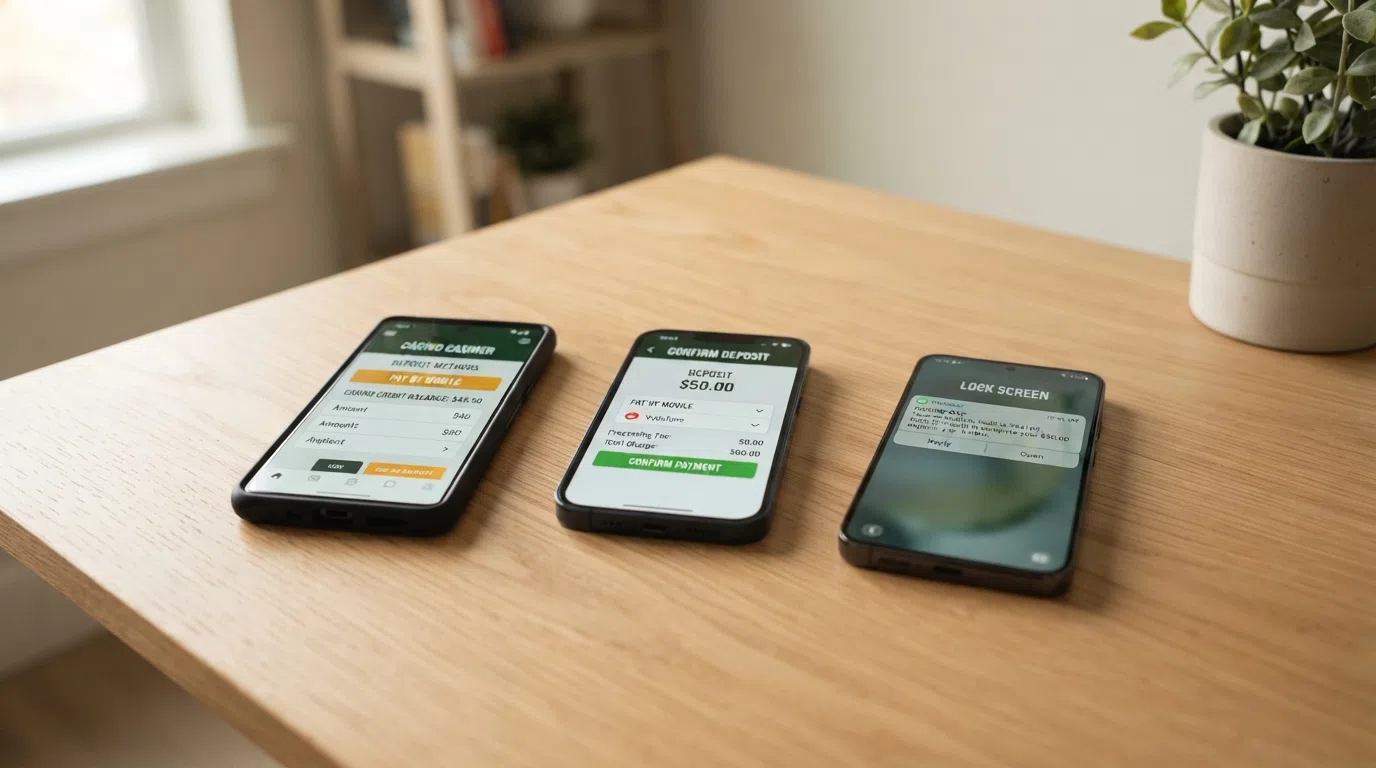
How to Deposit with Phone Credit in Five Steps
- Register an account and complete identity verification (mandatory before any deposit at a UKGC-licensed casino).
- Open the cashier and select “Pay by Mobile” or “Pay by Phone” as the deposit method.
- Enter the deposit amount within the available limit band, then type a UK mobile number.
- Confirm and wait for an SMS verification code to arrive on the handset.
- Enter the code at the cashier; the deposit lands in the casino balance instantly.
£5 Minimum Deposits: What You Can Play for a Fiver
Several UK phone-credit casinos accept deposits from £5, and that floor is the right place to start thinking about what the deposit actually buys. A £5 phone-credit deposit loaded into an online slot at a 20p stake per spin funds 25 spins, which is short enough to be a real session. At the statutory maximum stake of £5 per spin for players aged 25 and over, the same deposit disappears on a single spin — which is why the £5 stake cap matters in practice for any phone-credit player.
Table games and live casino are where the £5 floor starts to break down. Blackjack minimums at most UK live tables sit at £1 or £5 per hand, but the higher-volatility variants and the side-bet-heavy tables routinely require £5 or more as the minimum chip. A single hand at a £5 minimum blackjack table burns the entire £5 deposit. Live game-show products and roulette tables frequently start at £1 per spin, but the effective spend per round is higher than a penny slot. The £5 phone-credit deposit is, in practice, a slots deposit. That is a feature of the math, not a marketing preference.
Your Deposit Limits: Daily Caps, Network Rules and the UKGC Gross Limit
| Limit Type | Typical Amount | Set By | Applies To |
|---|---|---|---|
| Per-transaction cap | £10–£30 | Payment provider (Boku, Fonix, Siru) | Each individual deposit attempt |
| Daily network cap | ~£40 | Mobile network (EE, O2, Vodafone, Three) | All phone-billed transactions in a 24-hour period |
| Monthly network cap | ~£240 | Mobile network | All phone-billed transactions in a calendar month |
| Player-set deposit limit | Variable (player choice) | Player, via operator deposit-limit tool | All deposit methods on the account |
| UKGC gross deposit limit (from 30 September 2026) | Variable (player choice) | Player, via operator tool — the only figure legally called a “deposit limit” | All money paid into the account over a set duration |
The layers stack. A per-transaction cap on the payment provider sits inside a daily network cap, which sits inside a monthly network cap, and on top of all three comes the customer-set deposit limit the UKGC now requires every player to engage with. From 31 October 2025, every UKGC-licensed operator must prompt a customer to set a financial limit before the first deposit and must action a decrease immediately. From 30 September 2026, the gross deposit limit — based solely on the amount a customer pays into the account over a set duration — becomes the only figure operators may legally call a “deposit limit”.
The UKGC’s own framing of that rule, from its 2026 consultation, is that the gross deposit limit must be “based solely on the amount a customer pays into their account over a set duration”. The point of the language is to stop operators from marketing bonus-credit or net-of-winnings caps as a “deposit limit” — those figures measure something else. For a phone-credit player, the gross deposit limit and the network’s monthly cap both work in the same direction: they set a ceiling on cash flowing in. The two together are why the phone-credit deposit experience feels unusually well-braked, and why the same £240 monthly network ceiling that frustrates a high-volume card depositor reads as a feature to anyone trying to keep casino spend contained.
The Withdrawal Problem: Why Winnings Need Another Route
Phone credit is one-way. A UK casino cannot credit winnings back to a phone bill or refill a prepaid balance, because the carrier-billing rails have no receiving side. The player has to register and verify a separate withdrawal method before the first payout, and the choice is one of three: a debit card, a bank transfer, or an e-wallet.
There is also a sequencing rule that catches out first-time players. Under standard anti-money-laundering practice, the same method used for withdrawal must have been used for at least one prior deposit. A player who deposits exclusively by phone credit and then tries to withdraw to a brand-new debit card can be asked to make a small deposit with that card first. The cleanest path is to make at least one small deposit on the chosen withdrawal method early in the account’s life, before any meaningful balance builds up.
Withdrawal speed itself depends on the chosen method. Debit cards and major e-wallets typically process payouts within a few days of the casino’s internal processing; bank transfers can take longer. Phone credit is the fastest route in, and one of the slowest routes out — because it is not a route out at all.
Mobile-First: What Makes Phone Credit Casinos Live on Your Handset
The phone-credit deposit method was built for the device in the player’s hand, and the rest of the casino experience has caught up. The cashier sits inside the same session the game is running in; the SMS code arrives on the same screen the slot is spinning on. The friction of moving to a banking app — the dominant interruption in a card-based deposit flow — does not exist here.
Apps vs Browser: Where Phone Credit Casinos Perform Best
A dedicated casino app can trim a tap or two from the deposit flow by storing the phone-number preference and skipping a re-entry prompt, but the deeper difference is what the app can do that a browser cannot. Push notifications carry deposit-limit reminders and session-time alerts the moment the player has set them, without the player needing to be in the casino session. That is genuinely useful for the player who wants the operator’s safer-gambling tools to interrupt them.
Mobile-browser play needs no download and works on any device with a working browser. The trade-off is that the phone number usually has to be re-entered each session, and the player has to remember to visit the cashier rather than rely on a notification. None of the featured operators in this guide lack a mobile browser experience; not all of them offer a native app, and the choice of app versus browser should be made on whether the player wants notifications to be part of the safer-gambling setup, not on whether the deposit flow is better. The deposit flow is essentially identical in both.
Mobile UX and Compatibility: What Makes a Casino Feel Native
A mobile-built casino has the cashier in thumb-reach of the game-launch button, the SMS code entry above the keyboard rather than hidden under a pop-up, and a lobby that reloads at mobile resolutions without sideways scrolling. None of that is exotic, but it is rarer than it should be. A shrunken desktop site can technically accept a phone-credit deposit; the difference shows up in whether the SMS code field is visible, the deposit button is reachable, and the game tile is the right size for a thumb.
Compatibility across iOS and Android is essentially universal for carrier billing, because the method runs at the network layer and not inside the operating system. The handset version of the OS does not gate the deposit. What the handset can affect is data usage: live casino streams and HD slot animations can chew through a metered mobile data allowance, and a player on a limited plan should connect to Wi-Fi for the heavier game types.
Phone Credit Bonuses: When Your Free Spins Might Not Trigger
Phone-credit players are not excluded from bonuses by law; they are excluded by bonus terms. A surprising number of welcome offers carry a small-print clause that disqualifies deposits made through certain payment methods, and pay-by-phone is the method most often singled out — the “deposit only, no bonus” line that occasionally appears at the cashier. The fix is to check the bonus terms before depositing, not after.
The bigger ceiling sits on the bonus itself. Since 2025, the UKGC’s LCCP SR Code 5.1.1 has capped wagering requirements on UK-licensed casino bonuses at 10× and banned mixed-product promotional offers that span casino, bingo, lottery and betting in one package. Any wagering figure above 10× on a current UK offer is a legacy term from before the cap, and the operator is honouring it on deposits made under the older rules. New offers cannot legally exceed 10×, and any sign-up page that does is either displaying a stale banner or operating outside the GB licence.
The 10× Wagering Cap and What It Means for Your Bonus
The 10× wagering ceiling reshapes the comparison. On a £100 bonus at 10×, the player must stake £1,000 before any bonus winnings can be withdrawn. On the same £100 bonus at 30×, the figure is £3,000; at 45×, it is £4,500. The cap is generous to the player, but the 30× and 45× rates still visible in the featured set are pre-cap terms that survive on offers whose qualifying deposits were structured before the new rule. New UK offers cannot match them.
The cleanest position in the comparison is held by the wager-free operators. MrQ’s cash spins carry no playthrough at all, so any spin winnings are withdrawable as cash the moment they land. Mr Vegas’s 11 Welcome Spins on Pink Elephants 2 are wager-free on the same basis. Betfair’s initial 50 Free Spins are wager-free. BoyleSports’ tiered spins are wager-free on the sampled batch. Each of these offers trades a smaller headline value for the absence of a turnover commitment, and that trade is the point: a wager-free bonus is a bonus a player can ever actually withdraw.
Peachy Games’ 10× rate sits exactly at the regulatory ceiling — it is the most wagering a UK bonus can legally carry, and the operator is offering it on a 100% deposit match plus 100 free spins.
Why Phone Credit Deposits Shine on Slots (and Fade on Tables)
Online slots are where a phone-credit deposit lasts the longest, and the reason is arithmetic. A £10 phone-credit deposit at 20p per spin buys 50 spins, which is 4 minutes. The same £10 at a £1 minimum blackjack hand buys 10 hands, also 1 minute. Live casino games carry the highest minimums of any product in the lobby and consume a phone-credit deposit fastest.
The shape of the UK market reinforces the bias. Gambling Commission data to March 2026 shows total online gross gambling yield at £1.55 billion, with online slots contributing £773 million — a 12% year-on-year increase and the engine of the wider market’s growth. Average monthly active accounts reached 4.8 million across the period. Slots are not just the natural home for small phone-credit deposits; they are the bulk of where UK online gambling spend actually goes.
The Best Slot Providers for UK Phone Credit Players
Three studios dominate the slot inventories behind the featured phone-credit casinos: Pragmatic Play, Play’n GO, and NetEnt. Each supplies the majority of the most-played UK online slots and designs their games for mobile-first play, with touch-friendly spin buttons and vertical-screen layouts. Peachy Games’ published provider list is the most explicit in the featured set, naming all three.
The provider’s presence in a lobby signals game quality and game-recognition familiarity, but it does not guarantee that a specific title accepts the player’s phone-credit deposit at the minimum stake. The deposit goes into the casino balance first; what it is spent on is the player’s choice, and the per-spin stake is the player’s choice within the regulatory cap. A 20p spin on a Pragmatic Play title is just as available to a phone-credit depositor as a £5 spin — the cap, not the provider, is what bounds the choice.
Slots vs Table Games: What Phone Credit Deposits Buy You
The £5 stake cap matters because it bounds the speed at which a phone-credit deposit can be consumed. A £10 deposit at the maximum 20p stake buys 50 spins, the same deposit at the £2 cap for under-25s buys 5 spins per £10, and the same deposit at the £5 cap for over-25s buys two spins per £10 — at which point the game is over before the SMS code has finished timing out on the lock screen. The cap, in other words, is the reason the same £10 deposit can be a meaningful session on slots and a non-session on tables.
The spin-speed rules layer on top. Auto-play is banned in the UK; spin speed cannot exceed 2.5 seconds per game cycle; features that speed up play are banned. A player cannot, even if they wanted to, blast through a £10 deposit at 10 spins a second; the regulator has built the slow-down into the game design. That is a deliberate player-protection measure, and it is the reason a phone-credit deposit at a UK casino always lasts longer than the same deposit at an offshore site where the same protections do not apply.
Top 10 UK Phone Credit Casinos Compared
The table below ranks every featured operator by UKGC licence status and welcome-offer terms. Licence numbers are listed where confirmed from the Gambling Commission’s public register; operators marked “not confirmed” should be checked directly before depositing. Bonus values are those advertised at review time and may change — always verify phone-credit eligibility in the cashier terms before committing.

| Casino | UKGC Licence | Welcome Bonus | Free Spins | Wagering Requirement |
|---|---|---|---|---|
| MrQ | 60629 | — | Up to 300 Cash Spins | No wagering on cash spins |
| Duelz | 48695 | 100% up to £100 | 100 on Book of Dead (20/day over 5 days) | 30× deposit + bonus; 45× free spin winnings |
| Mr Vegas | 39380 | 100% up to £200 | 11 on Pink Elephants 2 | No wagering on welcome spins |
| Sky Vegas | 065519-R-339675-002 | — | — | — |
| Betfair | 039435-R-319329-007 | — | 50 no-wagering + 100 more with £10 stake | 0× on no-wagering batch |
| Betfred | Not confirmed this run | — | — | — |
| Paddy Power | 039426-R-319332-024 | — | 60 no-deposit + 200 with £10 deposit | Not confirmed this run for combined package |
| bet365 | 38721 | — | — | — |
| Peachy Games | Not confirmed this run | 100% deposit match | 100 | 10× |
| BoyleSports | Not confirmed this run | — | Up to 100 no-wagering (tiered by qualifying wager) | 0× on sampled no-wagering spins |
The empty cells are deliberate. Where the research did not surface a confirmed welcome offer, the cell is empty rather than guessed. The honest gap is more useful to a reader than a fabricated headline.
MrQ: Cash Spins with Zero Wagering — Why That Matters
MrQ’s licence number is 60629. The welcome offer is up to 300 Cash Spins, claimable within 24 hours of depositing, and the cash spins carry no wagering requirement on winnings. That is the bonus structure that costs the player the least in required turnover. Any spin winnings are withdrawable as cash the moment they land, which makes MrQ the cleanest wager-free position in the featured set. The licence is confirmed on the public register.
Duelz: A 100% Match and the 30× Wagering You Need to Clear
Duelz’s licence number is 48695. The welcome offer is 100% up to £100 plus 100 free spins on Book of Dead, with the spins released at 20 per day over five days and claimed via a daily pop-up during a seven-day window. The wagering requirement is 30× on the deposit plus bonus, and 45× on free-spin winnings. The 30× rate is above the 10× UKGC cap, which means the offer predates the cap; the operator applies it to the combined deposit-plus-bonus amount. Duelz is the clearest worked example of why a high headline match is not the same as a withdrawable bonus.
Mr Vegas: Wager-Free Welcome Spins from a Vegas-Themed Powerhouse
Mr Vegas’s licence number is 39380. The welcome offer is 100% up to £200 plus 11 Welcome Spins on Pink Elephants 2; the spins carry no wagering requirement and winnings are withdrawable as cash. A large slot and live-casino library sits behind the offer. Bonus validity window is not confirmed from sampled sources this review, so a player should check the promotion terms at sign-up.
Sky Vegas: Flutter’s Casino Giant and Phone Credit Deposits
Sky Vegas’s licence number is 065519-R-339675-002. The brand is Flutter Entertainment-backed, with a large slots and live-table portfolio. The welcome offer was not confirmed from pay-by-phone-specific sources this review, so a player should check the cashier for current terms and phone-credit eligibility before depositing. The brand’s scale and UK high-street presence make it one of the most recognisable names in the featured set; the absence of a confirmed welcome offer this run is a research gap, not a judgement on the operator.
Betfair: No-Wagering Free Spins from a Household Name
Betfair’s licence number is 039435-R-319329-007 (Betfair Casino Limited). The welcome offer is 50 wager-free free spins plus 100 more spins with a £10 stake. The initial 50 spins carry 0× wagering — winnings withdraw as cash without turnover. The casino and live-casino product sits alongside the better-known exchange and sportsbook, and the welcome package is the cleanest entry-level wager-free offer in the set after MrQ.
Betfred: A Veteran Bookmaker’s Casino — What Phone Credit Players Get
Betfred’s UKGC licence was not confirmed from the public register this review. The brand runs a large slots and live-casino portfolio behind a decades-old UK bookmaking name, and the welcome offer was not confirmed from pay-by-phone-specific sources. A player considering Betfred for a phone-credit deposit should verify the licence directly on the Gambling Commission’s public register and confirm the current welcome terms and phone-credit eligibility on site before depositing. The brand recognition is real; the gaps in the public-facing offer this run are real as well.
Paddy Power: No-Deposit Free Spins Before You Even Fund Your Account
Paddy Power’s licence number is 039426-R-319332-024 (PPB Entertainment Limited). The welcome offer is 60 Free Spins with no deposit required, plus a further 200 free spins with a £10 deposit. Paddy Power is the only operator in the featured set offering spins with zero deposit required upfront, which makes it the only zero-risk trial of the group. Wagering terms on the combined package are not confirmed this review; the player should check the bonus terms before claiming. The no-deposit batch is a strong fit for the player who wants to test a casino before committing phone credit.
bet365: The Industry Heavyweight — What Its Casino Offers Phone Credit Users
bet365’s licence number is 38721. The operator runs one of the UK’s largest gambling operations, with a major slots and live-casino suite. The welcome offer was not confirmed from pay-by-phone-specific sources this review, so a player should confirm phone-credit eligibility and current terms before depositing. The operator’s scale means its game library and mobile infrastructure are among the most developed in the market; the absence of a confirmed welcome offer this run means a phone-credit-specific review cannot rank it on bonus terms.
Peachy Games: Pragmatic Play, Play’n GO and a 10× Wagering Cap
Peachy Games’ UKGC licence was not confirmed from the public register this review. The confirmed providers are Pragmatic Play, Play’n GO and NetEnt — three of the largest slot studios supplying the UK market. The welcome offer is 100% deposit bonus plus 100 free spins at 10× wagering, which is exactly the regulatory maximum under the UKGC cap. The 10× rate is lower than the 30× and 45× rates carried by some peers, and the operator is offering it on a triple-A provider base. For a player who wants a wagering rate they can actually clear, Peachy is the cleanest cap-sitting option in the set.
BoyleSports: Tiered No-Wagering Free Spins for Phone Credit Deposits
BoyleSports’ UKGC licence was not confirmed from the public register this review. The welcome offer is up to 100 no-wagering free spins, tiered by the qualifying wager amount; 0× wagering means spin winnings withdraw as cash with no turnover requirement. The tiered structure means the full 100 spins require a higher qualifying wager than the base tier, and the player should read the promotion terms to understand which tier they will land on. The slots and live casino portfolio sits behind a well-known Irish-founded bookmaking brand, and the wager-free structure on the sampled no-wagering batch places BoyleSports alongside the cleanest offers in the comparison.
Is Your Phone Credit Casino Legal? The UKGC Licence You Need to See
The Gambling Commission is the single statutory regulator for Great Britain. The relevant statutes are the Gambling Act 2005, which set up the framework, and the Gambling (Licensing and Advertising) Act 2014, which extended the regime to any operator taking GB customers regardless of where the operator is based. Every online casino serving GB players must hold a UKGC operating licence; a Curaçao, Maltese, or Gibraltar licence is not a substitute.
The scope of the GB licence is England, Scotland and Wales only. Northern Ireland is outside the Commission’s current regulatory remit and is covered by separate older legislation. A casino licensed in Northern Ireland is not subject to the GB regime, and a GB-licensed casino does not have authority to operate there. A player in Northern Ireland has a different set of available operators than a player in Manchester.
Verification is straightforward: every UKGC licence has a public entry on the Gambling Commission’s public register, searchable by operator name or account number. The licence number formats in the comparison table above are the public-register format. If a number does not resolve, the licence is either not held, expired, or attached to a different legal entity than the one operating the site.
UK Gambling Commission Licensing: What It Covers
The UKGC’s regulatory remit runs through three licensing objectives under section 1 of the Gambling Act 2005: preventing gambling from being a source of crime or disorder, ensuring gambling is conducted fairly and openly, and protecting children and other vulnerable persons from being harmed or exploited. Day-to-day operator obligations sit in the Licence Conditions and Codes of Practice (LCCP) and the Remote Technical Standards (RTS), and the Commission can and does enforce them through licence reviews, financial penalties, and licence revocation.
For a phone-credit player, the most important LCCP conditions are: identity verification before deposit (mandatory since 7 May 2019), the credit card ban (in force from 14 April 2020, extended to credit-card-funded e-wallet payments), the ban on anonymous play, the 10× wagering cap and mixed-product promotional ban (LCCP SR Code 5.1.1, in force from 2025), and the deposit-limit prompting rules (from 31 October 2025). The credit card ban is the one that occasionally confuses phone-credit players: the ban extends to credit cards and to credit-card-funded payments, not to phone credit, which is a charge to a mobile bill or a deduction from prepaid balance. The two are not the same instrument, and phone-credit deposits remain permitted.
GamStop and Phone Credit Casinos: Self-Exclusion That Works
GAMSTOP is the national multi-operator online self-exclusion scheme for Great Britain, and participation has been mandatory for every GB-licensed online operating licence since 31 March 2020. Once a player registers with GAMSTOP, the exclusion is sent to every participating operator; the operator is required to close the account and refuse to accept deposits for the duration of the exclusion.
The exclusion periods are six months, one year, five years, or five years with auto-renewal. An exclusion cannot be cancelled early — once in place, it runs to the end of the selected period. After the period ends, the exclusion can continue for up to seven further years if the player does not actively contact GAMSTOP, which is a designed-in brake against an impulsive return to gambling at the end of a fixed exclusion.
The crucial limitation: GAMSTOP covers online gambling only at GB-licensed operators. A phone-credit casino without a UKGC licence is invisible to the scheme. A player who has self-excluded through GAMSTOP and then finds a way to deposit at an offshore site that accepts phone credit will not be blocked. The protection is real, but only within the boundaries of the GB licensing system.
Your Protections Under UK Law: Stake Caps, Deposit Limits and More
The online slots stake cap of £5 per spin for players aged 25 and over took effect on 9 April 2025; the lower £2 cap for players aged 18 to 24 took effect on 21 May 2025. The £2 cap for under-25s is explicitly justified by the UK Government on the grounds that the age band has the highest average problem-gambling score, lower disposable income, and ongoing neurological development. The cap is a hard ceiling and applies per game cycle, not per session.
The supporting game-design rules are the regulator’s answer to the same problem from the other side. Auto-play is banned. Spin speed cannot exceed 2.5 seconds per game cycle. Features that speed up play are banned. Losses disguised as wins are banned. Reverse withdrawals are permanently banned. Operators must display total session losses and wins plus time played. Each of these is a small friction, and the friction is the point.
From 31 October 2025, the deposit-limit prompt became mandatory: every UKGC-licensed operator must prompt the customer to set a financial limit before the first deposit, and must action a decrease immediately. From 30 September 2026, the gross deposit limit — based solely on money paid into the account over a set duration — becomes the only figure operators may legally call a “deposit limit”. The mandatory financial vulnerability check triggers from a net deposit threshold of £150 in a rolling 30-day period.
The collection of rules adds up to a regime that, for a UK phone-credit player, is the most player-protective online gambling framework currently in operation. A player in the UK cannot run an anonymous account, cannot use a credit card, cannot bet more than £5 a spin, cannot blast through spins at auto-play speed, and cannot withdraw a deposit and then change their mind. Each of those is a restriction; in combination, they are the reason the GB-licensed market is the only one in which the safer-gambling conversation in the rest of this guide makes sense.
Playing Safely: The Tools Every Phone Credit Player Should Use
The UKGC framework delivers a baseline; the operator-level tools let the player go further. Reality checks, time-outs, deposit limits, and self-exclusion are not optional at a UK-licensed casino, and the player’s job is to set them, not just to know they exist.
Deposit Limits: How Phone Credit Billing Helps You Cap Spending
The phone-credit method itself enforces a natural spending brake, and the UKGC’s deposit-limit tools strengthen it. The network’s daily cap of around £40 and monthly cap of around £240 create a hard ceiling that a debit card does not impose, and the caps operate at the network layer — they cannot be raised by the casino and they cannot be bypassed by a different payment method on the same account.
On top of that comes the customer-set deposit limit. Since 31 October 2025, every UKGC-licensed operator must prompt the player to set a financial limit before the first deposit, must make it easy to review and alter the limit, and must action a decrease immediately. An increase is not immediate; it typically comes with a cooling-off period, which is the regulator’s deliberate brake against impulsive limit changes during a losing session. From 30 September 2026, the gross deposit limit — based solely on money paid into the account over a set duration — becomes the only figure the operator may call a “deposit limit”, and that change tightens the language rather than loosening the rules.
The combination of network caps and mandatory player-set limits is why phone-credit depositors face a double layer of spending control that card depositors do not. The card deposit can, in principle, run as high as the player can fund; the phone-credit deposit hits a network ceiling first, and a player-set limit second. For a player who values that double ceiling, the phone-credit method is not a workaround for the safer-gambling regime; it is a particularly clean fit with it.
Reality Checks, Time-Outs and Session Limits
Reality checks are mandatory pop-ups that display time elapsed and net spend at intervals the player can set — typically every 15, 30, or 60 minutes. They pause play until acknowledged, which is the point. Time-outs let a player lock themselves out of the account for a short cooling-off period, usually 24 hours to six weeks. Session limits automatically end a playing session after a pre-set duration. None of these tools are optional at a UKGC-licensed casino, and the LCCP requires the operator to make them prominent rather than buried in a settings menu.
The tools work best when the player sets them up *before* the first session, not after a difficult run. Reality-check intervals chosen in advance tend to be longer and more sensible than intervals chosen in the heat of play. Time-outs chosen when the player is in a calm frame of mind are typically longer than those chosen after a loss. The same logic applies to deposit limits; the limit set in the operator’s deposit-limit tool is more useful than the one the player wishes they had set an hour ago.
Where to Get Help: GamCare, BeGambleAware and the NHS
- GamCare runs the National Gambling Helpline on 0808 8020 133 and reported 996 referrals to treatment and peer-based support services in January 2026 — a 48% year-on-year increase.
- BeGambleAware funds research and treatment. Its 2024 survey found almost 1 in 3 adults (30%) experiencing any level of gambling problems wanted treatment or support, up from 17% in 2020.
- The NHS runs specialist gambling-harm clinics across Great Britain, accessible through a GP or self-referral.
- Gamblers Anonymous offers peer-support meetings nationwide, with no referral required.
GamCare’s 2026 data showed that 82% of helpline contacts who disclosed a form of gambling cited struggles with online gambling — the highest rate since 2021. The trend is not encouraging, and the help services are not struggling to find the people who need them. A player who finds the deposit-limit tools and reality checks are not enough should call the helpline before the next session, not after.
How We Chose the Best Phone Credit Casinos
The operator set was selected for phone-credit relevance from the UK-accessible market, not by market share alone. The featured ten include the operators whose cashier explicitly supports pay-by-phone deposits or whose phone-credit acceptance is well documented in the sampled review sources; operators without a confirmed pay-by-phone route were excluded.
Every operator’s UKGC licence status was checked against the Gambling Commission’s public register. Where the licence number resolved, it is in the table; where it could not be matched in the sampled review, the cell says “not confirmed this run”, which is a research gap rather than a judgement that the operator is unlicensed. A player who sees a “not confirmed” entry can do the check themselves in under a minute; the operator’s customer service or the public register will resolve it.
Bonus terms were drawn from the operator’s own site and from pay-by-phone specialist sources sampled in the review period. Where the sampled sources did not surface a confirmed welcome offer, the table shows a blank rather than a guess. The ranking weights three things: licence transparency, welcome-offer value, and the fairness of wagering terms. No percentage weighting is applied, because the qualitative difference between a wager-free offer and a 45× offer is self-evident; the table presents the offers on their own terms, and the reader can rank them by the column that matters most to them.
Phone Credit or Debit Card: Which Deposit Method Is Right for You?
The two methods optimise for different things, and the right answer depends on what the player values. Phone credit wins on privacy — no bank details are shared with the casino at any point in the deposit — and on spending control, because the network caps and the UKGC’s mandatory deposit-limit prompt together create a double ceiling that a debit card deposit does not impose. The method also wins on session continuity: the deposit happens on the same device the player is playing on, with no need to open a banking app mid-session.
Phone credit loses on withdrawals. Every cash-out requires a separate registered method, and the extra step adds friction that a debit card deposit avoids. The phone bill cannot receive funds, the prepaid balance cannot be refilled by a casino, and the player has to maintain a working withdrawal method on the account or face delays on the first payout.
The decision turns on a single question. Does the player prioritise deposit privacy and built-in spending brakes, or the convenience of a single payment method that handles both deposits and withdrawals? For a player who values the hard monthly cap the phone bill imposes — the £240 network ceiling that reads as a feature rather than a restriction — the phone-credit method is the better fit. For a player who wants one payment method end to end and is comfortable setting their own deposit limits, the debit card is the cleaner experience.
The two are not mutually exclusive. Many UK players use a debit card as the primary method and keep phone credit for the sessions where they want the network-level cap to enforce a budget. The setup works because the deposit-limit tool and the GAMSTOP exclusion apply to the account, not the method. The phone bill is one rail into the account; the debit card is another. The rules apply to both.
Frequently Asked Questions About UK Phone Credit Casinos
Are pay-by-phone casino deposits eligible for welcome bonuses?
Some are, some are not. The payment method itself is not banned from UK bonuses, but individual bonus terms occasionally exclude pay-by-phone deposits. Check the bonus terms at the cashier before depositing, and look for the specific method exclusion language — most operators who exclude pay-by-phone state it explicitly in the small print. The bigger constraint is the 10× wagering cap on UK bonuses: a bonus that looks generous on the headline can still cost the player the required turnover to clear, and that turnover is the same regardless of how the deposit was made.
Does paying by phone bill make casino play any safer?
It adds one layer of protection that card deposits do not have. The network’s daily cap of around £40 and monthly cap of around £240 create a hard ceiling that a debit card does not impose, and the UKGC’s deposit-limit tools sit on top of that. Phone credit is not a substitute for the safer-gambling controls every UKGC-licensed casino must offer — reality checks, time-outs, session limits, and GAMSTOP all still apply — but the network cap is a structural brake that card deposits do not have.
What happens if my pay-by-phone deposit fails or the SMS code does not arrive?
The most common cause is a network coverage gap: the SMS is sent to the handset, but the handset cannot receive it at that moment. Waiting a few seconds and requesting the code again is usually enough. If the deposit does not complete, the funds are not taken from the phone bill or prepaid balance; the transaction is left in a pending state and typically reverses within a few hours. If the deposit appears to have gone through but the casino balance has not updated, the player should contact the operator’s customer service with the SMS timestamp and the amount; the operator can trace the deposit through the payment provider.
How much can I deposit per day with a pay-by-phone casino account?
The network cap sits at around £40 per day across all phone-billed transactions, and the monthly cap sits at around £240. The per-transaction cap is set by the payment provider and usually falls between £10 and £30. The customer’s own deposit limit, set via the operator’s deposit-limit tool, is an additional ceiling on top of the network caps. The lowest of the three limits is the effective ceiling for the day, and a player who is hitting a wall they do not expect should check which of the three limits is in play — the answer depends on the network, the account type, and the player’s own setting.
Who can I call if gambling on phone credit casinos gets out of hand?
GamCare runs the National Gambling Helpline on 0808 8020 133, free and confidential, 24 hours a day. BeGambleAware funds research and treatment and can signpost to local services. The NHS runs specialist gambling-harm clinics across Great Britain, accessible through a GP or self-referral. Gamblers Anonymous offers peer-support meetings nationwide with no referral required. GAMSTOP is the national self-exclusion scheme, free to register, and exclusion periods of six months, one year, or five years are available. Help is free, confidential, and available right now.
What Is a Pay-by-Phone Casino?
A pay-by-phone casino is any online casino that lets the player fund a deposit by charging the amount to a monthly mobile phone bill or by deducting it from prepaid (PAYG) credit already loaded on the handset. Nothing in that definition is exotic; the defining trait is what the method *does not* require. No debit or credit card. No bank account. No e-wallet registration. The player hands over a phone number, the network confirms the charge, and the deposit lands.
The method is deposit-only. That is the rule every UK-facing operator works under, and it is the one a player feels most when they try to cash out. A casino cannot push winnings back onto a phone bill or a prepaid balance; the network has no receiving capability. The withdrawal must travel by a separate registered method, and the player has to set one up before the first payout.
There is also a hard prerequisite the marketing copy usually omits: since 7 May 2019, every UKGC-licensed casino has had to verify the player’s name, address and date of birth before the first deposit — including deposits made with no-deposit bonuses. A pay-by-phone casino is, structurally, a fully identified casino. The “no bank details” promise is real; the “no verification” promise that some affiliate pages imply is not.
Phone Bill vs Prepaid Credit: Which One Are You Using?
The same deposit behaves differently depending on whether the phone runs on a contract or on PAYG. Contract customers see the deposit added to the next monthly statement as a separate line item, sitting alongside the regular tariff charges. PAYG customers must have sufficient credit already loaded on the handset before the deposit can be confirmed; the deduction happens immediately and the balance visibly drops.
The practical difference is what the spend leaves behind. A contract customer has a paper trail: a bill line item that names the merchant, a date, and an amount. A PAYG customer has a balance number that quietly shrinks. The networks also enforce different caps on the two account types, and the specific ceiling that applies to a given account is not always the headline number a payment provider publishes. Anyone hitting a per-transaction wall they did not expect should check whether the limit comes from the network tier, the account type, or the payment intermediary — three different ceilings can all be in play at once.
No-Deposit Phone Credit Bonuses: Do They Exist?
Yes — and one sits in the featured set. Paddy Power’s 60 Free Spins with no deposit required lets a UK player sample the slots lobby before funding the account, which is the only honest zero-risk trial in the comparison below. The catch is that identity verification is still mandatory before the bonus can be credited; a no-deposit bonus is not an anonymous bonus. The free spins themselves may carry wagering terms on any winnings, which the player has to clear before the cash is withdrawable.
No-deposit offers are a feature of specific operators, not of the phone-credit method. Most phone-credit casinos offer a deposit-match welcome bonus, not a no-deposit one, and the absence of a no-deposit deal is not a mark against the method.
Deposit-Match vs No-Deposit: Which Phone Credit Bonus Costs Less?
A deposit-match bonus multiplies the player’s own money and ties it to a wagering requirement. Duelz’s 100% up to £100 plus 100 free spins is a textbook example: the player deposits £100, the casino matches it with a £100 bonus, and the combined £200 carries a 30× playthrough on the deposit plus bonus, which works out to a £6,000 turnover before the bonus funds (and any winnings from them) become withdrawable. On top of that, the 100 free spins on Book of Dead carry their own 45× wagering on whatever they return.
A no-deposit bonus costs nothing upfront. Paddy Power’s 60 Free Spins with no deposit required cost the player only the time it takes to register and verify. The catch, again, is that any winnings from the spins are typically capped, and may carry their own wagering before withdrawal.
Wager-free offers — MrQ, Mr Vegas, Betfair, BoyleSports — eliminate the turnover cost entirely, but they tend to carry smaller headline values. The arithmetic favours them for any player who is going to clear a small bonus and walk away, and disfavours them for the player who would have deposited anyway and wants the largest possible headline to chase. There is no universally right answer; the right answer depends on whether the player values low commitment or high ceiling.
A worked example: the Duelz welcome bonus, taking the £100 maximum match and the 30× deposit-plus-bonus wagering as research records them, requires a turnover of £6,000 before the bonus funds are withdrawable. At the £5 statutory maximum stake per spin for players aged 25+, that is 1,200 spins, which — at the regulator’s mandatory 2.5-second minimum game cycle — works out to roughly 17 minutes of unbroken play, with the player’s own £100 deposit on the line alongside the £100 bonus. The cost of the bonus, in expected terms, is the expected loss on £6,000 of slot turnover at the game’s RTP; the *time* cost is the 50 minutes of play. The two are not the same number, and the calculation answers how long, never what the player is likely to win.
Payments – No Deposit Casino Bonuses UK
Content created by the «No Deposit Casino Bonuses UK» team