The Anjouan Casino Licence, Explained for UK Players
 Available in GB
Every Anjouan-licensed casino advertising to UK players is doing two things at once. It is operating outside its own licence terms, because the United Kingdom is on Anjouan’s own excluded-markets list. And it is serving customers that the British regulator has spent the last decade building a wall around, because GAMSTOP cannot reach offshore sites. The licence is real, the regime is real, the operator roster is real, and so is the gap a UK player walks into when they deposit.
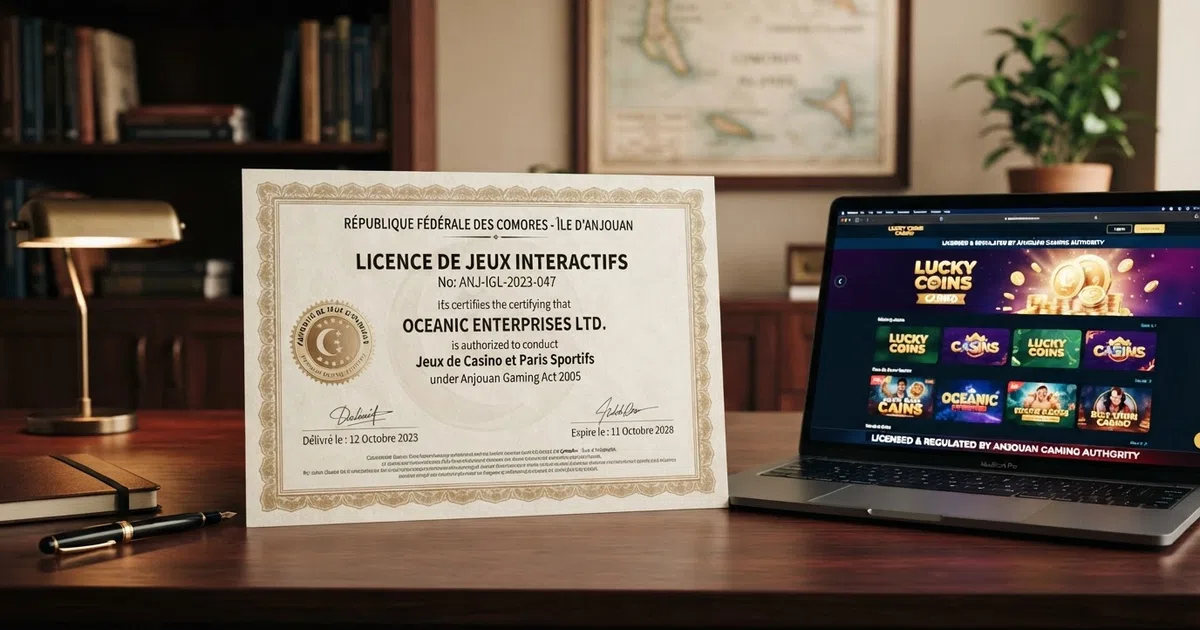
This page works through what an Anjouan Internet Gaming Licence actually is, why the UK regulator does not treat it as a substitute for a Gambling Commission permit, and what ten currently operating Anjouan-licensed casinos look like once you check them against the public register. None of them hold a UKGC licence. All of them are offshore relative to GB law. That is the framing for everything below, and it does not soften.
Current as of 17 August 2026 and verified against the Anjouan Gaming public register and the UK Gambling Commission’s register of licence holders.
An Anjouan Licence Is Real — but Its Credibility Is Contested
The Anjouan Internet Gaming Licence is the permit issued by the Anjouan Offshore Financial Authority under the Computer Gaming Licensing Act 007 of 2005, with day-to-day licensing administration handled by Anjouan Licensing Services Inc. It sits inside the Autonomous Island of Anjouan in the Union of the Comoros, and it is one of the more contested permits in the offshore iGaming market, partly because of what it covers and partly because of who oversees it.
The scale is what makes the Anjouan regime worth taking seriously. The public register carried roughly 1,400 active licence holders by mid-2026, and total licences issued across the regime’s life has now passed 1,650. That puts Anjouan in the same conversation as Curaçao’s old master-licence system, and the trajectory is steeper: operators have been migrating from Curaçao as that jurisdiction reforms its framework, and Anjouan has become the default destination for crypto-first brands, multi-vertical sportsbooks, and new entrants who want one permit rather than five. None of that turns an Anjouan permit into a UKGC permit, and the credibility question hangs over the regime from two directions at once.
The Anjouan authority itself has been blunt about the limits of its own document. Its own statement, responding to operator criticism from major regulated groups, is worth quoting in full: “An Anjouan Internet Gaming Licence is not, and has never been presented as, a universal authorisation to operate in every country in the world. No licensing authority can exempt an operator from local law in jurisdictions where local authorisation is required.” That sentence governs the rest of this page. The licence exists. It is not market access. Local law, including GB law, still applies.
The Offshore Permit That Covers Everything — Casino, Sportsbook, and Crypto Under One Licence
A single Anjouan B2C Internet Gaming Licence covers slots, live casino, sportsbook, poker, esports, prediction markets, and crypto gaming, with no per-vertical carve-outs. An operator that wants to launch a casino and a sportsbook under Anjouan buys one permit, not two. An operator that wants to add crypto payments on top of the same brand does not need a separate digital-asset authorisation — crypto is permitted under the framework and there is no token whitelist, so BTC, ETH, USDT, USDC, and the longer tail of altcoins can be accepted under the same licence.
The fiscal structure explains why operators pick it. Anjouan’s GGR tax rate is 0%, with no corporate income tax or VAT for qualifying International Business Companies. An operator moving from a regime where the headline tax rate is materially higher recovers a chunk of margin on day one. The issuance and annual renewal fee is €17,828, with an additional €500 per domain or URL — meaningful for a multi-brand group running dozens of sites, modest for a single operator launching one brand.
The all-in-one design is the single most attractive structural feature of the Anjouan permit, and it is the reason the operator roster spans crypto-native brands, sportsbook-led operations, and groups running dozens of casino brands under one licence. Compare that with a UKGC licence, where each vertical carries its own compliance overhead, and the cost differential is the first thing an operator’s finance team will model. The model is not wrong. The wrong step is treating a finance team’s calculation as a substitute for a regulatory framework.
Who Carries an Anjouan Licence — Crypto Casinos, New Entrants, and Established Operators
The Anjouan register is dominated by three operator types. The largest cohort is crypto-first brands — sites that take BTC, ETH, and stablecoins as their default deposit rail and offer a fiat alternative as a courtesy. The second is sportsbook-led multi-vertical operators running casino, live dealer, and sometimes poker alongside their sports product, often on white-label platforms. The third is the group-level operator: companies like Igloo Ventures SRL, which run forty-five or more casino brands under a single Anjouan licence, with the brands differentiated by theme and target market but sharing compliance, payment rails, and bonus terms.
That is the structural reason the licence appeals to new entrants. A group that wants to test ten different brand presentations against ten different affiliate sources can spin each up under the same umbrella licence, paying €500 per additional domain rather than a fresh €17,828 per permit. Established operators migrating from Curaçao, where the master-licence model is being replaced by per-vertical permits under the new National Ordinance, have found Anjouan a near-substitute for what Curaçao used to offer — same breadth of verticals, similar low-friction onboarding, and a credible-sounding regulatory body on the website.
The migration explains the trajectory. The Anjouan register did not grow at this rate before the Curaçao reform was announced, and it is unlikely to keep growing at this rate once the post-reform Curaçao framework stabilises. What the register looks like in 2026 is a snapshot of a market in transition, with Anjouan as the holding pattern for operators who want a multi-vertical offshore permit and are not yet committed to a heavier jurisdiction.
Bonuses at Anjouan-Licensed Casinos — Big Numbers Come with Real Conditions
The bonus numbers at Anjouan-licensed casinos are large because the framework allows them. Welcome packages of 500% up to $8,000, 1 BTC crypto-match offers, and rakeback with zero wagering all sit comfortably in the same ranking — the regime does not cap bonus size, does not cap the match percentage, and does not mandate a maximum bonus-to-deposit ratio. The cap that does bite is the wagering multiplier, and the operator’s own choice on validity, game eligibility, and max bet during wagering.
Ybets runs a four-deposit welcome package totalling 500% up to $8,000 plus 400 free spins, with 200% and 100 free spins on the first deposit and 100% plus 100 free spins on each of the next three. The 400 free spins land on Gates of Olympus 1000. The wagering is split: 30x on the bonus funds, 45x on free spin winnings — a structure that makes the headline match look bigger than the effective playthrough suggests, because the spin winnings carry a steeper multiplier than the cash bonus. Validity is 60 days from activation, with a $15 minimum deposit per stage. Bets.io offers a three-deposit 225% welcome up to 1 BTC plus 225 free spins, with a unified 40x wagering on both bonus funds and free spin winnings; the free spins run on Olympus TRUEWAYS and Bonanza Billion from Bgaming, and a high-roller alternative of 300% plus 300 free spins up to 35,000 USDT sits alongside the standard package.
Duel rejects the bonus model entirely. The operator pays 50% instant rakeback on every slot spin and 80% on Duel Blackjack as real, withdrawable cash — 0x wagering, no bonus code, no validity clock. A seven-figure monthly leaderboard (over $1 million monthly, $500,000 weekly, $50,000 daily) sits on top. Rainbet offers a choice: a 40x wager-locked promotion across three deposits or a 0x no-wager alternative on a single deposit — but the wager-locked option carries a 2% of deposit max bet during wagering, excludes Hacksaw Gaming and Nolimit City slots, and excludes any game with RTP above 97.4%, which is the structural price of the high headline match.
The pattern is consistent. The bigger the headline, the more conditional the playthrough. Anjouan-licensed operators are not bound by the UKGC’s December 2025 cap of 10x maximum wagering — that ceiling applies only to operators licensed in Great Britain — and the wagering multiples on offer sit between 30x and 45x for most welcome packages in this set, with one operator at 0x and one offering the choice. The trade is the same trade every offshore bonus carries: bigger headline, longer playthrough, more game restrictions, and no recourse to a UK regulator if the operator changes the terms mid-promotion.
What the Ybets Bonus Actually Costs — A Worked Example
Take the Ybets welcome at face value: 500% up to $8,000, with 30x wagering on bonus funds. A first deposit of $1,000 produces a $5,000 bonus, and the required turnover before any withdrawal is $5,000 multiplied by 30, which is $150,000 in wagered play. With online slots returning roughly 96% to the player on average — and that is an average, not a guarantee for any specific spin or session — the expected loss from clearing that $5,000 bonus is $150,000 multiplied by 4%, which is $6,000. The expected cost of claiming the bonus is therefore higher than the bonus itself. The 400 free spins on Gates of Olympus 1000 carry a separate 45x multiplier on whatever they pay out, and that adds another expected loss on top. This is an average across many spins, not a promise of what any individual player will pay; actual outcomes vary spin by spin. The point of the arithmetic is that the headline match and the expected cost of clearing it are not the same number, and the latter is the one that belongs on the reader’s side of the table.
How to Verify an Anjouan Casino Licence — the Public Register and What It Tells You
The Anjouan public register lives at Anjouangaming.com and is searchable by licence number, company name, or domain. Every active licence carries a status — Active, Suspended, Revoked, or Expired — and a clickable record that names the operator entity, the licence tier, and the issue date where published. The regulator also makes an interactive licence seal available to operators, which is the small badge a verified site displays in its footer; clicking the seal should resolve to the operator’s entry on the public register.
The register is the only verification tool that matters, because the counterfeit problem is real. As the register has grown past 1,400 active licensees, so has the number of operators displaying fake or unverifiable Anjouan licence claims on their websites. Some are expired licences being shown as current. Some are licence numbers that resolve to no record. Some are wholly invented numbers designed to look like the ALSI-202411xxx-FI1 format. None of these are caught by a reader who trusts the footer badge.
The verification step takes under a minute: take the licence number from the operator’s footer, paste it into the register’s search field, and confirm the company name on the entry matches the entity in the operator’s terms of service. If the two do not match — or if the number does not resolve — the licence is either counterfeit, expired, or attached to a different entity. In any of those cases, the operator is not what it claims to be, and a UK player depositing with that operator has no Anjouan-layer protection to fall back on either.
The Legal Reality: Why an Anjouan Licence Is No Substitute for UKGC Protection
The cleanest way to state the legal position is also the shortest. An Anjouan licence is not market access. The United Kingdom does not recognise Anjouan permits, and a UKGC licence is required for any operator serving GB customers under the Gambling (Licensing and Advertising) Act 2014. The Act extended point-of-consumption regulation to remote gambling in 2014, which means the question is no longer where the operator is based but where the customer is sitting when they place the bet. A customer in London using an Anjouan-licensed casino is gambling on an unlicensed site from the perspective of GB law, regardless of what the footer says.
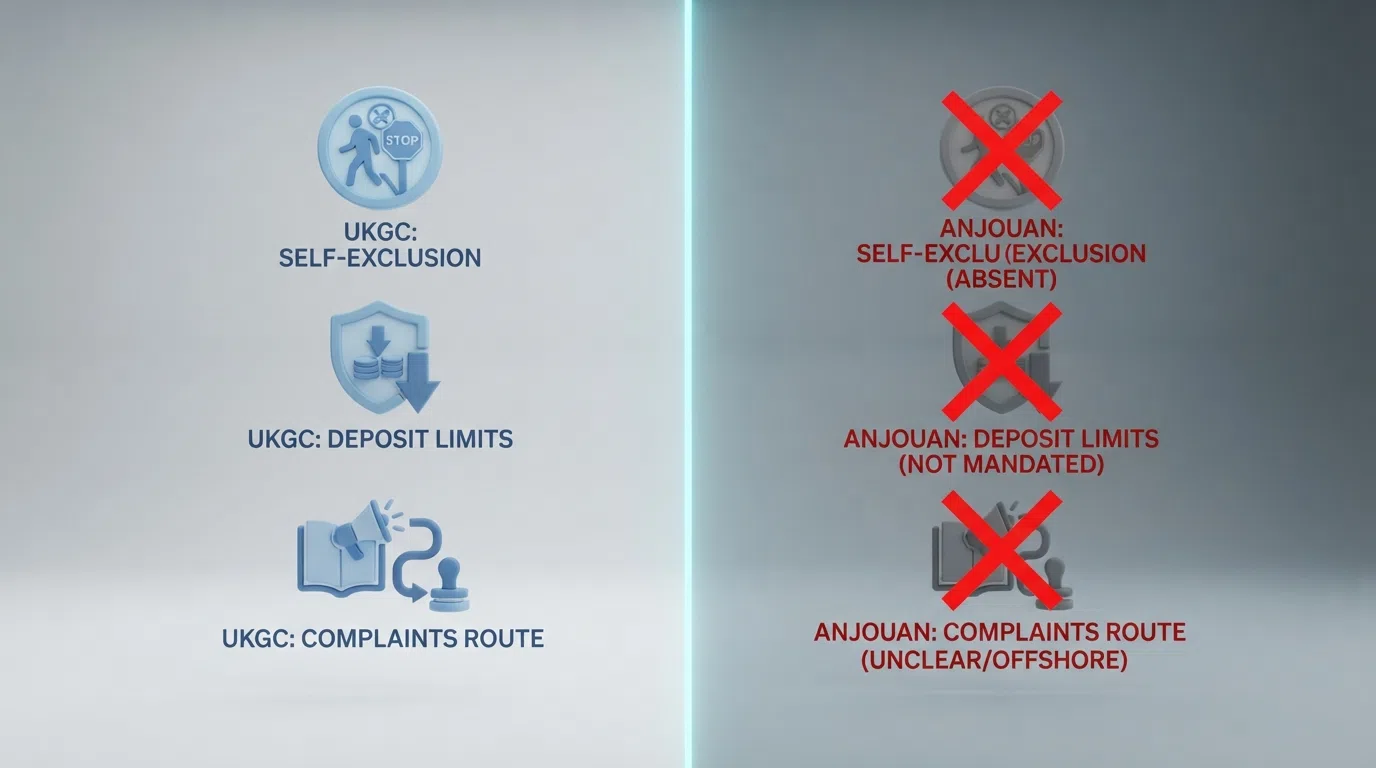
The player-side consequence is the most important number on this page, because it is the number a reader acts on. There is no penalty in UK law for a player who gambles on an unlicensed site. Every sanction in section 33 of the Gambling Act 2005 — up to 51 weeks’ imprisonment, unlimited fine, or both — targets operators, advertisers, and intermediaries. No traced case has prosecuted a UK player for the act of depositing on an offshore site. What the player loses is protection, and the protection lost is not abstract.
| Protection Feature | Under an Anjouan Licence | Under a UKGC Licence |
|---|---|---|
| Self-exclusion scheme | Operator-level only, no central register equivalent to GAMSTOP | GAMSTOP, mandatory for every GB-licensed online operator since 31 March 2020 |
| Complaints route | Operator’s internal procedure (30-day SLA) escalating to an approved ADR provider | UKGC complaints route and approved ADR providers |
| Fund segregation | No guaranteed fund segregation requirement under the Anjouan framework | Operators required to segregate player funds in protected accounts |
| Online slots stake cap | No statutory stake cap under the Anjouan framework | £5 per game cycle for players 25+, £2 for players 18–24 (April/May 2025) |
| Deposit-limit prompt | No mandatory deposit-limit prompt required | Mandatory prompt before first deposit, from 31 October 2025 |
| Spin speed and auto-play | No statutory game-design rules | Auto-play banned since 31 October 2021; spin speed ≥2.5 seconds |
| Credit card payments | Operators may accept credit cards (no framework-level prohibition) | Banned for all remote gambling since 14 April 2020 |
| Reverse withdrawals | No framework-level prohibition | Permanently banned since 31 October 2021 |
| Bonus wagering cap | No cap on wagering multiplier | Hard 10x ceiling on all bonus wagering since 19 December 2025 |
| Reality checks and time-outs | Operator-discretion, no statutory mandate | Required under LCCP social responsibility code |
| Financial vulnerability checks | Not required | Light-touch checks at £150 net deposit in rolling 30 days since 28 February 2025 |
| Identity verification before deposit | Operator-level, varies | Mandatory before first deposit since 7 May 2019 |
The Anjouan side of that table is not a hostile reading. It is what the framework requires. The Anjouan regime has no central self-exclusion register, no statutory stake cap, no mandatory deposit-limit prompt, no bonus-wagering ceiling, and no permanent ban on reverse withdrawals. It does not require financial vulnerability checks and does not require credit card prohibition. None of those are oversights in the licence terms; they are choices the framework does not make, and the absence of each is the gap a UK player falls through.
The UKGC side of the table is what those gaps look like when filled. Every line in the right column is a rule the British regulator has introduced, mostly in the last five years, to address specific harms. GAMSTOP exists because self-exclusion only works if it is multi-operator. The stake caps exist because high-velocity slots are the highest-risk product. The bonus cap exists because 30x and 40x wagering is a known marker of harm. The credit card ban exists because credit-funded gambling is a known marker of harm. Each gap on the Anjouan side of the table is a harm vector the UKGC has decided to close. Anjouan has not closed it.
How an Anjouan Gaming Licence Works — Process, Cost, and Timeline
An operator applying for an Anjouan B2C Internet Gaming Licence pays €17,828 for issuance and the same €17,828 for annual renewal, with €500 per additional domain or URL. The application process runs two to six weeks for a straightforward file, longer where the operator’s corporate structure, beneficial ownership, or platform provider triggers additional review. The regulator requires KYC and AML documentation on the operator and its ultimate beneficial owners, and the licence is granted to the company rather than to the brand.
The cost structure is the main reason mid-sized groups consolidate brands under one licence. A group running twenty casino brands pays €17,828 plus nineteen times €500, which is €27,328 in year one and €17,828 in each renewal year. The same group licensing each brand separately in a heavier jurisdiction would pay a multiple of that figure and absorb a longer per-application timeline. Anjouan’s economics reward consolidation, and the operator roster reflects it.
The application is not a rubber stamp. The regulator does check corporate structure and does publish revocations, but the threshold of review is lower than a UKGC application, where the licensing objectives — preventing crime, ensuring fairness, protecting children and vulnerable persons — are tested against an operator’s full product roadmap before the licence is granted. The Anjouan process is faster, lighter, and cheaper, and those three properties are not unrelated.
The B2B Licensing Regime — What Changed in July 2025
The biggest structural change to the Anjouan framework in 2026 is the B2B regime that took effect on 1 July 2025. From that date, every B2B service provider serving an Anjouan-licensed operator — software suppliers, platform providers, RNG certifiers, payment processors — must hold either a full B2B licence or a B2B Licence Recognition Certificate. A 90-day transition period expired on 30 September 2025, after which any B2B provider without recognition is no longer in good standing within the Anjouan supply chain.
The B2B layer is the regulatory tightening that distinguishes Anjouan from the pre-reform Curaçao model. Under the old Curaçao master-licence system, a software supplier could serve a Curaçao operator without holding its own permit — the operator’s licence covered the entire stack. The Anjouan regime now requires the supplier to be recognised in its own right, which means the regulator has a direct line to the platform provider, the game-testing lab, and the payment processor. That is closer to how the UKGC’s software and platform supplier licensing works than to the old Curaçao umbrella, and it is the single strongest signal that Anjouan is investing in the legitimacy of its own framework.
It is also, for now, a one-line change in a regime that still does not require the player-facing protections the UKGC has built over the last decade. The B2B layer governs the supply chain. It does not govern the bonus terms, the stake caps, the self-exclusion architecture, or the deposit-limit prompt. Those remain operator-level decisions or are simply absent, and a UK player reading this in 2026 should treat the B2B regime as evidence that Anjouan is moving, not as evidence that it has arrived.
Why the UK Sits on Anjouan’s Excluded-Market List
Anjouan’s own licence terms name the United Kingdom, the United States, Australia, France, Germany, the Netherlands, Spain, Austria, the Comoros host territory, and FATF-blacklisted countries as excluded markets. Operators holding an Anjouan licence are required to geo-block these jurisdictions at signup and at payment. An Anjouan-licensed casino accepting a UK registration is operating outside its own licence terms, and any subsequent dispute with that operator is weaker for it — the player can point to the licence terms the operator has agreed to, and the operator’s position becomes harder to defend.
The geo-block is implemented at signup and at payment, which means the operator’s KYC and payment-processor stack both filter UK customers out before a deposit is taken. That the filter does not always hold is a separate problem, and it is the one the rest of this section addresses. The architecture is in place. The implementation is patchy. The legal exposure for non-compliance sits with the operator, not the player, and the player who has been accepted in spite of the geo-block is, in the language of the licence terms, an operator-side error.
What UK Players Lose — No GAMSTOP, No UKGC Protection, No British Consumer Redress
GAMSTOP is the single most-cited absence, and it is the absence with the highest real-world cost. GAMSTOP is the national multi-operator online self-exclusion scheme for Great Britain, mandatory for every GB-licensed online operating licence since 31 March 2020. A player who self-excludes via GAMSTOP is excluded from every UKGC-licensed online operator at once, for a minimum of six months and a maximum of five years plus auto-renewal. The exclusion cannot be cancelled early. As the offshore-casino guidance puts it plainly: “GAMSTOP only blocks operators licensed by the UK Gambling Commission, so it cannot reach offshore sites by design.” An Anjouan-licensed casino is offshore by definition. GAMSTOP does not block it.
The other absences are less visible and similarly consequential. The UKGC complaints route — the mechanism by which a player escalates a dispute with a GB-licensed operator to the regulator — does not exist for an Anjouan dispute. The player must exhaust the operator’s internal procedure (a 30-day service-level agreement is the standard) and then escalate to an approved ADR provider; the Anjouan authority itself does not mediate or adjudicate. If the ADR provider’s decision is not honoured, the player’s remaining routes are private international arbitration and the courts of the operator’s home jurisdiction — for most of the operators in this ranking, that means Costa Rica, Nevis, or another offshore seat, in a language the player is unlikely to speak and at a cost the player is unlikely to recover.
Fund segregation, the mechanism that protects player balances if an operator becomes insolvent, is not guaranteed under the Anjouan framework. A UKGC-licensed operator must hold player funds in protected accounts; an Anjouan-licensed operator is not bound by an equivalent rule. The bonus wagering cap of 10x introduced by the UKGC in December 2025 does not apply, which is why the welcome packages in this set run at 30x, 40x, and 45x rather than the UK ceiling. The £5 and £2 per-game-cycle stake caps on online slots do not apply, which is why slot sessions at Anjouan-licensed casinos can run at higher stakes than the UKGC allows. Reverse withdrawals are not banned, which means a player who requests a withdrawal can be offered a button that reverses it — a feature the UKGC banned permanently in October 2021. None of these are edge cases. They are the day-to-day mechanics of an Anjouan-licensed casino, and a UK player who has only ever used a GB-licensed site will encounter each of them as a new experience.
Player Protection and Dispute Resolution Under an Anjouan Licence
The Anjouan framework does provide a dispute route, and it is worth describing honestly. The operator must maintain an internal complaints procedure with a 30-day service-level agreement. If the complaint is unresolved after that window, the player can escalate to an approved independent ADR provider with which the operator is contracted. The Anjouan Gaming Authority itself does not handle, mediate, or adjudicate player disputes — that is the explicit position in the regulator’s third-party complaint policy, and it is a meaningful boundary.
The ADR layer is real but limited. An ADR provider’s decision is binding on the operator in most cases, but the provider’s enforcement tools are contractual rather than statutory. If the operator declines to honour the decision, the player’s recourse is a contractual claim, which is more expensive and slower than a UKGC route. The Anjouan authority can revoke a licence for non-compliance, but the revocation happens after the player has lost their balance, not before.
Self-exclusion under the Anjouan framework is operator-level only. There is no central register, no multi-operator opt-out, and no equivalent to the five-year-plus GAMSTOP minimum. Operators must honour a self-exclusion request within 24 hours and report it to the authority within one working day, but the next Anjouan-licensed casino the player opens an account with has no record of the exclusion. The architecture requires the player to repeat the request at every operator, indefinitely, and the failure mode is well known: a player who has self-excluded from one site to manage a gambling problem can open an account at the next one in the time it takes to verify an email address. That is the structural risk the UKGC’s central scheme was designed to close, and Anjouan has not closed it.
The “Non-GAMSTOP” Pipeline — How Offshore Casinos Reach Self-Excluded UK Players
The phrase “non-GAMSTOP casino” is the marketing label that ties the Anjouan operator roster to the UK self-exclusion system. A UK player who has self-excluded via GAMSTOP and then searches for a way back into online gambling will find, in the search results, a cluster of Anjouan-licensed sites marketed specifically as outside the GAMSTOP net. That is not a coincidence in the SEO results. It is the primary marketing channel for Anjouan casinos reaching UK players, and it targets a population the British regulator has spent a decade protecting.
The UKGC’s response to this pipeline is disruption rather than blocking. The Commission does not hold statutory ISP or DNS blocking powers — proposed legislation has not been enacted — and its enforcement works through cease-and-desist notices, search-engine delisting referrals, domain registrar pressure, and payment-provider referrals. The published numbers are large: 3,140 disruption notices, 447,778 URLs referred to search engines, and 287,961 URLs removed between April 2024 and June 2025, with 208,088 enforcement actions on illegal online gambling between October 2024 and September 2025. None of that is a block. It is friction, and the operators that the friction catches are the ones that respond. The operators that do not respond keep running.
The non-GAMSTOP pipeline is the responsible-gambling concern at the centre of this page, and it is the one the rest of the page cannot resolve. A UK player who has self-excluded and is looking for a way back in will find Anjouan-licensed casinos waiting. The bonuses are large. The verification is light. The games are familiar. The fact that the player has self-excluded is the most important fact about that player, and the offshore marketing channel treats it as an addressable market.
Anjouan vs Curaçao vs MGA — How the Offshore Licences Compare
A UK player searching for offshore casinos will encounter three licences most often. Anjouan, Curaçao, and the Malta Gaming Authority. They are not the same.
Curaçao is in transition. The old master-licence structure — one permit per operator, covering all verticals — is being replaced by a per-vertical licensing framework under the National Ordinance, and operators have been migrating to Anjouan during the transition. Curaçao’s post-reform framework is closer to the UKGC model than to what came before, with separate B2C and B2B permits, but the transition has been long and not all operators have completed it. Anjouan occupies the position Curaçao vacated: one permit, all verticals, fast turnaround, lower compliance overhead. The B2B layer introduced in July 2025 is the structural reason Anjouan is not a pure repeat of the old Curaçao model.
The Malta Gaming Authority is the heavyweight of the three. The MGA is an EU-recognised regulator, its framework requires fund segregation, mandatory ADR through the Malta Arbitration Centre, and a multi-vertical licensing model with separate permits for casino, sportsbook, and skill games. MGA-licensed operators are subject to the EU’s AML directives, which is a stricter baseline than Anjouan’s. MGA recognition does not, however, translate to UK market access — a UK player using an MGA-licensed casino is still on an unlicensed site from the GB perspective, because the UK is outside the EU regulatory passport system. The MGA is the more credible licence, not the more accessible one.
For a UK player comparing the three, the hierarchy is credibility, not market access. MGA is the most credible. Anjouan is in the middle. Curaçao pre-reform was the least credible and is in the process of becoming more credible. None of the three grants UK market access. None of the three is a substitute for a UKGC licence. None of the three is reachable by GAMSTOP.
The Anjouan-Licensed Casinos We Reviewed in 2026 — Ranked and Compared
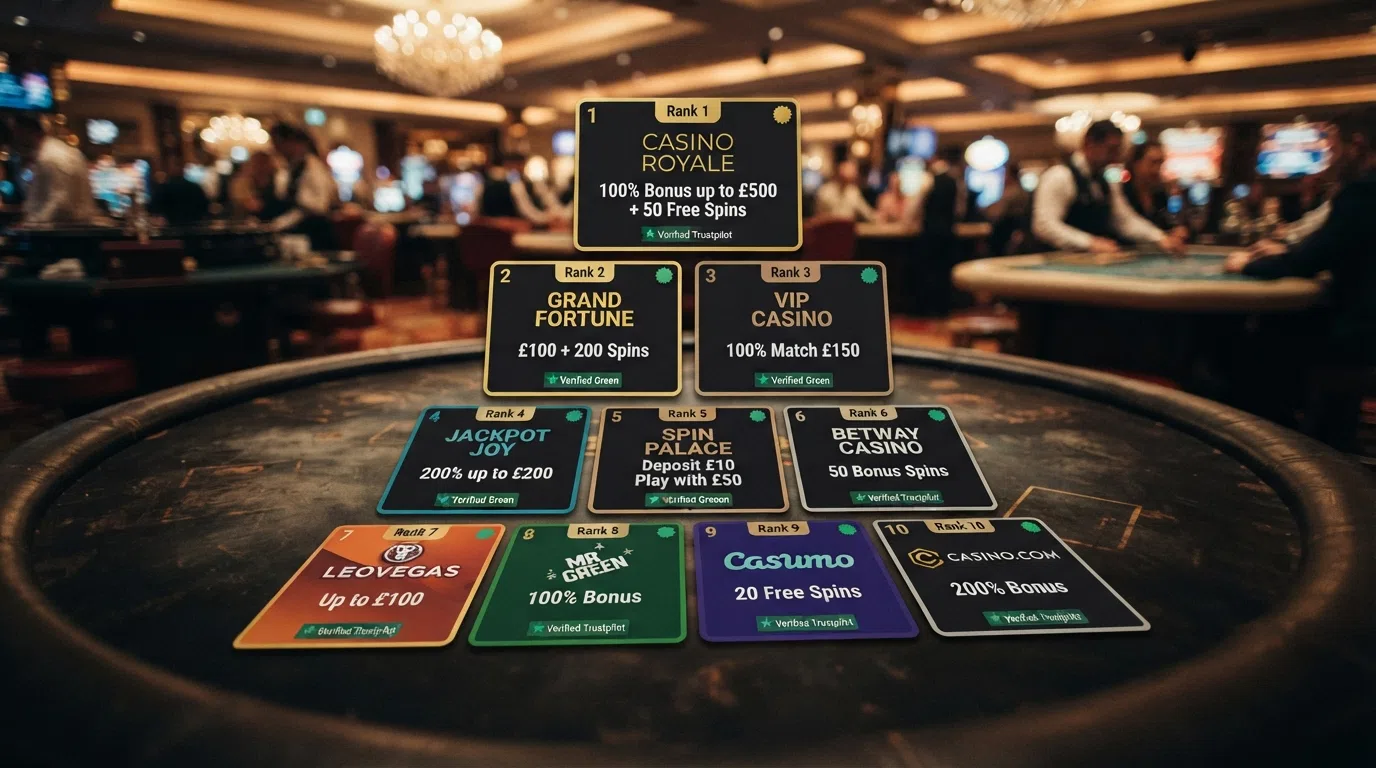
The table below ranks the ten Anjouan-licensed casinos reviewed for this page against three operator-facing criteria: the welcome-bonus headline, the structure that headline translates into once the wagering is applied, and the breadth of game verticals the operator carries. None of the ten holds a UKGC licence, and all are unlicensed in the GB market. The ranking reflects the bonus structure and game offering, not the legal position, which is identical across all ten.
| Casino | Welcome Bonus | Bonus Structure | Game Verticals |
|---|---|---|---|
| Ybets | 500% up to $8,000 + 400 free spins | 30x bonus / 45x free spin winnings, 60-day validity, four-deposit structure | Slots, live dealer, table games, sportsbook, esports |
| Bets.io | 225% up to 1 BTC + 225 free spins (or 300% + 300 FS up to 35,000 USDT high-roller) | 40x on bonus and free spin winnings, three-deposit structure | Slots, live casino, table games |
| Duel | No welcome bonus; 50% instant rakeback on slots, 80% on Duel Blackjack | 0x wagering, rakeback paid as withdrawable cash | Slots, table games, live dealer |
| Rainbet | Choice of 40x wager-locked three-deposit or 0x no-wager single-deposit | 2% of deposit max bet during wagering; Hacksaw and Nolimit City excluded; games over 97.4% RTP excluded | Slots, live casino, table games |
| Wazamba | $750 + 200 free spins | — | Slots, live casino, table games, sportsbook |
| Del Oro | Multiple casino bonuses; 15% weekly cashback; 13-tier VIP programme | — | Slots, live casino, table games, sportsbook (3,500+ games) |
| Winnerz | 100% up to €1,000 + 100 free spins | — | Slots, live casino, table games |
| Trickz | Cashback bonus structure | — | Slots and additional verticals (provider list multiple) |
| Tomcasino | $500 welcome bonus | — | Slots, live casino, table games (21,000+ games) |
| Spinbetter | — | — | Slots, live casino, sportsbook |
The ranking reflects the depth of verifiable information available for each operator on the date of review. Where a welcome-bonus headline, wagering structure, or vertical set was not confirmed, the cell is left as the article-language no-data marker rather than carried over from another operator. The data is current as of 17 August 2026 and the cells where research was not surfaced are the cells where a UK player should make the fewest assumptions.
How We Evaluated Anjouan-Licensed Casinos — Safety, Fairness, and Player Experience
The evaluation criteria were not invented for this page. They follow the standard of competing operator reviews in the UK-facing market, adjusted for the offshore context. The first check is licence verifiability — every operator was checked against the Anjouan public register at Anjouangaming.com, and the licence number on the operator’s footer was matched against the register entry. Where the number did not resolve, the operator was either not listed or listed under a different entity, and the page flags the discrepancy.
The second check is the UKGC public register. Every operator was checked against the UK Gambling Commission’s register of licence holders, and every check returned a negative result. None of the ten operators is licensed in Great Britain, and the page states that for each one rather than leaving the reader to assume it.
The third check is bonus terms, read in full. Wagering multiplier, validity window, game restrictions, max bet during wagering, and max cashout were each evaluated against the headline match. The split wagering on Ybets (30x on bonus, 45x on free spin winnings) is a meaningful structural difference from Bets.io’s unified 40x, and the page reads that difference as it applies to a player deciding between the two.
The fourth check is the game-selection breadth and provider quality — slots, live dealer, table games, sportsbook coverage where present, and the volume of titles. The fifth is complaint history, where surfaced: Tomcasino’s Casino.Guru safety index of 4.4 (Low) and its unresolved complaint involving a Spanish player is the most material finding in this set, and the page names the operator, the safety index, and the nature of the complaint. The sixth is the responsible-gambling tools the operator offers, compared against the UKGC baseline. The seventh is payment flexibility, including crypto support. Each criterion is qualitative, and the weighting is the editor’s.
What to Check Before You Play at Any Anjouan-Licensed Casino
A UK player who proceeds past the warnings on this page should complete the following checks before depositing. The list is not exhaustive, and the order matters.
- Verify the Anjouan licence number on the public register at Anjouangaming.com. Match the company name on the register entry against the entity in the operator’s terms of service.
- Confirm the operator’s excluded-markets list and check whether the operator geo-blocks UK players at signup. If the operator is accepting UK registrations, it is operating outside its own licence terms.
- Read the bonus terms in full. Wagering multiplier, validity window, max bet during wagering, game eligibility, and max cashout are the five figures that determine what the bonus is actually worth.
- Confirm the operator names an approved ADR provider in its terms. If no ADR provider is named, the dispute route after the 30-day internal SLA is unclear.
- Check the operator’s complaint history on Casino.Guru or a similar public database. A low safety index or an unresolved complaint is a signal that the operator’s customer-side record does not match its marketing.
The checklist is the minimum, not the maximum. None of the checks restores GAMSTOP coverage or substitutes a UKGC licence, and the player who has self-excluded via GAMSTOP and is looking for a way back in is the player the checklist is least likely to help.
Ybets — The Deepest Headline Match in the Set, Split Across Four Deposits
Ybets is the deepest headline match in the reviewed set. The 500% up to $8,000 plus 400 free spins welcome package runs across four deposits, with a 200% match plus 100 free spins on the first deposit and 100% plus 100 free spins on each of deposits two through four. The free spins run on Gates of Olympus 1000, and the minimum deposit per bonus stage is $15. The licence is Anjouan ALSI-202411003-FI1, verified against the public register and valid until November 2026, with Sigg Marketing Limited as the operator entity.
The structure is where the headline stops being a clean win. The wagering is split: 30x on the bonus funds, 45x on the free spin winnings, which means the spin component carries a higher playthrough than the cash component. Validity is 60 days from activation, which is generous by industry standards but means a player who clears the first deposit and slows on the second faces a clock. The operator runs slots, live dealer, table games, a sportsbook, and esports, and is crypto-friendly across BTC, ETH, and other major tokens.
Ybets provides the most substantial headline match for crypto-first players with significant bankrolls who can commit to the four-stage deposit structure. Keep in mind that the 60-day window is absolute; failure to meet the wagering requirements within this period results in the forfeiture of pending bonus stages.
Bets.io — Crypto-First Casino with 1 BTC Welcome Bonus
Bets.io is a crypto-native operator with a Costa Rica-registered parent, Tessera Limited S.R.L., and a confirmed Anjouan licence. The welcome package runs 225% up to 1 BTC plus 225 free spins across three deposits: 100% up to 1 BTC plus 100 free spins on the first, 75% up to 1,000 USDT plus 75 free spins on the second, and 50% up to 500 USDT plus 50 free spins on the third. The free spins land on Olympus TRUEWAYS and Bonanza Billion, both from Bgaming. Wagering is a unified 40x on both bonus funds and free spin winnings.
The high-roller alternative is the more aggressive of the two offers: 300% plus 300 free spins up to 35,000 USDT, which is a larger absolute cap for a player depositing at scale. The crypto-first positioning means fiat deposit rails are present but secondary, and the operator’s payment flexibility is the strongest in the reviewed set for players already holding BTC or USDT.
The unified 40x wagering is cleaner than Ybets’s split structure, because the player does not need to track two playthrough clocks. The percentage match is lower than Ybets’s headline, and the absolute cap denominated in BTC is the draw for a player whose bankroll is already in crypto.
Duel — Rakeback Instead of Bonuses, with Zero Wagering
Duel is the only operator in the set that has rejected the traditional bonus model. There is no welcome bonus and no deposit match. Instead, the operator pays 50% instant rakeback on every slot spin and 80% instant rakeback on Duel Blackjack, paid as real withdrawable cash with 0x wagering. The leaderboard adds a separate prize layer: over $1 million paid monthly, $500,000 weekly, and $50,000 daily.
The operator is Immortal Snail LLC, registered in Nevis (L22982), with Anjouan licence ALSI-202411026-FI1. The site runs slots, table games, and live dealer, and the cashback positioning is the central pitch: a player who would otherwise clear a 30x or 40x bonus is paid a slice of every bet as cash, with no playthrough and no validity clock. The trade is that the headline number is smaller per deposit than the welcome packages at Ybets or Bets.io, but the effective value compounds across every session rather than concentrating on a first deposit.
For a high-volume player who plays regularly, the rakeback model returns more per spin than a welcome bonus clears on its first deposit. For a player who deposits once and stops, the welcome packages at the other operators are the larger headline. The choice is a play-pattern question, not a bonus-size question.
Rainbet — Choose Between Wager-Locked and No-Wager Bonus
Rainbet is the only operator in the set that gives the player a direct choice between a high-wagering promotion and a no-wager alternative. The 40x wager-locked option runs across three deposits. The 0x no-wager option is single-deposit. The licence is Anjouan ALSI-152406029-FI2, verified as valid against the public register in February 2026.
The wager-locked option carries the structural costs of the high-match model: a 2% of deposit max bet during wagering, exclusion of Hacksaw Gaming and Nolimit City slots, and exclusion of any game with RTP over 97.4%. The exclusions are not editorial. The Hacksaw and Nolimit City carve-outs are because the provider’s high-volatility titles do not perform well under bonus playthrough math, and the 97.4% RTP ceiling is a similar line: above that RTP, the bonus is theoretically clearable, so the games are removed from bonus play.
The no-wager option is the cleaner offer, but it is single-deposit, meaning those pursuing a multi-stage bonus must commit to the standard wagering requirements. Players wanting to avoid complex game restrictions or prolonged playthroughs should favour the single-deposit, no-wager alternative.
Wazamba — $750 Welcome Package with 200 Free Spins
Wazamba runs a $750 plus 200 free spins welcome package across a multi-vertical platform covering casino, live casino, table games, and sportsbook. The Anjouan licence number is ALSI-202411077-F12, confirmed against the public register. Specific terms for wagering, validity, and operator entity are unavailable.
The review sources note that Wazamba offers basic responsible-gambling tools but not the UKGC-standard suite. The sportsbook plus casino combination is the operator’s positioning: a player who wants slots, live dealer, and sports betting under one login has a single-wallet product here. The bonus amount is more modest than Ybets’s or Bets.io’s, and the offer is closer to Del Oro’s mid-range positioning than to the leaders.
Wazamba integrates a wide variety of gaming options into a single-wallet platform, making it a natural choice for those who want casino games and sports betting in one place. It is a solid multi-vertical contender, despite lacking the aggressive bonus headline seen elsewhere.
Del Oro — 3,500+ Games and a 15% Weekly Cashback Programme
Del Oro is a volume play. The game library runs to 3,500+ titles across slots, live casino, table games, and a sportsbook, and the operator’s positioning is built on the breadth of the catalogue. The 15% weekly cashback and the 13-tier VIP programme target retention rather than acquisition, and the multiple casino bonuses available are the operator’s acquisition layer.
The Anjouan licence is confirmed. Specific details regarding the licence number, operator entity, wagering multiplier, free spin terms, validity window, and domain are unavailable. The cashback positioning is the structural contrast with the deposit-match operators in the set: a player who plays regularly is paid a percentage of net losses back weekly, which is a different economic model from a one-off welcome match.
Del Oro’s appeal lies in its loyalty-driven retention structure rather than a singular upfront offer. Regular players who value consistent weekly cashback over high-match welcome bonuses will find the operator’s loyalty programme provides better long-term value.
Winnerz — 100% Match and 100 Free Spins from a Multi-Brand Operator
Winnerz runs a 100% match up to €1,000 plus 100 free spins, with the operator being Igloo Ventures SRL — a group that operates more than forty-five casino brands under the same Anjouan licence. The licence is confirmed, the operator entity is named, and the welcome offer is the simplest in the set.
Specific details regarding wagering, validity, domain, and crypto support are unavailable. The Igloo Ventures network is the operator’s structural feature: a player who has played at any of the forty-five sister brands will recognise the platform, the payment rails, and the bonus terms. The shared ownership means a complaint history at one brand is part of the group’s record, and a player who values a single operator’s track record over a brand-specific one is reading the right detail.
For a player who values a straightforward match-and-spins offer from a known multi-brand operator, the position is clean. The offer is not the largest, and the group-scale implication is the part of the picture a single welcome bonus does not show.
Trickz — Cashback-Focused Casino Experience
Trickz is the second operator in the set built around cashback rather than a deposit-match bonus. The Anjouan licence is confirmed, the game-provider list runs to multiple studios, and the operator’s positioning is the alternative to the deposit-match mainstream.
The connection to the Igloo Ventures SRL network is possible but not confirmed this run, and the page states the uncertainty rather than asserting the link. The cashback structure, if it follows the group’s other brands, would offer a percentage of net losses back to the player on a recurring basis, which is the same retention model Del Oro uses.
For a player who prefers cashback to a deposit match, the offer is a fit. The cashback model is a distinct alternative to standard deposit matches, though players should consult the full terms to clarify any ambiguity in the verified data.
Tomcasino — 21,000+ Games, but a Low Safety Index
Tomcasino runs the largest game library in the reviewed set — more than 21,000 titles — under a Costa Rica-registered operator (Tom Limitada, S.R.L.) with a confirmed Anjouan licence. The welcome bonus is $500, with structure, wagering, and validity subject to the operator’s current terms.
The figure that distinguishes Tomcasino in this ranking is not the game count. It is the Casino.Guru safety index of 4.4, classified as Low, with an unresolved complaint involving a Spanish player. A safety index in that band is a signal that the operator’s customer-side record does not match the marketing. The complaint is unresolved, which means the dispute did not close cleanly, and the safety-index calculation reflects the open status.
For a player who values a large game catalogue, the offer is the deepest in the set. For a player who weighs complaint history before depositing, the safety index and the unresolved dispute are the most material findings in the ranking.
Spinbetter — Sportsbook and Casino Under One Anjouan Licence
Spinbetter is the least fleshed-out entry in the ranking. The Anjouan licence is confirmed, tracked under the regime by Atlas and sharkbetting, and the operator runs slots, live casino, and a sportsbook. Specific details regarding the welcome bonus, free spin terms, wagering, validity, operator entity, domain, and crypto support are unavailable.
The page states the gaps because the gaps are the relevant fact. An operator whose licence is verified but whose bonus terms are not publicly stated is harder to compare against the rest of the set, and a UK player evaluating Spinbetter against Ybets or Bets.io is doing so without the welcome-offer detail. The sportsbook-led positioning is the operator’s most legible feature.
For a player who values a sportsbook alongside a casino, the platform is a fit. For a player who needs to compare welcome terms across operators, the data is not on the page, and the operator’s own bonus terms page is the next stop.
Responsible Gambling: The Safety Net UK Players Leave Behind
The page up to here has been about what an Anjouan-licensed casino is and what it offers. This section is about what a UK player leaves behind when they use one, and the help that is still available regardless of which site they play on.
UK Responsible-Gambling Tools That Offshore Casinos Cannot Offer
The responsible-gambling framework a UK player is used to is the result of layered regulation, built over the last decade. GAMSTOP has been mandatory for every GB-licensed online operating licence since 31 March 2020 — a national multi-operator self-exclusion scheme that covers every UKGC-licensed site in a single registration. The mandatory deposit-limit prompt, in force from 31 October 2025, requires operators to ask a customer to set a financial limit before their first deposit, with a gross deposit limit offered with at least equal prominence. Reality checks and time-outs are LCCP-mandated. The auto-play ban and the 2.5-second minimum spin speed on online slots have been in force since 31 October 2021, and reverse withdrawals were banned permanently at the same time. Light-touch financial vulnerability checks, using publicly available data on county court judgments, IVAs, and bankruptcies, have applied at the £150 net deposit threshold in a rolling 30 days since 28 February 2025. The credit card ban has applied to all remote gambling since 14 April 2020, and it extends to credit-card-funded e-wallet payments.
An Anjouan-licensed casino is not bound by any of these. The architecture a UK player is used to is a UKGC architecture, and the casinos in this set do not carry it.
What the Anjouan Licence Requires of Operators on Responsible Gambling
The Anjouan framework requires operator-level self-exclusion only. Operators must honour a self-exclusion request within 24 hours and report it to the authority within one working day. There is no central register, no multi-operator opt-out, and no equivalent to the five-year-plus GAMSTOP minimum.
The framework does not require a deposit-limit prompt, does not cap stakes, does not mandate reality checks or time-outs, does not prohibit reverse withdrawals, and does not require financial vulnerability checks. The 24-hour honouring requirement is the only obligation with a comparable speed-of-execution to the UKGC architecture, and it operates at the operator level rather than across the regime.
Self-Exclusion for UK Players at Offshore Casinos — What Actually Works
A UK player who wants to self-exclude from Anjouan-licensed casinos must do so operator by operator. Each request is honoured within 24 hours under the Anjouan framework, but the next Anjouan-licensed casino the player opens an account with has no record of the previous exclusion. The architecture is open by default. The player closes each door individually.
The structural risk is the one GAMSTOP was designed to close. A player who has self-excluded to manage a gambling problem can open an account at a different Anjouan-licensed casino in the time it takes to verify an email address, and the per-operator exclusion does not transfer. The Igloo Ventures SRL group, which runs forty-five or more brands under a single Anjouan licence, is a useful example: a player who self-excludes from Winnerz is not self-excluded from the group’s other forty-four brands unless they request the same exclusion at each one.
GAMSTOP remains the only robust option for a UK player who wants to self-exclude across the GB-licensed market, and the offshore gap is the reason offshore casinos appear in the search results of self-excluded players. Software-based blocking tools — Gamban, BetBlocker, and similar — are a supplementary measure, and the UKGC has supported their promotion as a harm-reduction tool, but they are not a substitute for GAMSTOP’s central scheme.
Where to Get Help — UK Gambling Support Services
UK gambling support services are available regardless of which site a player uses, and the routes are well-established. The National Gambling Helpline, run by GamCare, is free, confidential, and available 24/7 on 0808 8020 133. GambleAware provides information, advice, and treatment signposting. The NHS runs gambling harm clinics — the NHS Northern Gambling Service and the NHS National Problem Gambling Clinic, plus services in Scotland and Wales. Gamblers Anonymous runs peer-support groups across the UK.
The funding for these services comes in part from the statutory gambling levy, which commenced on 6 April 2025 under the Gambling Levy Regulations 2025. Remote casino licence holders pay 1.1% of gross gambling yield, with the proceeds split 50% to treatment (NHS), 30% to prevention (the Office for Health Improvement and Disparities), and 20% to research (UKRI). The levy is a GB-licensed-operator obligation, and offshore casinos do not contribute to it. The services it funds are available to all UK residents, including players at offshore sites.
The Prevalence Reality — Problem Gambling and the Offshore Risk
The NHS Health Survey for England 2021 found that 0.4% of adults in England scored 8 or higher on the Problem Gambling Severity Index, classifying them as problem gamblers. The figure is a population prevalence, not a player-base prevalence, and the actual rate among active online gamblers is higher. The Gambling Commission’s prevalence survey has tracked the same trend with different methodology, and the underlying finding is consistent: a small percentage of the population accounts for a disproportionate share of gambling harm, and the most acute harm is concentrated in the products with the highest session intensity.
The offshore-casino marketing channel is a specific harm vector for that population. The “non-GAMSTOP” label targets players who have already self-excluded — a population the UK regulator has decided is at higher risk and has built a wall around. The Anjouan casinos in this set, and the wider group of offshore casinos that share the marketing channel, reach that population by being outside the wall. The UKGC’s enforcement response is large in volume — 3,140 disruption notices, 447,778 URLs referred, and 287,961 URLs removed between April 2024 and June 2025 — but it is disruption, not blocking, and the channel remains open.
How We Selected and Ranked These Operators
The ten operators in the ranking were selected against four sources, in this order of priority: the Anjouan public register, the UK Gambling Commission’s register of licence holders, Casino.Guru’s safety-index data and complaint history, and the operator’s own terms of service and bonus terms where published.
The Anjouan public register was the primary verification source. Every operator in the ranking was checked against the register, and the licence number, where surfaced, was verified as Active. Operators whose licence number could not be matched to a register entry were either re-checked or excluded, and the ranking flags the entries where the number is not surfaced. The UKGC register was the disqualifier. Every operator was checked against the Commission’s public register, and every check returned a negative result, which is the basis for the consistent framing that none of the ten is licensed in GB.
Casino.Guru’s safety-index data and complaint history provided the customer-side record. Tomcasino’s safety index of 4.4 and its unresolved complaint involving a Spanish player is the most material finding in this set, and it appears in the operator write-up rather than being averaged into a single score. Bonus terms, game-selection breadth, and responsible-gambling tools were read from the operator’s own site where published and from review sources where the operator’s own terms were not complete. The gaps in the verified data are stated in the write-up, because a gap is a fact about an operator’s transparency, and the ranking reflects it.
The ranking order was set on the depth of the verified welcome-bonus headline, the clarity of the bonus structure, and the breadth of the game offering. The legal position — that none of the ten holds a UKGC licence — is identical across the set and is not a ranking criterion. The framing at the top of the section states that for the whole ranking, and the table does not repeat it cell by cell.
What UK Players Should Actually Do About Anjouan-Licensed Casinos
The protection gap is the answer to the question the page is built around, and the gap is specific rather than abstract. A UK player at an Anjouan-licensed casino has no GAMSTOP coverage, no UKGC complaints route, no UK-approved ADR through the Commission, no guaranteed fund segregation, no £5 or £2 stake cap protection on slots, no mandatory deposit-limit prompt, no credit card ban enforcement, no reality-check or auto-play ban, and no financial vulnerability checks. Each of those is a UKGC rule, introduced in the last decade to address a specific harm, and the Anjouan framework does not carry any of them. The “non-GAMSTOP” marketing label is the symptom of the gap, and the gap is the reason the label exists.
The operators reviewed in this ranking are offshore and unlicensed in GB regardless of bonus appeal. The 500% welcome match at Ybets, the 1 BTC package at Bets.io, the zero-wager rakeback at Duel, and the 21,000-game library at Tomcasino are real offers at real operators with verified Anjouan licences — and none of that changes the legal position. A UK player who chooses to proceed should at minimum verify the licence on the Anjouan public register, read the bonus terms in full, confirm an ADR provider is named, and set a hard deposit limit before playing. The verification step is a minute. The deposit limit is a number the player sets and the operator cannot lower.
The safer alternative is a UKGC-licensed operator, where every protection described on this page is mandatory and enforced. The 10x bonus wagering cap, the £5 and £2 stake caps, the mandatory deposit-limit prompt, the GAMSTOP coverage, the Commission complaints route, and the fund-segregation requirements are not features a UKGC operator can offer or withhold. They are the conditions of the licence, and a UK player who plays within the GB-licensed market has each of them by default. The decision is the reader’s, but the information asymmetry this page closes is the one between a headline bonus figure and the legal reality behind it.
Frequently Asked Questions
Is the Anjouan gaming licence recognised by the UK Gambling Commission?
No. The UK Gambling Commission does not recognise Anjouan permits, and a UKGC licence is required for any operator serving GB customers under the Gambling (Licensing and Advertising) Act 2014. An Anjouan-licensed casino is offshore from the GB perspective regardless of the operator’s own licence terms.
Can UK players legally play at casinos licensed in Anjouan?
UK players are not subject to criminal liability under section 33 of the Gambling Act 2005 for the act of gambling on an unlicensed site — the offence targets operators, not consumers. However, the UK is on Anjouan’s own excluded-markets list, and operators accepting UK registrations are operating outside their licence terms. What the player loses is protection, not liberty.
How do I verify that an Anjouan casino licence is genuine?
The Anjouan public register at Anjouangaming.com is the only verification tool. Search by licence number, company name, or domain, and confirm the status reads Active. Match the company name on the register entry against the entity in the operator’s terms of service. If the two do not match, or if the number does not resolve, the licence is counterfeit, expired, or attached to a different entity.
What happens if I have a dispute with an Anjouan-licensed casino as a UK player?
The Anjouan Gaming Authority does not mediate or adjudicate disputes. The player must first exhaust the operator’s internal complaints procedure, which carries a 30-day service-level agreement. If unresolved, the case escalates to an approved independent ADR provider. The ADR decision is binding on the operator in most cases but is enforced contractually rather than statutorily, and the player’s remaining route is a private claim in the operator’s home jurisdiction.
Does Anjouan licence crypto casinos and is crypto gambling legal for UK players?
Yes on the first, no on the second. The Anjouan framework explicitly permits crypto gambling, with BTC, ETH, USDT, USDC, and altcoins accepted under the B2C Internet Gaming Licence with no separate digital-asset authorisation. Crypto gambling at a UKGC-licensed operator is legal for UK players; crypto gambling at an Anjouan-licensed casino is offshore, and the operator’s crypto acceptance does not change the legal position from the GB perspective.
What are the excluded and restricted countries for Anjouan-licensed operators?
Anjouan’s excluded-markets list covers the United Kingdom, the United States, Australia, France, Germany, the Netherlands, Spain, Austria, the Comoros host territory, and FATF-blacklisted countries. Operators holding an Anjouan licence must geo-block these jurisdictions at signup and at payment, and any operator accepting registrations from these countries is operating outside its own licence terms.
The Credibility Question — Is the Anjouan Regime Legitimate?
The contested claim that hangs over the Anjouan regime is the one that surfaced in December 2025 from Comoros national authorities. ABC News Australia reported that Comoros officials had described certain Anjouan regulators as “fictitious entities” operating illegally. The claim is contested by Anjouan itself, and the report has not been resolved into a formal jurisdictional finding, but the reputational signal is real: a national authority in the licensing state has questioned the legitimacy of the bodies issuing the permits, and that question has not been closed.
What Anjouan does enforce is narrower but real. The Authority publishes revoked licences on its enforcement page, runs the B2B mandatory regime introduced in July 2025 — software suppliers, platform providers, RNG certifiers, and payment processors serving Anjouan operators must now hold their own recognition — and requires operators to contract with approved independent ADR providers for dispute resolution. The B2B layer in particular is a tightening that the old Curaçao master-licence system did not require at the same scale, and it is the strongest signal that Anjouan is moving toward a more rigorous regime rather than away from one.
Curaçao pre-reform is the comparison most operators reach for, and it is the right one. Curaçao’s old master-licence structure was the most permissive permit in offshore iGaming for a decade, and its post-2024 reform has been a painful transition for operators used to that latitude. Anjouan now occupies a similar position to where Curaçao sat ten years ago, with the difference that Anjouan is making the B2B and ADR moves earlier in its lifecycle. The question is whether those moves continue, or whether the regime settles into the same low-enforcement pattern that the old Curaçao system eventually normalised. For a UK player reading this in 2026, the answer is that the regime is real enough to verify and not real enough to substitute for a UKGC licence.
Licence – No Deposit Casino Bonuses UK
Content created by the «No Deposit Casino Bonuses UK» team